Intercom
 Shopify
 Stripe
 Slack
Slack Notion
 Google Workspace
 Confluence

CallMiner: The Complete Guide (2026)


CallMiner is one of the older names in conversation intelligence, built for a completely different job than an AI agent that answers tickets: it listens to and scores 100% of a contact center's interactions instead of resolving any of them itself. This guide covers what CallMiner's platform actually does, what its enterprise pricing looks like from real contract data, what reviewers say, and where it fits next to Observe.AI and a help-desk-native alternative.

We build AI agents for customer service that act on tickets directly, so this guide treats CallMiner as what it is: an analytics and coaching layer working a completely different job.
What is CallMiner
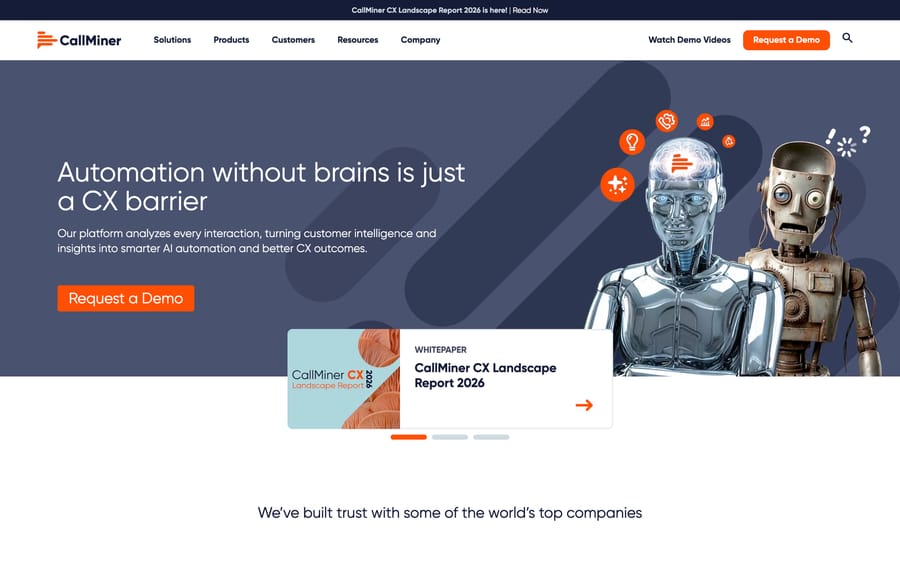
CallMiner calls itself "the global leader in AI-powered conversation intelligence and customer experience automation." The core idea predates most of the current generation of AI vendors: capture every customer interaction, whether it's a phone call, email, text, survey response, or screen recording, and run AI over all of it, far beyond the small sample a human QA team could ever manually review. Its published customer list includes SiriusXM, Dell, PennyMac, British Gas, Mint Mobile, DIRECTV, Lumen, and Santander, which points squarely at large, high-volume contact center operations.
CallMiner organizes its platform around four stages: Capture (ingesting the interaction), Analyze (turning it into scored, searchable intelligence), Augment (real-time agent coaching), and Automate (deploying AI agents on top of what's been learned). That order matters. Automation is the last stage, built on the first three, and CallMiner's pitch is that you can't automate well what you haven't measured first.
How CallMiner's AI works
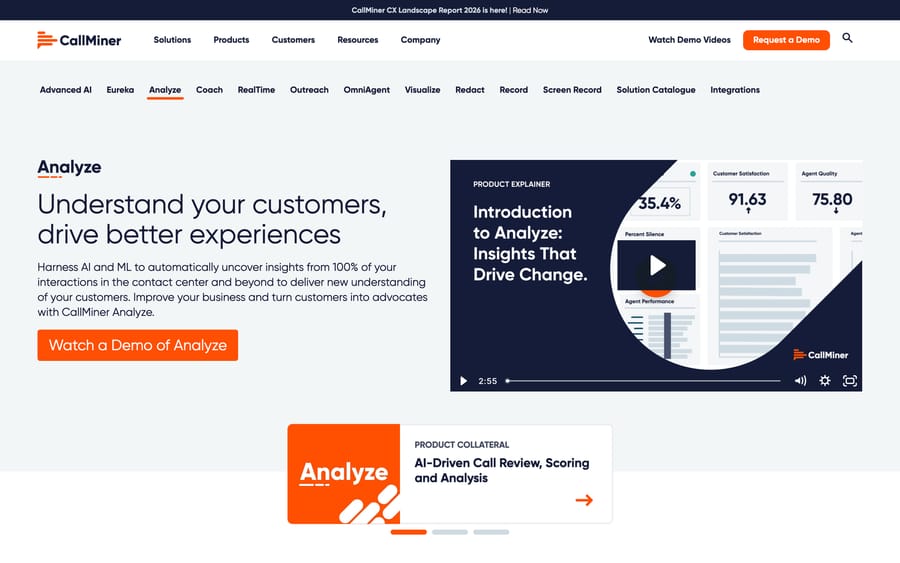
Analyze is the core engine, built on CallMiner's Eureka platform: it uses AI and machine learning to automatically score every call, chat, email, web interaction, survey, and SMS a business captures, surfacing patterns a sampled QA process would miss entirely. The screenshot above, from CallMiner's own product page, shows what that scoring looks like in practice: a Customer Satisfaction figure (91.63) and an Agent Quality figure (75.80), both computed continuously.
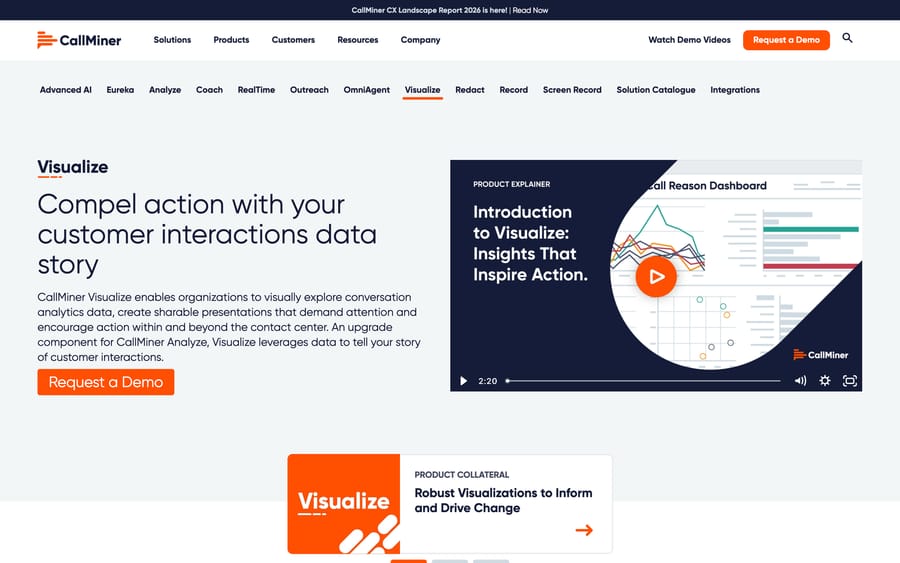
RealTime and Coach move that same analysis into the moment a call is still happening: agents get live guidance, and after the fact, get personalized coaching based on what the AI actually observed in their calls, going well past a supervisor's occasional spot-check. OmniAgent is where CallMiner's own generative AI agents sit, automating the interactions the platform has already learned are safe to hand off. Redact strips sensitive data (card numbers, personal details) from recordings and transcripts for compliance. Visualize, built on Tableau, turns the underlying analytics into shareable dashboards and reports.
Key features
- Capture: ingests 100% of omnichannel interactions, calls, chat, email, SMS, surveys, and screen recordings.
- Analyze (Eureka): AI scoring across every captured interaction, no sampling involved.
- RealTime: live guidance surfaced to agents during a call.
- Coach: personalized, AI-informed coaching plans for individual agents.
- OmniAgent: CallMiner's own generative AI agents for automating learned-safe interactions.
- Redact: automatic removal of sensitive data from recordings and transcripts.
- Visualize: Tableau-powered dashboards for sharing analytics beyond the contact center.
CallMiner pricing
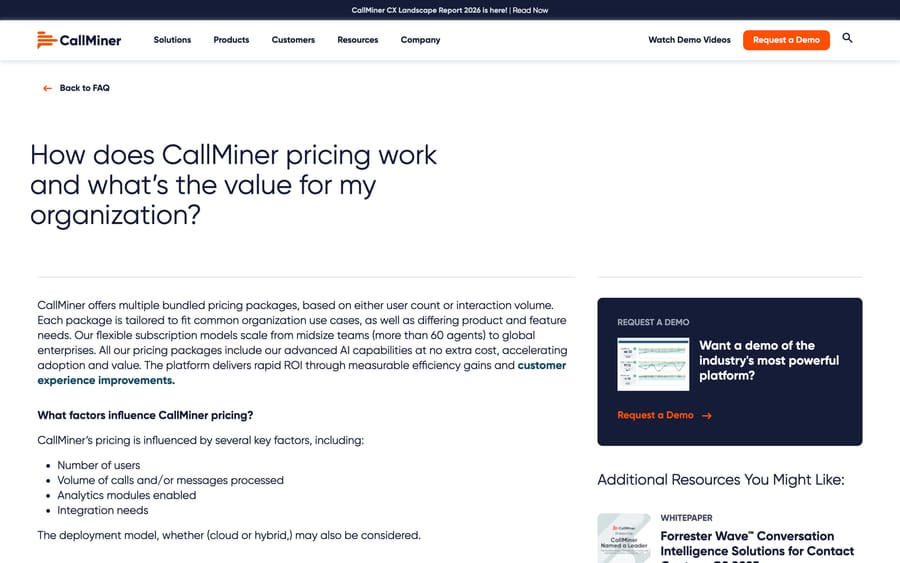
CallMiner's own FAQ confirms what its sales process implies: pricing stays bundled and unpublished. In its own words, packages are "based on either user count or interaction volume," scale from "midsize teams (60+ agents) to global enterprises," and the FAQ lists number of users, volume of calls and messages, analytics modules enabled, integration needs, and deployment model (cloud or hybrid) as the factors that set the final number. Advanced AI is included in every package at no extra listed cost, which at least removes one common opaque-vendor trick: a separate AI upcharge on top of the base platform fee.
For an actual number, Vendr's buyer data puts the average annual contract at roughly $101,865, with a typical range running up to about $140,000 a year, and reports that buyers who negotiate, especially around multi-year terms or end-of-quarter timing, get discounts averaging 15% and sometimes as much as 33% off the initial quote. Run that against a 100-agent contact center: at the reported average, that's roughly $1,020 per agent per year, or about $85 a month per seat, before any negotiated discount. That's the number to bring into a sales call, since CallMiner's own page won't give it to you.
The incentive behind bundled, volume-based enterprise pricing is straightforward: CallMiner earns more from a buyer with more interaction volume and more analytics modules turned on, regardless of whether any of that analysis actually changes an outcome. That's normal for enterprise CX software, but it also means the sales process decides what you pay, and the quote you're handed is only ever a starting position.
Real users on CallMiner
Capterra shows a 4.6 out of 5 rating from just 5 reviews (checked 2026-09-17), a small enough sample to treat as directional at best. Gisele F., an analyst in paper and forest products, described it as "easy-to-access, very simple to use software." Amber C., a customer service representative in consumer goods, said "I like that you can see all the aspects of your performance... just what you need to improve on," pointing at the Coach-style individual visibility as the standout feature for an actual working agent.
A secondary search pass reported a G2 rating of 4.5 out of 5 from 223 reviews, which would be a far more substantial sample, but G2 blocked direct verification, so that figure should be treated as unconfirmed. CallMiner has also been named a Leader in Forrester's Wave for Customer Feedback Management and Analytics Solutions (Q3 2026), which speaks to analyst opinion more than day-to-day user sentiment.
Pros and cons
Pros
- Captures and scores 100% of interactions instead of a sampled QA process.
- Advanced AI capabilities included in every package, with no separate AI line item.
- Genuine analyst recognition (Forrester Wave Leader) alongside strong small-sample review scores.
- Redact and compliance tooling built in, which matters for regulated industries like the finance and healthcare names on its customer list.
Cons
- No published pricing; every deal requires a sales conversation, and the real number (roughly $85 to $100+ per agent per month at the reported average) only surfaces through third-party contract data.
- Public review volume is thin on Capterra, and the more substantial G2 figure couldn't be independently confirmed.
- Built for scoring and coaching. A separate tool is still needed if the actual goal is automated resolution.
- Aimed at midsize-to-enterprise contact centers (60+ agents); overkill for a small support team.
Who CallMiner is best for
CallMiner fits teams running large contact centers, generally 60 or more agents, that need to score and act on 100% of their interactions instead of a QA sample, and that have a compliance or coaching function that will actually use Redact, Coach, and RealTime day to day. It's built for teams already running a mature quality program who want AI to scale that program.
It's a poor fit for a small support team without a dedicated QA function, and it doesn't solve the problem of an overflowing Zendesk or Freshdesk queue; CallMiner tells you how your agents are doing, it doesn't answer tickets for them.
CallMiner vs alternatives
| CallMiner | Observe.AI | Macha | |
|---|---|---|---|
| Model | Conversation intelligence and coaching, with generative AI agents (OmniAgent) | Agentic AI platform for CX, built on conversation intelligence | AI agent layer on your existing help desk |
| Best for | Large contact centers (60+ agents) with a mature QA and coaching function | Contact centers wanting AI agents alongside analytics | Teams on Zendesk, Freshdesk, Gorgias, or Front automating ticket volume |
| Pricing | Not published; averages ~$101,865/year per Vendr, based on users and interaction volume | Not published; roughly $69/agent/month is a third-party AWS Marketplace estimate | From $299/mo for 750 tickets (about $0.40/ticket), published |
| Core mechanism | Scores 100% of interactions, then automates what's proven safe | Purpose-built agents on top of interaction data | Agents read and act on the ticket directly |
| Setup | Enterprise implementation, sales-led | Enterprise implementation, sales-led | Built, tested, and monitored by the Macha team |
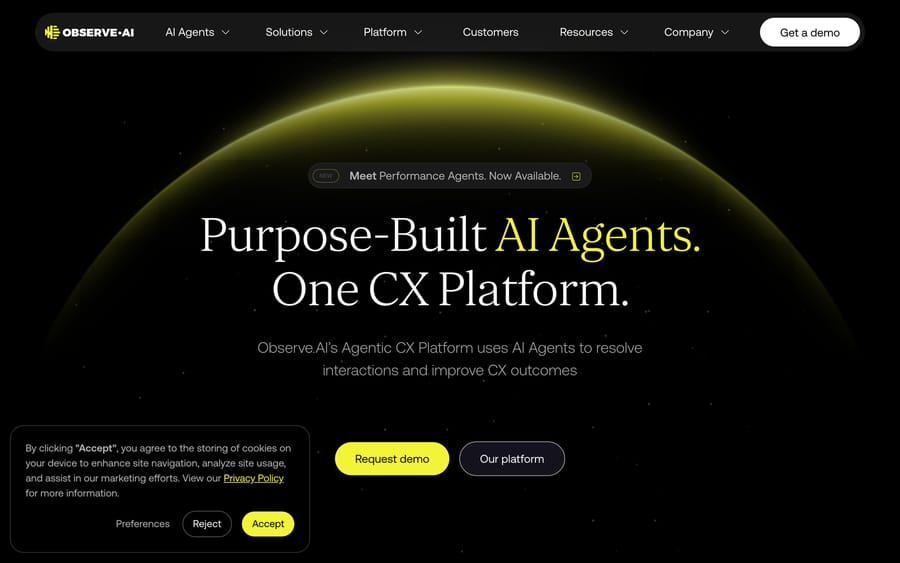
CallMiner and Observe.AI both start from the same place: analyze everything, then automate what the analysis says is safe. See our Observe.AI guide for the deeper comparison between the two. Macha starts somewhere else entirely: it acts on the ticket a customer already sent, inside the help desk your team already uses, without requiring a contact-center-scale analytics program first. If a growing support queue is your actual problem, Macha gets you automated resolution faster and at a fraction of CallMiner's reported contract size. See pricing for the current numbers.
How we researched this: we checked CallMiner's own homepage, pricing FAQ, and Analyze/Visualize product pages directly on 2026-09-17, using a scripted cookie-accept to get past a site-wide consent modal. Vendr supplied the only concrete pricing figures available, since CallMiner's own FAQ confirms pricing is unpublished. Capterra's rating and quotes were pulled directly; the G2 figure came only from a secondary source we couldn't independently verify. Observe.AI's estimate came from third-party AWS Marketplace pricing research instead of a vendor-published rate.
FAQ
What is CallMiner? CallMiner is a conversation intelligence and CX automation platform that captures and scores customer interactions across every channel, then uses that analysis to power real-time agent coaching and, more recently, its own generative AI agents.
How much does CallMiner cost? CallMiner doesn't publish pricing; packages are bundled by user count or interaction volume. Vendr's buyer data puts the average annual contract at roughly $101,865, with a typical range up to about $140,000, and negotiated discounts averaging 15%.
Does CallMiner replace a help desk? No. CallMiner analyzes and, through OmniAgent, can automate some interactions, but it's built as an analytics and coaching layer for a contact center, distinct from a ticketing system or a help-desk replacement.
What's the difference between CallMiner Analyze and CallMiner Automate? Analyze scores and surfaces insight from every captured interaction. Automate (OmniAgent) is where generative AI agents act on what Analyze has already proven safe to hand off.
Is CallMiner good, based on reviews? Capterra shows 4.6 out of 5 from a small sample of 5 reviews, with reviewers praising ease of use and individual performance visibility. A larger G2 figure exists in secondary sources but couldn't be independently confirmed.
What are good CallMiner alternatives? Observe.AI is the closest direct comparison, starting from the same analyze-then-automate model. For teams whose real bottleneck is ticket volume instead of contact-center QA, Macha is a different kind of tool built for that specific job.
Who uses CallMiner? Published customers include SiriusXM, Dell, PennyMac, British Gas, Mint Mobile, DIRECTV, Lumen, and Santander, concentrated in telecom, retail, finance, and insurance.
CallMiner makes sense for a large contact center that wants AI layered onto an existing QA and coaching program. If your bottleneck is actually the ticket queue in Zendesk or Freshdesk, start a Macha trial or check /pricing.
Sources: CallMiner homepage, CallMiner pricing FAQ, CallMiner Analyze, CallMiner Visualize, Vendr, CallMiner buyer guide, Capterra, CallMiner Eureka reviews (capterra.com/p/130323/Eureka/reviews; blocks automated fetches, checked manually), Observe.AI homepage, Macha's Observe.AI guide.
Resolve tickets automatically with AI agents
Macha's AI agents work on top of the help desk you already use — no code.