Intercom
 Shopify
 Stripe
 Slack
Slack Notion
 Google Workspace
 Confluence

Command AI: The Complete Guide (2026)


If you're researching Command AI, you're probably evaluating in-product AI assistance — a way to help your end users actually use your software, through in-app search, an AI copilot that can answer questions and take actions, and proactive nudges that guide people at the right moment. This guide is a genuine, researched walk-through of what Command AI is, where it came from (it was formerly CommandBar), how its AI actually works, the Amplitude acquisition that reshaped it, what it costs, its pros and cons, who it's for, and a fair look at the alternatives.
Key takeaways
- Command AI, formerly CommandBar, is an in-product AI assistance platform embedded in web apps to help end users through search, an AI copilot, and proactive nudges rather than resolving support tickets.
- Amplitude acquired Command AI in October 2024 in a deal reportedly worth north of $45 million, though Amplitude did not disclose official terms.
- Command AI began in 2020 as CommandBar, founded by Princeton classmates James Evans, Richard Freling, and Vinay Ayyala, and went through Y Combinator's Summer 2020 batch.
- Command AI no longer publishes standalone plan pricing since the Amplitude acquisition, and cost typically scales with monthly active users and feature scope.
- Command AI's customers include Netlify, Freshworks, Gusto, Yotpo, AngelList, HashiCorp, and LaunchDarkly.

One fact reframes the whole evaluation, so it's worth stating up front: Command AI is now part of Amplitude. Amplitude acquired Command AI in October 2024 in a deal reportedly worth north of $45 million (a figure TechCrunch attributes to a source; Amplitude did not disclose terms), folding its in-product assistance into Amplitude's analytics and engagement platform. If you're shopping today, you're evaluating an Amplitude product, not an independent startup — keep that in mind for pricing, roadmap and packaging.
Amplitude's own framing is that Command AI "remains operational and will continue to be indefinitely," with the underlying infrastructure being migrated onto Amplitude over time and the more advanced capabilities (the AI Copilot in particular) surfacing inside Amplitude's higher-end Growth and Enterprise plans through 2025. In practice that means two things for a buyer: the product isn't going away, but its future is now an Amplitude roadmap decision rather than a standalone-startup one. That's a meaningful difference from evaluating, say, an independent vendor whose entire company lives or dies by this one product.
What is Command AI?
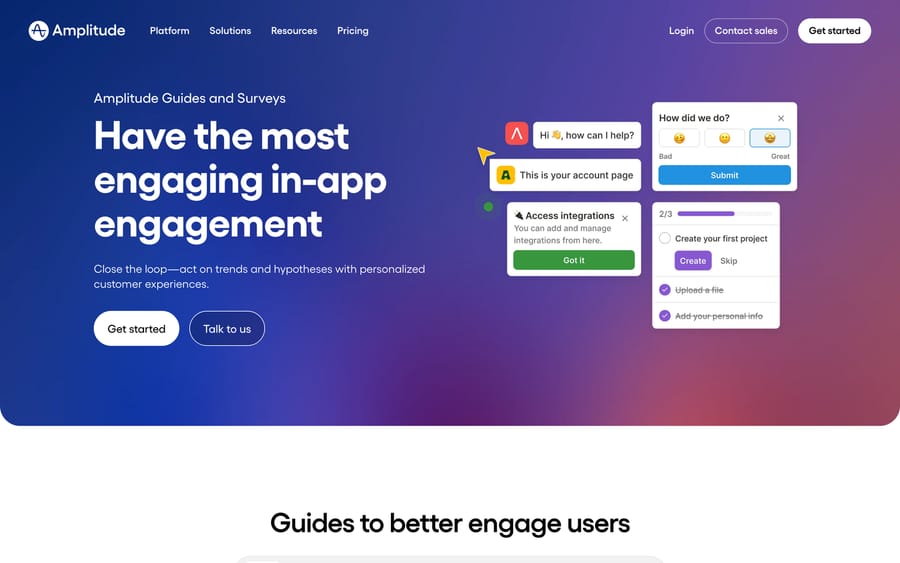
Command AI's homepage (formerly CommandBar), focused on in-product user assistance.
Command AI is an in-product, end-user AI assistance platform. You embed it in your web app and it helps your users — not your support agents — find things, get answers, and get guided through features. Its lineage explains its shape: it began in 2020 as CommandBar, founded by Princeton classmates James Evans, Richard Freling and Vinay Ayyala, who were building a coding tool (codePost), found their own UI too complex, and shipped an internal cmd+k search bar to fix it. That search widget became the product, went through Y Combinator (Summer 2020), and expanded into a full suite before rebranding to Command AI.
The distinction that matters throughout this guide: Command AI is about helping people use your software — onboarding, product adoption, in-app self-service — rather than resolving inbound support tickets in a help desk. It sits in the digital adoption and product-experience space, which is why Amplitude, an analytics company obsessed with product engagement, wanted it.
Product-wise, Command AI organizes its capabilities into two "suites" that map cleanly onto the two jobs it does:
- An Assist Suite — reactive help for when a user is stuck: Copilot (the AI assistant), Spotlight (natural-language search / command palette) and In-App Help (an embedded, searchable help center, historically branded HelpHub).
- A Nudge Suite — proactive guidance that reaches out before the user asks: Announcements, Surveys, Product Tours and Checklists (originally shipped as "Nudges and Questlists").
The through-line is the user is inside your app right now, and Command AI meets them there — either answering the question they typed or nudging them toward the action they haven't taken yet. It counts a roster of well-known product-led SaaS companies as customers, including Netlify, Freshworks, Gusto, Yotpo, AngelList, HashiCorp and LaunchDarkly — teams with genuinely complex products where in-app guidance moves activation and retention. That customer profile tells you exactly who the product is built for: product-led growth companies, not support-ticket call centers.
How Command AI's AI works
Command AI layers several capabilities into your product, all triggered from inside the app the user is already in:
- Spotlight — a natural-language / cmd+k search interface that lets users search across your app with plain keywords and jump to actions or content.
- Copilot — the flagship feature: an AI assistant that answers questions from your content, performs actions on the user's behalf, and can co-browse — effectively taking control of the cursor to walk a user through a workflow step by step.
- Nudges — proactive, in-app messages for onboarding, feature discovery and guidance. Nudge Autopilot decides automatically when to intervene based on user metrics, rather than requiring you to hand-configure every trigger.
- HelpHub — an embedded help center so users can self-serve documentation without leaving the app.
Post-acquisition, the strategic bet is that Amplitude's behavioral data makes the nudges smarter — knowing exactly which users are stuck and when to intervene, so assistance is triggered by real usage signals rather than guesswork.
How it's deployed
Command AI is a front-end SDK you embed in a web application — its whole pitch is that you add universal search, nudges and in-app help "with one integration." That JavaScript-first deployment model is what makes it fast to ship for a product team, and it's also what defines its boundary: it lives inside your product's UI in the browser. It does not sit in front of your email queue, your chat inbox or your help-desk ticket pipeline. If a customer never opens your app — they just email support — Command AI isn't in that path at all.
Integrations
Command AI's integrations reflect its adoption-and-analytics DNA rather than a support-operations one:
- Analytics / product data — Amplitude (naturally), plus Mixpanel, PostHog, Heap and LogRocket, so nudges can be targeted by real behavioral cohorts.
- CRM — HubSpot and Salesforce.
- Help desk — Zendesk, Freshdesk and Help Scout, primarily as content sources and context, not as an automation surface.
- Knowledge / docs — content from Document360, Archbee and HelpJuice can be ingested to train Copilot and populate In-App Help.
Note the shape of that list: help desks appear as places to pull knowledge from, not places where Command AI resolves tickets. That's a useful tell for where it fits.
Key features
- Spotlight — natural-language in-app search and command palette
- Copilot — AI assistant that answers, takes actions, and co-browses/guides users
- Nudges + Nudge Autopilot — proactive, metric-driven in-product messaging
- HelpHub — embedded, searchable help center
- Onboarding flows, tours and surveys (deepened via Amplitude)
- Analytics on adoption and engagement (native to Amplitude's platform)
- Developer-friendly embedding for web applications
Command AI pricing (honestly opaque)
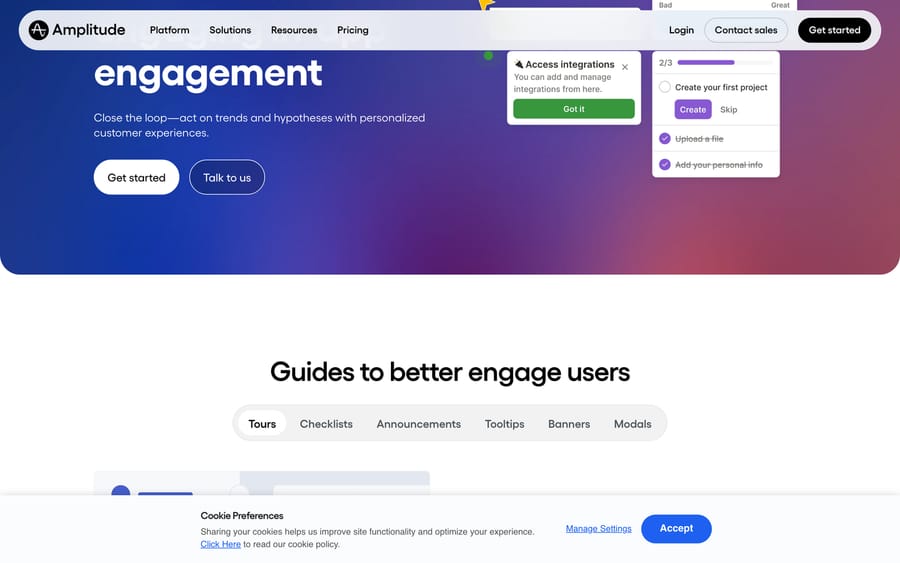
Command AI no longer publishes standalone tier pricing — post-acquisition, the page routes into Amplitude's platform rather than listing plan tiers.
Here's the honest part: Command AI does not clearly publish standard plan pricing. It has historically been custom / quote-based, and since the Amplitude acquisition its packaging is increasingly tied to Amplitude's platform rather than a simple self-serve price list. The pricing page exists, but the actual numbers come from a sales conversation, and cost typically scales with monthly active users, feature scope (Copilot and co-browsing tend to be higher tiers) and whether you're buying it standalone or bundled with Amplitude.
If exact, published per-seat or per-MAU pricing is a hard requirement for you, treat Command AI as "contact sales" pricing and budget for a quote-based enterprise motion. That's typical for digital-adoption platforms, but it's the opposite of a transparent, self-serve number — so plan your evaluation accordingly and confirm current terms directly with Amplitude.
What actually drives the cost
Without inventing figures, it's fair to describe the levers that move a quote, because they're consistent across this category:
- Monthly active users (MAU) / traffic. Because Command AI runs on your end users, pricing tends to scale with how many people see it — the same MAU-based model most digital-adoption tools use. High-traffic consumer-scale apps cost more than a niche B2B tool.
- Which suite you turn on. Basic nudges and in-app help sit at a different tier than the AI Copilot (answering, co-browsing, taking actions), which is the premium capability and, post-acquisition, is signposted toward Amplitude's Growth and Enterprise plans.
- Standalone vs. bundled with Amplitude. The best economics now come from buying it as part of an Amplitude platform deal. A standalone purchase is possible but is increasingly the less-favored path, and you may find the sales conversation steering you toward the wider platform.
- Enterprise requirements. SSO/SAML, security review, higher support tiers and volume all push the number up, as with any enterprise SaaS.
The honest summary: budget for an annual, sales-negotiated contract that scales with your active-user count and the sophistication of the AI features you enable, and get current terms in writing from Amplitude before you commit.
Pros and cons
Pros
- Best-in-class in-app assistance — Copilot's ability to answer and co-browse (take the cursor and show the user) is genuinely differentiated.
- Proactive, data-driven nudges — especially post-Amplitude, intervention timing is informed by real usage data.
- Strong developer ergonomics — it was built by engineers for embedding into complex web apps.
- Backed by Amplitude — more resources, analytics depth and platform integration.
- Proven with serious teams — a customer base including Netlify, Freshworks, Gusto, HashiCorp and LaunchDarkly is real social proof for complex-product onboarding.
- One-integration deployment — a single front-end SDK gets search, nudges and in-app help live quickly for a product team.
Cons
- Opaque, sales-led pricing — no clean published number to plan around, and it scales with MAU.
- Acquisition uncertainty — packaging and roadmap now bend toward Amplitude's platform, which may or may not match your stack; the standalone motion is being de-emphasized in favor of a bundle.
- Wrong tool for ticket deflection — it helps users use your product; it is not a help-desk AI agent that resolves inbound support tickets end to end. If a customer emails or opens a ticket instead of using your app, Command AI isn't in that flow.
- Best value if you're (or plan to be) an Amplitude customer — standalone buyers may get less of the story, and non-Amplitude analytics stacks lose some of the "smarter nudges" advantage.
- Web-app-centric — its browser SDK model is a natural fit for SaaS web products but a weaker one for native mobile-first or non-app support surfaces.
Who Command AI is best for
Command AI is a strong fit for B2B SaaS product and growth teams who want to improve onboarding, feature adoption and in-app self-service — companies with a complex product where users get lost, and where nudging, in-app search and a guiding copilot move activation and retention. It's an especially natural fit if you already run Amplitude for product analytics.
It's the wrong tool if your actual problem is inbound customer support volume — tickets, emails and chats hitting a help desk that you need AI to resolve. That's a different job.
Command AI vs alternatives (including Macha)
| Command AI (Amplitude) | Digital adoption platforms (Pendo, WalkMe) | Macha | |
|---|---|---|---|
| Primary job | In-app end-user assistance & adoption | Onboarding, tours, guidance | Resolve support tickets in your help desk |
| Where it lives | Inside your product UI (front-end SDK) | Inside your product UI | Inside your help desk (Zendesk/Freshdesk/Front/Intercom/Gorgias) |
| Trigger | User is in your app; nudges from usage signals | User is in your app | Customer sends a ticket/email/chat |
| Best for | SaaS product/growth teams (PLG) | Enterprise adoption programs | Support teams automating tickets |
| AI actions | Copilot performs in-app actions & co-browses | Limited | Agents take real actions via custom tools |
| Deployment | JavaScript SDK in your web app | JS SDK / browser extension | Connects to your existing help desk — no rip-and-replace |
| Analytics tie-in | Deep (native to Amplitude) | Native product analytics | Resolution / deflection reporting |
| Pricing | Custom / sales-led, scales with MAU | Custom / sales-led | From $299/mo for 750 tickets (~$0.40/ticket) |
| Ownership | Part of Amplitude (since Oct 2024) | Independent | Independent |
The clean way to think about it: Command AI helps a user succeed inside your product; Macha resolves the support request a user sends to your team. They're adjacent — both use AI to reduce friction — but they solve different problems. If your challenge is inbound support that lands in a help desk, Macha is the closer fit: it runs as an AI agent layer on top of your existing help desk, reads your knowledge and past tickets, and resolves or drafts responses in that native workflow with per-ticket pricing — you pay for the tickets the AI handles (from $299/month for 750), not per seat or per MAU. You build agents in plain English and give them custom tools to take real actions. If your challenge is product adoption and in-app guidance, Command AI (now within Amplitude) is built for exactly that — and if you are weighing an in-product assistant against a docs-grounded one, our guides to Inkeep and kapa.ai cover the two that come up most often alongside it. Picking by the job to be done beats picking by the buzzword.
How we researched this
This guide is built from Command AI’s own product and documentation pages and from Amplitude’s post-acquisition material, which is where the packaging now lives; Command AI does not publish a price, so the pricing section describes the model rather than quoting a rate. On September 21, 2026 we re-checked the internal links in this post and added the comparisons above; we did not obtain a quote on that pass. We have not run Command AI ourselves, and G2 turned away every request we made that day, so this guide carries no third-party review score rather than an estimated one.
FAQ
Is Command AI the same as CommandBar? Yes. CommandBar rebranded to Command AI, then was acquired by Amplitude in October 2024. You'll still see both names in the wild.
Who owns Command AI? Amplitude. It acquired Command AI in October 2024, in a deal reportedly worth north of $45 million (terms were not officially disclosed), and integrated it into its analytics and engagement platform.
What does Command AI do? It provides in-product, end-user AI assistance: in-app search (Spotlight), an AI copilot that answers questions and co-browses, proactive nudges for onboarding and adoption, and an embedded help center (HelpHub).
How much does Command AI cost? Pricing is custom/sales-led rather than publicly published, and packaging is increasingly tied to Amplitude. Expect a quote-based enterprise motion; confirm current terms with Amplitude.
Is Command AI a customer support tool? Not primarily. It's built for in-app product adoption and self-service — helping users succeed inside your product. To resolve inbound support tickets that land in a help desk, a help-desk-native AI agent layer like Macha is a closer fit.
What is HelpHub / In-App Help? HelpHub is Command AI's embedded help center: semantic search across your docs, instant AI answers to common questions, and an in-app widget to display it all. It launched in 2023 as one of the first products to "overlay ChatGPT onto any product," and now sits within the Assist Suite as In-App Help.
What does Copilot actually do? Copilot is Command AI's embedded AI assistant. It answers user questions from your content, can trigger in-product walkthroughs on the fly, complete actions on the user's behalf, and co-browse — effectively taking the cursor to walk a user through a workflow. It's the premium capability and, post-acquisition, is signposted toward Amplitude's Growth and Enterprise tiers.
How is Command AI deployed? As a front-end JavaScript SDK embedded in your web application — "one integration" adds search, nudges and in-app help. It lives in your product's browser UI, not in your email or ticket pipeline.
Who uses Command AI? Product-led SaaS companies with complex products, including Netlify, Freshworks, Gusto, Yotpo, AngelList, HashiCorp and LaunchDarkly.
Command AI vs. Pendo or WalkMe — what's the difference? They overlap heavily on onboarding, tours and nudges. Command AI leans harder into AI-native assistance (its Copilot and natural-language search) and now benefits from Amplitude's behavioral data; Pendo and WalkMe are broader, established digital-adoption suites. All three are in-product tools and all three price by sales conversation. None of them resolve inbound support tickets — that's a different category.
What's the best Command AI alternative for customer support? If your real problem is inbound support volume rather than in-app adoption, you want a help-desk-native AI agent, not an in-product assistant. Macha runs as an AI agent layer on top of Zendesk, Freshdesk, Front, Intercom or Gorgias, resolves and drafts ticket responses in that native workflow, and prices by ticket volume, from $299/month for 750 tickets.
If your problem is inbound support volume rather than in-app product adoption, look at how Macha's AI agents for customer service resolve tickets inside the help desk you already run — with pricing tied to actions taken, not seats or monthly active users.
Resolve tickets automatically with AI agents
Macha's AI agents work on top of the help desk you already use — no code.