Shopify
 Stripe
 Slack
Slack Notion
 Google Workspace
 Confluence

Common Freshdesk Problems & How to Fix Them (2026)


Most Freshdesk problems fall into a handful of recurring patterns: an email that never became a ticket, an SLA clock that shows the wrong time, an automation rule that quietly refuses to fire, a notification nobody received, and a reply that landed in a customer's spam folder. None of them mean Freshdesk is broken — almost every one traces back to a specific setting in a specific menu, and once you know where to look the fix takes minutes. This hub walks through the most-searched Freshdesk headaches, points you at the exact place to check, and links out to the deep-dive troubleshooting guide for each. Bookmark it as your first stop when something stops working.

How to troubleshoot Freshdesk methodically
Before diving into any single symptom, it helps to have a repeatable approach. Freshdesk is deterministic — it does exactly what its rules, policies, and channel settings tell it to — so "it's not working" almost always means a rule is matching in the wrong order, a setting is toggled off, or a mailbox has silently disconnected. Three habits solve the majority of tickets:
- Check the ticket's own activity log. Open the ticket and click Show Activities (top-right of the ticket detail view). This is the single most useful diagnostic in Freshdesk — it shows you which automations ran, which SLA was applied, and what changed when.
- Remember that order decides everything. Both SLA policies and automation rules stop at the first match. A broad rule sitting near the top will "swallow" tickets meant for a stricter rule below it.
- Confirm the plan gate. Several features people assume are universal — multiple SLA policies, reminders, escalations, some analytics — are gated to higher plans or add-ons. If a toggle is missing entirely, it's usually the plan, not a bug.
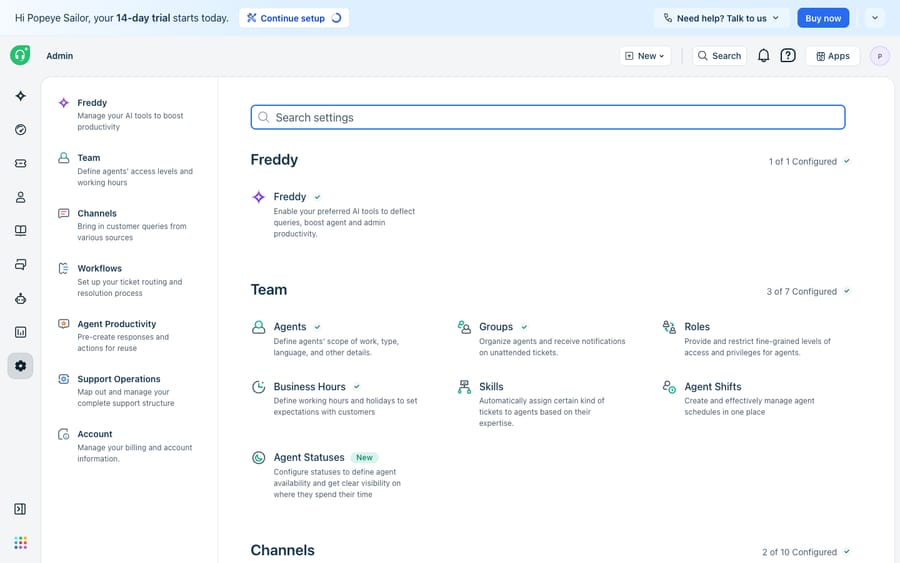
Almost every fix below starts from this Admin hub, so it's worth getting familiar with the left-nav grouping: Channels holds email, Workflows holds SLAs and automations and notifications, and Account holds the helpdesk-wide restrictions that quietly block mail.
Problem 1: Emails aren't turning into tickets
This is the most common — and most alarming — Freshdesk problem, because it looks like customers are being ignored. The cause is almost always in the email plumbing rather than in Freshdesk itself. Per Freshworks' guide on what to do when none of your emails are getting converted into tickets, work through these in order:
- Confirm forwarding is set up from your support mailbox to the Freshdesk forwarding address, and that your support email address and the Freshdesk forwarding address are not the same — if they match, mail loops instead of converting.
- Check the spam/trash folder inside Freshdesk. Open the ticket Views icon and look at the Spam and Trash views; a filter or the spam classifier may be catching legitimate mail.
- Check Helpdesk Restrictions. Under Admin → Account → Helpdesk Settings, a domain-restriction feature may be silently dropping mail from any domain you haven't whitelisted.
- Reauthorize the mailbox / enable IMAP. If you use a custom mail server, a disconnected mailbox or a mailbox with IMAP disabled will stop conversion entirely.
For a full decision tree — including the "long forwarding address" test under Admin → Channels → Email and the Office 365 / Gmail server specifics — see our deep dive on why your Freshdesk email isn't working.
Problem 2: SLA timers show the wrong time
The classic complaint is "my SLA says 8 hours left but the deadline is tomorrow" — or a ticket that breaches when it shouldn't have. SLAs in Freshdesk are almost never wrong; they're just measuring against a configuration you may have forgotten. The two usual culprits are business hours (a ticket that lands at 6pm on Friday is either burning time or paused until Monday, depending on whether the target uses Business hours or a 24×7 Calendar) and ticket status (statuses marked as "pause SLA timer," like Waiting on Customer, stop the clock in ways that surprise people). Policy order matters too: the first SLA policy whose conditions match is the one applied.
We untangle all of this — including which statuses pause the timer and how to reconcile the timer with your reporting — in why your Freshdesk SLA isn't calculating correctly.
Problem 3: Automation rules aren't firing
You built a rule to auto-assign or auto-tag tickets, the conditions look right, and nothing happens. Freshworks' why are my automations not working article names the traps precisely, and they catch even experienced admins:
- Rule order. For Ticket Creation automations, a new ticket triggers the first rule it matches and then stops — later rules never run. Put specific rules above generic ones.
- The requester is an agent. Automations don't run when the ticket's requester is an agent, which is exactly why test tickets you raise yourself appear to "do nothing."
- You used New Email instead of New Ticket. The New Email option is for outbound mail and does not trigger creation automations; use New Ticket to test.
- An invalid custom field. If a rule references a custom field that was later deleted or renamed, the whole rule becomes invalid and silently stops. Freshworks documents this in why is my automation rule not working even though the conditions are satisfied.
The fastest diagnostic, again, is Show Activities on the ticket — it names any rule that actually ran. Full walkthrough in Freshdesk automations not firing.
Problem 4: Notifications aren't reaching agents (or customers)
Two different failures hide under "notifications not working," and they're fixed in different places. Agent notifications — new-ticket alerts, SLA-violation emails, assignment notices — are toggled under Admin → Workflows → Email Notifications → Agent Notifications; if agents aren't getting alerted, the specific notification is usually switched off there, or the agent's own profile notification preferences override it. Customer notifications — the replies and confirmations your requesters expect — depend on the requester notifications being enabled and, critically, on the mail actually being delivered rather than filtered. We cover both branches, including the profile-level overrides people forget, in Freshdesk notifications not working.
Problem 5: Freshdesk emails land in customers' spam
If your automated replies keep hitting junk folders, the problem is email authentication, not content. As deliverability guides consistently note, Freshdesk mail sent "on behalf of" your domain fails DMARC when DKIM or SPF isn't configured, and receiving servers quarantine it. The fixes are DNS-side:
- DKIM: copy the four system-generated CNAME records from Admin → Channels → Email → Advanced Settings into your DNS, per Freshworks' email domain verification using DKIM records guide. Allow up to 24 hours to verify.
- SPF: if needed, publish
v=spf1 include:email.freshdesk.com ~all, following create an SPF record to ensure proper email delivery. SPF isn't strictly required once DKIM is in place. - DMARC: Freshdesk doesn't generate a DMARC record, and each domain can only have one — so add or align an existing policy rather than duplicating it.
One honest caveat: if you use a custom mailbox, the standard DKIM guide doesn't apply — signing happens on your provider's infrastructure, so you'll set DKIM up with them. Full guide: Freshdesk emails going to spam.
A quick reference: symptom → where to look
| Symptom | First place to check | Deep dive |
|---|---|---|
| Emails not becoming tickets | Forwarding config; Spam/Trash views; Helpdesk Restrictions | Email not working |
| SLA shows wrong time / breaches early | Business hours; SLA-pausing statuses; policy order | SLA not calculating |
| Automation rule doesn't fire | Rule order; agent-as-requester; invalid custom field; Show Activities | Automations not firing |
| Agents/customers miss notifications | Admin → Workflows → Email Notifications; profile preferences | Notifications not working |
| Replies land in spam | DKIM CNAMEs; SPF; DMARC alignment | Emails going to spam |
The honest limits — and where an AI layer helps
Freshdesk's native tooling is genuinely capable, and the Freshworks help-desk troubleshooting guide plus the marketplace cover most configuration problems well. But notice a pattern across all five problems above: every one is a plumbing fix. Once the plumbing works, Freshdesk faithfully routes, times, and notifies — but it still can't read a ticket, understand what the customer actually needs, and draft the answer. The rules you spend time ordering fire on keywords and fields; they don't reason. And native analytics that would help you spot these failures at scale (trend dashboards, some custom metrics) are gated to higher Analytics Pro tiers on many plans, so smaller teams often can't see the pattern until customers complain.
This is the seam where an AI agent layer fits — and it's worth understanding the category first. The broader field of AI agents for customer service exists to do the reasoning-heavy work that keyword rules can't. Macha is one such layer: it runs on top of the Freshdesk you already use as a native connector — it does not replace your help desk, its automations, or its SLA policies. You connect Macha to Freshdesk with your subdomain and API key, and it reads and writes the same tickets your rules already touch: triaging by intent rather than brittle keyword conditions, drafting or posting grounded replies, and looking up order or account status through a custom tool that turns a REST API into something an agent can call. If your goal is fewer of these fires in the first place, the practical starting point is our guide to how to automate Freshdesk with AI. (Macha's connector is for Freshdesk specifically — not Freshchat, Freshservice, or Freshcaller. And credits are consumed per AI action, not per resolution — see the pricing breakdown.)
The clean division of labour: keep Freshdesk as the system of record for channels, timing, and routing — and fix its configuration problems using the guides above — then layer an agent on top for the reasoning the platform was never meant to do.
FAQ
Why are my emails not being converted into tickets in Freshdesk? Usually it's an email-plumbing issue: forwarding isn't set up, your support address and the Freshdesk forwarding address are identical, the mail is sitting in Freshdesk's Spam/Trash views, or a Helpdesk Restrictions rule (Admin → Account → Helpdesk Settings) is dropping an un-whitelisted domain. A disconnected custom mailbox or disabled IMAP will also stop conversion.
Why isn't my Freshdesk automation rule firing even though the conditions match? Common causes: another rule higher in the order matched first and stopped execution; the requester is an agent (automations skip agent-raised tickets); you tested with New Email (outbound) instead of New Ticket; or the rule references a deleted custom field, which makes the whole rule invalid. Use Show Activities on the ticket to see what actually ran.
Why do Freshdesk emails go to my customers' spam folders? It's an authentication problem. Configure DKIM (four CNAME records from Admin → Channels → Email → Advanced Settings), optionally SPF (v=spf1 include:email.freshdesk.com ~all), and make sure your domain's DMARC policy is aligned. If you use a custom mailbox, set up DKIM with that provider instead.
Why does my Freshdesk SLA show the wrong time? Almost always business hours or ticket status. A target set to Business hours pauses outside working hours, and statuses configured to pause the SLA timer (like Waiting on Customer) stop the clock. Policy order also matters — the first matching SLA policy wins.
Can I add AI to Freshdesk without replacing it? Yes. An AI agent layer like Macha connects to Freshdesk as a native connector and runs on top of your existing help desk, automations, and SLAs — it doesn't replace them. It handles the reasoning-heavy work (understanding intent, drafting grounded replies, looking up data) that Freshdesk's rules can't.
Fixed the plumbing and want your agents to do more than route tickets? Start a free trial of Macha and connect it to your Freshdesk in minutes.
Add AI agents to your Freshdesk
Macha reads the ticket, drafts the reply and takes the action, inside the Freshdesk you already run.