





 Shopify
 Stripe
 Slack
 Notion
 Google Workspace
 Confluence


Crisp vs Intercom (2026): Pricing, AI Costs and Which Team Each Fits


In Crisp vs Intercom, Crisp is the cheaper tool by a wide margin: it charges per workspace, from $45 a month for 4 agents to $295 for 20, with AI credits for its Hugo agent included. Intercom charges per seat, from $29 to $132 a month billed annually, plus $0.99 for every outcome its Fin AI agent delivers. Pick Crisp if you are a small team that wants chat, email and messaging apps in one inbox on a fixed bill. Pick Intercom if support happens inside your product, you need deeper workflows and reporting, and you can carry a bill that grows with every AI resolution. Prices below are from both vendors' pricing pages, checked on November 21, 2026.
Key takeaways
- Crisp prices per workspace at $45, $95 or $295 a month, while Intercom prices per seat at $29, $85 or $132 a month billed annually.
- Crisp's Hugo AI comes with a monthly credit allowance of $5, $25 or $75, which Crisp says covers about 90, 450 or 1,350 automated conversations.
- Intercom's Fin AI agent costs $0.99 per outcome on every plan, and Fin bought standalone carries a 50-outcome monthly minimum.
- For 8 agents and 1,000 AI conversations a month, our rough math puts Crisp Essentials near $126 and Intercom Essential near $826.
- Macha runs inside both Crisp and Intercom, and the Macha team sets up and monitors the agent at about $0.40 per ticket with a dedicated success manager.
Crisp or Intercom: which should you pick?
| If you are... | Pick | Why |
|---|---|---|
| A team of 2 to 10 on a tight budget | Crisp | One workspace price covers up to 10 agents on Essentials ($95) |
| A SaaS team doing in-app onboarding, tours and product messages | Intercom | The Messenger and proactive messaging are its core product |
| Selling across WhatsApp, Instagram, Messenger and email | Crisp | The omnichannel inbox starts on the $95 Essentials plan |
| Running SLAs, multibrand or HIPAA workloads | Intercom | SLAs, multibrand and HIPAA support sit on the $132 Expert plan |
| Wanting the AI bill fixed in advance | Crisp | Hugo runs on an included credit pool, with pay-as-you-go only if you turn it on |
| Wanting the most mature AI agent and can pay per outcome | Intercom | Fin is the product Intercom builds around, at $0.99 an outcome |
| Happy with your desk but your AI doesn't resolve enough | Add an AI agent layer | Macha runs inside both, so you don't have to migrate |
How does Crisp pricing compare with Intercom pricing?
The two vendors bill on different units, and that difference decides most comparisons before features come into it. Crisp charges per workspace: you pay one price and get a fixed number of agent seats with it. Intercom charges per seat, then adds usage charges for its AI. Our Crisp pricing breakdown has Crisp's side in full, with worked monthly bills.
| Crisp (per workspace, per month) | Intercom (per seat, per month, billed annually) | |
|---|---|---|
| Free | $0, 2 agents, chat widget and shared inbox | No free plan |
| Entry | Mini: $45, 4 agents | Essential: $29 list ($19 for new customers on the page we fetched) |
| Mid | Essentials: $95, 10 agents | Advanced: $85, plus 20 free Lite seats |
| Top | Plus: $295, 20 agents and up | Expert: $132, plus 50 free Lite seats |
| Enterprise | Custom | Talk to sales |
| Extra agents | $10 a month each | Another full seat at the plan price |
| AI agent | Hugo credits included: $5, $25 or $75 a month | Fin: $0.99 per outcome on every plan |
| Agent-assist AI | Internal AI Copilot and AI writing assistant listed; plan not stated on the pricing page | Copilot: $29 a teammate billed annually, $35 monthly |
We checked both pricing pages on November 21, 2026 and captured the screenshots below. Sources: Crisp pricing and Intercom pricing, both checked November 21, 2026. Crisp's page lists monthly prices only and says yearly billing can be switched on in the app, without printing the yearly price. Intercom's page lists annual prices; its FAQ says Essential and Advanced can also be paid monthly, without printing the monthly seat rate.
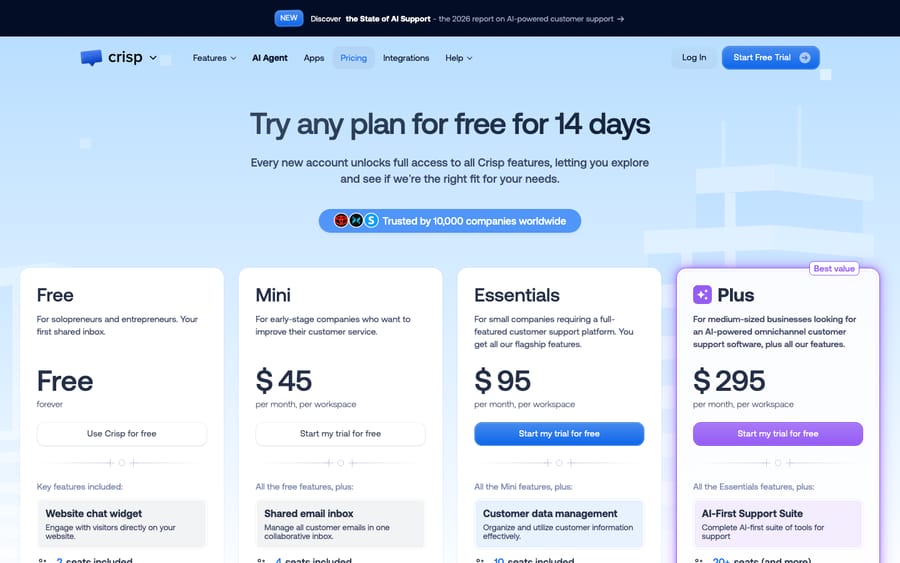
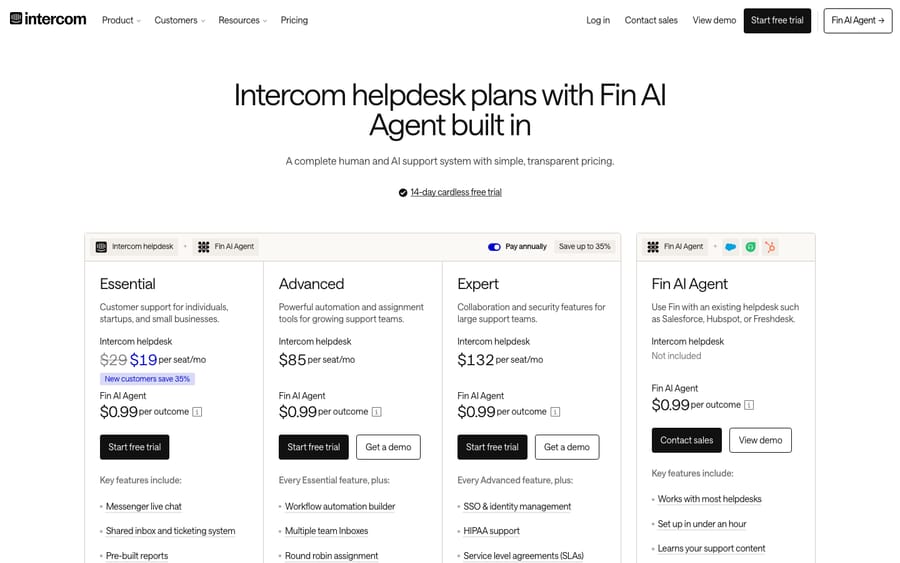
Per-workspace pricing is how Crisp wins small teams: a 4-person team pays $45 a month in total, while the same team on Intercom's Essential plan pays $116 a month at the $29 list price before any AI. Crisp earns its upgrades through caps instead. The omnichannel inbox (WhatsApp, Instagram, SMS and more), routing rules and the knowledge base start on Essentials, and the ticketing system, white-label branding and 100+ integrations wait on Plus. A team that needs WhatsApp pays $95, not $45, whatever its size.
Intercom's seat-plus-outcome model is the reverse. Seats are expensive, and Fin's charge grows as Fin gets better at its job. Intercom's incentive follows: it makes more money the more conversations Fin closes, so it has every reason to make Fin good and no reason to cap the bill. Crisp aims straight at that model on its own AI page, which says "You'll not have to pay 1$ per resolved conversation."
What does each cost at 8 agents and 1,000 AI conversations a month?
Here's the arithmetic for one realistic small team. The assumptions: 8 agents, 1,000 conversations a month that the AI handles, and 60% of those ending as a billable Fin outcome on Intercom (Intercom counts an outcome for a resolution, a Procedure handoff, a disqualification or a self-serve routing, capped at one charge per conversation; the full list is in the AI section below).
| Crisp Essentials | Intercom Essential (list) | |
|---|---|---|
| Seats | $95 covers 10 agents | 8 × $29 = $232 |
| AI included | $25 of credit, about 450 conversations | None |
| AI beyond that | 550 more conversations, about $31 at the implied rate | 600 outcomes × $0.99 = $594 |
| Rough monthly total | about $126 | about $826 |
Crisp doesn't publish a pay-as-you-go rate for Hugo. Its plans imply about $0.056 a conversation ($25 for about 450), so the $31 line is our estimate from that ratio, not a quoted price. On Intercom, swap Essential for Advanced (where the workflow builder lives) and seats rise to 8 × $85 = $680, taking the total to about $1,274. Add Copilot for all 8 agents and Intercom adds another 8 × $29 = $232.
At the $19 new-customer seat price shown on Intercom's page, seats fall to 8 × $19 = $152 and the Intercom total to about $746. Either way, Crisp is roughly six times cheaper at this size. The gap is what you pay Intercom for: a more developed AI agent, deeper workflows, product tours, SLAs and reporting. Whether that's worth $600 to $700 a month depends on whether your support happens inside a software product.
How the totals move with team size and Fin's outcome rate
| Scenario | Crisp | Intercom |
|---|---|---|
| 3 agents, 300 AI conversations (Crisp Mini; Intercom Essential at $29) | $45 + about $12 overflow = about $57 | 3 × $29 + 180 outcomes × $0.99 = about $265 |
| 8 agents, 1,000 AI conversations, 30% become outcomes | about $126 | $232 + 300 × $0.99 = about $529 |
| 8 agents, 1,000 AI conversations, 80% become outcomes | about $126 | $232 + 800 × $0.99 = about $1,024 |
| 20 agents, 3,000 AI conversations (Crisp Plus; Intercom Advanced, 60% outcomes) | $295 + about $92 overflow = about $387 | 20 × $85 + 1,800 × $0.99 = about $3,482 |
Crisp's column barely moves with Fin-style success because its AI cost is set by conversations, not outcomes. Intercom's column swings by about $500 at 8 agents depending on how often Fin resolves, which is the forecasting risk to plan around. Crisp's overflow figures use the same implied $0.056 rate, so treat them as estimates.
Which wins on features?
| Capability | Edge | Why |
|---|---|---|
| Live chat widget | Tie | Both are chat-first products with a polished widget |
| Channels | Crisp | WhatsApp, Instagram, Messenger, SMS, Line, Viber and email in one inbox from Essentials |
| In-app messaging, tours, product messages | Intercom | Its origin; Crisp has nothing equivalent at the same depth |
| Ticketing | Intercom | Crisp's ticketing system is a Plus feature; Intercom's inbox and tickets are on every plan |
| Workflows and routing | Intercom | Workflow builder on Advanced; Crisp's workflow builder and routing rules start on Essentials but are simpler |
| AI agent | Intercom | Fin is Intercom's main product; Hugo is capable but newer |
| AI cost predictability | Crisp | Credit pool with an opt-in overflow, against an uncapped per-outcome charge |
| SLAs, HIPAA, multibrand | Intercom | All listed on Expert |
| Price for small teams | Crisp | $45 to $95 total against $29 to $85 per seat |
| Integrations | Tie | Both connect to the common SaaS and ecommerce tools; Crisp lists 100+ integrations on Plus, and Intercom runs its own App Store |
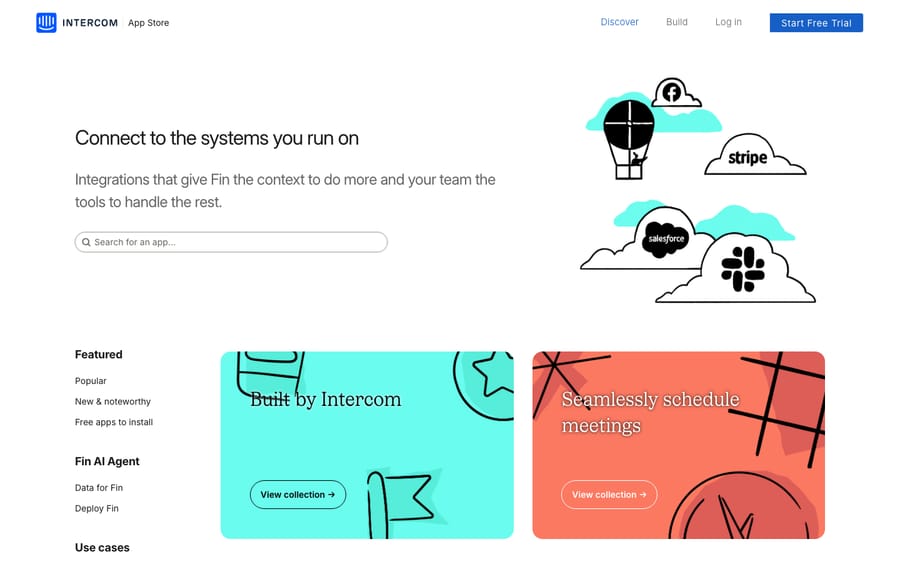
Intercom's App Store sorts its integrations around Fin, with collections for data Fin can read and places Fin can be deployed. Crisp's integrations sit on its pricing page as a Plus feature.
Crisp treats support as a shared inbox with chat at the center and AI on a budget. Intercom treats support as part of the product experience: the Messenger, onboarding tours, outbound messages and Fin all sit in one system designed for software companies.
What AI does each sell, and what does it cost?
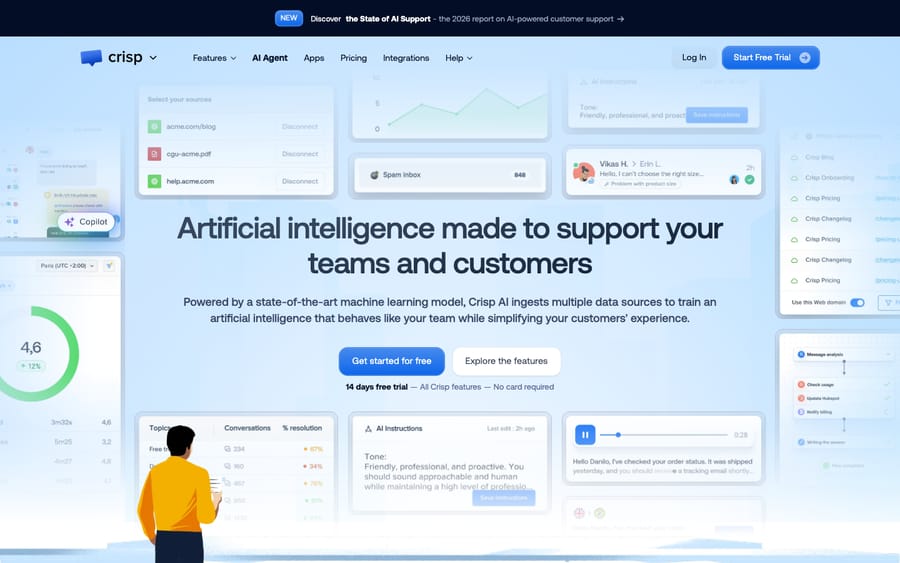
Crisp sells Hugo. Crisp's AI page lists web chat, WhatsApp, Messenger, Instagram and email as the channels where Hugo's workflows run, trained on your knowledge base, website and documents, with a handoff to a person when it can't answer. In its February 1, 2026 AI update, Crisp says each plan includes a free monthly credit allowance used when Hugo handles conversations: $5 on Mini (about 90 conversations), $25 on Essentials (about 450) and $75 on Plus (about 1,350). Past the allowance you can enable pay-as-you-go "to keep Hugo running without interruption." The same post says Hugo can trigger actions from a conversation through one-click integrations, and through no-code agents built on n8n, Zapier or Make. Our Crisp AI explainer goes deeper on Hugo, and our guide to Hugo credits shows how fast each allowance runs out.
Intercom sells Fin. Fin costs $0.99 per outcome on all three plans, and it can also be bought on its own for other help desks with a 50-outcome monthly minimum, per Fin's pricing page. Fin's pricing page lists what counts: a resolution (no further help requested after Fin's last answer), a Procedure handoff to a person, a disqualification and a self-serve routing each cost $0.99, a sales qualification costs $9.99, and conversations passed to your team without an outcome aren't charged. Charges are capped at one outcome per conversation. Copilot, the agent-facing helper, is separate at $29 a teammate a month billed annually. Our Intercom Fin explainer covers how outcomes are counted.
One ownership change to weigh in a long-term decision: Salesforce completed its acquisition of Fin, which its release describes as "formerly Intercom," on September 10, 2026. The release says Fin will keep serving its customers as part of Salesforce's AI Labs. Intercom's pricing page still listed $0.99 per outcome on November 21, 2026.
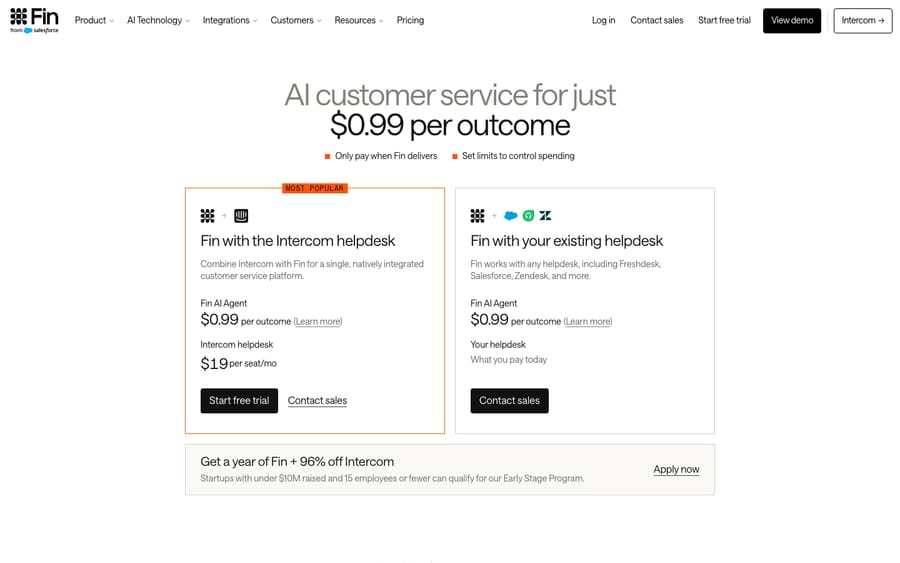
In practice, Hugo costs roughly 6 cents a conversation inside the allowance, and Fin costs 99 cents an outcome. For a team handling a few hundred AI conversations a month, Hugo is close to free. For a team that wants an AI agent to finish complex workflows inside a SaaS product, Fin is the more developed tool, and the price reflects that.
Who is each platform built for?
Crisp fits small and mid-size teams, often SaaS startups and online stores, who want chat, email and messaging apps in one inbox without a per-seat bill. It suits teams of 2 to 20 where one person might answer chat, email and WhatsApp in the same hour.
Intercom fits product-led software companies where support, onboarding and growth messaging run through one Messenger, and teams that want SLAs, multibrand, HIPAA support and a mature AI agent. It's priced for teams that measure the cost of support against revenue per customer, not for a five-person store. The exception is very early startups: Fin's pricing page advertises a year of Fin and 96% off Intercom for companies with under $10M raised and 15 employees or fewer, through its Early Stage Program.
If you're comparing Intercom with a heavier ticketing desk instead, see Zendesk vs Intercom. If Crisp is close but not quite right, our best Crisp alternatives list covers the field.
What do users say about Crisp and Intercom?
We could not load G2 or Capterra (both returned 403 to our fetch), so the public ratings we checked are Trustpilot's, read on November 21, 2026. Crisp's TrustScore was 1.9 from 56 reviews; Intercom's page showed 2.0 from 13 reviews. Trustpilot pages for software vendors draw mostly from unhappy customers, and both samples are small, so read them for themes rather than scores. Our Crisp review reads across G2, Capterra and Trustpilot together. On Crisp, recent reviews repeat two complaints: slow or unhelpful support replies, and accounts suspended or hard to close, with one free-plan user praising the help they got. A reviewer from Chile put it in five words on October 21, 2026: "Support is friendly but useless." On Intercom, the themes are cost, slow support, and billing or account-access problems. A reviewer from Denmark on October 4, 2026 called it a company "charging $3000+ a month for 20 seats."
The themes match each pricing model. Crisp users rarely complain about the bill; Intercom users often do.
What breaks if you move from Crisp to Intercom, or back?
Conversation history and contacts move through each vendor's API or a migration service. Crisp's segments map loosely to Intercom's tags and attributes. What doesn't move: Crisp's chatbot scenarios and workflows, Intercom's Workflows and Series, saved replies in either direction, and every AI setup, because Hugo's training and Fin's content and procedures are configured separately. Plan to rebuild automation and retrain the AI from scratch.
The bigger cost is the AI bill changing shape. A team moving from Crisp to Intercom goes from a credit pool to a per-outcome charge, so forecast outcomes before signing. A team moving the other way should check whether Crisp's channels and simpler workflows cover what Intercom's Workflows were doing.
Where Macha fits
Macha runs inside both Crisp and Intercom, so a team that's happy with its desk but not with its AI results doesn't have to pick between them to fix that. On Crisp, Macha's connector reads conversations and customer profiles, replies on the customer's channel, drafts replies as internal notes for review, updates segments, changes the conversation state and routes to an operator or team. It starts automatically on a new conversation or a new customer message. With Macha's Shopify and Stripe connectors attached, the same agent can look up an order or a subscription before it replies, as in the Crisp order-status use case.
The difference from Hugo and Fin is who does the work. Hugo and Fin are self-serve: you write the content, set up the actions and tune the agent yourself. Macha is done for you. The Macha team analyzes your past conversations, builds the knowledge base and the agent, and runs it in safe mode, drafting internal notes your team approves, until the drafts are right. That's included on the trial and every plan at about $0.40 per ticket, which covers setup and a dedicated success manager who handles your changes.
Hugo inside its allowance costs a few cents a conversation, which Macha doesn't match. Against Fin's $0.99 per outcome, Macha's about $0.40 per ticket counts one conversation once, however many messages it takes, and the AI model doesn't change the charge. Plans start at $299/month for 750 tickets. See Macha on Crisp, Macha on Intercom, or the Crisp internal-note drafts use case for the safe-mode workflow.
Macha fits teams on Zendesk, Freshdesk, Gorgias, Front, Gladly, Crisp, HubSpot or Intercom that want an agent acting inside the conversation, with Shopify, Stripe or their own APIs behind it, and would rather not build and tune it themselves. A team whose AI questions are simple FAQs is often well served by Hugo's included credits.
To try it on your own Crisp or Intercom workspace, the trial is $50 of free usage (about 125 tickets), no credit card, no time limit, and the Macha team does the setup: start a trial.
Common questions
Is Crisp cheaper than Intercom?
Yes, at almost every team size. Crisp's Essentials plan is $95 a month for 10 agents, while 10 seats on Intercom's Essential plan cost $290 a month at the $29 list price billed annually, or $190 at the $19 new-customer price. Crisp also includes AI credits, while Intercom bills Fin at $0.99 per outcome.
Did Salesforce buy Intercom?
Salesforce completed its acquisition of Fin, described in its September 10, 2026 press release as "formerly Intercom." Intercom's helpdesk plans and Fin's $0.99 per-outcome price were still listed on Intercom's pricing page on November 21, 2026.
Is Crisp's Hugo as good as Intercom's Fin?
Fin is the more developed agent, with workflows and procedures built for SaaS support, and Intercom builds its product around it. Hugo covers knowledge-base answers across chat, WhatsApp, Messenger, Instagram and email, and actions through integrations and no-code tools. Test both on your own conversations during the trials.
Does Crisp have a free plan?
Yes. Crisp's Free plan covers 2 agents with the chat widget, shared inbox, mobile apps and contact forms, but no AI credits. Paid plans include a 14-day trial with no card required, per Crisp's AI page.
Can I use Fin on Crisp?
Fin's pricing page says Fin works with any helpdesk, naming Freshdesk, Salesforce and Zendesk, with a 50-outcome monthly minimum when bought on its own. Crisp isn't named there, so ask Fin's sales team before planning on it (checked November 21, 2026). Macha runs inside Crisp.
Which is better for a SaaS startup?
Intercom, if in-app onboarding, product tours and proactive messages are part of the job and the budget allows per-seat pricing. Crisp, if the main need is answering chat, email and messaging apps from a small team on a fixed monthly bill.
How we researched this
- Intercom App Store: intercom.com/app-store, captured November 21, 2026.
- Vendor pricing: crisp.chat/en/pricing, intercom.com/pricing and fin.ai/pricing, fetched November 21, 2026. Screenshots of the Crisp, Intercom and Fin pricing pages were captured the same day. Ownership: Salesforce's press release of September 10, 2026.
- Crisp AI: crisp.chat/en/ai and Crisp's AI update of February 1, 2026, fetched November 21, 2026.
- Computed figures: the 3-, 8- and 20-agent examples are our arithmetic from list prices. Crisp's per-conversation rate ($25 ÷ 450 ≈ $0.056) is implied by its allowance, not published. The 60% outcome share for Fin is an assumption; use your own.
- User sentiment: Trustpilot pages for Crisp and Intercom, read November 21, 2026; quotes are attributed by country and date, without reviewer names. G2 and Capterra returned 403 to our fetch, so their ratings are not used.
- Macha: capabilities on Crisp come from Macha's own Crisp connector and the Crisp integration page. Macha is our product. We have not run Hugo or Fin on live traffic for this comparison; feature claims come from each vendor's public pages.