







 Shopify
 Stripe
 Slack
 Notion
 Google Workspace
 Confluence


Crisp vs Tidio (2026): Which Live Chat Fits a Shopify Store?


Tidio is the easier pick for a Shopify store that wants chat and an AI agent running from a Shopify app install, and Crisp is the cheaper pick once conversation volume grows. The difference is the billing unit. Tidio bills by conversation, with its Lyro AI and your human agents drawing on one shared monthly quota, from $33 a month billed yearly for 50 conversations. Crisp bills per workspace, from $45 a month for 4 agents, with a monthly credit allowance for its Hugo AI agent included. Prices below come from both vendors' sites and their Shopify App Store listings, checked on November 21, 2026.
Key takeaways
- Tidio's Starter plan with Lyro costs $390 a year for 50 conversations a month, and Lyro and human conversations count against the same quota.
- Crisp charges $45, $95 or $295 a month per workspace, with Hugo AI credits of $5, $25 or $75 included.
- On Shopify, Tidio's app shows 4.8 stars from 1,357 reviews and Crisp's shows 4.0 from 34, both read on November 21, 2026.
- For a store with 1,000 conversations a month and 600 handled by AI, our rough math puts Crisp Essentials near $103 and Tidio Growth near $700 on monthly billing.
- Macha runs inside Crisp but does not connect to Tidio, so a Tidio store would need to move its chat to use Macha.

Crisp or Tidio: which should a store pick?
| If you are... | Pick | Why |
|---|---|---|
| A new Shopify store that wants chat and AI live today | Tidio | The Shopify app is built for it, and Lyro gets 50 free conversations to try |
| A store doing more than a few hundred conversations a month | Crisp | Workspace pricing doesn't climb with every chat the way a conversation quota does |
| Selling on WhatsApp, Instagram and Messenger as well as the site | Crisp | The omnichannel inbox starts on the $95 Essentials plan |
| Wanting to edit or refund Shopify orders from the chat window | Tidio | Its Shopify listing says agents can edit and refund orders without leaving Tidio |
| More than 10 agents | Crisp | Plus covers 20+ agents; Tidio's Starter and Growth plans stop at 10 seats |
| Planning around a Black Friday spike | Crisp | A seasonal surge can push you into a higher Tidio conversation tier; Crisp's price is set by seats |
How does Crisp pricing compare with Tidio pricing?
We checked both pricing pages and both Shopify App Store listings on November 21, 2026 and captured the screenshots below.
| Crisp (per workspace, per month) | Tidio (with Lyro AI) | |
|---|---|---|
| Free | $0, 2 agents, chat widget, shared inbox, no AI credits | $0, 50 human conversations a month, 50 Lyro conversations once |
| Entry | Mini: $45, 4 agents, $5 AI credit (about 90 AI conversations) | Starter: $390 a year (about $33 a month) or $39 on monthly billing, for 50 conversations |
| Mid | Essentials: $95, 10 agents, $25 AI credit (about 450) | Growth: $750 a year (about $63 a month) for 100 conversations; $75 to $700 a month on monthly billing for 100 to 1,000 |
| Top | Plus: $295, 20+ agents, $75 AI credit (about 1,350) | Plus: from $300 a month plus usage; Premium: contact sales, from 3,000 Lyro conversations, Lyro as a managed service, pay-per-resolution billing and a guaranteed 50% Lyro resolution rate (both by agreement) |
| Seats | Fixed per plan; $10 a month per extra agent | Up to 10 on Starter and Growth |
| What the price is tied to | Seats, channels and AI credits | Conversations, AI and human combined |
Sources: Crisp pricing, Tidio pricing, and the Tidio and Crisp Shopify listings. Tidio's own site displays its yearly prices as a monthly figure ($33 for Starter, $63 for Growth); the monthly-billing range of $75 to $700 for Growth comes from its Shopify listing. Tidio's FAQ says plans with Lyro cost more than "Human only" plans for the same quota, and the Shopify listing puts Human-only Starter at $29 a month and Growth at $49 to $199.
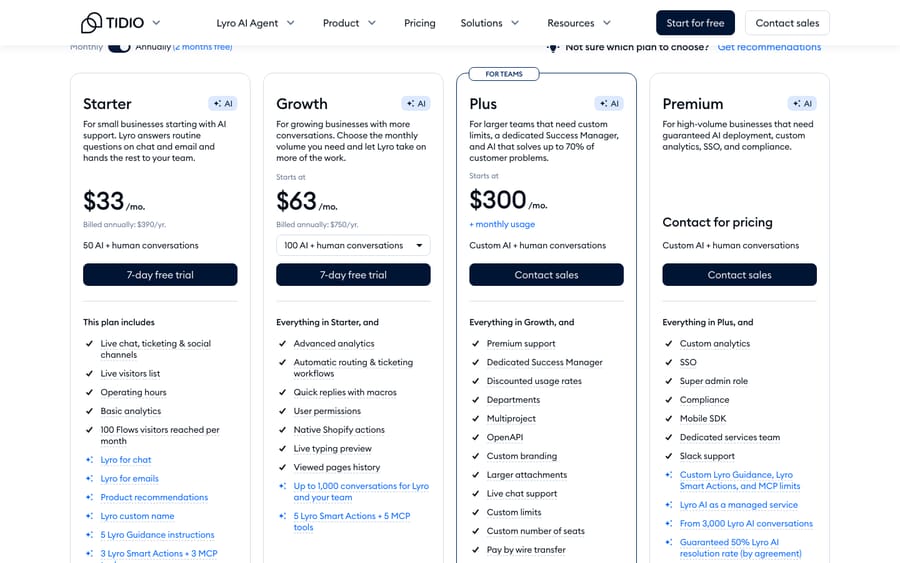
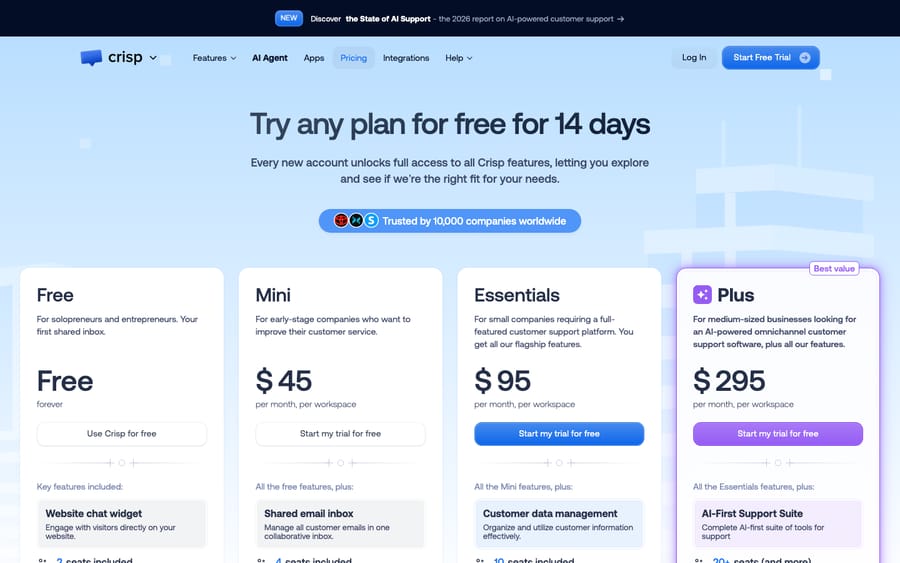
The two models reward different stores. Tidio's conversation quota is cheap at the bottom: $390 a year covers a store that gets a couple of chats a day. But every conversation counts, human or AI (the pricing page says conversations handled by Lyro and your team "count toward the same plan limit"), so the bill tracks traffic, and traffic is what a store is trying to grow. Tidio earns more as your store gets busier, whether or not Lyro does more of the work. Crisp's incentive runs through seats and channels instead. A 3-person store on Crisp pays the same in November as in March, and Crisp earns its upgrades when you need WhatsApp (Essentials) or ticketing and 100+ integrations (Plus).
What does each cost at 1,000 conversations a month?
Here's one busy month for a 3-agent store: 1,000 conversations, 600 of them handled by the AI agent and 400 by people.
| Crisp Essentials | Tidio Growth with Lyro (monthly billing) | |
|---|---|---|
| Base price | $95 for up to 10 agents | $700 for 1,000 shared conversations |
| AI included | $25 of credit, about 450 AI conversations | All 1,000 conversations can be Lyro or human |
| AI beyond that | 150 more, about $8 at the implied rate | Included in the quota |
| Rough monthly total | about $103 | about $700 |
Crisp doesn't publish its pay-as-you-go rate for Hugo. Its plans imply about $0.056 a conversation ($25 for about 450), so the $8 line is our estimate from that ratio. Tidio's $700 is the top of the $75 to $700 range on its Shopify listing, which it ties to 1,000 shared conversations; yearly billing brings it down by about two months. A store that only needs chat and email could run Crisp Mini at $45 plus overflow credits instead.
At low volume the gap narrows and can flip. A store with 50 conversations a month pays $33 a month for Tidio Starter billed yearly, against $45 for Crisp Mini, so Tidio is cheaper. At 100 conversations, Tidio Growth costs $63 a month billed yearly or $75 monthly, and Crisp Mini at $45 is cheaper again if chat and email are enough; a store that needs WhatsApp or Instagram on Crisp pays $95 for Essentials. The smallest stores pay least on Tidio, which is part of why so many start there. Our Crisp pricing breakdown has the Crisp side bill by bill.
What AI does each sell, and what does it cost?
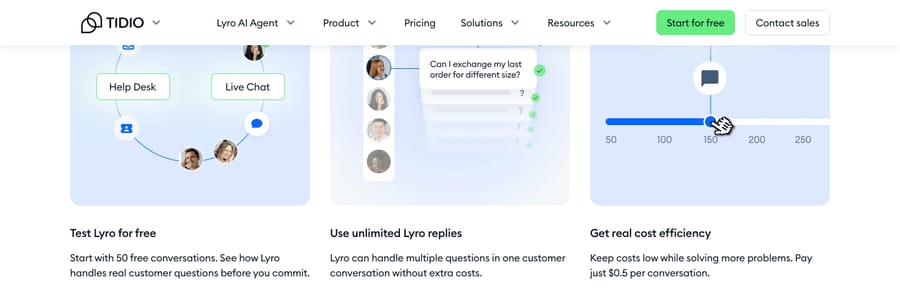
Tidio sells Lyro. Lyro answers from the content you give it and hands off to a person when it can't. Tidio's Lyro page says "Pay just $0.5 per conversation," counts a conversation once if it has at least one Lyro reply, and says customers "average a 75% resolution rate with Lyro" without defining resolution. Every account starts with 50 free Lyro conversations that don't renew. Lyro Connect, which puts Lyro on another desk such as Zendesk, Intercom or Salesforce, is described on the same Lyro page as available with Plus and Premium in one place and with Premium in another, so confirm the plan with Tidio. Tidio's Shopify listing adds that Lyro answers order status questions and that Growth includes native Shopify actions. Our Tidio Lyro explainer covers the older pack pricing and how it has moved.
Crisp sells Hugo. Crisp's AI page lists web chat, WhatsApp, Messenger, Instagram and email as the channels where Hugo's workflows run, trained on your knowledge base, website and documents. In its February 1, 2026 update, Crisp says each plan includes a monthly credit allowance and that pay-as-you-go can be enabled "to keep Hugo running without interruption." Hugo can trigger actions through one-click integrations and through no-code agents built on n8n, Zapier or Make. More in our Crisp AI explainer.
Per conversation, Hugo inside its allowance costs about 6 cents and Lyro about 50. Tidio's offer is a more packaged agent for stores; Crisp's is a cheaper agent you configure across more channels.
How do they compare on Shopify?
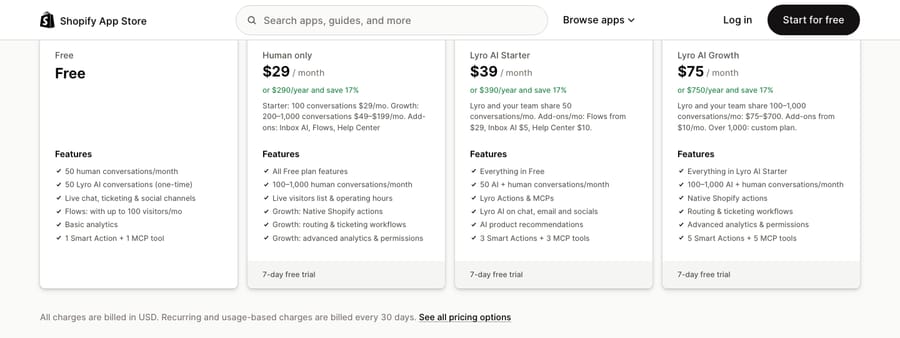
Tidio is the more Shopify-native of the two. Its app listing (4.8 stars, 1,357 reviews on November 21, 2026) says agents see Shopify orders beside each chat and can "Edit and refund Shopify orders without leaving Tidio," and it lists order tracking among its workflow automations.
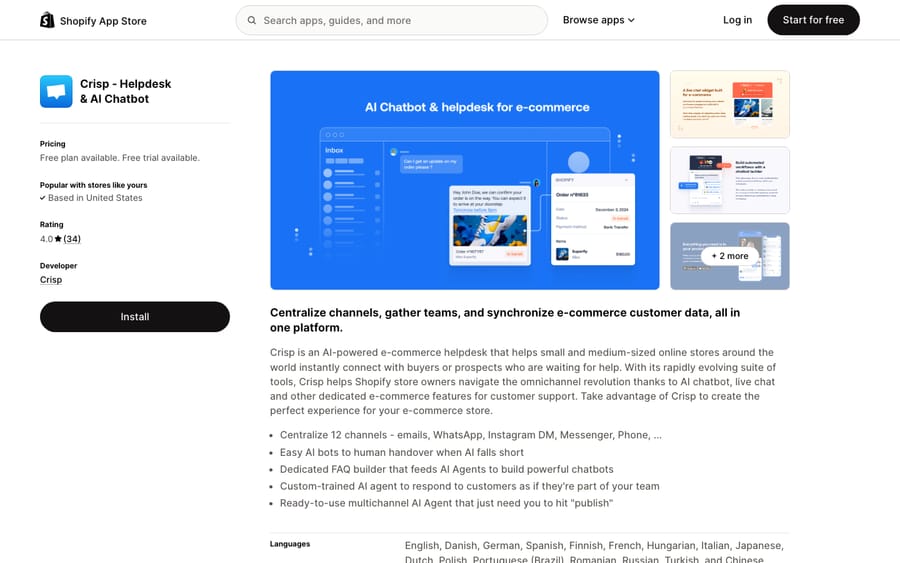
Crisp's app (4.0 stars, 34 reviews) leads with channels: it centralizes 12, including email, WhatsApp, Instagram DM and Messenger, and supports 16 languages. Crisp's Shopify integration page says agents can view a customer's order history in the inbox and "activate advanced features, such as refunds, straight from Crisp."
Here is how the Shopify features line up, with the plan gates each source states:
| Shopify capability | Tidio | Crisp |
|---|---|---|
| Orders beside the chat | Yes, per its listing | Order history in the inbox, per its integration page |
| Edit or refund orders from the chat | Edit and refund, per its listing | Refunds "straight from Crisp," per its integration page |
| Native Shopify actions | Growth plan and up, per its listing | Not listed as a plan feature |
| AI order-status answers | Lyro answers order status questions, per its listing | Hugo actions through integrations or n8n, Zapier or Make agents |
| Channels and languages in the app | Email, Instagram, WhatsApp and Messenger in one inbox | 12 channels and 16 languages, per its listing |
Tidio is shaped for a store owner installing an app; Crisp is shaped for a support team running several channels.
Where your data lives. Crisp's pricing page lists "EU-Hosted: Your data is hosted on European servers" and offers a data processing agreement. Tidio's privacy policy says it mainly processes data "within the EEA," and that some data "may be transferred from the EEA and/or the United Kingdom and processed in the United States." A store with strict EU residency needs should read both documents before signing.
Who is each built for?
Tidio fits Shopify and WooCommerce store owners with low to moderate chat volume who want an AI agent with Shopify order context and a setup they can finish themselves. It's a strong fit for stores where one owner or a small team answers chat between other jobs.
Crisp fits stores and SaaS teams with more conversations, several channels and a few agents who share the load. Its workspace pricing makes the bill predictable through seasonal peaks, and its AI credits make basic automation close to free. Crisp's Shopify listing names 16 supported languages, which helps stores selling across several countries.
If neither quite fits, see our best Tidio alternatives and best Crisp alternatives lists, or the full Tidio pricing breakdown. If budget is the main constraint, our list of free Crisp alternatives covers tools with a usable $0 tier.
What do users say about Crisp and Tidio?
Beyond the Shopify listings above, we read both vendors' Trustpilot pages on November 21, 2026 (G2 and Capterra returned 403 to our fetch). Tidio's TrustScore was 3.5 from 225 reviews; Crisp's was 1.9 from 56. Trustpilot pages for software draw mostly from unhappy customers, so read the themes rather than the scores. Both vendors' recent reviews repeat the same two complaints: accounts suspended or locked without a clear explanation, and billing or cancellation problems. Tidio reviewers add trouble reaching a person behind Lyro; Crisp reviewers add slow support replies, while one free-plan user praised the help they got. On the Shopify App Store, where reviews come from merchants who installed the app, Tidio's 4.8 from 1,357 reviews is the stronger signal for stores.
Two reviews from those listings, read November 21, 2026, show what each side praises. A US store wrote on Tidio's listing on November 6, 2026 that "Lyro, the AI LLM has brought up our 'resolve rates' to around 80%." A French store wrote on Crisp's listing on March 4, 2025 that "Crisp offers unbeatable pricing. 10x cheaper than competitors and just as powerful." The negatives show up too: another US store's Tidio review on October 31, 2026 opens with "Use caution with Tidio," and goes on to describe how a question about a custom order's status was handled.
What breaks if you switch from Tidio to Crisp, or back?
Crisp's pricing page lists exporting conversation transcripts and exporting data for backup; check Tidio's export options for your plan before you commit, then move history with a migration service or a short script. What doesn't move is the automation. Tidio's Flows (its visual chatbot and automation builder, priced separately past 100 visitors a month on most plans) need rebuilding by hand in Crisp's workflow builder; neither vendor's pricing or integration pages we read mention an import path between the two. Lyro's training content and Hugo's knowledge sources are set up separately too, so plan to load your FAQs and policies again.
The Shopify side needs a fresh install either way: each tool connects to the store through its own app, and order context only appears after the new app syncs. Saved replies, tags and segments are worth exporting before you cancel, because they're the part of a chat setup that took the longest to build.
The bill changes shape as well. Moving from Tidio to Crisp swaps a conversation quota for a seat count, which helps a busy store and can cost a quiet one more. Moving from Crisp to Tidio does the reverse. Count last year's conversations by month, including November and December, before you pick a Tidio tier.
Where Macha fits
Macha runs inside Crisp. It doesn't connect to Tidio as of November 2026, so a store on Tidio would need to move its chat to Crisp or another supported desk to use it. Macha currently runs on Zendesk, Freshdesk, Gorgias, Front, Gladly, Crisp, HubSpot or Intercom. It fits teams that already answer Shopify customers in Crisp and want an agent that looks up the order before it replies.
On Crisp, Macha's agent reads the conversation and the customer's profile, looks up the order with Macha's Shopify connector (Get Order, Search Orders, Lookup Customer, Customer Orders), and replies on the customer's channel. It can also draft the reply as an internal note for your team to approve, tag the conversation with a segment, change its state, or route it to the right operator or team. It starts automatically on a new conversation or a new customer message. Shopify refunds and cancellations are available as tools that ask for confirmation; a refund covers the full remaining order, so partial refunds stay with a person. The order-status use case and the after-hours use case show both flows.
The difference is in who does the work, and at what size. Hugo is self-serve: your team trains and tunes it. Tidio offers more help as you move up: its Plus plan (from $300 a month plus usage) includes a dedicated Success Manager, and Premium sells Lyro as a managed service with pay-per-resolution billing and a guaranteed 50% resolution rate by agreement, from 3,000 Lyro conversations. On Starter and Growth, Lyro is self-serve too. Macha is done for you on every plan, including the trial. The Macha team analyzes your past conversations, builds the knowledge base and the agent, and runs it in safe mode until the drafts are right, included on the trial and every plan at about $0.40 per ticket, which covers setup and a dedicated success manager who handles your changes. Plans start at $299/month for 750 tickets. That's more per conversation than Hugo's included credits; it buys an agent your team doesn't have to build. See Macha on Crisp.
Common questions
Is Tidio cheaper than Crisp?
Only at the very bottom: Tidio Starter with Lyro is $33 a month billed yearly for 50 conversations, against $45 for Crisp Mini. At 100 conversations Tidio Growth is $63 a month billed yearly, more than Crisp Mini. As conversations grow, Tidio's quota tiers climb to $700 a month for 1,000 on monthly billing, while Crisp's price stays tied to seats and AI credits.
Is Tidio's Lyro better than Crisp's Hugo?
Lyro is more packaged for stores, with order status answers and Shopify actions on Growth. Hugo covers more channels and costs far less per conversation inside its allowance. Run both free allowances (50 Lyro conversations on Tidio; Crisp's 14-day trial) on your real questions.
Which works better with Shopify?
Tidio, on the evidence of the listings: 1,357 reviews at 4.8 stars, order editing and refunds from the chat, and Lyro order-status answers. Crisp shows order history in the inbox and offers refunds through its integration, with 34 reviews at 4.0 stars.
Do AI conversations count against Tidio's quota?
Yes. Tidio's plans are priced on AI plus human conversations combined, and a conversation counts once if Lyro replied at least once in it, per Tidio's Lyro page.
Can I use Macha with Tidio?
No. As of November 21, 2026, Macha doesn't connect to Tidio. It runs inside Crisp, where it reads and replies to conversations and looks up Shopify orders.
How we researched this
- Vendor pricing and product pages: crisp.chat/en/pricing, tidio.com/pricing, tidio.com/lyro, Crisp's Shopify integration and Crisp's February 1, 2026 AI update, all fetched November 21, 2026.
- Shopify App Store listings: Tidio and Crisp, read November 21, 2026. The listings price in local currency by visitor location, so our screenshots were captured as a US visitor sees them.
- Computed figures: the 1,000-conversation example is our arithmetic. Crisp's per-conversation rate ($25 ÷ 450 ≈ $0.056) is implied, not published. The 600/400 AI-human split is an assumption.
- User sentiment: Trustpilot pages for Crisp and Tidio, read November 21, 2026 and paraphrased without reviewer names; the three quotes come from the Shopify App Store reviews for Tidio and Crisp, read the same day, attributed by store country and date only.
- Data hosting: Crisp's pricing page and Tidio's privacy policy, read November 21, 2026. G2 and Capterra returned 403 to our fetch, so their ratings are not used.
- Macha: capabilities on Crisp come from Macha's own Crisp connector and the Crisp integration page. Macha is our product. We have not run Lyro or Hugo on live store traffic for this comparison; their features come from the vendors' public pages.