Intercom
 Shopify
 Stripe
 Slack
Slack Notion
 Google Workspace
 Confluence

How Much Does Tidio Cost in 2026? Plans, Lyro Rates and Real Monthly Bills


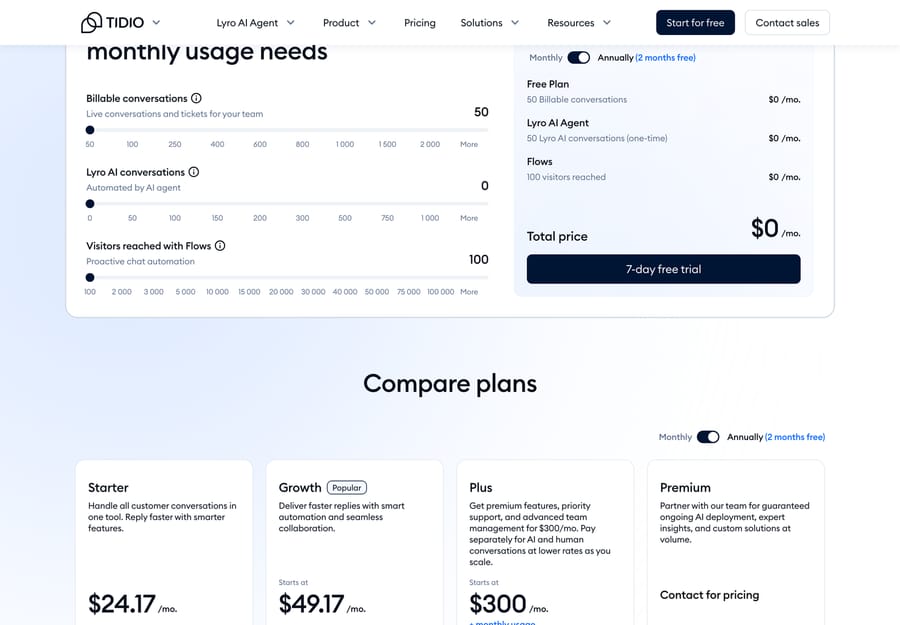
Tidio starts at $29 a month for 100 human-handled conversations, shown as $24.17 because the pricing page loads on annual billing. The Lyro AI agent and Flows automation are separate meters on top, and most teams end up buying two of the three.
Key takeaways
- Tidio sells three separate meters, human conversations, Lyro AI conversations and Flows visitors, with the Customer Service tier starting at $29.00 a month or $24.17 annually for 100 conversations.
- Tidio's Free plan includes 50 billable conversations a month, 10 seats, 100 unique visitors for Flows, and a one-time, non-renewable allowance of 50 Lyro conversations.
- Tidio automatically upgrades a monthly, non-Plus subscription to the next pricing rung once usage hits 95% of quota, after showing a warning at 80%.
- Tidio's Lyro AI agent rate flattens at 70 cents per conversation from the 200-conversation rung upward on monthly billing, or 58.3 cents annually.
- Tidio scores 4.6 out of 5 on G2 from 1,962 reviews, with 'Expensive' cited in 76 mentions among the platform's most common complaints.

Tidio's paid plans start at $29 a month billed monthly, or $24.17 a month billed annually, for 100 human-handled conversations, and the Lyro AI agent is a separate purchase from $39 a month for 50 AI conversations. We read every figure below off Tidio's live pricing page and help center on 22 September 2026 and rechecked the rate ladders in the page source on 24 September: the three ladders, the Free plan limits that get misquoted constantly, the automatic upgrade that fires at 95% of your quota, and the two prices the page carries in its source but does not print.
How much does Tidio cost?
Tidio does not sell one plan. It sells three meters, human conversations, Lyro AI conversations, and Flows visitors, and your bill is whatever combination you pick. Seats are not one of the meters: every self-serve plan includes ten.
| What you are buying | Entry price, monthly | Entry price, annual | What the entry price covers |
|---|---|---|---|
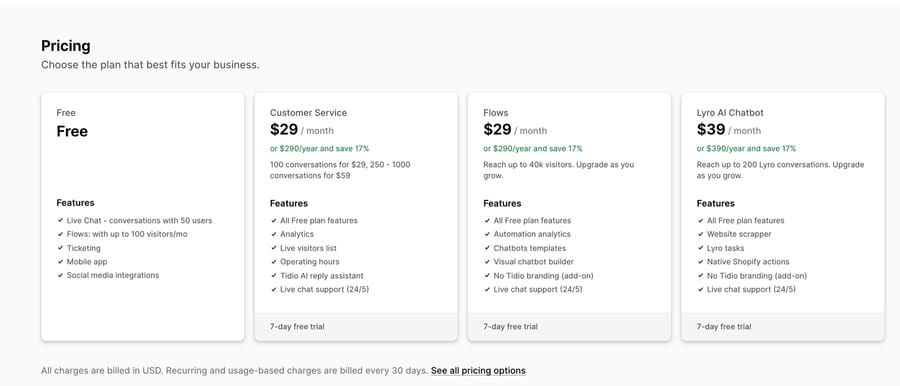
| Customer Service (human conversations) | $29.00/mo | $24.17/mo ($290/yr) | 100 billable conversations a month |
| Lyro AI Agent | $39.00/mo | $32.50/mo ($390/yr) | 50 Lyro conversations a month |
| Flows (rule-based automation) | $29.00/mo | $24.17/mo ($290/yr) | 2,000 visitors reached a month |
| Free | $0 | $0 | 50 billable conversations, 10 seats, 100 Flows visitors, 50 Lyro conversations once |
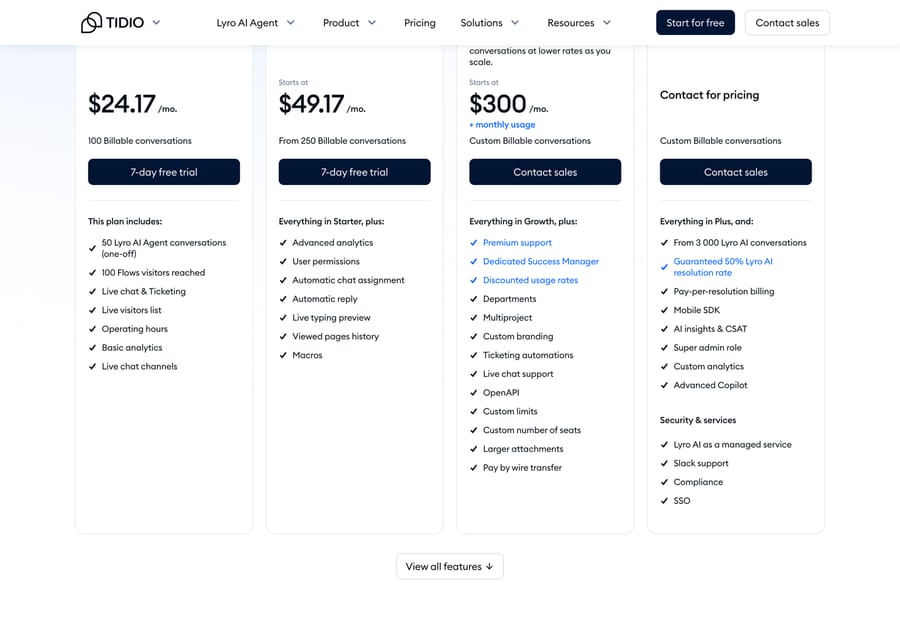
| Plus | From $300/mo plus usage | Not sold annually | Custom volumes, custom seats, discounted usage rates |
| Premium | Contact sales | Not sold annually | From 3,000 Lyro conversations, pay-per-resolution billing |
Prices checked 22 September 2026 on tidio.com/pricing, US-served, every figure asserted as a dollar sign.
Why does Tidio show $24.17 when the invoice says $29?
Tidio's page loads with the Annually toggle already on, badged "2 months free". The annual rate is exactly ten twelfths of the monthly one, so every headline price on that page is 17% below what you pay if you bill monthly.
| Plan | Monthly billing | Annual billing, shown per month | Annual billing, per year |
|---|---|---|---|
| Starter (100 conversations) | $29.00 | $24.17 | $290 |
| Growth (from 250 conversations) | $59.00 | $49.17 | $590 |
| Lyro AI Agent (50 conversations) | $39.00 | $32.50 | $390 |
| Flows (2,000 visitors) | $29.00 | $24.17 | $290 |
That is a real discount, not a trick, but it is worth knowing which one you are reading, because third-party pages quote the two interchangeably. The Shopify App Store listing for Tidio, which is the same product sold through Shopify billing, prints the monthly figures: $29, $29 and $39, with "or $290/year and save 17%" under each.
What does each Customer Service rung cost?
This is the meter for conversations your team handles. The rungs are fixed steps, not a per-unit rate, and the page's calculator simply picks the next rung up from whatever you type.
| Billable conversations / month | Monthly billing | Annual, per month | Cost per conversation, monthly |
|---|---|---|---|
| 50 (Free) | $0 | $0 | $0 |
| 100 | $29.00 | $24.17 | $0.290 |
| 250 | $59.00 | $49.17 | $0.236 |
| 400 | $89.00 | $74.17 | $0.223 |
| 600 | $129.00 | $107.50 | $0.215 |
| 800 | $159.00 | $132.50 | $0.199 |
| 1,000 | $179.00 | $149.17 | $0.179 |
| 1,500 | $249.00 | $207.50 | $0.166 |
| 2,000 | $349.00 | $290.83 | $0.175 |
Read the last column before you buy the biggest rung you can afford. Unit cost falls all the way up the ladder and then goes back up at the top: 1,500 conversations cost 16.6 cents each, 2,000 cost 17.5 cents each. A desk doing 1,600 conversations a month pays $349 on the 2,000 rung; the same desk doing 1,500 pays $249. There is no rung between them, so the hundred conversations either side of 1,500 are the most expensive hundred Tidio sells.
What counts as a billable conversation in Tidio?
Tidio's definition is unusually buyer-friendly and worth understanding, because it changes the volume you should budget for.
A conversation becomes billable only when a human on your team replies to it or starts it. Tidio's pricing FAQ says it plainly: "Unanswered messages initiated by visitors/customers are not counted" and "Responses from Flows and Lyro AI Agent are not counted as 'agent replies'." So spam, browsing chatter nobody answers, and anything Lyro or a Flow handles end to end do not touch this meter.
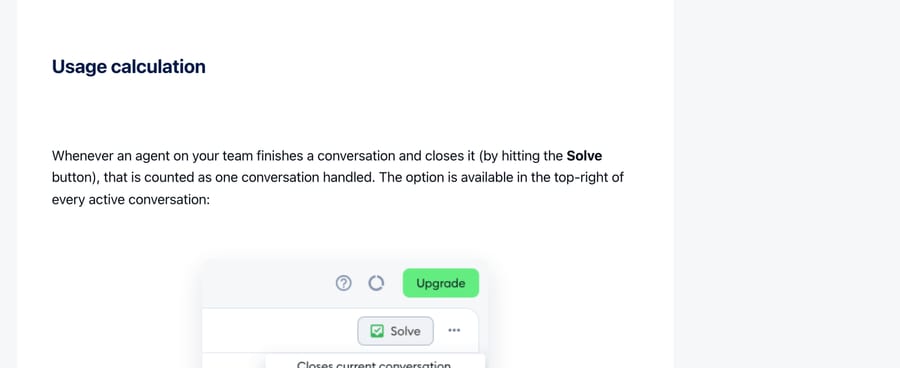
The help center is more precise about the mechanics: the count lands when an agent closes the thread. "Whenever an agent on your team finishes a conversation and closes it (by hitting the Solve button), that is counted as one conversation handled", once per thread, "no matter how many messages have been exchanged in the process". Email tickets count the same way, one per thread.
The cost of running out is steep, though, and it is not an overage charge. Tidio's help center says that at 80% of quota you get a banner and an email, and that if you hit the limit "you will no longer be able to respond to incoming messages, nor see their details". The meter does not bill past its rung, it stops the inbox.
Does Tidio upgrade your plan automatically?
Which is why the next mechanic exists, and why it belongs in any honest read of Tidio's pricing. From the help center: "If you use 95% of your quota, the auto-upgrade will activate. The package in question will automatically update to the next level (e.g. your Customer Service package can upgrade from 250 billable conversations to 400)."
It is on by default, it applies to the Customer Service, Flows and Lyro meters alike, and Tidio names the conditions: it only runs on monthly, non-Plus subscriptions, never on a free account, a trial, an annual plan or a Plus plan. The setting is called "Automatically upgrade the limit once it's reached" and you can turn it off.
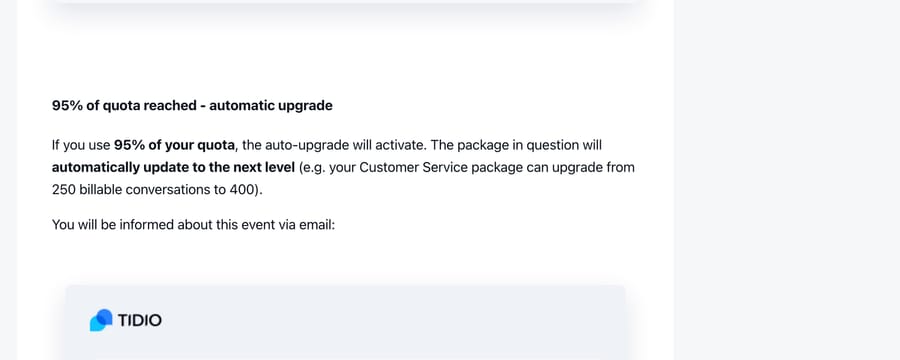
One busy month on monthly billing therefore moves you a rung, $59 to $89 on the example Tidio gives, and it is your job to move back down. Annual billing is immune to it, which is an odd incentive: the cheaper basis is also the one that can raise itself.
How much does the Lyro AI agent cost?
Lyro is the AI agent, and it bills on its own meter at roughly four times the rate of a human conversation.
| Lyro conversations / month | Monthly billing | Annual, per month | Cost per Lyro conversation, monthly |
|---|---|---|---|
| 50, once (lifetime) | $0 | $0 | $0 |
| 50 | $39.00 | $32.50 | $0.780 |
| 100 | $75.00 | $62.50 | $0.750 |
| 150 | $110.00 | $91.67 | $0.733 |
| 200 | $140.00 | $116.67 | $0.700 |
| 300 | $210.00 | $175.00 | $0.700 |
| 500 | $350.00 | $291.67 | $0.700 |
| 750 | $525.00 | $437.50 | $0.700 |
| 1,000 | $700.00 | $583.33 | $0.700 |
The rate flattens at 70 cents and stays there, so above 200 conversations there is no volume discount left on monthly billing. Annual billing takes it to 58.3 cents.
What the meter charges for matters more than the rate. Tidio counts "a customer interaction initiated through any channel integrated with Tidio that has at least one reply from our AI Agent", and it counts the same whether Lyro solves the problem or hands it straight to a human: "Even if Lyro replies a dozen times or more to solve the customer's problem, or if the customer leaves the chat window and returns to it at a later time, that still counts as a single conversation." That is a touch meter, not an outcome meter. Fin bills $0.99 but only on a resolution or a handoff you configured, and states that "You're not charged when a conversation is simply passed to your team without an outcome"; Help Scout's AI Answers bills $0.75 per resolution. Lyro's 70 cents is the cheapest of the three per unit and the broadest in what it counts.
The exception sits at the top of the range. Tidio's Premium card advertises "Pay-per-resolution billing" and a "Guaranteed 50% Lyro AI resolution rate", so Tidio does sell an outcome meter, on the tier you have to phone for.
What does Tidio's Free plan include?
This is the most misreported part of Tidio's pricing, including by us once, so here it is with the source attached. The Free plan is not on the compare-plans strip at all; it appears in the calculator when you leave every slider at its minimum, and in the far-left column of the feature table.
- 50 billable conversations a month. The rendered card prints "50 Billable conversations / mo." and the page's own data object carries
HandledConversationsquota 50. - 10 seats. Same data object,
ActiveOperatorsLimitFeature10. Ten agents on a free plan is unusual and it is real. - 100 unique visitors a month, for Flows only. Tidio's FAQ: "the Free Customer Service plan limits them to interact with only 100 unique visitors per month." This caps the automation builder. It is not the plan's conversation allowance, and quoting it as one understates the free tier by half.
- 50 Lyro conversations, once. Not monthly. The help center is explicit: "a non-renewable quota of 50 Lyro conversations... if you reach that limit - Lyro stops working, and the quota will not reset (as opposed to quotas for live chat and flows)."
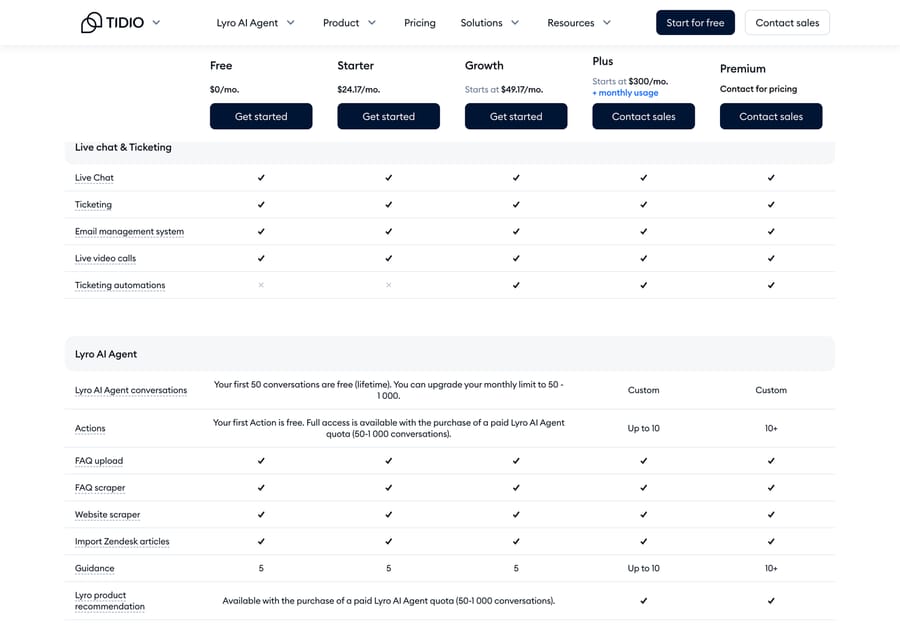
There is also a 7-day free trial of the full feature set, with no card required, after which the account drops to Free unless you subscribe.
What does Flows cost?
Flows is the rule-based automation builder, billed on unique visitors reached rather than conversations.
| Visitors reached / month | Monthly billing | Annual, per month |
|---|---|---|
| 100 | $0 | $0 |
| 2,000 | $29.00 | $24.17 |
| 5,000 | $49.00 | $40.83 |
| 10,000 | $69.00 | $57.50 |
| 20,000 | $99.00 | $82.50 |
| 50,000 | $169.00 | $140.83 |
| 100,000 | $299.00 | $249.17 |
(The full ladder also has rungs at 3,000, 15,000, 30,000, 40,000 and 75,000.) Above 100,000 visitors it is Plus only.
What does Tidio cost a small, mid-size and large desk?
Every line is arithmetic on a rate stated above. Monthly and annual are both shown because the gap is 17% and the automatic upgrade only exists on one of them.
A two-person Shopify store: 250 human conversations, 200 Lyro conversations
- Customer Service, 250 rung: $59.00 monthly, $49.17 annual.
- Lyro, 200 rung: $140.00 monthly, $116.67 annual.
- Flows: free tier, 100 visitors.
- Monthly billing: $199.00 a month, $2,388 a year. Annual billing: $165.84 a month, $1,990 a year.
- Across 450 handled conversations that is 44.2 cents each on monthly billing, 36.9 cents on annual.
A mid-market desk: 1,000 human conversations, 500 Lyro, 10,000 Flows visitors
- Customer Service, 1,000 rung: $179.00 / $149.17.
- Lyro, 500 rung: $350.00 / $291.67.
- Flows, 10,000 rung: $69.00 / $57.50.
- Monthly billing: $598.00 a month, $7,176 a year. Annual billing: $498.34 a month, $5,980 a year.
- Across 1,500 conversations: 39.9 cents each monthly, 33.2 cents annual. The AI is 59% of the bill and handles a third of the volume.
A large desk at the ceiling of self-serve: 2,000 human, 1,000 Lyro, 50,000 Flows
- Customer Service, 2,000 rung: $349.00 / $290.83.
- Lyro, 1,000 rung: $700.00 / $583.33.
- Flows, 50,000 rung: $169.00 / $140.83.
- Monthly billing: $1,218.00 a month, $14,616 a year. Annual billing: $1,015.00 a month, $12,180 a year.
That third model is the last one you can price yourself. One more conversation and you are on Plus, where the platform fee is $300 a month and the conversations are quoted separately.
What does Tidio not publish?
Plus usage rates. The Plus card reads "Starts at $300/mo. + monthly usage" and promises "Discounted usage rates", "Custom number of seats" and payment by wire transfer. The discount is not quantified anywhere on the page, so nobody can tell you where Plus overtakes stacking three self-serve ladders. Ours is the honest version: at the top of self-serve you are paying $1,218 a month, and Plus starts at $300 plus an unpublished rate, you have to ask.
Premium. Contact sales, described as "From 3 000 Lyro AI conversations", with a guaranteed 50% Lyro resolution rate, Lyro run as a managed service and pay-per-resolution billing.
Both cards, though, are rendered from a JSON object in the page's own source, and that object attaches figures to them: Plus carries {value: 5000, price: 30000} and Premium carries {value: 10000, price: 299900}, $300 and $2,999 a month, at 5,000 and 10,000 conversations. Treat the Premium figure as an indication rather than a quote: Plus's own $300 is explicitly a platform fee with usage on top, so the $2,999 is most likely the same shape, and both render on the page as contact-sales.
The marketplaces. We searched before writing that a price is unlisted. There is no Tidio listing on AWS Marketplace, on Microsoft's Azure Marketplace, or on Salesforce AgentExchange, all three searches return unrelated products. The one third-party channel that does carry prices is the Shopify App Store, and its figures need a caveat: the listing says "100 conversations for $29, 250 - 1000 conversations for $59", which is true only of the 250 rung. On tidio.com, 400 conversations cost $89, 600 cost $129, 800 cost $159 and 1,000 cost $179. If you are budgeting from the app store card, you are budgeting a third of the real number.
How does Tidio compare with Fin, Help Scout, Freshdesk and eesel AI?
Genuinely comparable products, each billing unit taken from that vendor's own live page. The volume column is the same everywhere: 1,000 AI-handled conversations a month.
| Product | AI billing unit | What 1,000 AI conversations cost | Seat cost underneath |
|---|---|---|---|
| Tidio (Lyro) | Per conversation Lyro replies to, resolved or not | $700/mo ($583.33 annual) | None, 10 seats included, no per-seat charge |
| Fin | Per outcome: resolution, configured handoff, disqualification | $990/mo, ordinary escalations free | Intercom seats from $29/seat/mo billed annually on Essential; on another help desk, a 50-outcome monthly minimum |
| Help Scout | Per AI Answers resolution | $750/mo | $25/user/mo (Standard) |
| Freshdesk (Freddy AI Agent) | Per session | $490/mo ($49 per 100 sessions) | Freshdesk plan on top, per agent |
| eesel AI | Per task (one ticket or chat session) | $400/mo, no platform fee on self-serve | None |
The billing unit tells you whose incentive it serves. Tidio's Lyro meter bills on contact, so it earns whether or not the AI finishes the job, the incentive is coverage, and the buyer carries the deflection risk. Fin's outcome meter is the opposite and costs more per unit for it. Tidio's genuine structural advantage is underneath all of it: no per-seat charge at all, ten seats on every self-serve plan including the free one, which is why a five-person team can run Tidio for less than a two-person team pays for most of this list.
On that arithmetic, Tidio's pricing suits teams with more people than volume: a small retail or e-commerce crew where five or six people dip into the widget between other jobs, a few hundred conversations a month, and one of the three meters doing most of the work. It is the wrong fit if you need all three meters at scale, because you then pay three subscriptions for one product, and it is the wrong fit if you already run a ticketing help desk, because you would be paying Tidio's conversation meter on volume your desk is already licensed for.
If you are weighing the whole category rather than the AI line, our best live chat software roundup and best Tidio alternatives cover the field, what Lyro actually does goes a level deeper on the agent itself, and our breakdowns of Intercom pricing and Help Scout pricing run this same exercise on the two closest rivals. For the pay-per-task model, eesel AI's guide sets out how that meter works.
What do buyers say about Tidio's cost?
On G2, Tidio scores 4.6 out of 5 from 1,962 reviews; on the Shopify App Store it scores 4.8 from 1,341. Both checked 22 September 2026. G2's own review-mined tag cloud puts "Expensive" (76 mentions) and "Cost" (56) among the top cons, alongside "Limited Customization" (57).
The complaint is consistently about the stacking, not the sticker. Mathew B., a warehouse specialist at a small business, titled his three-star review "Good if You can afford it" and wrote: "The cost is way too high, and they make you pay for multiple packages that really should be included in one. Overall, it feels very overpriced" (9 December 2024). A small-business reviewer posting as Direct C. gave two stars in July 2026 with a narrower version of the same point: "I'm not too happy with the AI chat feature; it feels like it's too expensive for what it offers" (28 July 2026). A current user reviewing in August 2026 put the value question directly: "The platform needs a major update to remain competitive and justify its price."
Read against the rate cards, that is coherent. Each ladder is individually cheap; a store that wants live chat, an AI agent and proactive automation buys three of them, and the bill reads like a plan three times the advertised price.
How we researched this
Every Tidio number here was read on 22 September 2026 from the live US-served pricing page, and we checked the currency symbol on each figure rather than assuming it, because several vendors in this category serve local currency by IP. We captured each price as a screenshot at the same time, so the figures in this guide and the images under them come from the same page load. Because tidio.com renders its plan cards and its calculator from a JSON blob in the page source, we took the full ladders from that blob and cross-checked them against a screenshot of the rendered cards, that is how the rungs between the advertised entry prices are available at all, since the page only shows one at a time. Billing mechanics that are not on the pricing page came from Tidio's help center, read in a browser because that host refuses scripted requests. We searched AWS Marketplace, Azure Marketplace and Salesforce AgentExchange before writing that Tidio is not listed on them. We did not get a sales quote, so the Plus usage rates and the Premium price are the two things here we cannot confirm, and we have said which is which.
Where does an AI agent layer like Macha fit?
Macha does not connect to Tidio, and this is a Tidio pricing guide, so this stays short and accurate. Macha is an AI agent layer that sits on top of a help desk a team already runs (Zendesk, Freshdesk, Gorgias, Front, HubSpot or Intercom), and never replaces the desk underneath it. If Tidio is your live chat widget and your tickets live in one of those, the second half of that sentence is where we are relevant.
The pricing contrast is the useful part for anyone modeling the numbers above. Macha bills on tickets, not on three parallel meters: $299 a month for 750 tickets, about $0.40 a ticket, with setup and monitoring by the Macha team included and $50 of free usage, no credit card, to try it. A ticket is one thread with one person, charged once however many replies it takes, the same one-per-thread logic as Tidio's billable conversation, applied to the whole bill rather than to one of three ladders. You can see the rate card on our pricing page, or start a trial and spend the $50 before deciding anything.
Frequently asked questions
How much does Tidio cost? Tidio's entry paid plan is $29 a month billed monthly, or $24.17 a month ($290 a year) billed annually, for 100 human-handled conversations. The Lyro AI agent is a separate purchase from $39 a month for 50 AI conversations, and Flows is separate again from $29 a month for 2,000 visitors reached. Most teams buy two of the three. Checked 22 September 2026.
Is Tidio free? Yes, permanently. The Free plan covers 50 billable conversations a month across up to 10 seats, plus 100 unique visitors a month for Flows and a one-off, non-renewable allowance of 50 Lyro AI conversations. There is also a 7-day free trial of the full feature set with no credit card required, after which the account reverts to Free.
What is a billable conversation in Tidio? Any live chat, ticket, email or social-channel thread that a human on your team replies to or starts. Tidio counts it once, when an agent closes the thread with the Solve button, however many messages were exchanged. Messages nobody answers do not count, and replies from Flows or from Lyro are not counted as agent replies.
How much does Lyro cost? From $39 a month for 50 Lyro conversations on monthly billing, rising to $700 a month for 1,000. The rate per conversation flattens at 70 cents from the 200 rung upward, or 58.3 cents on annual billing. Lyro bills for any conversation it replies to at least once, whether or not it resolves the issue; only the Premium tier is described as pay-per-resolution.
What happens when I hit my Tidio conversation limit? The inbox stops. Tidio's help center says that on reaching the limit "you will no longer be able to respond to incoming messages, nor see their details", with a warning banner from 80% of quota. On monthly, non-Plus subscriptions an automatic upgrade fires at 95% and moves you to the next rung, it is on by default and can be switched off.
Is Tidio's annual billing cheaper? Yes, by exactly 17%: the annual rate is ten twelfths of the monthly one, which Tidio badges as "2 months free". The trade-off is that the automatic upgrade at 95% of quota does not apply to annual plans, so an annual subscriber who outgrows a rung has to buy the next one deliberately rather than being moved.
Does Tidio charge per seat? No. Every self-serve plan, Free, Starter and Growth alike, includes 10 seats, and the Plus card offers to "Lift the seat limit and add as many teammates as you want, no per-seat charges." Your bill is driven by conversation and visitor volume, not headcount, which makes Tidio unusually cheap for a large team with modest volume.
What does Tidio Plus or Premium cost? Plus starts at $300 a month plus monthly usage at unpublished discounted rates, with custom seats and payment by wire transfer. Premium is contact-sales, from 3,000 Lyro conversations, with a guaranteed 50% Lyro resolution rate and pay-per-resolution billing. The pricing page's own data object attaches $300 at 5,000 conversations and $2,999 at 10,000 to the two tiers, but both render as contact-sales and Plus's figure is a platform fee rather than an all-in price.
Sources:
- Tidio pricing: plan cards, calculator, rate ladders, pricing FAQ, annual toggle
- Tidio help center: the monthly conversations limit: how a billable conversation is counted, what happens at the limit
- Tidio help center: automatic upgrades: the 80% alert and the 95% automatic upgrade
- Tidio help center: the Lyro AI agent limit: the 50-conversation lifetime allowance
- Tidio on the Shopify App Store: third-party listing prices and rating
- G2: Tidio reviews: rating, review count and cited reviews
Simple per-ticket AI pricing
One thread with one person is one charge, however many replies it takes.