Intercom
 Shopify
 Stripe
 Slack
Slack Notion
 Google Workspace
 Confluence

Glean Pricing (2026): Plans, Real Costs and What You'll Actually Pay


Glean doesn't publish a price, but it does publish how it bills: a per-user seat, plus either pooled FlexCredits (the Enterprise Flex plan) or model usage charged at the providers' own API rates (the Core Suite plan). Reported deals put the seat at roughly $30 to $48 a user a month depending on size, and Vendr's median Glean contract is $98,890 a year. Below is what each plan includes, what the credits and model charges buy, and what 100, 230 and 700 seats come to.
Key takeaways
- Glean doesn't publish a price, billing per user seat plus either pooled FlexCredits on Enterprise Flex or model usage at provider API rates on Core Suite, with Vendr's median contract at $98,890 a year.
- Reported deals put the Glean seat at roughly $45 to $48 a user a month for about 200 to 230 users, dropping to about $30 a month at 700 users, according to competitor Slite.
- The Enterprise Flex seat includes unlimited Fast Mode queries and up to 100 Standard-model Thinking or Adaptive Reasoning queries per user per week before FlexCredits are drawn down.
- On Core Suite, Glean's own Waldo model costs $0.50 per million input tokens and $2.50 per million output tokens, and a typical employee's daily search usage comes to about $4.83 a month.
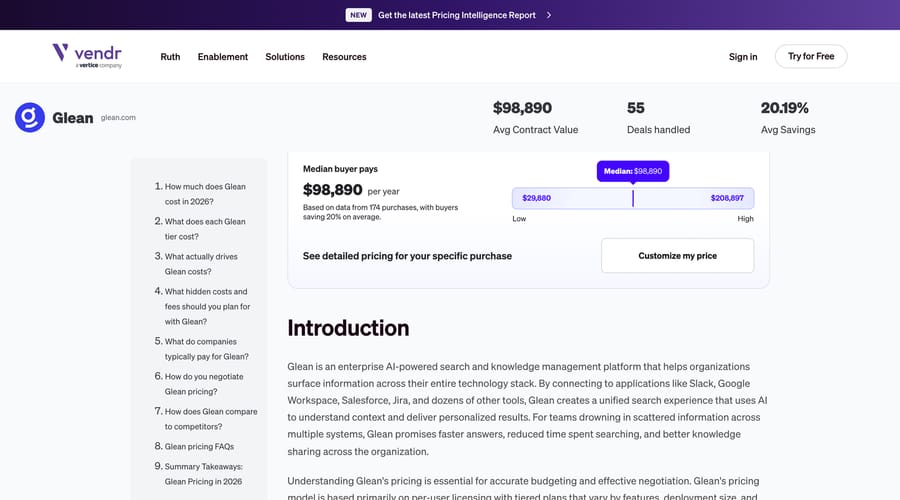
- Vendr's data across 174 purchases puts the Glean contract range from $29,880 to $208,897 a year, with a median of $98,890.

Glean plans and what each one charges for
| Plan | Price | What the seat includes | What costs extra | Limits |
|---|---|---|---|---|
| Enterprise Flex | Per user per month, quote only; plus a base pool of FlexCredits | Unlimited Fast Mode queries, basic search, Collections, Go Links, people directory, agent building and sharing; Thinking and Adaptive Reasoning queries on Standard models up to 100 per user per week | Premium models, agent runs, deep research, slide and code generation, meeting notes, voice, Client APIs (all in FlexCredits); more credits via FlexCredit Packs | No dollar value per FlexCredit is published |
| Core Suite | Per user per month, quote only; plus an upfront commit for Model Hub usage | Search, enterprise graph, connectors, memory, Glean Protect, agent building and governance, the library, Glean in Slack, Teams and Zoom | Reasoning modes, canvas, deep research, meeting notes, voice, Chat and Agents APIs, charged at model or provider API rates | Flexible Model Management fee is a percentage of LLM usage; the percentage isn't published |
| Glean Enterprise (legacy) | Existing contracts | Per its original terms | Flex features at Glean's discretion until renewal | Moves to Enterprise Flex at renewal |
| Add-ons (listed in the Enterprise Flex docs) | Site-wide annual fee, quote only | n/a | Protect+ (sensitive content and prompt-injection protection) and Premium Support (24x7, one-hour critical response) | n/a |
Prices checked September 19, 2026 on Glean's Enterprise Flex and Core Suite documentation. glean.com/pricing redirects to the homepage, and there's no self-serve plan or trial.
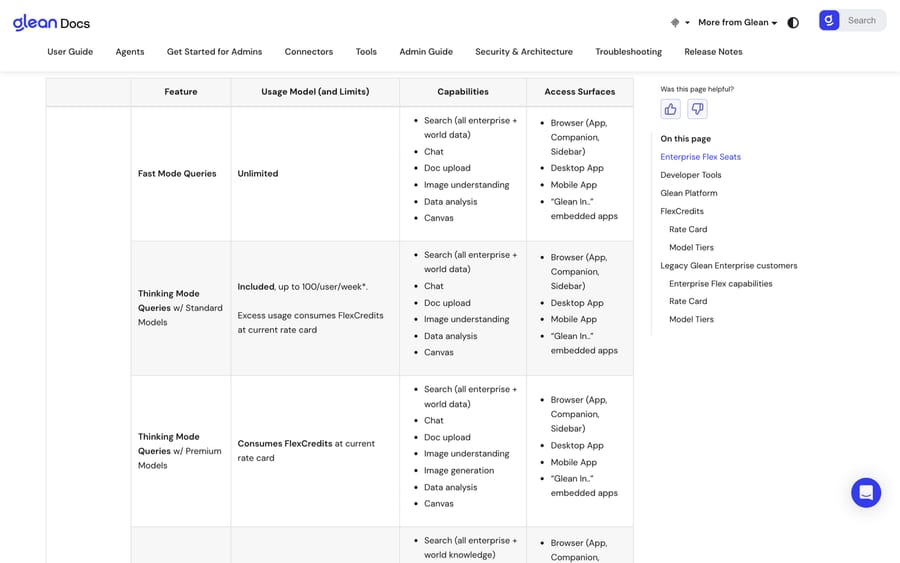
Glean's docs call Enterprise Flex "Glean's new pricing model", and customers on the older Glean Enterprise plan "will need to move entirely to Glean Enterprise Flex" at the end of their term. The Core Suite page, with its model price table updated September 16, 2026, describes a second current option in which you pay for model tokens directly. Which one you're offered depends on the deal, and our Glean guide covers what the product does. This post is only about the bill.
Where to find a Glean price when the website has none
A price that isn't on the website is sometimes on a marketplace. We checked all of them on September 19, 2026:
| Source | What it shows |
|---|---|
| glean.com/pricing | Redirects to the homepage; no prices |
| Glean docs | Credit rates and model token rates; no seat price and no dollar value per credit |
| AWS Marketplace | "Glean Work AI Platform", a 12-month contract with one dimension, "Seats: Number of monthly Glean users", at a placeholder $100,000,000.00 per 12 months; purchase by private offer |
| Google Cloud Marketplace | "This product can only be purchased through a private offer" |
| Microsoft Marketplace | No Glean listing |
| G2 pricing tab | "not listed on G2 by the vendor" |
| Vendr | Median $98,890 a year, from $29,880 to $208,897, "based on data from 174 purchases" |
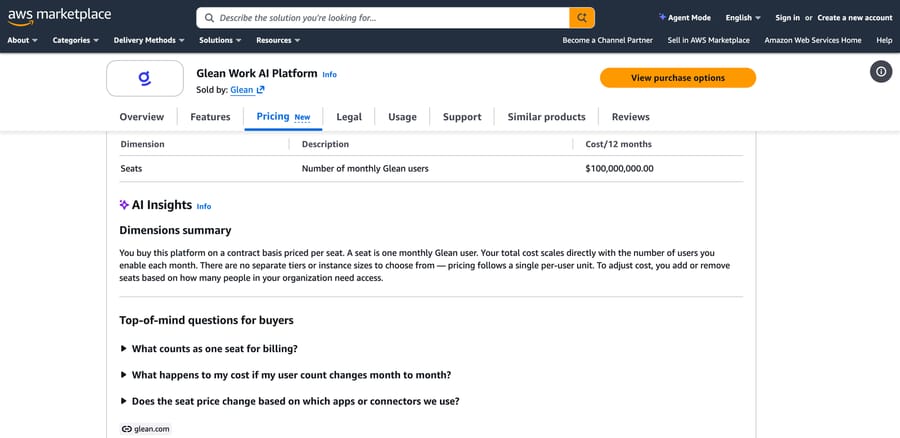
The AWS listing does confirm the unit. Its own summary says "a seat is one monthly Glean user" with "no separate tiers or instance sizes", so the seat count is the whole negotiation. The $100 million figure is a placeholder that stops anyone clicking "buy" on a public offer.
Vendr is the neutral number. It's a procurement service, not a Glean rival, and its median buyer pays $98,890 a year. The page's header counts 55 deals Vendr handled itself, while the price box cites 174 purchases, so read the range as buyer-reported data, not a price list.
The only per-seat figures in public come from Slite, which sells a competing knowledge base, so weigh them with that in mind. Its June 2026 review cites an April 2026 deployment at "roughly $45–48 per user per month for approximately 200–230 users", and a company of about 700 employees that "estimated annual spend at around $250,000 per year". That second figure works out at $357 a user a year, about $30 a month, which is a little higher than the "around $300 per user" Slite rounds it to.
What FlexCredits buy
On Enterprise Flex, every advanced feature draws from a credit pool shared across the company. Glean publishes typical consumption, not fixed prices, because each run costs what its work costs: how many connectors an agent searches, how many steps it takes, which model it uses.
| Capability | Typical FlexCredits (median) | 90th percentile |
|---|---|---|
| Fast Mode Assistant query | 0 from the Assistant (unlimited); ~3 via API | ~15 |
| Thinking Mode, Standard models | ~7 (included up to 100 a week) | ~26 |
| Thinking Mode, Premium models | ~35 | ~120 |
| Adaptive Reasoning, Standard models | ~11 (included up to 100 a week) | ~38 |
| Adaptive Reasoning, Premium models | ~26 | ~83 |
| Glean agent run | ~7 | ~114 |
| Deep Research run | ~33 | ~144 |
| Slide generation | ~45 | ~142 |
| Meeting notes | ~9 | ~18 |
| Voice session | ~3 | ~26 |
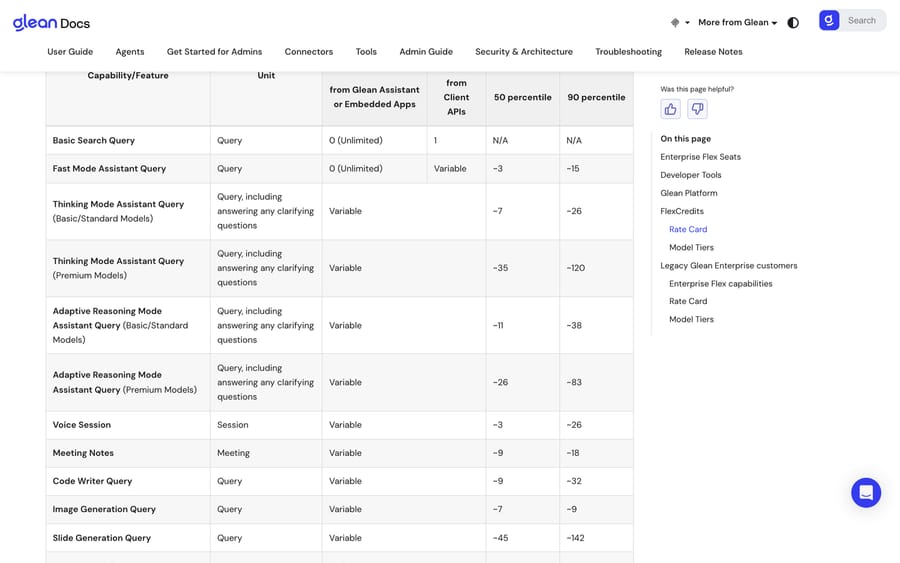
Two rules change the arithmetic. A Thinking Mode query that uses more than 30 credits "will be counted as multiple queries" against the 100-a-week allowance, so heavy prompts use it up faster. And Glean's auto model selector can pick a Premium model on its own, which then consumes credits; admins can turn Premium models off in the admin console.
What's missing is the exchange rate. The docs never say what a FlexCredit costs in dollars, what size the included base pool is, or what a FlexCredit Pack costs. Those three numbers are in your quote, and you need all three before the rate card means anything.
What Model Hub usage costs on Core Suite
Core Suite replaces credits with a meter you can check. Model usage is "charged at model or hosting provider API rates", from an upfront commit, and Glean publishes the per-million-token prices it passes through. Glean's own Waldo model is $0.50 per million input tokens and $2.50 per million output.
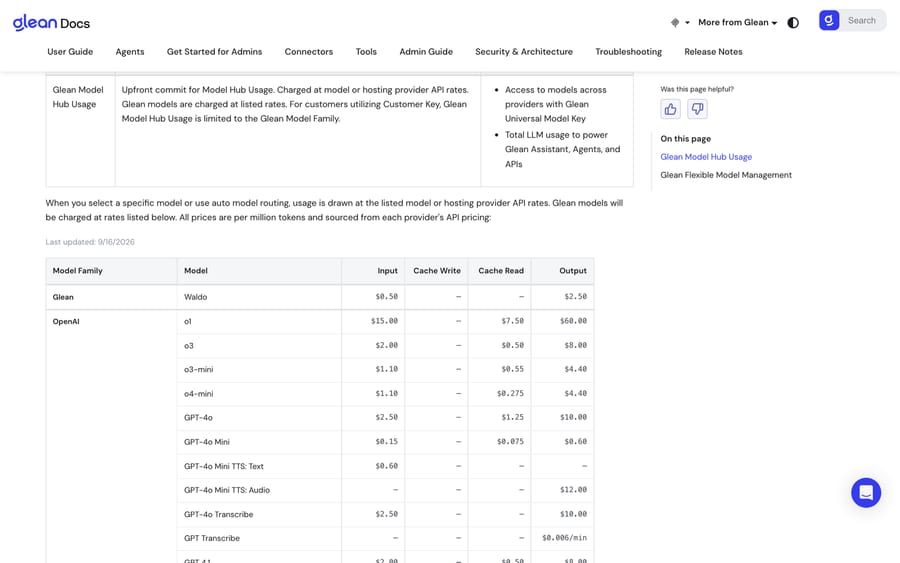
Glean's Gemini setup guide gives per-query token counts. A Thinking Mode query on Gemini 3.1 Pro averages 35,600 input, 11,200 cached and 2,000 output tokens, "about $0.09 per query". A Fast Mode query on Gemini Flash 3.0 averages 12,500 input, 5,200 cached and 418 output tokens, "about $0.005 per query".
That makes usage estimable. Take an employee who asks 10 Fast Mode questions and 2 Thinking Mode questions each workday, over 21 workdays:
- Fast: 210 × $0.005 = $1.05
- Thinking: 42 × $0.09 = $3.78
- Total: about $4.83 a user a month in model usage, plus the Flexible Model Management fee, a percentage of usage that Glean doesn't publish.
On Enterprise Flex the same person uses 10 Thinking queries a week, a tenth of the included 100, so they'd consume no FlexCredits at all. For ordinary search-and-ask use, the seat is almost the entire bill on either plan. Credits and Model Hub usage start to matter when you run agents, premium models or deep research at volume.
Worked costs at three company sizes
Seat prices below are estimates from the reported deals above, not Glean quotes. Usage uses the $4.83-a-month profile on Core Suite; on Enterprise Flex that profile fits inside the allowance.
| Size | Seat estimate | Seats per year | Model Hub usage per year (Core Suite) | Estimated total |
|---|---|---|---|---|
| 100 seats (a small rollout) | $45–$48 a month, the 230-seat rate; we assume a smaller deal pays at least that | 100 × $45–$48 × 12 = $54,000–$57,600 | 100 × $4.83 × 12 = $5,796 | $54,000–$63,396 |
| 230 seats (a mid-sized company) | $45–$48 a month (Slite, April 2026 deal) | 230 × $45–$48 × 12 = $124,200–$132,480 | 230 × $4.83 × 12 = $13,331 | $124,200–$145,811 |
| 700 seats (a large rollout) | about $30 a month ($250,000 ÷ 700 ÷ 12) | $250,000 (reported total) | 700 × $4.83 × 12 = $40,572 | $250,000–$290,572 |
The low end of each total is Enterprise Flex with usage inside the allowance; the high end adds Core Suite model usage. Neither includes FlexCredit Packs, agent runs, Protect+, Premium Support, implementation, or the Flexible Model Management fee.
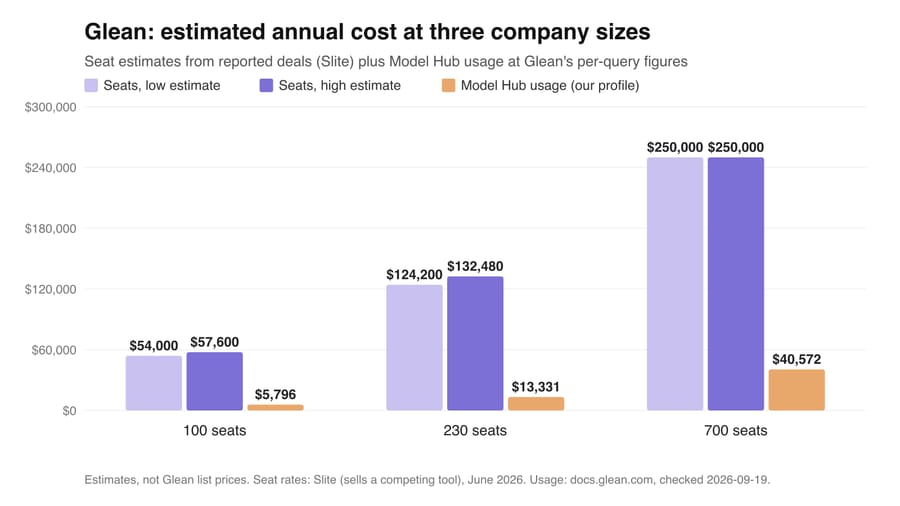
Check the totals against Vendr. Its median of $98,890 a year sits between our 100-seat and 230-seat rows, and at $45 to $48 a seat it would buy about 170 to 185 seats. Its high of $208,897 sits below the 700-seat figure Slite reports, which fits a buyer set weighted toward smaller deployments.
What drives a Glean bill up
Seat count. The AWS listing makes the seat the only unit, and a seat is a monthly user. Glean's docs say Enterprise Flex seats are "designed to be deployed to every employee", which is the incentive to name: the plan is built to be bought company-wide, not for the 40 people who'd use it most.
Agents. An agent run's median is ~7 credits but its 90th percentile is ~114, a 16x spread. A team that schedules agents across many connectors will live at the expensive end.
Premium models. Thinking Mode on a Premium model is ~35 credits at the median, five times the Standard-model rate, and the auto selector can choose one for you.
Deep research and slides. ~33 and ~45 credits a run at the median, with 90th percentiles over 140.
The model management fee. On Core Suite, a percentage of all LLM usage goes to Glean on top of the provider rates.
Add-ons. Protect+ and Premium Support are separate site-wide annual fees.
What pushes it down: supplying your own LLM keys or self-hosting Glean in your cloud. The docs say seats and FlexCredits "are discounted" for customers who do either, to reflect the compute they carry themselves.
What the billing model rewards
A seat price rewards breadth. Glean earns the same whether an employee asks it one question a month or fifty, so its incentive is to be deployed to everyone and to count every login as a seat. The included allowances are generous for ordinary use, 100 reasoning queries a week is far more than most people ask, which makes the seat feel all-inclusive and pushes the bill toward headcount.
The credits and Model Hub usage sit on top for the work that costs Glean real compute: agents, premium models, research. That split is fair to the buyer on everyday search, since unlimited Fast Mode means nobody rations questions. It's less predictable for agents, where Glean publishes percentiles instead of prices and the dollar value of a credit is in the contract.
What users say about the price
G2 rates Glean 4.7 out of 5 from 336 reviews, Gartner Peer Insights 4.5 from 366 ratings across all markets, and Google Cloud Marketplace 4.2 from 12 (all read on September 19, 2026). Recent G2 reviews rarely mention cost, and when they do they split.
- An HR operations reviewer at an enterprise of more than 1,000 employees wrote: "I think the cost of subscription is on higher side" (G2, August 28, 2026).
- A reviewer at a mid-market utilities company came out the other way: "the time saved searching across tools easily outweighs the cost" (G2, September 1, 2026).
- A FinOps value engineer at an enterprise of more than 1,000 employees wanted Glean to say when it can't find something, instead of sending them "to Slack and search myself" (G2, September 10, 2026). That's a quality complaint, but it bears on value: a query that ends in a manual search still costs a seat.
The pattern in these and the reviews our Glean guide covers: people like the single search bar, and the complaints are about price at smaller scale, latency and answers that miss.
How Glean compares on price at 230 seats
| Product | Billing unit | Published price | 230 seats for a year | Notes |
|---|---|---|---|---|
| Glean | Seat, plus FlexCredits or Model Hub usage | Not published | $124,200–$132,480 (estimate, Slite, a competitor); Vendr median $98,890 | Quote only |
| Microsoft 365 Copilot | Seat | $30 a user a month, paid yearly | $82,800 | Needs a qualifying Microsoft 365 plan; agents for customers bill Copilot Studio credits |
| Gemini Enterprise | Seat | Business from $21; Standard/Plus from $30 a seat a month | $57,960 (Business, up to 300 seats) to $82,800 | A $0-seat pay-as-you-go edition is rolling out to a limited group |
| Guru | Package | Not published; "Book a call" | Not published | Knowledge verification more than company-wide search |
| Moveworks (ServiceNow) | Not published | Not published | Not published | Employee IT and HR requests |
Sources: Microsoft 365 Copilot pricing, Gemini Enterprise, Guru pricing, all checked September 19, 2026. More on the others in our Moveworks and Guru guides.
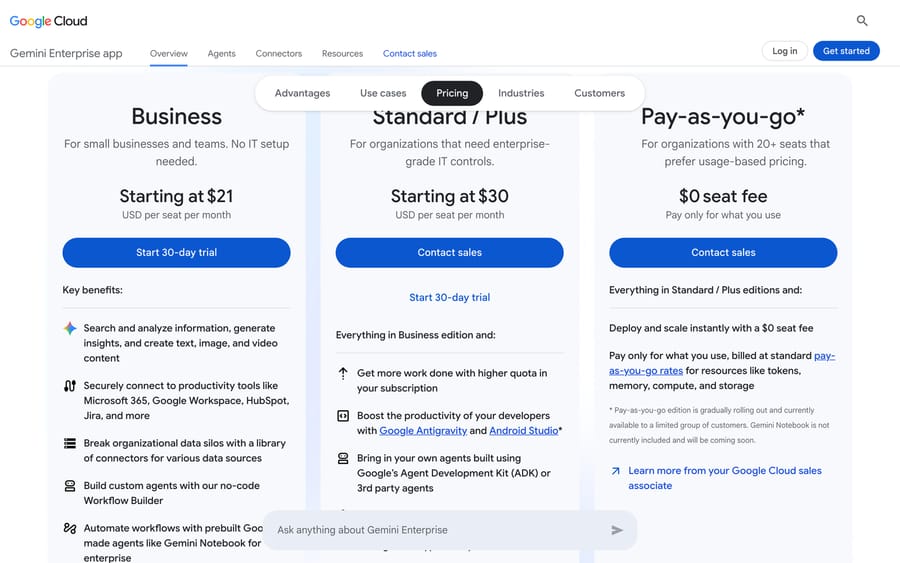
The two hyperscaler seats are cheaper per head and published, and a company that already buys Microsoft 365 or Google Workspace has a vendor relationship to build on. Glean's case is breadth across both ecosystems and the rest of the tool sprawl (Slack, Jira, Salesforce, GitHub) under one permission-aware index, which is what the premium over $30 is buying.
If the reason you're pricing Glean is a support queue, the unit is wrong for the job. A seat license bills for every employee who could search, while a support team's cost follows the tickets that come in. Macha is an AI agent layer on your help desk, and it fits teams already running Zendesk, Freshdesk, Gorgias, Front, HubSpot or Intercom: from $299 a month for 750 tickets (about $0.40 a ticket), one charge per ticket however many replies it takes, with the agents built, tested and monitored by the Macha team. It isn't company-wide search, and it doesn't try to be; our overview of AI agents for customer service covers where each kind of tool fits.
How we researched this
We checked Glean's Enterprise Flex and Core Suite documentation, its Gemini setup guide, glean.com, the AWS, Google Cloud and Microsoft marketplaces, Vendr and G2's pricing tab on September 19, 2026, and read G2 and Gartner Peer Insights ratings in a browser the same day. Glean sells only through sales, so we did not get a quote or use the product; every seat price here is a third-party estimate, labeled with its source, and the usage profile is our own assumption priced with Glean's published per-query figures. We could not find the dollar value of a FlexCredit or the size of the included credit pool anywhere public.
Frequently asked questions
How much does Glean cost per user? Glean doesn't publish a seat price. Reported deals put it at about $45 to $48 a user a month for roughly 200 to 230 users and about $30 a month at 700 users, per Slite, which sells a competing product. Vendr's median Glean contract is $98,890 a year.
What is Glean Enterprise Flex? Glean's current pricing model: a per-user seat that includes unlimited Fast Mode queries and up to 100 Standard-model Thinking and Adaptive Reasoning queries per user per week, plus a company-wide pool of FlexCredits for agents, premium models, deep research, slides, meeting notes and API use. Extra credits come in FlexCredit Packs.
How much is a Glean FlexCredit worth? Glean doesn't publish a dollar value. Its rate card lists typical credits per task, for example about 7 for a median agent run and about 114 at the 90th percentile, but the price of a credit, the size of the included pool and the cost of a pack are set in your contract.
Is there a minimum Glean contract? Glean doesn't publish one. Vendr's lowest recorded Glean contract is $29,880 a year, and at the reported $45 to $48 a seat that's roughly 50 to 55 users. The search overviews that quote a 100-seat minimum don't cite Glean for it.
Does Glean have a free trial? No self-serve trial exists, and glean.com/pricing redirects to the homepage. Every purchase starts with a demo and a sales quote.
Does Glean use ChatGPT? Glean routes to many models, not one. Its Model Hub lists OpenAI models alongside Google Gemini, Anthropic Claude, Amazon Nova, open models and its own Waldo model, and customers can bring their own LLM keys for a discount on seats and credits.
What are the key differences between Copilot and Glean on price? Microsoft 365 Copilot publishes its seat at $30 a user a month paid yearly, on top of a Microsoft 365 plan. Glean's seat is quote-only and reported at $30 to $48 depending on size, with agent and premium-model use billed separately in FlexCredits or Model Hub usage. Copilot's included agent use covers licensed employees inside Microsoft 365; Glean indexes across Microsoft, Google and other tools in one place.
Who are Glean's main competitors? On price and scope: Microsoft 365 Copilot and Gemini Enterprise, which publish seat prices, and Moveworks and Guru, which don't. Glean.ai is a different company, an accounts-payable tool with its own plans.
Is Glean a good AI? Buyers rate it well: 4.7 out of 5 on G2 from 336 reviews and 4.5 on Gartner Peer Insights from 366 ratings. Reviewers praise the single search bar across tools; the complaints are price for smaller teams, latency and answers that miss.
For support teams on Zendesk, Freshdesk, Gorgias or Front, Macha's pricing page shows the per-ticket tiers, and you can start with $50 of free usage on your own tickets.
Sources: Glean Enterprise Flex (docs) · Glean Core Suite (docs) · Glean Gemini setup (docs) · glean.com/pricing · AWS Marketplace: Glean Work AI Platform · Google Cloud Marketplace: Glean listing (console, sign-in required) · Vendr: Glean · Slite's Glean review · G2 reviews · G2 pricing · Gartner Peer Insights · Microsoft 365 Copilot pricing · Gemini Enterprise · Guru pricing
Simple per-ticket AI pricing
One thread with one person is one charge, however many replies it takes.