Intercom
 Shopify
 Stripe
 Slack
Slack Notion
 Google Workspace
 Confluence

Hippocratic AI: The Complete Guide (2026)


Hippocratic AI builds voice AI agents for healthcare. Not chatbots that answer support tickets, but phone-calling agents that a hospital or health plan puts on the phone with patients for post-discharge check-ins, medication reminders, and appointment scheduling. This guide covers what the company actually builds, how its safety architecture works, what a deal costs, and where it sits against Notable and Suki AI, two other vendors selling AI into the same health systems.

We build AI agents for customer service ourselves, on the support side of things, so we're not a competitor writing a hit piece and we're not Hippocratic AI's sales team either. Where a claim is vendor-reported, we say so.
What is Hippocratic AI?
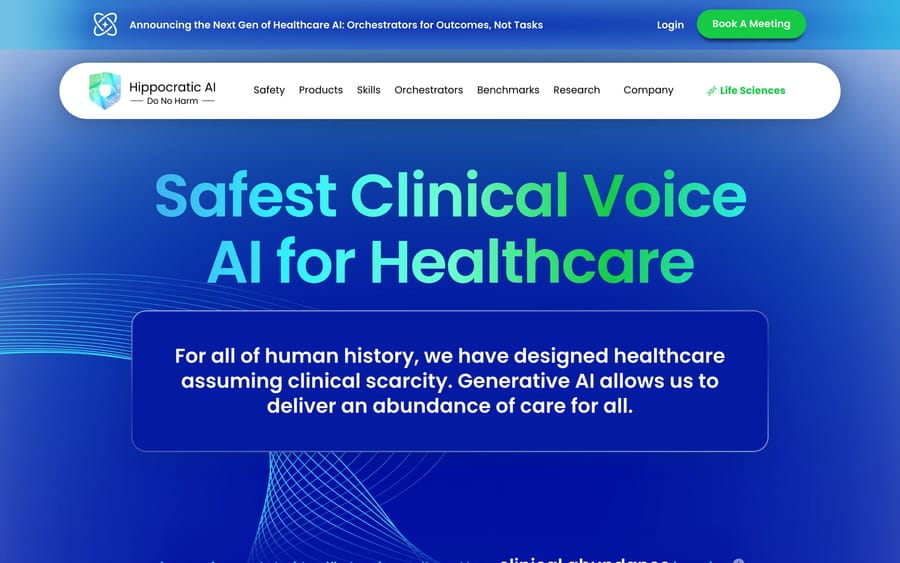
Hippocratic AI is a healthcare AI company, founded in 2023 and based in Palo Alto, that builds voice agents for the phone calls a hospital, health plan, or life-sciences company would otherwise need a person to make. The company's own framing is "Orchestrators for Outcomes, Not Tasks": the pitch is that an agent should own a whole workflow, like getting a discharged pneumonia patient through their full recovery plan, instead of one task like sending a reminder text.
The company sells into three buyer groups. Providers get agents for onboarding, readmission reduction, pharmacy support, and ambulatory care. Payors get agents for chronic care management and member retention. Life-sciences companies get agents for trial enrollment and drug-safety monitoring. All three run on the same underlying model, which Hippocratic AI calls Polaris.
Hippocratic AI draws an explicit, published line around what its agents will do. The company states it will not build agents for diagnosis, prescriptions, hospice care, mental health disorders, or children under two. That's a narrower scope than "AI for healthcare" suggests, and it's the company's own safety boundary. Check it against your own use case before a sales call.
How Hippocratic AI's AI works
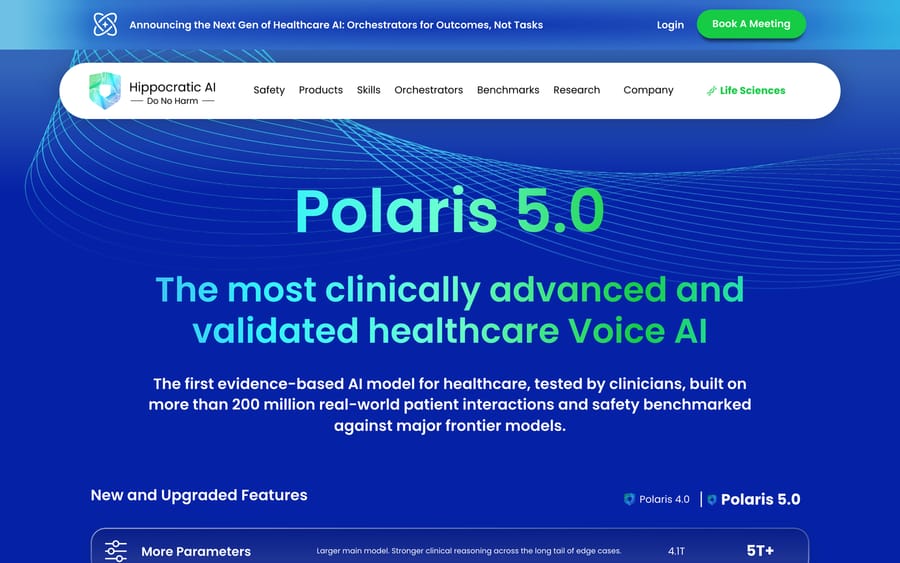
The model behind the agents is called Polaris, now on its fifth major version. Hippocratic AI describes Polaris 5.0 as "the first evidence-based AI model for healthcare, tested by clinicians, built on more than 200 million real-world patient interactions and safety benchmarked against major frontier models." Between versions 4.0 and 5.0, the company says the model grew from 4.1 trillion to more than 5 trillion parameters.
According to NVIDIA's case study on the deployment, the underlying architecture, which Hippocratic AI calls a "constellation," runs more than 20 models per call instead of one. A primary model handles the conversation. A set of supervisory models each check a specific safety property: medical accuracy, tone, and whether the conversation has drifted into a topic the agent isn't cleared for. NVIDIA's write-up counts 22 models running simultaneously per inference call on H200 GPUs, using TensorRT-LLM for optimization and Amazon SageMaker HyperPod for training infrastructure.
That validation-by-committee design is the company's real differentiator. Most conversational AI vendors validate a model once, before shipping it, then monitor output after the fact. Hippocratic AI checks safety on every single response, inline, before the patient hears it. A Hippocratic AI call therefore costs more compute per conversation than a single-model chatbot does, and that's the tradeoff the company is explicitly optimizing for: fewer bad outcomes at a higher compute bill, which is a defensible choice in healthcare specifically because a wrong medical answer costs far more than a wrong support-ticket answer. The company reports its agents have been validated by more than 6,000 nurses and 300 physicians, and states zero incidents of patient harm since launch across a reported 250 million patient interactions. Those are vendor-reported figures. We found no independent, third-party audit of them.
Key features
- Polaris 5.0 - the underlying model, trained on 200M+ patient interactions, built around parallel safety-checking models instead of one large model per call.
- Named agent products including Nurse Co-Pilot (a voice agent for inpatient nurses), an AI Front Door and AI Physician Front Door for scheduling and triage-adjacent calls, and an AI Call Supervisor for quality monitoring.
- 300+ pre-built clinical use case agents across roughly 25 medical specialties. Cervical cancer screening reminders, postpartum mental-health check-ins, and diabetes screening outreach are examples the company names.
- AI Certified Agent Builder, a no-code interface the company says lets a clinician configure a new agent without an engineering team. Real deployments still involve Hippocratic AI's own team for integration and tuning.
- Sector-specific orchestrators for provider, payor, and life-sciences workflows, sold as separate product lines instead of one general-purpose bot.
- 50+ EMR integrations, Epic among them, per the company's own homepage. This is the line to press hardest on in a demo: a patient-calling agent that can't write an outcome back to the record you actually run is a phone bank, not an orchestrator, and "integrates with Epic" covers everything from a read-only feed to bidirectional documentation. Ask which one you're getting, on your EMR, at your organization.
Nurse Co-Pilot, as a worked example
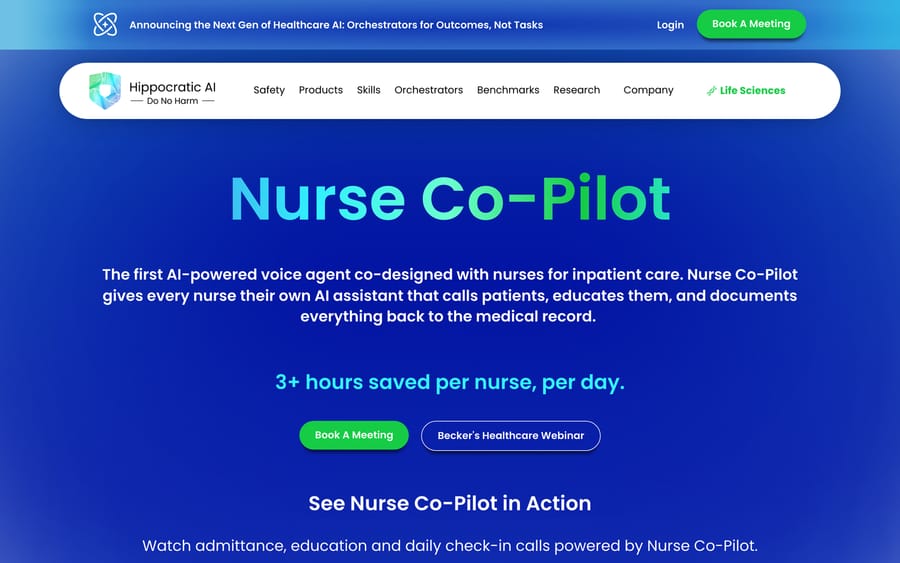
Nurse Co-Pilot is worth walking through because it's the most concretely scoped product Hippocratic AI publishes numbers for. It's a voice agent, co-developed with Cleveland Clinic, Cincinnati Children's, and OhioHealth as pilot partners, that calls a patient on a nurse's behalf to run admission education, daily check-ins, and medication-adherence calls, then writes the outcome back to the medical record. Hippocratic AI's own time-motion figures claim roughly 15 minutes saved per shift on admission education, 60 minutes on patient education, 40 minutes on caregiver engagement, and 60 minutes on medication adherence, adding up to the headline "3+ hours saved per nurse, per day" figure. Those numbers come from the vendor's own internal measurements rather than a peer-reviewed study, so treat them as a starting estimate to validate against your own nurse staffing model.
What anyone other than the vendor says
This is the weakest part of the evidence base, and it's worth being explicit about why. Hippocratic AI's G2 seller listing shows zero reviews. There is no Capterra corpus, no TrustRadius entry, no PeerSpot thread. For a company reporting 250 million patient interactions, that is a striking absence, and it has a straightforward explanation: nobody who buys this is a self-serve user who leaves a star rating. Buyers are health-system executives on multi-month enterprise contracts, and that population does not review software publicly. Treat it as a gap in your evidence, not as a signal about quality either way. It does mean that almost everything in the section above is the vendor describing itself.
The one place independent confirmation does exist is the customers' own announcements. WellSpan Health published its own account of a Hippocratic AI deployment: an agent named Ana that phones patients to improve colorectal cancer screening rates and to walk them through colonoscopy prep and follow-up, run in English and Spanish, with more than 100 patients engaged in the pilot phase and thousands of eligible patients targeted. Kasey Paulus, WellSpan's senior vice president and chief nursing executive, framed the choice in safety terms: "We're committed to utilizing AI that's designed to ensure patient safety continues to be our top priority." Universal Health Services has separately announced its own deployment for post-discharge patient engagement.
Those are still press releases, written by organizations with a reason to sound pleased. But the buyer wrote them, they name a specific clinical workflow instead of a category, and they give a scale figure you can hold a vendor to. A pilot measured in hundreds of patients is a very different fact from 250 million interactions, and both are true at once. When Hippocratic AI's sales team quotes you the big number, the useful follow-up is which deployment it came from and how long that customer has been live.
Hippocratic AI pricing
Hippocratic AI does not publish pricing. There's no pricing page, no calculator, and no self-serve signup anywhere on the site. Every path, including the one on the page you'd expect a price to live on, leads to a "Book a Meeting" button.
We checked for a published number before writing "not published." No AWS, Azure, or Google Cloud Marketplace listing for Hippocratic AI exists as of this writing. Vendr, which does track a median contract value for peers like Netomi and Ada, has no public entry for Hippocratic AI either. That's a genuine gap in the market's usual transparency workarounds, not a step we skipped.
What we can say is directional. Hippocratic AI sells enterprise contracts to health systems, payors, and life-sciences companies, priced per deal instead of per seat. The sales conversation is reportedly structured around call volume and the number of agent use cases deployed, with onboarding, readmission, and chronic care each priced as a distinct product line instead of one flat platform fee. Expect a multi-month procurement cycle involving IT security review and, given the buyer, likely a HIPAA business associate agreement. None of that shows up on a self-serve pricing page, because there isn't one to build.
The incentive behind the opacity
Per-deal, sales-led pricing isn't unique to Hippocratic AI. Notable and Suki AI are the same shape, and so is most enterprise healthcare software. The reason is straightforward: a health system's willingness to pay scales with call volume and clinical risk tolerance, not headcount. A published per-seat price would either overcharge a small pilot or undercharge a national rollout, so the vendor keeps every number in a live sales conversation where it can be sized to the deal. The cost a buyer absorbs in exchange is that you can't compare Hippocratic AI's price to a competitor's without running two separate sales processes.
Pros and cons
Pros
- A published, specific safety architecture (parallel validation models per call) instead of a marketing claim about "guardrails."
- Real pilot partnerships with named health systems: Cleveland Clinic, Cincinnati Children's, OhioHealth, and Sutter Health, not just logos on a page. WellSpan Health and Universal Health Services have published their own accounts of live deployments, which is independent of Hippocratic AI's marketing.
- Deep EMR coverage claimed, 50+ integrations including Epic, which is the practical gate on whether a patient-calling agent can write anything back.
- Deep specialization: 300+ pre-built clinical agents across roughly 25 specialties, versus a generalist conversational AI platform retrofitted for healthcare.
- Backed by serious capital, $444M raised to date per Hippocratic AI's own homepage (press-reported rounds add up to roughly $404M via FierceHealthcare and Businesswire, so the vendor's live total is the more current figure), and real clinical review infrastructure (6,000+ nurses, 300+ physicians validating agents).
Cons
- Zero pricing transparency, and no marketplace listing or Vendr estimate to triangulate from. You negotiate blind until the first call.
- No public review corpus at all. Hippocratic AI's G2 seller page shows zero reviews and no other review site carries it, so apart from a handful of customer press releases there's nothing independent to check the marketing against.
- A deliberately narrow safety scope rules out some workflows a buyer might assume are in scope: no diagnosis, prescriptions, hospice, mental health, or pediatric patients under two.
- Enterprise-sales-only motion, so you sign a contract and clear procurement before you can test the product.
Who Hippocratic AI is best for
Hippocratic AI fits teams inside a health system, payor, or life-sciences company running a specific, high-volume phone-call workload they want automated safely: post-discharge follow-up calls, chronic-care check-ins, or clinical trial enrollment screening. It also fits organizations with the compliance appetite to sign an enterprise contract and pass IT security review before testing anything. If you're the nurse-staffing or care-management leader trying to close a specific gap, like discharged patients not answering follow-up calls, Hippocratic AI's use-case-specific agents are worth a serious look.
It's the wrong fit if you only need to automate a handful of appointment reminders without a procurement team behind you, and it's the wrong tool entirely for a support or patient-services team whose actual problem is email and chat tickets: insurance verification questions, portal password resets, appointment-mix-up messages. That's a help-desk automation problem. It's priced and built on a completely different model than clinical voice AI.
Hippocratic AI vs alternatives
| Hippocratic AI | Notable | Suki AI | Macha | |
|---|---|---|---|---|
| Model | Voice AI agents for patient-facing calls (Polaris) | AI agents for healthcare admin workflows (intake, RCM, prior auth) | Ambient AI for clinical documentation and coding | AI agent layer on your existing help desk |
| Primary channel | Outbound/inbound voice | Backend workflow automation | In-visit ambient listening | Email + chat tickets |
| Best for | Health systems automating patient phone calls at scale | Health systems automating administrative and revenue-cycle workflows | Clinicians reducing documentation time | Support teams on Zendesk, Freshdesk, Front, or Gorgias |
| Pricing | Not published; no marketplace or Vendr listing found | Not published; demo-gated | Not published; demo-gated | From $299/mo for 750 tickets (~$0.40/ticket), published |
| Self-serve trial | No | No | No | $50 of free usage, no credit card |
| Setup | Multi-month enterprise deployment with Hippocratic AI's team | Enterprise deployment with Notable's team | Enterprise deployment with Suki's team | Built, tested and monitored by the Macha team |
| Replaces your help desk? | Not applicable; not a help desk product | Not applicable; not a help desk product | Not applicable; not a help desk product | No, it deliberately augments it |
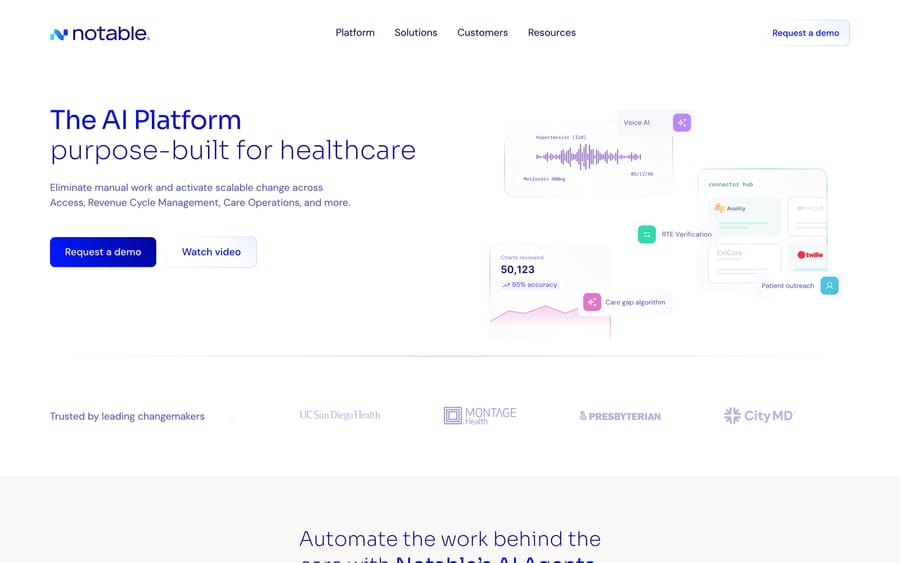
Notable is the closer comparison of the two named here. Like Hippocratic AI, it sells AI agents into health systems on a per-deal enterprise contract, but its agents run administrative and revenue-cycle workflows: prior authorization, patient intake, chart review.
Suki AI solves a narrower, adjacent problem: ambient documentation during a clinical visit. It's a complement to either vendor, not a substitute for them.

None of these three touch a support team's ticket queue, which is where Macha fits instead. Say a health system's patient-services or member-support line runs its email and chat backlog through Zendesk or another help desk: insurance-eligibility questions, appointment-change requests, portal access issues. Macha runs as an agent layer on top of that help desk, priced per ticket instead of per enterprise contract, which is a genuinely different job than Hippocratic AI's. A health system evaluating Hippocratic AI for its nurse call volume might separately need something like Macha for its support inbox. Neither purchase substitutes for the other.
How we researched this
We pulled product and architecture claims directly from hippocraticai.com (home, the Nurse Co-Pilot and Polaris 5.0 pages, fetched 2026-09-17) and NVIDIA's published case study on Hippocratic AI's infrastructure. Funding figures come from FierceHealthcare (Series B) and Businesswire (Series C), cross-checked against Tracxn. We checked AWS, Azure, and Google Cloud Marketplace and Vendr for a pricing estimate and found none: a genuine absence, not a skipped step. G2 and Capterra both blocked direct access with a Cloudflare 403, including through a headless browser. What we could confirm via a cached search result is that Hippocratic AI's G2 seller listing shows zero reviews, which we're reporting as the honest state of public review evidence instead of filling in a rating that has never been recorded. For independent evidence we went to the customers instead: WellSpan Health's own deployment announcement was fetched and read directly, and Universal Health Services' announcement is cited from its own newsroom (the page returned a 403 to automated access, so it's cited by name rather than quoted).
FAQ
What is Hippocratic AI? A healthcare AI company that builds voice agents for patient-facing phone calls: post-discharge check-ins, medication adherence, appointment scheduling. It's sold to health systems, payors, and life-sciences companies, and it doesn't handle diagnosis, prescriptions, or mental health care.
How much does Hippocratic AI cost? Pricing isn't published. There's no marketplace listing or Vendr estimate to check it against either, which is unusual even for enterprise healthcare AI. Expect a sales-led, per-deal negotiation tied to call volume and the number of agent use cases deployed.
Does Hippocratic AI offer a free trial? No. Every path on the site leads to booking a meeting with sales, not a self-serve signup.
What is Polaris? Polaris is Hippocratic AI's underlying model, now on version 5.0, built around a "constellation" of one primary model plus roughly 20 supervisory models that check safety properties on every response before it reaches a patient.
What can't Hippocratic AI's agents do? The company publishes explicit boundaries: no diagnosis, no prescriptions, no hospice care, no mental health disorders, and no patients under two years old.
Is there independent review data on Hippocratic AI? No review-site data at all. Its G2 seller listing shows zero reviews as of this check, and no other review platform carries it. The closest thing to independent evidence is customers publishing their own deployment announcements: WellSpan Health has described an agent named Ana running colorectal-cancer screening outreach in English and Spanish, and Universal Health Services has announced a post-discharge engagement deployment.
What are good alternatives to Hippocratic AI? For administrative and revenue-cycle automation at a health system, Notable is the closer comparison. For ambient clinical documentation, Suki AI solves an adjacent but different problem. Neither substitutes for Hippocratic AI's voice-calling agents, and none of the three fit a patient-support email or chat queue, which is a help-desk automation problem instead.
Who are Hippocratic AI's named customers? Cleveland Clinic, Cincinnati Children's, OhioHealth, and Sutter Health are named as pilot or customer partners on the company's site. A Cincinnati Children's executive and an OhioHealth executive are quoted by name: "For Hippocratic, AI safety is not a press release. It's a practice," says Oliver Rhine, Chief Strategy Officer and President, Global at Cincinnati Children's. "We're finding her to really take things off of our clinicians' plates and repurpose their time to things more appropriate for their licensure," says Tyler Kocher, Head of New Ventures at OhioHealth.
Automating patient-facing phone calls and automating a support ticket queue are different problems with different vendors. If yours is the second one, with email and chat tickets piling up in Zendesk, Freshdesk, Front, or Gorgias, see how Macha's pricing works or start a trial.
Sources: Hippocratic AI, Hippocratic AI - Nurse Co-Pilot, Hippocratic AI - Polaris 5.0, NVIDIA case study on Hippocratic AI, FierceHealthcare, "Hippocratic AI banks $141M Series B" (blocks automated fetches, cited as text), Businesswire, Series C announcement, WellSpan Health, "WellSpan one of the first to launch Hippocratic AI's generative AI healthcare agent", Universal Health Services newsroom, "Universal Health Services launches Hippocratic AI's generative AI healthcare agents" (uhs.com; blocks automated fetches, cited as text), Notable, Suki AI, G2 Hippocratic AI seller page (blocks automated fetches, cited as text; zero reviews confirmed via cached search result).
Resolve tickets automatically with AI agents
Macha's AI agents work on top of the help desk you already use — no code.