Intercom
 Shopify
 Stripe
 Slack
Slack Notion
 Google Workspace
 Confluence

What Happened to OTRS Community Edition? Znuny, OTOBO and the Forks in 2026


OTRS AG stopped supporting ((OTRS)) Community Edition at the end of 2020, so an unforked install has had no vendor security fix since. Znuny and OTOBO both shipped releases on 16 September 2026, the fork that kept the Community Edition name last released in December 2024, and modern OTRS is sold only by quote.
Key takeaways
- ((OTRS)) Community Edition has had no vendor security fixes since OTRS AG withdrew from the open-source project at the end of 2020, leaving it on version 6.0.x.
- Znuny, maintained by Znuny GmbH since 2021, is the most steadily patched fork, with LTS 6.5.25 and Znuny 7.3.7 both released on 2026-09-16.
- OTOBO from Rother OSS shipped version 11.0.18 and the 11.1.0 Beta3 on 2026-09-16, alongside a security advisory for an HTTPBasicAuth authentication bypass.
- The Centuran-run fork that kept the Community Edition name has not published a release since version 6.0.41, announced on 10 December 2024.
- Modern OTRS, owned by EasyVista since 3 February 2025, publishes no price, and its how-to-buy configurator ends in a quote request.

((OTRS)) Community Edition is discontinued: OTRS AG withdrew from the open-source project at the end of 2020, and the actively patched replacement is Znuny, whose LTS 6.5.25 and 7.3.7 releases both shipped on 2026-09-16. OTOBO is the other maintained fork, and modern OTRS, owned by EasyVista since 3 February 2025, is sold only by quote.
What happened to ((OTRS)) Community Edition?
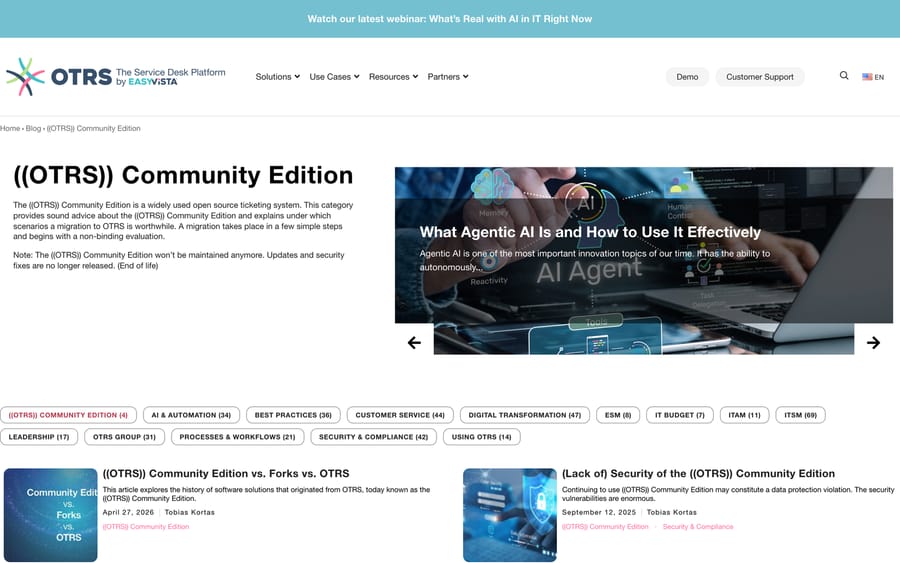
OTRS is one of the oldest ticketing systems still in use. Its own account says that as early as 2015 the open-source version ran at more than 150,000 companies. In 2018 OTRS AG renamed every version before 7 to ((OTRS)) Community Edition, and at the end of 2020 it withdrew from the open-source project entirely and stopped supporting it. The site that kept the Community Edition name dates the discontinuation to January 2021.
Since then the software has stayed exactly where it was: version 6.0.x, no manufacturer support, no official documentation. OTRS's page says it plainly, and goes further in a September 2025 post arguing that continuing to run the Community Edition may itself be a data-protection problem. Read that with the incentive in view: OTRS sells the commercial product that the abandoned edition competes with, so it earns money when you migrate. The underlying point is still true. Unpatched web software with a public login page is a genuine risk, and the code base is now six years past its last vendor release.
Two smaller facts explain the confusion people still have. First, OTRS never was an independent community project: OTRS GmbH, then OTRS AG, always owned the code, which is why the company could simply stop. Second, OTRS itself changed hands. Since 3 February 2025, when EasyVista announced it had completed the acquisition of a majority stake in OTRS Group, otrs.com brands itself "The Service Desk Platform by EasyVista". The product you would migrate to is now part of a French ITSM group.
Which OTRS forks are still maintained?
OTRS published the family tree itself, dated 27 April 2026. Six forks, in the order they appeared:
| Fork | Started | Based on | State in September 2026 |
|---|---|---|---|
| KIXDesk (now KIX) | 2016 | OTRS 5 | Largely rewritten; hybrid model, a light version on GitHub and the rest commercial |
| O-Fork (Einraumwerk) | 2018 | OTRS 6 | New interface, sells itself as the successor to the last free CE |
| OTOBO (Rother OSS) | 2019/2020 | OTRS 6 | Active; 11.0.18 and 11.1.0 Beta3 released 2026-09-16 |
| Znuny LTS | 2021 | OTRS 6 | Active; 6.5.25 released 2026-09-16 |
| Znuny | 2021 | OTRS 6 | Active; 7.3.7 released 2026-09-16 |
| ((OTRS)) Community Edition (Centuran) | 2022 | OTRS 6 | Newest release 6.0.41, announced 10 December 2024 |
The practical read is that two projects are doing the work: Znuny and OTOBO.
What is Znuny?
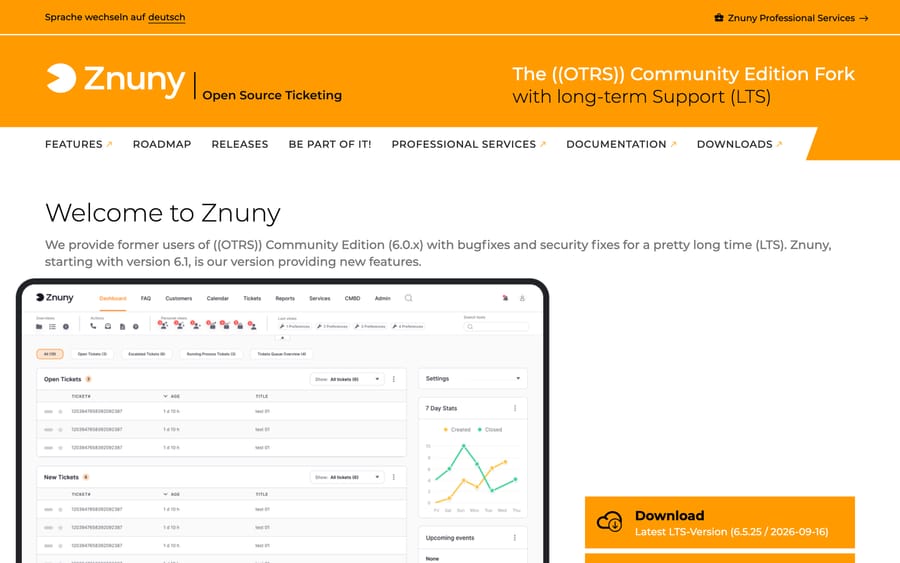
Znuny GmbH runs two lines. Znuny LTS stays deliberately close to the 6.0.x code the Community Edition ended on and ships bug fixes and security fixes with no new features, so an existing CE install upgrades with the least surprise. Znuny proper, from 6.1 onward, adds features and a new interface.
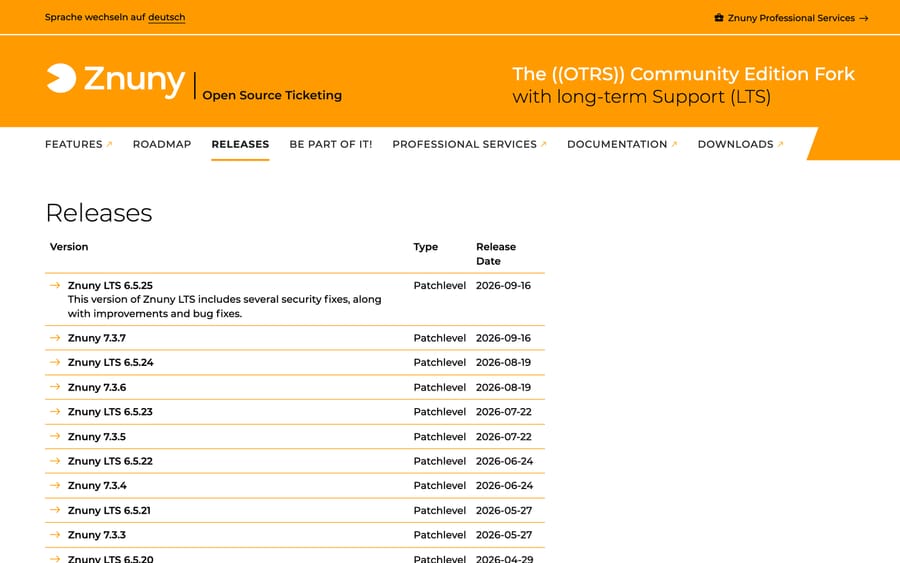
The release cadence is the thing to check, and it holds up. On 2026-09-24 the site still offered LTS 6.5.25 and Znuny 7.3.7, both dated 2026-09-16, and the releases table shows a patchlevel pair landing every month from March to September 2026. The 6.5.25 notes say it includes several security fixes. There is one visible gap, between 2025-09-24 and 2026-03-25, which is worth knowing if you depend on a monthly patch rhythm.
The GitHub repository is GPL-3.0 with 596 stars and 121 forks, last pushed on 2026-09-23. That is a small audience by open-source standards and an entirely normal one for enterprise ticketing in the German-speaking market, which is where most Znuny deployments are. Gartner Peer Insights lists Znuny at 4.3 out of 5 from 3 ratings, checked 2026-09-20, which is too few to mean anything and is the only analyst listing we found.
What is OTOBO?
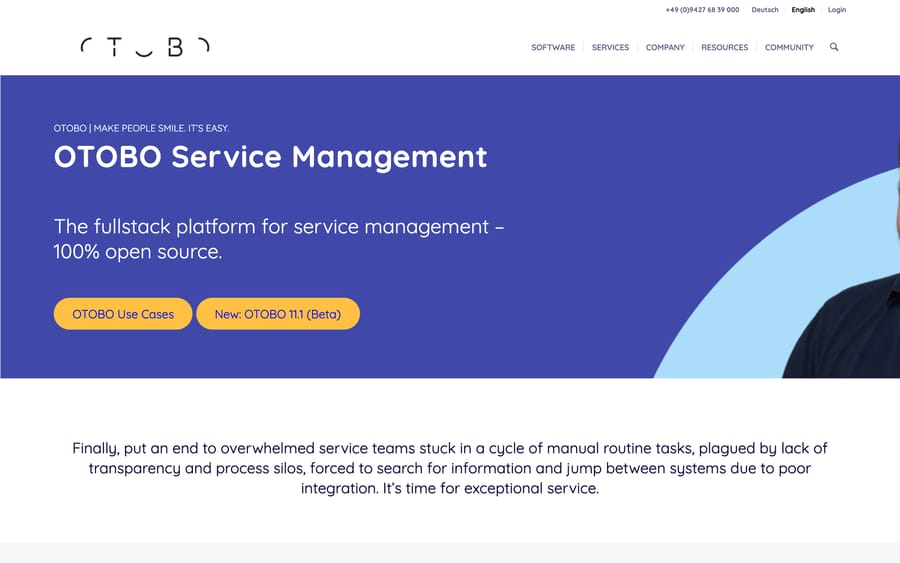
OTOBO is built by Rother OSS GmbH and has moved furthest from the original. It covers ITSM, customer service and enterprise service management, ships a CMDB and SLAs, and offers an AI plugin for classifying and prioritizing tickets. Its site says the platform is "100% open source and license-free". On 2026-09-16 Rother OSS shipped the stable OTOBO 11.0.18 and the 11.1.0 Beta3, and published a security advisory the same day for an HTTPBasicAuth authentication bypass, so check which patch level you run. OTOBO's own user guide documents the lineage in a copyright line that names OTRS AG for the original version and Rother OSS for the modifications.
Choose OTOBO if you want the fork that kept building. Choose Znuny LTS if you want the fork that kept your 6.0.x configuration working.
Is otrscommunityedition.com still maintained?
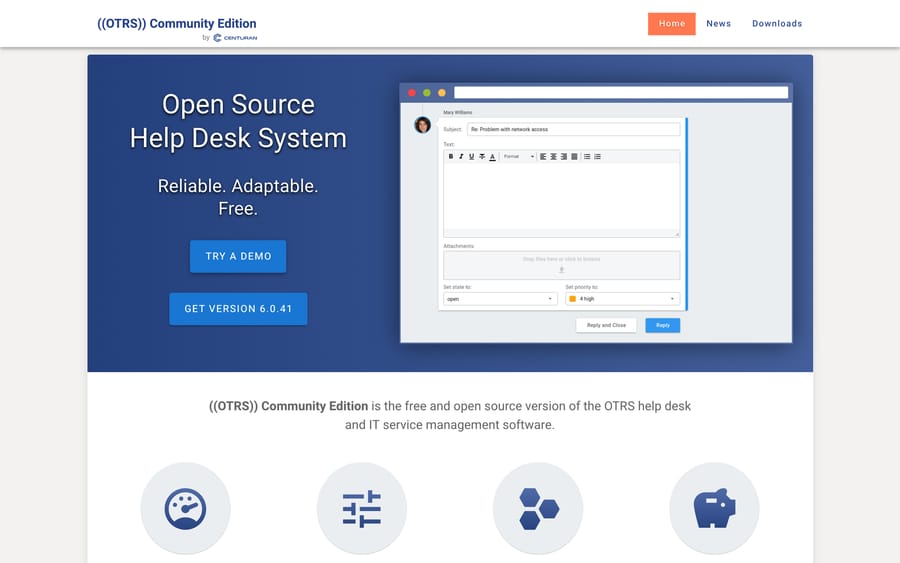
otrscommunityedition.com, run by Centuran Consulting, is the fork that stayed closest of all, which is both its appeal and its problem. It inherits the exact name, so search sends people there first. Its newest release is 6.0.41, announced on 10 December 2024, which fixed a cross-site scripting flaw in the web installer reported by XBOW Security. That is also the most recent item on its news page, so as of September 2026 the line has gone roughly 21 months without a published release. If you land there because the name matched, check that date before you install.
What do Znuny, OTOBO and modern OTRS cost?
The forks are free. Znuny, OTOBO and the Centuran build are all free to download and self-host, under GPL-3.0 for Znuny. All three companies sell services around them: consulting, migration, hosting and support, all quoted on request. The cost you actually carry is the same as any self-hosted Perl and database application: a server, backups, TLS, and somebody who reads security advisories.
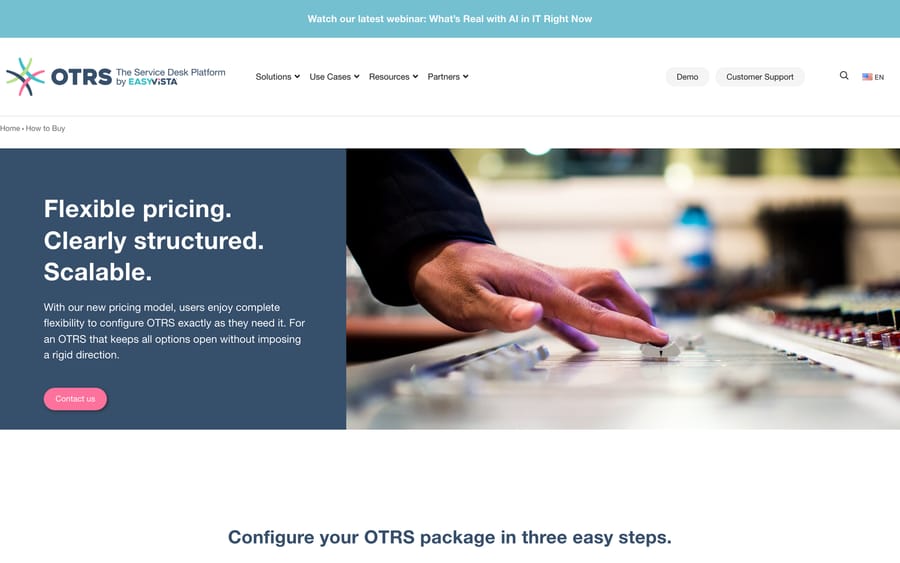
Modern OTRS publishes no price at all. Its how-to-buy page is a three-step configurator: pick a licensed user count, pick Starter, Advanced or Pro, then add extras including AI Credits, storage, asset and CI capacity, SMS alerts and on-premise services. Every path ends at "Get a quote". Pro lists unlimited configuration items, 24x7 support and 12,000 AI credits.
We looked for a number elsewhere before writing that. AWS Marketplace has an OTRS listing, but it's an Ubuntu AMI published by bCloud LLC with its own maintenance support. That is a third party's packaging of the software, and its price is bCloud's. Azure, Google Cloud and Vendr turned up nothing. So "not published" is the accurate answer here, and any OTRS budget starts with a sales conversation.
Name the incentive on both sides. OTRS earns when a stranded Community Edition user migrates to a licensed seat, which is why its blog argues the security case so hard. The forks earn from services, which is why they give the software away and sell the migration. Neither is dishonest. Both explain what you will be told.
What do users say about OTRS and its forks?
The review data here has a catch worth stating. Capterra's OTRS listing holds 4.4 out of 5 from 96 reviews, read on 2026-09-20, with ease of use at 4.2 and customer service at 4.3, and the page states it was last updated on 16 September 2026. That listing does not separate people running the free Community Edition years ago from people on modern licensed OTRS, so it reads as a verdict on the whole family.
The reviews split along exactly the line you would expect. Alan S., a consulting engineer in IT services, rated it 5 out of 5 on 9 October 2020 and still wrote that "the support is little to non-existent but that is expected with the free tier", which is the free-edition experience in one sentence. Nicolas P., an IT administrator, rated it 3 out of 5 on 19 January 2025 and said it's "not easy to use and maybe too option for small company", which is the other recurring theme: OTRS-family software is configurable to a fault.
The community view is consistent and a little affectionate. An r/selfhosted thread on Zammad alternatives has the Community Edition recommended as less fancy-looking and therefore lighter on resources, which is the honest pitch for this whole family. An r/foss post walks through running Znuny on Rocky Linux. These are not busy communities; they're small groups of people who know Perl-era ticketing and keep it running.
Who should run an OTRS fork, and who shouldn't?
The forks fit an organization that already runs ((OTRS)) Community Edition and has years of process built into it: queues, ACLs, dynamic fields, process tickets, ITSM modules. For that team, Znuny LTS is the lowest-risk path back to patched software, and it's the reason Znuny exists. They also fit European public-sector and mid-market IT where the data stays on your own hardware and the interface being plain is a feature.
They're the wrong choice for a team starting from zero in 2026. The concepts are heavy, the interface is dated, and the installed base is small enough that you'll be reading German-language forum posts. Someone choosing a first help desk today has better options: Zammad from the same country with a modern interface, GLPI if assets matter, or a hosted desk if nobody wants to run Perl. Our open-source ticketing roundup and free IT ticketing systems cover those side by side.
They're also the wrong fit if your queue is customer-facing chat rather than internal tickets. Chatwoot is the open-source tool shaped for that, and our free help desk roundup covers the hosted options.
How do Znuny LTS, Znuny 7, OTOBO and modern OTRS compare?
| Znuny LTS | Znuny 7.x | OTOBO | Modern OTRS | |
|---|---|---|---|---|
| Cost | Free, self-hosted | Free, self-hosted | Free, self-hosted | Quote only |
| License | GPL-3.0 | GPL-3.0 | Open source, license-free per its site | Commercial |
| Newest release checked 2026-09-24 | 6.5.25, 2026-09-16 | 7.3.7, 2026-09-16 | 11.0.18 stable, 11.1.0 Beta3, both 2026-09-16 | Vendor-maintained |
| Closest to your CE config | Yes | Partly | Least | Migration project |
| New features | No, fixes only | Yes | Yes | Yes |
| Who to call | Znuny GmbH, paid services | Znuny GmbH | Rother OSS | OTRS, now EasyVista |
If you want one sentence: patch to Znuny LTS now because it's the shortest safe move, evaluate OTOBO if you want the platform to keep growing, and treat modern OTRS as a procurement exercise with a sales cycle attached.
Can you add an AI agent to Znuny, OTOBO or OTRS?
We build Macha, an AI agent layer that answers tickets inside a help desk a team already uses. It runs on Zendesk, Freshdesk, Gorgias, Front, HubSpot or Intercom, and it does not connect to Znuny, OTOBO or OTRS, so nothing in this guide is a pitch. If you end up moving off an abandoned edition onto one of those desks, our pricing is published per ticket rather than per agent, and our team builds and monitors the agents. If you stay on a fork, the automation worth your time is the one already in the box: ACLs, generic agents and process tickets.
How we researched this
We read the primary sources on 2026-09-20 and rechecked the release pages and repository counts on 2026-09-24: OTRS's own Community Edition archive page and its history of the forks, znuny.org and its release table, otrscommunityedition.com and its news index, otobo.io, and otrs.com/how-to-buy. Repository facts came from the GitHub API. We checked AWS Marketplace before saying OTRS publishes no price. We did not install any of these systems, so nothing here is a measurement from an instance of ours.
Frequently asked questions
Is ((OTRS)) Community Edition still free? The 6.0.x code is still downloadable and still free, but it is not maintained. OTRS's own site labels it end of life and says updates and security fixes are no longer released. Running it unpatched on the internet is the risk you are accepting.
When did OTRS stop supporting the Community Edition? OTRS AG withdrew from the open-source project at the end of 2020, per its own history of the forks. The site that carries the Community Edition name dates the discontinuation to January 2021.
What is Znuny? A fork of ((OTRS)) Community Edition maintained by Znuny GmbH since 2021. Znuny LTS continues the 6.0.x line with bug fixes and security fixes only; Znuny from 6.1 onward adds features and a new interface. Both are free, GPL-3.0 and self-hosted, with paid services available.
Znuny vs OTOBO: what's the difference? Znuny stays close to the original, which makes upgrading an existing Community Edition install straightforward, and Znuny LTS deliberately ships no new features. OTOBO has moved further, with its own interface, ITSM scope, CMDB and an AI plugin, and its stable line is 11.0.18, with 11.1 in beta. Pick Znuny for continuity, OTOBO for a platform that keeps developing.
Is Znuny actively maintained? Yes. On 2026-09-24 the newest releases were LTS 6.5.25 and Znuny 7.3.7, both dated 2026-09-16, and the release table shows a monthly patchlevel rhythm from March 2026 with one gap between September 2025 and March 2026.
Should I use otrscommunityedition.com? Only with your eyes open. It's a real fork maintained by Centuran Consulting and it keeps the original name, but its newest release is 6.0.41 from 10 December 2024 and that's also its most recent news item. If you want an actively patched build, Znuny is the safer choice.
What does OTRS cost now? It isn't published. The how-to-buy page is a configurator, covering licensed user count, a Starter, Advanced or Pro base, then extras, and it ends in a quote request. We checked AWS, Azure, Google Cloud and Vendr before writing that; the only marketplace listing is a third-party AMI from bCloud, whose price is bCloud's own.
Who owns OTRS now? EasyVista. Its blog post dated 3 February 2025 announces the completed acquisition of a majority stake in OTRS Group, and otrs.com now brands as "The Service Desk Platform by EasyVista".
Is there a migration path from Community Edition to Znuny? Znuny LTS exists precisely for that, continuing the 6.0.x line so an existing install can be upgraded rather than rebuilt. Znuny GmbH sells professional services for the move, and so do several partners. Test on a copy of your database first, as with any upgrade that crosses six years of fixes.
Sources: ((OTRS)) Community Edition archive, ((OTRS)) Community Edition vs. Forks vs. OTRS, (Lack of) Security of the ((OTRS)) Community Edition, OTRS how to buy, EasyVista + OTRS, znuny.org, Znuny releases, znuny/Znuny on GitHub, Znuny on Gartner Peer Insights, otrscommunityedition.com, its news index, otobo.io, OTOBO user guide, Capterra OTRS reviews.
Resolve tickets automatically with AI agents
Macha's AI agents work on top of the help desk you already use — no code.