Intercom
 Shopify
 Stripe
 Slack
Slack Notion
 Google Workspace
 Confluence

PolyAI: The Complete Guide (2026)


One thing to clear up before anything else: if you searched "polyai" expecting an 823,000-a-month keyword, that volume belongs to an unrelated chatbot app, not this company. This guide is about poly.ai, the enterprise voice AI platform used by PG&E, UniCredit, and Fogo de Chão. It covers what the platform actually does, how its per-minute pricing works, what's real about its case-study numbers, and where it fits next to Parloa and a help-desk-native alternative.

We build AI agents for customer service as a layer on top of a help desk instead of a standalone voice platform, so this guide reads PolyAI as a specialist in a category we don't compete in.
What is PolyAI
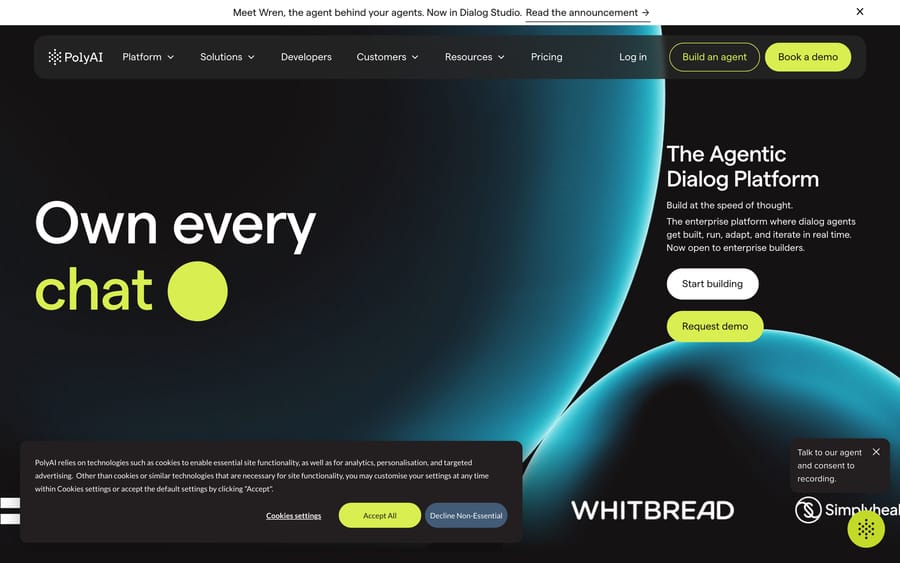
PolyAI builds enterprise voice AI agents, and its own homepage frames the product as "The Agentic Dialog Platform," a recent repositioning that leans into the same agentic-AI language most of the category has adopted in 2026. At the time of research, the site was promoting a new feature called Wren, described as "the agent behind your agents," now built into something PolyAI calls Dialog Studio, on top of its existing Agent Studio and Agent Development Kit (ADK) build paths.
The platform is built around a proprietary model called Raven, which PolyAI says is trained on more than 1 billion enterprise conversations. Two ways to build sit on top of it: Agent Studio, a no-code builder for non-technical teams, and the ADK, a developer-focused framework, both running on what PolyAI calls the same "dialog-native runtime." Compliance is built in by default rather than bolted on: SOC 2, HIPAA, GDPR, and PCI DSS are listed as standard across every agent, with brand voice held consistent across channels and languages.
How PolyAI's voice agents work
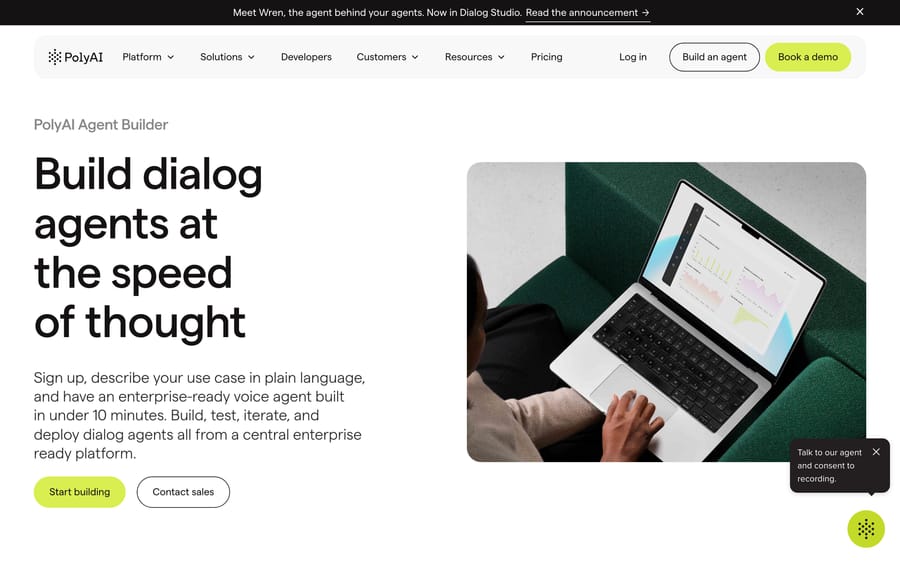
PolyAI's own positioning draws a sharp line against two categories it doesn't want to be grouped with: "Not a chatbot. Not voice bolted onto chat." Instead, it describes a full-stack dialog agent built specifically for enterprise voice, distinct from a text-first chatbot that had voice added as an afterthought. Agent Studio, shown above, promises an enterprise-ready voice agent built from a plain-language use-case description in under 10 minutes, then built, tested, iterated, and deployed from one central platform.
The Data & Insights layer is where PolyAI tries to close the loop between deployment and improvement: every conversation an agent handles is scored, searchable, and explained, with a generative-AI query interface that answers plain-language questions like "what have been the most common calls about parcel-delivery problems in the past three months." PolyAI's own framing is pointed here too: "Most contact centers guess why customers call. We know." That's a real mechanism worth understanding, since it's the difference between a dashboard of aggregate metrics and being able to ask a specific operational question and get the actual calls behind the answer.
Key features
- Agent Studio: no-code voice agent builder for non-technical teams.
- ADK (Agent Development Kit): a developer-focused framework on the same underlying runtime.
- Wren / Dialog Studio: PolyAI's newest layer for designing, building, testing, and continuously optimizing dialog agents.
- Raven model: a proprietary model trained on 1B+ enterprise conversations.
- Built-in compliance: SOC 2, HIPAA, GDPR, and PCI DSS standard on every agent.
- Data & Insights: conversation scoring, plain-language search, and customizable operational dashboards.
- Multi-language support: consistent brand voice maintained across languages and channels.
PolyAI pricing
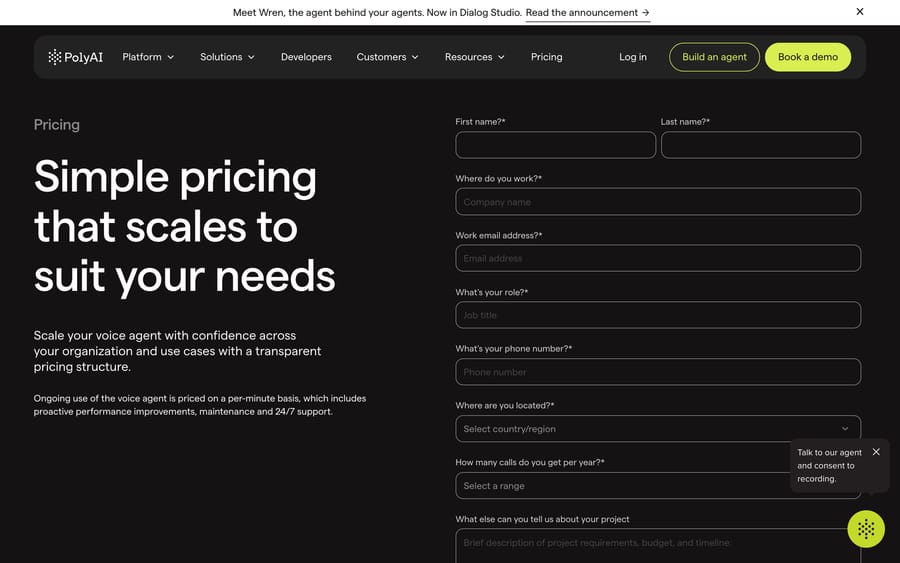
PolyAI states its pricing mechanism plainly, even without a number attached: "Ongoing use of the voice agent is priced on a per-minute basis, which includes proactive performance improvements, maintenance and 24/7 support." No tiers or rates are published, and the pricing page's own lead-gen form asks for annual call volume before routing a prospect to sales, which is the clearest signal available that the actual per-minute rate is negotiated based on scale rather than fixed.
No third-party benchmark exists to fill that gap either: this guide checked for a Vendr buyer guide and any AWS, Azure, or GCP Marketplace listing and found neither. That leaves per-minute voice pricing as a mechanism worth understanding on its own terms: unlike a flat per-ticket or per-resolution charge, a per-minute meter means a slower agent, or a caller who gets stuck in a longer back-and-forth, directly costs more, which gives PolyAI a real incentive to keep its own agents fast and its call durations short, an incentive that happens to align with what the customer wants too.
Real users on PolyAI
There's a genuine gap here worth stating outright: no independently verifiable review-site data exists for PolyAI that this guide could access. G2 blocked automated fetches entirely, TrustRadius returned the same, Capterra has no matching product listing under any plausible slug, and PeerSpot has no PolyAI product page at all. That's not necessarily a red flag on its own, enterprise voice AI sold through a demo-first, sales-led process often has thin public review coverage, but it does mean this guide can't hand you a star rating with a straight face, so it isn't going to try.
What is available is PolyAI's own case-study library, which is more granular than most vendors publish: Pacific Gas & Electric says it saved 35,000 labor hours; UniCredit reports a 14-point NPS improvement; Fogo de Chão cites 95% customer satisfaction; Audibel reports a 44% reduction in call abandonment; and several hospitality customers (Hawksmoor, The Melting Pot, Golden Nugget) report specific revenue or automation numbers tied to missed-call recovery and after-hours bookings. These are vendor-published figures, unaudited, but they're attributed to named companies with specific numbers instead of left as vague marketing claims.
Pros and cons
Pros
- Full-stack, voice-native architecture instead of a text chatbot with voice added on top.
- Compliance (SOC 2, HIPAA, GDPR, PCI DSS) built in by default across every agent.
- Granular, named customer case studies with specific numbers across a wide range of industries.
- A pricing mechanism (per-minute) that keeps PolyAI's incentive aligned with fast, efficient calls.
Cons
- No published pricing and no third-party benchmark (Vendr, marketplace listings) to estimate real cost in advance.
- No independently verifiable review-site data exists anywhere this guide could check.
- Case-study results are vendor-published rather than independently audited.
- Sales-led, demo-first process with no self-serve way to test the product before a call.
Who PolyAI is best for
PolyAI suits you if you run a large, voice-heavy operation, utilities, financial services, healthcare, hospitality, or retail chains named directly in its case studies, with call volumes high enough that a per-minute pricing conversation with sales makes sense, and where the compliance requirements (HIPAA, PCI DSS) are a real constraint rather than a nice-to-have.
It's a poor match for a smaller team without that call volume, or for a buyer who wants to see a real number before booking a demo, since nothing on PolyAI's own site gives you one.
PolyAI vs alternatives
| PolyAI | Parloa | Macha | |
|---|---|---|---|
| Model | Full-stack voice AI, proprietary Raven model, per-minute pricing | Voice AI agent platform for contact centers | AI agent layer on your existing help desk |
| Best for | Large, voice-heavy enterprises in regulated or high-compliance industries | Enterprise contact centers automating voice | Teams on Zendesk, Freshdesk, Gorgias, or Front automating ticket volume |
| Pricing | Not published; per-minute, scaled to call volume | Not published; enterprise quote | From $299/mo for 750 tickets (about $0.40/ticket), published |
| Compliance | SOC 2, HIPAA, GDPR, PCI DSS standard on every agent | Enterprise-grade, vendor-specific | Standard controls; scoped per agent |
| Channel | Voice-first, with multi-language support | Voice-first | Email, chat, and messaging tickets |
See our Parloa guide and our Cresta guide for two more enterprise voice and contact-center AI comparisons; all three vendors, including PolyAI, are competing for the same large, voice-heavy buyer with opaque, volume-scaled pricing. Macha isn't part of that conversation: it has nothing to say about a phone system, and instead reads and acts on the tickets already sitting in a help desk a team runs today. If your actual bottleneck is Zendesk or Freshdesk volume rather than call center minutes, Macha is a far more direct and transparently priced fix. See pricing for the current numbers.
How we researched this: we checked poly.ai's own homepage, pricing page, Agent Studio page, and customers page directly on 2026-09-17. No Vendr buyer guide or cloud marketplace listing exists for PolyAI, so the per-minute pricing mechanism is confirmed but the rate itself is not. G2, TrustRadius, Capterra, and PeerSpot were all checked for review data; none returned anything independently verifiable for this vendor.
FAQ
What is PolyAI? PolyAI (poly.ai) is an enterprise voice AI platform, positioned as "The Agentic Dialog Platform," building full-stack voice agents on a proprietary model called Raven for large, voice-heavy businesses.
Is "PolyAI" the same as the "polyai" search term with 823,000 monthly searches? No. That search volume belongs to an unrelated chatbot app. This guide covers poly.ai, the enterprise voice AI company used by PG&E, UniCredit, and Fogo de Chão.
How much does PolyAI cost? PolyAI doesn't publish pricing. It charges per minute of voice agent usage, which includes ongoing performance improvements, maintenance, and 24/7 support, but the actual rate is negotiated based on call volume through a sales conversation.
Is PolyAI good, based on reviews? No independently verifiable review-site data exists. G2 and TrustRadius blocked access, Capterra has no matching listing, and PeerSpot has no PolyAI product page, so this guide can't responsibly cite a star rating.
What is Raven? Raven is PolyAI's proprietary AI model, which the company says is trained on more than 1 billion enterprise conversations.
What are good PolyAI alternatives? Parloa and Cresta are the closest direct comparisons for enterprise voice and contact-center AI. For a team whose real bottleneck is ticket volume in a help desk instead of phone calls, Macha is a different kind of tool built for that job.
Does PolyAI offer a self-serve trial? No. PolyAI's process is sales-led and demo-first; there's no published self-serve signup or trial on its site.
PolyAI is a serious option for a large, voice-heavy, compliance-conscious enterprise. If your bottleneck is actually the ticket queue in Zendesk or Freshdesk, start a Macha trial or check /pricing.
Sources: PolyAI homepage, PolyAI pricing, PolyAI, Agent Studio, PolyAI, Wren dialog agent, PolyAI customers, PolyAI, Data and Insights, Parloa homepage.
Resolve tickets automatically with AI agents
Macha's AI agents work on top of the help desk you already use — no code.