





 Shopify
 Stripe
 Slack
Slack Notion
 Google Workspace
 Confluence

How Do You Send Proactive Shipping Updates in Gorgias With AI? (2026)


Gorgias data puts WISMO at roughly 18% of incoming support requests, and most automation only answers the shopper once they ask. A scheduled AI agent on top of Gorgias checks tracking state and messages delayed or stuck shipments first.
Key takeaways
- Proactive shipping-update AI for Gorgias runs an agent every hour, every four hours or daily to check tracking and message only shoppers whose orders are delayed or stuck.
- WISMO accounts for roughly 18% of incoming support requests on average, and Gorgias estimates a manually handled WISMO ticket costs $12.18 to $12.40.
- Gorgias AI Agent bundles 30 to 530 automated interactions a month depending on plan and charges $1.50 per automated interaction past that limit.
- In a Gorgias case study, the brand Jaxxon saw billable chat tickets fall 17% within a month of launching self-service order tracking.
- Macha bills per ticket, from $299 a month for 750 tickets, so a scheduled check that sends a delay heads-up is charged once per conversation, and setup by the Macha team plus a dedicated success manager are included.

Proactive shipping-update AI for Gorgias runs an AI agent on a schedule (every hour, every four hours or daily) that checks order and carrier tracking state and messages only the shoppers whose shipments are delayed or stuck, before they open a "where is my order?" ticket. Gorgias's native tools answer the customer who asks; the scheduled agent layer reaches the customer first.
| Native Gorgias Automate / AI | AI agent layer (Macha on top of Gorgias) | |
|---|---|---|
| Best at | Deflecting the customer who asks | Acting on events before the customer asks |
| Billing frame | Per automated interaction (plan bundles of 30 to 530, then $1.50 each) | Per ticket, one conversation charged once: from $299 a month for 750 tickets, with setup and a dedicated success manager included (see pricing) |
| Trigger | Inbound message / lifecycle event | Scheduled runs that poll order + tracking state |
| Response | Template chosen by rule | Reasoned, grounded, per-shipment message |
| Proactive outreach | Templated delay emails | Event-aware: delay vs exception vs on-time |
Neither column is "worse." Deflection and event-driven action are different jobs, and the rest of this piece shows where each one fits.
Why is WISMO worth pre-empting?
WISMO ("where is my order?") is one of the most common questions in ecommerce support. According to Gorgias's own data, it accounts for roughly 18% of incoming requests on average, and Gorgias estimates a WISMO ticket handled manually costs a business $12.18 to $12.40. That is a lot of money and agent attention spent restating information the customer could have had automatically.
The trap is that most WISMO automation is still reactive: it waits for the customer to ask, then answers well. That's a real improvement over a human copy-pasting a tracking link, but it still lets the anxiety build. The customer refreshes the carrier page, sees "no movement for four days," and then contacts you already frustrated. Proactive shipping-update AI closes that window by treating delivery events as triggers (a delay, an exception, a stalled scan) and reaching out before the shopper does.
What does Gorgias do natively to reduce WISMO?
Credit where it's due: Gorgias ships several tools that meaningfully reduce WISMO, and for a lot of stores they're enough to start.
- Self-service order tracking. Gorgias can surface order status and tracking directly in the chat widget and Help Center, letting shoppers check their own package. In a Gorgias case study, the brand Jaxxon saw billable chat tickets fall 17% within a month of launching self-service.
- Rules. The Rules engine can detect shipping-related language in an incoming message and auto-respond with the tracking number when it's available, or a status update when tracking isn't live yet.
- Automate. Gorgias's Automate product offers pre-built autoresponders and Flows that deflect common order-status questions without an agent touching them.
- Proactive post-purchase emails. This is the important one: Gorgias recommends automating delivery-update emails at each post-purchase stage (order confirmation, shipping notification, packing updates and, crucially, delay updates) to inform customers of issues before they escalate.
That last capability matters because it shows Gorgias already believes in proactivity. The native building blocks are there. For a full tour of the AI side of the platform, our Gorgias AI Agent explained and Gorgias Automate AI complete guide posts go deeper than we can here.
Where do Gorgias's native tools stop?
Native Gorgias automation is strong at deflection: answering the customer who asks. It's less suited to true event-driven resolution across your whole shipping graph, and there are three specific seams.
First, native proactivity is largely template-and-trigger, not reasoning. A rule fires on a keyword or a lifecycle event and sends a pre-written message. It doesn't read a carrier exception, decide whether this particular shipment warrants an apology plus a reship offer versus a simple "still on its way" reassurance, and phrase that per-customer. It sends the template you built for the trigger you anticipated.
Second, the billing model rewards deflection, not action. Gorgias's AI Agent is priced per automated interaction. The Gorgias pricing page (checked 24 September 2026) puts AI Agent on every plan with a monthly bundle: 30 automated interactions on Starter and Basic, 190 on Pro and 530 on Advanced, then $1.50 per automated interaction past the limit. Its plan comparison lists an effective rate of $1.00 on Starter, $0.90 on Basic and Pro, and $0.85 on Advanced. That's a clean model for reactive deflection. But a proactive outreach, messaging someone about a delay they haven't complained about yet, doesn't fit neatly into a "resolution" frame, because there was no inbound conversation to resolve. (Some third-party analyses, such as myAskAI's breakdown, also report that an AI Agent interaction can count as a helpdesk ticket too; confirm the exact behaviour against your own invoice.)
Third, it's triggered by inbound messages, not by your systems' state. The native engine is fundamentally reactive to a conversation starting. Firing an outreach the moment a carrier reports an exception, with no customer message involved, is exactly the kind of "run on a schedule, check the world, act if something's wrong" loop that a rules engine wasn't built for.
The point is to use each tool for what it's good at, which is the whole thesis of AI agents for customer service.
How do you build proactive shipping updates on top of Gorgias?
Here's how to build genuinely pre-emptive shipping updates as a layer on top of Gorgias, without replacing anything you already run.
- Keep native deflection on. Leave your self-service tracking, Rules, and Automate flows running; they handle the shopper who still asks. This layer is additive.
- Give the agent read access to shipping state. Macha's Shopify connector reads orders and customers. Carrier scans from AfterShip or Shippo come in through a custom tool: you wrap a REST endpoint and the agent calls it to fetch a shipment's current status.
- Run the agent on a schedule, not on an inbound message. This is the mechanism that makes proactivity possible: a recurring trigger that wakes the agent every hour (or every four hours) to scan open orders for trouble.
- Classify each shipment by event, not keyword. On each run, the agent reasons over each order: on-time (do nothing), delayed (carrier estimate slipped: send a reassuring heads-up), or exception (failed delivery, stuck scan, wrong-address flag: send an action-oriented message and, where policy allows, offer the next step).
- Write back into Gorgias. The outreach and any resulting conversation live in the Gorgias ticket your agents already use, so support keeps a single source of truth and can take over any thread. Macha's Gorgias connector searches, replies to and updates tickets; to open a brand-new outbound ticket, add a custom tool that calls Gorgias's create-ticket API.
- Escalate the hard ones. If a shipment is genuinely lost or a customer replies with something outside policy, hand off to a human with full context attached. The agent shouldn't guess on refunds.
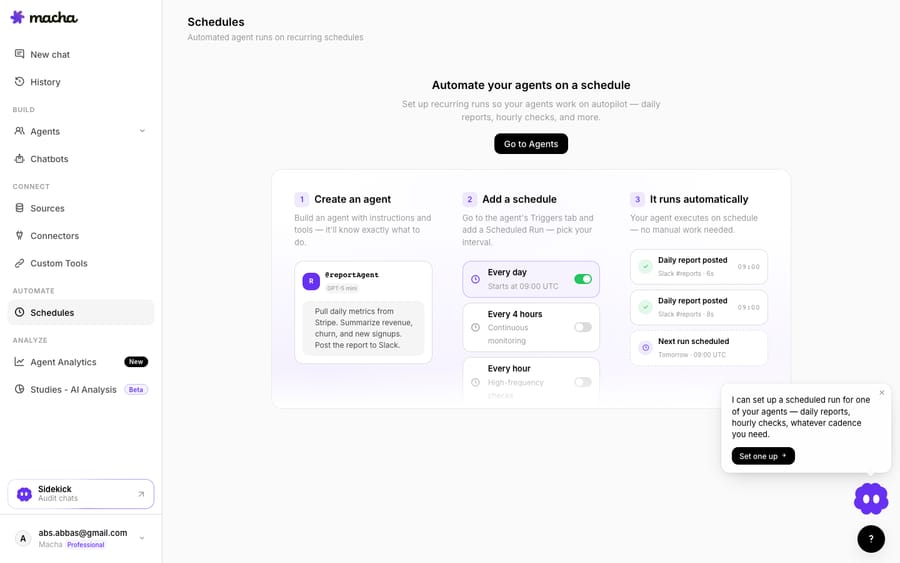
The screenshot above is the piece that makes proactive outreach real: Schedules. Instead of waiting for a customer message, an agent runs on a recurring trigger (every hour, every four hours, every day), checks the state of your orders, and only messages the shoppers whose shipments actually need it. That's the difference between "answer WISMO faster" and "make most WISMO tickets never happen."
What does a stalled carrier scan look like with proactive AI?
Concretely, imagine a Shopify store shipping via UPS. A customer's order was marked shipped four days ago but hasn't had a new carrier scan since. Natively, nothing happens until that customer notices and opens a chat, at which point a Rule can hand them the (unhelpful, static) tracking link.
With a proactive layer: the hourly scheduled run flags the order as stalled (shipped, no scan in 72+ hours). The agent composes a specific message ("Your order #10428 is taking longer than expected; the carrier hasn't scanned it since Tuesday. We're on it and will update you within 24 hours"), posts it as a Gorgias ticket, and tags the ticket for ops. The customer feels looked-after instead of ignored, and the WISMO ticket that would have arrived tomorrow simply doesn't. Multiply that across the ~18% of your volume that WISMO represents and the deflection compounds.
How does Macha fit with Gorgias?
Macha is not a Gorgias replacement. It's an AI agent layer that runs on top of the Gorgias you already use, via a live native connector. Your inbox, your Rules, your Automate flows and your macros all stay exactly where they are. You connect Macha to Gorgias, point it at your order and tracking data through custom tools, and set schedules so agents act on shipping events instead of waiting for messages.
The billing difference is worth stating plainly and fairly. Gorgias AI Agent charges per automated interaction, a model that fits reactive deflection well. Macha bills per ticket (one conversation, charged once, however many checks, messages and tool calls go into it), which is the model that fits proactive, event-driven work, because a lot of valuable outreach (scanning orders, sending a heads-up nobody complained about) isn't a "resolution" of an inbound ticket at all. Neither is universally cheaper; they're priced for different shapes of work. Macha is one plan priced by ticket volume, from $299 a month for 750 tickets (about $0.40 a ticket), with scheduled triggers included. You don't have to build the agent yourself: the Macha team sets it up on your Gorgias, wires in the tracking tools, tests it on a sample of your past WISMO tickets and runs it in safe mode, so nothing reaches a shopper until you say so. The price also covers a dedicated success manager who handles your changes afterwards: new carriers, instruction changes, new tools. See the Macha pricing page for every tier, and our Gorgias pricing explained breakdown for the native side.
The clean division of labour: let Gorgias stay the system of record for conversations and its native tools handle the customers who ask; layer Macha on top to catch shipping trouble first and turn it into outreach before it becomes a ticket.
FAQ
Does Gorgias handle WISMO on its own? Yes, partly. Natively, Gorgias can deflect WISMO through self-service order tracking (one Gorgias customer, Jaxxon, saw a 17% drop in billable chat tickets), Rules that inject tracking into replies, and Automate autoresponders, plus templated proactive delivery emails. These are strong at answering the customer who asks. A dedicated AI layer adds event-driven, reasoned outreach that fires before the customer asks.
How is proactive different from Gorgias's automated delivery emails? Gorgias's native proactive emails are template-and-trigger: a lifecycle event fires a pre-written message. A proactive AI agent reasons per shipment, distinguishing a minor delay from a genuine exception, and writes a message fit to that specific situation, then logs it in Gorgias.
How does Gorgias AI Agent bill for this? Per automated interaction. Gorgias's pricing page bundles 30 to 530 automated interactions a month depending on plan, then charges $1.50 per interaction past the limit, and bills only when the AI resolves the conversation. Macha, by contrast, charges per ticket (one conversation, charged once), which suits proactive runs where there's no inbound conversation to "resolve."
Do I have to replace Gorgias to run proactive shipping AI? No. Macha is an AI agent layer that connects to Gorgias as a live native connector and runs on top of it. Your Gorgias inbox, Rules, Automate flows, and macros stay exactly as they are. The Macha team sets the agent up for you, and that setup is included in the price of about $0.40 a ticket.
What triggers the proactive outreach? A schedule. Instead of an inbound message, the agent runs on a recurring trigger (every hour, every four hours, or daily), scans open orders and tracking state, and messages only the shoppers whose shipments are delayed or in exception.
Ready to cut WISMO before it arrives? Start a free trial of Macha and connect it to your Gorgias in minutes. The Macha team builds the first agent for you.