Intercom
 Shopify
 Stripe
 Slack
Slack Notion
 Google Workspace
 Confluence

What Is FreeScout? The Free, Self-Hosted Help Scout Alternative and Its Real Cost (2026)


FreeScout is a free, open-source shared inbox you run on your own PHP and MySQL server, with no cap on agents, conversations or mailboxes and a layout close to Help Scout's. Tags, saved replies, workflows, reports and the API are paid modules, but each is a one-time purchase, so a working five-agent desk costs about $138 in its first year.
Key takeaways
- FreeScout is a free, self-hosted, AGPL-3.0 shared inbox with no cap on agents, conversations or mailboxes, built as a Laravel application that resembles Help Scout.
- FreeScout sells tags, saved replies, workflows, custom fields, a knowledge base, reports and an API as separate one-time modules priced from $1.99 to $24.00 each.
- A ten-module FreeScout set covering tags, saved replies, workflows, custom fields, knowledge base, reports, CSAT, portal, spam filter and rebranding costs $100.91 once, with no subscription.
- FreeScout has no hosted edition; its wiki lists managed hosting on PikaPods at $3.10 a month and Zenith at $20 a month.
- Help Scout's Standard plan costs $25 per user a month, so five agents pay $1,500 a year, against a first-year FreeScout cost of $138.11 with ten modules and PikaPods hosting.

FreeScout is a free, AGPL-3.0 shared inbox and help desk you self-host on PHP and MySQL, with no cap on agents, conversations or mailboxes; features such as tags, saved replies, workflows and reports are paid modules at $1.99 to $24.00 each, bought once. Prices were read on FreeScout's own pages on September 20, 2026, and the release data and Help Scout prices were rechecked on September 24, 2026.
| FreeScout cost item | Price |
|---|---|
| Core application | Free, unlimited agents and mailboxes |
| Single paid module | $1.99 to $24.00, one-time |
| Ten-module working set | $100.91, one-time |
| Managed hosting (PikaPods) | $3.10 a month |
| Help Scout Standard, for comparison | $25 per user a month |
What is FreeScout, and who builds it?
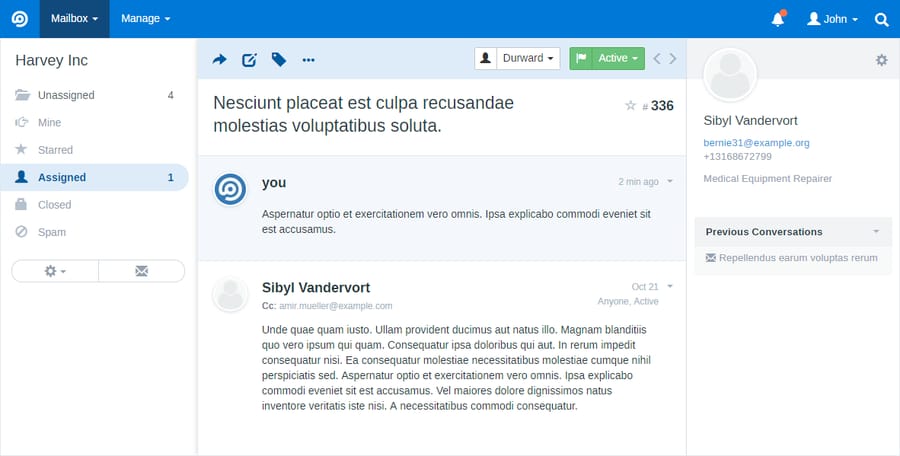
FreeScout is a Laravel application that turns one or more email mailboxes into a shared, threaded inbox with assignment, internal notes, collision detection and a customer sidebar. The layout will be immediately familiar to anyone who has used Help Scout, which is the point: the project describes itself on its homepage as a free self-hosted Zendesk and Help Scout alternative.
The project lives on GitHub under freescout-help-desk/freescout with an AGPL-3.0 license, 4.6k stars and 718 forks. What stands out next to other self-hosted desks is the release rhythm: versions 1.8.238, 1.8.239, 1.8.240 and 1.8.241 shipped on August 31, September 4, September 12 and September 19, 2026. That is roughly a release a week, against 20 open issues and 3 open pull requests on September 20; 1.8.241 was still the latest release on September 24. The repository was created in June 2018, and the homepage marks eight years of the project.
Requirements are deliberately low. The README lists Nginx, Apache or IIS, PHP 7.4 through 8.x, and MySQL 5.0+, MariaDB or PostgreSQL, and states there are no minimum CPU or RAM requirements. Shared hosting is explicitly supported, which is unusual for a modern help desk and is a large part of why the thing spreads.
What does FreeScout's free core include?
The core application, and only the core. FreeScout's own wiki FAQ answers the seat question without hedging: asked whether there are any limitations on the number of agents or tickets, it says there are none.
So the free core gives you unlimited agents, unlimited conversations, unlimited mailboxes, email fetching over IMAP or POP3 with OAuth for Microsoft 365 and Google Workspace, assignment, internal notes, collision detection, starred and followed conversations, forwarding, merging, search, 33 translations and mobile apps.
What it does not give you, because each of these is a separate paid module:
| Capability | Module | One-time price |
|---|---|---|
| Tags on conversations | Tags | $6.99 |
| Canned responses | Saved Replies | $4.99 |
| SLA rules and automation | Workflows | $14.99 |
| Ticket priorities | Custom Fields | $7.99 |
| Customer-facing help center | Knowledge Base | $12.00 |
| Reporting | Reports | $14.99 |
| CSAT ratings | Satisfaction Ratings | $8.99 |
| Portal and web contact form | End-User Portal | $12.99 |
| REST API and webhooks | API & Webhooks | $12.99 |
| Spam filtering | Spam Filter | $5.99 |
| Removing FreeScout branding | Customization & Rebranding | $10.99 |
Those figures are the USD prices published on each module's own page on September 20, 2026. Be aware that freescout.net converts prices to the visitor's local currency, so the number on screen may not be the dollar figure.
Seventy-one modules carry a price, from $1.99 for the Extended Editor up to $24.00 for Mail Signing. The store terms are the part worth reading closely: licenses are lifetime, for a single FreeScout instance, with lifetime updates included; every module's source is AGPL-3.0; and all payments are non-refundable.
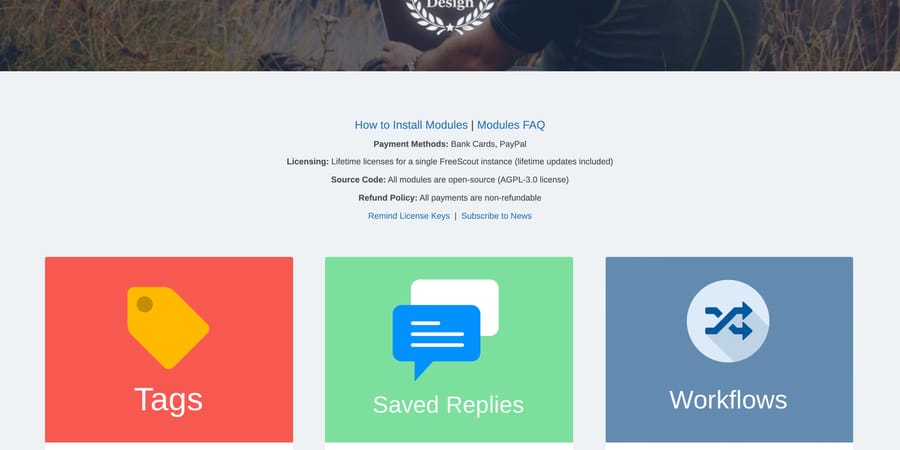
Two smaller things behave differently from what people expect. Outgoing customer emails carry FreeScout branding by default, controlled by a "Spread the Word" checkbox under Manage › Settings, so switching it off is a setting and removing it from the interface is a $10.99 module. And priorities are not a core field; they arrive through Custom Fields.
Name the incentive here, because it's an unusually clean one. FreeScout earns nothing from your seat count, your ticket volume or your uptime. It earns a few dollars, once, each time a feature matters enough to you to click buy. That pushes the project toward shipping many small, cheap, optional things and away from the annual price rises that produce migration threads. It also means nobody at FreeScout is paid to make sure your server stays up.
How much does FreeScout cost once you add modules and hosting?
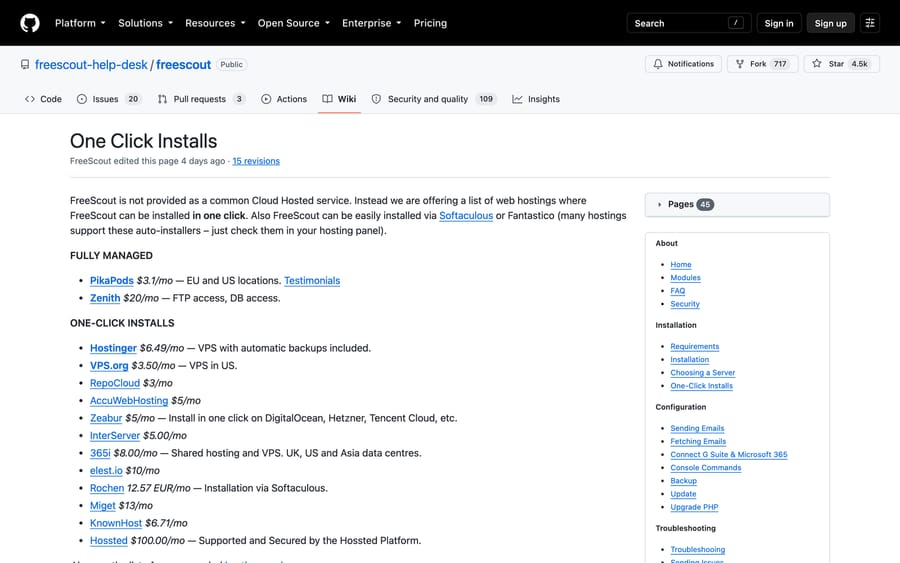
There is no hosted edition. The One Click Installs wiki page, last edited on September 16, 2026, says so directly and lists hosts instead. Two are fully managed: PikaPods at $3.10 a month with EU and US locations, and Zenith at $20 a month with FTP and database access. Twelve more offer one-click installs, from RepoCloud at $3 and VPS.org at $3.50 up to Miget at $13 and Hossted at $100.
So a realistic first-year bill for a five-agent team looks like this. Take the ten modules above that most desks end up buying (tags, saved replies, workflows, custom fields, knowledge base, reports, satisfaction ratings, end-user portal, spam filter and rebranding): $100.91, once. Add managed hosting on PikaPods at $3.10 a month: $37.20 a year. Year one is $138.11. Year two is $37.20.
Compare that with Help Scout's published pricing, read the same day. Its Free plan covers 5 users, 1 Inbox, 1 Docs site and 100 contacts a month, with 10 saved replies and 10 tags. Standard is $25 per user a month for up to 25 users, so five agents is $125 a month, $1,500 a year at the displayed rate, with 16% off for annual billing. AI Answers is $0.75 per resolution on top.
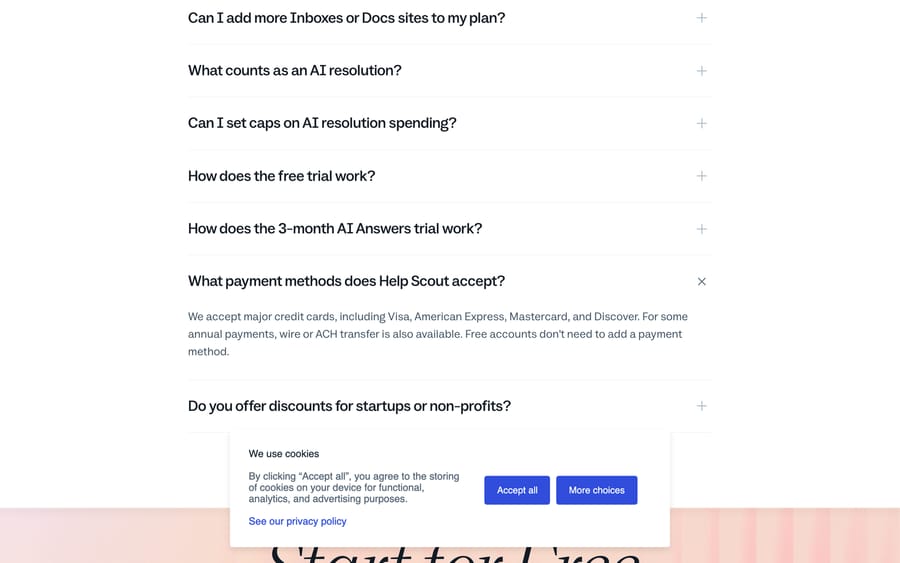
The gap is roughly ten to one, and that is genuinely what drives the migration threads. r/SaaS carries one titled "HelpScout is significantly raising its prices out of nowhere", and r/Freescout carries "Helpscout > Free scout migration". The line item missing from both columns is your own time: someone has to patch a weekly-release Laravel app, keep IMAP and OAuth working, and own the backups.
Migration is a solved problem, if a fiddly one. The Migrate to FreeScout wiki page documents two routes: a free community Help Scout module, or the third-party Help Desk Migration service for other desks. Both need the API & Webhooks module installed first, and bringing custom fields and tags across needs those two modules too. FreeScout's own FAQ page still answers the migration question with "No for now"; that entry is stale, and the migration page is the one to follow.
Who should use FreeScout, and who shouldn't?
It suits a small team that already runs a server, spends most of its support day in email, and is paying per-seat prices that have outgrown the value they get. Agencies and product companies with 3 to 15 support people are the recurring profile, and the seat count is the whole argument: adding a sixth agent costs nothing.
It also suits anyone who needs the mail to stay on their own infrastructure for a data-residency or procurement reason, because a shared host running PHP is a much lower bar than a Docker cluster.
FreeScout is the wrong fit if nobody will own patching a weekly-release application, if you need voice or a real omnichannel contact center, if procurement requires a vendor with an SLA and a support contract to sign, or if you want to evaluate it against peer reviews before committing. On that last point, be honest about what the evidence is: FreeScout has no G2, Capterra or SourceForge listing we could find on September 20, 2026. The public signals are the GitHub repository, the project's own testimonials page (which names Piwigo, whose Pierrick Le Gall wrote on April 26, 2025 that moving its ticket manager to FreeScout was "a very good decision", and PetaPod in November 2025), and threads like r/selfhosted's "Freescout - Very Underrated". That is thinner evidence than a rating with a review count, and it deserves less weight.
How does FreeScout compare with osTicket, Zammad and Help Scout?
| FreeScout | osTicket | Zammad | Help Scout | |
|---|---|---|---|---|
| Model | Self-hosted, AGPL-3.0 | Self-hosted, GPL-2.0 | Self-hosted, or hosted | Hosted only |
| Free tier | Unlimited agents and tickets | Unlimited agents and tickets | Self-hosted build only | 5 users, 1 inbox, 100 contacts/mo |
| Paid entry | Modules $1.99–$24.00, one-time | $12/agent/mo hosted | €7/agent/mo, max 5 agents | $25/user/mo |
| Shape | Shared mailbox with threads | Ticket queue with departments | IT service desk | Shared mailbox with Docs and AI |
| Release rhythm | Weekly | Roughly annual | Regular | Continuous |
| Watch out for | Core is thin until you buy modules | Interface age | Agent caps on hosted plans | Per-seat cost as the team grows |
osTicket is the other name people mean by "free self-hosted help desk". It ships SLAs, departments and a knowledge base in the box, so a bare osTicket install does more than a bare FreeScout install. It also looks its age, and its 1.x line ships about one release a year.
Zammad is the pick when the queue is an internal IT service desk. Self-hosting is free; hosted Starter is €7 per agent a month billed annually and caps at five agents, with SLAs starting at Professional (€16).
Help Scout is the paid comparison and the incumbent most FreeScout users left. Its Free plan is real and is the right answer for a team of five with one inbox and light volume; the decision point arrives when you need a second inbox, more than 100 contacts a month, or more than 10 saved replies, all of which push you to $25 a user. Our Help Scout alternatives roundup covers the rest of that field, and the shared inbox comparison covers the same job from the tool side. For free hosted options instead, see free help desk software.
How we researched this
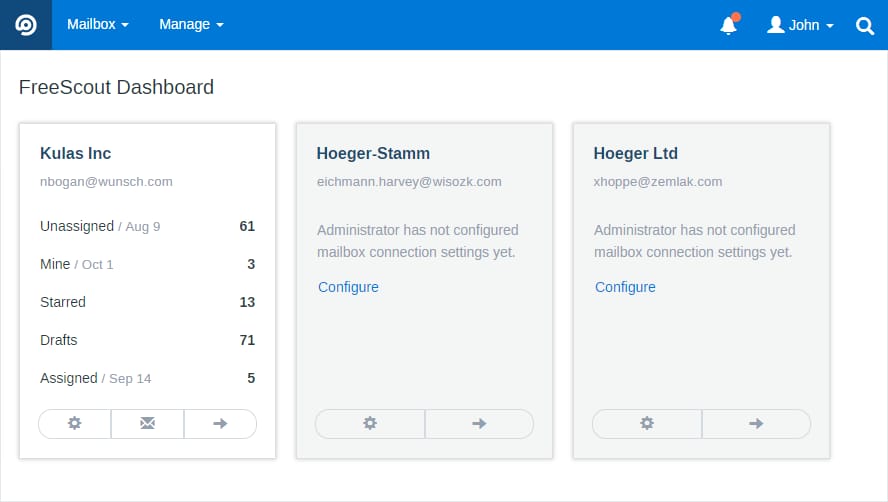
We read freescout.net's homepage, module store and individual module pages, the GitHub repository, the README, and the Installation Guide, FAQ, One Click Installs and Migrate to FreeScout wiki pages, all on September 20, 2026, and took the module prices from each page's published structured data because the site converts displayed prices to the visitor's local currency. We checked Help Scout's pricing page the same day and again on September 24, 2026, along with Zammad's pricing and FreeScout's GitHub releases. We did not install FreeScout on our own server, and we did not register for its public demo, which asks for an email address; the two interface screenshots are FreeScout's own published product images. We searched for a G2, Capterra or SourceForge listing and did not find one, which is why this post has no rating and review count.
Frequently asked questions
Is FreeScout really free? The core application is, under the AGPL-3.0 license, with no limit on agents, conversations or mailboxes; FreeScout's own wiki FAQ answers the question with "No. There are no any limitations." You pay for hosting, and for any of the 71 modules you decide you need.
How much do FreeScout modules cost? They range from $1.99 to $24.00 as one-time purchases, and the store's terms describe them as lifetime licenses for a single FreeScout instance with lifetime updates included. A ten-module set covering tags, saved replies, workflows, custom fields, knowledge base, reports, CSAT, portal, spam filter and rebranding comes to $100.91 at the prices published on September 20, 2026. All payments are non-refundable.
Is there a hosted version of FreeScout? No. The One Click Installs wiki page states FreeScout is not offered as a common cloud-hosted service and lists hosts instead. Two managed options appear there: PikaPods at $3.10 a month and Zenith at $20 a month.
What are FreeScout's requirements? Nginx, Apache or IIS; PHP 7.4 to 8.x; and MySQL 5.0+, MariaDB or PostgreSQL. The README states there are no minimum CPU or RAM requirements and that shared hosting works.
Can I migrate from Help Scout to FreeScout? Yes. The Migrate to FreeScout wiki page documents a free community Help Scout module and the paid third-party Help Desk Migration service for other help desks. Both need the API & Webhooks module ($12.99) installed first, and bringing custom fields and tags across needs the Custom Fields ($7.99) and Tags ($6.99) modules. FreeScout's FAQ page still says no migration tool exists; that answer is out of date.
Does FreeScout put its branding on my emails? By default, yes. A "Spread the Word" option under Manage › Settings controls the footer in customer emails and can be unchecked. Removing FreeScout branding from the interface itself is the Customization & Rebranding module at $10.99.
How does FreeScout compare with osTicket? FreeScout has the more modern interface, a weekly release rhythm and a thinner core; osTicket ships SLAs, departments and a knowledge base free but looks dated and releases roughly once a year. Both are unlimited on agents and tickets, and both are your problem to patch.
Sources: freescout.net · freescout.net/modules · Workflows module · Knowledge Base module · API & Webhooks module · GitHub repository · FreeScout wiki FAQ · One Click Installs · Migrate to FreeScout · helpscout.com/pricing · zammad.com/en/pricing
Simple per-ticket AI pricing
One thread with one person is one charge, however many replies it takes.