Intercom
 Shopify
 Stripe
 Slack
Slack Notion
 Google Workspace
 Confluence

What Is Zammad? Free Open-Source Help Desk, Pricing and License (2026)


Zammad is an open-source help desk from Germany that you can self-host for free with every feature and no cap on agents or tickets, or rent hosted from €7 per agent a month. Its business is hosting and support, and the one catch worth knowing is that the repository license is AGPL-3.0, not the GPL v3 its own marketing page shows.
Key takeaways
- Zammad is a free, open-source help desk you can self-host with the full feature set and no agent or ticket cap, running on Ruby on Rails, PostgreSQL and Elasticsearch.
- Zammad's hosted plans cost €7 per agent a month for up to 5 agents on Starter v2, €16 for up to 35 agents on Professional v2 and €25 for unlimited agents on Plus v2.
- Zammad's repository ships under AGPL-3.0 even though its open-source page says GPL v3, which matters if you modify Zammad and expose it to customers over a network.
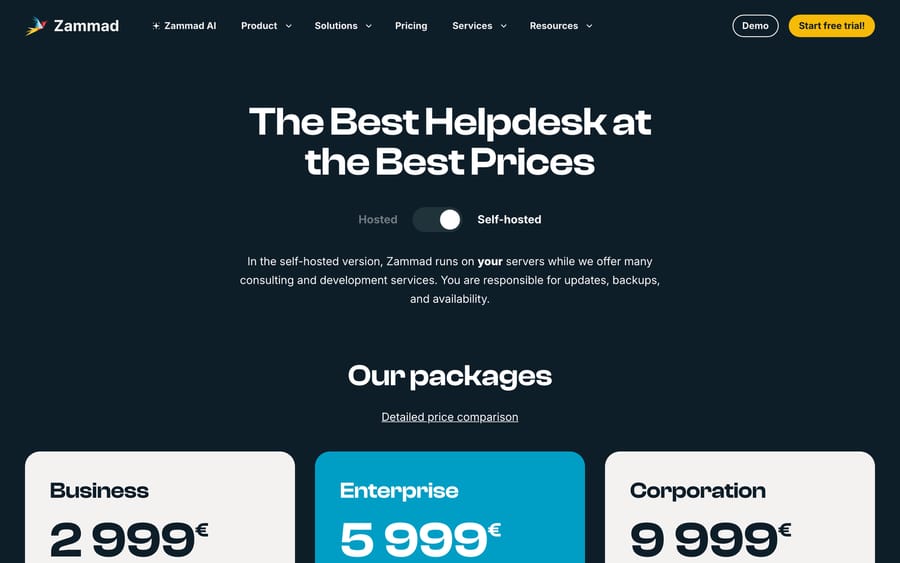
- Zammad's self-hosted support contracts run from €2,999 a year for Business to €9,999 a year for Corporation, which adds a 2-hour response and 95 service requests.
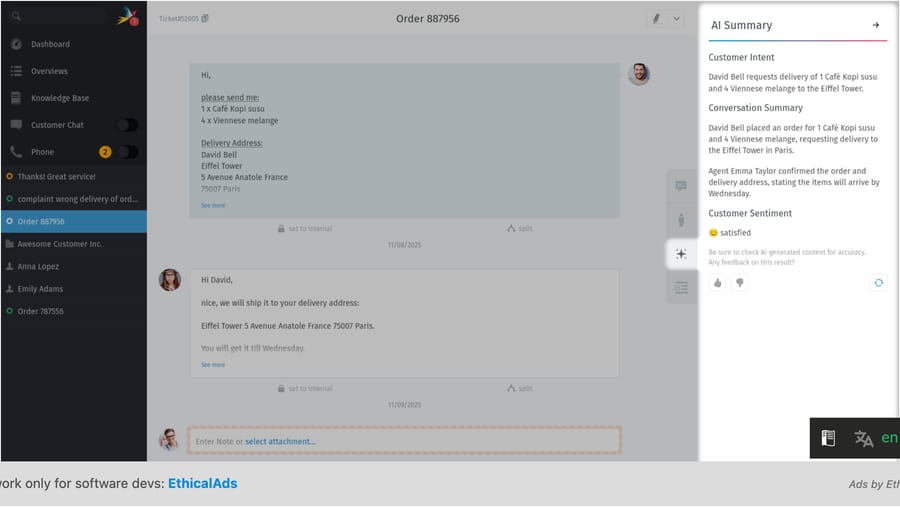
- Zammad bills its optional AI features at €0.03 per AI call, about €90 a month for a team running 3,000 AI-assisted tickets.

Zammad is a free, open-source help desk from Zammad GmbH in Germany: you can self-host it with the full feature set and no agent or ticket cap, or pay from €7 per agent a month for the hosted version. The current release is Zammad 7.2, the repository license is AGPL-3.0, and the optional AI features cost €0.03 per call.
| Route | Price (excl. VAT) | Limits |
|---|---|---|
| Self-hosted | Free | No agent or ticket cap; you run PostgreSQL, Elasticsearch and updates |
| Hosted Starter v2 | €7 / agent / month annual, €9 monthly | Max 5 agents |
| Hosted Professional v2 | €16 annual, €18 monthly | Max 35 agents |
| Hosted Plus v2 | €25 annual, €27 monthly | Unlimited agents |
| Self-hosted support | €2,999 to €9,999 / year | Business, Enterprise or Corporation package |
| AI features | €0.03 per AI call | Optional, enabled feature by feature |
What is Zammad, and who makes it?
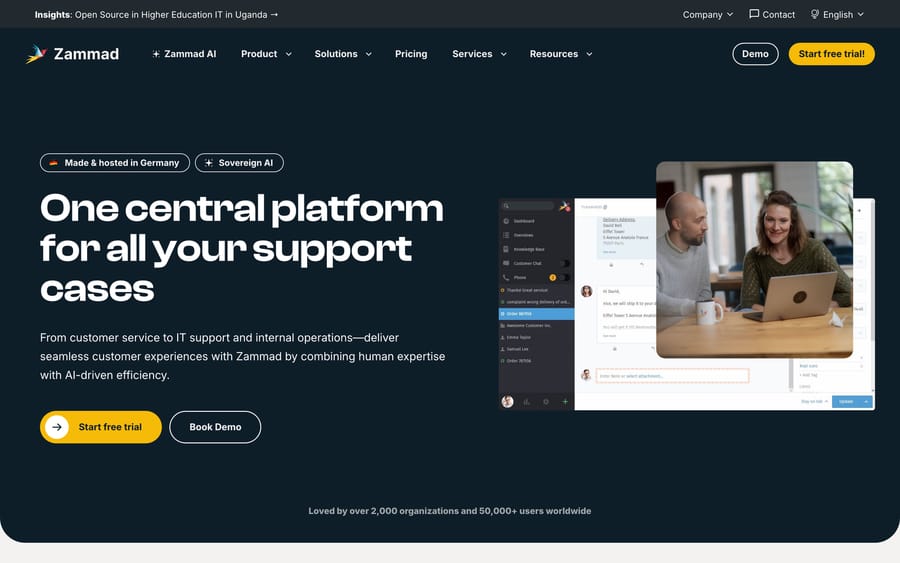
Zammad is a Ruby on Rails web application built by Zammad GmbH in Germany, and it does the classic help desk job: tickets arrive by email, web form, chat, phone, SMS, Telegram, Facebook or WhatsApp depending on your plan, agents work them in a tabbed interface with states, priorities, owners and tags, and rules move them around. It ships a knowledge base, text modules and macros, triggers and schedulers, SLAs, time accounting and a reporting layer. Zammad's home page says over 2,000 organizations and more than 50,000 users run it.
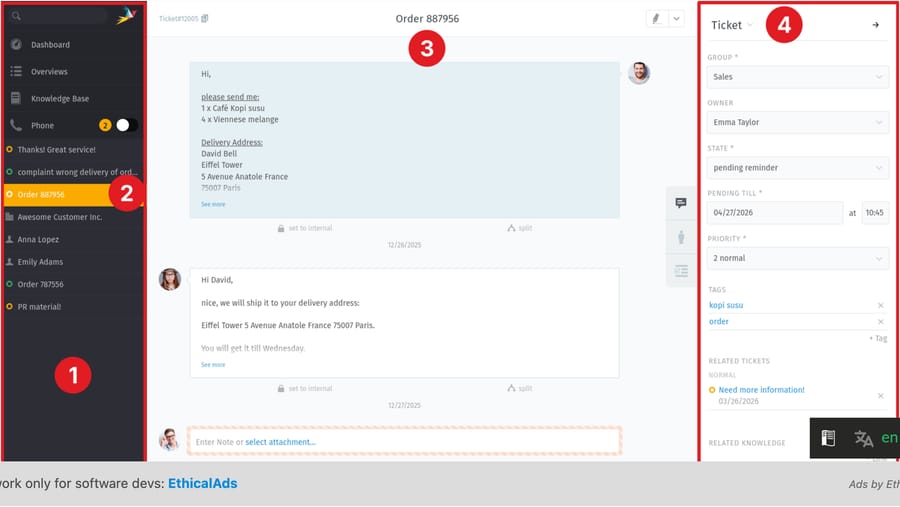
Two design choices explain why people like it. The first is the tabbed workspace: open tickets stay open as tabs, so an agent juggling six threads is not navigating back to a list. The second is that every object is searchable full text, backed by Elasticsearch, which is why Zammad wants more RAM than a PHP desk does.
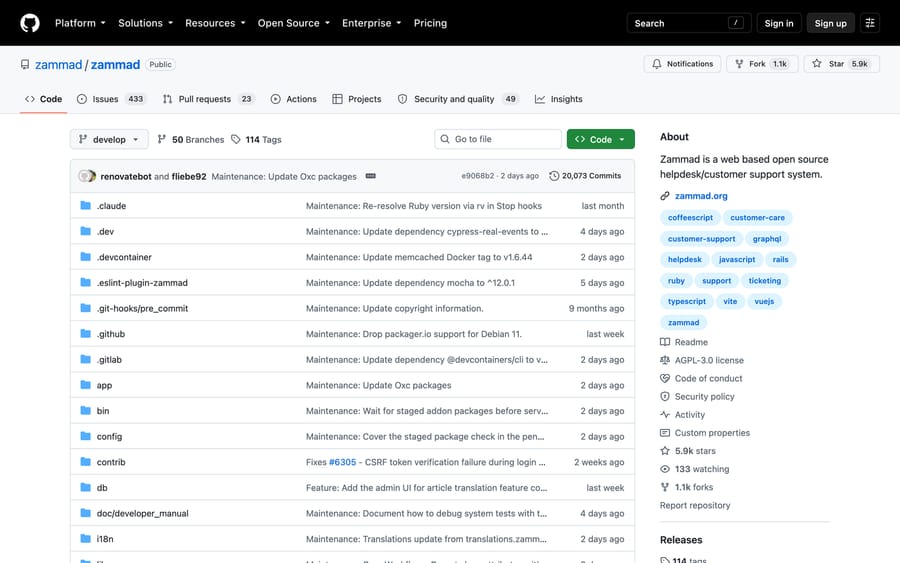
The GitHub repository carried 5,950 stars and 1,061 forks on 2026-09-24, with a push the same day; the repo page showed 20,073 commits when we captured it four days earlier. The project is written in Ruby with a Vue front end, and the pricing page was announcing the Zammad 7.2 release. That is a busy, staffed project rather than a hobby one.
What does the free, self-hosted Zammad include?
Self-hosting Zammad is free, and unusually the free version is the whole product:
- The full feature set. Zammad's open-source page puts it plainly: an open-source help desk "with the full feature set, not a watered-down edition". There is no community edition with features held back, which is the opposite of how most open-core vendors work.
- No agent cap and no ticket cap when you self-host. The seat caps you see on the price list belong to the hosted plans.
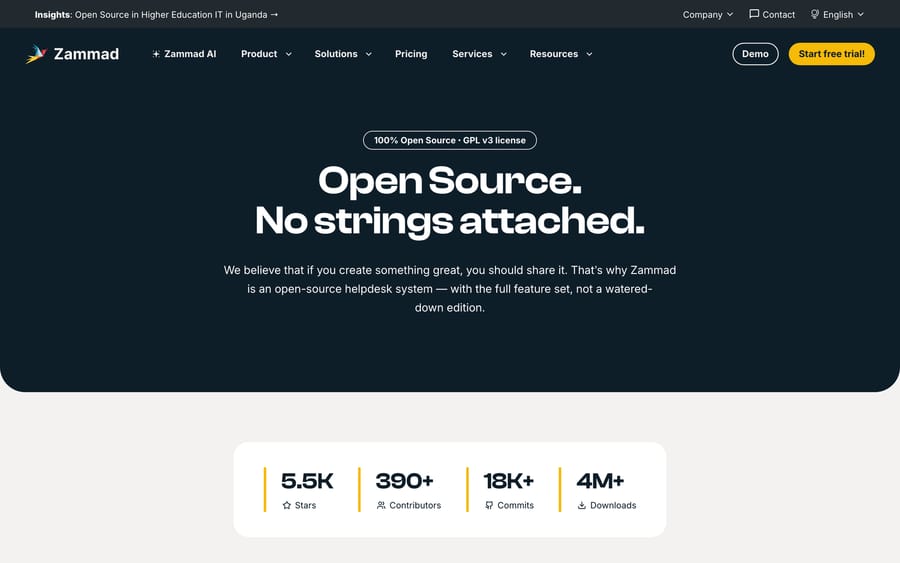
- The source, for good. The repository is public and the project publishes 4M-plus downloads, 390-plus contributors and 18K-plus commits on its own counter.
What you pay instead is infrastructure and attention. Zammad needs PostgreSQL, Elasticsearch, a Ruby runtime and a reverse proxy, and Zammad's own self-hosted copy says it directly: you are responsible for updates, backups and availability. That is a heavier stack than a PHP desk on shared hosting. The r/selfhosted answer that keeps coming up in free ticketing threads is that two Zammad instances run flawlessly and are easy to maintain once they are up, with the docs and the forum doing the rest.
Is Zammad GPL or AGPL?
The badge on that page says "100% Open Source · GPL v3 license". The repository's LICENSE file is the GNU Affero General Public License v3, and GitHub's sidebar reads AGPL-3.0. We checked both on 2026-09-20.
The difference is not pedantry. Plain GPL triggers its sharing obligation when you distribute the software. AGPL triggers it when you let users interact with a modified version over a network, which is exactly what running a help desk means. If you fork Zammad, change it and expose it to your customers, AGPL asks you to offer that modified source to them. Most teams self-hosting an unmodified Zammad will never notice. Anyone planning to build a product on top of it should read the license file rather than the marketing badge.
How much does Zammad cost hosted or with a support contract?
Zammad publishes every number, which puts it ahead of most of the category. All prices exclude VAT; we read them on 2026-09-20 and they were unchanged on 2026-09-24.
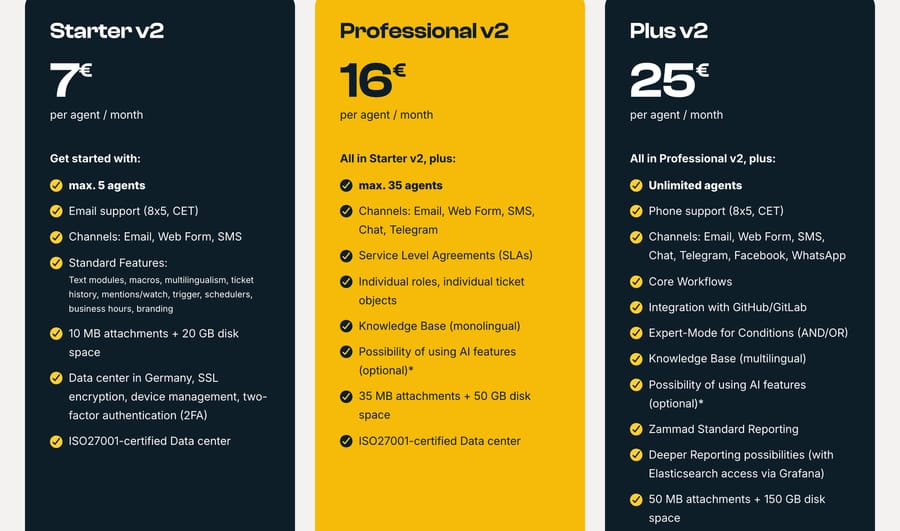
Hosted, in German data centers:
| Plan | Annual | Monthly | Agent cap | Notable additions |
|---|---|---|---|---|
| Starter v2 | €7 / agent / month | €9 | Max 5 agents | Email, web form, SMS; text modules, macros, triggers, schedulers; 20 GB disk |
| Professional v2 | €16 / agent / month | €18 | Max 35 agents | Adds chat and Telegram, SLAs, individual roles and ticket objects, knowledge base, 50 GB |
| Plus v2 | €25 / agent / month | €27 | Unlimited agents | Adds Facebook and WhatsApp, Core Workflows, GitHub/GitLab, multilingual knowledge base, reporting, 150 GB |
The 10% annual discount is the gap between those two columns. Every hosted tier sits in an ISO 27001-certified German data center, and the footer of the pricing page carries ISO 27001, GDPR and SOC 2 Type I marks.
Self-hosted with a support contract, for teams who run the software themselves but want somebody to call:
| Package | Price | What it buys |
|---|---|---|
| Business | €2,999 / year | Email support, 6-hour response, 15 service requests, bug escalations, security advisories |
| Enterprise | €5,999 / year | Adds phone support, 4-hour response, 45 service requests, an initial assessment |
| Corporation | €9,999 / year | Adds a 2-hour response and 95 service requests, plus patch-level and release updates |
AI is metered separately. Zammad's AI features are optional and billed at €0.03 per AI call, where a call is one interaction such as generating a ticket summary. At 3,000 AI-assisted tickets a month that is €90, on top of seats.
Worth doing the arithmetic. A 10-agent team on Professional v2 pays €160 a month, or €1,920 a year. The same team self-hosting pays €0 for the software plus a server, and €2,999 a year if they want the Business support contract. So paid support costs more than the hosted product until you pass roughly 15 agents. If you are self-hosting to save money, self-host without the contract and budget the hours instead.
Name the incentive. Zammad's business model is hosting, support and services, so the company earns nothing by holding a feature back, and its open-source page is a recruiting tool for exactly that. The flip side is that per-agent hosted pricing still rewards the vendor when your team grows, and the AI meter rewards it per interaction. Both are ordinary, and both are worth knowing before you model a bill.
What do Zammad users say about it?
The sample is small. Zammad holds 4.6 out of 5 from 7 reviews on Capterra, read on 2026-09-20, with Ease of Use at 4.7 from 7, Value for Money at 5.0 from 6 and Customer Service at 4.5 from 4; the page states it was last updated on 16 September 2026. Software Advice carries the same 4.6 from 7. Seven reviews is not a dataset, so we weight the public threads more heavily here than the score.
On Zammad's own forum, a user posting on 8 May 2024 opened with praise and a complaint in the same breath: the setup and configuration are "intuitive, simple", and the gripe is about feature requests where "users are dismissed as isolated cases", specifically around flexible time recording and per-customer PDF reports. A Zammad team member replied in the same thread that a feature has to be interesting to a high share of users or the team is spending resources on something nearly nobody uses, which is an honest answer and also tells you how the roadmap gets set. A third poster on 31 May 2024 called the system "very bland" and said he did not think it was ready for production, which is a minority view worth seeing.
The Reddit split is consistent. In a free ticketing thread on r/selfhosted the recommendation is two instances running flawlessly with decent docs. In r/sysadmin's "Ticketing Systems. Any good ones?" someone is stuck with Zammad and finds it "very basic for automations". Both can be true: Zammad is solid at the ticket lifecycle and thinner at rule-based automation than Zendesk or Freshdesk.
Who should use Zammad, and who shouldn't?
Zammad fits a team of roughly 3 to 35 agents that wants a real multi-channel desk, has someone comfortable with PostgreSQL and Elasticsearch, and either wants European hosting or wants the data on its own hardware. It suits internal IT desks and B2B support teams especially, where email and forms carry most of the volume and the knowledge base does the rest. The German hosting and the compliance marks make it an easy sell in European procurement, which is a real advantage that has nothing to do with features.
It's the wrong choice if nobody maintains servers and €7 an agent is not in the budget, because there's no free hosted tier to fall back on. It's the wrong fit if your automation needs are complex, since that is the recurring complaint. And it's the wrong fit if you need asset management with your tickets: Zammad does not do hardware, and GLPI does.
If your support is really a website chat widget rather than a ticket queue, Chatwoot is the open-source tool built for that shape.
How does Zammad compare with osTicket, GLPI and Freshdesk?
| Zammad | osTicket | GLPI | Freshdesk | |
|---|---|---|---|---|
| Free route | Self-host, full feature set, no seat cap | Self-host, GPL-2.0 | Self-host, GPL-3.0, no seat cap | No free plan; a Free program for up to 2 agents for 6 months |
| Cheapest paid | €7 / agent / month (max 5 agents) | $12 / agent / month cloud | €19 / user / month cloud, or €100 / month self-hosted support | $19 / agent / month (annual) |
| License | AGPL-3.0 in the repository | GPL-2.0 | GPL-3.0 | Proprietary |
| Stack | Ruby on Rails, PostgreSQL, Elasticsearch | PHP, MySQL | PHP, MySQL | Hosted |
| Assets and CMDB | No | No | Yes | Add-on via Freshservice |
| Best at | Multi-channel ticketing with a modern interface | Configurable intake forms on cheap hosting | Tickets and hardware in one database | Automation, reporting, AI, integrations |
Prices read live on 2026-09-20 and rechecked on 2026-09-24 from zammad.com, osticket.com, glpi-project.org and freshworks.com.
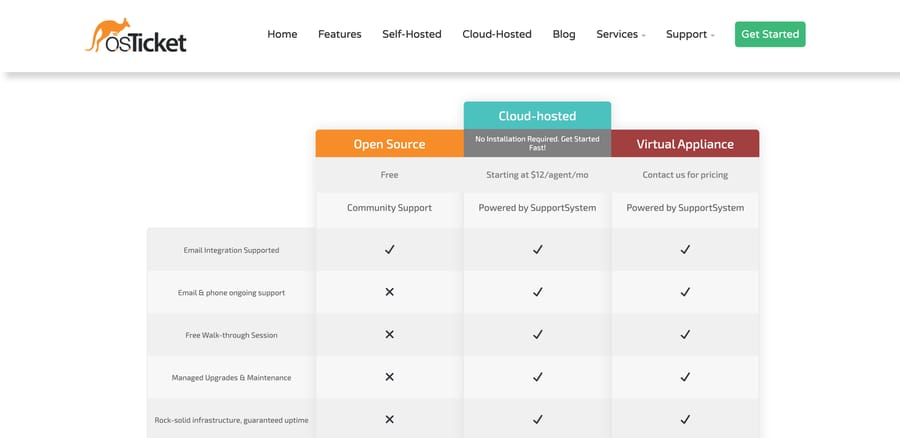
osTicket is the other name in every "free ticketing system" thread. It's GPL-2.0, runs on PHP and MySQL, and installs on hosting that will not run Zammad. Its editions page prices the cloud version from $12 per agent per month. Where osTicket wins is intake: custom forms and custom fields are its strength. Where it loses is the interface, which reviewers and Redditors consistently describe as dated. The last commit on its repository when we checked was pushed in June 2026, and the site is advertising an osTicket 2.0 rewrite.
GLPI wins when the ticket is about a laptop. It's free to self-host under GPL-3.0, its cloud starts at €19 per user per month with a 45-day trial, and it puts the asset record one click from the ticket. It's also more work to configure and its interface is the one people complain about most. Read our free IT ticketing roundup for the side-by-side.
Freshdesk is the paid comparison, and it comes with a correction. Freshdesk has no free plan any more. We checked freshworks.com/freshdesk/pricing on 2026-09-20 and again on 2026-09-24: it publishes Growth at $19, Pro at $55 and Enterprise at $89 per agent per month billed annually, the phrase "free plan" is not on the page, the old /freshdesk/free-help-desk-software/ URL returns a 404, and signup offers a 14-day trial. The closest thing left is Freshworks' Free program, which covers up to 2 agents for 6 months. Freddy AI Agent comes with 500 sessions, a one-time allowance per account, and then costs $49 per 100 sessions. A 10-agent team pays $190 a month there against €160 on Zammad Professional v2, and what the extra buys is the automation depth that Zammad's users ask for.
For the wider field, our open-source ticketing roundup and best free help desk software put all of these together.
Can you add an AI agent to Zammad?
We build Macha, an AI agent layer that answers tickets inside a help desk a team already runs. It runs on Zendesk, Freshdesk, Gorgias, Front, HubSpot or Intercom, and it does not connect to Zammad, so on a Zammad instance the AI on the table is Zammad's own, metered at €0.03 per call and aimed at helping the agent rather than replacing the reply. If you end up on one of those desks instead, our pricing is published per ticket rather than per agent, and our team builds and monitors the agents.
How we researched this
We read zammad.com on 2026-09-20 and rechecked the prices, the GitHub counts and the competitor pages on 2026-09-24: the pricing page with both its hosted and self-hosted tabs, the open-source page and the home page. Repository facts came from the GitHub API and from the repo page itself, and we read the LICENSE file directly rather than trusting either summary. The interface screenshots are Zammad's own documentation images. We did not install Zammad, so nothing here is a measurement from an instance of ours, and the one contradiction we found between two vendor pages is printed below instead of quietly resolved.
Frequently asked questions
Is Zammad free? Yes, if you self-host it. The software is free with the full feature set, no agent cap and no ticket cap, and Zammad says so on its own open-source page. You pay for the server, and optionally for a support contract starting at €2,999 a year.
Is there a free Zammad cloud plan? No. The hosted product starts at €7 per agent per month billed annually, or €9 monthly, capped at 5 agents on that tier. There's a free trial, and then it ends.
What license is Zammad under? The repository ships the GNU Affero General Public License v3, and GitHub labels it AGPL-3.0, although zammad.com's open-source page says GPL v3. Take the license file as authoritative. AGPL matters if you modify Zammad and expose it over a network.
Zammad vs osTicket: which should I choose? osTicket if you need custom intake forms and the cheapest possible hosting, since it runs on any PHP box. Zammad if you want a modern tabbed interface, multi-channel intake and full-text search, and you can run PostgreSQL and Elasticsearch. Both are free to self-host, so install both before deciding.
What does Zammad need to run? Ruby on Rails with PostgreSQL and Elasticsearch, plus a reverse proxy. Zammad's page says outright that in the self-hosted version you're responsible for updates, backups and availability. Budget a real VM rather than shared hosting.
Does Zammad do asset management? No. Tickets, knowledge, channels and reporting, yes; hardware, licenses and a CMDB, no. If you need both in one system, GLPI is the open-source option that covers them.
How much do Zammad's AI features cost? €0.03 per AI call, on top of your plan, where a call is one interaction such as generating a ticket summary. It's optional and can be enabled feature by feature. At 3,000 AI-assisted tickets a month that is about €90.
How many agents does Zammad support? Self-hosted, as many as your server handles. Hosted, the tier decides it: 5 on Starter v2, 35 on Professional v2, unlimited on Plus v2 at €25 per agent per month.
Is Zammad good for a small IT team? Yes, and it's one of the better options at 3 to 10 people, provided one of you is comfortable maintaining the stack. Teams without that person should take the hosted plan or pick a desk that runs on shared hosting.
Sources: zammad.com, Zammad pricing, Zammad open source, zammad/zammad on GitHub, Zammad user documentation, Capterra Zammad reviews, Zammad community thread, osTicket editions, GLPI pricing, Freshdesk pricing.
Simple per-ticket AI pricing
One thread with one person is one charge, however many replies it takes.