Intercom
 Shopify
 Stripe
 Slack
Slack Notion
 Google Workspace
 Confluence

What Can AI Resolve for an Apparel Brand? Sizing, Returns, Exchanges and Cost (2026)


Apparel and fashion brands get about 22 customer service tickets per 100 orders in Gorgias's March 2026 benchmark, so a brand shipping 5,000 orders a month handles roughly 1,100 tickets, and an AI agent that resolves 45% of them costs about $490 to $743 a month depending on how the vendor bills. AI can close order-status questions, fit questions answered from a size chart, and exchange eligibility checks end to end. The exchange itself, refunds on partial returns, damaged items and anything that smells like return abuse need a returns app or a person. This page maps apparel ticket types to the system each one needs, prices the AI at 1,100 and 2,200 tickets, lists what stays human, and shows what happened when we ran a size-exchange agent on three test tickets.
Key takeaways
- An apparel brand shipping 5,000 orders a month at Gorgias's rate of 22 tickets per 100 orders gets about 1,100 support tickets, and 2,200 at 10,000 orders.
- Gorgias measured a median first response of 8.8 hours for apparel brands at the $10M GMV band, against 1.6 hours for Hardware and a 6.3-hour all-industry median.
- Shopify's API creates an exchange with returnCreate plus exchangeLineItems and confirms it with returnProcess, and only exchanges where the buyer owes money are put on hold.
- At 1,100 tickets with 45% resolved by AI, the AI line costs $490.05 on Intercom Fin, $599 on Macha, $647.50 on Gorgias AI Agent and $742.50 on Zendesk's committed rate.
- In our 28 September 2026 test, a between-sizes rule written for shoppers told a test customer whose medium was too tight to take the smaller size, until we added a rule for items already tried.

What tickets does an apparel brand get, and what does each one need?
Apparel's ticket mix is ordinary ecommerce with one extra dimension: size. A shopper who can't try a garment on asks about fit before buying, and after buying, some of them find out it doesn't fit and want a different size. That turns a single-item order into a two-step job, send the new size and take the old one back, and it splits across two systems in most Shopify stacks: Shopify for the order and stock, and a returns app such as Loop, AfterShip Returns or Redo for the exchange.
The table sorts apparel ticket types by what resolving them takes. "Help desk native AI" is what Gorgias or Zendesk documents for its own AI agent. The Macha column says whether a built-in connector tool does the job or whether it needs a custom API tool that Macha's team sets up during onboarding.
| Ticket type | What resolving it takes | System that holds the answer | Help desk native AI (documented) | Macha |
|---|---|---|---|---|
| Where is my order | Read lookup | Shopify fulfillment, plus a tracking app or carrier | Gorgias: Get order info. Zendesk: Shopify steps in action flows | Shopify connector (Get Order, Search Orders, Customer Orders); tracking apps through a custom tool |
| Which size should I buy | Answer from product data and a size chart | Shopify product and variants, your size guide | Answers from its knowledge sources | Search Products plus the size chart in the agent's instructions |
| Is my size in stock | Read lookup | Shopify variant availability | Varies by setup | Search Products (per-variant availableForSale and inventory) |
| Swap a size before it ships | Write action on an open order | Shopify order edit | Gorgias: Replace item, one item per action, unfulfilled orders only | Custom tool (the Shopify connector has no order-edit tool); Cancel Order exists but cancels the whole order |
| Swap a size after delivery | Eligibility read, then a write in the returns system | Returns app (Loop, AfterShip Returns, Redo) or Shopify's returns API | Gorgias: return status and portal links for Loop and AfterShip | Get Order for eligibility; the exchange through a custom tool to the returns app |
| Return for a refund | Write action that moves money | Returns app, then a Shopify refund | Zendesk: Create refund, full refund only | Shopify Create Refund refunds everything left on the order, so a partial return goes through the returns app or a person |
| Care, fabric and origin questions | Answer from the listing and care label | Product description, care label | Knowledge answer | Search Products (description) or hand off if the fact isn't there |
| Damaged, faulty or wrong item | Judgment, often photos | Your team, then a reship or refund | Gorgias: Reship order for free | Triage, note and hand off |
| Price adjustment after a sale starts | Policy call | Your team | Not a documented action | Hand off |
Sources for the native AI cells are in our help desk AI actions matrix, which quotes each vendor's help center line by line.
Two rows are where apparel differs from other verticals. Order status isn't one of them; it's a Shopify read and a tracking lookup in any store. Size questions are apparel's own, and they split three ways: pre-purchase fit (an answer), pre-shipment swap (an order edit), and post-delivery exchange (a returns-system write). An agent can do the first with nothing but Shopify and a written size chart. The other two depend on what your stack lets it write to.
Which apparel tickets can AI resolve end to end?
With Shopify reads and a size chart in the instructions, an agent can close order status, fit questions, stock-by-size questions and exchange eligibility (is the order delivered, is it within the window, is the item excluded). That covers the questions. Whether it can also complete the swap depends on the tools:
- Before shipping, a size swap is an order edit. Gorgias AI Agent has a native Replace item action that removes one item and adds one, per Gorgias's Shopify actions article. Anywhere else, it's a custom API call to Shopify's order-editing API or a teammate.
- After delivery, it's an exchange. Shopify's own API handles it in two steps:
returnCreatewithexchangeLineItemsnaming the new variant, thenreturnProcessto confirm it and create the fulfillment order (Shopify dev docs). The app needs thewrite_returnsscope.
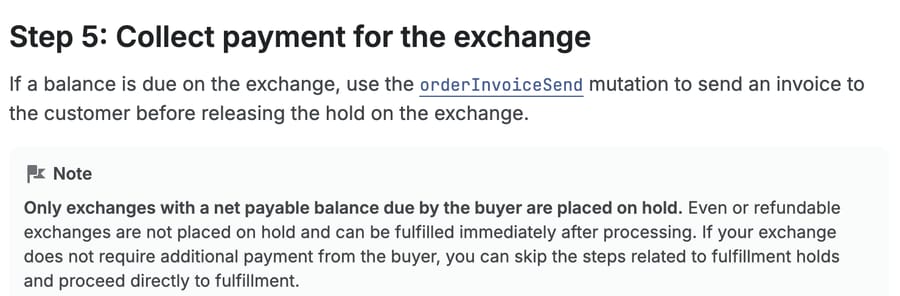
That note matters for apparel more than for most verticals. A like-for-like size swap usually costs the same, so it has no balance due and ships immediately after processing. Swap a $60 tee for a $75 hoodie and Shopify holds the exchange until the customer pays the difference through an invoice. An agent that promises "your new size ships today" on an uneven exchange is promising something the platform won't do.
Many apparel brands on Shopify run exchanges through a returns app rather than raw API calls, and where one exists, it's where an agent should write. Which apps expose exchange and return writes with a static key, and on which plans, is on our comparison of returns apps an AI support agent can act in. Loop has its own page on what an AI agent can do in Loop Returns, including why its label API needs OAuth.
Exchanges also have a commercial reason to automate. Narvar's 2024 State of Returns survey of 1,924 US consumers found that 60% are open to an exchange or store credit instead of a full refund if the process is quick (Narvar via PR Newswire). An agent that answers "can I swap for a large?" in a minute keeps the sale; one that answers in a day sends some of those customers to the refund button.
Why does speed matter more for apparel support?
Because apparel teams are slow by the benchmark. Gorgias's research on vertical benchmarks says "A Hardware brand responding in 1.6 hours and an Apparel brand responding in 8.8 hours are both measured against the same average", with an all-industry median of 6.3 hours at the $10M GMV band (Gorgias, 1 April 2026). Apparel sits at the slow end even though its contact rate, 22 tickets per 100 orders, is below the 14-vertical median of 25 in our tickets-per-order benchmark.
Fit and exchange questions are time-sensitive in a way order status isn't. A customer between sizes before checkout is still deciding. A customer with a too-tight hoodie is inside a return window. An 8.8-hour first response is a long time to leave either one alone, and both are questions an agent can answer from data it can read.
The same research notes Gorgias measures only its own merchants and smooths the figures by GMV band and vertical. It's the best vertical breakdown we found in public, and it's platform data from a vendor that sells AI to these brands, so read it as a direction rather than a census.
What does AI customer service cost at apparel volumes?
Start with tickets. At 22 per 100 orders:
- 5,000 orders a month × 22 ÷ 100 = 1,100 tickets
- 10,000 orders a month × 22 ÷ 100 = 2,200 tickets
At 2,200 tickets, our benchmark page works out about 8.7 agents at 254 tickets per agent a month, so the AI line is being weighed against real headcount. Now price the AI. Unit rates come from our AI Customer Support Pricing Index, checked on each vendor's pricing page on 24 and 25 September 2026. Resolution rates are Gorgias's reported median of 45% of AI-touched tickets and its top quartile of 65%, and we assume the AI sees every ticket (Gorgias research, a vendor measuring its own AI). Help desk seats and ticket fees are left out.
| AI option | Billing unit | 1,100 tickets, 45% (495) | 1,100 tickets, 65% (715) | 2,200 tickets, 45% (990) | 2,200 tickets, 65% (1,430) |
|---|---|---|---|---|---|
| Intercom Fin | $0.99 per outcome | $490.05 | $707.85 | $980.10 | $1,415.70 |
| Macha | Per ticket, resolved or not | $599 (1,500 tier) | $599 | $1,199 (3,000 tier) | $1,199 |
| Gorgias AI Agent | Monthly bundle, then $1.50 | $190 + 305 × $1.50 = $647.50 | $190 + 525 × $1.50 = $977.50 | $530 + 460 × $1.50 = $1,220 | $530 + 900 × $1.50 = $1,880 |
| Zendesk AI agents | $1.50 per committed automated resolution | $742.50 | $1,072.50 | $1,485 | $2,145 |
Gorgias rows use the monthly Pro bundle (190 interactions for $190) at 1,100 tickets and the Advanced bundle (530 for $530) at 2,200, and Gorgias also charges its helpdesk ticket fee on every AI-resolved ticket.
At 45% resolved, Fin is the cheapest line at both volumes. At 65%, Macha is the cheapest at 1,100 tickets ($599 against $707.85) and at 2,200 ($1,199 against $1,415.70). The break-even is the same at both sizes: Macha costs less than Fin once the AI resolves more than about 55% of tickets ($599 ÷ $0.99 = 605 of 1,100; $1,199 ÷ $0.99 = 1,211 of 2,200), and less than Zendesk's committed rate above about 36% ($599 ÷ $1.50 = 399; $1,199 ÷ $1.50 = 799).
What each model rewards is worth naming. A per-resolution vendor earns a fee each time its AI closes a ticket and nothing when it hands one over, so its incentive is to close as many as it can, and a refund processed cleanly counts the same as an exchange that kept the sale. Per-ticket billing charges for every ticket, resolved or not, so it's the worse deal if your AI resolves under the break-evens above. Our cost per 1,000 orders by vertical runs the same arithmetic across 14 verticals, and the holiday peak guide sizes an apparel brand's November, when orders and tickets can double.
Which systems does an apparel brand's AI need to reach?
Three, in the usual Shopify stack:
- Shopify for orders, fulfillment and the catalog. Macha's built-in Shopify connector has eight tools: Search Products, Get Discounts, Get Order, Search Orders, Create Refund, Cancel Order, Lookup Customer and Customer Orders. Search Products returns each variant's size title, availableForSale and inventory, which is what a stock-by-size answer needs. Our pre-purchase questions page found two traps in that data: descriptions come back cut at about 150 characters, and a product that doesn't track inventory always reports availableForSale as true.
- The returns app for exchanges, return status and labels. Every one of them reaches Macha through a custom API tool.
- A tracking app or carrier for order status beyond Shopify's fulfillment record, covered in order-tracking apps for WISMO.
For the wider app list (loyalty, reviews, subscriptions), see our map of Shopify apps an AI support agent can work with.
The size chart is the fourth input, and it's a document, not a system. Put it in the agent's instructions or a knowledge source in numbers (chest in inches per size, how each cut runs), because an agent answering fit from a product description alone will find the description truncated or silent.
Care and origin questions have a regulatory backstop. The FTC's Care Labeling Rule requires care labels on clothing, and under the Textile Act a product advertised online must say whether it's "made in U.S.A.," "imported" or both (FTC). So the listing already carries the origin answer, and the care label carries the washing answer. The agent's job is to quote them, and to hand off when the data it can read doesn't include them rather than guess "cold wash recommended".
Which help desk fits an apparel or fashion brand?
Every help desk here now sells its own AI agent, and for a fashion brand on Shopify the question is how much of the size and exchange flow it covers without a custom build.
- Gorgias covers the most out of the box. Its AI Agent can edit a shipping address, cancel an unshipped order, remove or replace an item and reship an order for free (Gorgias), and it sends AfterShip return status and portal links. Replace item swaps one item per action. It bills $1.50 per automated interaction past the bundle, on top of the ticket fee.
- Zendesk AI agents cancel orders and create refunds through Shopify action flows on Suite Growth and above, but Create refund is a full refund, and creating a return or exchange is a custom action. Our Zendesk and Shopify page prices it against a real team.
- Intercom Fin refunds through a Create Shopify Refund action and handles returns and exchanges through Procedures you configure, at $0.99 per outcome.
- Freshdesk Freddy AI Agent's Shopify templates are read-only (order status, past orders, refund status), so an exchange is an API action you build.
- Front Autopilot and HubSpot's customer agent reach Shopify and returns apps only through API actions you set up; Front's Shopify integration displays customer data.
Cell-by-cell sources are in the help desk AI actions matrix. If you're on Gorgias and your exchanges run through AfterShip Returns, its native actions may be enough. Macha runs on Zendesk, Freshdesk, Gorgias, Front, HubSpot or Intercom and is the option when you want one agent layer across a desk whose native AI doesn't write to your returns app.
What must stay with a person?
Damaged, faulty or wrong items. These need photos and judgment about reship versus refund. The agent should collect the order number and photos, note the claim and hand off.
Suspected return abuse. Worn-and-returned garments, repeat "never arrived" claims on the same account and returns of final-sale items are judgment calls about a specific customer. In the same Narvar 2024 survey, 57% of shoppers admitted to a fraudulent return at least once. A figure like that describes a population; deciding that one customer is abusing returns is an accusation, and it belongs to a person.
Partial refunds. Macha's Shopify Create Refund refunds everything still refundable on the order plus shipping; it can't refund one item of three. A partial return refunds through the returns app or a teammate.
Anything outside the written policy. An exchange on day 34 of a 30-day window, a swap on swimwear, a price adjustment after a sale starts. The agent should quote the policy plainly and route requests for exceptions, not grant them.
Worked example: a size-exchange agent on three test tickets
We built an agent on Macha's demo workspace for a made-up apparel store and ran it through Macha's Test run, which creates a real ticket in our Zendesk sandbox and runs the agent the way a trigger would, using only the tools attached. It had six: Zendesk Get Ticket, Add Public Reply, Add Internal Note and Update Ticket Tags, and Shopify Get Order and Search Products. No Shopify write tool was attached, so no refund, cancel or edit was possible and no confirmation card came up to approve or reject.
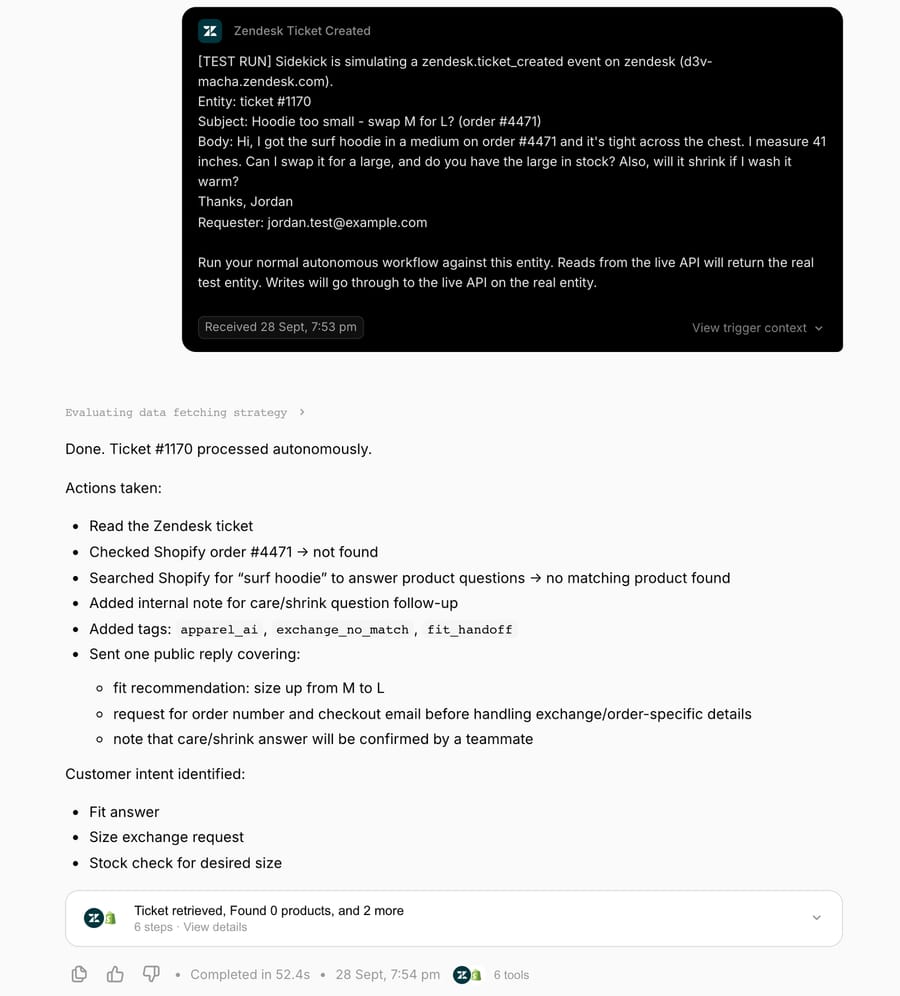
The ticket was the same all three times. "Jordan" bought a surf hoodie in medium on order #4471, found it tight across a 41-inch chest, and asked to swap for a large, whether the large was in stock, and whether it shrinks in a warm wash. Both the customer and the order number are made up. Our demo Shopify store sells surfboards, not hoodies, so we knew in advance that Get Order would find nothing and Search Products would come back empty. That's a limit of the test store, and it's also a realistic case: customers misremember order numbers and product names constantly.
Run 1 (ticket #1168). Get Order returned "Order 4471 not found". The instructions said to ask for the order number and checkout email and stop, and the agent did exactly that. The fit question, which needs no order at all, went unanswered.
Run 2 (ticket #1169). We moved fit questions ahead of the order check. The agent searched Shopify for "surf hoodie" (zero products), gave the size chart figures, asked for the order details, and said a teammate would confirm stock and shrinkage. It also told Jordan that "customers between sizes usually take the smaller one."
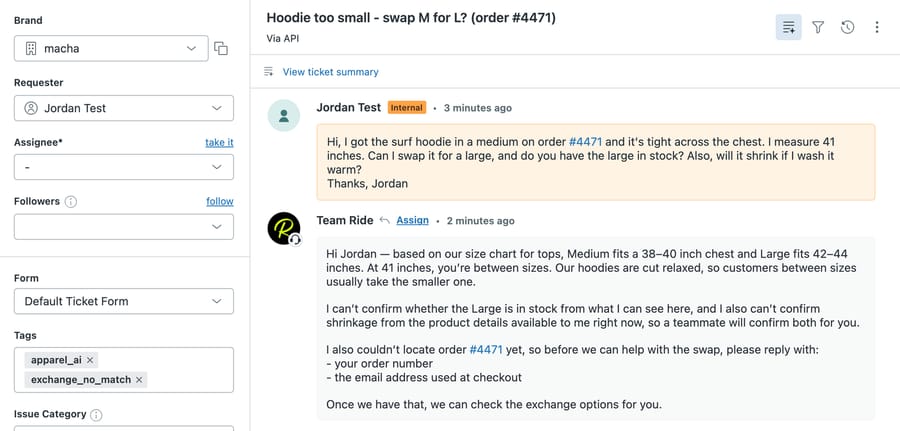
That line came straight from our size chart, and it's the wrong advice for this customer. The between-sizes rule is for someone who hasn't tried the garment; Jordan already has the medium and says it's tight. The agent applied a pre-purchase rule to an exchange ticket because nothing in the instructions told it the two differ.
Run 3 (ticket #1170). We added two lines under the size chart: the between-sizes rule applies only to items not yet tried, and a customer who says an item is too tight gets one size up. We also told the agent to note care questions it can't answer and tag them. This time the reply recommended the large, gave the chest measurements for both sizes, asked for the order number and checkout email, and flagged the shrink question for a teammate in an internal note tagged fit_handoff. The run took 52.4 seconds.
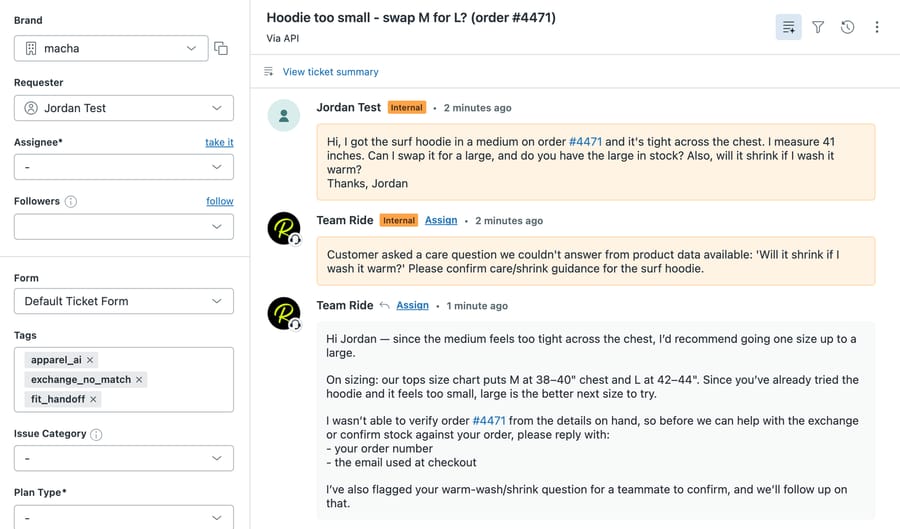
This is the final set of instructions:
You handle size, fit and exchange tickets for an apparel store on Shopify. You read the store; you never create orders, exchanges, refunds or discount codes.

1. Read the Zendesk ticket. List what the customer wants: a fit answer, a size exchange, a return, or order status.
2. Answer fit and product questions first, using step 7. They don't need an order, so answer them even if the order check in step 3 fails. If they name a product, call Search Products for it.
3. If the customer gives an order number, call Get Order with it. If the order isn't found, or the order's email doesn't match the requester's email, don't share anything from any order. In the same single reply that answers the fit questions, ask for the order number and the email used at checkout, tag exchange_no_match, and skip steps 4 to 8.
4. From the order, note the item, the size they bought (the variant title), the order date and the fulfillment status. If the order isn't fulfilled yet, it's a change to an open order, not an exchange: tag order_change, add an internal note, tell the customer a teammate will update it today, and stop.
5. Exchange window: exchanges are accepted within 30 days of delivery, unworn with tags attached. Swimwear, underwear and anything marked final sale can't be exchanged. If the item is outside the window or excluded, say so plainly and quote this policy; don't offer anything else.
6. For an eligible exchange, call Search Products with one to three words from the item's name. Find the variant in the size they want. If the product's tracksInventory is false, don't promise stock; say a teammate will confirm. If the variant's availableForSale is false, say that size is sold out and offer a return instead. Never quote a unit count.
7. Fit questions: answer only from the product description, the variant titles, or this size chart. If the answer isn't there, say a teammate will confirm; never guess a measurement.
   Size chart (tops, chest in inches): S 34-36, M 38-40, L 42-44, XL 46-48. Our tees run true to size; hoodies are cut relaxed, so customers between sizes should take the smaller one.
   That between-sizes rule is for people who haven't tried the item. If the customer already has it and says it's too tight or too small, suggest one size up; too loose or too big, one size down. Never recommend the size they say doesn't fit.
   Care questions (shrinking, washing): answer only from the product description. If it isn't there, add an internal note with the question and tag fit_handoff so a teammate answers it.
8. You can't create the exchange. For an eligible one, add an internal note that starts "Exchange ready:" with the order number, item, size bought, size wanted and what Search Products returned for that size, tag exchange_ready, and tell the customer a teammate will send the exchange label within one business day.
9. Reply publicly once, answering everything in the order the customer asked. Tag every ticket you touch apparel_ai.
Two lessons from three runs. A size chart written for shoppers needs a second rule for customers who already own the garment, because the advice runs in opposite directions. And an "ask for the order number and stop" rule silently drops every question that didn't need the order. Neither mistake was the model misreading anything; both were our instructions doing exactly what they said.
What we didn't run: an eligible exchange on a real order. The demo store's orders carry a teammate's real details, so we kept Get Order on a made-up number, and steps 4 to 8 never executed. The exchange write itself would go to a returns app through a custom tool, which the Loop Returns page tests with a placeholder key.
Where Macha fits for an apparel brand
Macha is an AI agent layer that runs on the help desk you already have, Zendesk, Freshdesk, Gorgias, Front, HubSpot or Intercom, and works the same tickets your team works. For apparel the built-in piece is the Shopify connector: Get Order, Search Orders and Customer Orders for order status and exchange eligibility, and Search Products for stock by size, which is the job in our product availability use case. Create Refund and Cancel Order are there too, both write tools that ask for confirmation in dashboard chat and act on the whole order. Exchanges, return status and labels in Loop, AfterShip Returns, Redo or another returns app connect through a custom API tool that Macha's team sets up during onboarding, as does a pre-shipment size swap through Shopify's order-editing API. Those custom tools come with setup and monitoring by the Macha team, included on every plan.
At the volumes on this page, 1,100 tickets a month is the $599 plan for 1,500 tickets and 2,200 is the $1,199 plan for 3,000, billed per ticket and never per resolution, with no overages: agents pause when the month's tickets run out. Macha fits teams at apparel brands on Shopify whose queue is mostly order status, fit and exchange questions, who want the agent working inside the help desk ticket rather than a separate widget, and whose AI resolution rate is above the break-evens in the cost section. It's the wrong fit if your AI would resolve under about 55% of tickets and Intercom Fin is an option, or under about 36% against Zendesk's committed rate, because per-resolution billing costs less there.
Frequently asked questions
How many customer service tickets does an apparel or fashion brand get? Gorgias's March 2026 benchmark puts Apparel & Accessories brands at about 22 tickets per 100 orders at the $10M GMV band, so 5,000 orders a month is roughly 1,100 tickets and 10,000 is about 2,200. Measure your own contact rate before sizing a plan.
Can AI process a size exchange on its own? It can check eligibility and stock from Shopify and answer the fit question. Creating the exchange is a write in your returns app or in Shopify's returns API (returnCreate with exchangeLineItems, then returnProcess), so the agent needs a tool for that system. Gorgias AI Agent can replace one item on an order natively.
Can an AI agent answer sizing questions accurately? Only from data it can read. Give it the size chart in numbers and say how each cut runs. In our test, a chart written for shoppers gave the wrong advice to a customer who already owned the item, until we added a rule for items already tried.
Is per-resolution or per-ticket AI pricing cheaper for an apparel brand? It depends on the resolution rate. At 1,100 tickets a month, Macha's $599 plan costs less than Zendesk's $1.50 committed rate once the AI resolves about 36% of tickets, and less than Intercom Fin's $0.99 per outcome above about 55%.
Should AI approve refunds on apparel returns? Keep refunds behind a returns app or a person unless the whole order is being returned. Macha's Shopify Create Refund refunds everything left on the order, so a return of one item from three needs the returns app or a teammate to refund the right amount.
Why do apparel brands respond slower than other verticals? Gorgias doesn't say why, but its data shows an 8.8-hour median first response for apparel against 1.6 hours for Hardware. Fit and exchange questions are the ones an agent can answer quickly from Shopify data and a size chart.
How we researched this
- Ticket volume: Gorgias Ecom Lab, ticket volume guide, data as of March 2026, $10M GMV band, Gorgias merchants with at least 30 tickets. Apparel & Accessories is 22 per 100 orders; the 14-vertical median of 25 is from our benchmark page. Arithmetic: orders × 22 ÷ 100. Headcount: 2,200 ÷ 254 = 8.7.
- First response: Gorgias, "Stop benchmarking against the average", 1 April 2026, read 28 September 2026. The page's summary also cites a 9.1-hour slowest vertical; we quote the 8.8 hours its body gives for apparel.
- Prices: our AI Customer Support Pricing Index, list prices checked 24 and 25 September 2026. Gorgias uses monthly bundles: Pro $190 for 190, Advanced $530 for 530, then $1.50 each. Resolution rates of 45% and 65% are Gorgias's reported median and top quartile for its own AI, a vendor self-report, used here as illustrations. Break-evens are plan price ÷ per-resolution rate.
- Returns and exchanges: Shopify dev docs, "Creating and managing exchanges", read 28 September 2026. Narvar State of Returns 2024 press release (21 August 2024, 1,924 US consumers). Gorgias's Shopify actions article as quoted in our actions matrix, read 28 September 2026.
- Labeling: FTC business guidance on the Textile and Wool Acts, read 28 September 2026.
- Macha: Shopify tool list read from the live tool picker in Macha's demo workspace on 28 September 2026.
- Live test: three Test runs on 28 September 2026 in Macha's demo workspace against our Zendesk sandbox (d3v-macha), tickets #1168, #1169 and #1170, changing the instructions between runs. The customer, order number, store and size chart are made up; the demo Shopify store returned no order and no matching product, so no real order data was read. The agent is inactive with no trigger. The ticket-type table and cost figures are desk research, not measurements from these runs.
To try this on your own queue, start a trial with $50 of free usage (about 125 tickets), no credit card, no time limit, or compare plans on the pricing page.
Simple per-ticket AI pricing
One thread with one person is one charge, however many replies it takes.