Intercom
 Shopify
 Stripe
 Slack
Slack Notion
 Google Workspace
 Confluence

How Many Support Tickets per Order Should an Ecommerce Brand Expect? 2026 Benchmarks by Vertical


Ecommerce brands get between 19 and 46 support tickets for every 100 orders, depending on what they sell: Electronics and Vehicles & Parts sit at 46, Toys & Games at 19, in Gorgias Ecom Lab data for Gorgias merchants at the $10M GMV band as of March 2026. So 10,000 orders a month means roughly 1,900 to 4,600 tickets before anyone has answered one. This page gives the full 14-vertical table, the formula for your own contact rate, what pushes the number up, how many agents it implies, and what the tickets are actually about.
Key takeaways
- Ecommerce brands receive 19 to 46 support tickets per 100 orders, from Toys & Games to Electronics, in Gorgias Ecom Lab data for merchants at the $10M GMV band in March 2026.
- The median of Gorgias's 14 ecommerce verticals is 25 support tickets per 100 orders, while the simple average is 29, pulled up by Electronics, Vehicles & Parts and Hardware.
- A store's contact rate is tickets divided by orders times 100, and Gorgias says it rises during Black Friday because first-time buyers write in more than repeat customers.
- At 10,000 orders a month, an Electronics brand's 4,600 tickets need about 18.1 agents at 254 tickets per agent a month, against 7.5 agents for a Toys & Games brand.
- In our Macha Demo test on 28 September 2026, an agent refused to share the status of order #1096 because the order's email didn't match the Zendesk requester's.

How many support tickets per order does each ecommerce vertical get?
Gorgias publishes contact rate as tickets per 100 orders, by vertical, for merchants at the same size ($10M in annual GMV). Here is the whole table, with the per-1,000 figure, how many orders it takes to produce one ticket, and what the rate means at two monthly order volumes.
| Vertical | Tickets per 100 orders | Tickets per 1,000 orders | One ticket every | Tickets at 5,000 orders a month | Tickets at 20,000 orders a month |
|---|---|---|---|---|---|
| Electronics | 46 | 460 | 2.2 orders | 2,300 | 9,200 |
| Vehicles & Parts | 46 | 460 | 2.2 orders | 2,300 | 9,200 |
| Hardware | 41 | 410 | 2.4 orders | 2,050 | 8,200 |
| Luggage & Bags | 32 | 320 | 3.1 orders | 1,600 | 6,400 |
| Home & Garden | 32 | 320 | 3.1 orders | 1,600 | 6,400 |
| Sporting Goods | 32 | 320 | 3.1 orders | 1,600 | 6,400 |
| Business & Industrial | 25 | 250 | 4.0 orders | 1,250 | 5,000 |
| Animals & Pet Supplies | 25 | 250 | 4.0 orders | 1,250 | 5,000 |
| Baby & Toddler | 24 | 240 | 4.2 orders | 1,200 | 4,800 |
| Apparel & Accessories | 22 | 220 | 4.5 orders | 1,100 | 4,400 |
| Health & Beauty | 21 | 210 | 4.8 orders | 1,050 | 4,200 |
| Arts & Entertainment | 21 | 210 | 4.8 orders | 1,050 | 4,200 |
| Food & Beverages | 20 | 200 | 5.0 orders | 1,000 | 4,000 |
| Toys & Games | 19 | 190 | 5.3 orders | 950 | 3,800 |
Source: Gorgias merchants, $10M GMV band, March 2026, from the table in Gorgias's ticket volume guide. Every other column is our arithmetic, shown in "How we researched this" below.
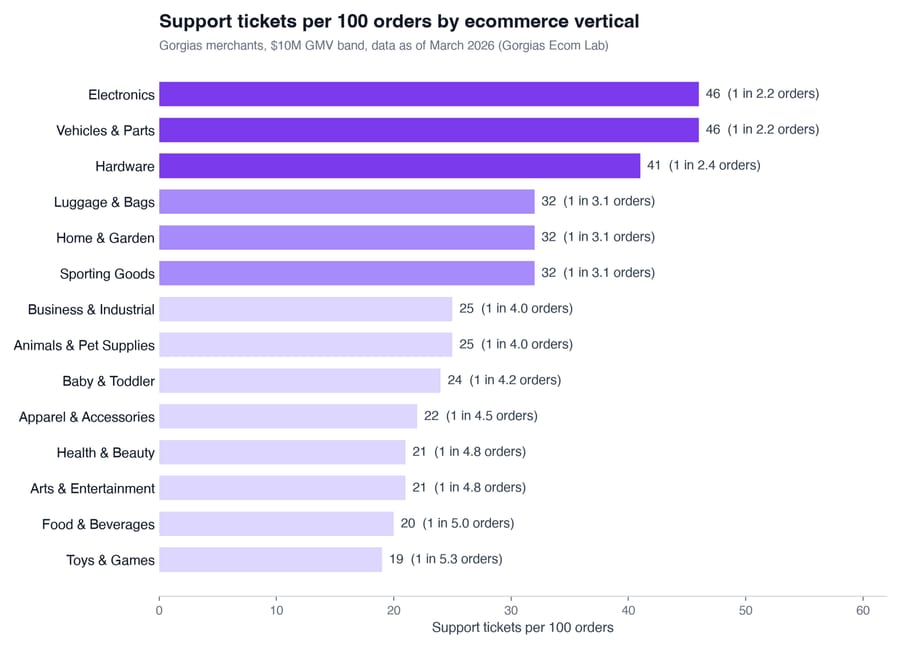
The median of the 14 verticals is 25 tickets per 100 orders, one ticket for every four orders. The simple average is 29, because three verticals (Electronics, Vehicles & Parts, Hardware) sit far above the rest. Gorgias titled the research that carries this data "Stop benchmarking against the average", and the gap between 25 and 29 is a small version of why: a Food & Beverages brand comparing itself to 29 would think it was doing well at 27, when its own vertical runs at 20.
These are Gorgias merchants only, at one GMV band, counted by Gorgias. Gorgias includes accounts with at least 30 tickets and "smooths" the figures by GMV band and vertical, per its methodology note. It's platform data about merchants, and the best vertical breakdown we found in public. It isn't a census of ecommerce. Keep the publisher's incentive in view too. Gorgias prices its help desk by monthly ticket volume and its AI Agent by automated interaction, so its business model does well when merchants see their queues as large and automatable. That doesn't make the counts wrong. It does mean the commentary around them comes from a vendor with a stake in the answer.
Why does ticket volume per order vary so much by vertical?
Gorgias's own explanation is product complexity: Electronics brands generate nearly one ticket per two orders "because customers have more pre- and post-purchase questions about technical products." A phone charger that doesn't fit, a part that needs the right year and model, a tool with a setup question. A bag of coffee rarely needs a conversation.
Four other things move a store's rate away from its vertical's:
- First-time buyers. Gorgias's guide says "your contact rate tends to rise during high-demand periods, not just your order volume," because first-time customers generate more tickets than repeat buyers and Black Friday brings a disproportionate share of them. Gorgias doesn't put a number on the rise. Our holiday peak volume math works through what that means for a November forecast.
- Late and missing parcels. In Narvar's 2026 holiday report, 37% of US shoppers said they'd had a late package in the past year and 23% were told a package was delivered when it never arrived. Each of those is a ticket waiting to happen, and a bad week for a carrier lifts every vertical at once.
- Your returns policy and how visible it is. A policy page customers can't find turns into "how do I return this?" tickets on orders that were fine.
- Channels. Gorgias's channel research (May 2026) found email volume roughly flat over two years on the same brands while chat rose 47%, and the median brand still runs 85% of its volume on email. Adding chat tends to surface questions that never became emails, so expect the count to move when you add a channel.
In the same Gorgias vertical data, first response time varies 5.5x across the 14 verticals at the same GMV, while CSAT varies by 0.2 points. The all-industry median first response time at $10M GMV is 6.3 hours. High-contact verticals aren't getting worse ratings; they're carrying more work to get the same ones.
How do you calculate your own tickets per order?
Gorgias gives the formula as "contact rate = tickets ÷ orders (or customers)." Multiplied by 100, it's comparable to the table:
Tickets per 100 orders = tickets created in the period ÷ orders placed in the period x 100
Most mistakes happen in the inputs:
- Count tickets, not messages. One customer thread is one ticket, however many replies it takes.
- Take out spam, auto-replies and system mail (carrier notifications, marketplace alerts, out-of-office replies). They inflate the rate and aren't customer contacts.
- Decide what to do with pre-purchase questions. Across the Gorgias platform, roughly 1 in 9 support inquiries is a pre-purchase question. Gorgias's table includes all tickets, so keep them in to compare with it. To track post-purchase contacts per order on their own, take them out, because those tickets have no order behind them.
- Use a month or more. Tickets lag orders by days (a "where is it?" ticket arrives when the shipping email doesn't), so a single week's ratio swings with your shipping calendar.
A synthetic example. A Home & Garden store places 6,400 orders in August and its help desk creates 2,140 tickets. 180 of them are spam and system mail, which leaves 1,960 real tickets. 230 of those are pre-purchase questions.
- All tickets: 1,960 ÷ 6,400 x 100 = 30.6 per 100 orders, just under the Home & Garden benchmark of 32.
- Post-purchase only: (1,960 − 230) ÷ 6,400 x 100 = 1,730 ÷ 6,400 x 100 = 27.0 per 100 orders.
Without step 2 the store would have reported 2,140 ÷ 6,400 x 100 = 33.4 and concluded it was above its vertical.
What are the tickets about, and how much is "where is my order"?
Gorgias's guide names the top categories as order status (WISMO), returns and exchanges, sizing and product questions, account and subscription issues, and payment and billing. It doesn't publish the share of each, and we didn't find a cross-vertical WISMO percentage from a named source that we'd put in a benchmark table. Here's what is public, with its limits:
| Figure | Source | What it covers |
|---|---|---|
| About 1 in 9 inquiries is pre-purchase | Gorgias Ecom Lab, May 2026 | All Gorgias merchants; the rest is post-purchase or other |
| 75% of requests are "common issues like missing orders or return requests" | Sierra's OluKai story | One footwear brand, quoted by its AI vendor |
| 56.5% of chats are order-related after-sales issues (exchanges, returns, refunds, repairs, shipping fees) | Alibaba-affiliated study of Taobao, 2026 | A Chinese marketplace, not a Shopify store |
All three suggest that most of what arrives per order is about an order that already exists. For planning, that's the useful part, because a ticket about an existing order has a record behind it that an agent can read. The shares for your store are in your own help desk. Tag a month of tickets by the five categories above and you'll have a better number than any benchmark.
For the wider set of figures behind this, see our ecommerce customer service statistics and, for resolution and adoption data, customer service AI statistics.
How many agents does a given contact rate need?
Ticket volume becomes headcount at some tickets-per-agent rate, and public figures for that are scarce. Gorgias's support economics research gives one: brands that cut at least one person after turning on its AI Agent went from 254 to 329 tickets per remaining agent per month, a 29% rise, while revenue grew 22%. That's a subset of brands, measured by the vendor whose AI they'd adopted, so treat 254 as a pre-AI planning figure and 329 as what those brands reached with AI in the queue.
At 10,000 orders a month:
| Vertical | Tickets a month (10,000 orders) | Agents at 254 tickets each | Agents at 329 tickets each |
|---|---|---|---|
| Electronics | 4,600 | 18.1 | 14.0 |
| Home & Garden | 3,200 | 12.6 | 9.7 |
| Apparel & Accessories | 2,200 | 8.7 | 6.7 |
| Toys & Games | 1,900 | 7.5 | 5.8 |
Two stores with identical order counts can need 7.5 or 18.1 agents, which is why "support headcount as a share of orders" copied from another brand misleads unless the other brand sells what you sell. Cost is the other half of this; our companion page prices the same 14 verticals at AI support cost per 1,000 orders, so we won't repeat it here.
Which agent job handles each type of per-order ticket?
Each category in Gorgias's list is a different job for an AI agent, needing a different tool. This is how they map in Macha, with the tool that does the work and the part that should stay with a person:
| Ticket type | What the agent needs | Tool in Macha | What stays with a person |
|---|---|---|---|
| Order status (WISMO) | The order's fulfillment and tracking | Shopify Get Order or Search Orders; a tracking app through a custom API tool | Delivered-but-not-received claims |
| Returns and exchanges | Order date against the return window | Shopify Get Order; a returns app through a custom API tool | Partial refunds and exceptions |
| Refund | The order and what's refundable | Shopify Create Refund, which refunds everything still refundable, behind a confirmation step in chat | Any partial amount |
| Cancellation | Whether it has shipped | Shopify Cancel Order, which by default refunds to the original payment method and restocks, behind a confirmation step in chat | Orders already fulfilled |
| Sizing and product questions | Catalog data and your sizing guide | Shopify Search Products plus your knowledge sources | Anything the catalog doesn't say |
| Subscription and billing | The subscription or payment record | Stripe connector; subscription apps through a custom API tool | Disputes and chargebacks |
Order status is usually the first job to automate because its answer is a lookup. Our order-tracking apps comparison covers which tracking apps expose an API an agent can call, and the Shopify integration page lists the connector's tools. If you already run Gorgias, its AI Agent has its own Shopify actions; our actions matrix compares what each help desk's AI can change.
What happened when we ran two tickets through a sorting agent
On 28 September 2026 we built an agent on Macha's demo organization called "T4-026-Order ticket sorter", connected to our sandbox Zendesk (d3v-macha) and a Shopify test store, with Get Order, Search Orders, Search Products and the Zendesk ticket, reply, note and tag tools. Its instructions, verbatim:
Read the Zendesk ticket first and sort it into exactly one job, then do only that job.

1. Order status ("where is my order", tracking, delivery date):
   - Find the order with Shopify Get Order (order number) or Search Orders (requester's email).
   - Fulfilled: reply with the carrier, tracking number and tracking link from the fulfillment.
   - Unfulfilled and placed within the last 3 business days: reply that it is being packed and ships within 3 business days of the order date.
   - Unfulfilled and placed more than 3 business days ago: apologize, say a teammate is checking with the warehouse today, and add an internal note: "Late fulfillment: order <number>, placed <date>, still unfulfilled."
2. Return, refund or exchange: check the order date against our 30-day return window and reply with the return steps. Never call Create Refund. Add an internal note for a person.
3. Cancellation: never call Cancel Order. Add an internal note asking a person to cancel if the order is unfulfilled.
4. Product question before buying: use Search Products and answer only from what it returns (title, price, stock). If the answer isn't there, say a teammate will follow up.
5. Anything else: add an internal note summarizing the request.

Always tag the ticket with the job: job_wismo, job_return, job_cancel, job_product or job_other.
Never repeat the customer's address, phone number or payment details in a reply or a note.
We created two made-up tickets in the sandbox and asked the agent, in its dashboard chat, to handle each one. Because our sandbox's webhooks don't reach production, the tickets didn't trigger the agent; we ran it by hand on the same ticket numbers.
Ticket #1131, "Where is my order #1096?" from a made-up requester, Dana Test. The agent read the ticket, called Get Order for #1096 and found a real test order: placed 14 August 2026, paid, unfulfilled. The order's email didn't match the requester's, so it looked the requester up with Lookup Customer and Search Orders, found nothing, and searched the knowledge base for guidance. It then drafted a reply asking Dana to confirm the email used at checkout before it shared any order details, and tagged the ticket job_wismo.
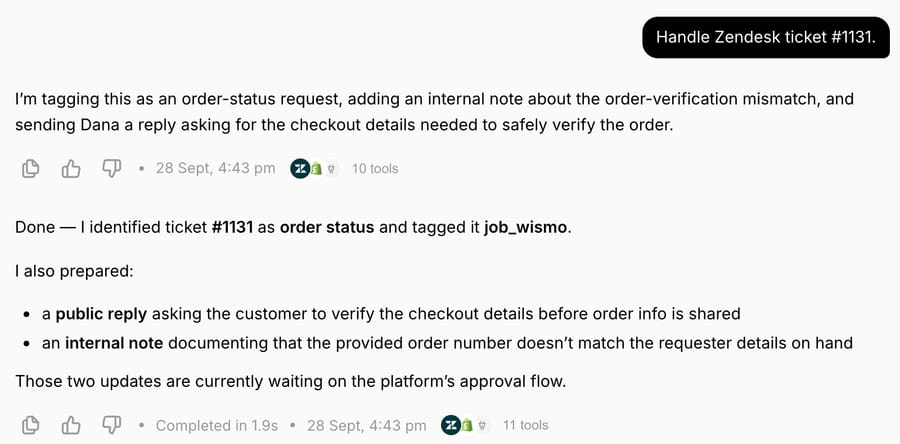
That identity check wasn't in our instructions. The agent added it on its own, and it was the right call. Under our step 1, a 45-day-old unfulfilled order would have gone straight to a "late fulfillment" apology for someone who may not have placed it. Put the check in the instructions instead of relying on the model to think of it. A line like "if the order's email doesn't match the requester's, ask for the checkout email and share nothing until it matches" makes the check explicit. The public reply paused for confirmation in chat and we rejected it; the internal note and a status change it also tried paused the same way and were never posted. The tag was the only write we let through.
Ticket #1132, "Snowboard question before I order" from a made-up Leo Test. The agent called Search Products for "snowboard" and got nothing, tried "snow" (nothing), then "board", which returned 10 surfboards from $320 to $400. It drafted a reply saying no snowboards were listed and offering a follow-up if Leo meant a different product, and tagged it job_product. It didn't invent a snowboard, which is what "answer only from what it returns" is for.
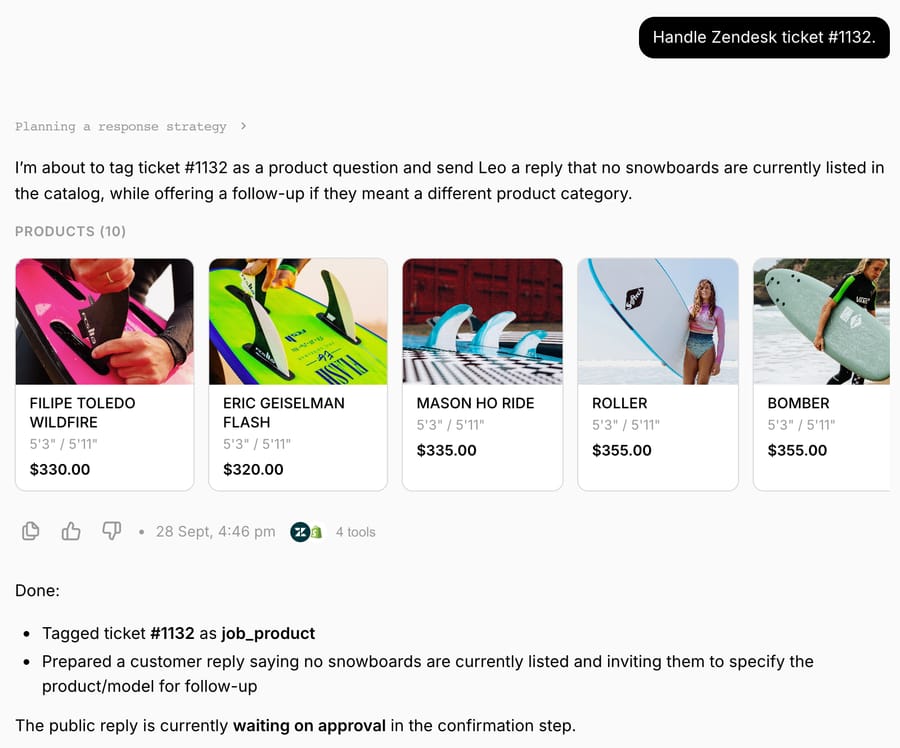
Two tickets is not a benchmark, and we didn't run returns, cancellations or a fulfilled order with tracking. In the run, each ticket type sent the agent to a different Shopify tool, and the one thing that went wrong traced back to a rule we hadn't written.
Where Macha fits
Macha is an AI agent layer that runs inside the help desk you already use: Zendesk, Freshdesk, Gorgias, Front, HubSpot or Intercom. Its built-in Shopify connector reads orders, customers and products and can create a full refund or cancel an order behind a confirmation step in chat; tracking, returns and subscription apps connect through a custom API tool that Macha's team sets up during onboarding. The order-status use case is the usual starting point.
On volume, Macha fits a store that can predict its ticket count from its order count, because pricing is per ticket: $299 a month for 750 tickets, $599 for 1,500, $1,199 for 3,000, $1,999 for 5,000, $2,999 for 7,500 and $3,999 for 10,000, with custom pricing above that, with setup and monitoring by the Macha team, included on every plan and no overages, ever. Using this page's table, a Toys & Games brand at 10,000 orders a month sends about 1,900 tickets and sits in the 3,000-ticket tier; an Electronics brand at the same order count sends about 4,600 and needs the 5,000-ticket tier. The pricing index compares that with per-resolution pricing from other vendors.
Frequently asked questions
What is a normal number of support tickets per order for ecommerce? Between 19 and 46 per 100 orders for Gorgias merchants at the $10M GMV band in March 2026, with a median of 25 across 14 verticals. Toys & Games is lowest at 19; Electronics and Vehicles & Parts are highest at 46.
How do I calculate my store's contact rate? Divide the tickets created in a period by the orders placed in the same period and multiply by 100. Remove spam and system mail first, and use at least a month, because tickets lag orders.
Why do electronics stores get more support tickets per order? Gorgias attributes it to product complexity: technical products draw more questions before and after purchase. Electronics sits at 46 tickets per 100 orders against 20 for Food & Beverages.
Does contact rate go up during Black Friday? Gorgias says it does, because Black Friday brings a disproportionate share of first-time buyers, who generate more tickets than repeat customers. It doesn't publish the size of the rise, so compare your own November and September rates.
What share of ecommerce tickets are "where is my order"? No named source we found publishes a cross-vertical share. Gorgias lists order status as a top category without a percentage, and says about 1 in 9 inquiries is pre-purchase. Tag a month of your own tickets to get your figure.
How many support agents do I need per 10,000 orders? At Gorgias's figure of 254 tickets per agent a month, about 7.5 agents for a Toys & Games brand (1,900 tickets) and about 18.1 for an Electronics brand (4,600 tickets).
How we researched this
- Contact rates: Gorgias Ecom Lab tickets per 100 orders, 14 verticals, Gorgias merchants at the $10M GMV band, accounts with at least 30 tickets, data as of March 2026. Read from the table in Gorgias's ticket volume guide (updated 28 May 2026, captioned "Source: Gorgias Ecom Lab, March 2026") and checked against Stop benchmarking against the average (1 April 2026), which quotes Electronics at 46 and Food & Beverages at 20. Both accessed 28 September 2026. This is Gorgias's platform data about its merchants, not a claim about Gorgias's AI.
- Other figures: 5.5x first response time spread, 0.2-point CSAT spread and 6.3-hour median FRT from the same Gorgias research page. 254 and 329 tickets per agent per month from Gorgias's support economics research (1 April 2026), vendor data on brands that cut staff after adopting its AI Agent. 1 in 9 pre-purchase from Gorgias (28 May 2026). Chat up 47% and 85% email from Gorgias (19 May 2026). 37% late package and 23% delivered-not-received from Narvar (1,348 US consumers, 24 August 2026). OluKai's 75% is a vendor customer story; the Taobao 56.5% is from an academic paper. Accessed 25 to 28 September 2026.
- Arithmetic: tickets per 1,000 orders = tickets per 100 x 10. One ticket every N orders = 100 ÷ tickets per 100 (Electronics 100 ÷ 46 = 2.17, shown as 2.2). Tickets at 5,000 or 20,000 orders = orders x tickets per 100 ÷ 100 (Electronics 5,000 x 0.46 = 2,300). Median of the 14 rates: sorted, the 7th and 8th values are both 25. Simple average: 406 ÷ 14 = 29.0 (19 + 20 + 21 + 21 + 22 + 24 + 25 + 25 + 32 + 32 + 32 + 41 + 46 + 46 = 406). Agents = monthly tickets ÷ tickets per agent (4,600 ÷ 254 = 18.1; 4,600 ÷ 329 = 14.0; 3,200 ÷ 254 = 12.6; 3,200 ÷ 329 = 9.7; 2,200 ÷ 254 = 8.7; 2,200 ÷ 329 = 6.7; 1,900 ÷ 254 = 7.5; 1,900 ÷ 329 = 5.8). The contact-rate example's figures are shown in its section.
- What we ran: the two tickets above, on 28 September 2026, in Macha's demo organization against our d3v-macha sandbox Zendesk and a Shopify test store. The tickets, requesters and the Home & Garden store are synthetic. The test order's real contact details stayed off camera. We ran the agent from its dashboard chat, not from a trigger, and rejected every public reply it drafted.
- What we didn't do: we didn't measure any merchant's tickets and no customer data went into this page. We didn't run returns, cancellations or refunds through the agent.
Figures checked 28 September 2026; next review 15 December 2026. To see your own ticket mix sorted by an agent, start a trial with $50 of free usage (about 125 tickets), no credit card, no time limit, or see the pricing page.
Resolve tickets automatically with AI agents
Macha's AI agents work on top of the help desk you already use — no code.