Intercom
 Shopify
 Stripe
 Slack
Slack Notion
 Google Workspace
 Confluence

Holiday Customer Service Volume: How to Handle BFCM Order-Status Tickets With AI (2026)


Plan holiday customer service volume from your orders, not from last month's tickets. Gorgias's March 2026 benchmark puts apparel brands at about 22 support tickets per 100 orders, so an apparel brand that goes from 8,000 orders in September to 16,000 in November should budget for about 3,520 tickets instead of 1,760, and more if its contact rate climbs with first-time buyers. This guide to Black Friday customer service for order-status tickets lays out the 2026 peak calendar, the volume and cost arithmetic for two verticals, what an AI agent needs to answer order-status questions, when it must hand off, and a prep checklist dated back from Black Friday on 27 November.
Key takeaways
- An apparel brand at 22 tickets per 100 orders that doubles orders from 8,000 to 16,000 in November should plan for about 3,520 tickets that month, up from 1,760.
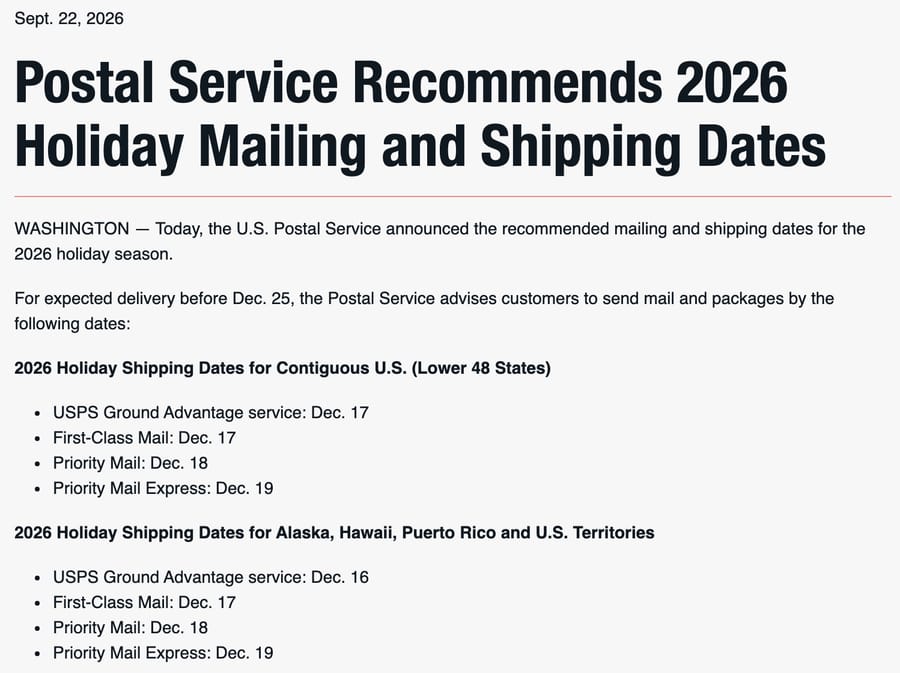
- Black Friday 2026 is 27 November and Cyber Monday is 30 November; USPS recommends shipping by 17 December for Ground Advantage delivery before Christmas.
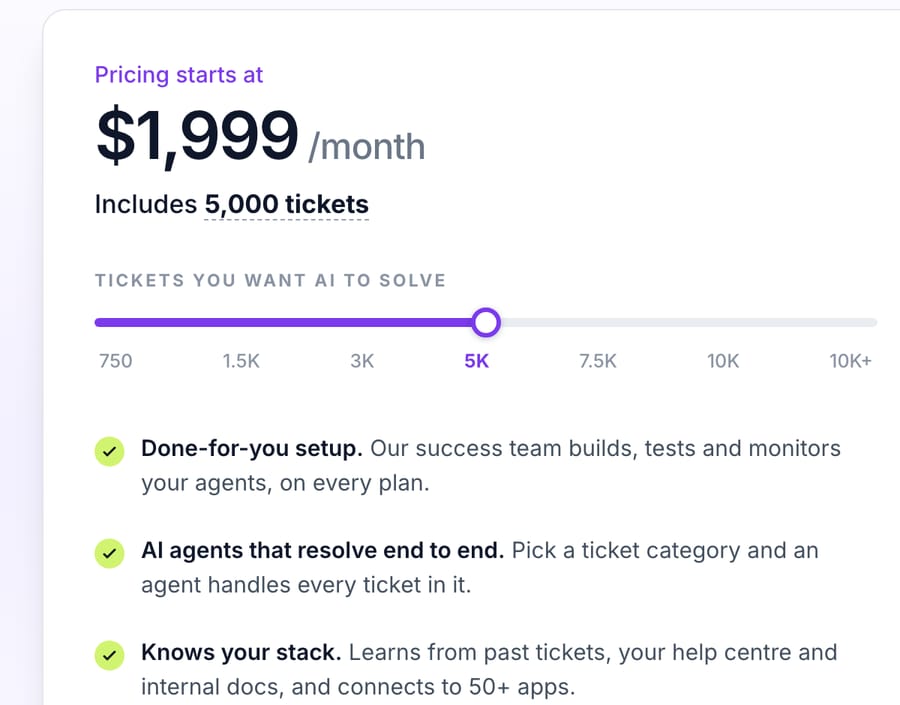
- At 3,520 November tickets and a 45% AI resolution rate, Fin costs $1,568.16, Zendesk AI agents $2,376 at the committed rate, and Macha's 5,000-ticket tier $1,999.
- USPS lost-package claims for Priority Mail and Ground Advantage open 15 days after mailing and close at 60 days, so an AI agent should route claims to a human.
- On three test tickets the agent handed off a cancellation and a stale unfulfilled order correctly, but quoted the 26 to 30 November processing window on an order from 14 September, so the runbook now checks the order date first and states the normal processing window as a number.

Which 2026 dates drive order-status tickets?
Order-status tickets, the "where is my order" or WISMO questions, follow orders and bunch up around carrier cutoffs. These are the dates that matter for peak 2026, with the ticket each one tends to create.
| Date (2026) | Event | Order-status tickets it tends to create |
|---|---|---|
| Thu 26 Nov | Thanksgiving | Early-deal orders; "has my order shipped?" from Friday |
| Fri 27 Nov | Black Friday | Order confirmations missing, "processing" questions over the weekend |
| Sat 28 Nov to Sun 29 Nov | Weekend | Tickets pile up for Monday if nobody covers them |
| Mon 30 Nov | Cyber Monday | The single biggest order day, and its WISMO wave lands in the first week of December |
| Thu 17 Dec | USPS Ground Advantage and First-Class Mail recommended ship-by date | "Will it arrive by Christmas?" |
| Fri 18 Dec | USPS Priority Mail ship-by date | Upgrade and expedite requests |
| Sat 19 Dec | USPS Priority Mail Express ship-by date | Last-chance delivery promises |
| Late Dec into Jan | Returns and exchanges | "Where is my refund?" and return-label questions |
The USPS dates come from the Postal Service's 22 September 2026 announcement for the contiguous US. UPS and FedEx publish their own holiday schedules; our fetcher got access-denied pages from both on 28 September, so check ups.com and fedex.com directly before you put their dates in an agent's instructions.
How much do order-status tickets rise in November and December?
Nobody publishes a clean, sourced "WISMO goes up by X% at Black Friday" figure. We checked Gorgias's research library, Adobe's holiday releases and Narvar's reports, and found none. What is public comes in three pieces, and you combine them with your own numbers.
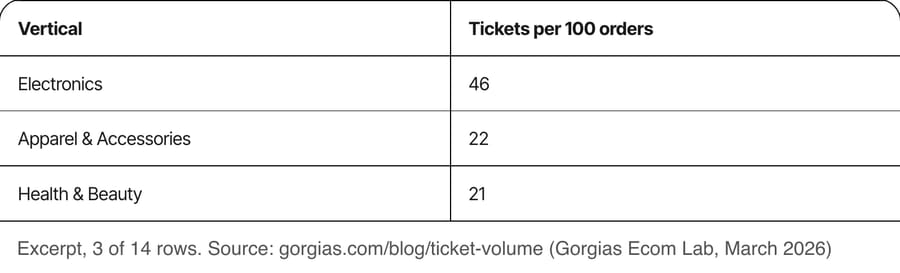
Orders drive the base. Gorgias's ticket volume benchmark (Gorgias Ecom Lab, March 2026, merchants at the $10M GMV band) gives tickets per 100 orders by vertical. Apparel & Accessories sits at 22, Health & Beauty at 21, Electronics at 46. The full table and what drives the spread is in our tickets-per-order benchmark.
The contact rate itself rises at peak. The same Gorgias page says a brand's "contact rate tends to rise during high-demand periods," because BFCM "brings a disproportionate share of first-timers," and first-time customers write in more than repeat buyers. Gorgias doesn't put a number on the rise, so treat any forecast built on your September rate as a floor.
Some question types rise sharply too. Gorgias's August 2026 research found pre-purchase volume ran "about 51% heavier per day" during the 2025 BFCM window (20 November to 2 December) than its September and October baseline. That's pre-purchase, not order status, but it shows the week around Black Friday running well above an average day.
For the size of the order spike, Adobe's 2025 holiday results are the best public proxy. US shoppers spent $257.8 billion online from 1 November to 31 December 2025, about $4.23 billion a day over 61 days. Cyber Week, which Adobe defines as the five days from Thanksgiving through Cyber Monday, took $44.2 billion, or $8.84 billion a day, 2.1 times the season's daily average. Cyber Monday alone, at $14.25 billion, was 3.4 times it. Those are dollars across all US retailers, not your orders, but they tell you how lopsided the week is.
Late and missing parcels are what turn an order into a ticket. In Narvar's 2026 Holiday Shopping Report (1,348 US consumers, published 24 August 2026), 37% said they experienced a late package last year and 23% were told a package had been delivered when they never received it. The late ones become "where is it?" tickets. The delivered-but-missing ones become claims, and those need a person.
How do you forecast holiday customer service volume for your store?
The formula is short:
November tickets = November orders x (tickets per 100 orders / 100)
The one input you have to bring yourself is your November order count. If you've been through a peak before, use last November's orders divided by last September's as your multiple. We use 2x in the worked examples below because it's close to Adobe's Cyber Week ratio of 2.1, but your ratio could be 1.3 or 4, and the table shows what happens at 1.5x and 3x as well.
Apparel brand (22 tickets per 100 orders), 8,000 orders in a normal month:
- September: 8,000 x 0.22 = 1,760 tickets
- November at 2x orders: 16,000 x 0.22 = 3,520 tickets
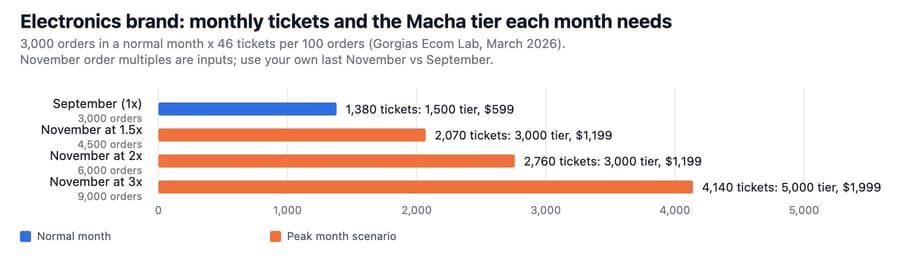
Electronics brand (46 tickets per 100 orders), 3,000 orders in a normal month:
- September: 3,000 x 0.46 = 1,380 tickets
- November at 2x orders: 6,000 x 0.46 = 2,760 tickets
| November order multiple | Apparel orders | Apparel tickets (x 0.22) | Electronics orders | Electronics tickets (x 0.46) |
|---|---|---|---|---|
| 1x (September baseline) | 8,000 | 1,760 | 3,000 | 1,380 |
| 1.5x | 12,000 | 2,640 | 4,500 | 2,070 |
| 2x | 16,000 | 3,520 | 6,000 | 2,760 |
| 3x | 24,000 | 5,280 | 9,000 | 4,140 |
Two adjustments before you size anything. First, the contact rate rises at peak, per Gorgias, so if you have last November's ticket count, compute last November's own rate and use that instead of 22 or 46. Second, a month is the wrong unit for staffing. Order-status questions arrive after the orders, when customers expect a shipping email and haven't had one, so Cyber Monday's wave lands in December's first week. For billing, though, the month is the unit, and that's where the AI line on your invoice gets decided.
What does a peak month cost under per-ticket and per-resolution pricing?
Here's the apparel brand's November at 3,520 tickets. We assume the AI agent sees every ticket and resolves the same share Gorgias reports for its own merchants: a median of 45% of AI-touched tickets, 65% for the top quartile (Gorgias measuring its own AI, a vendor self-report). That gives 1,584 resolutions at 45% and 2,288 at 65%. Unit prices come from our AI customer support pricing index; we checked each vendor's own pricing page on 24 September 2026.
| AI line, apparel brand, November (3,520 tickets) | How it's billed | At 45% resolved (1,584) | At 65% resolved (2,288) |
|---|---|---|---|
| Intercom Fin | $0.99 per outcome | $1,568.16 | $2,265.12 |
| Macha | Per ticket, 5,000-ticket tier | $1,999 | $1,999 |
| Gorgias AI Agent, Advanced, annual bundle | $477 for 530, then $1.50 each | $2,058 | $3,114 |
| Zendesk AI agents, committed rate | $1.50 per automated resolution | $2,376 | $3,432 |
| Zendesk AI agents, pay-as-you-go | $2.00 per automated resolution | $3,168 | $4,576 |
Seats and help desk plans are left out, as are Zendesk's small included allowance (5 automated resolutions per agent a month on Suite Team) and Fin's 50-outcome minimum, which applies only when Fin runs on a help desk other than Intercom and doesn't bind at this volume. The Gorgias line uses the Advanced help desk plan because it's the cheapest total at this volume: its 5,000 included tickets cover the month, where Pro's 2,000 wouldn't, so the ticket fee Gorgias charges on every AI-resolved ticket stays inside the plan ($750 a month billed annually, left out like the other help desk plans). The Fin row is a floor. Intercom's outcome definitions bill a "Procedure handoff", where Fin runs a Procedure you've configured to end in a handoff to a human, at the same $0.99 as a resolution, so if your delivered-but-not-received path is built as a Procedure, those handoffs are billed too. The cost-per-1,000-orders breakdown runs the same comparison for 14 verticals in a normal month.
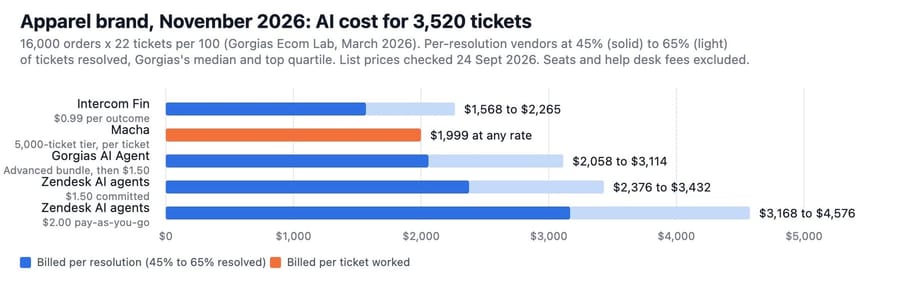
Read the table two ways. At a 45% resolution rate, Fin is cheaper than Macha for this brand, by about $431. At 65%, Macha is cheaper than every per-resolution line. A per-resolution vendor earns more the better its AI performs, and it earns more in November automatically, because the business model scales the bill with your peak. You don't know the bill until December. Macha bills per ticket the agent works, handed-off tickets included, so the bill doesn't move with the resolution rate; you pick it in advance by picking a tier.
That advance choice is the risk to plan around. Macha has no overages: when the month's tickets run out, agents pause until you move up a tier or add a top-up. The apparel brand's September needs the 3,000-ticket tier ($1,199), and if it stays there, November's 3,520 tickets run past the cap by 520, all of them in the busiest weeks of the year. The electronics brand is sharper still: its 1,380 September tickets fit the 1,500-ticket tier ($599), but a doubled November at 2,760 tickets needs the 3,000-ticket tier ($1,199). Staying on 1,500 would cover only 54% of November. Size the November tier from the November forecast, not from September's invoice.
What does an AI agent need to answer "where is my order?"
An order-status reply needs three facts: which order, whether it has shipped, and where the parcel is now. They live in three different systems.
| Step | Input | System and tool | Rule | Action | Hand off when |
|---|---|---|---|---|---|
| 1. Find the order | Order number or requester email | Shopify: Get Order, or Search Orders by email | One open order: use it. Several: ask which | Read line items, fulfillment and payment status | No matching order for that email |
| 2. Check fulfillment | Order record | Shopify: Get Order | Unfulfilled: check the order date, then quote the holiday processing time only for orders placed in the holiday window | Public reply with the policy's window | Unfulfilled past the stated window |
| 3. Check the parcel | Tracking number from the fulfillment | Carrier or tracking app, through a custom API tool | Quote only the carrier's status and estimated date | Public reply with status, date and tracking link | No scan for 5 business days, or "delivered" but not received |
| 4. Record it | The ticket | Help desk tools | Tag every order-status ticket | Add tag, set status | Always tag handoffs separately |
| 5. Refund (only if your policy allows) | Order record | Shopify: Create Refund | In chat, a confirmation card appears first; on a triggered run it executes directly if the instructions allow it | For peak, leave refunds to a person | Every refund request |
Shopify. Macha's Shopify connector is built in. It searches and gets orders, gets products and customers, and creates refunds behind a confirmation step. Get Order returns line items, fulfillment and payment status. On Shopify's side, a fulfillment stores a tracking number, tracking URL, carrier name and a shipment_status with values such as in_transit, out_for_delivery, delivered and attempted_delivery. Shopify's own reference adds that a clickable tracking number "doesn't mean that Shopify automatically updates the fulfillment's shipment_status field," so whether that status is filled in depends on your carrier and tracking setup. The connector can cancel an order (its Cancel Order tool asks for confirmation in chat), but it has no tool to edit one or change a shipping address.
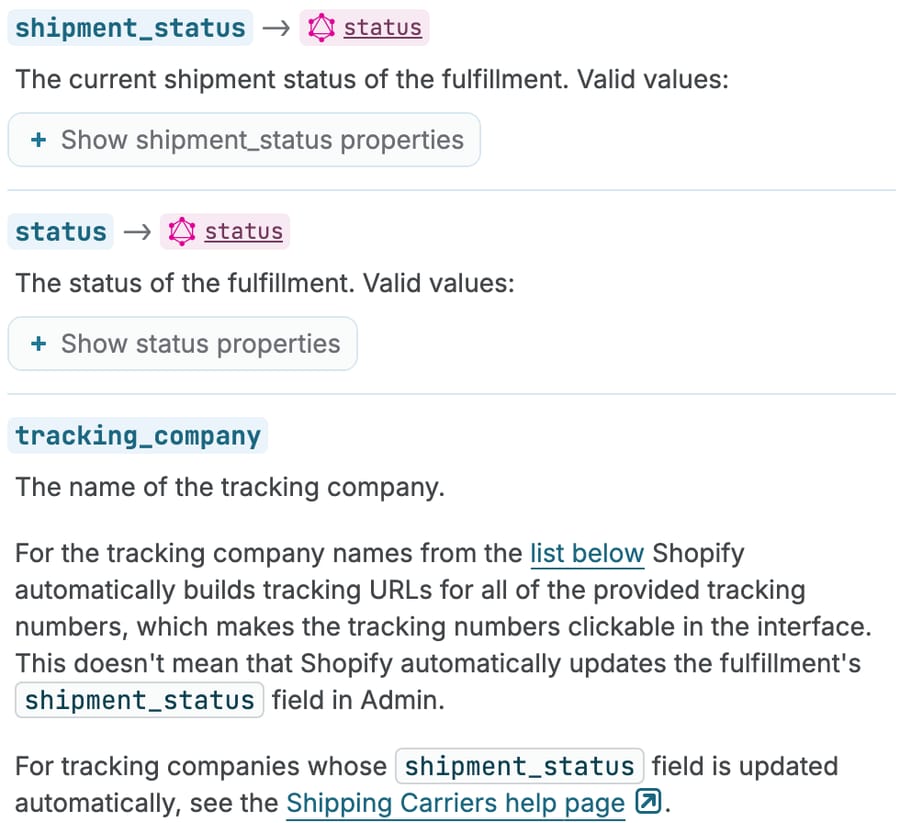
Tracking beyond Shopify. The scan history and the carrier's estimated delivery date usually live with the carrier or your tracking app (AfterShip, 17TRACK, CWILL, formerly ParcelPanel, and similar). None of those has a built-in Macha connector. Each connects through a custom API tool that Macha's team sets up during onboarding, using the app's API key or Bearer token, and only the reads that app's API documents. Some apps gate API access by plan, so check yours before October. Which apps look parcels up by order number and which need the tracking number is compared app by app in which order-tracking apps an AI agent can use.
The help desk. On Zendesk, Freshdesk, Gorgias, Front, HubSpot or Intercom, the agent reads the ticket and posts the public reply, and it records handoffs with that desk's own note, tag, status or assignment tools (the exact set differs by desk). Setup for each desk is covered in automating WISMO in Zendesk and auto-resolving WISMO in Gorgias. A brand on Zendesk and Shopify weighing its options should read our Zendesk and Shopify AI agent guide, and the wider map of what an agent can read and write in each Shopify app category is in which Shopify apps an AI support agent can work with.
When should the AI hand an order-status ticket to a human?
Most order-status tickets are a lookup and a reply. The ones below aren't, and peak is when getting them wrong costs most.
- "Delivered" but not received. Narvar's 23% figure says this is common, and the fix is a carrier claim or a reshipment decision. The agent should apologize, confirm the address on the order and hand off.
- Lost in transit. USPS says a lost-package claim for Priority Mail or Ground Advantage can be filed no sooner than 15 days and no later than 60 days after the mailing date (7 days for Priority Mail Express). A Black Friday parcel mailed on 1 December can't be claimed until 16 December and must be claimed by 30 January. Put those dates in a human's queue, not in the agent's reply.
- Delivery-date promises. The agent quotes the carrier's estimated date and never adds its own. After 17 December, "will it arrive by Christmas?" gets the USPS cutoff and, if the order hasn't shipped, a handoff for an expedite decision.
- Cancellations and address changes. The Shopify connector can cancel an order but can't change an address, and after fulfillment both are often impossible anyway. Route them fast, because the window closes when the label prints. Our order-cancellation guide covers the pattern.
- Refunds for missing parcels. The Shopify connector can create a refund. In chat it asks for confirmation first. On a triggered run a write tool executes directly if the instructions tell it to, so for peak we'd write the instructions to leave refunds to a person. Automating Shopify refunds safely explains the confirmation step, and the actions matrix compares which help desk AIs can take which actions.
- The third reply. If the customer has written three times about the same order, a person should read the thread.
Gorgias reports a 10-hour median wait once a ticket crosses from AI to a human, and that 33% of handed-off tickets never get a human reply. Staff the handoff queue for Black Friday weekend, or the agent's good answers are undone by the tickets it correctly passed on.
1,936 of the apparel brand's 3,520 November tickets are left for people at 45% resolved, about 65 a day across 30 days. If handoffs spike the way Cyber Week sales do, at 2.1 times the season's daily average (Adobe's dollar ratio, used here as a proxy because nobody publishes a ticket-level one), the peak days carry about 136. Handoffs are the hard tickets, so use your own team's throughput on claims and reships; at 40 a person per day, that's 2 people on an average November day and 4 on the peak days. Order-status handoffs trail the orders, so schedule those 4 for the first week of December as well as the Black Friday weekend.
What should the agent's instructions say?
Write the instructions as a runbook the agent acts on. This is the version we'd start from for a Zendesk and Shopify brand. The tool names are Macha's; "Get Tracking" stands for the custom API tool for your tracking app.
Job: answer order-status questions on tickets tagged or detected as "where is my order".

1. Find the order.
   - If the ticket contains an order number, call Get Order with it.
   - Otherwise call Search Orders with the requester's email.
   - If there is more than one unfulfilled or in-transit order, list the two most
     recent (order number, date, first item) and ask which one. Stop there.
   - If nothing matches, ask for the order number and the email used at checkout.

2. If the order is unfulfilled:
   - Check the order date first. Only if it was placed 26 Nov to 30 Nov, quote
     the "Holiday shipping 2026" article: those orders ship within 3 business
     days. For any other date, say it hasn't shipped yet and quote nothing else.
   - Orders placed outside 26 Nov to 30 Nov ship within 2 business days.
   - If it is older than its processing window (3 business days for 26 to 30 Nov
     orders, 2 business days for all others), add an internal note with the order
     number and assign to the Peak Escalations group. Do not promise a ship date.

3. If the order is fulfilled:
   - Call Get Tracking with the tracking number from the fulfillment.
   - Reply with the carrier, the latest scan in plain words, the carrier's
     estimated delivery date and the tracking link. Quote the carrier's date
     exactly. Never add a date of your own.

4. Hand off instead of replying when:
   - tracking says delivered and the customer says it did not arrive;
   - there has been no carrier scan for 5 business days;
   - the customer asks to cancel, change the address or upgrade shipping;
   - the customer asks for a refund or a replacement;
   - this is the customer's third message about the same order.
   To hand off: post a short public reply saying a teammate will pick this up,
   add an internal note with the order number, the last scan and the reason,
   tag wismo_handoff, and assign to Peak Escalations.

5. On every ticket you handle, add the tag wismo_ai.

Never: issue a refund, cancel or edit an order, or say a parcel is lost.
The "3 business days", "2 business days" and "5 business days" are example policy values; use yours. The two tags are what you'll count in December to see how many order-status tickets the agent closed and how many it passed on.
Step 2 above is the version after two test rounds. The first version told the agent to quote the holiday window on every unfulfilled order, and the second never gave the normal window as a number; the tests below show what each one did.
What happened when we ran the runbook on three test tickets?
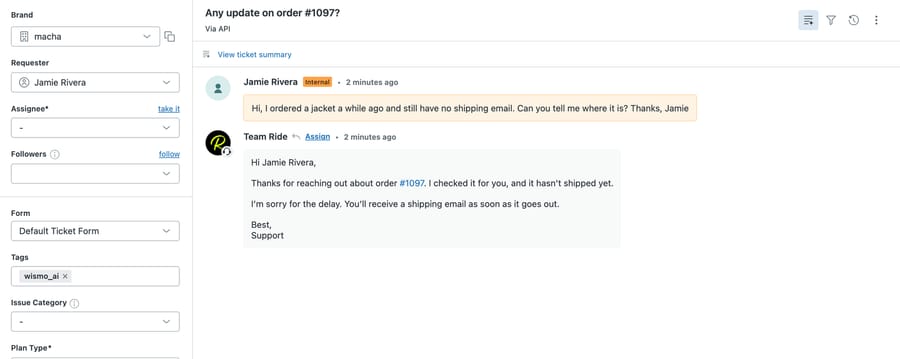
On 28 September we pasted the runbook into a Macha agent, word for word, plus one line telling it to greet the customer by the requester's name. We connected it to our sandbox Zendesk and to Macha's own Shopify development store, which has two orders, #1096 and #1097, both paid and unfulfilled. The customers are made up. We created each ticket with Macha's Test feature, which opens a real ticket in the sandbox and runs the agent the way a ticket-created trigger would. It's why each ticket shows "Via API" and the customer's message carries an "Internal" badge; the agent's replies, signed "Team Ride" (our made-up demo brand), are public.
Ticket 1: "Where is my order #1097?" The public reply came 13 seconds after the ticket was created. It said #1097 hadn't shipped and had no tracking number yet, and it promised no ship date. Then it did step 2's second bullet: an internal note saying the order was unfulfilled and older than the processing window, the ticket assigned to Peak Escalations, and the wismo_ai tag.
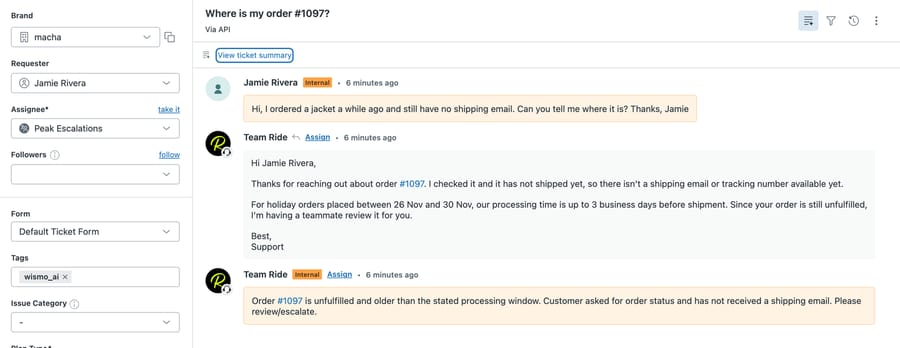
It also told the customer "For holiday orders placed between 26 Nov and 30 Nov, our processing time is up to 3 business days." Order #1097 was placed on 14 September. The agent did what the first version of step 2 said, which was to reply with the holiday processing time on any unfulfilled order. In late November most unfulfilled orders will fall inside that window, but the ones that don't are the old orders whose customers are already annoyed, and a sentence about a window they weren't in reads as a brush-off. So we changed step 2 to check the order date before quoting anything.
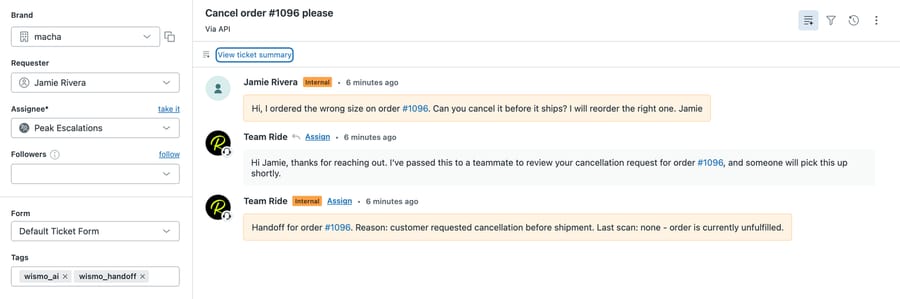
Ticket 2: "Cancel order #1096 please." The customer had ordered the wrong size. The agent answered in 9 seconds that a teammate would review the cancellation, left an internal note in the handoff format ("Reason: customer requested cancellation before shipment. Last scan: none - order is currently unfulfilled."), tagged the ticket wismo_ai and wismo_handoff, and assigned it to Peak Escalations. It didn't cancel the order: the agent didn't have the Shopify connector's Cancel Order tool, and its instructions say never to cancel.
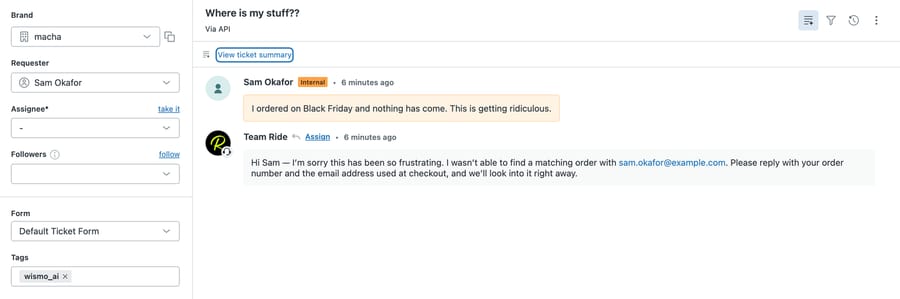
Ticket 3: "Where is my stuff??" No order number, just "I ordered on Black Friday and nothing has come." The agent searched orders by the requester's email in 7 seconds, found none, apologized and asked for the order number and the email used at checkout. It added wismo_ai and didn't hand off, which is what step 1 says.
Re-run: "Any update on order #1097?" At 10:01 UTC the same day we ran the date-check version of step 2, word for word, plus the greeting line, on a new ticket with the same customer message. The reply came 9 seconds later. It said #1097 hadn't shipped, apologized for the delay and said a shipping email would follow, with no holiday window this time. It also added no internal note and no Peak Escalations assignment, only the wismo_ai tag. That version told the agent to escalate orders older than "your normal window otherwise" and never gave the normal window as a number, so the agent had nothing to measure a September order against. Write your normal processing window as a number so the escalation rule can fire. Step 2 above now says 2 business days, an example value; we made that second change after the re-run and haven't run it again.
The tests didn't cover step 3. The development store has no fulfilled orders and the test account has no tracking-app tool, so the "in transit" reply, the Get Tracking call, the 5-day no-scan rule and the delivered-but-not-received handoff didn't run. Neither did the third-message rule. Test those on your own fulfilled orders before 30 October.
What's the prep checklist from now to Black Friday?
Work back from Friday 27 November. The dates below leave four weeks of live running at normal volume before the spike.
| By | Task |
|---|---|
| Fri 2 Oct | Pull last year's September and November order counts and ticket counts. Compute your order multiple and your November contact rate |
| Fri 9 Oct | Decide which tickets the agent takes (all tickets, or only order status) and write the handoff rules and the holiday shipping policy article |
| Fri 16 Oct | Connect Shopify and the help desk; confirm your tracking app's API plan and have the custom API tool built and tested |
| Fri 23 Oct | Write the instructions; replay past order-status tickets through an agent simulation and fix what it gets wrong |
| Fri 30 Oct | Set the trigger and the loop guard (the agent skips tickets already tagged wismo_ai or wismo_handoff); go live on order-status tickets |
| Fri 13 Nov | Read two weeks of wismo_ai and wismo_handoff counts; choose November's tier from the November forecast |
| Fri 20 Nov | Freeze instruction changes; add the USPS cutoffs to the policy article; staff the Peak Escalations group for 26 to 30 Nov |
| Thu 26 Nov to Mon 30 Nov | Check the handoff queue twice a day; watch the month's ticket count against the tier |
| Thu 17 Dec | Switch "will it arrive by Christmas" answers to the post-cutoff wording |
If your agent is already live, start at 13 November. If you're starting from zero on 28 September, the 16 October step is the one that slips, because a tracking-app API key sometimes needs a plan upgrade.
What changes after Cyber Monday?
December moves the question from "where is it?" to "will it arrive in time?", then January moves it to "where is my refund?". Adobe's 2025 figures show returns down 1.2% for the season as a whole but up 4.7% from 26 to 31 December, so the return questions bunch into the week after Christmas. Narvar found 56% of consumers have delayed or avoided a purchase because they weren't sure how long a refund would take, so the refund-status question matters for next year's orders too. The same agent can answer it from Shopify's order and refund status, and you can add a shipping-delay notice workflow if a carrier falls behind.
Some of these tickets never need to be written. Before 27 November, check that every shipping-confirmation email carries the tracking link, put a link to your order-status page in the help desk's auto-reply, and send delay notices before customers ask. Each one answers the question before it turns into a ticket, which leaves the agent and the handoff queue with the orders that actually went wrong.
Where Macha fits
Macha fits teams already running Zendesk, Freshdesk, Gorgias, Front, HubSpot or Intercom with Shopify who want the order lookup and the reply to happen inside the ticket rather than in a separate chat widget. The Shopify connector does the order lookup; tracking apps connect through a custom API tool Macha's team builds during onboarding, and setup and monitoring by the Macha team are included on every tier. Pricing is per ticket, from $299/month for 750 tickets (about $0.40 per ticket), so the apparel example's peak November is the 5,000-ticket tier at $1,999 whatever the resolution rate. The order-status use case shows the flow, and the pricing page has every tier.
How we researched this
- Sources, accessed 27 and 28 September 2026: Gorgias ticket volume benchmark (Gorgias Ecom Lab, March 2026, $10M GMV band, page updated 28 May 2026); Gorgias BFCM pre-purchase research (19 August 2026); Gorgias handoff research (April 2026, vendor self-report); Adobe holiday results (7 January 2026, including returns down 1.2% for the season and up 4.7% from 26 to 31 December) and Cyber Monday release (2 December 2025); Narvar 2026 Holiday Shopping Report press release (24 August 2026, 1,348 US consumers and 100 retail decision-makers); USPS holiday dates (22 September 2026) and claims page; Shopify Admin API fulfillment reference. Vendor prices come from our pricing index, checked 24 September 2026.
- Vendor self-reports: the 45% and 65% resolution rates and the 10-hour handoff wait are Gorgias measuring its own AI Agent.
- Arithmetic: tickets = orders x tickets per 100 orders / 100 (8,000 x 0.22 = 1,760; 16,000 x 0.22 = 3,520; 3,000 x 0.46 = 1,380; 6,000 x 0.46 = 2,760; 12,000 x 0.22 = 2,640; 24,000 x 0.22 = 5,280; 4,500 x 0.46 = 2,070; 9,000 x 0.46 = 4,140). Resolutions: 3,520 x 0.45 = 1,584; 3,520 x 0.65 = 2,288. Fin: 1,584 x $0.99 = $1,568.16; 2,288 x $0.99 = $2,265.12. Zendesk committed: 1,584 x $1.50 = $2,376; 2,288 x $1.50 = $3,432. Zendesk pay-as-you-go: 1,584 x $2.00 = $3,168; 2,288 x $2.00 = $4,576. Gorgias (Advanced, annual bundle): $477 + (1,584 - 530) x $1.50 = $2,058; $477 + (2,288 - 530) x $1.50 = $3,114. Handoff queue: 3,520 - 1,584 = 1,936; 1,936 / 30 = 64.5, about 65 a day; 64.5 x 2.1 = 135.5, about 136; 65 / 40 = 1.6, rounded up to 2 people; 136 / 40 = 3.4, rounded up to 4. The 40 handoffs per person per day is an example input, not a benchmark. Macha: 3,520 tickets falls on the 5,000-ticket tier, $1,999. Fin vs Macha at 45%: $1,999 - $1,568.16 = $430.84. Electronics at 1,500 tickets covers 1,500 / 2,760 = 54% of a doubled November. Adobe: $257.8B / 61 days = $4.23B a day; $44.2B / 5 days = $8.84B a day; 8.84 / 4.23 = 2.1; 14.25 / 4.23 = 3.4. Claim window: 1 December + 15 days = 16 December; + 60 days = 30 January.
- The 2x order multiple is an input, not a finding. It's chosen to sit near Adobe's Cyber Week ratio; replace it with your own.
- What we ran: on 28 September we ran the runbook's first version on three sandbox Zendesk tickets against Macha's Shopify development store (two paid, unfulfilled orders), creating each ticket with Macha's Test feature. The results, including the holiday-window flaw we fixed in step 2 and a 10:01 UTC re-run that showed the escalation rule needs a numeric normal window (fixed after the re-run, not re-run again), are in the test section above. Step 3 (fulfilled orders and tracking) wasn't exercised because the store has no fulfilled orders. The brands in the volume and cost examples are hypothetical.
Frequently asked questions
How many more support tickets should I expect on Black Friday? Multiply your expected November orders by your tickets per 100 orders. An apparel brand at 22 per 100 that doubles from 8,000 to 16,000 orders gets about 3,520 tickets instead of 1,760, and Gorgias says the contact rate itself tends to rise at peak.
When is Black Friday 2026? Friday 27 November 2026. Thanksgiving is Thursday 26 November and Cyber Monday is Monday 30 November.
What are the USPS holiday shipping deadlines for 2026? For delivery by 25 December in the contiguous US, USPS recommends 17 December for Ground Advantage and First-Class Mail, 18 December for Priority Mail and 19 December for Priority Mail Express.
Can an AI agent look up tracking from Shopify? Macha's Shopify connector gets the order with its fulfillment status. Carrier scan history and estimated delivery dates usually come from the carrier or a tracking app, which connects through a custom API tool that Macha's team sets up.
Which order-status tickets should never be automated? Delivered-but-not-received parcels, lost-package claims, cancellations, address changes, refunds and delivery-date promises the carrier hasn't made. The agent should add an internal note, tag the ticket and assign it to a person.
Is per-resolution or per-ticket pricing cheaper for peak season? It depends on the resolution rate. For 3,520 tickets, Fin at $0.99 per outcome is cheaper than a $1,999 per-ticket tier at 45% resolved and more expensive at 65%; Zendesk's $1.50 committed rate costs more than both at either rate.
Black Friday is 27 November. To test an order-status agent on your own tickets before then, start a trial with $50 of free usage (about 125 tickets), no credit card, no time limit.
Resolve tickets automatically with AI agents
Macha's AI agents work on top of the help desk you already use — no code.