Intercom
 Shopify
 Stripe
 Slack
Slack Notion
 Google Workspace
 Confluence

What Does AI Customer Support Cost per 1,000 Orders? 14 Ecommerce Verticals Priced


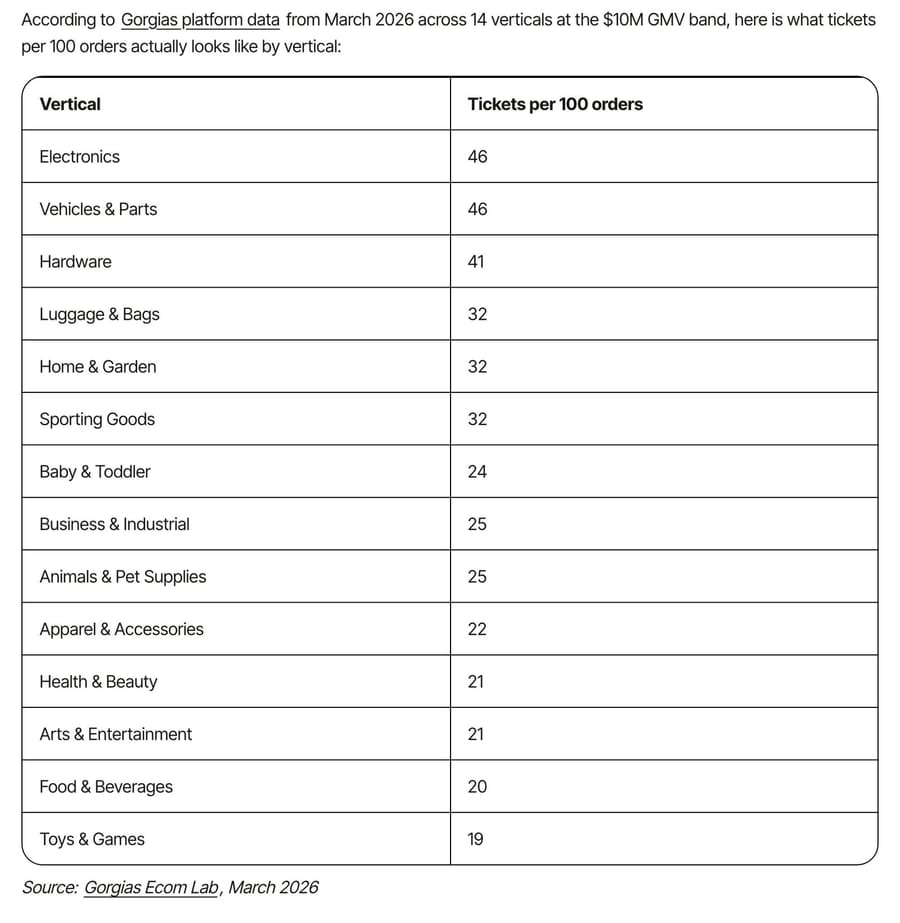
Priced against Gorgias Ecom Lab contact rates, AI customer support costs $76 to $598 in AI fees per 1,000 ecommerce orders at 2026 list prices, depending on your vertical, your vendor's billing unit and how many tickets the AI resolves. The same Ecom Lab data puts Electronics at 46 support tickets per 100 orders and Toys & Games at 19, so 1,000 orders means 190 to 460 tickets before any AI touches them. This page converts those contact rates into monthly AI cost for Zendesk, Intercom Fin, Gorgias AI Agent and Macha, shows the arithmetic behind every figure, and gives you the formula to swap in your own contact rate.
Key takeaways
- At 45% of tickets resolved by AI, Zendesk's $1.50 committed rate costs $310.50 per 1,000 Electronics orders and $128.25 per 1,000 Toys & Games orders.
- Gorgias Ecom Lab data shows 1,000 orders produce 190 to 460 support tickets across 14 ecommerce verticals, a 2.4x spread between Toys & Games and Electronics.
- Per-resolution pricing bills 44% more when the AI resolution rate rises from the Gorgias median of 45% to the top-quartile 65%, while per-ticket pricing stays flat.
- Macha bills about $0.40 on every ticket, so it costs less than Intercom Fin's $0.99 per outcome only when Fin would resolve more than about 40% of tickets.
- In our 28 September 2026 sandbox test, per-ticket pricing billed both an answered order-status ticket and a damaged-item handoff, while per-resolution pricing would bill only the answered one.

How much does AI support cost per 1,000 orders in each vertical?
The table takes Gorgias's tickets per 100 orders, multiplies by 10 to get tickets per 1,000 orders, assumes the AI resolves 45% of them (the Gorgias median), and prices those resolutions at each vendor's published rate. Macha bills every ticket it works rather than every resolution, so its column is tickets x $0.40.
| Vertical | Tickets per 100 orders | Tickets per 1,000 orders | AI resolutions at 45% | Zendesk $1.50 committed | Zendesk $2.00 PAYG | Intercom Fin $0.99 | Gorgias AI Agent $1.00 | Macha ~$0.40 per ticket |
|---|---|---|---|---|---|---|---|---|
| Electronics | 46 | 460 | 207 | $310.50 | $414.00 | $204.93 | $207.00 | $184.00 |
| Vehicles & Parts | 46 | 460 | 207 | $310.50 | $414.00 | $204.93 | $207.00 | $184.00 |
| Hardware | 41 | 410 | 184.5 | $276.75 | $369.00 | $182.66 | $184.50 | $164.00 |
| Luggage & Bags | 32 | 320 | 144 | $216.00 | $288.00 | $142.56 | $144.00 | $128.00 |
| Home & Garden | 32 | 320 | 144 | $216.00 | $288.00 | $142.56 | $144.00 | $128.00 |
| Sporting Goods | 32 | 320 | 144 | $216.00 | $288.00 | $142.56 | $144.00 | $128.00 |
| Business & Industrial | 25 | 250 | 112.5 | $168.75 | $225.00 | $111.38 | $112.50 | $100.00 |
| Animals & Pet Supplies | 25 | 250 | 112.5 | $168.75 | $225.00 | $111.38 | $112.50 | $100.00 |
| Baby & Toddler | 24 | 240 | 108 | $162.00 | $216.00 | $106.92 | $108.00 | $96.00 |
| Apparel & Accessories | 22 | 220 | 99 | $148.50 | $198.00 | $98.01 | $99.00 | $88.00 |
| Health & Beauty | 21 | 210 | 94.5 | $141.75 | $189.00 | $93.56 | $94.50 | $84.00 |
| Arts & Entertainment | 21 | 210 | 94.5 | $141.75 | $189.00 | $93.56 | $94.50 | $84.00 |
| Food & Beverages | 20 | 200 | 90 | $135.00 | $180.00 | $89.10 | $90.00 | $80.00 |
| Toys & Games | 19 | 190 | 85.5 | $128.25 | $171.00 | $84.65 | $85.50 | $76.00 |
Contact rates are for Gorgias merchants at the $10M GMV band, March 2026, from the Gorgias Ecom Lab table. Unit prices are list prices from our AI Customer Support Pricing Index, checked 24 September 2026. All columns are AI fees only: no help desk seats, plans or included allowances. Gorgias lists Baby & Toddler (24) above Business & Industrial (25); we sorted by value.
We ran every cell through a short script and checked the rows by hand; here is one row worked through. Electronics: 46 x 10 = 460 tickets; 460 x 0.45 = 207 resolutions; 207 x $1.50 = $310.50 on Zendesk, 207 x $0.99 = $204.93 on Fin, and 460 x $0.40 = $184 on Macha. The lowest figure on the page is Macha on Toys & Games (190 x $0.40 = $76) and the highest is Zendesk pay-as-you-go on Electronics at the 65% rate in the next section (299 x $2.00 = $598). On Zendesk's committed rate the same cell is $448.50 (299 x $1.50).
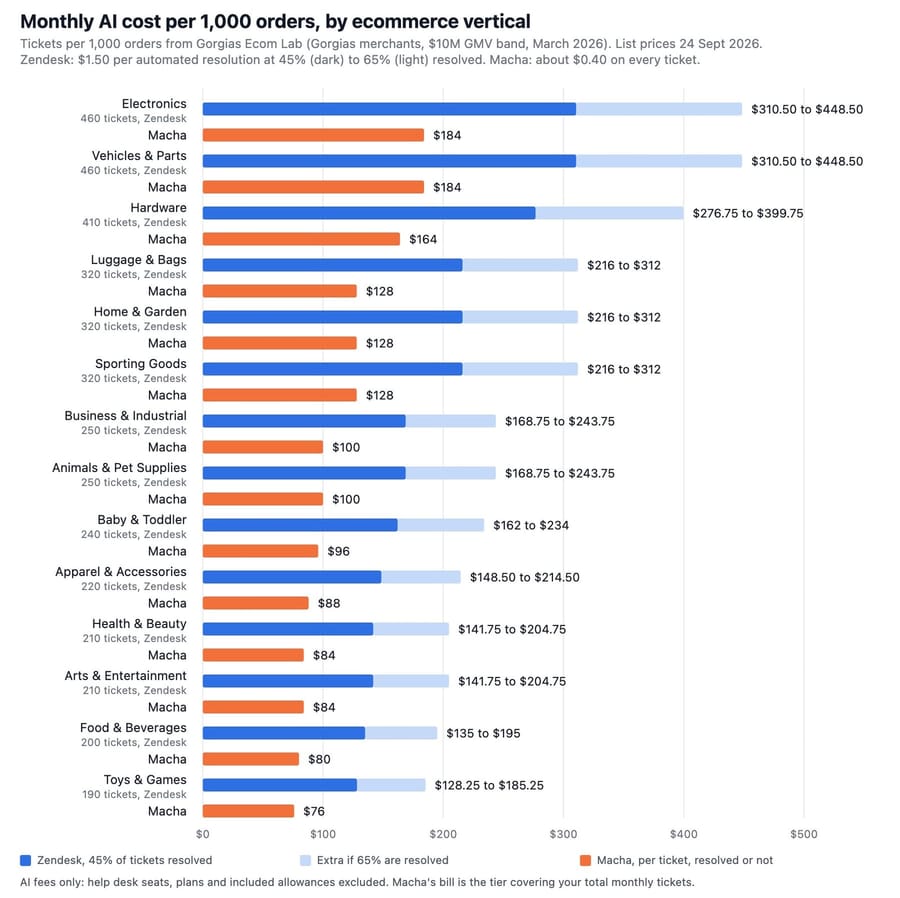
Your vertical moves the cost as much as your vendor does. Electronics sends 2.4x the tickets of Toys & Games (46 ÷ 19 = 2.42), so an Electronics brand pays roughly 2.4 times as much per order on every vendor in the table. The widest vendor gap in the same row, Zendesk pay-as-you-go against Macha, is 2.25x ($414 ÷ $184). Gorgias puts the gap down to product complexity rather than service quality: technical products draw more pre- and post-purchase questions. For the contact-rate benchmarks themselves, and what drives them by vertical, see our companion page on support tickets per order by ecommerce vertical.
What happens to the cost if your AI resolves 65% instead of 45%?
Per-resolution bills go up. Gorgias Ecom Lab reports that the median brand resolves 45% of AI-touched tickets end to end and the top quartile clears 65% (Gorgias, April 2026). Those are Gorgias measuring its own AI Agent, so treat them as a vendor self-report, and note the denominator is AI-touched tickets rather than all tickets. We use them as the two planning points because they are the only published ecommerce-specific pair we found.
| Vertical | Tickets per 1,000 orders | AI resolutions at 65% | Zendesk $1.50 committed | Zendesk $2.00 PAYG | Intercom Fin $0.99 | Gorgias AI Agent $1.00 | Macha ~$0.40 per ticket |
|---|---|---|---|---|---|---|---|
| Electronics | 460 | 299 | $448.50 | $598.00 | $296.01 | $299.00 | $184.00 |
| Vehicles & Parts | 460 | 299 | $448.50 | $598.00 | $296.01 | $299.00 | $184.00 |
| Hardware | 410 | 266.5 | $399.75 | $533.00 | $263.84 | $266.50 | $164.00 |
| Luggage & Bags | 320 | 208 | $312.00 | $416.00 | $205.92 | $208.00 | $128.00 |
| Home & Garden | 320 | 208 | $312.00 | $416.00 | $205.92 | $208.00 | $128.00 |
| Sporting Goods | 320 | 208 | $312.00 | $416.00 | $205.92 | $208.00 | $128.00 |
| Business & Industrial | 250 | 162.5 | $243.75 | $325.00 | $160.88 | $162.50 | $100.00 |
| Animals & Pet Supplies | 250 | 162.5 | $243.75 | $325.00 | $160.88 | $162.50 | $100.00 |
| Baby & Toddler | 240 | 156 | $234.00 | $312.00 | $154.44 | $156.00 | $96.00 |
| Apparel & Accessories | 220 | 143 | $214.50 | $286.00 | $141.57 | $143.00 | $88.00 |
| Health & Beauty | 210 | 136.5 | $204.75 | $273.00 | $135.14 | $136.50 | $84.00 |
| Arts & Entertainment | 210 | 136.5 | $204.75 | $273.00 | $135.14 | $136.50 | $84.00 |
| Food & Beverages | 200 | 130 | $195.00 | $260.00 | $128.70 | $130.00 | $80.00 |
| Toys & Games | 190 | 123.5 | $185.25 | $247.00 | $122.27 | $123.50 | $76.00 |
Every per-resolution column rises by 65 ÷ 45 = 1.44, or 44%. The Macha column doesn't move, because it was already billing all 460 Electronics tickets.
The two models carry opposite incentives. A per-resolution vendor earns more as its AI gets better, so your bill grows with your success, and it earns nothing on the tickets it fails, so a weak deployment is cheap. A per-ticket vendor earns the same whether the AI resolves a ticket or hands it to a human, so the risk of a poor resolution rate sits with you, and the upside of a high one does too. We've written up the per-attempt side of this, with every vendor that bills whether or not it resolves, in AI support tools that charge without resolving.
At what resolution rate does per-ticket pricing beat per-resolution pricing?
Divide the per-ticket price by the per-resolution price. Below that resolution rate the per-resolution vendor is cheaper; above it, the per-ticket vendor is.
| Per-resolution price | Break-even resolution rate vs ~$0.40 per ticket | Arithmetic |
|---|---|---|
| Zendesk $2.00 pay-as-you-go | 20% | 0.40 ÷ 2.00 |
| Zendesk $1.50 committed | 26.7% | 0.40 ÷ 1.50 |
| Gorgias $1.50 past the bundle | 26.7% | 0.40 ÷ 1.50 |
| Gorgias $1.00 inside a monthly bundle | 40% | 0.40 ÷ 1.00 |
| Intercom Fin $0.99 | 40.4% | 0.40 ÷ 0.99 |
At the Gorgias median of 45%, every per-resolution price in the table is above its break-even, so Macha's column comes out lowest in both tables. But the margin against Fin is thin: at 45%, Fin costs $0.4455 per ticket (0.45 x $0.99) against Macha's $0.40. A brand whose AI resolves 35% of tickets pays Fin $0.3465 a ticket and should take Fin on price alone.
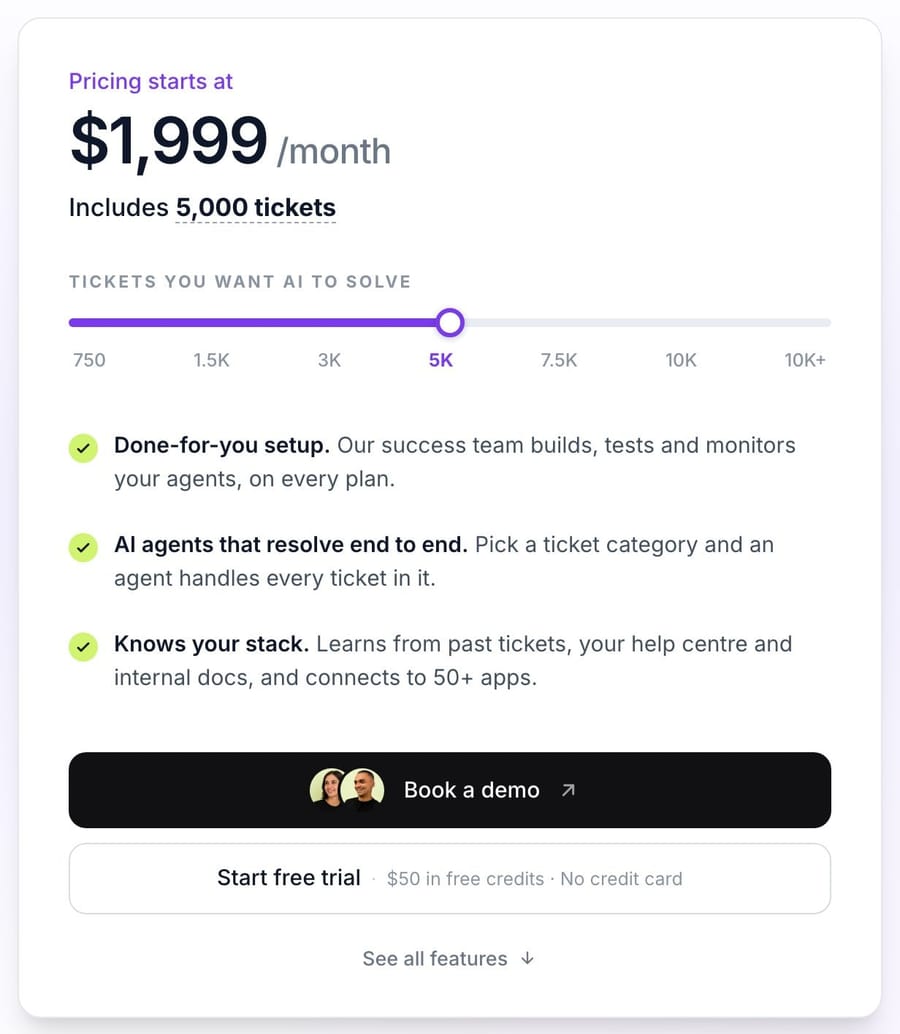
The $0.40 figure also flatters Macha at awkward volumes. Macha sells tiers ($299 a month for 750 tickets, $599 for 1,500, $1,199 for 3,000, $1,999 for 5,000, $2,999 for 7,500 and $3,999 for 10,000, with custom pricing above that), and each tier works out at about $0.40 only when you use all of it. A brand with 1,100 tickets a month buys the 1,500 tier for $599, which is $0.54 a ticket used (599 ÷ 1,100 = 0.5445), and the break-even against Fin moves to 55% (0.5445 ÷ 0.99). The worked examples below use real tiers for that reason.
What does one ticket cost under each billing model?
The tables price averages. To see what each billing unit counts on a single ticket, we ran two made-up tickets through an agent on 28 September 2026. The agent ran on Macha's test org with two built-in connectors: Shopify (our development store) and Zendesk (a sandbox instance). Its instructions were four numbered rules; these two decide what each ticket costs:
2. Order status: find the order with Shopify Get Order or Search Orders. If it is unfulfilled, reply that it hasn't shipped yet and that it ships within 2 business days of the order date. Then tag the ticket ai_answered. 3. Damaged item, wrong item, refund or cancellation: never call Create Refund or Cancel Order. Reply that a teammate will review it today, add an internal note with the order number, what the customer reported and what they asked for, and tag the ticket ai_handoff.
We created both tickets with Macha's agent Test feature, which opens a real ticket in the sandbox and runs the agent the way a ticket-created trigger would. The Test feature posts the customer's text as an internal comment "Via API", which is why the customer messages below carry an Internal badge.
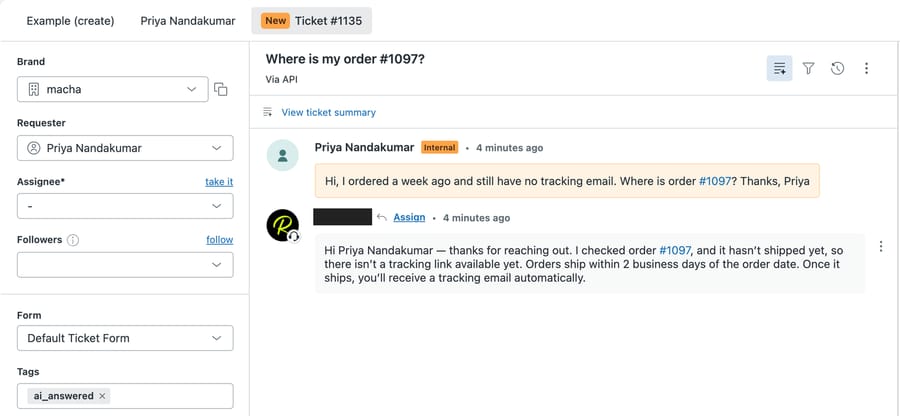
Ticket #1135, from a made-up customer, asked where order #1097 was. The agent made four tool calls (Get Ticket, Shopify Get Order, Add Public Reply, Update Ticket Tags), replied 7 seconds after the ticket was created (11:23:44 to 11:23:51 UTC) and tagged it ai_answered. The reply is accurate about the status and weak on substance: #1097 was placed on 14 September, so "ships within 2 business days of the order date" describes a window that had already passed. Our rule didn't tell the agent to check the order's age, and it didn't.
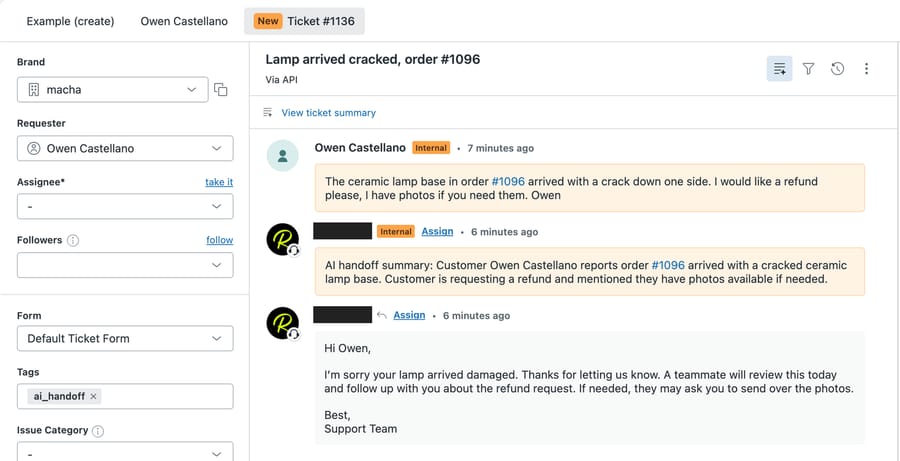
Ticket #1136 reported a cracked lamp base on order #1096 and asked for a refund. The agent made four tool calls (Get Ticket, Add Public Reply, Add Internal Note, Update Ticket Tags): it wrote an internal handoff note, told the customer a teammate would review it today, tagged it ai_handoff and issued no refund, 8 seconds after creation (11:23:45 to 11:23:53 UTC). Here is what each billing unit would charge for those two tickets, from each vendor's published definition:
| Ticket | What the agent did | Macha, per ticket | Zendesk, per automated resolution | Intercom Fin, per outcome | Gorgias AI Agent, per automated interaction |
|---|---|---|---|---|---|
| #1135 order status | Answered, no human involved | One ticket, about $0.40 | $1.50 if the customer doesn't come back and Zendesk's check verifies it as resolved | $0.99 if the customer doesn't ask for more help | $1.00 in the bundle, plus the help desk ticket fee |
| #1136 damaged item | Handed to a person, no refund | One ticket, about $0.40 | $0 (escalated to a human) | $0 on a plain handoff; $0.99 if a Fin Procedure completes and ends in the handoff | $0 automation fee; help desk ticket fee only |
| Total | about $0.80 | $1.50 | $0.99 to $1.98 | $1.00 plus two ticket fees |
Macha's run log recorded one identical charge for each of the two tickets, whatever the outcome. The per-resolution columns charge only for #1135, the ticket where our instructions produced a stale shipping window. If the customer on #1135 never replies, Zendesk, Fin and Gorgias would each count that as a success. That's the incentive at the scale of one ticket. A resolution-billed vendor is paid for tickets that end without a human, and a customer who gives up on a vague answer ends the same way as a satisfied one. A per-ticket vendor is paid the same for #1136 as for #1135, so a queue full of handoffs still costs you about $0.40 a ticket on Macha and nothing in AI fees on Zendesk.
The tags are the useful part for budgeting. Count ai_answered against ai_answered plus ai_handoff for a month and you have your own resolution rate, the one input in the formula below that no benchmark can give you. Discount it for tickets reopened within a few days, because those are the ones a per-resolution vendor refunds or never bills.
How do you calculate AI support cost from your own contact rate?
Use your own numbers where you have them; the Gorgias table is a fallback. Three lines:
- Monthly tickets = monthly orders x (your tickets ÷ your orders). Take the last 12 months of both and divide, so seasonality averages out.
- Per-resolution cost = monthly tickets x expected AI resolution rate x price per resolution, plus any seat, plan or bundle the vendor requires.
- Per-ticket cost = the cheapest tier that covers your monthly tickets. For Macha that's the tier table above; nothing is billed per resolution.
To get cost per 1,000 orders, divide the monthly cost by monthly orders and multiply by 1,000. Gorgias's own ticket-volume guide prints step 1 as "Projected tickets = projected orders × (tickets per 100 orders ÷ 100)", which is the same formula with the contact rate expressed per 100.
If you don't have a resolution rate yet, run the arithmetic twice, at 45% and 65%, and budget for the higher per-resolution figure, since 65% is the result you're paying the AI to reach.
What does it cost at 5,000, 15,000 and 20,000 orders a month?
Three synthetic brands, one per contact-rate band. Zendesk and Fin are AI fees only. Gorgias uses its monthly AI Agent bundle on the help desk plan that fits the ticket volume (Pro: 190 automated interactions for $190; Advanced: 530 for $530; $1.50 each past the bundle), per the Gorgias pricing page as read into our index. Macha uses the cheapest tier that covers the month's tickets. The Electronics brand's 9,200 tickets exceed Gorgias Advanced's 5,000-ticket allowance, so it would pay help desk ticket overage ($0.36 a ticket) or move to Enterprise, and its 530-interaction bundle is our assumption, since Enterprise pricing isn't published.
| Brand | Monthly tickets | AI resolutions at 45% | Zendesk $1.50 | Intercom Fin | Gorgias AI Agent | Macha tier |
|---|---|---|---|---|---|---|
| Apparel & Accessories, 5,000 orders | 5,000 x 0.22 = 1,100 | 495 | 495 x $1.50 = $742.50 | 495 x $0.99 = $490.05 | $190 + 305 x $1.50 = $647.50 | 1,500 tier = $599 |
| Home & Garden, 15,000 orders | 15,000 x 0.32 = 4,800 | 2,160 | 2,160 x $1.50 = $3,240 | 2,160 x $0.99 = $2,138.40 | $530 + 1,630 x $1.50 = $2,975 | 5,000 tier = $1,999 |
| Electronics, 20,000 orders | 20,000 x 0.46 = 9,200 | 4,140 | 4,140 x $1.50 = $6,210 | 4,140 x $0.99 = $4,098.60 | $530 + 3,610 x $1.50 = $5,945 | 10,000 tier = $3,999 |
Per 1,000 orders, the apparel brand pays $98.01 on Fin ($490.05 ÷ 5) and $119.80 on Macha ($599 ÷ 5), so Fin is cheaper at this size, because 1,100 tickets sits awkwardly on a 1,500-ticket tier. The Home & Garden brand pays $133.27 per 1,000 orders on Macha ($1,999 ÷ 15) against $142.56 on Fin and $216 on Zendesk. At 65% resolved, the same Home & Garden brand's bills become 3,120 x $1.50 = $4,680 on Zendesk and 3,120 x $0.99 = $3,088.80 on Fin, while Macha stays at $1,999.
The Gorgias column carries one more charge the table leaves out. Gorgias bills an AI-resolved ticket both an automation fee and a help desk ticket fee (Gorgias docs). A Gorgias merchant pays that ticket fee whether a human or the AI answers, so it isn't an extra AI cost, but it does mean automation doesn't shrink the help desk line. Fin has its own wrinkle: an outcome includes a completed workflow that ends in a handoff, so treat the Fin column as a floor. If Fin runs on a help desk other than Intercom, a minimum monthly commitment applies (Intercom's example is 50 outcomes). For the vendor-by-vendor detail, see Zendesk AI pricing, Intercom Fin pricing and Gorgias pricing.
What changes the number for your store?
Channel mix. Gorgias found AI resolves one in four chat tickets but one in 26 email tickets, and the median brand still runs 85% of its support through email (Gorgias, May 2026). That measure divides by all tickets in a channel, not AI-touched ones, so it isn't directly comparable to the 45%, but the direction matters: an email-heavy store should plan nearer the low end of any resolution range, which makes per-resolution pricing cheaper for it.
Ticket mix. About 1 in 9 inquiries on Gorgias is a pre-purchase question (Gorgias, May 2026). Order status, returns and policy questions are the easy half to automate; warranty claims and damaged-item disputes are not. Your resolution rate is really a weighted average of per-category rates. Our ecommerce customer service statistics collect what the primary sources say about WISMO and returns volume.
Store size. Gorgias reports every figure in its table at the $10M GMV band. A $1M store or a $100M store may sit above or below its vertical's row, which is why your own tickets-to-orders ratio beats the benchmark.
Peak season. Contact rates rise when order volume does, because new customers ask more questions. We plan that separately in how AI handles holiday-peak WISMO tickets.
Where Macha fits
Macha is an AI agent layer that works inside the help desk you already run: Zendesk, Freshdesk, Gorgias, Front, HubSpot or Intercom. On Zendesk or Gorgias its built-in connector reads the ticket, posts a public reply or an internal note, sets tags and fields, and assigns; Macha's Shopify connector searches and reads orders and products, reads the customer record, and can cancel an order (refunded to the original payment method and restocked by default) or refund all remaining refundable items and shipping, both behind a confirmation step in chat. Create Refund can't refund a partial amount. Editing an order (address, items) isn't a built-in Shopify tool; that connects through a custom API tool that Macha's team sets up during onboarding. If you want to see which help desk AI agents can take which of those actions, our actions matrix lays them side by side.
On price, Macha fits teams whose ticket count is predictable from its order count and whose AI would resolve more than 40.4% of tickets, because above that rate a fully used per-ticket tier undercuts every per-resolution rate in this page's tables. At the three volumes above, that's the $599, $1,999 and $3,999 tiers, with setup and monitoring by the Macha team included and no overages: agents pause when the month's tickets run out. A store resolving a third of its tickets or less will usually pay less on Fin.
Frequently asked questions
What does AI customer service cost per order? Between about $0.08 and $0.60 an order in AI fees, from $76 to $598 per 1,000 orders, at 2026 list prices. The low end is a Toys & Games store on Macha; the high end is an Electronics store on Zendesk's $2.00 pay-as-you-go rate with 65% of tickets resolved by AI. On Zendesk's $1.50 committed rate that store pays $448.50, about $0.45 an order.
How many support tickets does 1,000 ecommerce orders create? 190 to 460 for Gorgias merchants at the $10M GMV band in March 2026, from Toys & Games (19 per 100 orders) to Electronics and Vehicles & Parts (46 per 100).
Is per-resolution or per-ticket AI pricing cheaper for ecommerce? It depends on your resolution rate. Against about $0.40 per ticket, Zendesk's $1.50 committed rate breaks even at 26.7% resolved and Intercom Fin's $0.99 at 40.4%. Above those rates, per-ticket is cheaper.
Does a higher AI resolution rate raise my bill? On per-resolution pricing, yes. Moving from 45% to 65% resolved raises Zendesk, Fin and Gorgias AI fees by 44%, while the human team handles 200 fewer tickets per 1,000 AI-touched ones. Per-ticket pricing doesn't change.
What do these figures leave out? Help desk seats and plans, Zendesk's included automated resolutions per agent, Gorgias's help desk ticket fee, and the human time on tickets the AI doesn't resolve. They're the AI line of the budget, not the whole support cost; for the rest, see our customer support cost and AI ROI statistics.
How we researched this
- Contact rates: Gorgias Ecom Lab tickets per 100 orders, 14 verticals, Gorgias merchants with at least 30 tickets, $10M GMV band, data as of March 2026. Table read on the Gorgias ticket-volume guide (updated 28 May 2026) and cross-checked against Stop benchmarking against the average (1 April 2026), which quotes Electronics at 46 and Food & Beverages at 20. Accessed 28 September 2026. This is platform data about merchants, not a claim about Gorgias's AI.
- Resolution rates: 45% median and 65% top quartile of AI-touched tickets closed with no human message, from The cheapest ticket is the one a human never touches (28 April 2026). Vendor self-report: Gorgias measuring its own AI Agent. Accessed 25 September 2026.
- Prices: Zendesk $1.50 committed and $2.00 pay-as-you-go per automated resolution (zendesk.com/pricing); Intercom Fin $0.99 per outcome (intercom.com/pricing); Gorgias AI Agent bundles and $1.50 overage (gorgias.com/pricing); Macha tiers (getmacha.com/pricing). All read 24 September 2026 for the Pricing Index. Gorgias's $1.00 is the in-bundle rate on monthly billing.
- Arithmetic: tickets per 1,000 orders = tickets per 100 x 10. Resolutions = tickets x 0.45 or 0.65. Per-resolution cost = resolutions x unit price. Macha per 1,000 orders = tickets x $0.40; in the worked examples, the cheapest tier covering the month. Gorgias worked examples = bundle price + (resolutions − bundle size) x $1.50. Break-even rate = $0.40 ÷ per-resolution price. Cost per order = cost per 1,000 orders ÷ 1,000.
- What we checked: we re-read the Gorgias table on 28 September 2026 and captured it for this page, and we checked the Macha 5,000-ticket price on our own pricing page the same day.
- What we ran live: on 28 September 2026 at 11:23 UTC we created an agent on Macha's test org (Shopify development store and a sandbox Zendesk, both built-in connectors) and ran two made-up tickets, #1135 and #1136, through the agent Test feature. Requesters, emails and messages are invented; orders #1096 and #1097 are test orders in our development store. The agent is left switched off with no trigger. We didn't post a customer follow-up, so neither ticket went through a vendor's 72-hour resolution window; the per-resolution charges in that table are what each vendor's published definition would bill, not observed invoices.
- What we didn't do: we didn't measure anyone's tickets. The three brands are synthetic, built from the vertical medians, and no customer data went into this page. If you'd rather price from a full volume table than from orders, our 1,000-ticket and 10,000-ticket breakdowns include seats and every published vendor.
Prices checked 24 September 2026; next review 15 December 2026. To price your own queue against real tickets, start a trial with $50 of free usage (about 125 tickets), no credit card, no time limit, or see the pricing page.
Simple per-ticket AI pricing
One thread with one person is one charge, however many replies it takes.