Intercom
 Shopify
 Stripe
 Slack
Slack Notion
 Google Workspace
 Confluence

Amazon Connect Pricing (2026): Plans, Real Costs and What You'll Actually Pay


Amazon Connect has no seats and no monthly minimum: on the default Connect Customer pricing you pay $0.038 per voice minute, $0.010 per chat message, $0.014 per SMS or WhatsApp message and $0.080 per email, with the AI features included, plus telephony charges on every call. The older Customer Basic mode charges less per unit ($0.018 a voice minute) but bills each AI feature separately. This guide lays out both rate cards, shows what a 10-agent, 50-agent and 250-agent contact center pays in a month, explains which charges push the bill past the headline rate, and compares the result with Five9, Genesys and Twilio Flex.

Every rate here comes from AWS's pricing appendix and the rate card below it. For what the product does, see our Amazon Connect guide; this page covers only what it costs.
Amazon Connect pricing at a glance
| Pricing mode | Monthly price | Annual price | What's included | Caps and limits |
|---|---|---|---|---|
| Connect Customer (formerly "Unlimited AI", the default for every new instance) | Usage only: $0.038/voice min, $0.010/chat message, $0.014/SMS or WhatsApp message, $0.080/email | Not published; AWS offers a "Request a pricing quote" route | AI agents and self-service (Lex included), conversational analytics and summaries, real-time agent assist, forecasting and scheduling, agent and self-service evaluations, screen recording | No seat licenses, no minimum. Telephony, Cases, Tasks, Customer Profiles with imported data, Live Sync and Bedrock costs are extra |
| Customer Basic (formerly "Individual features") | Usage only: $0.018/voice min, $0.004/chat message, $0.010/SMS or WhatsApp message, $0.050/email | Not published | Channels only; each feature is added and billed separately | Can't run the agentic AI agents, email analytics or AI case summaries. Forecasting is $27 and evaluations $12 per agent a month |
| AWS Free Tier | $0 for listed allowances | n/a | 1,000 Customer Profiles and 500 analytics chat messages a month for 12 months; 100,000 analytics voice minutes a month for 2 months; 30 days of evaluations; 90 days of forecasting | Channel minutes and messages are billed from the first minute |
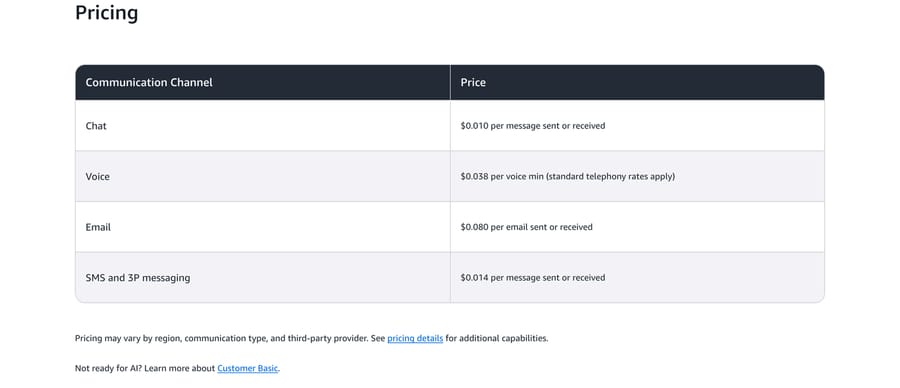
Prices checked September 19, 2026 on aws.amazon.com/products/connect/customer/pricing. The same rates appear in AWS's machine-readable Price List API (publication date September 11, 2026), and they're identical in the six regions we pulled: N. Virginia, Oregon, London, Frankfurt, Sydney and Tokyo.
How Connect Customer and Customer Basic differ
AWS has renamed both modes. Classmethod's DevelopersIO recorded the change on August 17, 2026: "Unlimited AI" became Connect Customer pricing and "Individual features" became Customer Basic. Classmethod reports that the pricing concept hasn't changed and tells readers to check the unit prices; the rates in this guide are the ones in AWS's current appendix and Price List. So a 2025 guide quoting "unlimited AI pricing" is describing the current default under its old name.
Connect Customer is one rate per channel with every AI feature switched on. The appendix table shows what that rate buys, and its first line sets the scope: "Connect Customer charges apply to all channel usage in your account." You can't enable it for the voice queue that benefits from agent assist and leave the high-volume chat queue on the cheaper rate. The switch is per instance.
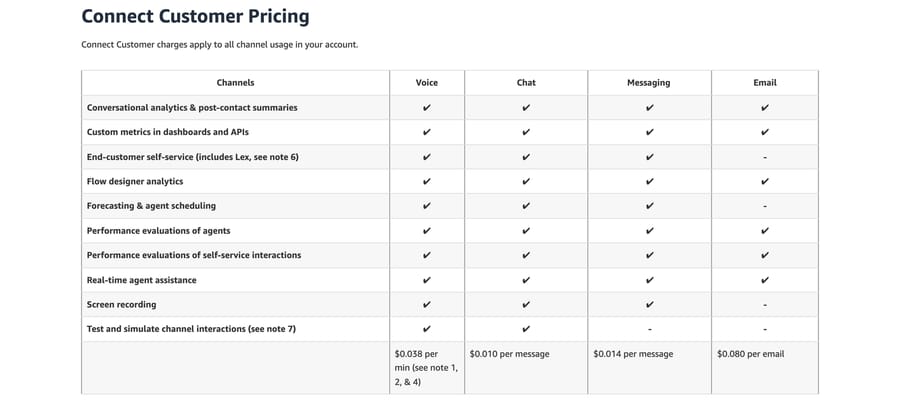
AWS's admin guide says "All new instances are Connect Customer instances." An older instance may still be on the old model until an admin clicks Enable, and going back is a Disable button on the same console page. The same page warns that if Connect Customer-only features are configured in your flows and you switch to Basic, "you might encounter runtime errors." Audit your flows before you downgrade.
Customer Basic starts from the channel rate and adds a price for each capability you turn on. The appendix still publishes the full Basic rate card, even though it now frames Basic as the option for customers who "might still be on" it.
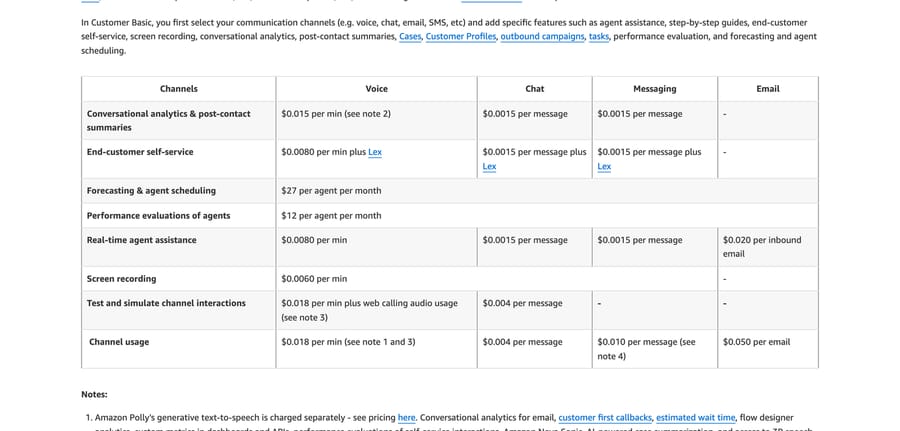
Some capabilities aren't available on Basic at any price. AWS's documentation lists the agentic CX designer, agentic voice (50+ languages, 100+ voices), AI agent observability, customer-first callbacks, email conversational analytics and AI case summarization as Connect Customer only. If the reason you're pricing Amazon Connect is its newer AI agents, Basic isn't an option.
When Customer Basic is cheaper, and when it isn't
The two rate cards cross over at a predictable point, because the Basic add-ons are priced per minute and per message too. Per voice minute:
| What you use on voice | Customer Basic | Connect Customer |
|---|---|---|
| Calls routed, nothing else | $0.018 | $0.038 |
| + conversational analytics and summaries ($0.015) | $0.033 | $0.038 |
| + real-time agent assist ($0.008) | $0.041 | $0.038 |
| + forecasting and scheduling, evaluations | $0.041 plus $39 per agent a month | $0.038 |
On voice, Basic stays cheaper until you add agent assist on top of analytics. The per-agent charges tip it further: an agent handling 2,000 minutes a month saves $10 on Basic with analytics alone (2,000 × $0.005), and forecasting plus evaluations cost that agent $39.
Chat crosses differently. Basic chat is $0.004 a message, analytics and agent assist add $0.0015 each, and Lex-based self-service adds $0.0015 plus Lex's own $0.00075 per text request. Even with all four, a Basic chat message costs about $0.00925 against Connect Customer's $0.010. A chat-heavy team that doesn't need workforce management or evaluations can run cheaper on Basic, as long as it can live without the agentic AI agents.
Email is simplest: $0.050 on Basic against $0.080, with agent assist at $0.020 per inbound email and no email analytics on Basic at all.
Telephony: the charge the headline rate leaves out
"$0.038 per voice min (standard telephony rates apply)" means two charges on every call: the Connect voice service and the phone network. AWS's appendix spells it out: "Connect Customer Voice has two charges: voice service ($0.038) and communication service." US telephony rates in the Global Telephony widget on September 19, 2026:
| US telephony item | Rate |
|---|---|
| Direct inward dial (DID) number | $0.03 a day |
| Toll-free number | $0.06 a day |
| Inbound call on a DID | $0.0022 a minute |
| Inbound call on a toll-free number | $0.012 a minute |
| Outbound call to a US number | $0.0048 a minute |
| In-app or web calling audio | $0.010 a minute |
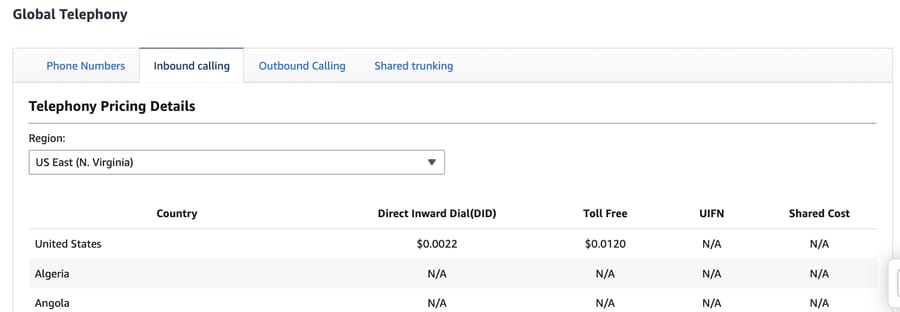
A toll-free inbound minute costs five times a DID minute, so on a toll-free line telephony adds about a third to the $0.038 service charge ($0.012 on $0.038). On a DID it adds under 6%.
Telephony also arrives as a separate line on the invoice. In AWS's own sample bill, "Contact Center Telecommunications (service sold by AMCS, LLC)" sits under Amazon Connect as its own service, so a finance team reconciling "Amazon Connect" alone will undercount the phone system.
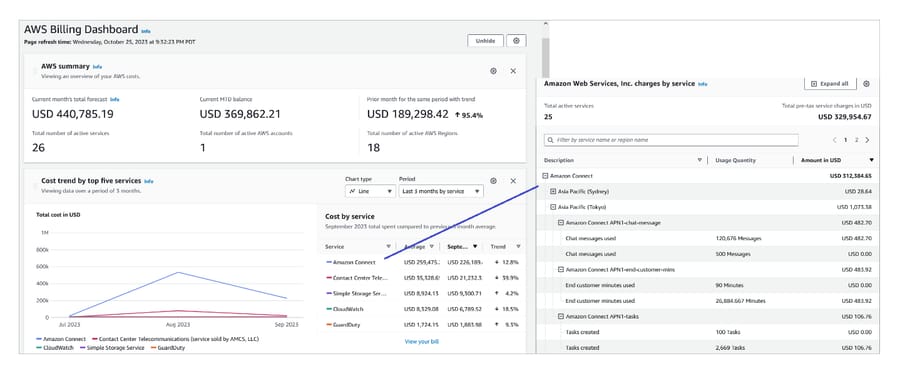
Two metering rules push minutes up. Voice service time counts "when the call is in a flow, in a queue, or connected to an agent," billed per second with a 10-second minimum. Telephony is billed per second with a 60-second minimum. If a caller waits eight minutes and talks for four, you pay for twelve.
What Amazon Connect costs at three team sizes
We modeled one month for three contact centers, using AWS's published US rates and these assumptions:
| Assumption | Small | Mid | Large |
|---|---|---|---|
| Agents | 10 | 50 | 250 |
| Inbound voice minutes (queue time included) | 20,000 | 100,000 | 600,000 |
| Chats (12 billed messages each, customer, agent and AI combined) | 2,000 | 10,000 | 50,000 |
| Emails sent or received (half inbound) | 3,000 | 15,000 | 60,000 |
| SMS or WhatsApp messages | 0 | 20,000 | 100,000 |
| Toll-free numbers | 1 | 1 | 5 |
That's 2,000 to 2,400 voice minutes per agent a month, a busy but ordinary phone queue. Here's the arithmetic on Connect Customer:
| Line (Connect Customer) | Small | Mid | Large |
|---|---|---|---|
| Voice service at $0.038/min | $760.00 | $3,800.00 | $22,800.00 |
| Toll-free minutes at $0.012 + numbers at $0.06/day | $241.80 | $1,201.80 | $7,209.00 |
| Chat at $0.010/message | $240.00 | $1,200.00 | $6,000.00 |
| Email at $0.080 each | $240.00 | $1,200.00 | $4,800.00 |
| SMS/WhatsApp at $0.014 | $0.00 | $280.00 | $1,400.00 |
| Month on Connect Customer | $1,481.80 | $7,681.80 | $42,209.00 |
| Same, before telephony | $1,240.00 | $6,480.00 | $35,000.00 |
| Per agent, telephony included | $148.18 | $153.64 | $168.84 |
| Same month on DID numbers instead of toll-free | $1,284.90 | $6,700.90 | $36,324.50 |
Number type sets most of the telephony line. Put the same inbound minutes on DID numbers and telephony falls from $241.80, $1,201.80 and $7,209.00 to $44.90, $220.90 and $1,324.50 (100,000 × $0.0022 plus $0.03 × 30 days at mid size). The trade is that callers pay for a local call instead of dialing free.
And the same volumes on Customer Basic, first with channels only, then with the features that Connect Customer bundles (analytics and agent assist on voice and chat, assist on inbound email, forecasting and evaluations for every agent):
| Line (Customer Basic) | Small | Mid | Large |
|---|---|---|---|
| Channels at $0.018/min, $0.004/chat msg, $0.050/email, $0.010/SMS, plus the same telephony | $847.80 | $4,431.80 | $24,409.00 |
| + voice analytics and assist at $0.023/min | $460.00 | $2,300.00 | $13,800.00 |
| + chat and SMS analytics and assist at $0.003/message | $72.00 | $420.00 | $2,100.00 |
| + email assist at $0.020 per inbound email | $30.00 | $150.00 | $600.00 |
| + forecasting ($27) and evaluations ($12) per agent | $390.00 | $1,950.00 | $9,750.00 |
| Month on Basic with those features | $1,799.80 | $9,251.80 | $50,659.00 |
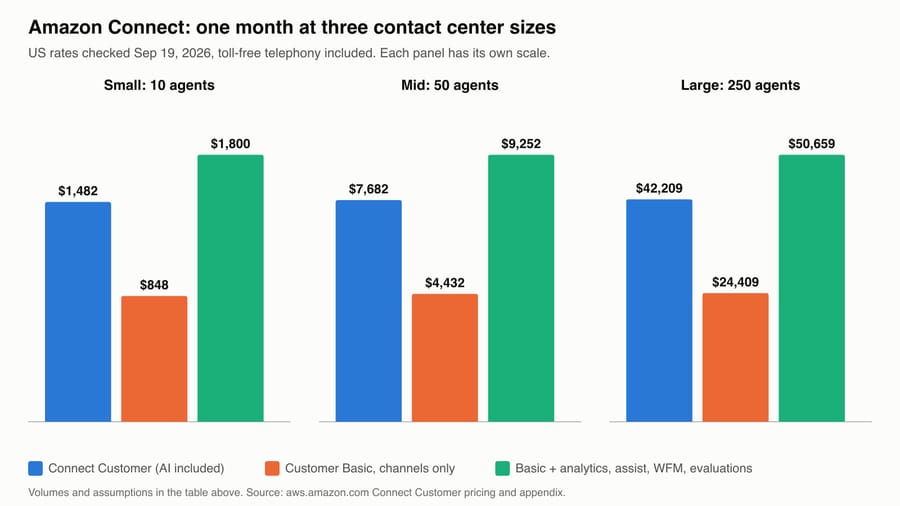
Connect Customer costs between $148 and $169 per agent a month at these volumes with toll-free telephony, or $124 to $140 before it, which lands in the same range as seat-priced contact centers (see the comparison below). Basic with channels only runs about 42% cheaper than Connect Customer at every size, because it drops the AI, and the saving holds only if you genuinely don't want analytics, assist or WFM. And once you add those back on Basic, it costs 20% to 22% more than Connect Customer, mostly from the $39 per-agent charges.
AWS's Price List carries separate "agents forecasted" and "agents scheduled" SKUs at $27 each, but the appendix bills $27 per agent "forecasted or scheduled", and its own example charges 300 scheduled agents $8,100, one $27 each. We counted it once per agent.
We didn't model AI agent self-service minutes separately. On Connect Customer they're the same $0.038 a minute or $0.010 a message as any other contact; on Basic they'd add $0.008 a minute plus Lex requests.
What drives an Amazon Connect bill up
- Queue and hold time. Every minute a caller waits is billed at the full voice rate plus telephony. A 30-second cut in average wait saves 0.5 × $0.050 = $0.025 per call on a toll-free line.
- Chat message counting. AWS bills "all messages to and from Connect Customer, including those with end-customers, human or AI agents, managers chatting with their data (manager assist), or conversational designers." A chatty AI agent that sends three short replies instead of one costs three times as much, and a manager asking the assistant a question costs $0.020 (prompt plus answer).
- Email threads. Email is charged per email "sent or received", so a four-message thread is $0.32, not $0.08.
- Add-ons outside the channel rate. Cases at $0.12 per case created, Tasks at $0.07, Customer Profiles at $0.005 per profile used each day once you import outside data, outbound campaign voice at $0.045 a minute, and Live Sync at $0.01 a minute (free until November 30, 2026, then billed).
- External voice. Running analytics on calls from another phone system costs $0.032 a minute plus $100 per connector per day, which is $3,000 a month per connector before a single minute.
- AI plumbing billed by other AWS services. AI agents using Bedrock Knowledge Bases or AgentCore Gateway (including third-party agents over MCP) incur those services' charges, and third-party speech-to-text or text-to-speech providers bill you directly.
- Resilience. The Price List API shows Global Resiliency voice at $0.055 a minute against $0.038, about 45% more for a multi-region setup.
- SMS delivery. The $0.014 is Connect's handling charge; AWS's own example adds SMS delivery on top.
What the billing unit rewards
Amazon earns per minute and per message, whatever happens in them.
AWS's revenue rises with contact length, so the vendor has no pricing incentive to shorten your calls; that pressure has to come from you. A 12-minute call that the AI agent fumbles and a human rescues bills more than a 4-minute call it resolves cleanly. Per-resolution vendors have the opposite problem: they earn more when the AI claims more outcomes, which is why Fin's $0.99 per outcome depends so much on how "resolved" is defined.
AWS also doesn't profit from idle staff. Seat pricing charges for every logged-in or named agent whether the phone rings or not; Connect charges nothing for a quiet August. That's the strongest argument for the model, and it's why usage billing suits seasonal businesses.
The bundle also changes the upsell. Before Connect Customer, every AI feature was a new line item and a new approval. Flybuys' CX product manager says on AWS's own pricing page that the bundled price lets them add AI "without having to go through business cases and additional financial approval." The flip side is that you pay the $0.020 premium on every minute, including minutes on queues where nobody uses the AI.
How to track and forecast Amazon Connect costs
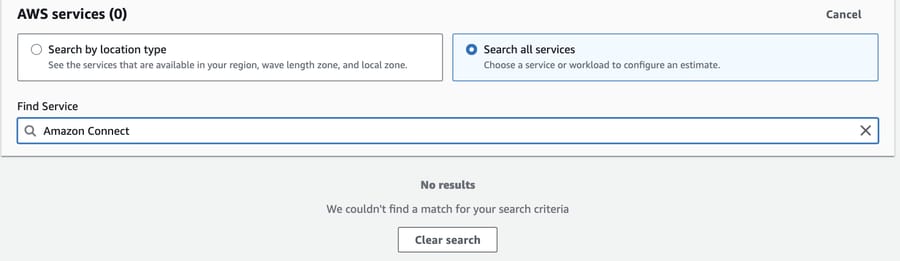
There's no Amazon Connect entry in the AWS Pricing Calculator. We searched calculator.aws for "Amazon Connect" and for "Connect" on September 19, 2026; the second search returns 20 services, including Direct Connect and Elemental MediaConnect, but not Amazon Connect. Third-party calculators (CloudInteract's, for one) fill the gap, and the tables above are the manual version.
For tracking spend after launch, AWS's granular billing guide is the tool. By default the bill summarizes Connect at account level by usage type. Connect automatically tags each contact with its instance ID and phone number, and you can add up to six of your own tags (department, cost center, business unit) through a Contact tags flow block or the TagContact API. Once activated in the Billing console, which takes up to 24 hours, those tags split the Connect bill in Cost Explorer.
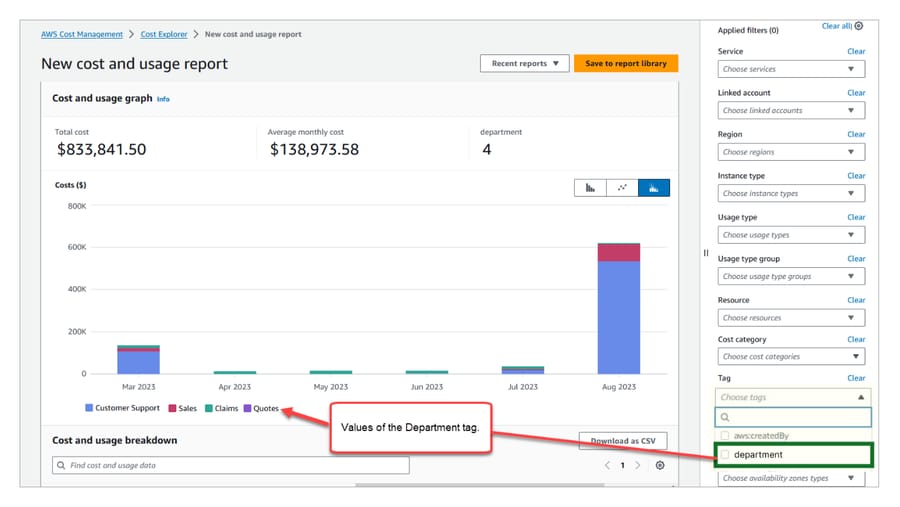
Two limits from the same page: tags can't be used as filters in Connect's own contact search or reports, and a tag edited more than three hours after the contact ends won't reach billing.
Free tier, trials and discounts
The AWS Free Tier for Connect covers features, not channels. During the first 12 months you get 1,000 Customer Profiles and 500 conversational-analytics chat messages a month. Trials start on first use: 100,000 analytics voice minutes a month for two months, 30 days of performance evaluations and 90 days of forecasting and scheduling. Voice minutes, chat messages and telephony are billed from the start, so a proof of concept costs a few dollars, not nothing.
AWS doesn't publish an annual or committed-use price for Connect. The pricing page carries a "Request a pricing quote" button, and practitioners describe contracts in the field. Amr Ehab, a solution architect at Rutotech, wrote on PeerSpot that "Most of my customers are not going with the pay-as-you-go pricing model, as they prefer yearly contracts or three-year contracts." We couldn't find any published discount level, so treat the list rates as the ceiling a negotiation starts from.
What users say about the cost
Amazon Connect holds 4.4 out of 5 on G2 from 92 reviews, 4.5 on Capterra from 96, 4.5 on Gartner Peer Insights from 941 ratings across all markets, and 4.2 on PeerSpot from 26 reviews (all checked September 19, 2026). G2's reviewer averages put implementation at 4 months and return on investment at 19 months.
Reviewers like the rate card and dislike the effort. Atharva P., a cloud BI engineer at an enterprise company, wrote on G2 in July 2026 that "The pay-as-you-go pricing model also delivers strong ROI compared to traditional contact centre solutions." Umar F., a manager in marketing and advertising, listed "No upfront costs or long-term commitments" as a top pro on Capterra in June 2025.
The recurring complaint is the cost that never appears on the AWS bill: people. Nikhil S., a help desk specialist at a small business, gave it 2 out of 5 on G2 in May 2026 because it "functions more like a toolkit for building a contact center rather than a complete software solution." Nadia N., reviewing for a small business the next day, said adjusting routing profiles in the AWS console "takes a steep learning curve." Jamie Elms, a DevOps engineer at Mission Labs, told PeerSpot the AI model "will cost more money, but you can opt in to getting features that are AI-enhanced," which is the Basic-versus-Connect Customer decision above in one sentence. Budget for an AWS-literate admin or a partner; at the small size, a full-time admin costs several times the $1,482 AWS bill.
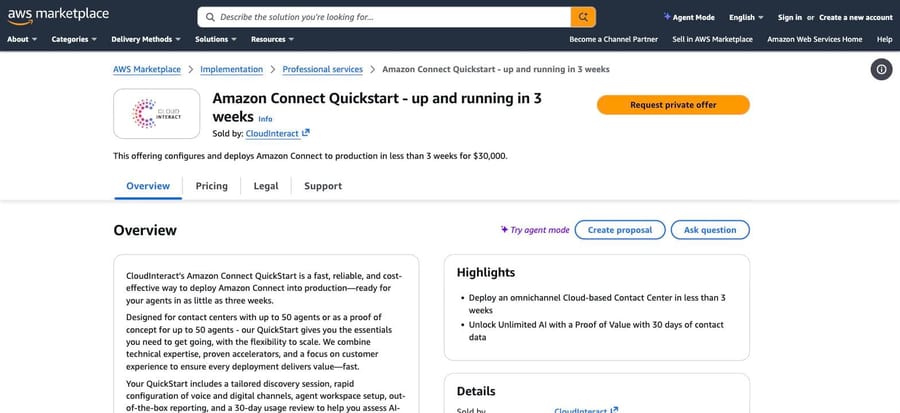
One partner publishes its price. CloudInteract's AWS Marketplace listing, "Amazon Connect Quickstart - up and running in 3 weeks", configures and deploys Connect to production for $30,000, sized for up to 50 agents, two channels and three queues, and it's bought through a private offer. That's a partner's services fee, not an AWS charge, and it's about 20 months of the small team's AWS bill.
How Amazon Connect pricing compares
Seat-priced contact centers publish a price per agent, so the fair comparison is the mid-size team from our model: 50 agents. Rival figures come from their own pricing pages on September 19, 2026, and cover seat licenses only. Five9, Genesys and Twilio add their own telephony and usage charges on top, which Connect's figures already include.
| Platform | Billing unit | Published price | 50 agents, one month |
|---|---|---|---|
| Amazon Connect (Connect Customer) | Voice minute, message, email | $0.038/min, $0.010/chat msg, $0.080/email | $5,002 voice only with toll-free telephony; $7,682 all channels (our mid model) |
| Five9 | Concurrent seat, 50-seat minimum | Digital $119, Core $159 a month; Plus, Pro, Enterprise by quote | $7,950 on Core (Digital has no voice) |
| Genesys Cloud CX | Named user, billed annually | CX 1 $75, CX 2 $115, CX 3 $155, CX 4 $240 | $5,750 on CX 2 |
| Twilio Flex | Named user or active user hour | $150 per named user, or $1 per active user hour | $7,500 named; $8,000 at 160 active hours each |
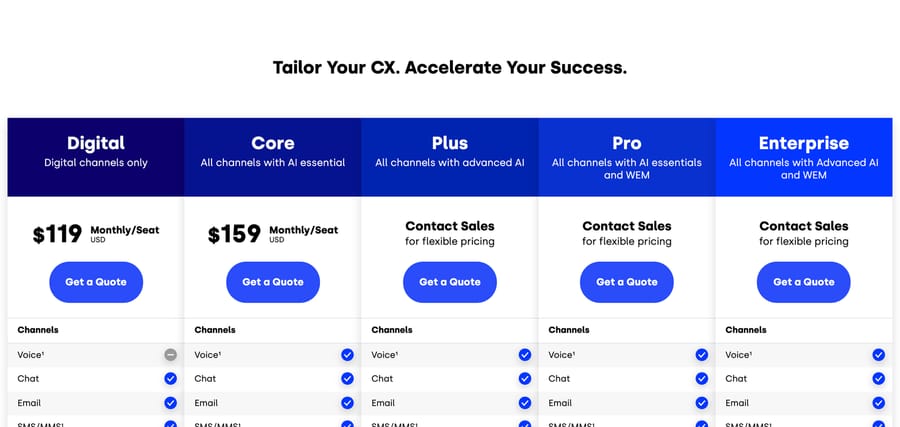
Five9 prices per concurrent seat with a 50-seat minimum, so a 10-agent team pays for 50 and a 24-hour operation with three shifts pays for the people online at once. At our small size Five9's floor is $5,950 a month on Digital against Connect's $1,482. Our Five9 guide covers its AI bundles.
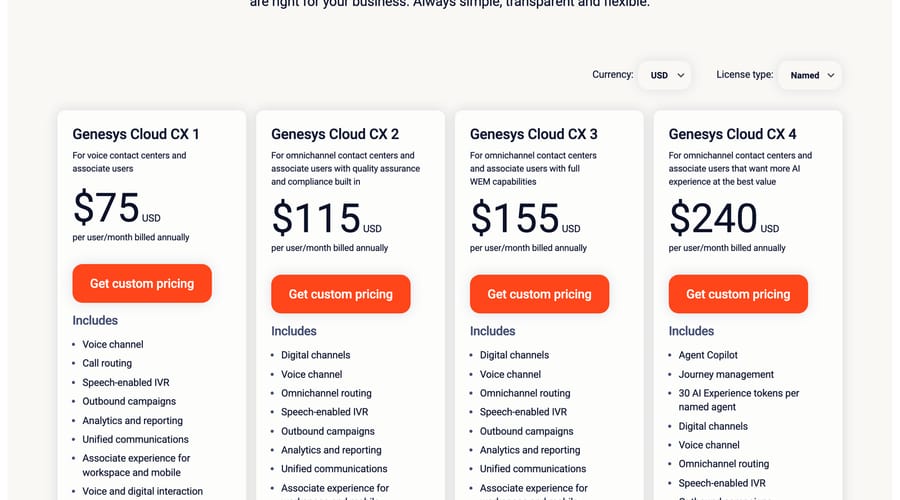
Genesys is the cheapest seat price in this table for an omnichannel team at $115, billed annually, and it meters AI separately through AI Experience tokens: every plan includes 250 tokens per org a month, and CX 4 adds 30 per named agent. See our Genesys Cloud guide.
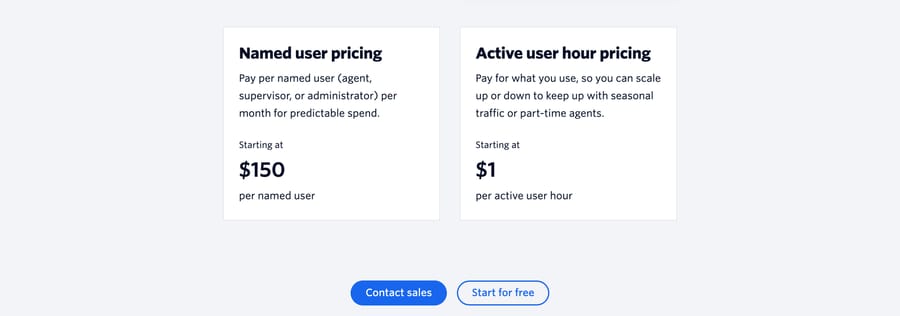
Twilio Flex offers both units: $150 per named user, which comes with a contract, or $1 per active user hour, with 5,000 free active user hours for new accounts. Active-hour billing suits part-time and seasonal teams the way Connect's usage billing does.
Connect wins clearly at the small end, where seat minimums hurt, and for seasonal volume. At 50 steady agents, Connect's voice-only month, $5,002 with toll-free telephony, is below Five9 Core's $7,950 and Twilio's $7,500 in seat fees alone, and above Genesys CX 1's $3,750, a voice-only plan, before any of the three adds its telephony. With chat, email and SMS on top, Connect's $7,682 sits inside the rivals' license range in the table, $5,750 to $8,000, and those fees still leave out their usage. At 250 agents with long calls, Connect's $140 per agent before telephony lands between Genesys CX 2 ($115) and CX 3 ($155), and every extra minute of handle time moves it up. If you're comparing enterprise suites, our guides to NICE CXone and Talkdesk cover the other two names that come up in most shortlists.
Where Macha fits, and where it doesn't
Macha isn't a contact center and doesn't replace Amazon Connect's phone routing. It's an AI agent layer on the help desk you already run: Zendesk, Freshdesk, Gorgias or Front. It fits teams whose volume is email and chat tickets that live in that help desk.
On Connect's price list, AWS's own appendix table leaves end-customer self-service unticked for email, and each email in a thread is a separate $0.080 charge. Macha bills one ticket per thread with one person however many replies it takes, from $299 a month for 750 tickets, about $0.40 a ticket, with setup and monitoring by the Macha team included (pricing). A team running phones on Connect and email in Zendesk can use both; our overview of AI agents for customer service covers how the two layers split.
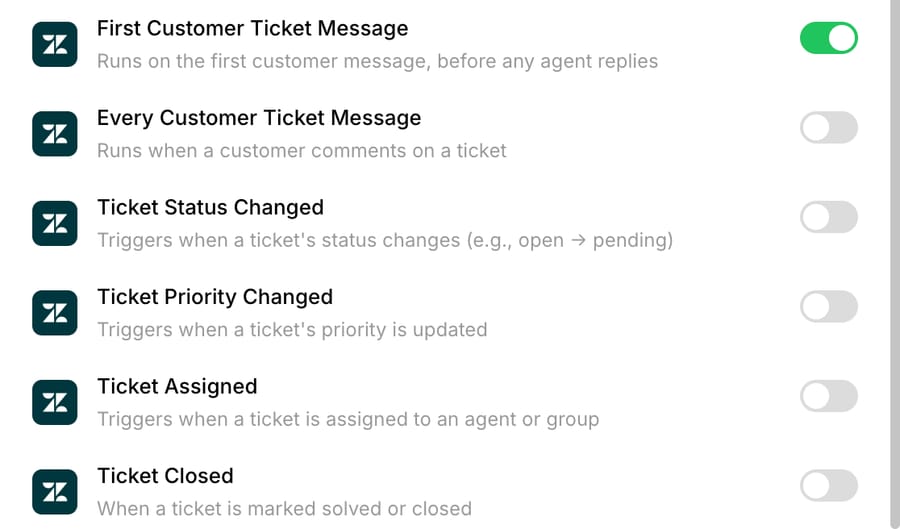
An agent can run on every customer reply in a thread, as in the trigger list above, and the thread still counts as one ticket.
Other Amazon Connect products and their pricing
"Amazon Connect" now names a family of products; the contact center is Connect Customer. Amazon Connect Health prices differently: ambient clinical documentation is $99 per user a month for up to 600 encounters, with $0.036 a minute beyond that, and patient verification is $0.15 per action, where AWS defines an action as one end-to-end patient conversation, with 30,000 free actions in a 30-day trial. We didn't price Connect Talent or Connect Decisions, which aren't customer service products.
How we researched this
We checked AWS's Connect Customer pricing page, the full pricing appendix, the Global Telephony widget and the Connect admin guide on September 19, 2026, and cross-checked every rate against AWS's Price List API in six regions. Ratings and quotes come from G2, Capterra, Gartner Peer Insights and PeerSpot, read in a browser the same day. We didn't create an AWS account or build an Amazon Connect instance, so the billing screenshots are AWS's own documentation examples from 2023, the Macha screenshot comes from our own demo workspace, and the three monthly costs are our arithmetic on published rates at volumes we chose, not invoices.
Frequently asked questions
How much does Amazon Connect cost per month? There's no monthly fee; you pay for usage. At our assumed volumes, Connect Customer costs about $1,482 a month for 10 agents, $7,682 for 50 and $42,209 for 250, telephony included, or roughly $148 to $169 per agent on toll-free numbers.
Is Amazon Connect free? No. The AWS Free Tier covers some features (1,000 Customer Profiles and 500 analytics chat messages a month for 12 months, plus time-limited trials of analytics, evaluations and forecasting), but voice minutes, chat messages and telephony are billed from the first use.
How does Amazon Connect work? Customers reach you through a phone number, a chat widget, SMS, WhatsApp or email. Flows you build in the Connect console route each contact through menus or AI self-service into queues, and agents answer in a browser-based workspace. AWS meters every minute a call spends in a flow, a queue or with an agent, plus every message and email, so the bill follows contact volume, not headcount.
What is Amazon Connect unlimited AI pricing? It's the old name for Connect Customer pricing: $0.038 a voice minute, $0.010 a chat message, $0.014 a messaging message and $0.080 an email, with AI agents, analytics, agent assist, forecasting and evaluations included. The rename was reported in August 2026.
What is Amazon Connect Customer Basic? The lower-rate mode that bills features separately: $0.018 a voice minute, $0.004 a chat message and $0.050 an email, with analytics, agent assist and self-service added per minute or message, and forecasting and evaluations at $27 and $12 per agent a month. It can't run the newer agentic AI agents.
Is there an Amazon Connect pricing calculator? Not from AWS. The AWS Pricing Calculator has no Amazon Connect service as of September 19, 2026, so you multiply your minutes, messages and emails by the rate card and add telephony, as in the tables above.
How much does an Amazon Connect phone number cost? In the US, a direct-dial number is $0.03 a day and a toll-free number $0.06 a day. Inbound minutes add $0.0022 on a DID or $0.012 on toll-free, and outbound calls to US numbers add $0.0048 a minute.
Is Amazon Connect billed on my AWS bill? Yes. Connect usage appears on your AWS bill, with telephony as a separate "Contact Center Telecommunications" line, and you can split costs by department or phone number with contact tags in Cost Explorer.
How much does Amazon Connect Health cost? Ambient documentation is $99 per user a month for up to 600 encounters, and patient verification is $0.15 per action, one end-to-end patient conversation, with free trials for first-time users.
Is Amazon Connect any good? It rates 4.4 on G2 (92 reviews) and 4.5 on Gartner Peer Insights (941 ratings). Reviewers praise the pay-as-you-go pricing and scale, and criticize the learning curve: it behaves like a toolkit that needs AWS skills.
What are some alternatives to Amazon Connect? Five9 ($119 to $159 per concurrent seat, 50-seat minimum), Genesys Cloud CX ($75 to $240 per user, billed annually) and Twilio Flex ($150 per named user or $1 per active hour) are the closest priced alternatives. For AI on email and chat tickets inside Zendesk, Freshdesk, Gorgias or Front, Macha is a different kind of tool.
If your ticket queue in one of those help desks is the bigger cost than the phone lines, start a Macha trial with $50 of free usage, or compare the tiers on our pricing page.
Sources: AWS Connect Customer pricing, AWS Connect Customer pricing appendix, AWS Price List API, AmazonConnect offer, AWS admin guide, Connect Customer, AWS admin guide, granular billing, Amazon Connect Health pricing, Classmethod DevelopersIO on the plan rename, G2 Amazon Connect reviews, Capterra Amazon Connect reviews, CloudInteract Amazon Connect Quickstart on AWS Marketplace, Gartner Peer Insights Amazon Connect, PeerSpot Amazon Connect pricing reviews, Five9 pricing, Genesys Cloud pricing, Twilio Flex pricing.
Simple per-ticket AI pricing
One thread with one person is one charge, however many replies it takes.