Shopify
 Stripe
 Slack
Slack Notion
 Google Workspace
 Confluence

How Much Does Decagon Cost? Decagon AI Pricing Explained (2026)


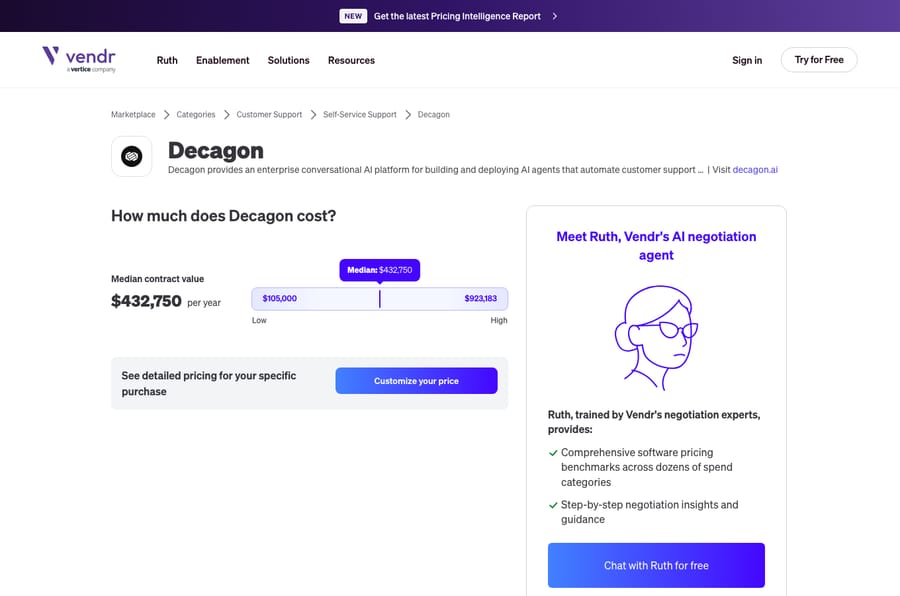
Decagon doesn't publish prices, so every number you'll find comes from someone else. The only buyer data, from the procurement platform Vendr, puts the median Decagon contract at $432,750 a year, with deals from $105,000 to $923,183, as of October 13, 2026. Decagon bills per conversation or per resolution under a yearly platform contract. A competitor, Quiq, estimates the rates at about $0.99 per conversation plus a platform fee of about $50,000 a year. On those estimates, 20,000 conversations a month costs about $24,000 a month, or $2.00 per resolved conversation at a 60% resolution rate. Below: where each figure comes from, why they disagree, and the arithmetic at three volumes.
Key takeaways
- Decagon publishes no prices; Vendr's buyer data puts the median Decagon contract at $432,750 a year, ranging from $105,000 to $923,183, as of October 13, 2026.
- Vendr's Decagon figures come from 12 purchases by only 2 buyers, so the median describes two companies' deals rather than a market rate.
- The widely repeated $50,000 platform fee and $0.99 per conversation come from Quiq, a Decagon competitor, which calls them estimates from public information and industry discussions.
- On Quiq's estimates and a 60% resolution rate, Decagon costs about $3.04 per resolution at 5,000 conversations a month and $1.72 at 100,000.
- Fin publishes $0.99 per outcome with no platform fee, and Macha charges about $0.40 per ticket with done-for-you setup and a dedicated success manager included.

Decagon pricing at a glance
| Figure | Amount | Source and date | Does the source sell against Decagon? |
|---|---|---|---|
| Published price | None; decagon.ai/pricing returns a 404 | Decagon, checked October 13, 2026 | n/a |
| Billing models | Per conversation, or a higher rate per resolution | Decagon's pricing post, December 10, 2024 | n/a |
| Median annual contract | $432,750 (range $105,000 to $923,183) | Vendr, checked October 13, 2026 | No |
| Platform fee | About $50,000 a year | Quiq, updated March 11, 2026 | Yes |
| Per conversation | About $0.99 | Quiq, updated March 11, 2026 | Yes |
| Per resolution | No verified figure | See "Why do Decagon price estimates disagree?" below | n/a |
| AWS Marketplace | One 12-month "Platform Access" dimension, private offer, $1,000,000 placeholder | AWS listing, checked October 13, 2026 | No |
Disclosure: Macha publishes this blog and sells an AI agent priced per ticket. We compare it with Decagon and Fin near the end, and every Decagon figure links to its source so you can check it.
How we researched this
On October 13, 2026 we opened Decagon's site, its pricing post and its AWS Marketplace listing in a headless browser, read Vendr's Decagon page including the purchase counts in its page data, and read every page that ChatGPT and Claude cited that day when asked "How much does Decagon cost?": Quiq, Fin, aissist, Sacra, ClickPost and CallCenterAdvisor. We noted each figure, its date and whether the publisher competes with Decagon. We could not buy Decagon or run it, because it sells only through a sales process with no self-serve account. So there is no first-hand Decagon run here. Every cost below is either Decagon's own wording, Vendr's buyer data, or a competitor's estimate labeled as one, and the per-resolution costs are our arithmetic on those figures, worked in the open.
For the product itself, see our Decagon AI review. This page covers only what you pay.
What does Decagon publish about its pricing?
Decagon publishes two things about pricing, and neither has a dollar figure.
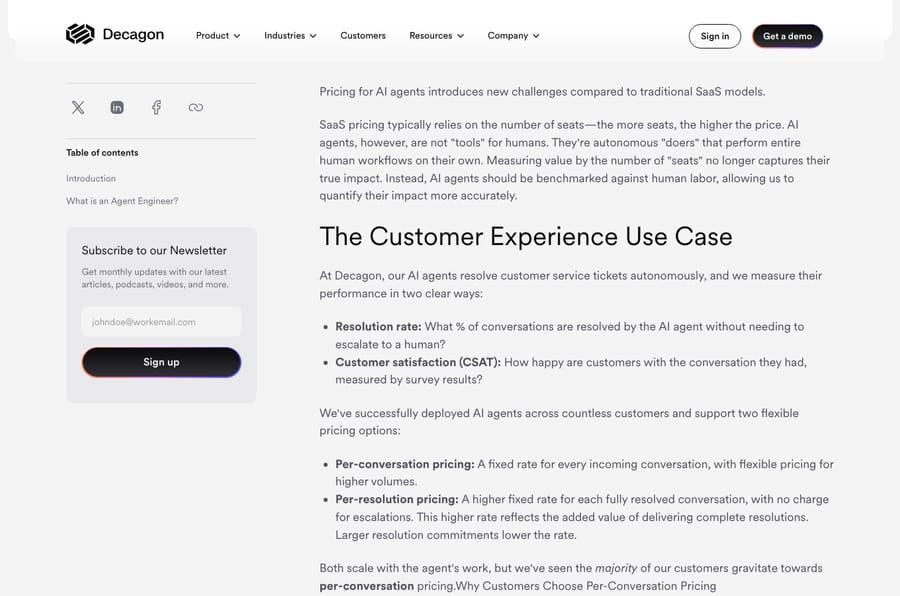
The first is a December 10, 2024 post by Bihan Jiang, Decagon's Director of Product. It describes two options. Per-conversation pricing is "a fixed rate for every incoming conversation, with flexible pricing for higher volumes." Per-resolution pricing is "a higher fixed rate for each fully resolved conversation, with no charge for escalations," and "larger resolution commitments lower the rate." The post says the majority of Decagon's customers choose per-conversation pricing.
The second is Decagon's AWS Marketplace listing, sold by Decagon AI. It has one pricing dimension, "Platform Access," on a 12-month contract, described as "Decagon platform access. Pricing determined by private offer." The $1,000,000.00 in the cost column is a placeholder. Listings priced by private offer show a round figure there, and Sierra's listing shows the same $1,000,000 for the same reason, as our Sierra pricing breakdown explains.
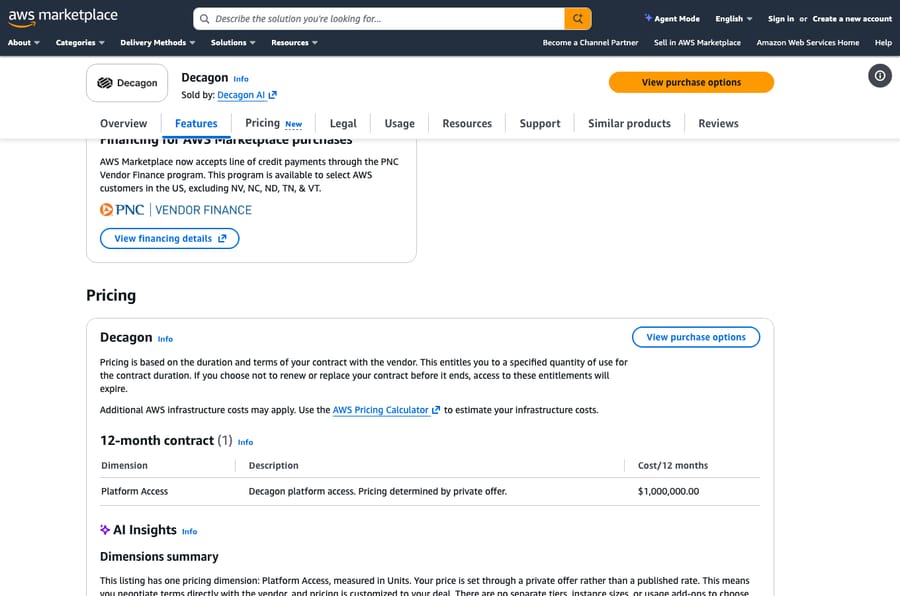
Read together, the two say a Decagon deal is a yearly platform contract with usage billed per conversation or per resolution. The listing has no separate usage dimension, so on AWS the whole deal sits inside the private offer. Decagon's site has no pricing page: decagon.ai/pricing returned a 404 on October 13, 2026, and CallCenterAdvisor recorded the same 404 on October 3.
Why do Decagon price estimates disagree?
Ask an AI assistant what Decagon costs and you'll get some mix of $50,000, $95,000, $386,000, $432,750, $0.99, $0.50 and $1.50. They come from six publishers, most of whom sell against Decagon.
$432,750 median, $105,000 to $923,183. Vendr's Decagon page, read October 13, 2026. Vendr runs software purchasing for companies and publishes what its customers paid, so this is the only figure based on real contracts. It's also thin: the page's own data counts 12 purchases from 2 unique buyers and 2 negotiations. The middle half of those purchases runs from $300,000 to $607,250. The $105,000 and $923,183 that Vendr labels Low and High are near the ends of its range, not single contracts: the page data puts the smallest purchase at $100,000 and the largest at $949,203. Treat it as what two companies paid, not a market rate.
$386,000 median, $95,000 to $590,000+. Fin's Decagon pricing article attributes this to Vendr. When we opened Vendr's page on October 13, 2026, it showed $432,750 instead. aissist read $432,750 on August 28, 2026, and our own pages recorded $432,750 on September 19 and 25, so $386,000 is either an older reading or a misquote that other articles copied.
About $50,000 a year platform fee and about $0.99 per conversation. These come from Quiq's Decagon pricing post, updated March 11, 2026. Quiq sells AI agents against Decagon, and it says the figures come from "public information and industry discussions." Fin, eesel and others repeat them, which makes them look corroborated when they share one origin. Vendr's page also shows "$50k," as a "redline threshold estimate" under Legal, which is about when Decagon negotiates contract terms. It isn't a fee.
About $95,000 a year. ClickPost, updated August 6, 2026, lists "~$95K/yr, ~6-wk deploy" for Decagon with no source.
$0.50 or $1.50 per resolution. Fin mentions "at least one reported" $0.50 per resolution and calls it a likely negotiated enterprise rate. aissist gives about $1.50, credited to "Sacra estimate via My AskAI." Sacra's Decagon page describes the two billing models and estimates Decagon's annualized revenue at $100M in July 2026, but it prints no per-resolution rate. Neither number has a source we could open.
If Quiq is right, a contract equals $50,000 plus $0.99 a conversation, and Vendr's figures translate into volumes:
- Low end of Vendr's range: ($105,000 − $50,000) ÷ $0.99 = 55,556 conversations a year, about 4,630 a month.
- Median: ($432,750 − $50,000) ÷ $0.99 = 386,616 a year, about 32,200 a month.
- High end of the range: ($923,183 − $50,000) ÷ $0.99 = 882,003 a year, about 73,500 a month.
That's a contact-center buyer, which matches the airlines, banks and telecoms Sacra lists among Decagon's customers alongside tech companies such as Notion and Duolingo. It also means the low end of Vendr's range and ClickPost's $95,000 point to the same thing: below about 4,000 to 5,000 conversations a month, Decagon is unlikely to be priced for you.
What does Decagon cost per resolution at 5,000, 20,000 and 100,000 conversations?
Decagon's rates aren't published, so this uses Quiq's estimate and says so in every row. The assumptions, the same as our Sierra breakdown:
- Volumes: 5,000, 20,000 and 100,000 conversations a month.
- Resolution rate: 60%, so 3,000, 12,000 and 60,000 resolutions.
- Platform fee: $50,000 a year (Quiq's estimate), which is $4,167 a month.
- Usage: $0.99 per conversation (Quiq's estimate) on the per-conversation model, which Decagon says most customers choose.
- Excluded: your help desk, voice minutes and any implementation fee.
| Conversations a month | Monthly cost: $4,167 + conversations × $0.99 | Per conversation | Per resolution at 60% |
|---|---|---|---|
| 5,000 | $4,167 + $4,950 = $9,117 | $1.82 | $9,117 ÷ 3,000 = $3.04 |
| 20,000 | $4,167 + $19,800 = $23,967 | $1.20 | $23,967 ÷ 12,000 = $2.00 |
| 100,000 | $4,167 + $99,000 = $103,167 | $1.03 | $103,167 ÷ 60,000 = $1.72 |
| 100,000 with 30% off usage | $4,167 + $69,300 = $73,467 | $0.73 | $73,467 ÷ 60,000 = $1.22 |
The last row uses a Vendr buyer note from August 30, 2024: one buyer got "a 30% discount off list price for 1mil+ conversations." At 100,000 a month you'd buy 1.2 million a year, so that discount is in reach. At the median contract's volume of about 32,200 conversations a month, the same model gives $432,750 ÷ 12 = $36,063 a month and $1.87 per resolution.
Two things move these numbers more than the rates. The platform fee is fixed, so at 5,000 conversations it adds $1.39 to every resolution, and at 100,000 it adds 7 cents. And per-conversation billing charges for the 40% the agent hands to a person, so each point of resolution rate you lose raises the cost per resolution. At 20,000 conversations, dropping from 60% to 50% takes it from $2.00 to $2.40.
Should you pick per-conversation or per-resolution billing?
The switch point is simple. Per-resolution is cheaper when its rate is below the per-conversation rate divided by your resolution rate. At $0.99 a conversation and 60% resolved, that's $0.99 ÷ 0.6 = $1.65. A per-resolution quote under $1.65 beats the per-conversation price at that rate. If you expect 40%, the switch point rises to $2.48.
Each model protects a different side. Per-conversation pays Decagon for every conversation, including the ones its agent escalates, so a weak month costs you the same. The incentive follows: on this model Decagon earns more when you send it more conversations, whether or not its agent resolves them. Decagon's post argues this is more predictable for the buyer, which is true, and most of its customers agree. Per-resolution moves the risk to Decagon, and Decagon prices that risk into "a higher fixed rate." It also makes the definition of "fully resolved" a contract term worth reading closely. Our guide to per-action and per-resolution pricing goes through the trade-off across vendors.
The practical move is to get both quotes and compute your own switch point with your real escalation rate, not the one in the sales deck.
What's in a Decagon contract?
Vendr's buyer notes are the only public look inside a signed Decagon deal. All six carry the same company size, about 219 people, so they may all come from one buyer. Read them as examples of what's negotiable rather than standard terms.
| Term | What a buyer got | Vendr note date |
|---|---|---|
| Payment schedule | Annual payment is standard; one buyer got quarterly after asking for monthly | August 30, 2024 |
| Volume discount | 30% off list price for 1 million+ conversations | August 30, 2024 |
| Startup risk | Contract language covering Decagon's insolvency | August 30, 2024 |
| SLA | SLA timing written into the MSA, with service credits if missed | August 30, 2024 |
| Term | A 2-year purchase with an opt-out for year 2 | February 24, 2025 |
| Seats | Unlimited admin seats | February 24, 2025 |
Add what Decagon and AWS say: a 12-month platform contract, a usage model you choose at signing, and lower per-resolution rates for larger commitments. Implementation time is reported, not published: ClickPost lists about six weeks without a source, and aissist cites G2 reviewers describing about two months. A few things no source answers, so ask in writing: whether voice minutes bill at the same rate as chat, whether implementation is a separate fee, what counts as a "fully resolved" conversation, and what happens when volume exceeds the contracted amount.
For the other vendors buyers shortlist against Decagon, see our Decagon alternatives. For how Decagon's contract compares with Sierra's outcome-based deal, see Decagon vs Sierra, and for Ada and Forethought next to both, our enterprise AI support pricing comparison.
How does Decagon compare with Fin and Macha on price?
Fin and Macha both publish prices, so the comparison is a published number against an estimate.
| Decagon (estimates, October 13, 2026) | Fin (fin.ai, October 13, 2026) | Macha (getmacha.com, October 13, 2026) | |
|---|---|---|---|
| Billing unit | Per conversation, or per resolution | Per outcome | Per ticket: one thread between Macha and one person, charged once no matter how many messages it takes |
| Published price | None | $0.99 per outcome | $299 a month for 750 tickets, $599 for 1,500, $1,199 for 3,000, $1,999 for 5,000, $2,999 for 7,500 and $3,999 for 10,000, with custom pricing above that |
| Platform fee | About $50,000 a year (Quiq's estimate) | None | None |
| Minimum | 12-month contract; low end of Vendr's range $105,000 | 50 outcomes a month when Fin runs on a help desk other than Intercom | The tier you pick, billed monthly |
| Setup | Sales-led deployment | You set it up | Done for you by the Macha team, with a dedicated success manager, included |
| Trial | None | 14 days | $50 of free usage (about 125 tickets), no credit card, no time limit |
| 5,000 conversations, 60% resolved | About $9,117 a month | 3,000 × $0.99 = $2,970 | $1,999 for 5,000 tickets |
| 20,000 conversations, 60% resolved | About $23,967 a month | 12,000 × $0.99 = $11,880 | Custom above 10,000 tickets |
| 100,000 conversations, 60% resolved | About $103,167 a month list, $73,467 with 30% off | 60,000 × $0.99 = $59,400 | Custom above 10,000 tickets |
Sources: Fin pricing and Macha pricing, both checked October 13, 2026; Decagon rows from the estimates above. Fin has been part of Salesforce since September 10, 2026. Our Fin pricing breakdown covers its billing in detail.
The models charge for different things. Fin bills only resolved outcomes. Decagon's per-conversation model and Macha both bill every conversation the agent handles, resolved or not, so their cost per resolution depends on your resolution rate. What Decagon's price buys that the others' doesn't is a vendor that builds deep, multi-step agents for voice and chat at contact-center scale, under an enterprise contract with SLAs. If you need that at 100,000 conversations a month, the per-resolution gap narrows.
Where Macha fits
Decagon's pricing is built for companies with tens of thousands of conversations a month and a procurement team. The arithmetic above shows why: below about 5,000 conversations, an estimated $50,000 platform fee spread over too few conversations makes each resolution expensive.
Macha fits teams already running Zendesk, Freshdesk, Gorgias, Front, HubSpot or Intercom who want an agent built for them without an enterprise contract. Like Decagon, the vendor's team does the build. Macha's done-for-you setup means the Macha team analyzes your past tickets, builds the knowledge base and the agent on your existing help desk, and runs it in safe mode, with drafts as internal notes, until the drafts are right. It costs about $0.40 per ticket, which includes the setup and a dedicated success manager who handles your changes after go-live, on the trial and every plan. Above 10,000 tickets a month, Macha is a custom quote too, but there's no platform fee and billing stays monthly.
Frequently asked questions
How much does Decagon cost? Decagon doesn't publish prices. Vendr's buyer data puts the median contract at $432,750 a year, with a range of $105,000 to $923,183, from 12 purchases by 2 buyers (checked October 13, 2026). A competitor, Quiq, estimates about $50,000 a year in platform fees plus about $0.99 per conversation.
Does Decagon have a pricing page? No. decagon.ai/pricing returned a 404 on October 13, 2026. Decagon's only public description of its billing is a December 2024 blog post that names per-conversation and per-resolution options without prices, and its AWS Marketplace listing shows a 12-month platform contract set by private offer.
How much does Decagon charge per conversation? Decagon hasn't published a rate. Quiq estimates about $0.99 per conversation, and that's the figure most articles repeat. One Vendr buyer reported 30% off list price for more than 1 million conversations, so large contracts likely pay less.
What is Decagon's per-resolution price? No public source gives one we could verify. Decagon says it's "a higher fixed rate" than per-conversation pricing and that larger commitments lower it. At $0.99 a conversation and a 60% resolution rate, a per-resolution rate under $1.65 would be the cheaper option.
Is Decagon more expensive than Fin? On the available estimates, yes, at most volumes. Fin publishes $0.99 per outcome with no platform fee. On Quiq's figures, Decagon costs about $3.04 per resolution at 5,000 conversations a month, $2.00 at 20,000 and $1.72 at 100,000, at a 60% resolution rate.
Why do I see $386,000 for Decagon's median contract? Fin's article attributes $386,000 to Vendr, and other pages copied it. Vendr's Decagon page showed $432,750 when we checked on October 13, 2026, and on our earlier checks in September.
If you'd rather see a price working before any contract, you can start a Macha trial with $50 of free usage (about 125 tickets), no credit card, no time limit. You connect your help desk in about 15 minutes, and the Macha team builds and tests the first agent on your past tickets.
Sources: Decagon: Pricing the AI Agent Economy · AWS Marketplace: Decagon · Vendr: Decagon · Quiq: Decagon pricing · Fin: Decagon AI pricing · aissist: Decagon pricing explained · Sacra: Decagon · ClickPost: AI chatbot pricing · CallCenterAdvisor: Decagon · Fin pricing