Intercom
 Shopify
 Stripe
 Slack
Slack Notion
 Google Workspace
 Confluence

Decagon vs Sierra AI (2026): Which Costs Less, and Who Owns the Agent After Launch?


Decagon and Sierra both sell enterprise AI agents for chat, email and voice on annual contracts with no public price list. The differences that change your bill and your workload are what you pay for (Decagon offers per-conversation or per-resolution, Sierra mainly per outcome) and who edits the agent after launch.
Key takeaways
- Decagon lets customers choose per-conversation or per-resolution billing, while Sierra bills mainly per outcome such as a resolved conversation, saved cancellation or upsell.
- Neither Decagon nor Sierra publishes a price, and Vendr reports Decagon's median buyer contract at $432,750 a year, about $36,063 a month, with no Sierra data.
- At a 60% resolution rate, a $0.99 per-conversation price equals $1.65 per resolution, the arithmetic Decagon uses to argue against outcome-based pricing.
- Sierra's trust center lists FedRAMP High and ISO 42001, which Decagon's trust center does not, so Sierra is the pick for US federal work.
- Sierra launched Ghostwriter in March 2026, a tool that builds and edits agents from prompts, SOPs or call recordings and runs simulations on each change.

Decagon lets you choose per-conversation or per-resolution billing and puts agent logic in plain-language procedures your team edits, while Sierra bills mainly per outcome and leans more on its own team and its Ghostwriter tool. Neither publishes a price: Vendr puts Decagon's median contract at $432,750 a year and has no Sierra data. Both vendors are well funded and moving fast. Decagon raised a $250 million Series D in January 2026, which it says tripled its valuation to $4.5 billion. Sierra raised $950 million at $15.8 billion in May 2026 and said in February it had passed $150M in annual recurring revenue. Our Decagon guide and Sierra guide cover each product; this page only compares them.
How do Decagon and Sierra compare at a glance?
| Decagon | Sierra | |
|---|---|---|
| Architecture | Agent logic in Agent Operating Procedures (AOPs), natural language compiled to workflows with code for sensitive steps | Agent OS: Agent Studio (no-code journeys), Agent SDK (code) and Ghostwriter (builds agents from prompts) |
| Channels | Chat, email, voice, SMS, WhatsApp | Chat, email, voice, SMS, WhatsApp, ChatGPT |
| Who builds | Your team, with a forward-deployed Decagon team included | Sierra's agent development team with your team, increasingly through Ghostwriter |
| Billing unit | Per conversation or per resolution, your choice | Per outcome (resolution, saved cancellation, upsell); per conversation for routing |
| Published price | None | None |
| AWS Marketplace | One 12-month platform dimension, private offer | 12-month platform dimension plus a per-outcome usage dimension, private offer |
| Buyer data (Vendr) | Median $432,750 a year | No data |
| Compliance (trust centers) | SOC 2 Type II, HIPAA, PCI DSS, ISO 27001, GDPR | SOC 2, HIPAA, PCI DSS, ISO 27001, ISO 42001, FedRAMP High, GDPR |
| Gartner Peer Insights | No reviews | 4.7 from 7 ratings |
| AWS Marketplace rating | 4.8 from 30 (reviews supplied by G2) | No ratings |
| G2 | 4.8 from 30 reviews | 4.5 from 130 reviews |
| Customers named | Chime, Hertz, Oura, Duolingo, Notion, Affirm, Avis Budget Group | SoFi, Rocket Mortgage, CarMax, Redfin, Airtable, Singtel, SiriusXM |
Checked September 19, 2026. Customers are from Decagon's AOP page and AWS listing and from Sierra's customers page; results they claim are the vendors' own. Compliance lists are from trust.decagon.ai and trust.sierra.ai.
Who builds and changes the agent after launch?
This is the question the rest of the comparison hangs on, and both vendors know it. Decagon's comparison page is titled "Your AI agent should belong to you," and its best-for row says Decagon suits "Teams that want to own and iterate on their agent directly" while Sierra suits "Teams that want the vendor to own their agent."
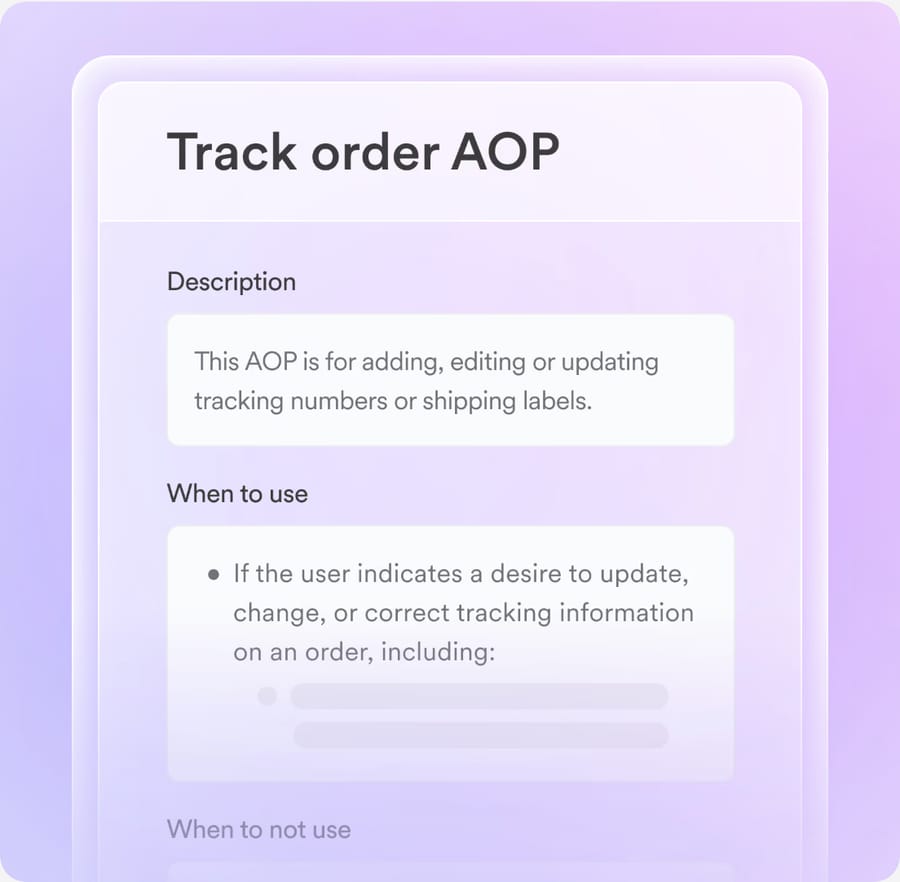
Decagon writes every workflow as an AOP: a plain-language procedure, like a standard operating procedure for a human agent, that the platform compiles into steps and tool calls. Its AOP page says technical teams "version with Git-based tracking and retain full ownership of code," and its comparison page says "100% of your agent logic runs on Agent Operating Procedures." Its Duet tool proposes changes from real conversations for a human to approve.
Sierra has three ways in. Agent Studio is its no-code builder, pitched to "Build complex agents that adhere to your goals and guardrails with composable building blocks." The Agent SDK is for engineers who want journeys as code. And Ghostwriter, launched in March 2026, builds and edits agents from prompts, SOPs or call recordings, runs simulations on each change and offers a "Fix with Ghostwriter" button on filed issues. Sierra's AWS listing still sells the relationship: "Work with an expert agent development team that has supported hundreds of deployments."
Decagon's page describes Sierra as "Agent Studio for building simple workflows. Complex logic moves to an SDK only technical teams can touch." Sierra's own pages describe Agent Studio as a builder for complex agents and pitch Ghostwriter to customer experience teams "whatever their technical expertise," so treat that row as Decagon's framing. What holds up is the difference in default: Decagon's model assumes your team edits the agent weekly, and Sierra's assumes its team and its tooling do a larger share of that work.
Both include a hands-on team. Decagon's FAQ says "A forward-deployed team are included with every engagement," and its AWS listing says it offers "a fully white-glove deployment model for teams that want it" and that enterprises deploy "in six to seven weeks." Cresta, which competes with both, writes in its comparison guide that "Decagon and Sierra both use forward-deployed, high-touch implementation models."
How do Decagon and Sierra charge?
Neither vendor has a pricing page. Both sell through AWS Marketplace, and the two listings show different structures.
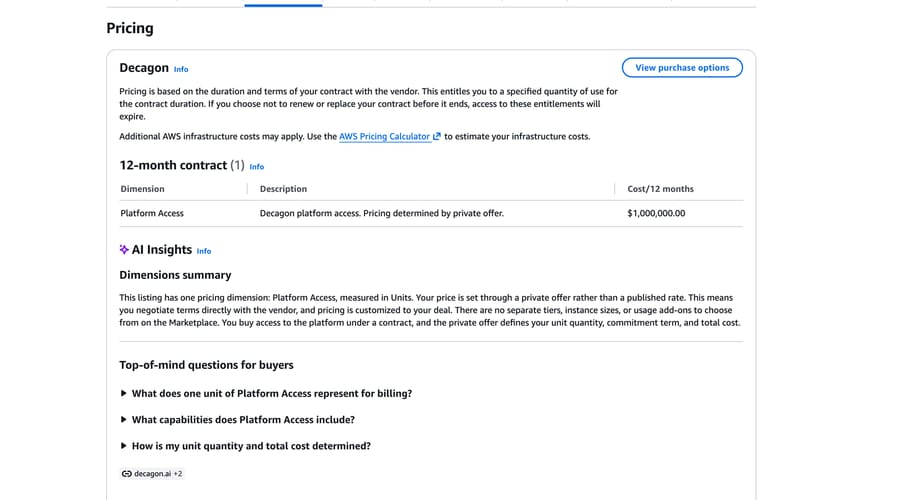
Decagon's AWS listing has a single 12-month dimension, "Platform Access," described as "Pricing determined by private offer," with a $1,000,000.00 placeholder. There's no usage dimension, so everything, including conversation or resolution volume, sits inside the negotiated contract. On its comparison page Decagon says customers choose per-conversation or per-resolution pricing and that "Most enterprises choose per-conversation for predictable costs and to avoid negotiating what counts as a 'resolution.'"
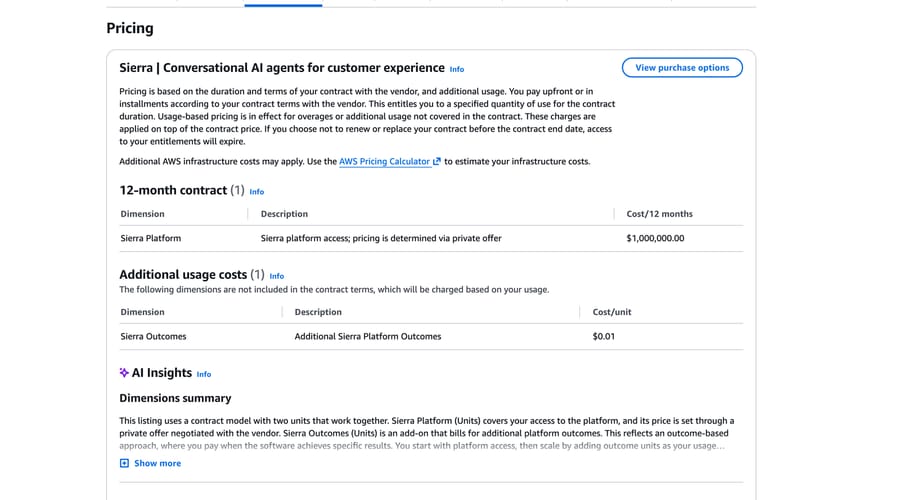
Sierra's AWS listing has a 12-month "Sierra Platform" dimension (also a $1,000,000.00 private-offer placeholder) and a usage dimension, "Sierra Outcomes," for "Additional Sierra Platform Outcomes," charged "on top of the contract price." That matches Sierra's outcome-based pricing post: you pay for a resolved conversation, a saved cancellation, an upsell or a cross-sell, and "If the conversation is unresolved, in most cases, there's no charge." The same post says routing or "greeter-style interactions" can be priced per conversation instead, so a Sierra phone deployment is often a blend.
What each billing unit rewards. A per-conversation price pays the vendor for every conversation the agent touches, so its incentive is volume; you get a predictable bill and carry the risk that the agent fails. A per-outcome price pays only when the agent succeeds, so the vendor carries that risk, but it earns more for everything counted as an outcome, and what counts is a contract term Sierra measures. Decagon's pitch against outcome pricing is exactly that negotiation. Sierra's pitch for it is that it only gets paid for "a job well done," as its homepage puts it. Both claims are true; which one suits you depends on whether you trust your own resolution measurement more than the vendor's.
The conversion between them is simple arithmetic. If a per-conversation rate is C and the agent resolves a share R of conversations, the matching per-resolution rate is C ÷ R. At a 60% resolution rate, a $0.99 conversation price equals $1.65 per resolution. A per-resolution quote below that is cheaper; above it, the per-conversation deal wins, provided your resolution rate holds.
What do they cost at 20,000 conversations a month?
We modeled one support operation on both: 20,000 conversations a month, 60% resolved by the agent (12,000 resolutions). Neither vendor publishes a rate, so every row below says where its number comes from and whether that source competes with the vendor.
| Row | Source (competes with the vendor?) | Monthly cost at 20,000 conversations |
|---|---|---|
| Decagon, buyer data | Vendr, median of its buyers' contracts (no) | $432,750 ÷ 12 = $36,063; range $8,750 to $76,932 |
| Decagon, per-conversation estimate | Quiq: "~$50,000+" platform fee, "roughly around $0.99 per conversation" (yes) | $4,167 + 20,000 × $0.99 = $23,967 |
| Sierra, platform estimate | Fin: contracts "approximately $150,000 or more" a year (yes; Fin is Salesforce-owned) | $12,500 + 12,000 × Sierra's outcome rate |
| Sierra, year one | Fin: $200,000 to $350,000+ including $50,000 to $200,000 setup (yes) | About $16,667 to $29,167+ averaged over year one |
| Sierra, buyer data | Vendr (no) | No data published |
Vendr's Decagon median isn't tied to a volume, so it says what Decagon's buyers typically sign for rather than what 20,000 conversations cost. On Quiq's and Fin's estimates, Sierra matches Decagon's per-conversation price only if its outcome rate is under about $0.96: ($23,967 − $12,500) ÷ 12,000. Treat that as a question to put to both sales teams, not a finding. Our Sierra guide builds a year-one cost model from the same estimates.
For comparison, Fin (owned by Salesforce since September 10, 2026) publishes $0.99 per outcome, which is $11,880 for the same 12,000 resolutions and no platform fee; its 50-outcome monthly minimum applies only when Fin runs on a help desk other than Intercom. Our Fin guide covers it.
Which one has the compliance, languages and channels you need?
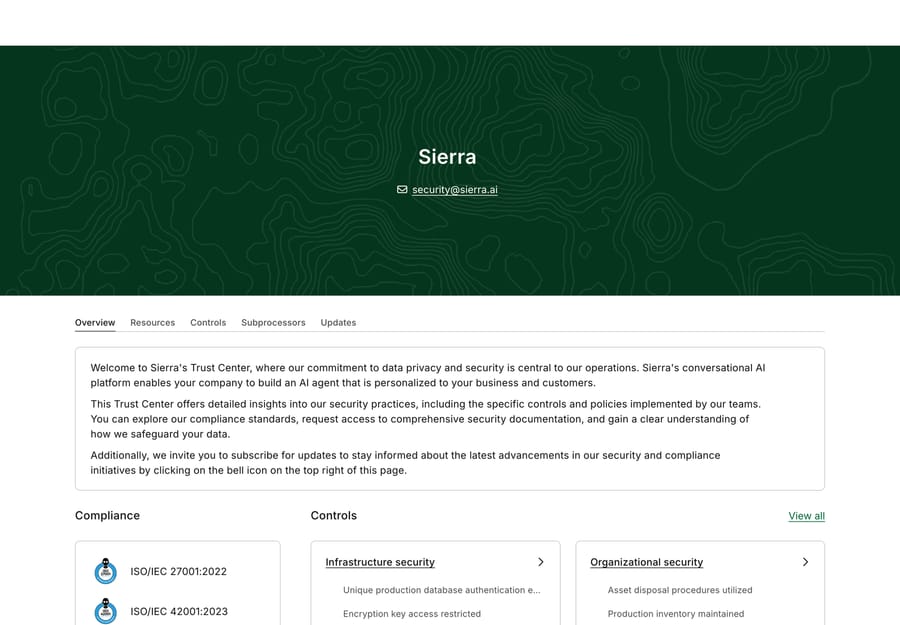
Both trust centers list SOC 2, HIPAA, PCI DSS 4.0.1, ISO 27001:2022 and GDPR. Sierra adds ISO 42001 (AI management), FedRAMP High and AIUC-1. For a US federal agency or a contractor that needs FedRAMP, that settles it.
On channels, Decagon lists chat, email, voice, SMS and WhatsApp and says it supports 70+ languages; Sierra's homepage lists chat, SMS, WhatsApp, email, voice and ChatGPT. Decagon's page says Sierra covers 58 languages; we couldn't find that number on Sierra's own pages, so check it against your language list. Both run voice, and both added voice features this summer: Sierra launched Voice Personas in August 2026, and Decagon's AWS listing describes "ultra-low latency voice built in."
How accurate is Decagon's comparison page?
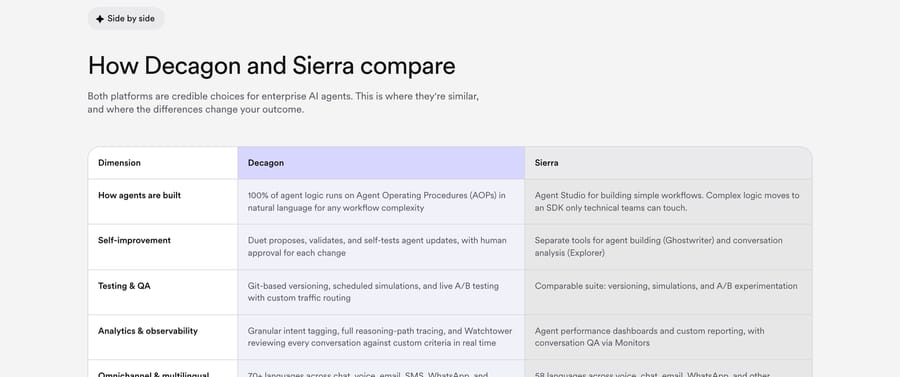
| Claim on Decagon's page | What Sierra's own pages say |
|---|---|
| Sierra builds "simple workflows" in Agent Studio; complex logic needs the SDK | Agent Studio is pitched for "complex agents"; Ghostwriter builds and edits agents from prompts for non-technical teams |
| Sierra's pricing model is "Per-resolution" | Mostly per outcome, with per-conversation pricing for routing and greeter-style conversations |
| Sierra has "Similar certifications, plus FedRAMP and ISO 42001" | Accurate per Sierra's trust center |
| Sierra's testing is a "Comparable suite: versioning, simulations, and A/B experimentation" | Consistent with Sierra's SDK and Ghostwriter pages, which describe simulations on every change |
Decagon's page is fair on testing and compliance and generous to Sierra in places. It understates Sierra's no-code tooling, which changed a lot with Ghostwriter in March 2026.
What do users say about Decagon and Sierra?
Real-user evidence for both is thin, because both sell only to large companies and neither has a self-serve tier.
| Source | Decagon | Sierra |
|---|---|---|
| Gartner Peer Insights | Vendor page, no reviews | 4.7 from 7 ratings |
| AWS Marketplace | 4.8 from 30 external reviews, all supplied by G2 | No ratings |
| Trustpilot | Unclaimed, no reviews | Unclaimed, no reviews |
| G2 | 4.8 from 30 reviews | 4.5 from 130 reviews |
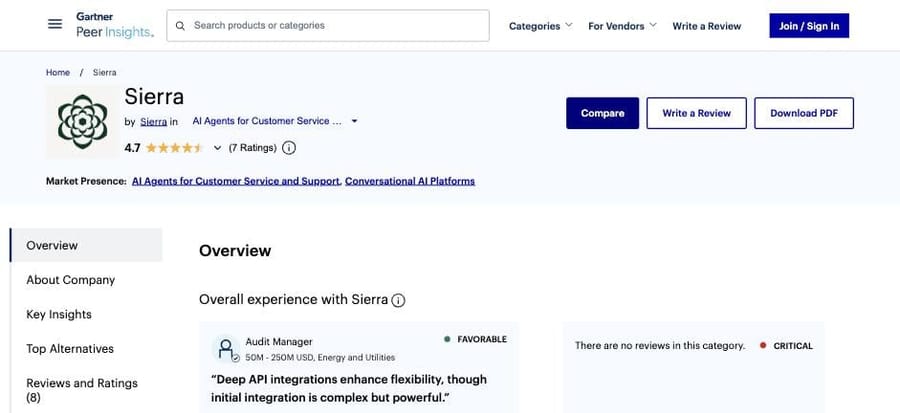
The reviews that exist point at the same two issues: setup effort and edge cases. On Gartner, an audit manager at an energy and utilities company with $50M to $250M in revenue wrote on June 13, 2026 that Sierra's "initial integration is complex but powerful." Among the G2 reviews shown on Decagon's AWS listing, Akash R. (September 3, 2026) wanted "better handling of edge cases and smoother handoffs," and CA Rahul B. (August 21, 2026) wrote, "I find the setup quite complex."
Should you choose Decagon, Sierra or neither?
Choose Decagon if your support or CX team wants to own agent logic and change it weekly without filing requests, you want the choice of per-conversation billing for a predictable budget, or your engineers want agent logic in Git.
Choose Sierra if you'd rather the vendor's team (and its Ghostwriter tooling) carry more of the build and tuning, you prefer to pay per outcome and can negotiate what counts, you need FedRAMP High or ISO 42001, or you want the larger, better-funded vendor for a multi-year bet.
Consider neither if you handle fewer than tens of thousands of conversations a month. On the only figures available, both start at a platform fee in the tens of thousands of dollars a year, and our Decagon alternatives and Sierra alternatives guides cover options with published prices. Our guide to customer service AI maps the whole market.
For a team already running Zendesk, Freshdesk, Gorgias, Front, HubSpot or Intercom, there's a different route. Macha is an AI agent layer on that help desk rather than a separate agent platform: agents work inside the ticket, billing is per ticket from $299 a month for 750 tickets with published tiers to 10,000, and setup and monitoring by the Macha team are included. It suits teams that want resolution inside the help desk they already run without a six-figure contract. Our guide to AI agents for customer service compares the approaches, and the tiers are on our pricing page.
How we researched this
On September 19, 2026 we checked Decagon's and Sierra's comparison, product, customer and trust-center pages, Sierra's pricing post and blog, both AWS Marketplace listings including their pricing tabs, Vendr's pages for both, and the competitor guides that rank for this search (Cresta, Quiq and Fin), all with a scripted browser. We read Gartner Peer Insights, G2 (Decagon 4.8 from 30 reviews, matching the figure on its AWS listing; Sierra 4.5 from 130) and Trustpilot with a scripted browser; the Reddit thread and the Blind post that rank for this search didn't load for us. Neither vendor offers a self-serve account, so we built no agent on either and didn't contact sales; every cost here is a labeled estimate, not a quote.
Frequently asked questions
Is Decagon AI good? Decagon's buyers include Chime, Hertz and Duolingo, and the G2 reviews shown on its AWS listing average 4.8 from 30. The recurring complaints are setup complexity and edge cases that still need a human. It suits large support teams that want to edit agent logic themselves.
Is Sierra AI any good? Sierra has 4.7 from 7 ratings on Gartner Peer Insights and customers including SoFi, Rocket Mortgage and CarMax. Reviewers call its integration work complex; the upside is a vendor team that carries much of the build.
Which is cheaper, Decagon or Sierra? Neither publishes prices. Vendr's buyer data puts Decagon's median contract at $432,750 a year, and it has no Sierra data. Competitor estimates put Decagon's platform fee around $50,000 a year plus about $0.99 a conversation (Quiq) and Sierra's at $150,000 or more plus outcomes (Fin). Get both quotes at your own volume.
How does Decagon's pricing differ from Sierra's? Decagon lets you choose per-conversation or per-resolution billing. Sierra bills mainly per outcome, such as a resolved conversation or a saved cancellation, with per-conversation pricing for routing calls.
Who are Sierra AI's main competitors? Decagon, Fin (part of Salesforce since September 10, 2026), Salesforce Agentforce, Cresta, Parloa and PolyAI for voice, and help-desk-native AI such as Zendesk's AI agents.
What is the best agentic AI for customer service? It depends on where your conversations live. For large companies buying a standalone agent platform, Decagon and Sierra lead the enterprise shortlist; for teams on a help desk, an agent layer inside that help desk avoids a second platform.
Which is better funded, Decagon or Sierra? Sierra raised $950 million at $15.8 billion in May 2026. Decagon raised $250 million at $4.5 billion in January 2026.
Does Sierra or Decagon have FedRAMP? Sierra's trust center lists FedRAMP High. Decagon's lists SOC 2 Type II, HIPAA, PCI DSS, ISO 27001 and GDPR.
If your support runs through Zendesk, Freshdesk, Gorgias, Front, HubSpot or Intercom, you can start a Macha trial with $50 of free usage and no card.
Sources: Decagon vs Sierra (Decagon) · Decagon AOPs · Decagon Series D · Decagon trust center · Decagon on AWS Marketplace · Vendr: Decagon · Sierra customers · Sierra Agent Studio · Sierra Agent SDK · Sierra Ghostwriter · Sierra: outcome-based pricing · Sierra: year two in review · Sierra trust center · Sierra on AWS Marketplace · CNBC: Sierra raises nearly $1 billion · Gartner Peer Insights: Sierra · Cresta: Decagon vs Sierra · Quiq: Decagon pricing · Fin: Sierra AI pricing
Simple per-ticket AI pricing
One thread with one person is one charge, however many replies it takes.