Shopify
 Stripe
 Slack
Slack Notion
 Google Workspace
 Confluence

Sierra vs Decagon vs Fin vs Ada (2026): Prices, Contracts and Which One Fits


Fin fits teams that want a published price and a live agent this month, especially on Intercom, at $0.99 per outcome. Ada fits mid-market and enterprise teams that want a no-code builder across chat, email and voice, from $30,000 a year. Decagon fits large companies whose operations team wants to own and edit the agent's logic, on contracts Vendr puts at a $432,750 median. Sierra fits large consumer brands that want the vendor's team to build and run a voice-and-chat agent and can pay a six-figure platform fee before the first outcome. Below: one table with every price checked on October 14, 2026, head-to-head pairs, the cost at 2,000, 10,000 and 50,000 conversations a month, and a table by buyer type.
Key takeaways
- Fin is the only one of the four with a full rate card on its own site: $0.99 per outcome, Intercom seats from $29, and a 50-outcome monthly minimum on other help desks.
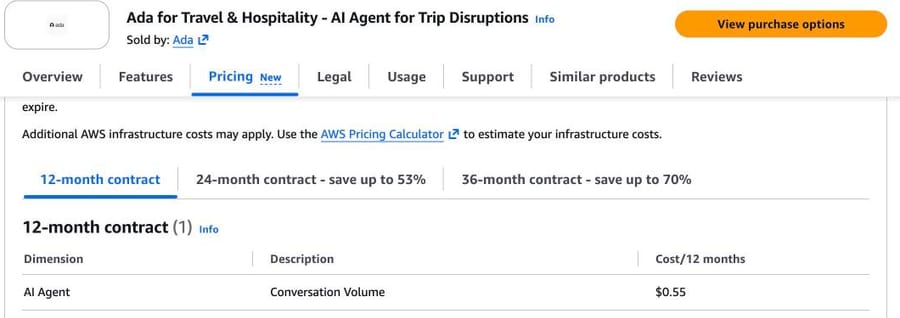
- Ada's lowest published price is $30,000 a year on Salesforce AgentExchange, its AWS travel and hospitality listing charges $0.55 a conversation, and its terms add 10% at each automatic one-year renewal.
- Vendr puts Decagon's median contract at $432,750 a year, while Sierra has no buyer data and a competitor's estimate starts its platform fee at $150,000 a year.
- At 10,000 conversations a month and 60% resolution, the AI bill comes to about $66,000 a year on Ada, $71,280 on Fin, $168,800 on Decagon and $222,000 to $330,000 on Sierra.
- For a B2B SaaS support team on Intercom, Fin is the default, and Decagon is the challenger, with Intercom listed among its pre-built integrations.

Disclosure: Macha publishes this blog and sells an AI agent for help desks. Macha is not one of the four and isn't ranked here. It gets one paragraph near the end, for teams none of the four suit.
How do Sierra, Decagon, Fin and Ada compare at a glance?
Every row was re-read on the vendor's own page, its marketplace listing or Vendr on October 14, 2026, unless the cell says otherwise. "Estimate" means a third party's figure, and the source is named because three of them sell against the vendor they're estimating.
| Sierra | Decagon | Fin | Ada | |
|---|---|---|---|---|
| Billing unit | Per outcome (a resolved conversation, a saved cancellation, an upsell), per conversation for routing calls | Per conversation or per resolution, chosen at signing | Per outcome, at most once per conversation | Per conversation (its service terms also allow automated resolutions) |
| Published price | None; sierra.ai/pricing returns a 404 | None; decagon.ai/pricing returns a 404 | $0.99 per outcome; $9.99 per sales qualification; Intercom seats $29, $85 or $132 a month (annual) | $30,000 a year floor (AgentExchange); $0.55 a conversation on its travel and hospitality AWS listing, 12-month contract |
| Typical contract | No buyer data. Estimate: platform from $150,000 a year, setup $50,000 to $200,000 (Fin, a competitor) | Vendr median $432,750 a year, range $105,000 to $923,183 | No contract needed on Intercom; no platform fee on other help desks | Vendr median $72,000 a year, range $36,211 to $286,200 |
| AWS Marketplace | 12-month platform via private offer, plus an outcomes usage dimension | One 12-month "Platform Access" dimension, private offer | Not used here | "Ada for Travel & Hospitality": $0.55 per conversation, 12-month contract; longer terms cheaper |
| Help desks named | No public list; its docs sit behind a sign-in | Zendesk, Salesforce, Intercom, Kustomer | Intercom, plus Salesforce, HubSpot, Freshworks, Dixa, Front, Zoho, Sprinklr, Gorgias | Documented handoffs to Zendesk and Salesforce |
| Voice | Yes, alongside chat, email, SMS, WhatsApp and ChatGPT | Yes; connectors for Amazon Connect and RingCentral | Fin Voice through sales: $1.99 per voice outcome on intercom.com, "custom pricing" for select customers on fin.ai | Yes; telephony through Twilio by default |
| How it's built | Sierra's agent development team with yours, plus Agent Studio, the Agent SDK and Ghostwriter | Your team writes Agent Operating Procedures; a forward-deployed Decagon team is included | Self-serve ("set up in under an hour"), or paid Deployment Services | Your team in Ada's no-code builder, with Ada's onboarding |
| Typical time to live | "Deploy in weeks" (Sierra); estimate 4 to 10 weeks onboarding, 3 to 7 months to full production (Fin) | "Six to seven weeks" for enterprises (Decagon's AWS listing) | Same day self-serve; Deployment Services: sandbox day 1, enterprise rollout under 90 days | Estimate 8 to 16 weeks (Fin, a competitor) |
| Who tunes it after launch | Sierra's team, increasingly through Ghostwriter | Your team, with Decagon's Duet suggesting changes | Your support ops team, or Fin's Scale engagement | Your team, through Coaching and Playbooks |
| Ideal size (our read) | Large consumer brands, tens of thousands of conversations a month and up | Enterprise and upper mid-market | Startups to enterprise, mostly on Intercom | Mid-market and enterprise, multi-channel |
| Customers the vendor names | SoFi, Rocket Mortgage, CarMax, Wayfair, Airtable | Duolingo, Chime, Square, Rippling, Perplexity | Anthropic, Rocket Money, Kalshi, Snowflake, Asana | GoFundMe, Life360, Checkr, IPSY |
| Resolution figure the vendor publishes | None on the pages we checked | None on the pages we checked | 76% average (Salesforce); 79% at Anthropic (fin.ai/customers) | None on the pages we checked |
| Compliance listed | SOC 2, HIPAA, PCI DSS, ISO 27001, ISO 42001, FedRAMP High (trust center, Sept 19) | SOC 2 Type II, HIPAA, PCI DSS, ISO 27001 (trust center, Sept 19) | Not compared here | Not compared here |
| Review scores (our earlier reads) | G2 4.5 from 130; Gartner Peer Insights 4.7 from 7 (Sept 19) | G2 4.8 from 30 (Sept 19) | G2 4.5 from 2,900+ (Sept 2026) | G2 4.6 from 173 (Sept 22) |
Salesforce completed its acquisition of Fin, the company formerly called Intercom, on September 10, 2026, and says Fin "will continue to serve its customers"; fin.ai/pricing still listed eight other help desks on October 14. Sierra raised $950 million at a $15.8 billion valuation in May 2026, and Decagon raised a $250 million Series D in January 2026.
What is each one, and who is it built for?
Sierra: the vendor builds it, and you pay for outcomes
Sierra sells an agent platform with a team attached. Its AWS Marketplace listing promises "a dedicated Agent Development team" that builds, launches and maintains the agent, and prices two things: a 12-month "Sierra Platform" contract set by private offer, and "Sierra Outcomes" charged on top for anything beyond the contracted quantity. The $1,000,000 and $0.01 on the listing are placeholders, not prices.
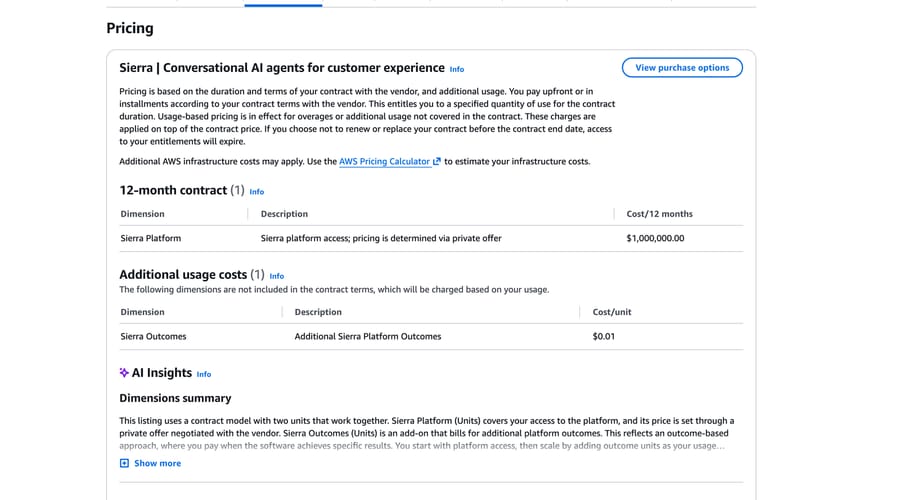
The only public dollar figures come from competitors. Fin estimates contracts from about $150,000 a year, setup of $50,000 to $200,000, and $200,000 to $350,000 or more in year one. CloudTalk adds $1 to $2.50 per outcome. Sierra hasn't confirmed any of it. The incentive in outcome pricing is worth naming: Sierra only earns when the agent succeeds, but it also earns on saves and upsells, so the contract's definition of an outcome matters as much as the rate. Users who've run the build say the same thing in different words: an audit manager at an energy company wrote on Gartner Peer Insights in June 2026 that Sierra's "initial integration is complex but powerful." Our Sierra pricing breakdown covers the AWS structure in detail.
Decagon: your operations team owns the logic
Decagon puts the agent's behavior in Agent Operating Procedures, plain-language procedures your team edits and versions, and includes a forward-deployed team at the start. Its AWS listing says enterprises deploy "in six to seven weeks" and offers "a fully white-glove deployment model for teams that want it." Its integrations page names Zendesk, Zendesk Sunshine, Salesforce and Intercom, plus Amazon Connect and RingCentral for voice.
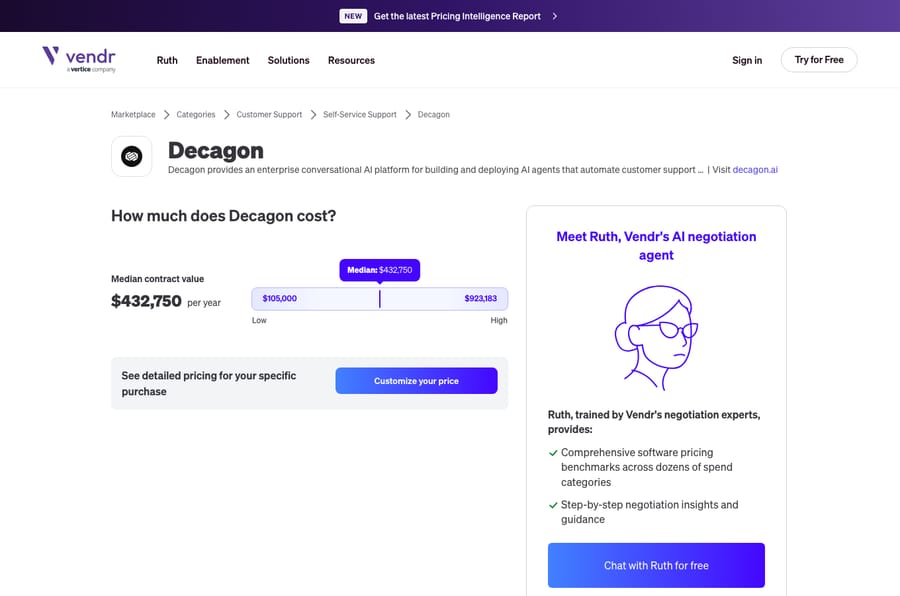
Vendr shows a median contract of $432,750 a year, ranging from $105,000 to $923,183. When we read its page data on October 13, those figures came from 12 purchases by 2 buyers, so treat them as two companies' deals. The figure most of the web repeats, a $50,000 platform fee plus about $0.99 a conversation, comes from Quiq, a competitor, and Quiq calls it an estimate. Decagon's own pricing post says most customers pick per-conversation billing. That choice gives you a predictable bill and leaves the risk of a failed conversation with you. Among the G2 reviews Decagon republishes on its AWS listing, one from August 2026 reads, "I find the setup quite complex," which matches the forward-deployed model: someone has to own those procedures. Our Decagon pricing page traces every Decagon figure to its source.
Fin: a published price and a free trial
Fin is the one you can buy without a sales call. fin.ai/pricing lists $0.99 per outcome, charged at most once per conversation, and $9.99 per sales qualification. On another help desk there's a 50-outcome monthly minimum and, in Fin's words, no "integration fees, setup fees, or platform charges." On Intercom you pay seats instead: $29, $85 or $132 a seat a month on annual billing, per intercom.com/pricing. The trial is 14 days with unlimited outcomes and no card.
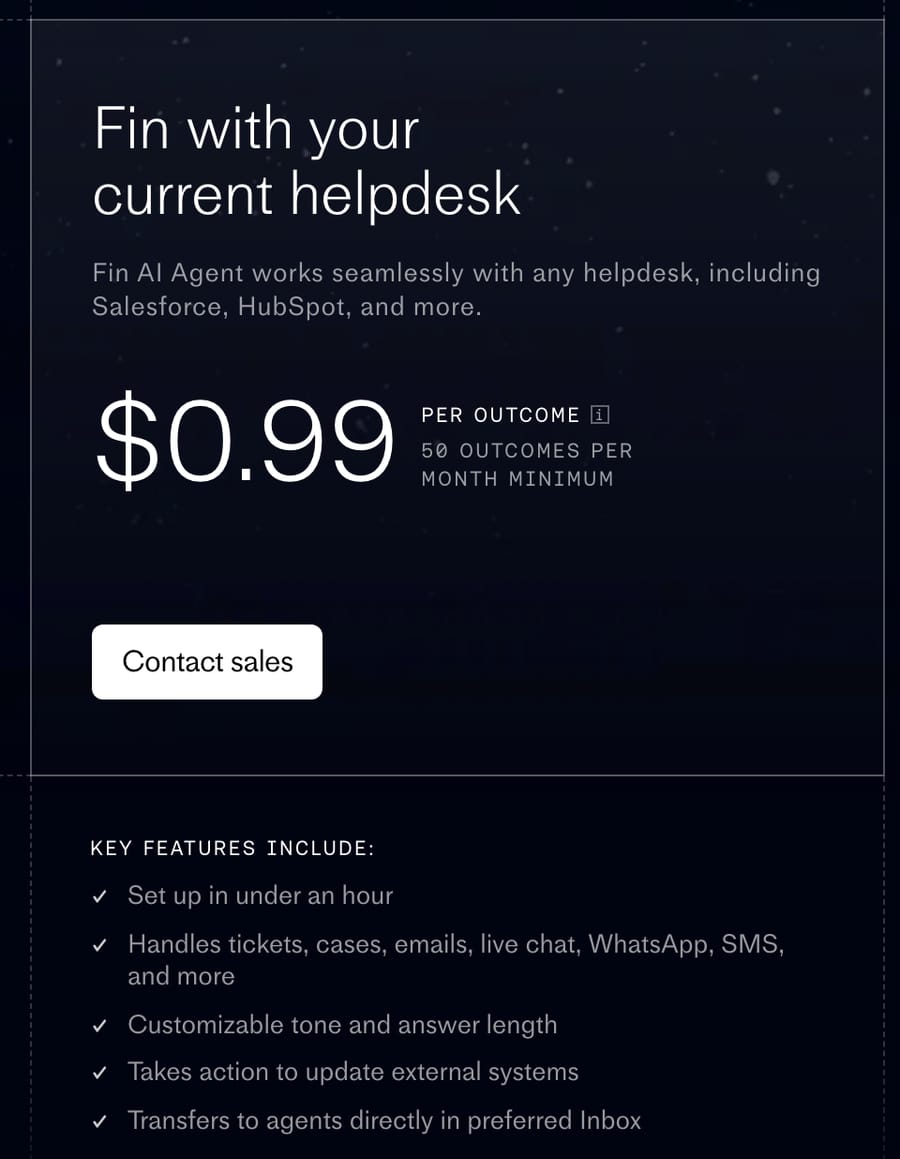
Fin's meter has a detail that moves the bill. An outcome counts as a resolution when the customer confirms it or when they leave without asking for more help after Fin's last answer, per Fin's outcomes article. An escalation with no outcome is free. So Fin earns more the more conversations end without a human, which suits you while each one saves more than $0.99 of agent time. For larger rollouts, Fin Deployment Services runs Analyze, Train, Test and Deploy with a sandbox on day one and an enterprise rollout "in under 90 days," at a price "scoped to your goals." The user quote Fin features on its customers page is about speed: setting up the knowledge base took "Literally 2.5hrs of work and it's good enough to push live." Our Fin pricing breakdown does the seat arithmetic.
Ada: a no-code builder with a published floor
Ada publishes no price on ada.cx, but its marketplace listings do. Salesforce AgentExchange shows "Starting at $30,000/Company/Year," and an AWS listing sold by Ada, "Ada for Travel & Hospitality - AI Agent for Trip Disruptions," charges $0.55 a conversation on a 12-month contract, with tabs for cheaper 24- and 36-month terms. It's the only per-conversation rate Ada prints, and it's pitched at travel companies, so treat it as a reference point rather than your quote. Vendr puts the median buyer at $72,000 a year and implementation at $15,000 to $100,000 or more.
Ada's Customer Terms of Use, updated August 5, 2026, renew orders automatically for one-year periods unless either side gives at least 30 days' notice, and fees for a renewal term go up 10% for the same services. That clause pays Ada for your inattention: miss the notice window and next year costs 10% more. Put a calendar reminder 60 days before term end on day one. Ada's handoff documentation covers Zendesk and Salesforce, and ada.cx/customers says it has served "over 350 businesses." The two review populations disagree: Ada scored 4.6 from 173 G2 reviews (the teams who build it) when we checked on September 22, 2026, while its Trustpilot score from end customers sat around 2.0 in June 2026, with complaints about bot loops that never reach a person. That gap is a handoff-design problem, and it's yours to solve in the build. Our Ada pricing guide lists every marketplace price with its date.
How do they compare head to head?
Sierra vs Decagon
Both sell enterprise agents for chat, email and voice on 12-month contracts with no price list. The split is who edits the agent after launch. Decagon's own comparison page says it suits "Teams that want to own and iterate on their agent directly" and Sierra suits "Teams that want the vendor to own their agent." Sierra's Ghostwriter, launched in March 2026, narrows that gap by letting non-engineers edit agents from prompts. On billing, Decagon lets you choose per conversation, and Sierra bills mainly per outcome. On compliance, Sierra's trust center listed FedRAMP High and ISO 42001 when we checked on September 19, 2026, and Decagon's didn't. Our Decagon vs Sierra comparison goes deeper.
Fin vs Decagon
This is the pair a B2B SaaS team on Intercom actually weighs. Fin runs inside Intercom with no contract and $0.99 per outcome. Decagon names Intercom as a pre-built integration but sells a yearly platform contract, with Vendr's lowest recorded deal at $105,000. Pick Decagon over Fin when your volume is high enough that a negotiated per-conversation rate beats $0.99 per outcome, or when you want agent logic in versioned procedures your engineers can review. The break-even is simple arithmetic: a per-conversation rate C matches Fin when C equals $0.99 times your resolution rate. At 60% resolution, that's about $0.59 a conversation before any platform fee.
Ada vs Fin
Both bill per unit, and their published rates are close: $0.55 per conversation on Ada's travel and hospitality AWS listing against $0.99 per outcome, which is $0.59 a conversation at 60% resolution. The difference is the floor and the contract. Ada's floor is $30,000 a year plus implementation, on an auto-renewing annual term. Fin has no floor on Intercom beyond your seats and a 50-outcome floor (about $49.50) elsewhere, billed monthly. Choose Ada if you're on Zendesk or Salesforce and want one no-code agent across voice and digital channels. Choose Fin if you're on Intercom or one of its eight listed help desks and want to start this week.
Sierra vs Ada
Both build multi-channel agents with voice, and both lean on their own teams at launch. Ada publishes a floor and a per-conversation rate; Sierra publishes neither. Ada's builder is designed for a CX team to run without engineers, while Sierra's model assumes its agent development team stays involved. On the competitor estimates above, Sierra's year one starts around $200,000, about seven times Ada's $30,000 floor. Pick Sierra for a flagship consumer voice deployment where the vendor's team carries the build. Pick Ada for a mid-market or enterprise team that wants to own a no-code agent across channels at a lower floor.
What do they cost at 2,000, 10,000 and 50,000 conversations a month?
Assumptions, so you can rebuild every cell: the AI resolves 60% of conversations; costs are the AI vendor's charges only, without help desk seats, voice minutes, Twilio fees or implementation unless the note says so; Fin uses $0.99 per outcome; Ada uses $0.55, the only per-conversation rate Ada publishes (on its travel and hospitality AWS listing, so your quote may differ), with the $30,000 floor; Decagon uses Quiq's estimate of a $50,000 platform fee plus $0.99 a conversation; Sierra uses Fin's $150,000 platform estimate plus CloudTalk's $1 to $2.50 per outcome. The last two rows are competitors' estimates, not quotes.
| Conversations a month | Fin | Ada | Decagon (estimate) | Sierra (estimate) |
|---|---|---|---|---|
| 2,000 (24,000 a year) | 14,400 × $0.99 = $14,256 a year, $0.59 a conversation | $13,200 at list, so the $30,000 floor applies: $1.25 a conversation | $50,000 + 24,000 × $0.99 = $73,760, $3.07 a conversation | $150,000 + 14,400 × $1 to $2.50 = $164,400 to $186,000, $6.85 to $7.75 a conversation |
| 10,000 (120,000 a year) | 72,000 × $0.99 = $71,280, $0.59 | 120,000 × $0.55 = $66,000, $0.55 | $50,000 + $118,800 = $168,800, $1.41 | $150,000 + $72,000 to $180,000 = $222,000 to $330,000, $1.85 to $2.75 |
| 50,000 (600,000 a year) | 360,000 × $0.99 = $356,400, $0.59 | 600,000 × $0.55 = $330,000, $0.55 | $50,000 + $594,000 = $644,000, $1.07 | $150,000 + $360,000 to $900,000 = $510,000 to $1,050,000, $0.85 to $1.75 |
The table leaves out three things. First, Fin's bill moves with your resolution rate and the others' mostly don't: at the 76% average Salesforce reports for Fin, every Fin cell rises by about 27%, to $0.75 a conversation. Second, Ada and Decagon list prices are starting points. Vendr reports Ada buyers landing 20% to 35% below the first quote when they bring a competing one, and Quiq notes that large Decagon customers negotiate lower per-conversation rates, which is how Vendr's $432,750 median can sit below the $644,000 list arithmetic at 50,000. Third, year one adds setup: $15,000 to $100,000 or more for Ada per Vendr, and $50,000 to $200,000 for Sierra per Fin's estimate. Fin on Intercom adds seats, about $850 a month for 10 Advanced seats.
At 2,000 conversations a month, only Fin is priced for you. At 10,000, Ada and Fin land close together and the contract terms decide it. At 50,000, a negotiated Decagon or Sierra deal can undercut list per-unit pricing, which is the volume these two are built for. Our enterprise pricing page runs the same arithmetic against Lorikeet, Yuma and Zendesk.
Which one fits your situation?
| You are | Look at first | Why |
|---|---|---|
| A B2B SaaS team on Intercom, under 10,000 conversations a month | Fin | Native to Intercom, $0.99 per outcome, a 14-day trial, no contract |
| A B2B SaaS team on Intercom at enterprise volume, with ops engineers | Fin, with Decagon as the challenger | Decagon names Intercom as an integration and puts logic in versioned procedures; get a per-conversation quote below $0.59 to beat Fin at 60% resolution |
| An enterprise where voice is the main channel | Sierra or Decagon | Both run voice on the same agent as chat; Decagon lists Amazon Connect and RingCentral connectors; Fin Voice is sales-only |
| A US federal agency or contractor | Sierra | FedRAMP High on its trust center (checked September 19, 2026) |
| A mid-market team on Zendesk or Salesforce without engineers | Ada | No-code builder, documented Zendesk and Salesforce handoffs, a $30,000 floor; also compare Zendesk's own AI agents against a third-party agent |
| A consumer brand that wants the vendor to run the agent | Sierra | A dedicated agent development team is part of the deal |
| A team that must model cost before talking to sales | Fin, then Ada | Fin publishes a full rate card; Ada publishes a floor and one per-conversation rate |
| A team on Gorgias, Front, HubSpot or Freshworks | Fin | Its pricing page lists all four; none of the other three names them on the pages we checked |
| A team under about 2,000 conversations a month | Probably none of the four | See the next section |
For the question that started this page, the best AI agent for a B2B SaaS support team on Intercom: start with Fin's trial, because it costs nothing to run on your own conversations. Bring Decagon in once your volume makes a six-figure contract cheaper than $0.99 per outcome, and get its per-conversation rate in writing.
What if none of the four fit?
If you handle a few thousand tickets a month, on a help desk you plan to keep, and nobody on the team has time to build and tune an agent, there are lighter routes: your help desk's own AI agents, self-serve layers you configure yourself, and done-for-you vendors. Macha, our product, is one of the done-for-you options: it runs on Zendesk, Freshdesk, Gorgias, Front, HubSpot or Intercom, and the Macha team analyzes your past tickets, builds the knowledge base and the agent, and runs it in safe mode, with drafts as internal notes until they're right. It costs about $0.40 per ticket, from $299/month for 750 tickets, and that includes done-for-you setup and a dedicated success manager who handles your changes after launch; we promise live in safe mode within 7 days, or your first month is free. It doesn't sell voice agents or the custom contract terms the four above build their enterprise deals around. The trial is $50 of free usage (about 125 tickets), no credit card, no time limit, and the tiers are on our pricing page.
Common questions
What is the best AI agent for a B2B SaaS support team that uses Intercom?
Fin, in most cases. It runs natively in Intercom at $0.99 per outcome with a 14-day trial, and it names B2B SaaS customers such as Snowflake, Asana and Anthropic. At high volume, Decagon is the strongest alternative of the four because it lists Intercom among its pre-built integrations; Sierra publishes no integrations list, and Ada's handoff docs cover Zendesk and Salesforce.
Which is cheapest: Sierra, Decagon, Fin or Ada?
At list prices, Fin is cheapest at 2,000 conversations a month ($14,256 a year at 60% resolution) because Ada's $30,000 floor applies. At 10,000 and 50,000, Ada's published $0.55 (from its travel and hospitality listing) is slightly below Fin's $0.59 a conversation, but confirm Ada's rate for your industry in a quote. Decagon and Sierra publish nothing, and on competitors' estimates they cost more until negotiated volume discounts kick in.
Do Sierra, Decagon and Ada replace my help desk?
No. All three are agent platforms that connect to a help desk you keep paying for. Fin is the exception only in that it also comes with Intercom's help desk; on Salesforce, HubSpot or Gorgias it runs as an add-on too. Our implementation guide covers what each route asks of your team.
How long does each one take to implement?
Fin's self-serve setup takes hours, per its pricing page, and its Deployment Services quote an enterprise rollout in under 90 days. Decagon's AWS listing says six to seven weeks for enterprises. For Sierra and Ada, the only figures are competitors' estimates: 4 to 10 weeks of onboarding for Sierra and 8 to 16 weeks for Ada. If you'd rather hire someone to run the rollout, our list of AI support implementation partners has prices by help desk.
Does Fin still work outside Intercom now that Salesforce owns it?
Yes, as of October 14, 2026. Salesforce completed the acquisition on September 10, 2026, and fin.ai/pricing still lists Salesforce, HubSpot, Freshworks, Dixa, Front, Zoho, Sprinklr and Gorgias at $0.99 per outcome with a 50-outcome monthly minimum. Zendesk isn't on that list.
Can I try any of them before signing?
Only Fin offers a self-serve trial: 14 days, unlimited outcomes, no card. Sierra and Decagon sell through sales, with no self-serve account. Ada has no self-serve signup, and ada.cx/pricing led to a demo form when we checked on October 13. If you're comparing Fin against other options, our Fin alternatives list covers ten.
How we researched this
On October 14, 2026 we re-read every price above on its source: fin.ai/pricing and intercom.com/pricing (in a headless browser, which is where the screenshot comes from), Fin's Deployment Services and customers pages, Salesforce's acquisition release, Ada's AgentExchange and AWS listings, Ada's Customer Terms of Use, handoff docs and customers page, Vendr's Ada and Decagon pages, Decagon's AWS listing, integrations page and homepage, Sierra's AWS listing, homepage and customers page, and the competitor estimates from Fin, Quiq and CloudTalk. decagon.ai/pricing and sierra.ai/pricing both returned 404, and docs.sierra.ai asked for a sign-in. Three screenshots are reused from our earlier pricing pages and carry their capture dates. Review scores and quotes come from our earlier reads, dated in the table; G2 and Trustpilot block scripted re-checks. We didn't buy or run any of the four, and we didn't contact sales, so every cost here is published-price arithmetic or a labeled third-party estimate. The resolution rates in vendor materials (76% for Fin, per Salesforce) are the vendors' own claims. Customer names are only those each vendor publishes. We'll re-check prices by December 14, 2026.