Intercom
 Shopify
 Stripe
 Slack
Slack Notion
 Google Workspace
 Confluence

Customer Service AI in 2026: What It Does, the Options, and What It Really Costs


Customer service AI is software that answers, sorts and increasingly resolves customer requests across chat, email and phone, either on its own or by drafting work for a human agent. This guide explains the six jobs it actually does, the seven kinds of product that sell it, and the billing units they charge in. It then works out what one normalized month of 3,000 support chats costs under each billing model, with a figure for 19 products plus our own, from vendor prices, cloud marketplace listings and buyer data checked on September 18 and 19, 2026. It also reports what happened when we gave two test agents a tool that looks orders up in a mock API.

Quick picks by situation
| Your situation | What to look at | Start with |
|---|---|---|
| Tickets in Zendesk, Freshdesk, Gorgias, Front, Intercom or HubSpot, no engineers to spare | An AI agent layer, or your help desk's own AI | Macha, or your help desk's native agent |
| You already run a help desk and want the least new software | Help-desk-native AI | Zendesk AI agents, Freddy AI Agent, Gorgias AI Agent, HubSpot Customer Agent |
| One support agent that runs on whatever help desk you use | Standalone support agent | Fin, or Ada and Sierra at enterprise budgets |
| One technical builder, website chat, a budget to predict | Agent builder | Botpress or Voiceflow |
| A large contact center with voice, many languages and an RFP | Enterprise CX platform | NiCE Cognigy, Kore.ai; PolyAI for voice |
| Engineers already deep in AWS, Microsoft or Google | Cloud components | Amazon Connect and Lex, Copilot Studio, Google Conversational Agents |
| Employees asking IT and HR questions, not customers | Employee service agent | Moveworks (ServiceNow), Copilot Studio |
If you want a ranked list of named agents rather than the category, our AI customer service agents roundup compares them one by one. This page is about how the category works and what it costs.
What AI customer support actually does
"AI in customer service" gets used for six different jobs. Vendors bundle them, but they fail differently and they're billed differently, so it pays to separate them before any demo.
| Job | What it does in practice | Where it goes wrong | Usually billed |
|---|---|---|---|
| Answer and resolve | Replies to the customer from your help center, policies and past tickets, and closes the conversation | Confident wrong answers when the knowledge is thin or out of date | Per resolution, outcome, conversation or ticket |
| Take actions | Looks up an order, changes an address, cancels a subscription, issues a refund, through tools connected to your systems | Claims an action it never took (we saw this in testing) | Same as above, sometimes per action |
| Draft for a human | Writes a reply, summarizes a thread or suggests a macro inside the agent's inbox | Saves less time than promised if agents rewrite every draft | Per seat add-on |
| Triage and route | Tags, prioritizes, sets fields and assigns tickets before a person opens them | Silent misroutes that nobody notices for weeks | Included, per ticket, or per action |
| Measure and review | Scores conversations for quality, finds contact reasons, flags churn risk | Dashboards nobody acts on | Per seat or per conversation analyzed |
| Voice | Answers the phone, verifies the caller, and resolves or routes the call | Latency and interruptions; mistakes are harder to catch in audio | Per minute |
The first two jobs are what most buyers mean in 2026, and they're what the AI Overview for this search calls autonomous agents. An agent that only answers can be grounded in documents and checked against them. An agent that acts needs permissions, confirmation rules and a log that proves each action happened. Our guide to what an AI customer support agent is goes deeper on that line, and AI agents for customer service covers the mechanics of tools and handoff.
How it differs from a chatbot and from a copilot
A 2018 chatbot followed a decision tree: each customer message matched an intent, and each intent triggered a scripted branch. It was predictable and brittle. A 2026 AI agent reads the whole conversation, decides what to do from written instructions, and calls tools to do it. That handles phrasing nobody planned for, and it also means "never promise a refund over $200" is a sentence you test for rather than a branch you can inspect.
A copilot is the same model pointed at your staff instead of your customers. It drafts, summarizes and searches, and a person sends every reply. Zendesk sells Copilot as a $50 per agent per month add-on on Professional and higher plans, per its pricing page, and Freshdesk sells Freddy AI Copilot at $29 per agent per month, per its pricing. Copilots are priced per seat because they make seats more productive. Customer-facing agents are priced per conversation or outcome because they replace work.
The seven kinds of customer service AI product
The type decides who builds the agent, where it runs, and what you pay for. Here are the seven, including the internal-use and contact-center buyers that most explainers skip.
| Type | Examples | Who builds it | Main channels | Billing unit |
|---|---|---|---|---|
| Help-desk-native AI | Zendesk AI agents, Freshworks Freddy, Gorgias AI Agent, HubSpot Customer Agent, Help Scout AI Answers, Salesforce Agentforce | Your support ops team, inside the help desk | Chat, email, messaging | Per resolution, session or conversation, plus seats |
| Standalone support agent | Fin, Ada, Sierra, Decagon, Forethought, Crescendo | The vendor with your team, or configured from your help center | Chat, email, voice | Per outcome or resolution, or an annual contract |
| AI agent layer on your help desk | Macha, eesel AI | The vendor's team or yours, inside the help desk you keep | Tickets (email, chat) | Per ticket |
| Agent builder | Botpress, Voiceflow, ElevenLabs Agents | One technical builder in a visual canvas | Web chat, messaging, voice | Conversations, credits or minutes, plus seats |
| Enterprise CX and contact-center platform | NiCE Cognigy, Kore.ai, Yellow.ai, PolyAI, Talkdesk | Developers or a systems integrator | Voice, chat, 30+ channels | Annual contract, sessions or minutes |
| Cloud components | Amazon Connect and Lex, Google Conversational Agents, Microsoft Copilot Studio | Your cloud engineers | Chat, voice | Per request, message, minute or credit pack |
| Employee service agent | Moveworks (now ServiceNow), Copilot Studio, IBM watsonx Orchestrate | IT, with the vendor | Slack, Teams, portals | Per user or usage tier |
Two questions place most buyers. First, will the AI talk to customers or to employees? An IT team answering password resets in Teams belongs in the last row, and our Moveworks guide covers that buyer. Second, do you want to keep the help desk you have? If yes, the first and third rows fit without a migration, and the second row mostly does too. If you're replacing the contact center anyway, the fifth row becomes relevant.
A third question decides the rest: who maintains the agent after launch? Policies change every month. An agent nobody owns drifts out of date, and the cheapest row in the cost tables below is cheap because it assumes engineers you already pay.
There's also an option that isn't a product: building your own agent on a model API, which our guide to building a support agent with Claude walks through. It's the cheapest per conversation and the most work per change.
How the types differ where it matters
Four practical differences follow from who builds the product.
Where the knowledge comes from. Help-desk-native AI reads the help center and macros already in that help desk. An answer that lives in a Google Doc or Confluence page isn't there unless someone copies it over. Standalone agents and agent layers connect to several sources. Builders and cloud components take whatever you wire up.
What it can do. Native AI can usually tag, route and update the ticket it lives in, and reach outside systems through that vendor's marketplace. Standalone agents and layers call your order, billing and subscription systems through connectors or custom API tools. Builders can call anything, if someone builds the call.
Where the conversation lives. Native AI and agent layers keep everything in the ticket, so reporting, SLAs and QA work as before. A standalone agent with its own widget creates a second place conversations live, and the handoff into the help desk becomes a thing to test.
Who is on the hook when it's wrong. With a builder or cloud components, you are. With a vendor-built enterprise agent, the vendor's team is, on a contract. With a product that includes setup and monitoring, it's shared: the vendor tunes it, you own the policies.
If you already have a bot that isn't working
Google's AI Overview for this search asks whether you're building something new or troubleshooting an existing system. Most "our bot is bad" problems come from one of four causes, and only one of them is fixed by buying something:
- The knowledge is wrong. The agent answers from an old return policy or a help center with gaps. Fix the source before you change vendors.
- It can only talk. Customers ask where their order is, and the bot links a tracking page. An agent that can look up the order needs a tool, which rules and FAQ bots don't have.
- The handoff is broken. The bot escalates without passing the conversation, so the customer repeats everything. Check what reaches the human: transcript, collected fields and the reason. Our human handoff guide lists what to test.
- Nobody measures it. Deflection counts conversations that ended, including angry customers who gave up. Measure resolution on a sample instead, as automated resolution vs deflection explains.
If the answer is the second cause, the market has moved since most bots were bought, and it's worth re-evaluating.
Customer service AI by channel
The AI Overview for this search also asks which channels you want to automate. The channel changes what "good" looks like more than the vendor does.
Email. Email tickets arrive with the whole problem in one message, often with an order number and an attachment, and nobody expects a reply in three seconds. That makes email the easiest place to start: the agent can take a minute to look things up, and a draft-first mode (the AI writes, a person sends) fits the way email teams already work. Per-ticket pricing counts a whole email thread once, however many follow-ups it takes. Per-session pricing can count one email thread as several sessions if replies span days, so ask how long a session lasts before comparing rates.
Live chat. Customers write in fragments and expect an answer in seconds, so latency and short, clear turns matter. Chat is where per-message and per-request pricing add up fastest, because a single problem takes six or eight turns. It's also where handoff has to be instant: a chat customer who waits two minutes for a human has usually left.
Messaging (WhatsApp, SMS, Instagram). Conversations stretch over hours or days, and the platforms add their own rules and fees. WhatsApp, for instance, restricts what a business can send outside its customer-service window. Check whether a product bills a two-day WhatsApp thread as one conversation or several.
Voice. The phone is the hardest channel: the agent has to understand speech, answer in under a second, handle interruptions and verify who's calling. It's billed per minute, and mistakes are harder to spot because nobody reads a transcript unless something goes wrong. Most support teams automate chat and email first and treat voice as a separate project with separate vendors.
Whose incentive each billing model serves
Learn the billing unit before the demo, because it decides what you pay for when the agent fails.
| Billing unit | Who uses it | You pay for | What the vendor earns more from |
|---|---|---|---|
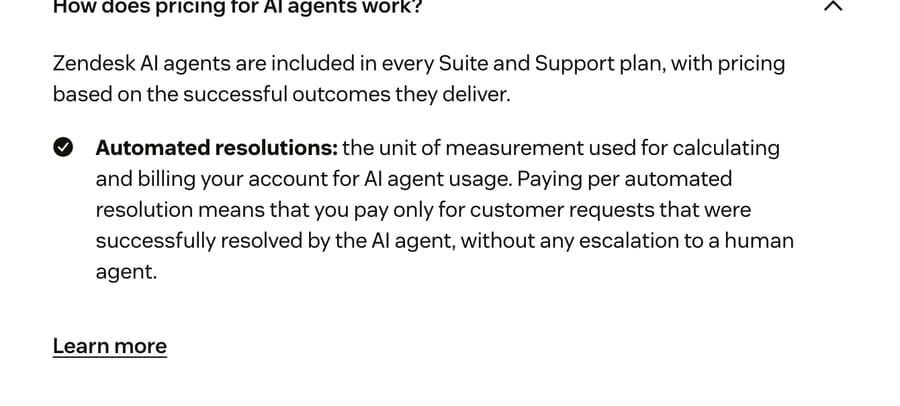
| Per resolution or outcome | Fin, Zendesk AI agents, Help Scout, HubSpot, Gorgias, Yellow.ai beyond its free tier | Conversations the vendor counts as resolved | Resolutions, as the vendor's own system defines and verifies them |
| Per session or conversation | Freshdesk Freddy, Botpress, Tidio Lyro, Salesforce Agentforce's older per-conversation plan (existing customers only) | Every conversation the AI touches, resolved or not | Volume |
| Per ticket | Macha, eesel AI | Each ticket the AI works, once, however many replies | Tickets you hand the agent, resolved or not |
| Credits per answer or action | Salesforce Flex Credits, Microsoft Copilot Studio, Voiceflow | Each step: an answer, a tool call, a flow run | Heavier agents; a tool call costs more than an answer |
| Per request, message or minute | Google, Amazon, ElevenLabs Agents | API calls, messages or seconds of audio | Longer, chattier conversations |
| Annual contract | Ada, Sierra, Decagon, Kore.ai, NiCE Cognigy, Kustomer, PolyAI | A committed platform fee, often plus usage | Committed spend and expansion at renewal |
| Per seat | Copilots, most help desks | Each human who uses the AI | More humans, which is the opposite of what the AI is for |
Per-resolution pricing sounds like the vendor only wins when you win. In practice, the vendor also defines the win. Zendesk splits AI outcomes into three tiers: an "assisted escalation" and a "contained resolution" don't count against your allowance, and a "verified resolution" does, after an LLM checks that the customer's request "was satisfactorily resolved", per its help article on resolution tiers. The same company's model decides what you're billed for. On Fin's pricing page, a "procedure handoff" to a human bills at $0.99 like a resolution does. Neither is unfair, but both mean the billing definition deserves the same scrutiny as the answer quality.
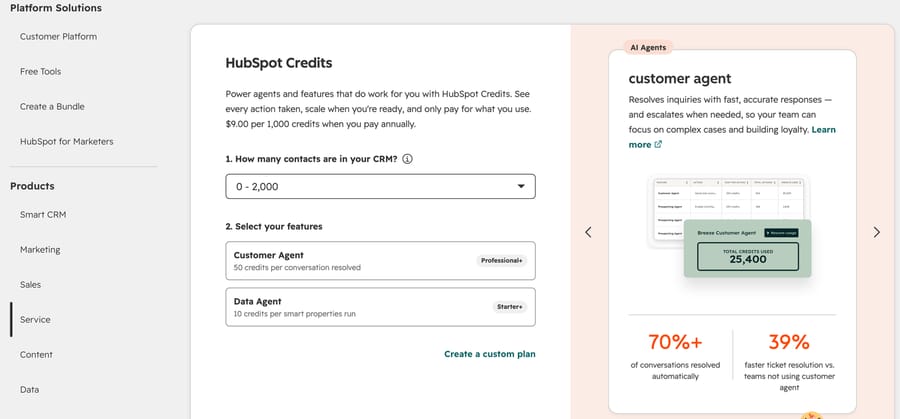
Per-ticket and per-session pricing make the opposite trade. You pay for failures too, and in exchange the bill is predictable and nobody argues about what counted. Credit packs sit in between: Microsoft charges 2 Copilot Credits for a generative answer and 5 for an agent action, per its billing rates page, so the same conversation costs more the more it does. HubSpot converts its credits into a per-resolution price: 50 credits for each conversation its Customer Agent resolves, at $9 per 1,000 credits paid annually, which is $0.45 a resolution, per its Service Hub pricing.
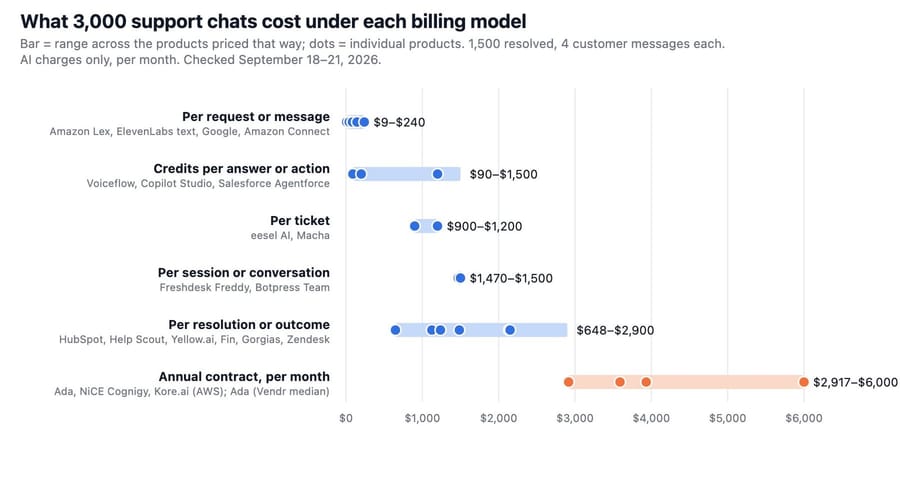
What 3,000 support chats cost under each billing model
The explainers ranking for this search don't price anything, and vendor pages show a starting price that doesn't tell you what a month costs. Here is one normalized month, grouped by the way each product charges, because the billing model explains most of the spread. Our roundup of AI customer service agents breaks the same month out agent by agent, with a chart for each.
Assumptions: 3,000 chat conversations a month handed to the AI, 4 customer messages each (12,000 customer messages, 12,000 AI replies), and the AI resolves half of them (1,500). Figures are the AI charge only; seats, the help desk itself and setup labor are extra. Prices were checked on September 18 and 19, 2026.
| Billing model | Unit price we found | Monthly AI cost at 3,000 chats | Products priced this way |
|---|---|---|---|
| Per request or message | $0.00075 to $0.012 a request; $0.003 to $0.010 a message | $9 to $240 | Amazon Lex $9 (12,000 text requests × $0.00075, Lex pricing); ElevenLabs Agents text $42 (12,000 replies × $0.003 plus the $6 Starter plan, or $78 if customer messages count too), plus the LLM; Google Conversational Agents $84 on Flows or $144 on Playbooks (Google pricing); Amazon Connect chat $240 (24,000 messages × $0.010, Connect pricing) |
| Credits per answer or action | About $0.0075 to $0.017 a Voiceflow reply; $0.016 a Copilot answer; $0.10 an Agentforce action | $90 to $1,500 | Voiceflow $90 to $204 (12,000 replies at the $0.0075 our run logged or the builder's ~$0.017 estimate, on the $60 Pro plan with its $60 of credit, assuming extra credit bills at face value); Microsoft Copilot Studio $200 to $400 (24,000 credits is one $200 pack; a 5-credit tool call per chat adds a second); Salesforce Agentforce $1,200 to $1,500 (240,000 Flex Credits: $1,200 pay-as-you-go at $0.005 a credit, $1,500 in prepaid 100,000-credit packs) |
| Per ticket | $0.30 to $0.40 a ticket | $900 to $1,200 | eesel AI $1,200 (3,000 × $0.40), or $900 with the 25% discount on its pricing page for an annual commitment; Macha $1,199 (the 3,000-ticket plan on our pricing page) |
| Per session or conversation | $0.49 a session; $0.50 a conversation | $1,470 to $1,500 | Freshdesk Freddy AI Agent $1,470 (30 packs of 100 sessions at $49; the 500 free sessions are a one-time trial allowance, per the FAQ on Freshdesk's pricing page); Botpress Team $1,500 ($750 billed annually for 1,500 conversations, plus 15 packs of 100 at $50) |
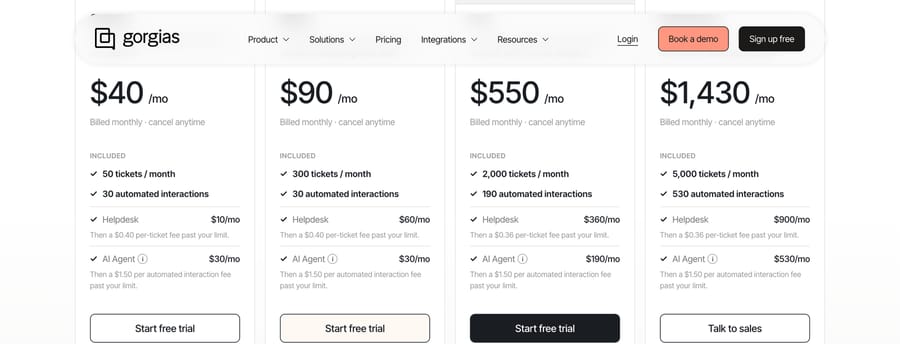
| Per resolution or outcome | $0.45 to $2.00 a resolution | $648 to $2,900 | HubSpot Customer Agent $648 ((75,000 − 3,000 included) credits × $0.009); Help Scout AI Answers $1,125 (1,500 × $0.75, Help Scout pricing); Yellow.ai Free plan $1,238 (1,250 resolutions × $0.99 after 500 free sessions); Fin $1,485 (1,500 × $0.99); Gorgias AI Agent $2,136 on annual billing ($171 for 190 automated interactions, then 1,310 × $1.50; $2,155 month to month); Zendesk AI agents $2,150 committed to $2,900 pay-as-you-go (1,500 × $1.50 = $2,250, or × $2.00 = $3,000, less a $100 allowance for 20 Suite Professional seats) |
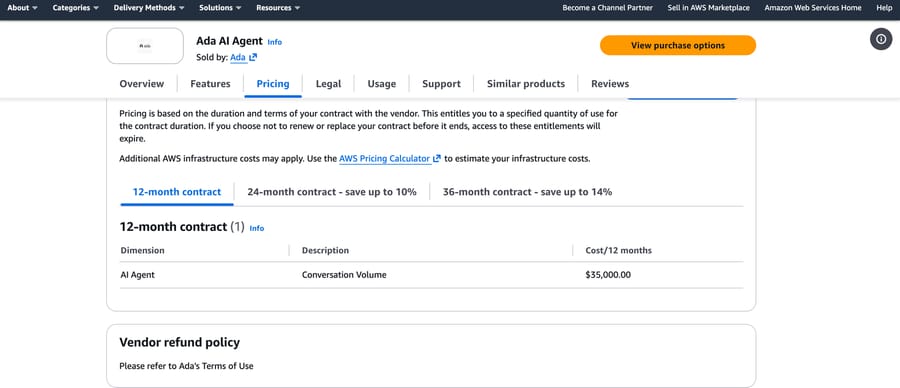
| Annual contract, as a monthly figure | $35,000 to $72,000 a year at the entry points we found | $2,917 to $6,000 | Ada $2,917 (its AWS listing: $35,000 for 12 months, volume unstated) or $6,000 (the median of 114 purchases on Vendr, a neutral buying service); NiCE Cognigy $3,590 (AWS: $43,080 a year for 60,000 conversations); Kore.ai $3,933 (AWS: $0.20 a session plus $40,000 a year of enterprise support) |
| Per minute (voice) | $0.038 to $0.08 a minute | Not part of this chat month | Amazon Connect, Google, ElevenLabs and Copilot Studio's classic voice; the roundup prices 12,000 voice minutes on each |
Zendesk's rate comes from Zendesk itself: its blog post on outcome-based pricing says "Zendesk charges $1.50 per automated resolution" (Zendesk blog), and its customer service chatbot buyer's guide markets the same agents. Its pricing page prints two rates, identically on every Suite and Support plan: $1.50 for a committed automated resolution and $2.00 pay-as-you-go, alongside the allowance ($5 per Suite Professional seat a month), so we show both and label which is which.
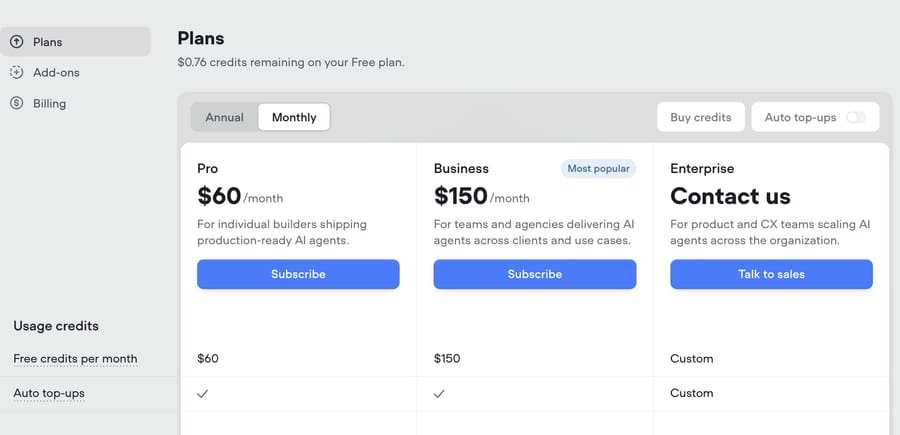
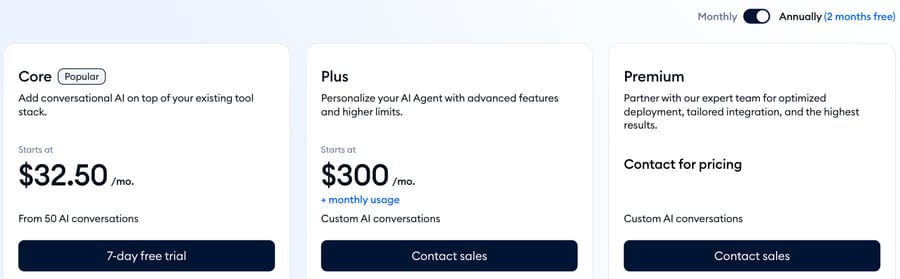
Seven products have no usable chat number at this volume. Sierra's and Decagon's AWS listings show a $1,000,000 "private offer" placeholder. Kustomer is quote-only (Vendr's buyer median is $138,073 a year for the whole platform, across 31 purchases). Forethought is sold through Zendesk sales since Zendesk completed its acquisition on March 26, 2026. Crescendo's AWS listing prices one unit at $0.01, a placeholder. Talkdesk's AWS listing sells seats ($135,000 over 36 months for 50 users), not an AI rate. And Tidio's Lyro starts at $32.50 a month for 50 AI conversations billed annually, with its Plus plan at $300 a month plus usage it doesn't publish, per Tidio's pricing.
The per-request rows look cheapest because the price leaves out the people: a $144 Google Playbooks month still needs engineers to build, test and maintain it, and Lex's $9 buys no channel at all. Per-ticket and per-session products cluster between $900 and $1,500. Per-resolution products spread widest, from $648 to $2,900, because their rates differ more than fourfold, from HubSpot's $0.45 to the $1.50 that Gorgias charges and Zendesk charges on a committed plan, and the $2.00 Zendesk charges pay-as-you-go. So the help desk's own AI isn't automatically the cheap option: at this volume, Gorgias's and Zendesk's cost more than a per-ticket add-on on the same help desk.
Per ticket or per resolution: where they cross
The billing units only compare cleanly once you fix a resolution rate, so it's worth doing this arithmetic for your own volume. A per-ticket price charges for every ticket the AI works. A per-resolution price charges only for the ones it closes. The two cost the same when the resolution rate equals the per-ticket price divided by the per-resolution price.
At $0.40 a ticket against Fin's $0.99 an outcome, that break-even is about 40%. Below 40% resolution, per-outcome is cheaper; above it, per-ticket is. Against Help Scout's $0.75 a resolution, the crossover is about 53%. Against HubSpot's effective $0.45 a resolution, it's about 89%, so HubSpot's Customer Agent is the cheaper unit for almost any team already paying for Service Hub Professional seats. Against the $1.50 that Gorgias charges and Zendesk charges on a committed plan, the crossover is about 27%; at Zendesk's $2.00 pay-as-you-go rate, it's 20%. An annual per-ticket rate of $0.30 moves every crossover down by a quarter: 30% against Fin, 20% against a $1.50 rate.
Early in a rollout, when the agent resolves a fifth of what it sees, per-resolution pricing protects you. Once it resolves more than half, you're paying a premium for the vendor carrying risk you no longer have. And every per-resolution vendor defines "resolved" itself, which is why the three-tier definitions from Zendesk above deserve a careful read before you compare rates.
If your support runs on the phone
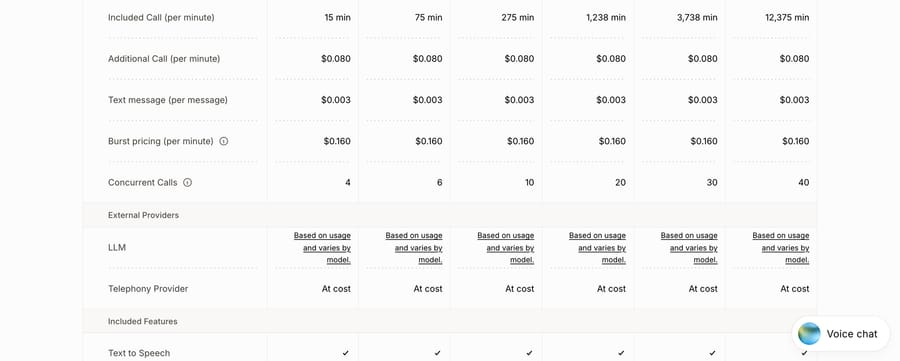
Voice is billed by the minute almost everywhere: $0.038 a minute on Amazon Connect before telephony, $0.001 or $0.002 a second on Google (6 or 12 cents a minute), and $0.08 for each minute past an ElevenLabs plan's allowance. Enterprise voice vendors sell commitments instead: PolyAI's AWS listing asks for $175,000 a year for 500,000 minutes, which is $0.35 a minute only if you use all of it. Per-minute pricing is honest about cost and says nothing about whether the call went well, so the incentive to keep calls short sits entirely with you. Latency, interruptions and caller verification matter more than the rate; our ElevenLabs integration guide shows one way to put a voice agent in front of an existing support stack.
What customer service AI still does badly
The failure modes are well known by now, and every product on this page has some version of them.
Confident answers from thin knowledge. An agent grounded on a help center with gaps will fill the gaps. The fix is on your side: the help center, the internal policy docs and your past ticket replies are the agent's real training material, and the ones nobody updated since last year are where the wrong answers come from.
Claimed actions and handoffs. Agents describe work they didn't do, as our test below shows. A reply that says "I've passed this to a teammate" is only true if a logged tool call says so.
Emotion and exceptions. A customer whose wedding order arrived broken doesn't want a policy quote. Agents detect frustration better than they used to, but the right move for most teams is a rule: certain topics, words or customer tiers go to a person on the first message.
Multi-system judgment. "Refund it if they're a good customer" needs order history, lifetime value and a judgment call. Agents can gather the data and propose; a person should approve, at least until you've read a few hundred of the proposals.
Cost at scale. Gartner's prediction that generative AI will cost more than $3 per resolution by 2030 rests on rising data center costs, AI vendors moving from subsidized growth to profit, and more complex use cases that consume more tokens. Whatever unit you buy in, model next year's bill at twice this year's turns per conversation.
How we researched this, and what our test showed
We pulled the live Google results for "customer service ai" and "ai customer support" on September 18, 2026, and read the pages ranking at the top, including IBM's and Zendesk's explainers, the Botpress, Gumloop and Freshworks listicles (Botpress and Freshworks each wrote a list that ranks themselves first), and the Reddit threads. The same day we checked every vendor's pricing page, searched AWS Marketplace, Azure Marketplace, Google Cloud Marketplace and Vendr for each vendor without a self-serve price, and read G2 and Gartner Peer Insights in a browser.
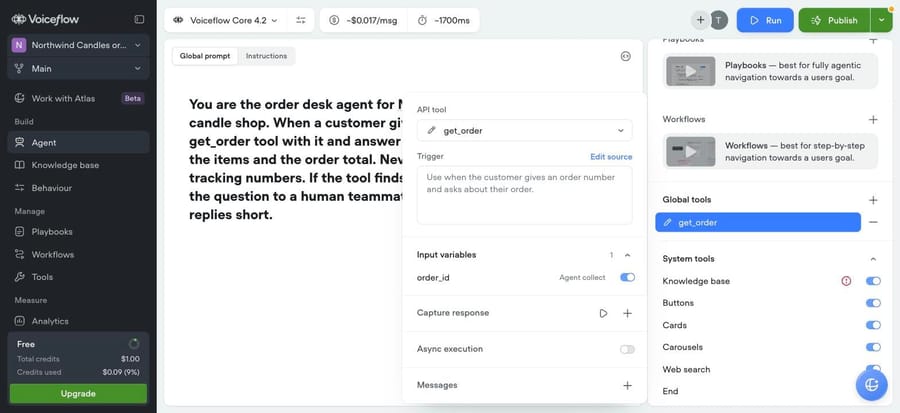
We also built one small order-desk agent on two free plans, ElevenLabs Agents and Voiceflow, and gave each a get_order tool that calls a public mock orders API. On Voiceflow, the agent looked up order 7 correctly, then offered to pass an address change to a human teammate although it had no handoff tool. Voiceflow's own automatic evaluations, which cost $0.0023 and $0.0012 of credit on this chat, graded it "Dissatisfied" and its deflection a "Fail", while noting that the agent "offered escalation to a human teammate". The ElevenLabs agent made the same unbacked handoff offer. The full test, with both transcripts and logs, is in our AI customer service agents roundup. We did not build an agent on any other product in this guide, and we did not run a voice turn because starting a call on ElevenLabs requires accepting its recording terms, which we didn't do on the test account.
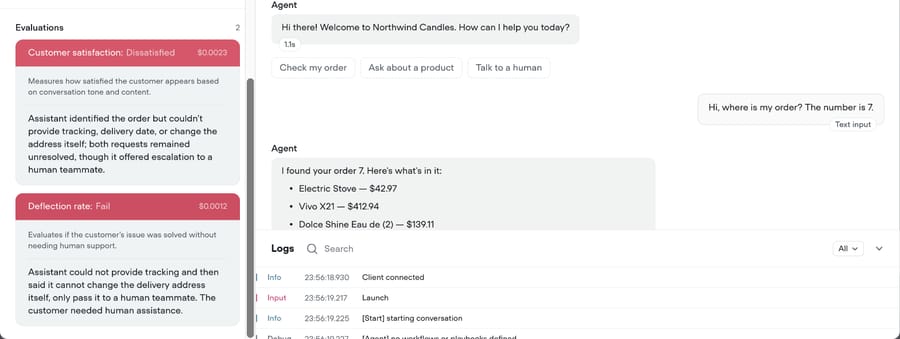
Here the platform's own model judged the conversation a failure. Under a per-resolution contract, a model like that decides whether you pay. Our guide to testing an AI agent before going live covers building your own checks, such as a test that fails whenever a reply offers a handoff without a handoff tool call.
Ratings for the products on this page
Review counts matter as much as stars: a 4.8 from 30 reviews says less than a 4.3 from 1,694. Ratings were read in a browser on September 18, 2026. Gartner figures are from its "AI Agents for Customer Service and Support" market unless marked; where a product isn't in that market, we used its conversational AI platforms listing or the whole-company figure, and say so.
| Product | G2 (stars, reviews) | Gartner Peer Insights |
|---|---|---|
| Zendesk (whole suite) | 4.3 (7,075) | 4.3 (47) |
| Salesforce Agentforce | 4.3 (1,694) | 4.3 (72) |
| Freshdesk | 4.4 (3,771) | 4.4 (2,294, Freshworks whole company) |
| HubSpot Service Hub | 4.4 (3,014) | Not in this market |
| Gorgias | 4.6 (582) | Not in this market |
| Help Scout | 4.4 (431) | Not in this market |
| Fin | 4.5 (3,912, whole Intercom listing) | 4.6 (18, conversational AI market) |
| Ada | 4.6 (173) | 4.5 (21, conversational AI market) |
| Sierra | 4.5 (130) | 4.7 (7) |
| Decagon | 4.8 (30) | No reviews |
| Forethought AI Agents | 4.3 (166) | 5.0 (1, conversational AI market) |
| Kustomer | 4.4 (566) | Not in this market |
| Kore.ai | 4.6 (505) | 4.2 (10); 4.3 (167) in conversational AI |
| NiCE Cognigy | 4.6 (13) | 4.8 (156, conversational AI market) |
| Yellow.ai | 4.4 (107) | 4.5 (2) |
| PolyAI | 5.0 (12) | 4.2 (5) |
| Talkdesk | 4.4 (2,601) | 4.4 (29) |
| eesel AI | 4.6 (20) | Not listed |
| Botpress | 4.5 (512) | Not listed |
| Crescendo.ai | No reviews yet | 4.5 (2) |
The most common complaints repeat across vendors. On G2, Zendesk's leading con tags are "Missing Features" (216) and "Learning Curve" (179); an admin at a mid-market company wrote that "the help files in the academy section are a bit outdated for the AI Agents part" (September 16, 2026). An enterprise reviewer in consulting named Agentforce's "hallucinations of course and consumption costs" as the downsides, adding that "the pricing is complex" (September 17, 2026). On Sierra, a small-business reviewer wrote that it "can be expensive, may need technical setup, and sometimes requires human support for complex or unusual issues" (September 17, 2026). Accuracy on unusual questions and unclear pricing are the two themes, whoever the vendor.
Three teams, three different answers
The same market looks different from three desks. These are composites, priced from the tables above.
A Shopify store on Gorgias, 3,000 tickets a month, 40% of them "where is my order". The obvious first move is Gorgias's own AI Agent, trained on the store's Shopify data, at about $2,136 a month in AI charges on annual billing at a 50% resolution rate. The alternative is an agent layer or add-on that bills per ticket, at $900 to $1,200 for all 3,000 tickets. Against Gorgias's $1.50 rate, the crossover with a $0.40 ticket is about 27%, so a store whose agent resolves more than a quarter of what it sees pays less on the per-ticket unit. What decides it is less the rate than the actions: whether the agent can edit an order, change an address and process a return, not just report tracking.
A B2B software company on Zendesk, 1,500 tickets a month, mostly how-to questions. Here the knowledge is the product documentation and past ticket replies, and the risk is a confident wrong answer about a feature. Native Zendesk AI agents keep everything in one place, and the per-resolution unit protects the team early on when resolution is low. A standalone agent such as Fin fits if the company also runs chat on its website outside Zendesk. The work that matters most is cleaning up the help center first.
A retailer's contact center, 40,000 calls and chats a month, six languages. This buyer is in a different market: NiCE Cognigy, Kore.ai, PolyAI and the contact-center suites, bought by RFP on an annual contract. The AWS listings above give a floor to negotiate from: Cognigy's smallest tier covers 60,000 conversations a year, well under this volume, and PolyAI's smallest commitment is 500,000 minutes a year. At this size, the cost of a missed phone verification or a badly handled complaint outweighs a few cents per conversation, so evaluation should weigh voice quality, security reviews and the integrator's track record.
How to choose customer service AI
Five questions, in this order, narrow the field faster than a feature matrix.
- Do you keep your help desk? Most teams should. Migrating tickets, macros and reporting to get an AI feature is the most expensive way to buy one. Native AI, standalone agents and agent layers all work without a migration.
- Which channels carry the volume? Email and chat favor ticket-based and resolution-based products. A phone-heavy operation belongs with voice platforms, where per-minute pricing and latency decide the shortlist.
- Does the AI need to act, or only answer? If half your volume is "where is my order" or "cancel my plan", you need tool calls into Shopify, your billing system or your own API, with confirmation rules. Answer-only products can't close those.
- Who maintains it? A builder or cloud component needs an owner with time every week. A vendor-built agent needs a change request. A product with a success team doing setup sits in between.
- What shape of bill can you live with? Per-resolution is cheapest when resolution is low and hardest to forecast. Per-ticket and per-session are easiest to forecast and charge for failures. Annual contracts suit volumes of tens of thousands a month.
What to evaluate in a customer service AI product
- Accuracy on your own tickets. Ask to run the agent against a few hundred of your past conversations before signing, and read the answers, not the summary score.
- Action safety. Which tools can it call, which need a human's confirmation, and is every action logged with its inputs and result?
- Handoff. What reaches the human, and does the AI ever promise a handoff it can't create? Our test above is a five-minute version of this check.
- Testing and versioning. Look for simulated conversations, a way to turn a bad transcript into a regression test, and publishing with a change history.
- Compliance by plan. SOC 2 is common; HIPAA, SSO and data residency are often top-tier only. Help Scout lists HIPAA compliance on its Pro plan.
- Languages. Ask which languages the agent is tested in, not which it "supports".
- Analytics you can act on. Resolution rate by contact reason, cost per conversation, and the conversations it got wrong.
Data security and privacy
Every product on this page reads customer conversations, and many send them to a third-party model provider. Ask five things in writing: where conversation data is stored and for how long; whether the vendor or its model provider trains on your data; whether personal data such as card numbers and addresses is redacted before it reaches the model; which certifications cover the product you're buying rather than the company (SOC 2 Type II, ISO 27001, HIPAA where it applies); and whether you can choose the data region. Plan tiers matter here too: Help Scout, for example, lists HIPAA compliance on its Pro plan only. An agent that can take actions also needs scoped permissions, so a support agent can issue a refund up to a limit but can't read payroll.
How to roll it out without a bad month
Start with one contact reason, not the whole queue. Pick the category with the most volume and the least judgment, such as order status or password resets, and put the agent on it in draft mode, where it writes and a human sends. Read two hundred drafts. Then let it reply on its own to that one category and measure resolution on a sample every week. Vendors' own resolution claims are ceilings from their best customers: HubSpot's pricing page says "70%+ of conversations resolved automatically", Tidio's says its Lyro agent handles "up to 67%" of customer service, and Crescendo's pricing page claims "70% resolution from day one". Your first month will be lower, and your own sample is the number to plan on.
Keep a human path that's one click away. Gartner predicts, in a January 26, 2026 newsroom release, that by 2028 rules guaranteeing customers the right to talk to a person will increase assisted service volume by 30%, so an AI rollout that hides the human will get more expensive, not less.
Where Macha fits
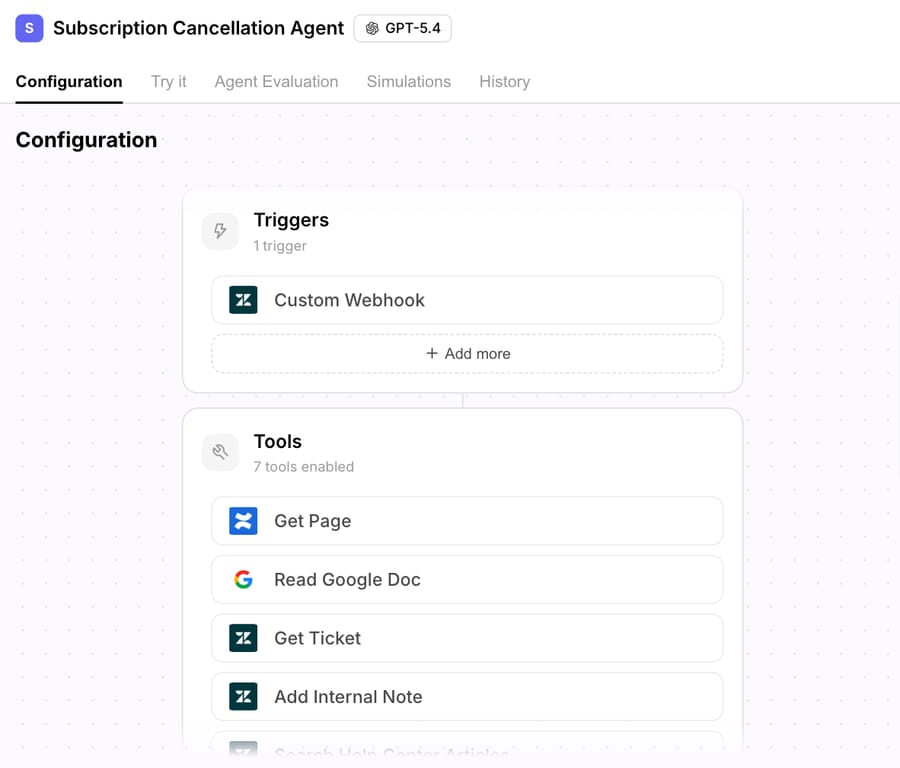
Macha is an AI agent layer that runs inside the help desk you already use: Zendesk, Freshdesk, Gorgias, Front, Intercom or HubSpot today, with the current list on our integrations page. Its agents read the ticket, reply or write an internal note, and take actions in connected tools such as Shopify, Stripe, Confluence, Notion or Google Workspace, with custom API tools for anything else. It isn't a help desk and it isn't a phone IVR. It fits teams whose customer conversations are already tickets in one of those help desks, who want the agent working inside the ticket, and who don't have engineers to build and maintain one.
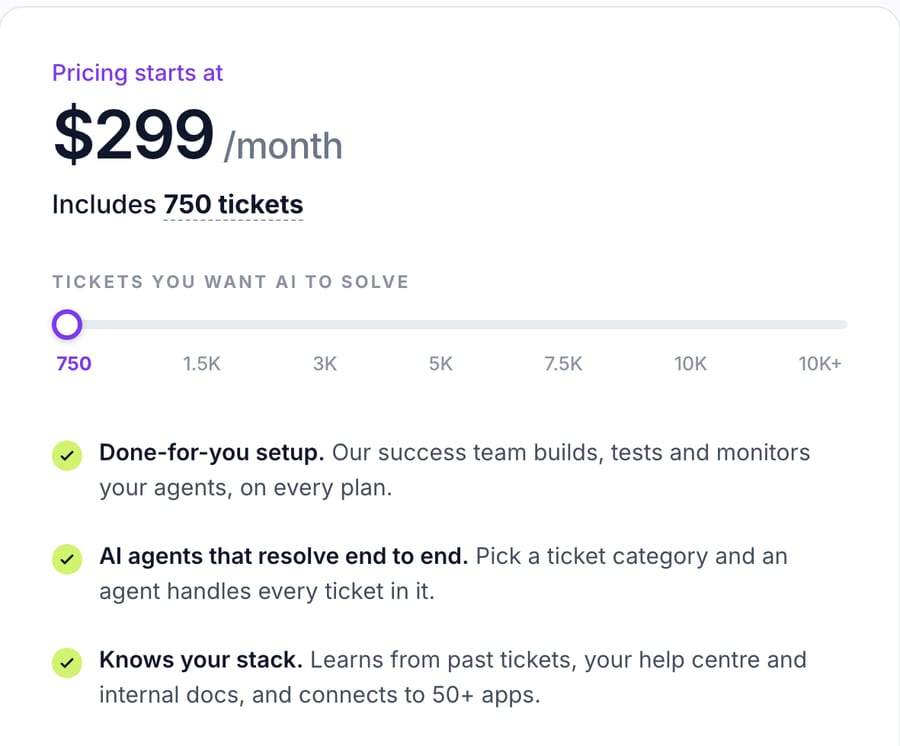
Pricing is one plan set by monthly ticket volume, from $299 for 750 tickets, which is about $0.40 a ticket at every tier; 3,000 tickets is $1,199. A ticket is one thread with one person, charged once however many replies it takes, and the model an agent runs on doesn't change the charge. Setup and monitoring by the Macha team are included on every plan, which answers the "who maintains it" question for a team without engineers. The billing unit has its own incentive: we earn more as you put more ticket categories on the agent, resolved or not, so we'd rather you start with the categories it handles well. See how Macha works on your help desk.
Who shouldn't buy customer service AI yet
At a few hundred conversations a month, a good help center and saved replies often do more than an agent, because setup and review time don't shrink with volume. Teams whose policies change weekly without anyone writing them down will get an agent that's confidently out of date. Regulated conversations (payments disputes, health questions) need compliance review and often a flow-based design before a prompt-based agent goes near them. And if your knowledge base has large gaps, buying an agent first means paying to discover them one wrong answer at a time.
Frequently asked questions
Can AI do customer service? Yes, for a defined share of it. AI agents in 2026 resolve routine requests end to end (order status, account changes, policy questions) and draft or route the rest. The share depends on how routine your volume is and whether the agent can take actions through tools. Plan on your own sample, not a vendor's headline figure.
Is customer service being replaced by AI? Partly, and more slowly than vendors suggest. Gartner predicts that by 2030 the cost per resolution for generative AI will exceed $3, "higher than many B2C offshore human agents", and that by 2028 right-to-a-human rules will raise assisted volume by 30%, per its January 26, 2026 press release, "Gartner Predicts GenAI Cost Per Resolution for Customer Service Will Exceed Offshore Human Agent Costs by 2030". The realistic shape is AI on routine volume and people on the rest.
Is there AI customer service? Yes. Every major help desk sells its own AI agent (Zendesk, Freshdesk, Gorgias, HubSpot, Help Scout, Salesforce), and standalone agents such as Fin and Ada run on top of them. The cost table above puts a monthly figure on 19 of them, plus Macha.
How can AI be used in customer support? Six ways: answering and resolving, taking actions such as refunds or address changes, drafting replies for agents, triaging and routing tickets, reviewing quality and contact reasons, and answering the phone. Most teams start with answering one high-volume category.
Which is the best AI for customer support? It depends on your help desk and channel. Teams on Zendesk, Freshdesk or Gorgias should compare the native agent with an agent layer; teams wanting one agent across help desks usually start with Fin; enterprises with voice volume look at Cognigy, Kore.ai or PolyAI. Our roundup of AI customer service agents compares them one by one, our list of AI agents for customer support covers the same question from the support-team side, and our customer service software comparison covers help desks with AI built in.
Can I talk with AI for free? As a consumer, yes: ChatGPT, Google Gemini and Microsoft Copilot all have free tiers you can type or speak to. As a business trying customer service AI, several products have free usage: Yellow.ai (500 chat sessions a month), Botpress Free (25 conversations), Help Scout AI Answers (a 3-month trial), HubSpot Customer Agent (14 days on a paid seat), Tidio (50 Lyro conversations), Voiceflow ($1 of credit) and Macha ($50 of free usage, no card). None covers production volume.
What is the 30% rule in AI? There's no standard definition; people use the phrase for several different rules of thumb. The 30% figure most relevant to support comes from Gartner, which predicts that rules guaranteeing a right to talk to a person will raise assisted service volume by 30% by 2028. For your own rollout, the number that matters is your resolution rate on a sample of real conversations, measured before you sign.
What are examples of AI in customer service? An agent that looks up an order and answers "where is my order" without a human; one that processes a subscription cancellation after offering the retention script; a copilot that drafts a reply from past tickets; and triage that tags and routes every new ticket. Vendors publish their own case figures: Zendesk's blog, for instance, says Unity deflected 8,000 tickets and saved $1.3 million with its AI.
What are the pros and cons of AI in customer service? The pros are instant answers at any hour, lower cost per routine conversation, and humans freed for complex cases. The cons are confident wrong answers when knowledge is thin, actions and handoffs it claims but didn't do, and a bill that grows with volume. The fixes are known: grounded knowledge, tool permissions, test sets and a visible human path.
Can AI answer customer service emails? Yes. Help-desk-native agents and agent layers answer email tickets the same way as chat, and per-ticket pricing counts a whole email thread once. Email is often the easier start, because a slower reply is acceptable and a draft-first mode is natural.
Will AI create or remove customer support jobs? Both. Routine first-line volume shrinks where AI resolves it, and new roles appear around it: someone has to own the knowledge base, write and test the agent's instructions, review its conversations and handle the escalations it hands over. Teams that roll AI out well usually move their best agents into those roles rather than cutting them.
What does Gartner say about AI in customer service? Gartner runs a Peer Insights market for "AI Agents for Customer Service and Support". On September 18, 2026, its most-rated products were Salesforce Agentforce (4.3 from 72 ratings), Zendesk (4.3 from 47) and Amazon Quick (4.4 from 45). Its analysts predict that generative AI will cost more than $3 per resolution by 2030, per its January 2026 press release.
If your support already runs as tickets in Zendesk, Freshdesk, Gorgias or Front, start a Macha trial with $50 of free usage and point an agent at one ticket category first.
Sources: IBM, AI in customer service, Zendesk, AI in customer service, Zendesk pricing, Zendesk, resolution tiers, Zendesk, resolution allowances, Zendesk completes acquisition of Forethought, PR Newswire, Freshdesk pricing, Gorgias pricing, Help Scout pricing, HubSpot Service Hub pricing, Salesforce Agentforce pricing, Fin pricing, eesel AI pricing, Yellow.ai pricing, Botpress pricing, Tidio pricing, Crescendo pricing, Amazon Lex pricing, Amazon Connect pricing, Google Conversational Agents pricing, Microsoft Copilot Studio billing rates, ElevenLabs Agents pricing, Ada on AWS Marketplace, NiCE Cognigy on AWS Marketplace, Kore.ai on AWS Marketplace, PolyAI on AWS Marketplace, Sierra on AWS Marketplace, Decagon on AWS Marketplace, Vendr, Ada, Vendr, Kustomer, Gartner, GenAI cost per resolution prediction, Gartner Peer Insights, AI agents for customer service and support, Tidio pricing, Zendesk blog, outcome-based pricing, Zendesk, customer service chatbots buyer's guide. Azure Marketplace and Google Cloud Marketplace searches, G2 search and review pages, all read September 18, 2026. Our own free-plan builds on ElevenLabs Agents and Voiceflow, September 18, 2026.
Simple per-ticket AI pricing
One thread with one person is one charge, however many replies it takes.