





 Shopify
 Stripe
 Slack
 Notion
 Google Workspace
 Confluence


Help Scout vs Crisp (2026): Per-Seat Email Help Desk or Flat-Priced Chat Inbox?


Help Scout is an email-first help desk priced per user: $25, $45 or $75 a user a month on annual billing, with its Scout AI agent at $0.75 per resolution. Crisp is a chat-first messaging inbox priced per workspace: $45, $95 or $295 a month with 4, 10 or 20 seats and some AI credit included. For a 10-person team, that's $250 a month in Help Scout Standard seats against $95 for Crisp Essentials. Help Scout is the stronger email help desk with a better knowledge base on cheap plans. Crisp is far cheaper per head and built around live chat, which is why it keeps coming up when Help Scout teams talk about leaving.
Key takeaways
- Help Scout charges $25, $45 or $75 per user a month billed annually, while Crisp charges $45, $95 or $295 a month per workspace with 4, 10 or 20 seats included.
- A 10-person team pays $250 a month for Help Scout Standard seats and $95 a month for Crisp Essentials, which includes 10 seats and $25 of AI credit.
- Help Scout's Scout agent costs $0.75 per resolution, while Crisp's Hugo spends token-based credits that Crisp estimates at $0.05 to $0.10 per fully handled conversation.
- Crisp's shared email inbox starts on its Mini plan at $45 a month, and its knowledge base starts on Essentials at $95.
- Help Scout includes a Docs knowledge base site on every plan, including the Free plan, which allows 5 users but caps monthly contacts.

| If you are... | Pick | Why |
|---|---|---|
| A team whose support arrives mostly by email | Help Scout | The shared email inbox is the core product, and Docs is included on every plan |
| A team whose support arrives mostly by website chat | Crisp | The chatbox, real-time inbox and Hugo are the core product |
| Growing headcount faster than budget | Crisp | Seats come in the workspace price; 10 seats cost $95 a month on Essentials |
| Needing a strong knowledge base on a low budget | Help Scout | 2 Docs sites on Standard; Crisp's knowledge base starts on Essentials |
| Wanting WhatsApp and Instagram cheaply | Either | Help Scout lists them on Standard ($25 a user); Crisp on Essentials ($95 a workspace) |
| Leaving Help Scout and wanting AI agents running on the new desk | Crisp plus an agent layer | Macha runs inside Crisp (see Where Macha fits) |
How does Help Scout pricing compare with Crisp pricing?
The two vendors charge for different things. Help Scout charges per user, so the bill tracks headcount. Crisp charges per workspace, so the bill tracks which feature tier you need, and seats come bundled. We checked both pricing pages on November 22, 2026.
| Plan level | Help Scout (per user a month, annual) | Crisp (per workspace a month) |
|---|---|---|
| Free | $0, 5 users, 1 inbox, 25 contacts a month on the plan card | $0, 2 seats, 100 customer profiles, chat widget, no AI credits |
| Entry | Standard: $25 ($30 monthly), up to 25 users | Mini: $45, 4 seats, 5,000 profiles, shared email inbox, $5 AI credit |
| Mid | Plus: $45 ($54 monthly), up to 50 users | Essentials: $95, 10 seats, 50,000 profiles, omnichannel inbox, knowledge base, $25 AI credit |
| Top | Pro: $75 ($90 monthly), 10-user minimum | Plus: $295, 20 or more seats, 200,000 profiles, $75 AI credit |
| Extra seats | Each user is a seat | $10 a month per extra seat |
| AI agent | Scout: $0.75 per resolution, 3 months free for new accounts | Hugo: spends the plan's AI credit, then Pay-As-You-Go if you turn it on |
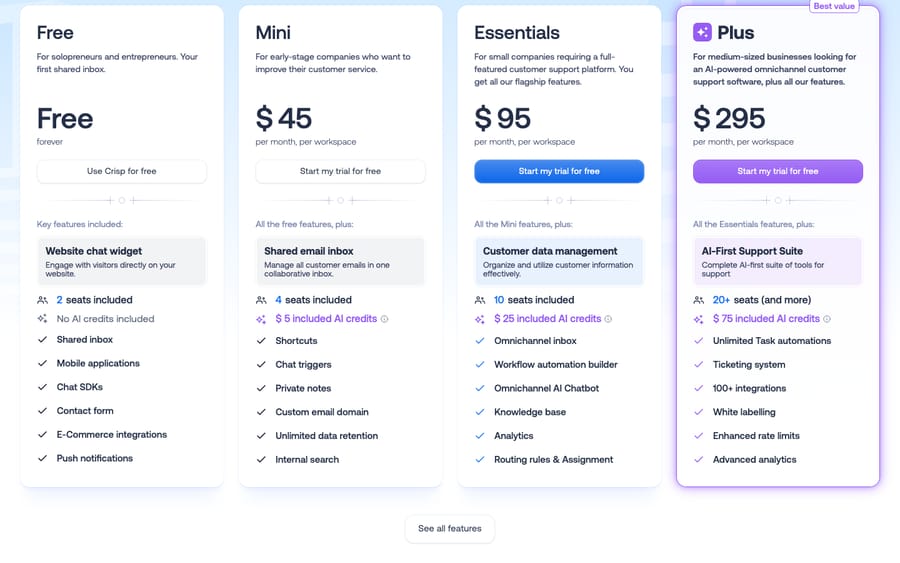
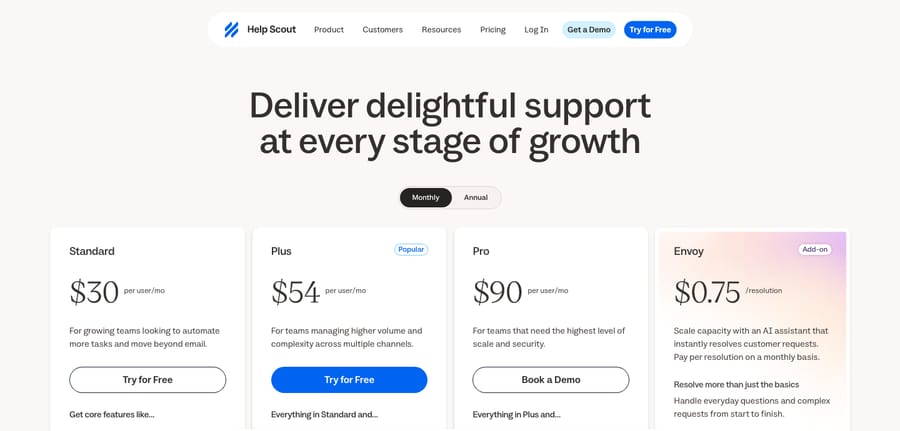
The incentives follow from the units. A per-seat vendor earns more when you hire, so Help Scout has no reason to bundle seats; it competes on product depth per seat, and its tiers add workflows, integrations and Docs sites. A per-workspace vendor earns more when you need the next feature tier, so Crisp gives seats away and gates features instead: the email inbox on Mini, the knowledge base and social channels on Essentials, ticketing and white labeling on Plus. If your team is large and your needs are simple, Crisp's model is cheaper. If your team is small and email-heavy, the gap narrows. Our Crisp pricing guide and Help Scout pricing guide break down each tier.
What do 10 and 20 seats cost on each?
Here's the arithmetic at list prices, assuming 450 AI-handled conversations a month, which is what Crisp says Essentials' $25 of credit covers.
| Line item | Help Scout Standard, 10 users | Crisp Essentials, 10 seats | Help Scout Standard, 20 users | Crisp Plus, 20 seats |
|---|---|---|---|---|
| Seats | 10 × $25 = $250 | Included in $95 | 20 × $25 = $500 | Included in $295 |
| AI on 450 conversations | 450 × $0.75 = $337.50 (if all resolve) | Covered by the $25 included credit | $337.50 | Covered by the $75 included credit |
| Monthly total | $587.50 | $95 | $837.50 | $295 |
| Year | $7,050 | $1,140 | $10,050 | $3,540 |
Two adjustments make this fairer. Help Scout only charges for conversations Scout fully resolves, so if half of the 450 escalate, Scout costs $168.75 and the 10-user total is $418.75. And Crisp's prices exclude VAT, while its included AI credit runs out faster on long conversations, because Hugo's credit is token-based. Even with both adjustments, Crisp costs a fraction of Help Scout at 10 seats and above. At 3 or 4 seats the gap is small: Help Scout Standard for 4 users is $100 a month against Crisp Mini at $45.
How do Scout and Hugo charge for AI?
Help Scout's AI resolutions pricing article charges $0.75 once per session when Scout answers and the customer "doesn't ask for additional help after the last AI response." Greetings and follow-up questions without an answer aren't billed. You set a monthly resolution limit; at the limit, Scout switches off in Beacon until the next cycle. Help Scout's Introducing Scout article says Scout evolved from AI Answers and now answers in Beacon and by email.
Crisp prices Hugo differently. Its Hugo pricing and billing article says credits are token-based and a conversation "is not billed per message," and estimates $0.05 to $0.10 for a conversation Hugo handles fully. Each plan's credit resets every billing cycle, currently on the 4th of the month, and unused credit doesn't roll over. When credit runs out and Pay-As-You-Go is off, Hugo stops answering and conversations go to people.
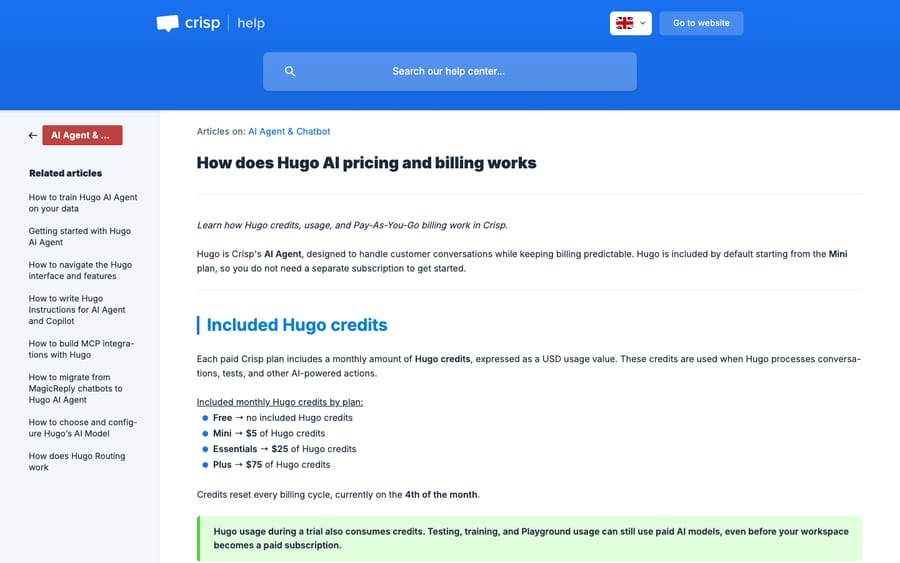
Per resolution, Hugo is the cheaper meter by a wide margin: $0.05 to $0.10 against $0.75. Help Scout's meter is easier to forecast, because a resolution is a fixed price whatever the conversation length. Crisp's moves with model choice and conversation length. The incentive differs too. Help Scout earns more the more conversations Scout marks resolved. Crisp earns more when you outgrow your included credit and move up a tier or switch on Pay-As-You-Go. Our Crisp Hugo credits guide shows how to estimate when your allowance runs out, and our Help Scout AI explainer covers Scout's setup.
Which platform wins on features?
| Capability | Winner | Why |
|---|---|---|
| Shared email inbox | Help Scout | Core product on every plan; Crisp's starts on Mini |
| Live chat | Crisp | The chatbox and real-time inbox are Crisp's core; Help Scout's chat runs through Beacon |
| Knowledge base on cheap plans | Help Scout | Docs on every plan; Crisp's knowledge base starts on Essentials |
| Seats per dollar | Crisp | 10 seats for $95 a month against $250 for 10 Help Scout Standard users |
| AI cost per handled conversation | Crisp | About $0.05 to $0.10 in Hugo credit against $0.75 per Scout resolution |
| AI cost predictability | Help Scout | A flat price per resolution; Hugo's cost moves with tokens and model |
| Workflows and automation | Help Scout | 150 basic workflows on Standard; Crisp reserves unlimited task automations for Plus |
| Ticketing | Help Scout | Every Help Scout conversation is a ticket; Crisp lists a ticketing system on Plus |
| CRM integrations | Help Scout | HubSpot, Salesforce and Jira on Plus; Crisp lists 100+ integrations on Plus |
| Free plan | Depends | Help Scout gives 5 users and email, capped on contacts; Crisp gives 2 seats and chat, capped at 100 profiles |
Help Scout wins on email, documentation and structure. Crisp wins on chat and on price per head.
Why do Help Scout teams move to Crisp?
Usually because of price. When Help Scout told customers in 2025 that it was moving from per-seat to per-contact billing, the April 2025 r/SaaS thread about it filled with suggestions, and Crisp came up more than once: one reply pointed out you can start free, another described a year on it without complaint. Later replies noted Help Scout had gone back to per-user pricing, which its pricing page now confirms. The underlying math hasn't changed, though. Per-user plans get expensive as you hire, and Crisp's don't.
The move costs something:
- Email depth. Crisp's shared email inbox is a Mini feature in a chat product. Teams with long, threaded email conversations notice the difference.
- Documentation. Help Scout Docs moves to Crisp's knowledge base, which starts on Essentials. Plan on rebuilding articles.
- Chat reliability on your side. Crisp's chatbox depends on a live WebSocket connection, and some problems (blocked networks, idle visitors) come with that design. Our common Crisp problems guide covers them.
- Feature gates. Crisp's pricing page lists unlimited data retention, private notes and chat triggers from Mini up, not on Free, and some automations wait for higher tiers. Read the plan page for the features you rely on before you move.
If you're weighing more than these two, our Help Scout alternatives comparison and Crisp alternatives comparison cover the rest, and our Crisp review collects what users say about it after the switch.
Which should you choose, Help Scout or Crisp?
Count where your conversations start. Export a month of conversations and sort them by channel. If more than about half arrive by email and run to several replies, Help Scout's inbox, workflows and Docs will serve you better, and at four or five users the price difference is under $100 a month. If most start in the chat widget and end in one or two exchanges, Crisp is built for exactly that, and its per-workspace price means the tenth teammate costs nothing extra.
Then count heads two years out. A team planning to go from 5 to 20 people pays $375 a month more for Help Scout Standard seats at the end of that growth (15 × $25), while Crisp moves from Essentials to Plus for $200 more. If headcount is the thing that will grow, Crisp's pricing ages better. If the knowledge base is what customers use most, Help Scout's ages better.
Where Macha fits
Macha isn't a help desk and doesn't replace either one. It runs AI agents inside Zendesk, Freshdesk, Gorgias, Front, Gladly, Crisp, HubSpot or Intercom, and Crisp is one of them. Help Scout isn't, as of November 2026. So Macha fits teams on Crisp, including teams that just moved from Help Scout and want an agent answering conversations with real order and account data from the first week. It's the wrong fit if you're staying on Help Scout.
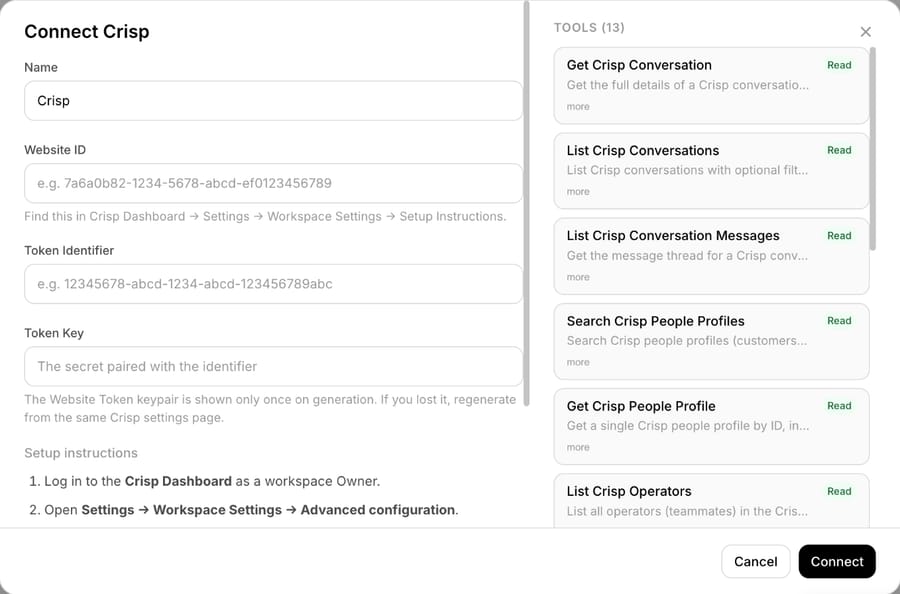
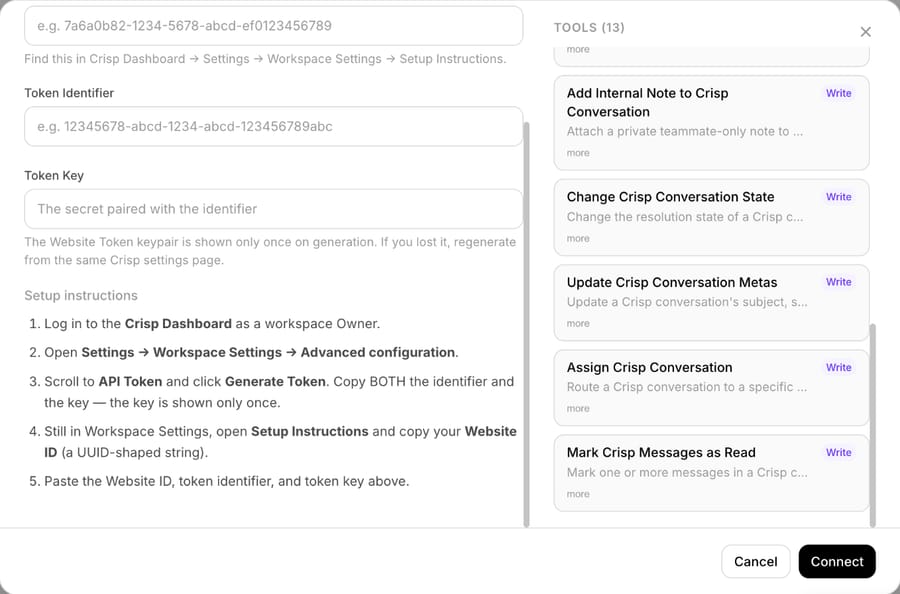
Through Macha's Crisp connector, an agent starts automatically on a New Conversation or New Customer Message. It reads the conversation, its messages and the person's profile, then replies on the customer's channel or drafts the answer as an internal note for a teammate to approve. It can also update the conversation's metas (subject, segments, custom data), change its state, assign it to an operator and mark messages as read.
Macha also reaches the systems where answers live, such as Shopify for "where's my order" and Stripe for billing questions, through its other connectors. Our use cases for drafting Crisp replies as internal notes and answering Crisp order-status chats with Shopify show the flows.
The price is about $0.40 per ticket: one conversation with one person counts once however many messages it takes, and the model doesn't change the charge. That price includes setup and a dedicated success manager who handles your changes. The Macha team analyzes your past conversations, builds the knowledge base and the agent, and runs it in safe mode until the drafts are right, on the trial and every plan. Hugo is cheaper per conversation; the difference is who does the work and what the agent can do. With Hugo, your team builds and tunes it, and it answers from your knowledge sources. With Macha, we build and tune it, and it can look up orders, tag, route and assign. See Macha on Crisp and the done-for-you setup. The trial is $50 of free usage (about 125 tickets), no credit card, no time limit.
Common questions
Is Crisp cheaper than Help Scout?
For most teams, yes. Crisp charges per workspace with seats included, so 10 seats on Essentials cost $95 a month against $250 for 10 Help Scout Standard users. At 3 or 4 users the gap is small, and Help Scout includes features Crisp gates to higher tiers.
Is Crisp a good Help Scout alternative?
For chat-led teams, yes. Crisp's live chat and per-workspace pricing are its strengths. For email-heavy teams that rely on Help Scout Docs, it's a weaker fit, because the email inbox starts on Mini and the knowledge base on Essentials.
Which AI is cheaper, Crisp Hugo or Help Scout Scout?
Hugo, per conversation. Crisp estimates $0.05 to $0.10 in credit for a conversation Hugo handles fully, and every paid plan includes some credit. Scout costs $0.75 per resolution, with 3 months free for new Help Scout accounts.
Does Crisp have a knowledge base like Help Scout Docs?
Yes, from the Essentials plan at $95 a month per workspace. Help Scout includes a Docs site on every plan, including Free.
Can I move from Help Scout to Crisp without losing history?
Plan for it. Help Scout's API lets you export conversations, but Crisp is chat-first and won't import a Help Scout mailbox as-is. Keep an export, rebuild saved replies and Docs articles, and run both for a short overlap.
Can I add an AI agent to Crisp without building it myself?
Yes. An agent layer such as Macha runs inside Crisp, and the Macha team sets it up, tests it on your past conversations and runs it in safe mode before it replies to customers.
How we researched this
- Help Scout, read November 22, 2026: the pricing page (plans, seat limits, channels on Standard, Docs sites, Envoy at $0.75 a resolution) and two docs articles on Scout and AI resolution billing.
- Crisp, read November 22, 2026: the pricing page (per-workspace prices, seats, profiles, AI credit and the conversations Crisp says each covers, extra seats at $10, VAT excluded) and the Hugo pricing and billing article on help.crisp.chat.
- Arithmetic: 10 × $25 = $250; 450 × $0.75 = $337.50; half resolved = $168.75; 20 × $25 = $500; years are monthly × 12.
- User reports: the April 2025 r/SaaS thread on Help Scout's pricing change, read through a Reddit archive and paraphrased.
- Macha's capabilities come from Macha's own Crisp connector (13 tools, 3 triggers) and the connector screens above, captured in Macha's demo workspace. Everything else on this page is from public pages. We didn't run the same conversations through Scout and Hugo.