Shopify
 Stripe
 Slack
Slack Notion
 Google Workspace
 Confluence

Is Gorgias Good for Small Stores and Startups in 2026?


Gorgias is a strong ecommerce help desk, but below roughly 100 support tickets a month most small Shopify stores pay for more than they use. Free Shopify Inbox or per-seat Re:amaze usually covers them until volume and repetitive tickets grow.
Key takeaways
- Gorgias suits small stores once they pass roughly 100 support tickets a month; below that, its per-ticket pricing and setup usually outweigh the value of its Shopify-native automation.
- Gorgias Basic costs $60 a month for 300 tickets, or $50 billed annually, and each extra ticket costs $0.40 on Starter and Basic.
- Adding the Gorgias AI Agent bundle of 30 interactions takes a 300-ticket store on Basic to $90 a month, and each interaction past the bundle costs $1.50.
- Re:amaze prices per seat rather than per ticket, with Basic at $29 per agent a month and a flat $59 unlimited-seat Starter plan capped at 500 conversations.
- Shopify Inbox is free and now includes an AI chat assistant for product questions and order updates, but it has no shared ticket queue across email and social channels.

Gorgias is good for a small store once it handles more than roughly 100 support tickets a month; below that, its $60-a-month Basic plan (300 tickets) is usually more help desk than you need, and free Shopify Inbox or per-seat Re:amaze covers you for less. Here is how the options compare on price, per each vendor's pricing page on 24 September 2026:
| Option | Entry price | How it bills | Best fit |
|---|---|---|---|
| Shopify Inbox | Free | Free app | New store, a few chats a day |
| Re:amaze | $29 per agent a month (Basic), or $59 flat Starter | Per seat; Starter caps at 500 conversations | 1 to 3 agents, predictable volume |
| Gorgias Starter | $10 a month, 50 tickets | Per ticket | Testing Gorgias at tiny volume |
| Gorgias Basic | $60 a month ($50 billed annually), 300 tickets | Per ticket, AI Agent bundle extra | 100+ tickets a month, heavy WISMO and returns |
What is Gorgias built for?
Gorgias is a help desk designed specifically for ecommerce, and that focus is its real strength. It pulls order data, tracking, and customer history straight from Shopify into the ticket, so an agent can see the order, issue a refund, or edit a shipping address without leaving the conversation. It centralizes email, live chat, Instagram, Facebook, and WhatsApp into one inbox, and it automates the repetitive stuff (the "where is my order" replies, the return requests, the macro-driven answers) with rules and an AI Agent. If you want a fuller tour of the product, our Gorgias for Shopify guide walks through the integration.
None of that is in dispute. The question for a small store isn't whether Gorgias is good. It's whether you have enough of the problem Gorgias solves to justify the price. A help desk built to make a five-agent team faster doesn't do much for a solo founder answering twelve emails a week.
Below what ticket volume is Gorgias overkill?
The rough consensus across merchant reviews and community threads is a useful rule of thumb. Reviews synthesizing small-store feedback (including discussion in Shopify communities and r/shopify) land on the same place: if you're handling fewer than about 100 tickets a month, Gorgias tends to feel like too much, because the setup effort and the cost don't justify what you get versus a simpler tool. One roundup of Shopify-store feedback puts it plainly: if you're paying for Gorgias and only using a fraction of its features, it's worth exploring a simpler setup (Helploom).
The reason is that Gorgias prices on ticket volume, not seats, so a tiny store pays for capacity it isn't using, while the features that make Gorgias worth the premium (heavy automation, AI deflection, multi-agent routing) only pay off once you have real volume to automate. Below the line, you're buying an engine with no road to drive it on.
How much does Gorgias actually cost a small store?
Gorgias's advertised entry price is famously low and easy to misread. Here's the real shape of it, per the official pricing page (24 September 2026). Helpdesk prices are monthly, with the annual rate in brackets; Starter is monthly only.
| Plan | Helpdesk price | Included tickets | Extra tickets | AI Agent bundle |
|---|---|---|---|---|
| Starter | $10/mo | 50 | $0.40 each | 30 interactions for $30 ($40 total) |
| Basic | $60/mo ($50 annual) | 300 | $0.40 each | 30 interactions for $30 |
| Pro | $360/mo ($300 annual) | 2,000 | $0.36 each | 190 interactions for $190 |
| Advanced | $900/mo ($750 annual) | 5,000 | $0.36 each | 530 interactions for $530 |
That $10 Starter is real, but it caps at 50 tickets and overages bite fast. The tier most small stores actually land on is Basic at $60 a month for 300 tickets, and the bill climbs from there. Our arithmetic from the table: a 300-ticket store on Basic with the AI Agent bundle pays $90 a month before any add-ons, and a store doing 400 tickets pays $40 more in extra tickets, so $130 a month. Third-party breakdowns land higher once voice and SMS are included (hellorep, Helploom).
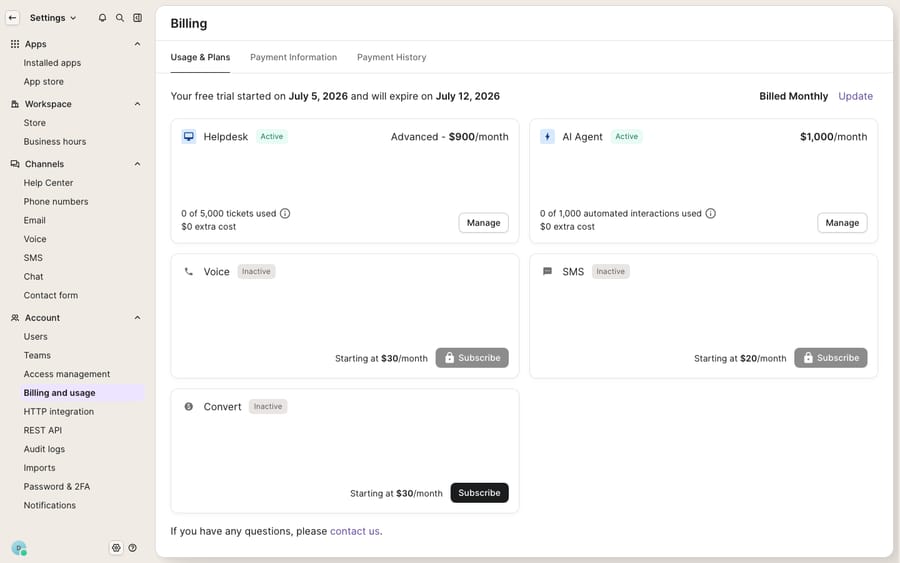
Two things drive the gap between the sticker and the bill. First, the AI Agent meter: once the bundle runs out, each automated interaction costs $1.50, and Gorgias's billing docs say each automated interaction also counts as one helpdesk ticket, so an automated reply uses both allowances (Gorgias billing docs). Second, the add-ons stack: the Usage & Plans screen above showed Voice from $30/month, SMS from $20/month, and the Convert shopping assistant from $30/month. The public pricing page no longer lists add-on rates and says they are tiered by volume. Each is optional, but each is a line item. We break the full math down in our Gorgias pricing explained piece, and if you're already on it and hurting, how to lower your Gorgias bill has the levers.
What are the cheaper options to try first?
For a store under the volume line, two options cover most needs at a fraction of the cost.
Shopify Inbox is free and lives inside the tool you already run. Its app listing now describes an AI sales associate on your storefront that answers product questions, FAQs and order updates, drawing on your catalog, inventory and policies. What it doesn't give you is a help desk: no shared ticket queue across email, Instagram and WhatsApp, and no rules-based workflows for returns or routing. For a brand-new store whose support is a handful of chat questions a day, that's often exactly enough, and it costs nothing.
Re:amaze is the closer feature-match to Gorgias at a friendlier price, and it's the one merchants most often name as the small-store alternative. Crucially, it prices per seat, not per ticket: Basic is $29/agent/month, with Pro at $49 and Plus at $69, plus a flat $59/month Starter plan for unlimited seats capped at 500 conversations (Re:amaze pricing). There's a 14-day trial with no card. It has native Shopify integration (view and edit orders, process refunds from the inbox), live chat, chatbots and FAQ management; SMS and voice channels sit on the Pro plan. For a two-to-three-agent store with predictable volume, per-seat pricing is far easier to forecast than Gorgias's per-ticket meter, which is exactly why it comes up so often (open.cx). We compare the two head-to-head in Gorgias vs Re:amaze.
Here's the quick who-fits-what:
| Your situation | Best fit |
|---|---|
| Brand-new store, a few chats a day, budget zero | Shopify Inbox (free) |
| 1–3 agents, predictable volume, want per-seat cost | Re:amaze |
| Under ~100 tickets/mo, no automation need yet | Shopify Inbox or Re:amaze |
| 100+ tickets/mo, heavy WISMO/returns, want Shopify-native automation | Gorgias |
When is it worth graduating up to Gorgias?
Gorgias earns its price when your support has shape: enough volume and repetition that automation saves real hours. The signals to watch for:
- You're consistently past 100–150 tickets a month, and a large share are repetitive (WISMO, returns, address changes) that automation could deflect.
- You've got more than one agent, and you're losing time to a scattered inbox: email in one place, Instagram DMs in another, chat in a third.
- Your order volume is stable enough to forecast tickets, so per-ticket pricing won't blindside you. Reviews consistently note Gorgias fits best for stores with predictable, stable volumes, with up to a few thousand orders a month as the sweet spot (featurebase).
- You want the Shopify-native depth (refunds, edits, and subscription actions from inside the ticket) that lighter tools only partly match.
If most of those are true, Gorgias stops being overkill and starts paying for itself. If you're weighing the broader "is it worth it" question at your specific numbers, our is Gorgias worth it breakdown runs the ROI logic.
What complaints should a small store know about before buying Gorgias?
Gorgias is one of the best ecommerce help desks on the market for stores that have grown into it. But a fair small-store verdict has to name the recurring gripes, because they're real. Billing shock is the loudest: the advertised entry price bears little relation to what an active store pays once extra tickets, AI interactions, and add-ons stack up, and the per-ticket meter makes bills hard to predict. Shopify-dependency is a genuine limitation: Gorgias also supports BigCommerce, Magento and WooCommerce, but the product is built around Shopify, so its depth thins out on another platform (we cover that in Gorgias for non-Shopify stores). Merchants also periodically report stability and outage frustrations, and sales pressure during upsell conversations. None of these are dealbreakers at the right scale, but they're the difference between a great fit and an expensive regret.
Can a small store get AI automation without a bigger Gorgias plan?
This is the seam where an AI layer can change the calculus. Many small brands feel pushed toward pricier tiers or bigger AI bundles to get automation, but automation doesn't have to live inside the help desk's per-interaction meter. The category of AI agents for customer service exists to do the reasoning-heavy deflection work on top of whatever inbox you run. Macha is one such layer: it sits on top of your existing help desk (Zendesk, Freshdesk, Gorgias, Front, HubSpot or Intercom) as a connector rather than replacing it, and it charges per ticket, not per resolution or interaction. One thread is charged once, however many messages and lookups it takes. It reads and writes the same tickets, drafts or sends grounded replies to the repetitive WISMO and returns questions, and can look up order or tracking status through a custom tool. Pricing starts at $299 a month for 750 tickets, about $0.40 each, with setup and monitoring by the Macha team included; the pricing page has the full model. A small store doesn't need Macha on day one. The point is that "I need automation" and "I must jump to a $360 plan" are not the same decision.
FAQ
Is Gorgias good for a small Shopify store? It can be, but usually only once you're past roughly 100 tickets a month with repetitive support you'd benefit from automating. Below that, most small stores find it more cost and setup than they need, and Shopify Inbox (free) or Re:amaze (per-seat) covers them for less.
How much does Gorgias really cost a small store? The $10 Starter caps at 50 tickets. Most small stores land on Basic at $60 a month ($50 billed annually) for 300 tickets; adding the AI Agent bundle of 30 interactions makes it $90, and every ticket past 300 costs $0.40. Voice, SMS and Convert add-ons are billed on top.
Gorgias vs Shopify Inbox: which for a startup? Shopify Inbox is free and fine for a brand-new store handling a few chat questions a day, and it now includes an AI chat assistant. Gorgias adds a shared ticket queue across email, social and chat, plus workflow automation, which is worth it once your volume and channel spread grow beyond what a chat widget handles.
What's the cheapest good alternative to Gorgias for a small store? Re:amaze is the most-cited match: native Shopify integration, live chat and chatbots at per-seat pricing ($29/agent/month, or a $59 flat unlimited-seat Starter capped at 500 conversations), which is far easier to forecast than per-ticket billing for a small team.
Can I add AI automation without paying for Gorgias's expensive tier? Yes. An AI agent layer like Macha connects on top of your existing help desk and charges per ticket (one conversation, charged once) rather than per automated interaction, so a small store can automate repetitive tickets without first jumping to Gorgias's higher plans. It complements your help desk rather than replacing it.
Weighing whether to graduate up, or automate where you are? Start a free trial of Macha and connect it to the help desk you already run in minutes.