Intercom
 Shopify
 Stripe
 Slack
Slack Notion
 Google Workspace
 Confluence

How Much Does Missive Cost in 2026? Plans, User Caps and AI Credits


Missive charges $14, $24 or $36 per user a month on yearly billing, with no free plan and no enterprise quote tier. What moves the bill is the user caps at 5 and 50, the shared-account meter and AI credits billed at cost plus 25%.
Key takeaways
- Missive prices three plans per user per month on yearly billing: Starter $14 for up to 5 users, Productive $24 for up to 50 users, and Business $36 for unlimited users.
- Missive's Starter plan caps at 5 users and its Productive plan caps at 50, so the sixth user costs $888 a year more and the fifty-first costs $7,632 a year more.
- Missive AI credits carry a 25% markup on the model provider's price, while bringing your own OpenAI, Anthropic or Gemini key bills at the provider's price with no markup.
- Missive organizations on Productive or Business start with $5 of free Missive AI credits, and the Starter plan has no AI assistant at all.
- Every Missive plan includes 5 shared accounts per user, with extra shared accounts costing $15 a month per additional block of 5.
Missive costs $14, $24 or $36 per user a month on yearly billing for its Starter, Productive and Business plans ($18, $30 and $45 monthly), and Starter stops at 5 users while Productive stops at 50. There is no free plan, AI is only on Productive and Business, and AI usage is billed at the model provider's price plus 25% unless you bring your own key.
How much does Missive cost in 2026?
| Plan | Yearly, per user / month | Monthly, per user / month | User cap | What you get |
|---|---|---|---|---|
| Starter | $14 | $18 | Up to 5 users | Email, SMS, social accounts, team inboxes, conversations, tasks, SOC 2 Type II |
| Productive | $24 | $30 | Up to 50 users | Adds integrations, rules and automations, basic analytics, API and MCP access, the AI assistant |
| Business | $36 | $45 | Unlimited | Adds SAML SSO, IP restriction, advanced analytics, personalized onboarding |
Prices checked 22 September 2026 and rechecked in the docs on 24 September on missiveapp.com/pricing and in Missive's billing documentation, which prints both bases in one table.
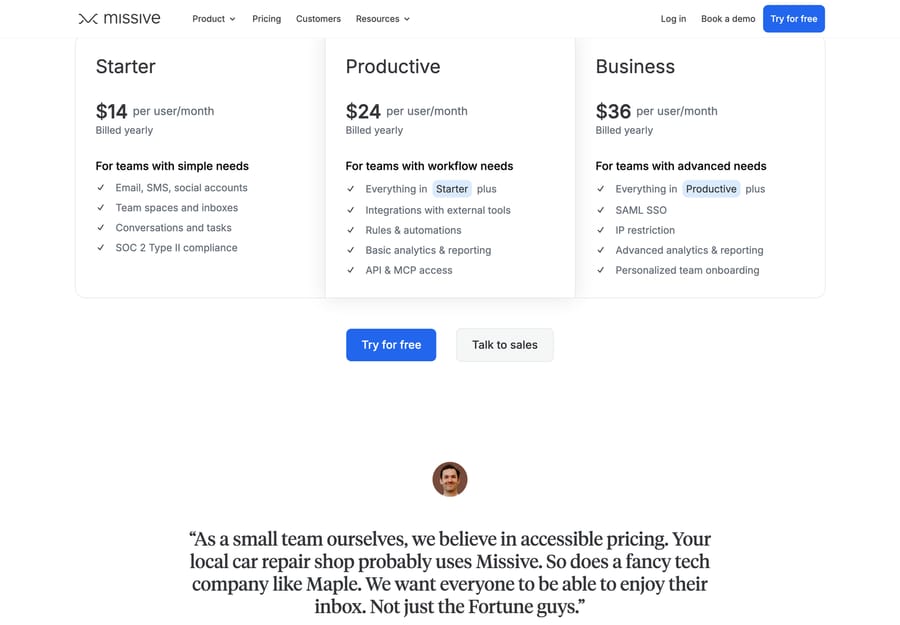
There is no free plan. Missive's docs say so in those words, and the pricing page has no free column. What you get instead is a 30-day free trial of Productive with no credit card, for up to 25 users with 10 shared accounts and 30 days of message history, and the trial "follows you rather than the organization, so creating a second organization doesn't start a second trial."
How much does Missive's yearly billing save?
The page's toggle defaults to yearly and carries a "20% off" badge. That is exact on two of the three plans and generous on the third.
| Plan | Yearly | Monthly | Actual saving |
|---|---|---|---|
| Starter | $14 | $18 | 22.2% |
| Productive | $24 | $30 | 20.0% |
| Business | $36 | $45 | 20.0% |
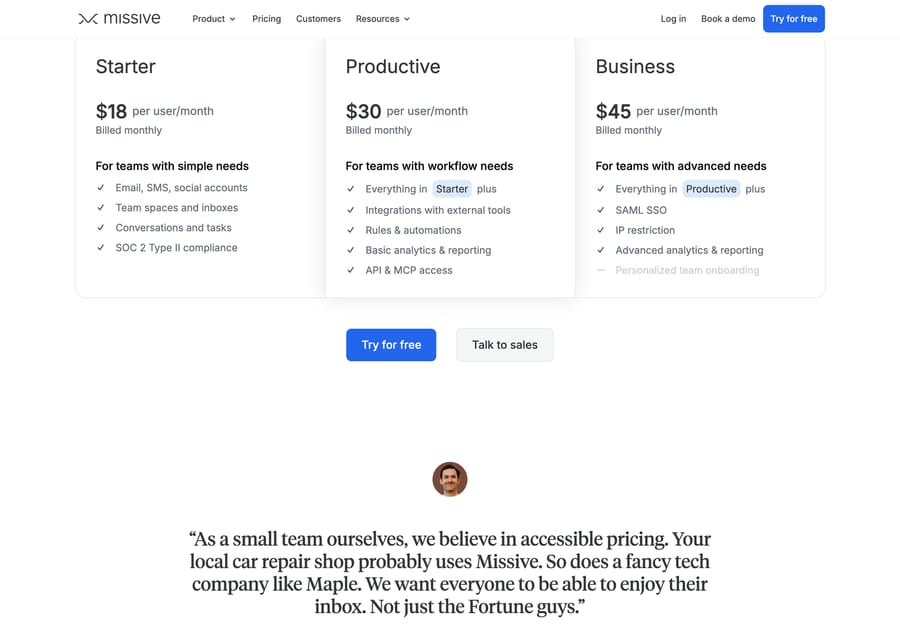
One thing the monthly view shows that the yearly view does not: personalized team onboarding greys out on monthly billing. It is a Business feature you get by committing, not by paying Business rates month to month.
The commitment is genuinely a commitment. Missive's billing FAQ says yearly plans are non-refundable, and that removing a user mid-term does not refund anything: you "will still be considered as paying for 10 users for the entire 12 months", though the seat can be reassigned to someone new. Adding a user mid-term bills immediately, prorated across the remaining months.
What happens when a team outgrows a Missive plan?
This is where Missive's bill actually moves. Starter stops at 5 users and Productive stops at 50, so the sixth person and the fifty-first person are the two most expensive hires you will make.
| Team size | Cheapest plan you can buy | Yearly cost | Per user / month |
|---|---|---|---|
| 5 | Starter | $840/yr | $14.00 |
| 6 | Productive | $1,728/yr | $24.00 |
| 10 | Productive | $2,880/yr | $24.00 |
| 50 | Productive | $14,400/yr | $24.00 |
| 51 | Business | $22,032/yr | $36.00 |
| 60 | Business | $25,920/yr | $36.00 |
The sixth user costs $888 a year, because the team moves from 5 × $14 to 6 × $24. The fifty-first user costs $7,632 a year, because 50 × $24 = $14,400 becomes 51 × $36 = $22,032. The product is identical on both sides of each line; the plan you are allowed to buy is not.
Neither cliff is a reason to avoid Missive. Both are a reason to know where you sit on the curve before you commit for a year, because the plan that is cheapest today can be the wrong one to sign the moment you hire.
What does each Missive plan include?
The three prices buy three quite different products, and the gating is sharper than most shared inboxes.
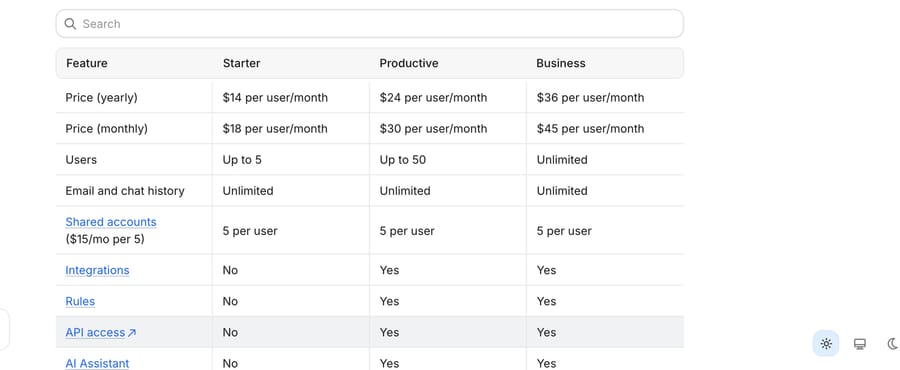
Starter, $14, up to 5 users. Email, SMS and social accounts, team spaces and inboxes, conversations and tasks, unlimited email and chat history, SOC 2 Type II. The docs table says No to integrations, No to rules, No to API access and No to the AI assistant. It is a collaborative inbox for a small team and nothing beyond that, which is the correct product for a five-person agency and a frustrating one for anybody trying to automate.
Productive, $24, up to 50 users. This is where Missive becomes a workflow tool: integrations with external tools, rules and automations (up to 1,000), basic analytics, API and MCP access, and the AI assistant. The MCP line is worth noticing at this price, because it means an AI agent you run elsewhere can talk to Missive through a documented interface on a $24 seat.
Business, $36, unlimited users. Everything above plus SAML SSO, IP restriction, advanced analytics and reporting, and personalized team onboarding. The three additions that matter are security controls and the seat cap coming off. If SSO is a procurement requirement, your entry price is $36, whatever your headcount.
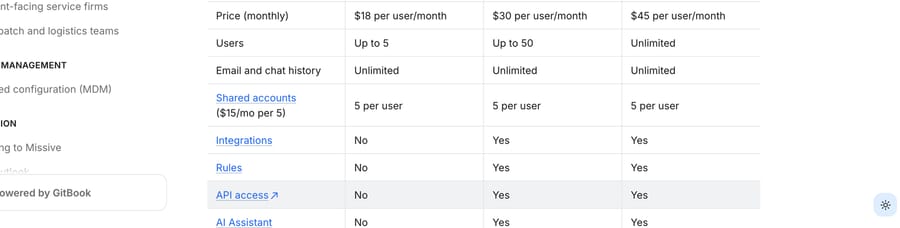
Two smaller gates that catch people. Analytics is Basic on Productive and Advanced on Business, so SLA, team and user performance reports sit on the top plan. And rules cap at 1,000 on both paid tiers that have them, which is a ceiling almost nobody reaches but is worth knowing exists.
How does Missive charge for AI?
Every other vendor in this category sells AI as a markup-free bundle, a per-seat add-on or a per-resolution meter. Missive resells the model providers at cost plus a fee, and publishes the fee.
From Missive's AI documentation: organizations on Productive or Business "start with $5 of free Missive AI credits", and "the balance works across every supported provider, so $5 can be spent on OpenAI, Anthropic, Gemini, or any mix." The rate is one line: "Missive AI credits include a 25% markup on the provider's price." When the balance hits $0, AI stops until an admin tops up.
The alternative is your own key. Bring one and usage "bills directly to your provider account at the provider's price, with no markup", and you get provider-side features Missive's credits do not expose, such as OpenAI's EU data residency. You can run both at once and pick per model.
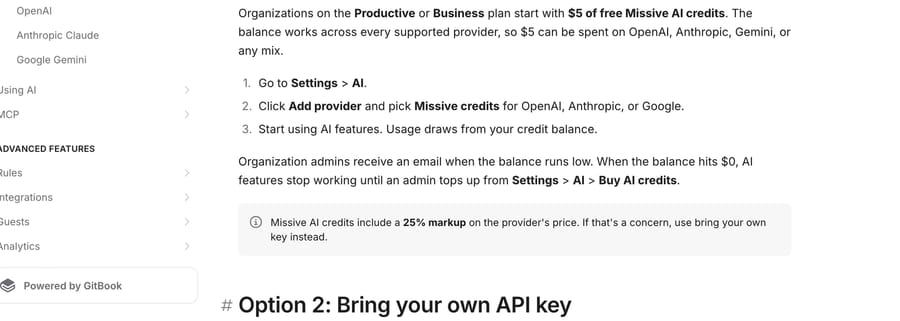
Three things follow from that, and they matter more than the percentage.
Missive is not selling you AI outcomes. There is no per-resolution price, no session pack and no seat surcharge, so there is nothing for Missive to be wrong about. You pay what the model costs. A desk spending $200 a month on models pays $250 through Missive credits or $200 with its own key, and Missive's incentive on that line is the $50, not your deflection rate.
Starter has no AI at all. The docs plan table puts the AI Assistant at No on Starter and Yes on Productive and Business. If AI is part of why you are looking at Missive, the entry price for you is $24, not $14.
The meter is denominated in dollars, not actions. Missive's usage screen shows AI actions, one per AI request, alongside AI usage in dollars per user, with the markup included in the dollar figure. That is the most honest AI reporting in this set: you can see what the model cost and what the vendor added.
How much do extra shared accounts cost?
Every plan includes 5 shared accounts per user and each user can connect 10 personal accounts. So a 10-person team gets 50 shared accounts, and a 100-person team gets 500.
Extras are $15 a month per 5 shared accounts, which is $3 an account, and Missive's billing FAQ notes they are "charged at your next billing cycle, not immediately when connected", so a burst of new inboxes shows up on the invoice a month after the decision that caused it.
For most support teams the included pool is irrelevant. For the industries Missive actively sells into, logistics, property management, accounting, agencies running client inboxes, it is the line to watch. A 10-person logistics team running 80 shared addresses is 30 accounts over its pool: 6 blocks × $15 = $90 a month, $1,080 a year, which is 38% on top of the same team's $240-a-month seat bill.
What does Missive cost for a 5, 12 or 55-person team?
Every line is arithmetic on a rate stated above.
A 5-person agency on Starter
- Yearly: 5 × $14 = $70 a month, $840 a year.
- Monthly: 5 × $18 = $90 a month, $1,080 a year. Committing saves $240, or 22.2%.
- 25 shared accounts included, unlimited email history, SOC 2 Type II.
- Integrations, rules, API access and the AI assistant all sit a plan higher. On Starter, Missive is a shared inbox and nothing else.
A 12-person support team on Productive, using AI
- Seats, yearly: 12 × $24 = $288 a month, $3,456 a year.
- Seats, monthly: 12 × $30 = $360 a month, $4,320 a year.
- 60 shared accounts included, which is more than this team will use.
- AI at $100 a month of underlying model usage: $125 a month on Missive credits, or $100 with your own key. Over a year that is $1,500 against $1,200.
- Year one on yearly billing with Missive credits: $3,456 + $1,500 = $4,956. With your own key: $4,656.
A 55-person operations team
- Productive is capped at 50 users, so this team is on Business.
- Yearly: 55 × $36 = $1,980 a month, $23,760 a year.
- Monthly: 55 × $45 = $2,475 a month, $29,700 a year.
- Had the team stopped at 50, Productive would have cost $14,400 a year. The five extra people add $9,360 a year, and only $2,160 of that is the five new seats themselves. The other $7,200 is the original fifty people going from $24 to $36.
What doesn't Missive publish?
Not much, which is unusual and worth saying plainly. Three plans, both billing bases, the user caps, the shared-account rate and the AI markup are all on public pages, and the docs table is more complete than the pricing page. There is no "contact sales" tier and no enterprise price to chase.
The gaps are narrow. Missive publishes no volume discount for very large seat counts, so a 500-seat buyer cannot tell from the page whether $36 is the real number. It does not publish what the model providers charge, so the 25% markup is a percentage of a figure you have to get from OpenAI, Anthropic or Google. And nonprofit or education pricing is not mentioned at all.
The marketplaces. We searched before writing that. Missive has no AWS Marketplace listing (a search returns 493 unrelated products and no link carrying the name), no Azure Marketplace listing, and nothing on Salesforce AgentExchange. Missive sells direct only, so the pricing page is the whole published price list, which, given how many vendors carry a stale second price list on a marketplace, is a simplification in the buyer's favor.
How does Missive pricing compare with Hiver, Front, Help Scout and Freshdesk?
Genuinely comparable shared-inbox products, priced for a 10-user team on annual billing, with each vendor's AI line stated separately.
| Product | Seats, 10 users / month | AI billing | Notable constraint |
|---|---|---|---|
| Missive Productive | $240 ($24 × 10) | Model cost + 25%, or your own key at cost | User cap of 50; AI is not on Starter |
| Hiver Growth | $250 ($25 × 10) | Included in the seat | Seats sold in blocks of 5 above 5 |
| Front Starter | $250 ($25 × 10) | Autopilot from $0.05 a conversation | Single-channel, and Starter caps at 10 seats |
| Help Scout Standard | $250 ($25 × 10) | AI Answers $0.75 per resolution | User cap of 25 on Standard |
| Freshdesk Growth | $190 ($19 × 10) | Freddy AI Copilot $29 per agent a month; 500 one-time AI Agent sessions, then $49 per 100 | Copilot is Pro and Enterprise only |
At ten users the seat prices are within $10 of each other, so the AI line is the real difference. Missive's is the only one that cannot be marked up twice: you pay the provider's rate plus a stated fee, or you pay the provider directly. Every other model in the table sets a price the vendor controls and the buyer cannot decompose.
The trade is that Missive is a collaboration product first and a help desk second. It has no per-resolution AI agent to deflect tickets with, no CSAT or SLA engine below Productive, and its own reviewers mostly describe a learning curve. It suits teams who live in a shared inbox all day and want collaboration rather than ticketing: agencies, logistics desks, clinics, property managers. It is the wrong fit if you need a ticketing help desk with SLAs and a deflecting AI agent, at any price.
Our Front vs Missive comparison sets the two side by side on features, the best shared inbox software roundup covers the wider field, and the same pricing exercise on the closest rivals is in our Front pricing, Help Scout pricing and Hiver pricing breakdowns.
What do Missive reviewers say about the price?
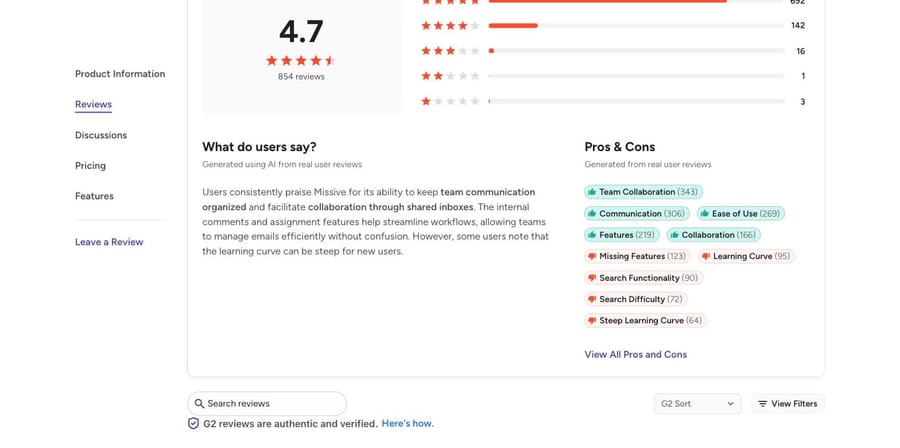
On G2, Missive scores 4.7 out of 5 from 854 reviews, checked 22 September 2026. The striking thing is the cons list, which G2 mines from the reviews themselves: Missing Features (123 mentions), Learning Curve (95), Search Functionality (90), Search Difficulty (72) and Steep Learning Curve (64). Price is not on it, and neither is cost, value or billing. For a product in a category where "expensive" is usually the top complaint, that is the clearest signal on the page.
What people do complain about is depth. Dilranjan K., an AI automation expert at a mid-market company, gave five stars on 10 June 2026 and still wrote: "The integration with our ITSM platform still has rough edges. Ideally a resolved email thread would automatically update the corresponding ticket, but right now that sync happens manually which creates extra steps at the end of every resolution." Another five-star reviewer put the onboarding cost plainly: "Getting comfortable with the more advanced features takes longer than using regular email. It took us a few weeks before everyone was consistently using all the collaboration tools the way they're meant to be used."
Read against the price list, that is a coherent picture. Missive is cheap, the complaints land on ceilings instead of invoices, and the hidden cost is the fortnight it takes a team to use it properly.
How we researched this
We read missiveapp.com/pricing on 22 September 2026 and we checked the dollar sign on each card rather than assuming it, and captured every figure as a screenshot at the same time. Because the page defaults to the yearly toggle, we clicked through to monthly and then verified both sets of numbers twice more: against the toggle's own data attributes in the page source, and against the plan table in Missive's documentation, which prints yearly and monthly side by side. The shared-account rate, the AI markup, the user caps and the refund rules all come from those docs, because the marketing page does not carry them. We searched AWS Marketplace, Azure Marketplace and Salesforce AgentExchange before writing that Missive sells only direct. We did not get a sales quote, so volume discounts above 50 seats are the one thing here we cannot tell you about.
Where does an AI agent layer like Macha fit?
Macha does not connect to Missive, and this is a Missive pricing guide, so this stays short and accurate. Macha is an AI agent layer that sits on top of a help desk a team already runs (Zendesk, Freshdesk, Gorgias, Front, HubSpot or Intercom), and it never replaces the desk underneath it. If Missive is your shared inbox, we are not part of that stack.
The pricing contrast is worth one paragraph because the two models are opposites. Missive charges for people and passes the AI through at cost plus 25%. Macha charges for work: $299 a month for 750 tickets, about $0.40 a ticket, with setup and monitoring by the Macha team included and $50 of free usage, no credit card, to try it. A ticket is one thread with one person, charged once however many replies it takes. A per-user product rewards a small team handling a lot; a per-ticket product rewards a large team handling a little. Knowing which describes you is most of the decision. You can see the whole rate card on our pricing page, or start a trial and spend the $50 before deciding anything.
Frequently asked questions
How much does Missive cost? Starter is $14 per user per month billed yearly and $18 billed monthly; Productive is $24 and $30; Business is $36 and $45. Starter is capped at 5 users, Productive at 50, and Business is unlimited. Checked 22 September 2026.
Does Missive have a free plan? No. Missive's own documentation states that it has no free plan, and the pricing page has no free column. New organizations get a single 30-day free trial of the Productive plan with no credit card, for up to 25 users, and the trial follows the person rather than the organization, so spinning up a second workspace does not start a second trial.
Does Missive's Starter plan include AI? No. Missive's plan table lists the AI assistant as No on Starter and Yes on Productive and Business, so a team that wants AI pays at least $24 per user a month on yearly billing, not $14.
Is Missive's AI included in the price? Only on Productive and Business, and only the access is included: the usage is billed. Organizations on those plans start with $5 of free Missive AI credits, and after that Missive AI credits carry a 25% markup on the model provider's own price. Bringing your own OpenAI, Anthropic or Google key bills you at the provider's price with no markup. Starter has no AI assistant at all.
What happens when a Missive team outgrows its plan? It moves up a whole plan, not a seat. The sixth user takes a team from Starter to Productive, which costs $888 a year more than five Starter seats. The fifty-first user takes a team from Productive to Business, which costs $7,632 a year more than fifty Productive seats.
How much do extra shared accounts cost in Missive? Every plan includes 5 shared accounts per user, so ten users get fifty. Beyond the pool, extras are $15 a month per 5 accounts, which works out at $3 an account, and Missive's billing FAQ says they are charged at your next billing cycle rather than when you connect them.
Can I get a refund on a yearly Missive plan? No. Missive's billing FAQ says it does not offer refunds for yearly plans, and that removing a user mid-term does not refund the remainder, although the seat can be reassigned to a new team member. Monthly subscriptions can be canceled at any time, also without a refund.
What happens to my data if I cancel Missive? The organization stays active until the end of the current billing period, then loses access until a new plan is chosen. Missive describes the state after that as content remaining available in read-only mode, with a paused organization unable to send messages, write comments or connect new accounts.
Is Missive cheaper than Front or Help Scout? At ten users on annual billing, Missive Productive is $240 a month against $250 for Front Starter and $250 for Help Scout Standard, so the seat prices are effectively level. The difference is the AI line: Missive charges model cost plus 25% or lets you bring your own key, Front's Autopilot starts at $0.05 a conversation, and Help Scout's AI Answers is $0.75 per resolution.
Sources:
- Missive pricing: plan prices, both billing bases, user caps, trial terms
- Missive docs: billing and plans: the plan table with both bases, shared-account rate, no-free-plan statement
- Missive docs: billing FAQ: proration, refunds, cancellation, trial rules
- Missive docs: setting up AI: the $5 credit, the 25% markup and bring-your-own-key
- G2: Missive reviews: rating, review count, mined cons and cited reviews
Simple per-ticket AI pricing
One thread with one person is one charge, however many replies it takes.