Intercom
 Shopify
 Stripe
 Slack
Slack Notion
 Google Workspace
 Confluence

Voiceflow Pricing (2026): Plans, Real Costs and What You'll Actually Pay


Voiceflow's paid plans are Pro at $60 a month and Business at $150 a month, or $54 and $135 billed annually, and each plan fee comes back to you as the same dollar amount of usage credit. On top of that you pay per use (half a cent for every customer message, model tokens at Voiceflow's rate card, five cents a phone minute), plus editor seats and add-ons, while Enterprise is quoted and Vendr's buyer data puts the median contract at $258,625 a year. This page has the plan table, the rate card, the cost of one real test conversation, and the monthly bill at 500, 3,000 and 10,000 support chats.

| Plan | Monthly | Billed annually | Usage credit included | Main limits (in-app plan table) |
|---|---|---|---|---|
| Free | $0 | – | $1.00, a one-time grant per the billing docs | 1 editor, not meant for production |
| Pro | $60/mo | $54/mo | $60 a month | 20 projects, 2 workspaces, 5 concurrent calls, 1 phone number, 1 month version history, no staging environment |
| Business | $150/mo | $135/mo | $150 a month | Unlimited projects, 5 workspaces, 15 concurrent calls, 1 phone number, staging environment, prioritized email support |
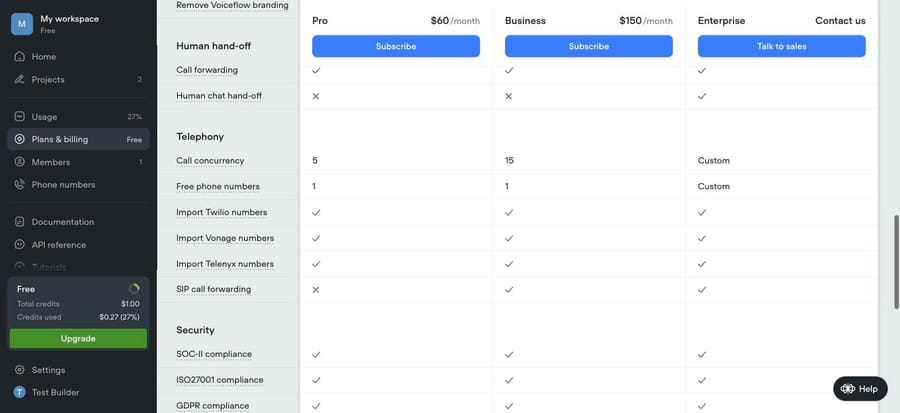
| Enterprise | Contact sales | Annual contract | Custom | SSO, HIPAA, PII redaction, SMS, human chat hand-off, custom cloud, implementation services |
Prices checked September 19, 2026 on Voiceflow's in-app Plans screen and its credits pricing table. The public pricing page shows no numbers at all.
If you want the product overview first, our Voiceflow guide covers how playbooks, workflows and the Zendesk integration work. This page stays on the bill. If you're still choosing between kinds of product, start with our overview of AI agents for customer service.
Where Voiceflow's prices actually live
Voiceflow moved its prices off the public site. The pricing page routes businesses to "Book a demo" and agencies to a free trial, and search results still quote an older credit system (10,000 credits on Pro, 30,000 on Business) that the product no longer uses. The current numbers sit in two places: the Plans screen inside a free account, and the credits pricing table in the docs.
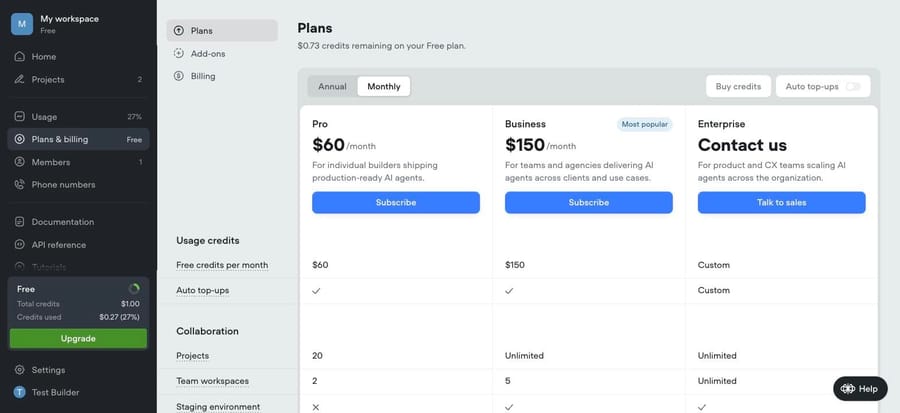
The in-app table is what a buyer sees before subscribing. Pro and Business each show "Free credits per month" equal to the plan fee ($60 and $150), auto top-ups on both, and an Annual toggle that drops them to $54 and $135 a month. G2's pricing tab lists the same two prices "per 1 editor", last updated April 30, 2026.
How the credit meter works
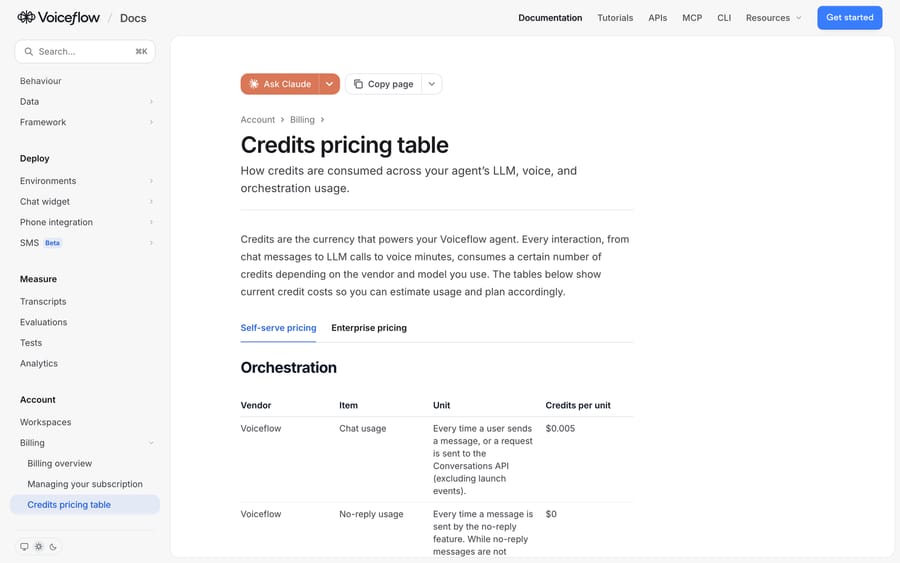
Credits are now denominated in dollars on self-serve plans. The rate card has three kinds of line:
- Orchestration. $0.005 "every time a user sends a message, or a request is sent to the Conversations API (excluding launch events)", and $0.05 per minute of phone call. No-reply messages are free unless they use a model.
- Models. A price per 1,000 input and output tokens for each model. Claude Sonnet 4.6 is $0.00375 in and $0.01875 out; GPT-5.5 is $0.00625 and $0.0375; GPT-4.1 nano is $0.000125 and $0.0005.
- Voice. Speech-to-text per minute (Deepgram $0.005 or $0.007125, ElevenLabs $0.0075) and text-to-speech per 1,000 characters (ElevenLabs $0.045, its multilingual voice $0.09).
The Enterprise tab of the same table prices everything in credits at 200 to the dollar: one credit per user message and ten per phone minute.
The plan fee works as a monthly minimum. Pro gives you $60 of usage for $60. When the balance hits zero, the subscription docs say auto top-ups buy "additional credits when your balance hits zero" in a dollar amount you set, and you can also move to a larger credit bundle. Buying credits is only available on Pro and Business; the button on a free account says so.
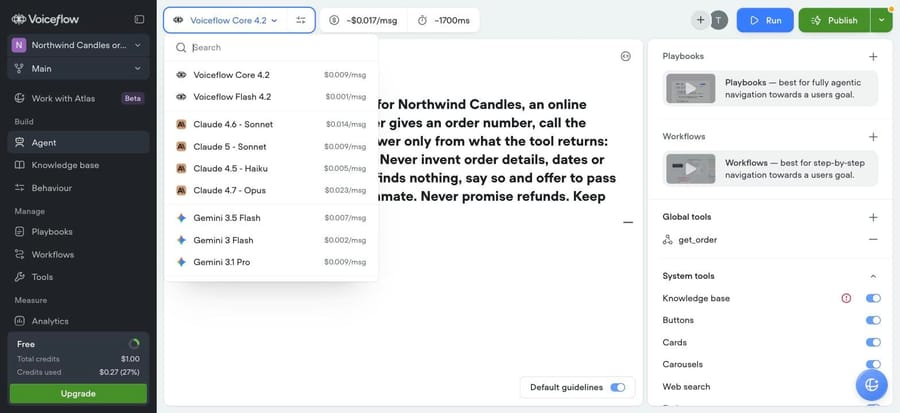
Model choice moves the bill more than anything else you control. The model picker in the builder shows an estimate per message for each one: Voiceflow Flash 4.2 at $0.001, Voiceflow Core 4.2 at $0.009, Claude 4.6 Sonnet at $0.014, and Claude 4.7 Opus, GPT-5.5 and GPT-5.6 Sol at $0.023.
What one support conversation cost in our test
We ran a two-turn chat on September 19, 2026 against an order-desk agent in our free Voiceflow account. The agent has one API tool, get_order, which fetches a test order from a public demo API, and it runs on Voiceflow Core 4.2, the default.
The customer asked what was in order 3. The log shows get_order succeeding in 205 ms and the agent listing all six items with the correct total. Voiceflow's "resources consumption" line for that turn billed $0.0072: 3,499 input tokens and 127 output tokens. The follow-up, a cracked candle and a refund request, billed $0.0061. The agent said it couldn't process refunds, which is what its prompt tells it.
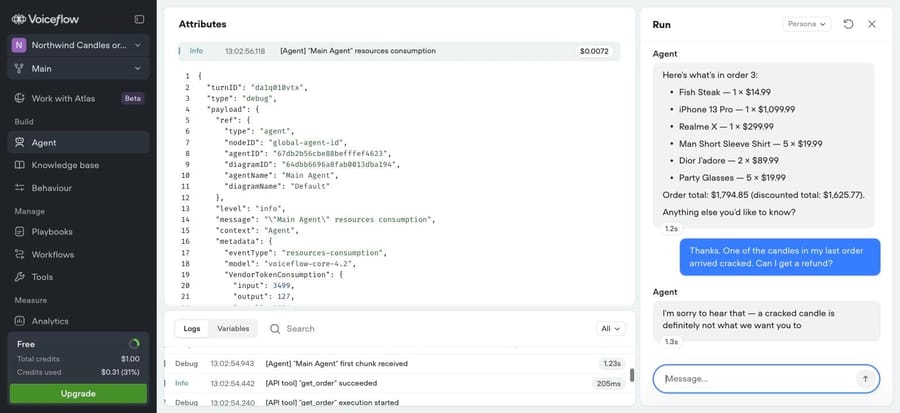
The input side was 85% of the model cost ($0.0061 of $0.0072), because the prompt, the tool definition and Voiceflow's default guidelines add up to about 3,500 tokens before the customer types anything. A longer prompt or a knowledge-base search raises every turn. The builder's header estimated "~$0.017/msg" for this agent, more than double what the log billed. The log is the number to trust; the estimate errs high.
Add the $0.005 message fee and our two turns cost about $0.023. The balance in the account moved from $0.27 to $0.31, but it rounds to the cent and includes the greeting, so we use the log lines.
Worked costs at three volumes
Assumptions, stated so you can change them. A chat has 4 customer messages and 4 agent replies. Each customer message costs $0.005. Each reply costs what our log showed on Core 4.2 (the average of $0.0072 and $0.0061, so $0.00665), or, for other models, the turn-1 token counts (3,499 in, 127 out) multiplied by that model's rate card price. Plans are bought as the cheapest combination: the Pro fee as a minimum, then auto top-ups at face value. Seats are left out and covered in the next section.
Per chat, that is $0.0466 on Core 4.2, $0.0820 on Claude Sonnet 4.6 and $0.1265 on GPT-5.5.
| Monthly volume | Who this is | Core 4.2 (our log) | Claude Sonnet 4.6 (rate card) | GPT-5.5 (rate card) |
|---|---|---|---|---|
| 500 chats | A small store or a pilot | $23.30 of usage, so the $60 Pro minimum applies: $60 | $41.01 of usage: $60 | $63.26: $60 Pro + $3.26 top-up = $63.26 |
| 3,000 chats | A mid-size support team | $139.80: $60 Pro + $79.80 top-ups = $139.80 | $246.03 | $379.57 |
| 10,000 chats | A large chat queue | $466.00 | $820.10 | $1,265.25 |
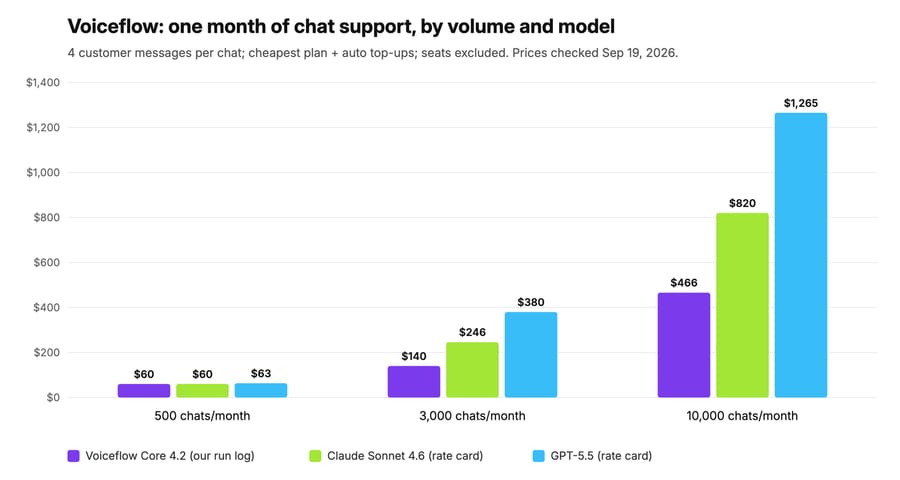
Once usage passes $150, Pro-plus-top-ups and Business cost the same, because both plans hand the fee back as credit. Business is worth its $90 premium for the staging environment, unlimited projects, forever version history and 15 concurrent calls, not for cheaper usage. At 3,000 chats on Core 4.2, Pro with top-ups is $10 cheaper than Business; at 10,000 chats they are identical.
Voice runs on the same meter. From the rate card, a phone minute is $0.05 of telephony, about $0.005 of Deepgram transcription, about $0.0225 of ElevenLabs speech if the agent speaks roughly 500 characters a minute, and about $0.013 of Core 4.2 model time at two replies a minute. That is roughly $0.09 a minute, so a three-minute call lands near $0.27. That figure is our estimate from the published rates. We didn't place a call, because the free account has no phone number set up.
What drives the bill up
The usage meter is cheap. The lines around it are where Voiceflow's revenue sits.
Editor seats. Vendr lists Pro and Business with one editor included and extra editors at $50 a month each; on our free account the Add-ons tab said one editor seat is included and listed the extra-seat price as $0, so we couldn't read the paid-plan figure there. Five people tuning the agent would add $200 a month, more than the 3,000-chat usage bill on Core 4.2. One June 2026 G2 reviewer, Jack M., a senior software engineer at a small business, wrote that he'd like "maybe around four or five" seats for the $60 price.
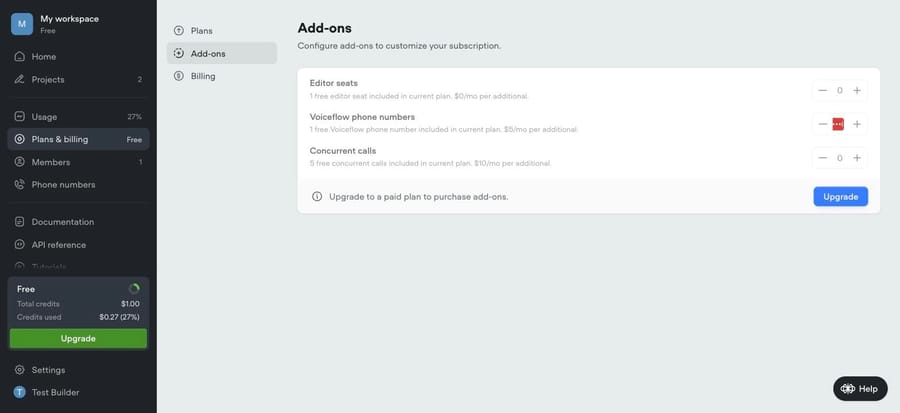
Voice capacity. Each plan includes one Voiceflow phone number and 5 (Pro) or 15 (Business) concurrent calls. The Add-ons tab prices extra numbers at $5 a month and extra concurrent calls at $10 a month each. A line that takes 30 calls at once on Business needs 15 more slots, or $150 a month.
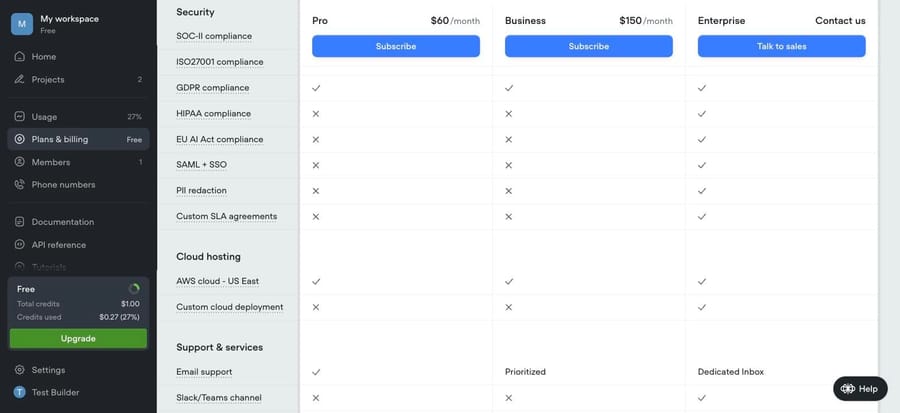
Features gated to Enterprise. The in-app plan table marks several things support teams ask for as Enterprise-only: human chat hand-off, SMS, mobile embed, automated QA testing, SSO, HIPAA, PII redaction and the EU AI Act compliance row. Voiceflow's docs describe a live-agent handoff step without naming a plan, so confirm with sales before you design around it, but the table on September 19 showed a cross for Pro and Business.
Model choice and prompt size. The chart above shows the spread: GPT-5.5 costs 2.7 times Core 4.2 for the same chats. A knowledge-base search that adds a few thousand tokens of retrieved text to each turn moves every row the same way.
Annual commitment. The annual toggle saves 10%: $54 instead of $60, $135 instead of $150. It only discounts the plan fee, and on our model the fee is less than half the bill from about 3,000 chats up on Pro.
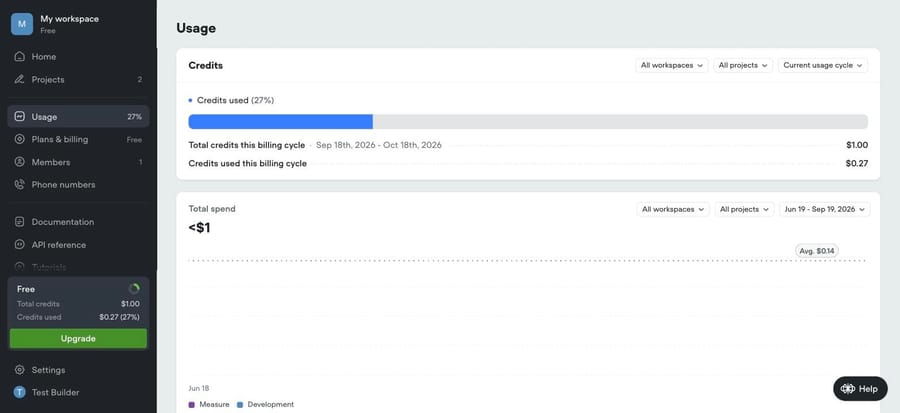
Voiceflow's Usage screen splits spend by workspace and project, which is how you'd find the playbook that is burning credit.
Voiceflow Enterprise pricing
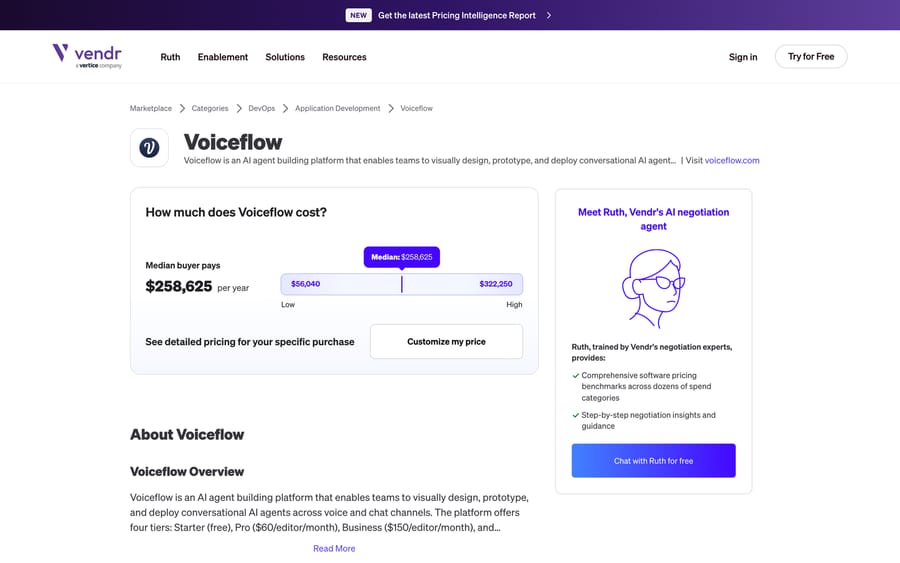
Enterprise is quoted, and the only neutral figures are Vendr's. Its Voiceflow page puts the median buyer at $258,625 a year, with a range from $56,040 to $322,250, and describes the structure as a flat platform fee of $34,500 a year that includes three editor licenses, with annual credits, private single-tenant cloud and an enablement package priced separately. Vendr is a software-buying service, not a Voiceflow competitor.
We searched AWS Marketplace, Azure Marketplace and Google Cloud Marketplace for a Voiceflow listing on September 19, 2026 and found none on any of them, so there is no public contract price to set against Vendr's.
What the billing model rewards
The incentive is easiest to see in the model rates. Voiceflow's per-token rates are a fixed markup on the model makers' own prices. Anthropic lists Claude Sonnet 4.6 at $3 per million input tokens and $15 per million output on its pricing page; Voiceflow charges $3.75 and $18.75. Haiku 4.5 ($1 and $5 at Anthropic) and Opus 4.7 ($5 and $25) show the same ratio: 1.25 times list. Voiceflow earns 25 cents on every dollar of model spend, whichever model you pick, so it has no reason to steer you to a cheaper one. It does show a per-message estimate for each model in the picker, so the choice is at least visible.
The plan fee returned as credit means a small team pays almost nothing for the platform itself. Seats, concurrency, phone numbers and the Enterprise feature gates are where the margin comes from. The business model is optimized for a builder sold to technical teams and agencies, where one editor ships the agent. It costs more as the number of people touching the agent grows, and for support teams that need SSO, HIPAA or in-widget handoff to a human, it means an Enterprise contract whatever the traffic.
How Voiceflow compares at 3,000 chats
Same volume for every row: 3,000 chats a month, 4 customer messages each. Rivals' prices are from their own pages on September 19, 2026.
| Platform | Billing unit | Cost at 3,000 chats | Notes |
|---|---|---|---|
| Voiceflow | Plan fee as a minimum, then $0.005 per customer message plus model tokens | $140 (Core 4.2) to $380 (GPT-5.5), plus seats | Human chat hand-off, SSO and HIPAA are Enterprise-only |
| Botpress | Conversations (two or more user messages) in a plan, then packs of 100 | Team: $750 + 15 packs × $50 = $1,500 billed annually ($1,689 monthly) | $150 of AI usage included; more is sold at cost. Unlimited seats on Team |
| Chatbase | Message credits | Standard $150 + 8,000 extra credits at $40 per 1,000 = $470 | Assumes one credit per AI reply, which its pricing page doesn't state |
| Fin | Outcomes, $0.99 each, 50-outcome monthly minimum | $1,485 if half the chats end as outcomes | Plus help desk seats |
| Macha | Tickets in your help desk | $1,199 for 3,000 tickets | Works tickets inside Zendesk, Freshdesk, Gorgias, Front, HubSpot or Intercom; not a web widget builder |
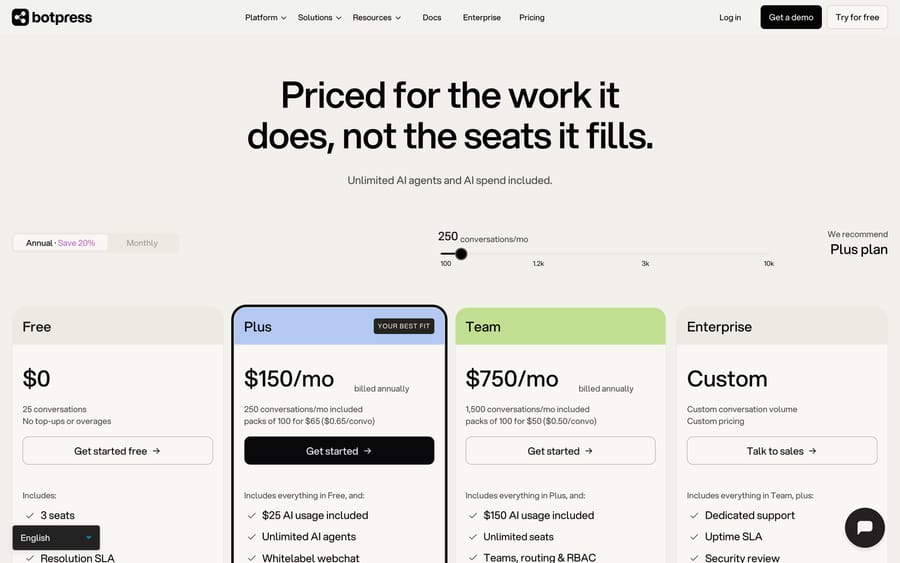
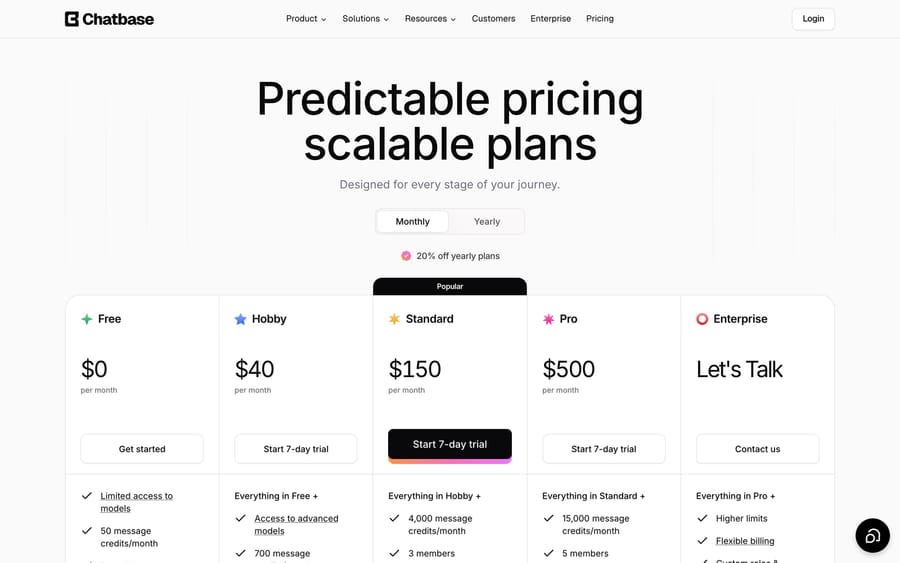
On raw usage, Voiceflow is the cheapest row by a wide margin, because it passes model cost through at a 25% markup instead of pricing per conversation or per outcome. Botpress charges more per chat but includes unlimited seats on Team and team routing, which matters if a support team, not one builder, will run it. Chatbase is the simpler docs-trained widget. Fin prices on outcomes, which ties its revenue to resolutions and makes a bad month cheaper.
Macha is a different shape of product. It's an AI agent layer that works the tickets already sitting in Zendesk, Freshdesk, Gorgias or Front: it reads an email ticket, looks up the order, writes the reply or internal note and tags it, and humans pick up anything it hands back in the same queue. A ticket is one charge however many replies or tool calls it takes, the model doesn't change the price, and the Macha team builds and monitors the agents on every plan. That fits teams whose volume arrives as help desk tickets. For a voice line or a custom web widget built by your own engineer, Voiceflow is the better fit. Our Macha on your help desk page shows how it works, and Macha pricing has the tiers.
What users say about Voiceflow's pricing
Voiceflow rates 4.6 out of 5 from 113 reviews on G2, 4.1 from 15 on Trustpilot, and has a Capterra listing with no reviews, all checked September 19, 2026. The praise is for the builder. The complaints that mention money are about predictability and seats:
- David S., a forward-deployed engineer at a small business, gave it 3.5 in September 2026: "The price was too high for a chatbot I need to develop myself."
- A small-business reviewer in consumer services, November 2025: "How credits are used is hard to untangle and somewhat intransparent."
- Brandyn F., an owner at a small business, November 2025, liked the product but not paying "my subscription in USD" as a Canadian customer.
The public rate card and the cost on every log line now answer the second complaint. The first, and the seat request, are about the plan structure.
How we researched this
On September 19, 2026 we read Voiceflow's pricing page, billing overview, subscription docs and credits pricing table, and the Plans, Add-ons and Usage screens inside our existing free Voiceflow account. We didn't subscribe: we opened the Business checkout modal and closed it without entering payment details, so paid-plan seat prices come from Vendr and G2, and the text says so where they appear. We ran one two-turn test chat on an agent with one API tool (get_order, which calls a public demo orders API) and quote cost only from Voiceflow's own log lines. We made no voice call, because the free account has no phone number configured. We searched AWS, Azure and Google Cloud marketplaces and Vendr for contract pricing, and read G2 reviews in a browser.
Is Voiceflow worth the price?
For a builder or agency shipping one agent, yes: $60 buys $60 of usage, and our Core 4.2 test chats cost under five cents each. For a CX team where five people edit the agent, add $200 of seats. If you need SSO, HIPAA, SMS or in-widget handoff to your human agents, budget for Enterprise, where Vendr's median contract is $258,625 a year.
Frequently asked questions
How much does Voiceflow cost per month? Pro is $60 a month and Business $150 a month, or $54 and $135 billed annually, as shown on the in-app Plans screen on September 19, 2026. Each plan fee is returned as usage credit. Usage beyond that is billed per message and per model token, and extra editor seats are $50 a month each according to Vendr.
Can I use Voiceflow for free? Yes. The Free plan comes with $1.00 of credit, which the billing docs describe as a one-time grant, and it isn't meant for production. You can build and test an agent on it, and buying extra credits requires Pro or Business.
How do Voiceflow credits work? On self-serve plans credits are dollars. Each customer message costs $0.005, each phone minute $0.05, and model calls are billed per 1,000 tokens at rates listed in the credits pricing table. Enterprise contracts price the same items in credits at 200 per dollar.
Is there a Voiceflow pricing calculator? Not a public one. The builder shows an estimated cost per message for each model, and the run log shows the actual cost of every turn. Multiply your monthly customer messages by $0.005, add the model cost per reply from a test run, and compare it with the $60 or $150 plan minimum.
How much does a Voiceflow phone call cost? The rate card charges $0.05 a minute for the phone line, plus speech-to-text, text-to-speech and model tokens. Our estimate from those published rates is about $0.09 a minute, or $0.27 for a three-minute call, before any extra phone numbers ($5 a month) or concurrent-call slots ($10 a month).
How much is Voiceflow Enterprise? Voiceflow quotes it. Vendr's buyer data puts the median at $258,625 a year, ranging from $56,040 to $322,250, built on a $34,500 platform fee that includes three editor licenses plus separately priced credits.
Is Voiceflow worth it? It is good value for one technical builder or an agency, because the plan fee comes back as credit and usage is cheap. It gets expensive through seats and through features that sit on Enterprise only, such as SSO, HIPAA and human chat hand-off.
What are good alternatives to Voiceflow for voice AI? Botpress lists voice only on Enterprise. ElevenLabs Agents, Retell and Vapi are voice-first builders with published per-minute pricing. For support tickets that live in a help desk rather than on a phone line, Macha works inside Zendesk, Freshdesk, Gorgias, Front, HubSpot or Intercom.
Does Voiceflow charge for seats? Yes. Paid plans include one editor according to Vendr and G2, and Vendr lists extra editors at $50 a month each. Voiceflow's billing docs confirm editor seats are a paid add-on.
If your support volume arrives as tickets in Zendesk, Freshdesk, Gorgias or Front, start a Macha trial with $50 of free usage and no card, or compare the tiers on Macha pricing.
Sources: Voiceflow pricing, Voiceflow credits pricing table, Voiceflow billing overview, Voiceflow: managing your subscription, Voiceflow homepage, Vendr: Voiceflow, G2 Voiceflow pricing, G2 Voiceflow reviews, Trustpilot (trustpilot.com/review/voiceflow.com, loaded in a browser; it returns 403 to scripts), Anthropic API pricing, Botpress pricing, Chatbase pricing, Fin pricing.
Simple per-ticket AI pricing
One thread with one person is one charge, however many replies it takes.