Intercom
 Shopify
 Stripe
 Slack
Slack Notion
 Google Workspace
 Confluence

Zendesk Suite Pricing: Which Plan Do You Actually Need?


Zendesk sells the Suite in four tiers that climb from $55 to north of $169 per agent per month — and the marketing page is built to nudge you up the ladder, not to tell you where to stop. The honest answer for most teams is "a tier or two lower than the demo suggested." The hard part is knowing which tier, because the difference between them isn't price — it's a handful of specific feature gates, and exactly one of those gates probably matters to you.

This is a decision guide, not a feature dump. For each tier you'll get the price, the few things it genuinely adds over the tier below, who it's right for, and — just as important — who's overpaying for it. Then a stop-at-first-match decision tree and a side-by-side table so you can land on an answer in a couple of minutes.
It's a spoke of our Zendesk pricing explained pillar, which covers add-ons, AI overage, and hidden fees in full; here we stay tightly focused on picking a tier.
How we sourced this (and what to double-check)
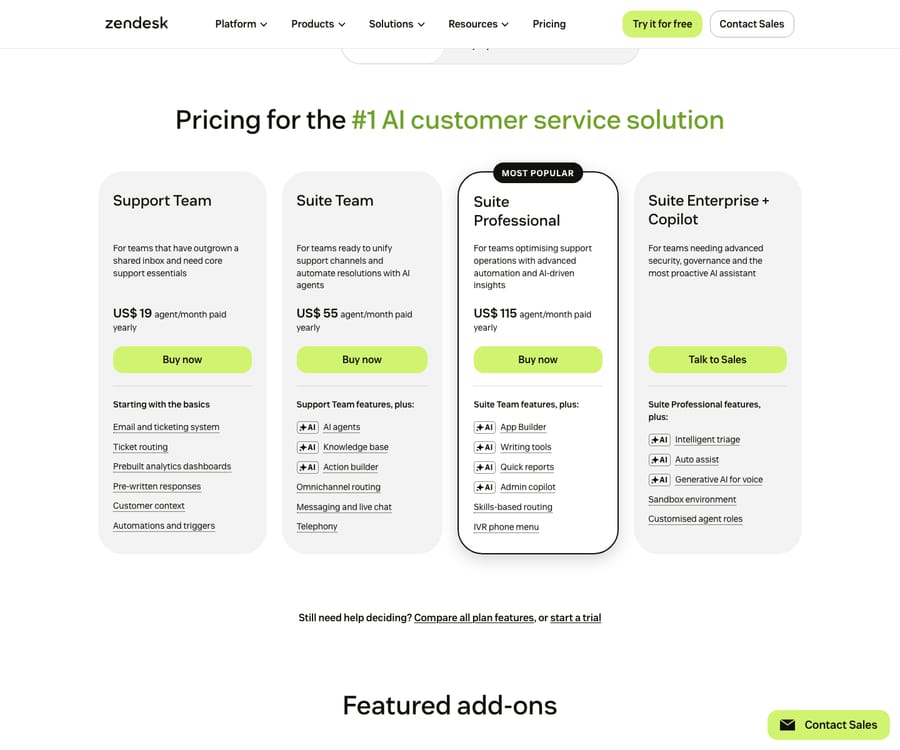
Plan prices are verified against Zendesk's official pricing page as of June 2026 (annual billing, per agent per month). The four public cards — Support Team $19, Suite Team $55, Suite Professional $115, and Suite Enterprise + Copilot (contact sales) — plus the $50 Copilot add-on are official. Suite Growth (~$89) and the legacy Enterprise list (~$169) are third-party figures (Growth no longer has its own public card), and monthly billing runs roughly 15–25% higher than the annual numbers below.
One honest caveat: the exact tier each feature lands on is the least authoritatively sourced part of any Zendesk write-up. Zendesk reshuffles its comparison grid periodically, so the gates below reflect Zendesk's comparison table as summarized in current teardowns — treat them as the decision drivers, but verify the one feature you actually care about against the live page before you sign. Finally, this isn't pure desk research: we tested in a live Zendesk account, and the screenshots below are our own.
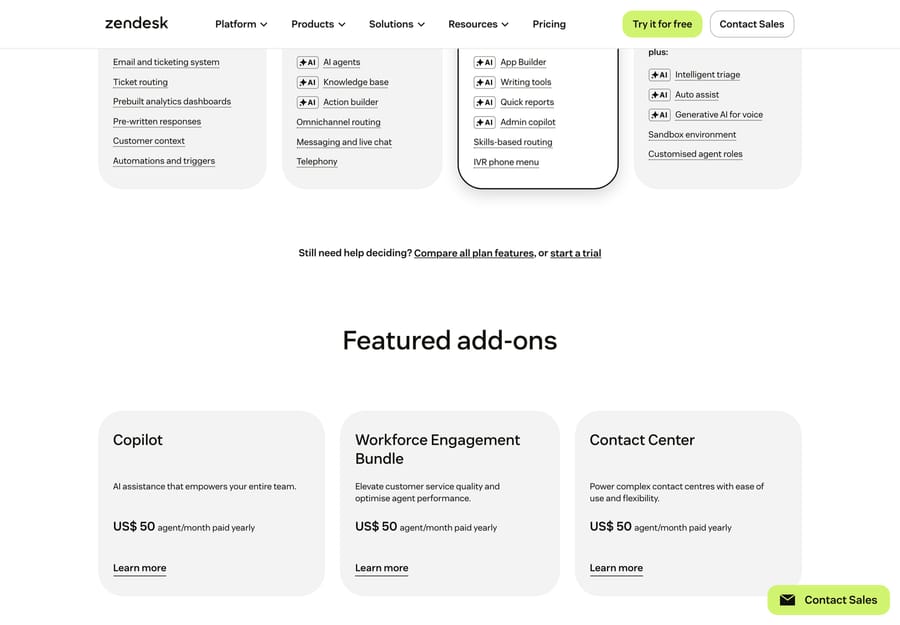
Beyond the per-seat plans, Zendesk’s AI and CX capabilities are sold as separate add-ons — each priced per agent on top of your base plan:
First question: do you even need the Suite?
Before comparing Suite tiers, rule out the cheapest door in. Zendesk still sells Support Team at $19/agent/mo — standalone ticketing with email, a web form, basic triggers and automations, prebuilt dashboards, and the app marketplace. What it does not include is the thing most people picture when they think "Zendesk": no native messaging, no live chat, and no help center / knowledge base. Those three only appear once you move to the Suite.
So the baseline test is simple. If your support is genuinely email-only — a small B2B team, an internal IT queue, a back-office function where customers never expect chat or a self-service portal — Support Team at $19 is all you need, and the Suite is overpaying. The moment you want a chat widget, a messaging channel, or a public help center, you're buying the Suite, and the real entry point becomes $55. Everything below is about the Suite.
Suite Team — $55/agent/mo
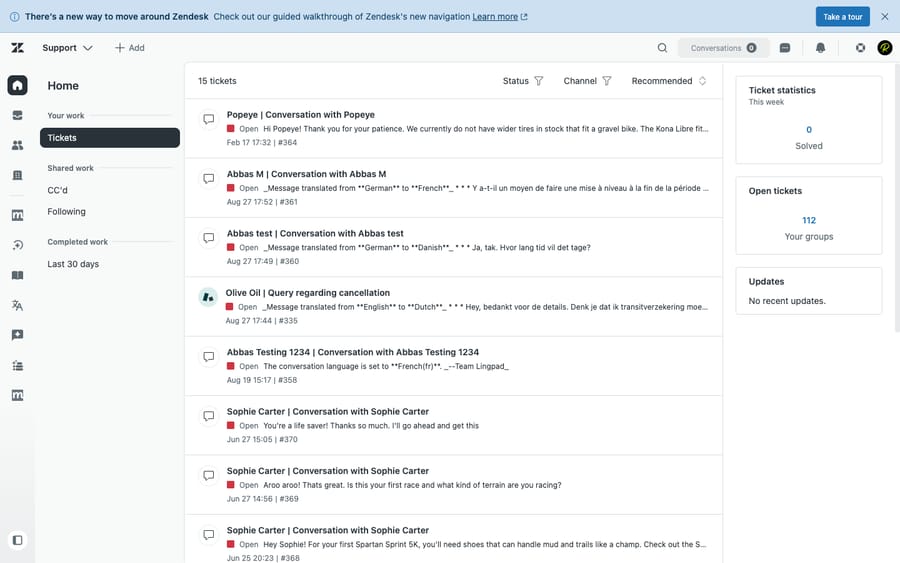
What it adds over Support Team ($19): this is the omnichannel jump. Suite Team turns email-only ticketing into multichannel support — live chat and messaging (web, mobile, and social like WhatsApp, Facebook, and Instagram), a help center / knowledge base for self-service, the unified agent workspace where every channel lands in one screen, basic AI agents with a small included automated-resolution allowance (5 per agent/mo), and prebuilt analytics.
Who it's right for: small-to-mid teams that want real omnichannel support without service-level machinery. If you need chat, a help center, and one place for agents to work tickets — and you don't yet track formal SLAs or run CSAT surveys — Team is the sweet spot and where most teams should start.
Who's overpaying: nobody, really — if you've ruled out email-only, $55 is the floor. The risk runs the other way: teams that do need SLA tracking or CSAT trying to make Team stretch and bolting on workarounds. If you find yourself missing one specific governance feature, that's the signal to look at Growth, not to live without it.
The unified workspace is the headline of this tier, and it's worth seeing what you actually get for the jump from $19 — here's the agent view from our test account:
Suite Growth — ~$89/agent/mo (third-party)
What it adds over Suite Team ($55): the service-management layer. Per Zendesk's comparison table, Growth introduces SLA management (track and enforce response/resolution targets), multiple ticket forms (different intake forms for different request types), light agents (read-and-collaborate seats that don't count as full paid agents — useful for stakeholders who comment but don't resolve), CSAT surveys, a fuller self-service customer portal, and more automation/business-rule headroom. The included AI allowance rises to 10 automated resolutions per agent/mo.
Who it's right for: growing teams that have to prove service quality — anyone with SLA commitments to customers, multiple request types that need their own forms, or a need to measure satisfaction with CSAT. Light agents alone can pay for the upgrade if you have a lot of internal stakeholders who only need to read and comment.
Who's overpaying: teams buying Growth purely as "Team but a bit more." If you don't have SLA targets, don't need CSAT, run a single intake form, and have no light-agent use case, the ~$34/agent jump from Team buys you very little. Be honest about whether you'll use the SLA engine — wanting it "for later" is the most common way teams overpay here.
A note on visibility: Growth no longer has its own card on the public pricing page, so its price is a third-party figure and you may need to ask sales for it directly.
Suite Professional — $115/agent/mo
What it adds over Suite Growth (~$89): routing, voice depth, extensibility, and compliance. Professional is where you get skills-based routing (send tickets to agents by skill, language, or expertise rather than round-robin), IVR / call routing for voice, the App Builder to create custom in-workspace apps, conversation and ad-hoc reporting beyond the prebuilt dashboards, side conversations (loop in other teams or vendors on a ticket without leaving it), integrated community forums, and the compliance gates that matter to regulated industries: HIPAA-eligible enablement and data residency / regional hosting. Included AI stays at 10 resolutions per agent/mo.
This is the Team vs Professional decision in a nutshell: Team is "can we do omnichannel support at all," Professional is "can we route, extend, report on, and govern it at scale." Most mid-market teams that pick Zendesk end up here.
Who it's right for: mid-market and scaling teams that route by skill, run a phone line that needs IVR, build custom workflows or integrations, or operate under HIPAA / data-residency requirements. Any one of those — especially HIPAA or data residency — justifies the tier on its own, because those gates simply don't exist below it.
Who's overpaying: teams that buy Professional for the prestige of "the popular plan" but only use what Growth offers. If you route round-robin, don't run voice with IVR, never build a custom app, and have no compliance mandate, you're paying ~$26/agent over Growth for capabilities sitting idle. Run the math: across 25 agents that's ~$650/mo, or ~$7,800/yr, for features you don't touch.
Suite Enterprise — contact sales (legacy list ~$169/agent/mo)
What it adds over Suite Professional ($115): governance and scale controls for large or complex organizations. Enterprise introduces custom agent roles and granular permissions (define exactly what each role can see and do), a sandbox for testing config changes before they hit production, multi-brand / multiple help centers (run distinct brands or regions from one instance), and contextual / dynamic workspaces that adapt the agent layout by ticket type, plus advanced knowledge management. The included AI allowance rises to 15 resolutions per agent/mo, and in 2026 Zendesk bundles its Copilot add-on into this tier as "Suite Enterprise + Copilot."
Who it's right for: large support orgs and enterprises that need tight access control, a safe place to test changes before rollout, or genuinely separate brands/regions in one instance. If a botched config change would page someone at 2 a.m., the sandbox alone is worth it; if compliance demands least-privilege access, custom roles are non-negotiable.
Who's overpaying: smaller teams seduced by the feature list. A 15-person team almost never needs custom roles, multi-brand, or a sandbox — and Enterprise is quote-only, which means a sales conversation and, typically, an annual commitment. Unless you can name the specific Enterprise gate you need (custom roles, sandbox, or multi-brand), Professional is almost certainly the right ceiling.
Which plan should you pick?
Work down this list and stop at the first match — that's your tier. The gates are ordered by what actually forces the decision, not by price:
- Is your support email-only, with no chat, messaging, or help center on the horizon? → Support Team ($19). Don't buy the Suite for channels you won't use.
- Do you operate under HIPAA, or need data residency / regional hosting? → Suite Professional ($115). These compliance gates don't exist on lower tiers — this overrides everything below it.
- Do you need custom agent roles, a sandbox, or multi-brand / multiple help centers? → Suite Enterprise (contact sales). These are the only reasons to go quote-only.
- Do you need skills-based routing, IVR/voice routing, the App Builder for custom apps, or ad-hoc conversation reporting? → Suite Professional ($115).
- Do you need SLA management, CSAT surveys, multiple ticket forms, or light (collaborator) agents? → Suite Growth (~$89).
- Do you just need omnichannel — chat, messaging, a help center, and one agent workspace? → Suite Team ($55). This is where most teams land.
If two gates pull you to different tiers, the higher tier wins (a tier includes everything below it). And if a single must-have feature is the only reason you're climbing, price that feature: sometimes a Zendesk app from the marketplace, or a focused third-party tool, closes the gap for less than the per-agent jump across your whole team.
Zendesk Suite plans compared
| Support Team | Suite Team | Suite Growth | Suite Professional | Suite Enterprise | |
|---|---|---|---|---|---|
| Price (annual, /agent/mo) | $19 | $55 | ~$89 (third-party) | $115 | Contact sales (legacy ~$169) |
| Email / ticketing | ✅ | ✅ | ✅ | ✅ | ✅ |
| Messaging + live chat | ❌ | ✅ | ✅ | ✅ | ✅ |
| Help center / knowledge base | ❌ | ✅ | ✅ | ✅ | ✅ |
| Unified agent workspace | ❌ | ✅ | ✅ | ✅ | ✅ |
| SLAs · CSAT · multiple forms · light agents | ❌ | ❌ | ✅ | ✅ | ✅ |
| Skills-based routing · IVR · App Builder · side convos | ❌ | ❌ | ❌ | ✅ | ✅ |
| HIPAA-eligible · data residency | ❌ | ❌ | ❌ | ✅ | ✅ |
| Custom roles · sandbox · multi-brand · dynamic workspaces | ❌ | ❌ | ❌ | ❌ | ✅ |
| Included automated resolutions / agent/mo | — | 5 | 10 | 10 | 15 |
Feature placement reflects Zendesk's comparison table as summarized in current third-party teardowns; Zendesk reshuffles its grid periodically, so confirm the specific feature you need on the live pricing page. Included automated resolutions per Zendesk's automated-resolutions help doc.
Don't forget the costs on top of the tier
Picking the right tier is half the budget; the add-ons are the other half. The biggest one is Copilot (formerly Advanced AI), a $50/agent/mo add-on on every tier except Enterprise (where it's bundled). That alone can turn a $115 Professional seat into an effective $165. On top of that, each tier's included automated resolutions (5/10/15 per agent/mo above) are a small free allowance — once your AI agents resolve more than that, you pay per resolution, and the meter scales with success. Voice and workforce features carry their own $50 bundles, and the pricing page notes App Builder, Action Builder, and Voice are billed on consumption above plan allowances.
2026 update — "verified resolutions" (Relate 2026): at Relate 2026 Zendesk shifted toward outcome-based pricing, and on May 18, 2026 it introduced a three-tier model (per its automated-resolution-tiers doc): Assisted Escalation (AI helped, a human finished) and Contained Resolution (AI finished but unverified) are now free, while only a Verified Resolution — where the AI resolved the issue and a separate LLM evaluation model confirmed it within 72 hours — counts against your allowance and is billed. So the committed/overage rates (~$1.50–$2.00, estimate) now apply to verified resolutions only; confirm which billing model your contract uses.
Net effect: your effective per-agent cost is often well above the tier sticker. We model the full stack — Copilot, AI overage, voice, escalation, and implementation — in what Zendesk really costs, break down the AI line specifically in Zendesk AI pricing explained, and show how it all scales seat-by-seat in Zendesk per-agent cost. If the tiers feel expensive for what you get, the best Zendesk alternatives compares the wider field.
One thing to weigh before you tier up for AI. A common reason teams climb to Professional or add Copilot is to get better automation — but autonomous resolution doesn't have to come from your help desk, and you shouldn't pay for a higher Suite tier just to unlock it. An AI agent layer like Macha runs on top of whichever Zendesk tier you pick (it's not a help desk and not a Zendesk replacement), resolving and automating tickets end to end. It's priced per ticket — one conversation, charged once however many messages it takes — rather than per seat plus per vendor-defined resolution. The honest watch-out: it's another vendor and integration to manage, it's only as good as the knowledge you connect, and ticket volume still costs money at volume — it's additive to your desk, not free. If that fits, you can start a trial and keep your existing tier lean.
Frequently asked questions
Which Zendesk plan should I choose? Start email-only at Support Team ($19) only if you'll never need chat or a help center. Otherwise begin at Suite Team ($55) for omnichannel; move to Growth (~$89) for SLAs/CSAT/light agents; Professional ($115) for skills-based routing, IVR, App Builder, or HIPAA/data residency; and Enterprise (contact sales) only for custom roles, sandbox, or multi-brand. Use the decision tree above and stop at the first match.
What's the difference between Zendesk Team and Professional? Suite Team ($55) gives you omnichannel basics — chat, messaging, help center, and the unified workspace. Suite Professional ($115) adds the scale and governance layer: skills-based routing, IVR/voice routing, the App Builder, ad-hoc conversation reporting, side conversations, and the compliance gates (HIPAA-eligible, data residency). Pick Team to do omnichannel; pick Professional to route, extend, and govern it at scale.
Do I need the Suite, or is Support Team enough? Support Team ($19) is email/ticketing only — no messaging, live chat, or help center. If your support is genuinely email-only it's all you need. The moment you want chat or a self-service help center, you're into the Suite, where the real entry point is Suite Team at $55.
How much is Zendesk Suite per agent? On annual billing: Suite Team $55, Suite Growth ~$89 (third-party — no public card), Suite Professional $115, and Suite Enterprise is contact-sales (legacy list ~$169). Monthly billing runs roughly 15–25% higher, and add-ons like Copilot ($50/agent) sit on top.
Is Suite Growth still available? Yes, but it no longer has its own card on Zendesk's public pricing page, so its ~$89 price is a third-party figure — you may need to ask Zendesk sales for it directly. It's the tier that adds SLAs, CSAT, multiple ticket forms, and light agents over Suite Team.
Can I mix tiers or pay monthly? All agents on an account are generally on the same Suite tier — you can't put some agents on Team and others on Professional. You can pay monthly, but it costs ~15–25% more than the annual prices above, and Zendesk contracts typically lock seats for the term. See what Zendesk really costs for the contract details.
The bottom line
Zendesk Suite pricing is really a feature-gate decision dressed up as a price ladder. Suite Team ($55) is where most teams should start once they need more than email; you only climb when a specific gate forces you to — SLAs and CSAT push you to Growth (~$89), routing/IVR/App Builder/HIPAA push you to Professional ($115), and custom roles/sandbox/multi-brand push you to Enterprise (contact sales). If you can't name the single feature driving an upgrade, you probably don't need it yet. Run the decision tree, confirm your one must-have feature on the live page, and factor in the Copilot and AI-resolution costs that ride on top before you sign.
Plan prices verified against Zendesk's official pricing page, June 2026 (annual, per agent/mo); Suite Growth and the legacy Enterprise list are third-party figures and per-tier feature placement reflects Zendesk's comparison table as summarized in current teardowns — confirm your specific feature and quote before budgeting. Zendesk changes pricing and packaging periodically.
Add AI agents to your Zendesk
Macha reads the ticket, drafts the reply and takes the action, inside the Zendesk you already run.