



 Intercom
 Shopify
 Stripe
 Slack
Slack Notion
 Google Workspace
 Confluence

Zendesk Per-Agent Cost: What You Pay as You Scale (2026)


Zendesk's pricing has one defining characteristic: it's per agent. You don't pay for tickets, contacts, or conversations — you pay a fixed monthly price for every seat, and that price repeats for each person you put on the platform. That model is predictable, which is its great virtue. It's also a model where the bill grows in a straight line with headcount — and where a single add-on can quietly raise the price of every seat at once.

This guide is about that scaling math. We'll cover what counts as a billable agent (versus a free light agent or an end-user), the per-agent price by tier, how add-ons like Copilot multiply across seats rather than charging a flat fee, and a clear table showing your monthly cost at 5, 20, 50, and 100 agents. Then the part most pricing pages skip: the "headcount tax" baked into per-seat pricing, when volume discounts kick in, and how AI changes the equation entirely. This is a spoke of our Zendesk pricing explained pillar — start there for the full plan-by-plan breakdown.
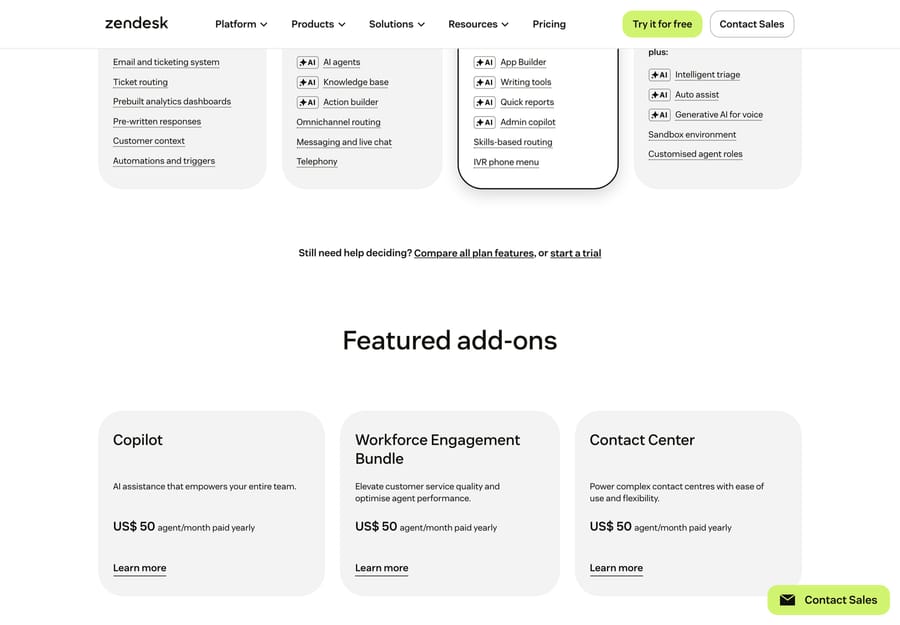
Copilot and Zendesk’s other AI/CX capabilities are sold as separate add-ons — each per agent, on top of your base plan:
Methodology: per-agent prices are verified against Zendesk's official pricing page (June 2026), annual billing, USD. Where a number is a third-party estimate or no longer on the public page, it's flagged inline. The scaling table is illustrative list math — not a quote — to show how the model compounds.
How Zendesk charges per agent
Zendesk bills a flat monthly fee for each agent seat. An agent is anyone who works tickets — replies to customers, manages conversations, handles calls. You buy a number of seats on a given plan, and your base subscription is simply seats × plan price. On an annual contract you commit to that seat count for the term; you generally can't drop below it mid-term (one of the costs that don't show up on the sticker).
Three things are easy to conflate, so it's worth being precise:
- Full agents — the paid seats. They have a mailbox in the agent workspace, respond to customers, and each one carries the per-agent price.
- Light agents — free (or included) internal collaborators. They can view tickets and add private internal comments, but they cannot publicly respond to customers. They're meant for subject-matter experts in other departments — engineering, billing, legal — whose input you need on a ticket without paying for a full seat. Light agents are available from Suite Growth upward; the number included varies by tier (third-party teardowns cite caps in the range of ~50 on Growth up to ~1,000 on Enterprise — confirm in your quote). For many teams these are the single biggest per-agent cost saver, so we come back to them below.
- End-users (customers) — the people who submit tickets. They are always free and unlimited. Zendesk never charges by contact or by ticket volume, which is exactly what makes it the opposite of a per-ticket tool like Gorgias.
So your bill is driven by one number: how many full agents you put on the platform.
Per-agent price by tier
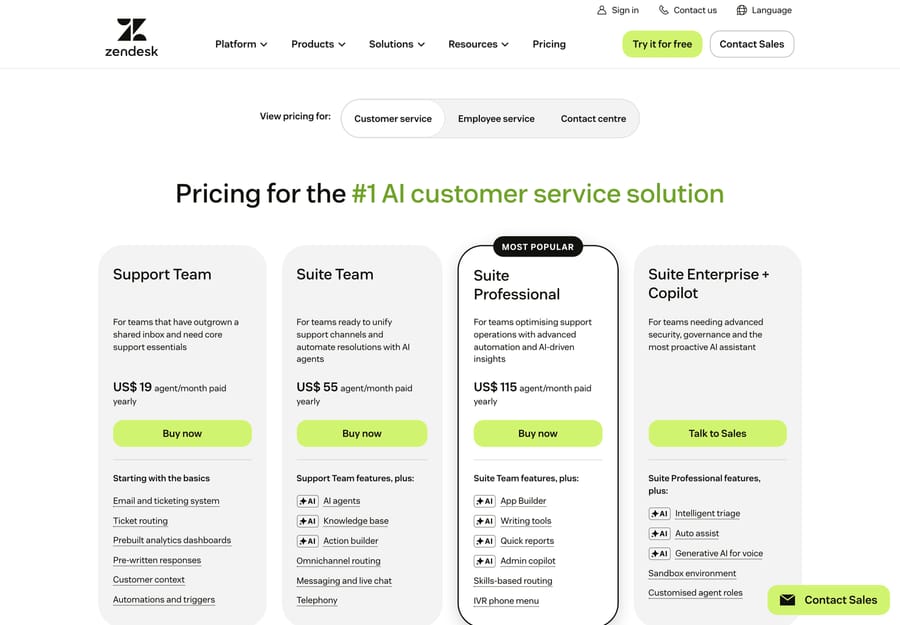
Here's what a single full-agent seat costs per month, on an annual contract:
| Plan | Per agent / month (annual) | What it unlocks |
|---|---|---|
| Support Team | $19 | Email/ticketing only — no chat, messaging, or help center |
| Suite Team | $55 | The real entry point: messaging, live chat, help center, basic AI agents |
| Suite Growth | ~$89 (third-party) | Adds SLAs, CSAT, multiple ticket forms, light agents |
| Suite Professional | $115 | Adds skills-based routing, IVR, custom apps, advanced reporting |
| Suite Enterprise | Contact sales (legacy list ~$169) | Adds custom roles, sandbox, multi-brand |
The $19, $55, $115 and "Enterprise = contact sales" figures are official. Suite Growth's price and the legacy Enterprise list price are third-party estimates — Zendesk's public page now shows a curated four-card view. Monthly billing runs roughly 15–25% higher per agent (Suite Team ~$69, Suite Professional ~$149, third-party).
For most teams that want more than email, the real entry point is Suite Team at $55/agent, not the $19 Support Team plan. If you're unsure which tier fits, we walk through it in which Zendesk Suite plan do you actually need.
Where to check this in your own account: your plan and seat count live in Zendesk under Admin Center → Account → Billing → Subscription. The metered AI charges are tracked separately under Admin Center → Account → Usage — look for Automated resolutions and any Overage. The takeaway: agent seats are billed on your plan, while AI automated resolutions accrue as usage on top — so your real bill is "seats + usage," not just the sticker price.
The part that surprises people: add-ons multiply per seat
Here's the mechanic that catches buyers off guard. When Zendesk says Copilot is $50/agent/month, that's not a flat $50 for your account — it's $50 added to every single seat. Turn it on for a 50-agent team and you've added $2,500/month ($30,000/year), not $50.
This is the most important thing to understand about per-agent pricing: every add-on you enable re-prices your entire roster. The bigger your team, the more each toggle costs. The main per-seat add-ons:
- Copilot (advanced AI) — +$50/agent/mo (official). Agent-assist, intelligent triage, AI-drafted replies. On Suite Professional this effectively turns a $115 seat into a $165 seat.
- Contact Center (Zendesk Talk / voice) — +$50/agent/mo bundle (official), plus per-minute usage on top.
- Workforce Engagement (WFM + QA) — +$50/agent/mo bundle (official). Forecasting, scheduling, and quality scoring.
Stack two of these and your effective per-agent cost can jump 50–90% over the base plan — before any usage-based AI charges. We unpack the AI side specifically in Zendesk AI pricing explained.
One thing that scales with you in your favor: each tier includes a free automated-resolution allowance per agent per month — 5 on Team, 10 on Growth/Professional, 15 on Enterprise (official, from Zendesk's automated-resolutions help doc). So a 50-agent Professional team starts with 500 free AI resolutions baked in. Useful, but it doesn't change the seat math — it just softens the AI bill on top of it.
2026 update — "verified resolutions" (Relate 2026): at Relate 2026 Zendesk shifted toward outcome-based pricing, and on May 18, 2026 it introduced a three-tier model (per its automated-resolution-tiers doc): Assisted Escalation (AI helped, a human finished) and Contained Resolution (AI finished but unverified) are now free, while only a Verified Resolution — where the AI resolved the issue and a separate LLM evaluation model confirmed it within 72 hours — counts against your allowance and is billed. So the committed/overage rates (~$1.50–$2.00, estimate) now apply to verified resolutions only; confirm which billing model your contract uses.
The scaling table: 5 to 100 agents
This is the whole point of per-agent pricing — watching it compound. Below is the monthly base subscription at four team sizes, on Suite Team vs. Suite Professional, with and without the Copilot add-on. Voice, workforce, and usage-based AI overage are excluded so you can see the seat math cleanly.
| Agents | Suite Team ($55) | Suite Team + Copilot ($105) | Suite Pro ($115) | Suite Pro + Copilot ($165) |
|---|---|---|---|---|
| 5 | $275 | $525 | $575 | $825 |
| 20 | $1,100 | $2,100 | $2,300 | $3,300 |
| 50 | $2,750 | $5,250 | $5,750 | $8,250 |
| 100 | $5,500 | $10,500 | $11,500 | $16,500 |
Illustrative list math, not a quote — base seat cost only, annual per-agent pricing × seats (+ $50/agent for Copilot). Excludes voice, WFM, usage-based AI resolution overage, implementation, and any negotiated discount.
A few things jump out. At 100 agents on Suite Professional with Copilot, you're at $16,500/month — roughly $198,000/year in seat cost alone. The same 100 agents on bare Suite Team run $5,500/month (~$66,000/year). And notice what Copilot does: at 100 agents it adds $5,000/month on either plan — the add-on alone costs as much as a whole sub-team. That's the multiplier effect in numbers.
The "headcount tax" — the real tension of per-agent pricing
Per-agent pricing has a hidden incentive structure, and it's worth naming because it should shape how you staff and automate.
Per-seat pricing rewards high tickets-per-agent. Because you pay the same $55 or $115 whether an agent closes 200 tickets a month or 2,000, the more volume you push through each seat, the lower your effective cost-per-ticket. A lean, efficient team gets a great deal.
But the same model penalizes adding seats. Every new hire is a fixed monthly cost that recurs forever — and if they're on an add-on like Copilot, they cost even more. Scaling your team is the only lever that moves your Zendesk bill, and it only moves it up. There's no volume relief from handling fewer tickets per person; if anything, a team that's underwater on volume and responds by hiring just makes the bill worse. We call this the headcount tax: with per-agent pricing, growth and cost are welded together.
This is the exact opposite of a usage/per-ticket model. Tools like Gorgias charge by billable ticket, so their cost tracks volume, not headcount — add ten agents and your bill doesn't change, but a spike in tickets does cost you. Neither model is universally better; they reward different things. Per-agent suits stable, efficient teams with steady volume; per-ticket suits small teams with spiky or seasonal volume. We do the full crossover math in Zendesk vs. Gorgias — it's the clearest illustration of how pricing model, not just price, decides what you pay.
Volume discounts and negotiating at scale
The list prices above are rack rates. They're what a small or mid-size team pays at face value — but they're not fixed law, especially as you scale.
- Enterprise is quote-only by design. Suite Enterprise has no public price precisely because it's negotiated. Once you're talking 50–100+ seats, the per-agent number is on the table.
- Discounts grow with commitment. Larger seat counts, multi-year terms, and prepaying annually are the standard levers Zendesk reps use to discount. Bundling add-ons (Copilot, voice, WFM) into the deal is another.
- The flip side: annual lock-in and escalation. Discounts usually come attached to a committed seat count you can't easily reduce mid-term, and contracts commonly carry 5–7% annual escalation clauses with renewal hikes reported at 15–25% (third-party). A discount in year one can erode by renewal. Read the full hidden-cost rundown before you sign.
The practical takeaway: at scale, the price in the table is a starting point for negotiation, not your destiny. Get a quote, and benchmark it.
How AI changes the per-agent math
Here's the lever that actually breaks the headcount tax. If your Zendesk cost only goes up when you add agents, then the way to bend the curve is to handle more support without adding agents — and that's precisely what ticket deflection and automation do.
When AI resolves repetitive, high-volume tickets end-to-end — password resets, order status, return policy, "where's my refund" — those tickets never reach a human queue. Your existing team absorbs growth instead of you hiring for it. On a per-agent model, every seat you don't have to add is the full annual price you save — $660/year per avoided Suite Team seat, $1,380 on Professional, more with Copilot. Deflection on a per-seat platform isn't just a service-quality win; it's a direct attack on the one cost lever that scales against you.
Zendesk's own AI plays into this, but note how it's priced: Copilot is per seat (so it raises the headcount tax rather than relieving it), and autonomous automated resolutions are billed per outcome beyond your included allowance. We cover both layers in Zendesk AI pricing explained — the short version is that AI can lower your seat growth while adding a usage line you need to watch.
An honest aside, if AI deflection is what you're after. The capability that reduces seats — autonomous resolution — doesn't have to come from your help desk. An AI agent layer like Macha runs on top of Zendesk (or whichever desk you keep), resolves repetitive tickets before they hit an agent, and is priced per ticket rather than per seat or per vendor-defined resolution — one conversation, charged once however many steps it takes (triage, lookup, draft, or full resolution), so the cost tracks the volume you handle rather than the size of your team. The honest caveats: it's another vendor and integration to manage, it only performs as well as the knowledge you connect to it, and per-ticket usage still costs money at volume — it's additive to your desk, not a free win. If the headcount tax is your real problem, deflecting tickets is the most direct fix; you can try it with a free trial ($50 of usage, no credit card required). (Native AI vs. an AI layer →)
Cut the per-agent bill: light agents
Before you buy more full seats, check whether the people you're seating actually need to respond to customers. If they only need to read tickets and add internal notes — your engineers, product folks, finance team weighing in on an escalation — they can be light agents, which are free/included rather than billed at the full per-agent rate.
On a 50-agent team where 15 of those "agents" are really internal collaborators, converting them to light agents (assuming your tier includes enough) takes the billable count from 50 to 35 — on Suite Professional, that's $1,725/month saved ($20,700/year) for the same group of people. Light agents are the most underused cost lever in Zendesk's per-agent model. The catch: they're a Suite Growth+ feature with per-tier caps, and they genuinely can't publicly reply — so they're for collaborators, not front-line support.
Frequently asked questions
How much does Zendesk cost per agent? On an annual contract: $19/agent/mo for Support Team (email only), $55 for Suite Team, ~$89 for Suite Growth (third-party), $115 for Suite Professional, and contact-sales for Suite Enterprise. Monthly billing runs roughly 15–25% higher per agent. Add-ons like Copilot add $50 per agent on top.
Does Zendesk charge per agent or per ticket? Per agent. You pay a flat monthly price for each full seat, regardless of how many tickets they handle. End-users (customers) and tickets are free and unlimited. This is the opposite of per-ticket tools like Gorgias, where cost scales with volume rather than headcount.
Do Zendesk add-ons cost per agent too? Yes — and this is the key trap. Copilot ($50), Contact Center ($50), and Workforce Engagement ($50) are all priced per agent, so they multiply across your whole team. Enabling Copilot for 50 agents is $2,500/month, not $50.
What's a light agent, and is it free? A light agent is an internal collaborator who can view tickets and add private comments but cannot respond to customers. They're included (free) on Suite Growth and above, with per-tier caps. Moving internal subject-matter experts to light-agent seats is one of the simplest ways to cut your per-agent bill.
Does Zendesk offer volume discounts as you scale? Yes, but they're negotiated, not published. Enterprise is quote-only, and larger seat counts, multi-year terms, and annual prepayment are the usual discount levers. Watch for annual lock-in and 5–7% escalation clauses that can erode the discount by renewal.
How can I reduce my Zendesk cost per agent? Three levers: (1) buy the right tier instead of over-buying, (2) convert internal collaborators to free light agents, and (3) deflect repetitive tickets with AI so you scale support without scaling seats — the most effective fix for the headcount tax, since every seat you avoid is the full annual price saved.
The bottom line
Zendesk's per-agent model is simple to budget and brutal to scale unchecked: your bill is seats × plan price, plus any per-seat add-ons that re-price the whole roster at once. At 100 agents, Suite Professional with Copilot is roughly $198,000/year in seats alone — and Copilot's $50 multiplier accounts for $60,000 of that. The model rewards squeezing more tickets through each agent and punishes adding headcount, so the smartest cost levers all point the same way: right-size the tier (see which Suite plan), use free light agents for collaborators, negotiate at scale, and above all deflect volume with AI so you don't add seats in the first place. Run the table for your own team size, factor in the costs that aren't on the page, and if the per-agent math doesn't work for you, the best Zendesk alternatives compare the field — including tools that price by usage instead of headcount.
Per-agent pricing verified against Zendesk's official pricing page, June 2026; third-party and estimated figures are flagged inline. The scaling table is illustrative list math, not a quote. Zendesk changes pricing and packaging periodically — confirm current numbers and your specific quote before budgeting.
Add AI agents to your Zendesk
Macha reads the ticket, drafts the reply and takes the action, inside the Zendesk you already run.