Intercom
 Shopify
 Stripe
 Slack
Slack Notion
 Google Workspace
 Confluence

What Are the Best ServiceNow Alternatives in 2026? 10 Scored, With Real Prices


Jira Service Management is the strongest ServiceNow alternative on our 30-point rubric, and ManageEngine ServiceDesk Plus is the cheapest full ITIL option at 50 technicians. ServiceNow publishes no price, so the benchmark is Vendr's median contract of $127,118 a year across 108 purchases.
Key takeaways
- Jira Service Management scored highest among ten ServiceNow alternatives, at 26 out of 30 on Macha's published rubric, and costs $20 per agent a month on Standard.
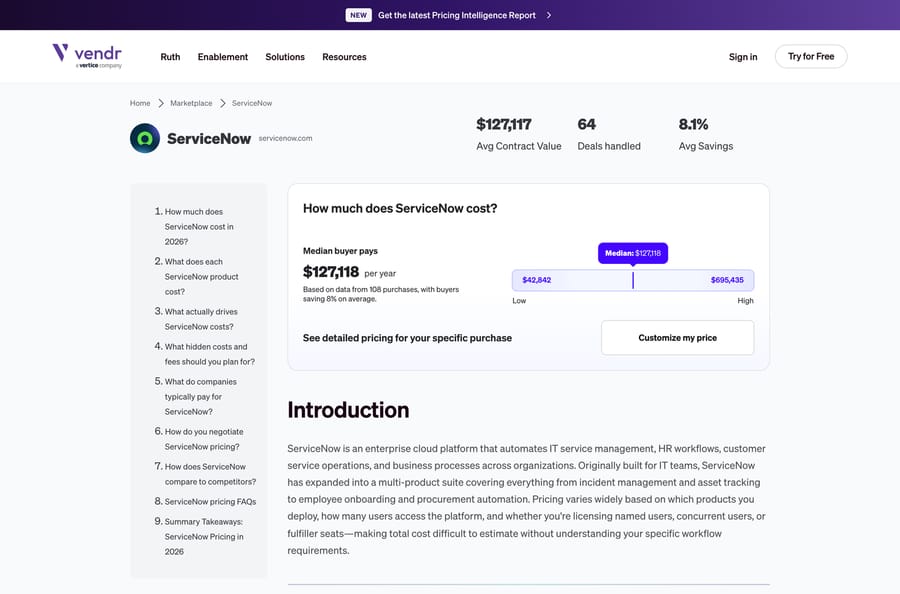
- ServiceNow publishes no price; Vendr's contract data shows a median ServiceNow buyer paying $127,118 a year across 108 purchases, ranging from $42,842 to $695,435.
- At fifty technicians, ManageEngine ServiceDesk Plus Professional costs $1,350 a month, the cheapest of ten ServiceNow alternatives against a $10,593-a-month ServiceNow benchmark.
- Atlassian bills its customer service AI agent at $1 per resolution, while Zendesk's pricing page lists $1.50 per committed automated resolution.
- InvGate Service Management's Starter plan is a flat $1,499 a year for five agents, while its Pro plan runs $500 per agent a year.

The strongest ServiceNow alternative for most IT teams is Jira Service Management, which scored 26 out of 30 on our rubric and costs $20 per agent a month on Standard or $51.42 on Premium. The cheapest full ITIL option is ManageEngine ServiceDesk Plus Professional at $1,350 a month for fifty technicians, against about $10,593 a month for the median ServiceNow contract in Vendr's data.
Macha publishes this page. Macha isn't an IT service management platform and is not one of the ten, so it's deliberately absent from the ranking and appears once, in a clearly marked section near the end about keeping the platform you already run. Every seat price here was read on the vendor's own live page, forced to the US region, in September 2026.
Which ServiceNow alternatives are worth a shortlist? (prices checked 22 to 24 September 2026)
Legend: ✅ native · ➕ configurable, you build it · ✖ not a focus.
| Alternative | Best for | Entry price | ITIL depth | AI a requester meets | Score |
|---|---|---|---|---|---|
| Jira Service Management | Atlassian shops and dev-adjacent IT | Free for 3 agents; $20 per agent/mo | ✅ | Virtual service agent on Premium | 26/30 |
| Freshservice | Mid-market IT wanting most of the depth | $19 per agent/mo annual | ✅ | Freddy, Copilot $29/agent | 24/30 |
| Zendesk | The customer-service half of ServiceNow | $55 per agent/mo annual | ✖ | Billed per automated resolution, $1.50 committed or $2.00 pay-as-you-go | 24/30 |
| ManageEngine ServiceDesk Plus | Asset-heavy desks on a budget | Free for 5 techs; US$13 per tech/mo | ✅ | Zia, no published meter | 23/30 |
| SysAid | Teams who want the AI bundled flat | $89 per agent/mo | ✅ | Agentic AI, no usage caps | 23/30 |
| Atera | Small IT teams who also run the endpoints | $149 per tech/mo annual | ➕ | AI copilot on every plan | 23/30 |
| SolarWinds Service Desk | Discovery and CMDB without the ceremony | $39 per tech/mo annual | ✅ | Virtual Agent on Advanced | 22/30 |
| InvGate Service Management | Five-person desks that still need ITIL | $1,499/yr for 5 agents | ✅ | AI Service Agent on Pro | 22/30 |
| Vivantio | Regulated internal desks | $49–$99 per agent/mo annual | ✅ | Included, no published meter | 20/30 |
| Halo | One platform across IT, HR and facilities | $99 per agent/mo annual | ✅ | Halo AI, included | 19/30 |
The column that decides most shortlists is ITIL depth. Seven of the ten carry incident, problem, change, release and a CMDB natively. Zendesk doesn't, and it's on this list for a different reason: ServiceNow sells customer service management as well as ITSM, and a team leaving the CSM half isn't looking for change management at all. Our Zendesk against ServiceNow comparison takes that fork properly, and help desk versus service desk explains why the two branches keep getting mixed up in one search.
Why do teams leave ServiceNow?
The complaints are consistent and they aren't about capability. On G2, where ServiceNow IT Service Management holds 4.5 from 1,985 ratings, the five most common negative tags are Learning Curve (70 mentions), Expensive (59), Complexity (53), Limited Customization (51) and Customization Difficulty (47). Read together they describe a platform people rate highly and still find hard to own.
Four specific things push a team to look:
- The bill has no ceiling you can see. Vendr's contract data puts the median ServiceNow buyer at $127,118 a year, with a low of $42,842 and a high of $695,435. A spread of sixteen to one on the same product is a negotiation problem, not a pricing model.
- Repackaging forces an upgrade. ServiceNow now sells ITSM as Foundation, Advanced and Prime. A reviewer on 10 September 2026, an enterprise buyer with more than 1,000 employees, put it plainly on G2: "The changes to the licensing policies have forced customers to go with at least Advanced or Prime, which hurts a lot of new customers."
- Time to live is measured in quarters. G2's own Value at a Glance panel averages ServiceNow's time to implement at five months. Every platform below ships a self-serve trial that runs for 14 to 30 days.
- Support covers the product, not your build. The same reviewer set repeats the point that ServiceNow's support covers out-of-the-box behavior and thins out sharply over customizations, which is where a mature instance actually lives. A long-running r/sysadmin thread, Has anyone left ServiceNow for another ITSM and/or ITAM, holds page one for this search on that question alone.
None of that means ServiceNow is the wrong answer. It means the question is whether you're buying the depth you are paying for, and there's a section near the end on who should stay.
What does a month cost at 50 technicians?
Every row uses the cheapest plan on that vendor's own price list that carries its AI capability, annual billing where it's offered, and fifty licensed technicians. Every number is reproducible from the rates in the entries further down.
| Alternative | Plan | Seats (50) | AI | Monthly total |
|---|---|---|---|---|
| ManageEngine ServiceDesk Plus | Professional | US$27 × 50 = $1,350 | Zia bundled, no published meter | $1,350 |
| InvGate Service Management | Pro | $500/yr ÷ 12 × 50 = $2,083 | AI Service Agent included | $2,083 |
| Jira Service Management | Premium | $51.42 × 50 = $2,571 | 1,000 assisted conversations included | $2,571 |
| Vivantio | Single plan | $49–$99 × 50 | Included | $2,450–$4,950 |
| Zendesk | Suite Team | $55 × 50 = $2,750 | Per automated resolution, billed on top | $2,750 plus usage |
| SysAid | Professional | $89 × 50 = $4,450 | Agentic AI, no usage caps | $4,450 |
| Freshservice | Pro | $99 × 50 = $4,950 | Freddy Copilot a further $29/agent | $4,950 |
| SolarWinds Service Desk | Advanced | $99 × 50 = $4,950 | Virtual Agent included | $4,950 |
| Halo | Single plan | $99 × 50 = $4,950 | Halo AI included | $4,950 plus onboarding |
| Atera | Professional | $149 × 50 = $7,450 | AI copilot included | $7,450 |
| ServiceNow, for reference | Quote | n/a | Now Assist, bundled, unpriced | $10,593 |
The ServiceNow row is the Vendr median divided by twelve, and it's the only estimate in the table. Four things are worth saying before anyone quotes this.
The spread is nearly eight to one on identical headcount, from $1,350 to $10,593, and the cheap end isn't a toy. ManageEngine ServiceDesk Plus Professional at fifty technicians carries incident, problem, change, release, a service catalog and assets.
Three of the four cheapest rows charge a flat annual number rather than a monthly seat, which is a different negotiating position. InvGate's Pro plan is $500 per agent per year; ManageEngine publishes an outright table by technician count, so you can read your own line without a call.
"Included" is doing a lot of work in the AI column. SysAid, Halo, Vivantio and SolarWinds all bundle their AI into the seat with no meter you can audit, which is generous until you want to know what it cost you. Jira Service Management publishes a unit rate, $1 per resolution for its customer service AI agent. Zendesk also bills per automated resolution, and its pricing page lists $1.50 committed and $2.00 pay-as-you-go. A published rate is the only kind you can forecast. The incentive under each model runs the opposite way, which is worth saying out loud: a per-seat price earns the vendor more as you hire, so nothing in it rewards them for deflecting work, while a per-resolution meter earns them more the more the AI closes, which is why the definition of "resolved" is always written by the vendor. Our piece on what deflection rate really measures is the background reading on how carefully that unit gets defined.
Halo's row is incomplete by design. The pricing page carries a footnote reading "Onboarding packages are required with purchase at a bespoke cost depending on scope", so $4,950 is a floor, not a quote.
How did we score the alternatives?
Most pages ranking for this search are published by someone selling one of the products on them. Ours is no exception, which is why the scoring below is printed in full, with every score visible.
Six criteria, each scored 0 to 5, for a maximum of 30. A platform needs 18 out of 30, or 60%, to get a full entry. Anything below the line is named at the end with its score. Ties are broken by ITIL depth, because that's what a ServiceNow buyer is actually replacing, and then by the independent review base.
| Criterion | 5 points | 0 points |
|---|---|---|
| Published pricing | Every seat rate and AI rate on the vendor's own page | Nothing public |
| Cost at 50 technicians | Under $2,000 a month | Over $8,000 a month, or quote-only |
| ITIL depth | Incident, problem, change, release, CMDB and assets | Ticketing only |
| AI a requester meets | Resolves or fulfils, with a published rate or explicit inclusion | No AI a requester ever talks to |
| Independent review base | 1,000 or more G2 ratings | None |
| Time to live | Self-serve trial, live in weeks | Months of implementation services |
| Platform | Pricing | Cost at 50 | ITIL | AI | Reviews | Time to live | Total | Score |
|---|---|---|---|---|---|---|---|---|
| Jira Service Management | 5 | 4 | 4 | 5 | 4 | 4 | 26 | 87% |
| Freshservice | 4 | 3 | 4 | 4 | 5 | 4 | 24 | 80% |
| Zendesk | 4 | 4 | 2 | 5 | 5 | 4 | 24 | 80% |
| ManageEngine ServiceDesk Plus | 5 | 5 | 5 | 2 | 3 | 3 | 23 | 77% |
| SysAid | 4 | 3 | 4 | 4 | 4 | 4 | 23 | 77% |
| Atera | 5 | 2 | 3 | 3 | 5 | 5 | 23 | 77% |
| SolarWinds Service Desk | 4 | 3 | 4 | 3 | 4 | 4 | 22 | 73% |
| InvGate Service Management | 5 | 5 | 4 | 3 | 1 | 4 | 22 | 73% |
| Vivantio | 3 | 4 | 4 | 3 | 3 | 3 | 20 | 67% |
| Halo | 4 | 3 | 5 | 3 | 1 | 3 | 19 | 63% |
| ServiceNow (benchmark) | 0 | 0 | 5 | 3 | 5 | 1 | 14 | 47% |
Three scores that look wrong at a glance and aren't. ServiceNow scores 14 and would not make its own list, which is a statement about price transparency and time to live rather than about the product: it takes a 5 for ITIL depth, the only 5 alongside ManageEngine and Halo, and a 5 for its review base. InvGate takes 5 for pricing and 1 for reviews in the same row, because it publishes a complete price list and has twenty G2 ratings. And Atera takes 3 for ITIL depth despite being the most expensive row in the cost model, because it's an endpoint-management product with a service desk attached rather than the reverse.
Macha isn't scored here. It is not an IT service management platform, and putting a non-ITSM product on an ITSM rubric would rig the table in one direction or the other.
The ten best ServiceNow alternatives
1. Jira Service Management, the one with published AI pricing
Best for: IT teams inside an organization that already runs Jira, where the service desk needs to hand work to engineering without an integration in the middle.
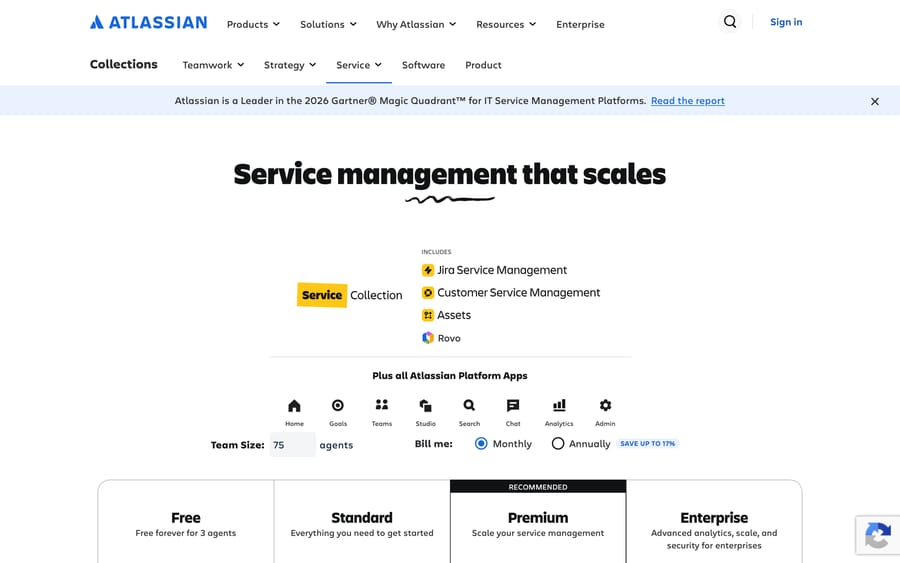
Key features: incident, problem, change, release and asset management; a customer portal with email, Slack and Teams intake; Rovo Agents, search and chat with 250, 700 and 1,500 Rovo credits per user a month on Standard, Premium and Enterprise; a virtual service agent on Premium; a free tier for three agents.
Pros: it's the only platform here that publishes a unit rate for AI that answers a requester. Atlassian's Customer Service Management product guide says AI agent resolutions "are billed at $1 per successfully resolved customer inquiry", and Premium bundles 1,000 assisted conversations a month for the internal virtual service agent, after which assisted conversations start at $0.30 each. Free forever for three agents is a real starting point, not a demo.
Where it falls short: two AI products with two different billing behaviors on one page is genuinely confusing, and the internal virtual service agent is a Premium feature, so the $20 Standard plan doesn't get it. Assets are capped by object count (5,000 on Standard) and you buy more at volume discounts. At 4.3 from 986 G2 ratings it is the lowest-rated of the top three here. And it is an Atlassian product: if you aren't already in that ecosystem, the gravity that makes it good is missing.
Pricing: Free forever for 3 agents; Standard $20 and Premium $51.42 per agent a month; Enterprise billed annually only. Customer Service AI Agent $1 per resolution; virtual service agent 1,000 assisted conversations a month on Premium, then from $0.30 each.
2. Freshservice, the mid-market default
Best for: IT organizations that want most of ServiceNow's shape without a five-month implementation, and are happy to lose some configurability for it.
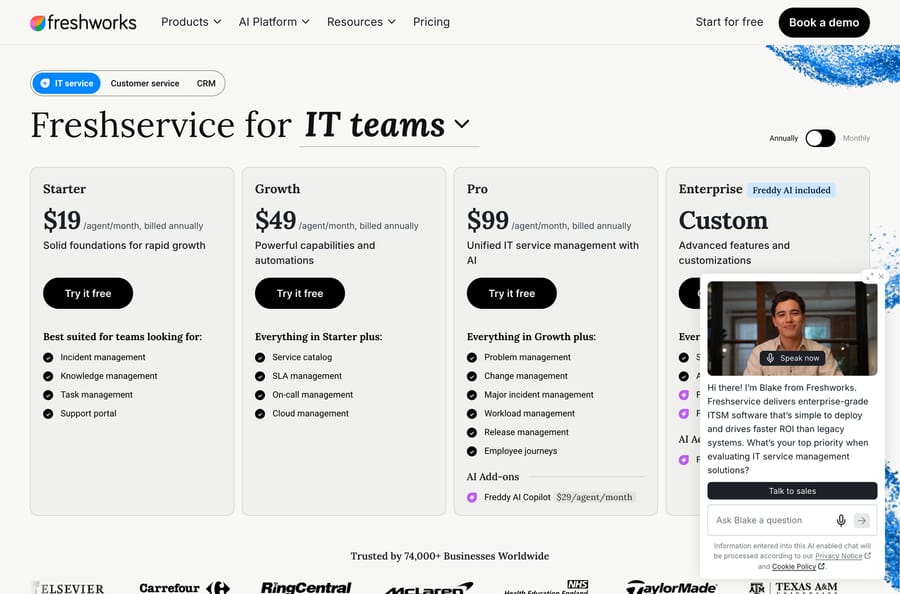
Key features: incident and knowledge management from Starter; service catalog, SLA and on-call from Growth; problem, change, release, major incident and employee journeys on Pro; Freddy AI across the platform, bundled on Enterprise. Our Freshservice explainer covers the product and the pricing breakdown goes tier by tier.
Pros: the strongest independent evidence base of any dedicated ITSM alternative here, 4.6 from 1,355 G2 ratings, and $19 a seat is the cheapest real entry to ITIL-shaped ticketing on this page. Freshworks is a named Leader in the 2026 Gartner Magic Quadrant for ITSM Platforms, per the claim on its own G2 listing.
Where it falls short: the ITIL half you probably came for (problem, change and release) starts on Pro at $99, which is five times the headline price. Freddy AI Copilot is a further $29 an agent on top, and the pricing page does not publish a session or resolution rate for the customer-facing AI agent at all, so you cannot forecast that line. Trustpilot, a much smaller and more self-selecting sample than G2, shows 2.2 from 102 reviews, with a recurring theme of slow commercial processes.
Pricing: Starter $19, Growth $49, Pro $99 per agent a month billed annually; Enterprise custom with Freddy AI included; Freddy AI Copilot $29 per agent a month on Growth and Pro; 14-day free trial.
3. Zendesk, for the customer-service half
Best for: teams replacing ServiceNow Customer Service Management rather than ITSM, where the requesters are customers and nobody needs a change advisory board.
Key features: omnichannel ticketing across email, chat, messaging, social and voice; the deepest routing and business rules on this page; AI agents that resolve, Copilot that drafts; the largest app marketplace in the category. If you are running both, our ServiceNow and Zendesk integration piece covers the seam.
Pros: the largest independent review base on the page by an order of magnitude, 4.3 from 7,075 G2 ratings and 4.4 from 1,049 on Gartner Peer Insights, and AI agents billed per automated resolution. Zendesk's pricing page lists the rate, $1.50 committed and $2.00 pay-as-you-go, and its comparison table includes 5 automated resolutions per agent a month on Support Team and Suite Team and 10 on Suite Professional (up to 10,000 a year). Zendesk's help center describes that allowance as a monthly dollar amount per seat since 18 May 2026: $2, $5 or $10 by plan, capped at $5,000 a year. Our Zendesk AI pricing breakdown does the arithmetic.
Where it falls short: it is not an ITSM platform, which is why it scores 2 for ITIL depth. No native change management, no problem management, no CMDB. You build those with custom objects or you buy them elsewhere. Two allowance models are live at the same time, so costing next month takes a spreadsheet. And at $55 a seat it is not the cheap option in its own category either.
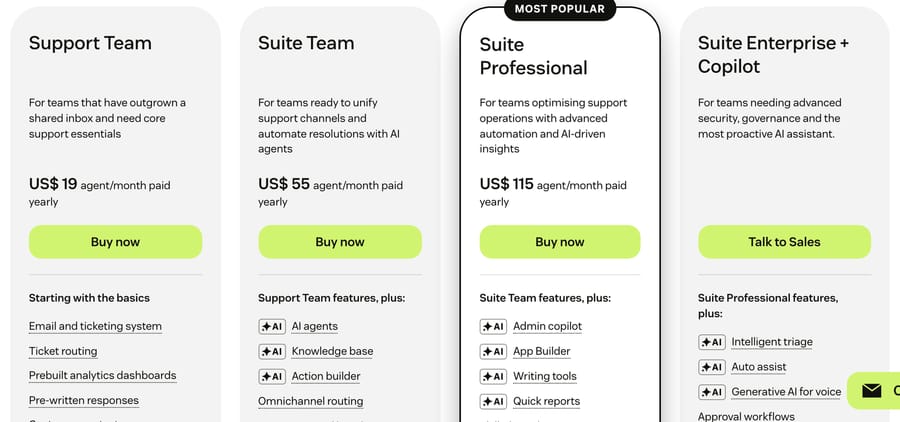
Pricing: Suite Team $55, Growth $89, Professional $115 per agent a month billed annually; automated resolutions billed per resolution at $1.50 committed or $2.00 pay-as-you-go, as listed on Zendesk's pricing page.
4. ManageEngine ServiceDesk Plus, the price list nobody else publishes
Best for: asset-heavy IT teams who want the full ITIL set and would rather read a price than book a call.
Key features: incident, problem, change, release and project management; CMDB and asset discovery; a service catalog; multi-instance support for separate departments; Zia across the product.
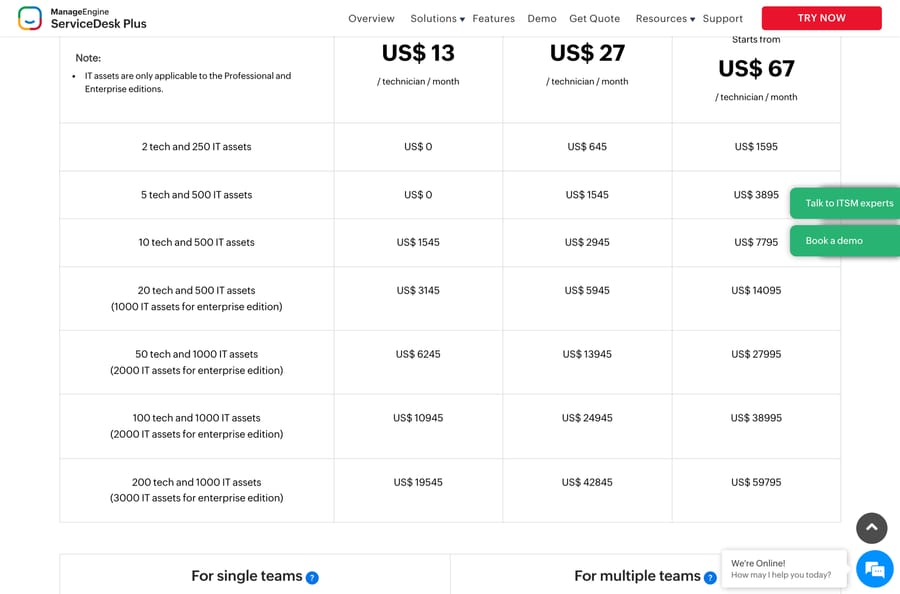
Pros: it publishes more pricing detail than any other vendor in this research: a full annual grid by technician count and asset count across three editions, from US$0 at five technicians on Standard to US$59,795 at two hundred technicians on Enterprise, plus itemized add-ons (CMDB US$1,595 a year, change and release US$3,195, live chat US$65 per technician a year). The free edition genuinely covers five technicians. At fifty technicians on Professional it is the cheapest row in the cost model by a third.
Where it falls short: the AI is the weakest of the ten on the one thing this rubric measures. Zia is bundled into the seat with no published meter and no stated resolution behavior, so it scores 2. The interface is the most dated here and reviewers say so; 4.2 from 251 G2 ratings is both the lowest average and a thin base for a product this old. Several capabilities that other vendors bundle (CMDB, service catalog, project management) are priced add-ons on the lower editions, so the headline US$13 is rarely what you pay.
Pricing: Standard US$13, Professional US$27, Enterprise from US$67 per technician a month; free edition for 5 technicians on Standard; 30-day trial.
5. SysAid, the flat-rate AI bet
Best for: IT teams who want the AI question settled at purchase rather than metered forever.
Key features: request, incident, change and problem management; all-in-one asset management; agentic AI that resolves incidents, fulfils requests and builds automations; a sandbox and tailor-made agents on Enterprise.
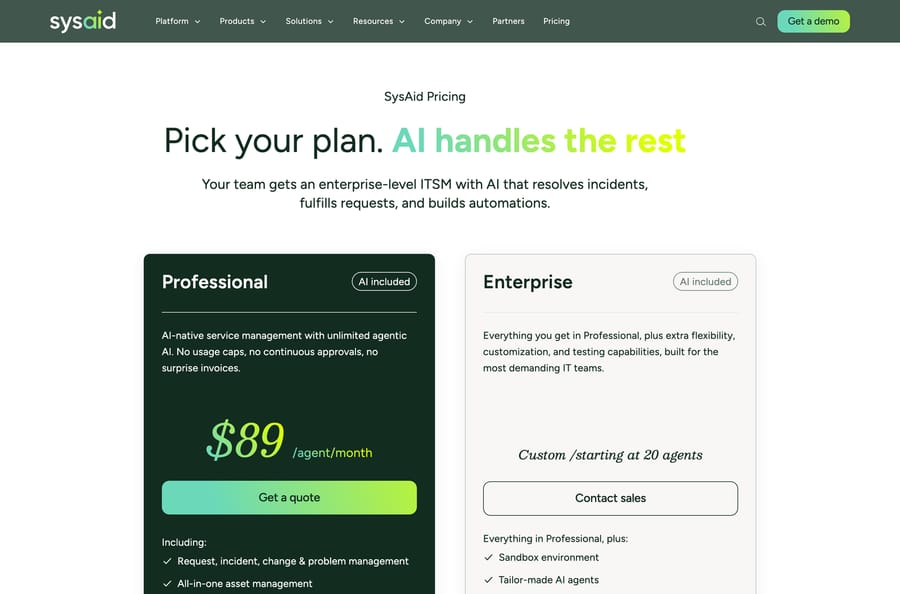
Pros: SysAid is the only vendor here that makes uncapped AI the headline of its pricing page, in its own words "unlimited agentic AI. No usage caps, no continuous approvals, no surprise invoices." For a team that has just spent two years watching a per-unit meter, that is a real proposition, and 4.5 from 753 G2 ratings is a solid base for a mid-sized vendor.
Where it falls short: exactly one number is published. The page prints $89 an agent a month for Professional and "Custom, starting at 20 agents" for Enterprise, with no annual-versus-monthly distinction, no add-on list and a Get a quote button where the buy button should be. That is better than ServiceNow and worse than everyone above it. At fifty technicians it is $4,450 a month, so "flat" is not the same as "cheap".
Pricing: Professional $89 per agent a month with AI included; Enterprise custom, starting at 20 agents.
6. Atera, if you run the endpoints too
Best for: small internal IT teams who are buying remote monitoring, patching and a service desk in one purchase, and who count devices rather than tickets.
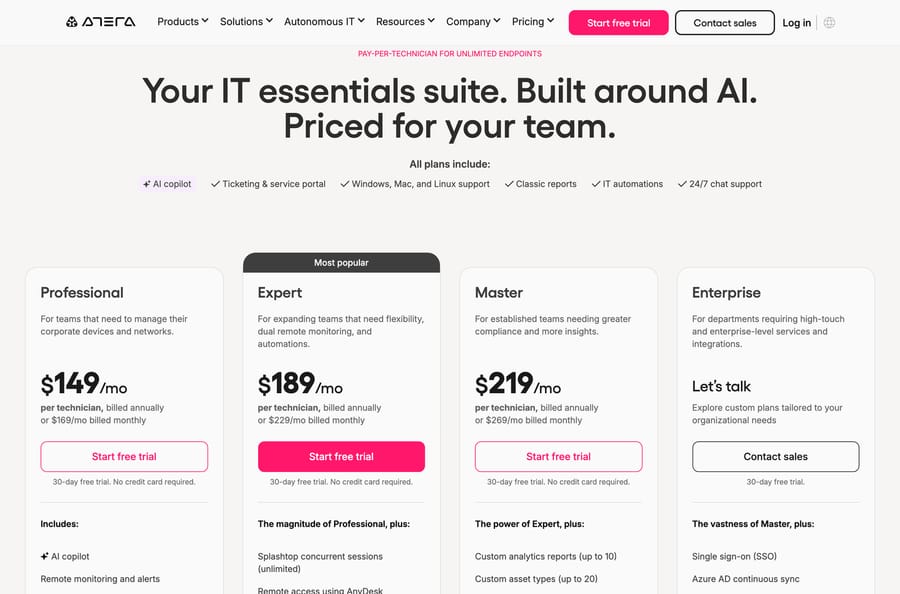
Key features: pay per technician for unlimited endpoints; remote monitoring and alerts; ticketing and a service portal; Windows, Mac and Linux support; IT automations; an AI copilot on every plan.
Pros: the pricing page is the most complete on this list after ManageEngine's, down to per-endpoint add-on rates, and the unlimited-endpoint model inverts the arithmetic for a team managing a lot of machines with few people. 4.6 from 1,267 G2 ratings, and a 30-day trial with no card.
Where it falls short: it is not an ITIL platform and does not pretend to be, which is why it scores 3 for depth. Change and problem management are thin, and a CMDB in the ServiceNow sense is not there. Per technician it is the most expensive row in the cost model at $7,450 a month for fifty, because the model assumes you are replacing an RMM as well. If you are not, you are paying for half a product.
Pricing: Professional $149, Expert $189, Master $219 per technician a month billed annually, or $169, $229 and $269 monthly; Enterprise by quote; 30-day trial, no card.
7. SolarWinds Service Desk, discovery without the ceremony
Best for: IT teams whose real problem is knowing what they own, and who want network discovery and a CMDB in the same product as the tickets.
Key features: incident, problem, change and release management; asset management, CMDB and network discovery; a service portal and catalog; a Virtual Agent from Advanced; AI incident summaries, guided solutions and runbook drafting on Premier.
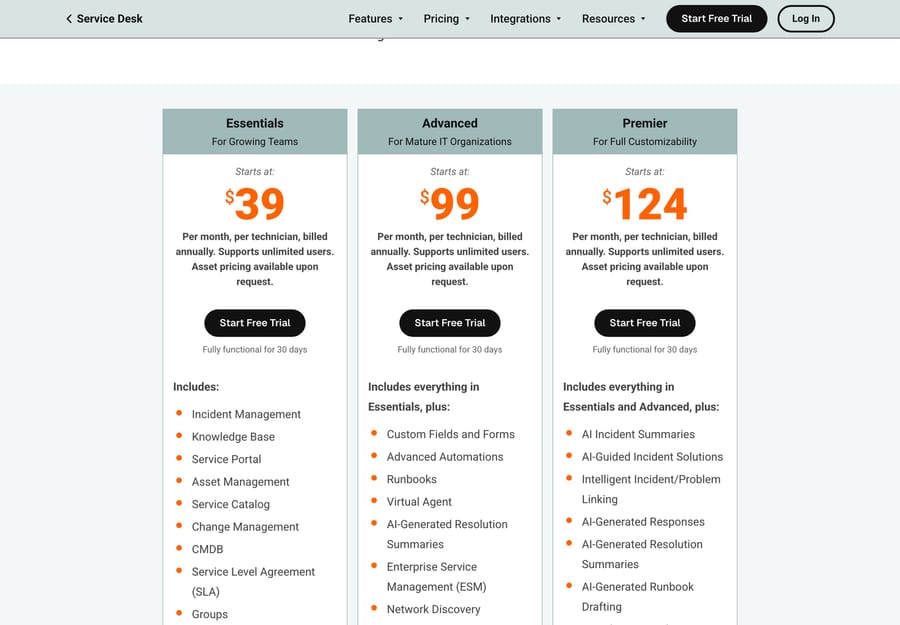
Pros: unlimited requesters on every plan, so the license counts only technicians, and the $39 Essentials tier already includes change management and a CMDB, which most vendors gate two tiers up. 4.3 from 787 G2 ratings. The plan feature lists are unusually specific about which AI capability sits on which tier.
Where it falls short: "Asset pricing available upon request" sits under all three plans, which means the thing the product is best at is the thing you cannot price. The Virtual Agent has no published rate. And SolarWinds' Vendr median across the whole company is $31,815 a year, which is a reminder that the listed seat price is a starting point in an enterprise negotiation rather than a checkout price.
Pricing: Essentials $39, Advanced $99, Premier $124 per technician a month billed annually; unlimited requesters; asset pricing on request; 30-day fully functional trial.
8. InvGate Service Management, the cheapest honest ITIL entry
Best for: a five-to-fifty person IT team that needs real ITIL process and an annual number it can put in a budget line.
Key features: incident, request, problem and change workflows; a no-code workflow builder; SSO and an AI Hub on every plan; an AI Service Agent and Microsoft Teams and WhatsApp intake on Pro; unlimited end users and approvers throughout.
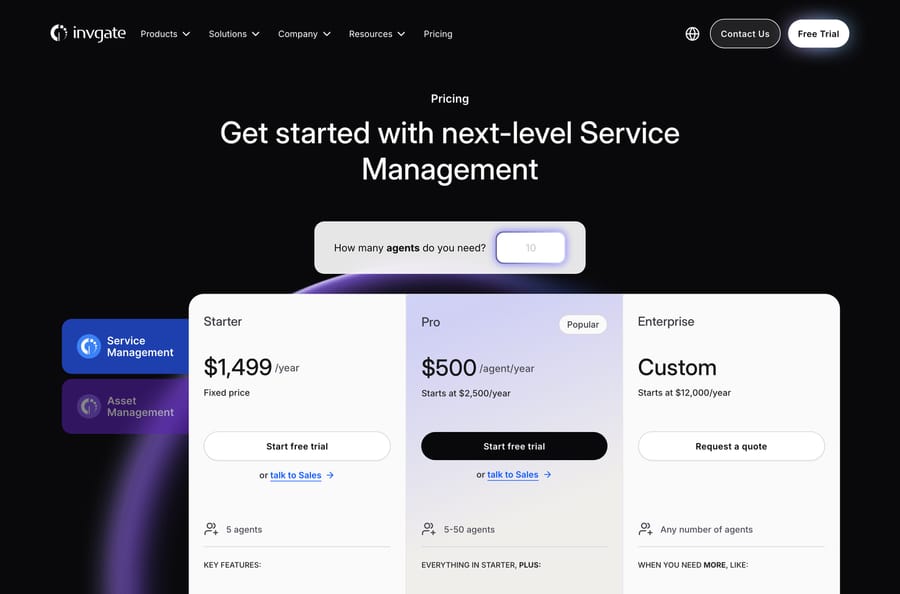
Pros: the pricing is unusually legible. Starter is a fixed $1,499 a year for five agents, a flat number and not a per-agent one, and Pro is $500 per agent a year, which works out to about $41.67 a month and makes it the second-cheapest row in the cost model. Thirty-day trial, no card.
Where it falls short: twenty G2 ratings. That is the thinnest evidence base of any platform on this list except Halo, and for a system of record that matters more than it does for a tool you can swap out in a week. The AI Service Agent is Pro-only and carries no published meter, and Enterprise starts at $12,000 a year, which is a sharp step up from Pro for a fifty-agent desk.
Pricing: Starter $1,499 a year fixed for 5 agents; Pro $500 per agent a year, starting at $2,500 a year, for 5 to 50 agents; Enterprise custom from $12,000 a year.
9. Vivantio, for desks with a compliance list
Best for: internal service desks that have to answer an auditor, where the certification list is part of the requirement rather than a nice-to-have.
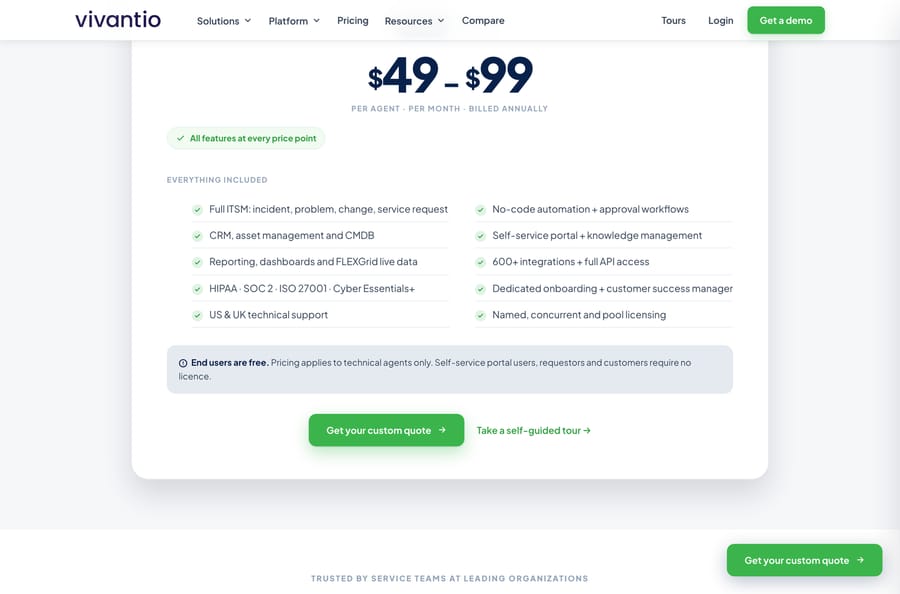
Key features: full ITSM across incident, problem, change and service request; CRM, asset management and a CMDB; no-code automation and approval workflows; self-service portal and knowledge management; 600-plus integrations and full API access; named, concurrent and pool licensing.
Pros: every feature ships at every price point, so there is no tier-shopping, and end users are free, and the license covers technical agents only. HIPAA, SOC 2, ISO 27001 and Cyber Essentials+ are all listed on the pricing page itself, which is rare at this size. Named, concurrent and pool licensing in one product is genuinely flexible for a desk with shift patterns.
Where it falls short: the published price is a range, $49 to $99, with no plan names and no rule for where you land in it, so you cannot cost a month without talking to someone. That two-to-one uncertainty is why it scores 3 for pricing rather than 5. The AI is bundled with no meter and no stated resolution behavior, and 4.3 from 295 G2 ratings puts it mid-table on evidence.
Pricing: $49 to $99 per agent a month billed annually, all features included, end users free.
10. Halo, one platform across every department
Best for: organizations that want IT, HR, facilities, customer service and even sales running on one license rather than four products.
Key features: ITSM with incident, service request, change, problem and major incident management; enterprise service management for HR, finance, legal and facilities; a customer-service module with an omnichannel inbox and live chat; CMDB, asset discovery and software asset management; project management and billing; Halo AI for agents, suggested replies, sentiment and triage.
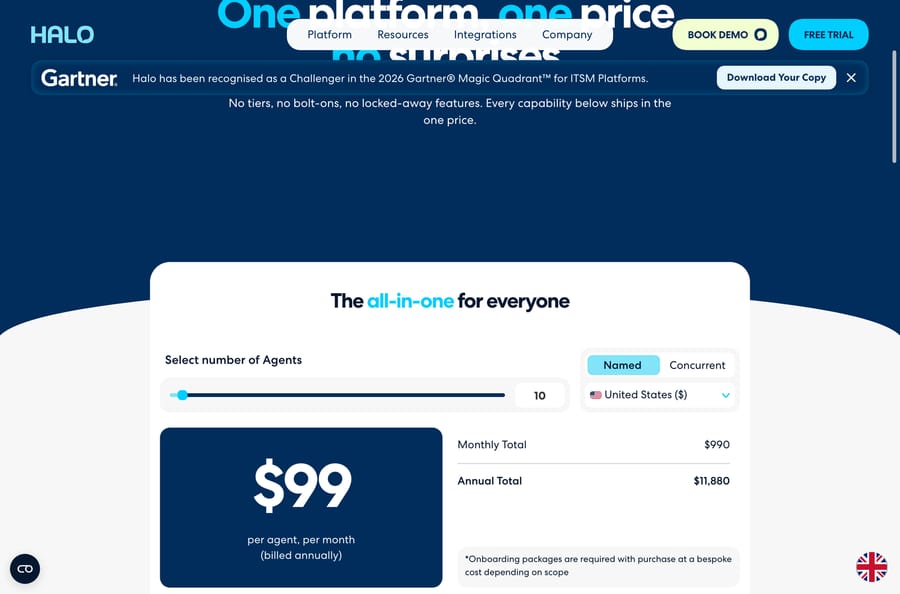
Pros: the broadest functional footprint on this page for a single per-agent price, with no tiers, editions or add-ons, and the page's own claim is "No tiers, no bolt-ons, no locked-away features." Halo's site banner claims Challenger placement in the 2026 Gartner Magic Quadrant for ITSM Platforms. The US price of $99 an agent is $990 a month and $11,880 a year at ten agents, printed on the page.
Where it falls short: two things pull the score down hard. Seventeen G2 ratings is the smallest evidence base here, and the pricing page carries the footnote "Onboarding packages are required with purchase at a bespoke cost depending on scope", so the transparent single price is not the whole bill, and the part that is not transparent is the part that killed ServiceNow for you. The page also defaults to GBP unless you change the region selector, so check the symbol before you quote it. Halo AI is included with no meter.
Pricing: $99 per agent a month billed annually in the United States, plus a required onboarding package at bespoke cost; an Enterprise Package with unlimited licenses and funded implementation at a fixed $1M a year.
Which alternatives missed the cut?
Three platforms that rank on page one for this search scored below 18 and get a named line each, with their score.
- Xurrent, 16/30. A credible ITSM and ESM platform with a good G2 average (4.6 from 87 ratings for Xurrent ITSM), and a pricing page that describes three tiers by platform-user count and prints no prices at all. Its own FAQ asks "What are the specific prices for each license plan?" and answers with a contact form. If opacity is why you are leaving, this is the wrong direction.
- TeamDynamix, 16/30. Strong in higher education, no-code, and 4.5 from 101 G2 ratings for its ITSM product. It publishes no price on its own site and has no Vendr page, so there is no number to put in the cost model.
- Ivanti ITSM, 16/30. The deepest ITIL feature set outside ServiceNow itself, and the only one here with a Vendr median that undercuts it meaningfully at $11,212 a year. It loses on transparency (no published price), on evidence (4.0 from 323, the lowest average on this page) and on time to live.
BMC Helix was checked and left out: bmc.com's Helix ITSM URL now redirects to a different domain, and we could not establish the current ownership and product status from a primary source we trust, so we leave it undescribed.
Who should stay on ServiceNow
Three situations where none of the ten is an upgrade.
You bought the platform, not the ticketing. If your instance runs HR service delivery, procurement, security operations and a custom application or two on the Now Platform, you are not comparing service desks. Only Halo attempts that breadth, at a fraction of the depth.
Your CMDB is load-bearing. ServiceNow's configuration management database and Service Graph connectors are the reason a lot of enterprises tolerate everything else. SolarWinds and ManageEngine have real CMDBs; neither has that.
You have already paid for the implementation. Five months of implementation is a sunk cost that is only worth abandoning if the annual license is the problem. Take the Vendr median as a negotiating anchor before taking it as a reason to migrate. Buyers in that dataset saved 8% on average.
What migrates off ServiceNow and what doesn't?
Plan on a quarter, not a weekend.
Migrates cleanly: users and groups, ticket history as a flat export, knowledge base articles as HTML, service catalog item definitions as a list, and SLA definitions as a description someone rebuilds.
Migrates with work: the CMDB. Every platform models configuration items differently, and relationship data is the part that breaks. Assume discovery re-runs from scratch on the new platform.
Does not migrate: scripted business rules, UI policies, client scripts and anything built on the Now Platform as an application. Those are rewrites. So are integrations built against ServiceNow's table API, and any report or dashboard your leadership actually reads.
Costs more than you think: retraining. Five months of implementation produced habits, macros and tribal knowledge in your technicians, and none of that exports.
What if the platform is fine and only the AI disappoints?
There is a fourth answer that is not on the list, and it needs saying plainly because it is the one we sell.
If your ticketing works and the only thing frustrating you is the AI attached to it, you can add an agent layer instead of migrating. That is what Macha is: an AI agent layer that runs on top of the help desk a team already uses, never a replacement for it, and it is out of the ranking above because it is not an IT service management platform and cannot be scored as one. Every agent you build is set by you to reply to the requester, write an internal note for a human, or only change fields on the ticket. It is priced on monthly ticket volume, from $299 a month for 750 tickets, about $0.40 a ticket at every tier, with setup and monitoring by our team included on every plan. A ticket is one thread with one person, charged once however many replies it takes. Full detail is on our pricing page.
Where it falls short, in the same terms as everything above: Zendesk is the only platform on this list it runs on. Macha runs on Zendesk, Freshdesk, Gorgias, Front, HubSpot or Intercom (see Macha on Zendesk and Macha on Freshdesk), and the current list is on our integrations page, so a ServiceNow, Jira Service Management, Freshservice, SysAid, Atera, SolarWinds, InvGate, Vivantio or Halo desk cannot run it today. Macha does have a Jira connector that searches, creates and comments on Jira issues and moves their status, which is for handing tickets to engineering, not for running on a service desk. It also has no independent review base at all, zero G2 ratings as of 22 September 2026, no voice channel, and an agent does what its instructions say, so vague instructions make a vague agent.
The honest version of this route for a ServiceNow buyer is narrow: it applies if you are moving the customer-service half to Zendesk and want the AI sorted at the same time. If you are replacing ITSM, one of the ten above is the move. Our piece on adding an AI layer instead of rip-and-replace makes both cases, and our help desk roundup covers the customer-service branch properly.
How we researched this
We checked every seat and AI rate on the vendor's own live page between 20 and 22 September 2026, in a real browser forced to the US region (US locale, New York timezone, English-US headers and the MaxMind geoip lookup stubbed) because Halo and Vivantio both default to pounds and ManageEngine and Freshworks both switch currency by location. Every figure printed here starts with a dollar sign on the page it came from. We captured each pricing page ourselves, and Halo's region selector was clicked to United States before the screenshot; Vivantio's USD toggle was already selected.
ServiceNow's and SolarWinds' pricing pages return Access Denied to scripted requests, so both were read in a real Chrome session, as were all thirteen G2 listings. Gartner Peer Insights' ITSM market page rendered only its navigation for us on 22 September, so we quote no Gartner rating and use G2 consistently for every platform instead. For the vendors with no self-serve price we also searched AWS Marketplace and Vendr; the results are logged per vendor, and where both came back empty, for Xurrent and TeamDynamix, we say there is no number rather than inventing one.
We did not build a service desk on any of these platforms for this guide, and we are not quoting benchmark results we did not run. The one estimate on the page, ServiceNow's monthly figure, is the Vendr median divided by twelve, and it carries that label everywhere it appears.
Frequently asked questions
How much does ServiceNow actually cost? ServiceNow does not publish a price. Its ITSM pricing page lists three packages (Foundation, Advanced and Prime) and a Get Custom Quote button. The best neutral figure available is Vendr's contract data: a median of $127,118 a year across 108 purchases, with a low of $42,842 and a high of $695,435. That works out to about $10,593 a month at the median.
Which ServiceNow alternative scored highest? Jira Service Management, at 26 out of 30, followed by Freshservice and Zendesk at 24 each. Jira Service Management costs $20 per agent a month on Standard and $51.42 on Premium, and is free forever for three agents.
What is the cheapest real alternative to ServiceNow? At fifty technicians, ManageEngine ServiceDesk Plus Professional at US$27 a technician a month, or $1,350 a month, and it carries the full ITIL set. Below that, ManageEngine's free edition covers five technicians and Jira Service Management is free forever for three. InvGate's Starter plan is a flat $1,499 a year for five agents.
Which ServiceNow alternative has the best AI? It depends what you mean by best. Jira Service Management publishes a unit rate you can forecast, $1 per resolution. Zendesk bills per automated resolution and lists $1.50 committed on its pricing page. SysAid makes the opposite bet and bundles uncapped agentic AI into a $89 seat. Everyone else includes AI with no meter, which is comfortable to buy and impossible to audit.
Is Jira Service Management a real replacement for ServiceNow? For most mid-market IT organizations, yes. It carries incident, problem, change, release and assets, it has a virtual service agent on Premium, and it scored highest on our rubric at 26 out of 30. Where it is not a replacement is the Now Platform: if you have custom applications, HR service delivery and procurement running on ServiceNow, you are comparing an ecosystem to a product.
What about ServiceNow for customer service rather than IT? That is a different shortlist. ServiceNow sells Customer Service Management alongside ITSM, and a team leaving that half wants omnichannel ticketing and AI resolution, not change management. Zendesk is the obvious move and scores 24 on this page despite taking 2 for ITIL depth; our Zendesk against ServiceNow comparison covers the fork.
How long does it take to migrate off ServiceNow? Budget a quarter. Users, ticket history, knowledge articles and catalog definitions export cleanly. The CMDB rarely does, because every platform models configuration items differently, and discovery usually re-runs from scratch. Scripted business rules, client scripts and anything built as a Now Platform application are rewrites, not migrations.
Do any of these have a free plan? Three. Jira Service Management is free forever for three agents with unlimited customers. ManageEngine ServiceDesk Plus has a free edition covering five technicians on the Standard edition. Everything else runs a trial: 14 days on Freshservice, 30 days on Atera, InvGate, ManageEngine and SolarWinds.
Can I keep ServiceNow and just fix the AI? Not with Macha, and we would rather say so than stretch. Macha runs on Zendesk, Freshdesk, Gorgias, Front, HubSpot and Intercom, and has no ServiceNow connector. If you are staying on ServiceNow, Now Assist is the in-platform route and the add-on market around it is where to look.
Which ServiceNow alternative should you pick?
The right ServiceNow alternative depends less on features than on which of the four complaints brought you here. Jira Service Management is the strongest all-round answer and the only one with a published AI rate. Freshservice is the mid-market default with the best evidence base. ManageEngine ServiceDesk Plus is the cheapest full ITIL set and publishes the most honest price list in the category. SysAid is the bet to take if uncapped AI is the point. SolarWinds Service Desk wins on discovery, InvGate on a small team's budget line, Vivantio on the compliance list, Halo on breadth across departments, and Atera only if you are replacing endpoint management at the same time. Zendesk is on this list for the customer-service half of ServiceNow, not the IT half.
Run the cost model on your own technician count before you compare headline prices, and take the Vendr median into your renewal before you take it as a reason to leave. And if the platform is fine and only the AI is the problem, adding an agent layer to the desk you already run is cheaper than a migration. On the desks we support, that starts with $50 of free usage and no credit card.
Sources: ServiceNow ITSM pricing · Vendr: ServiceNow · Jira Service Management pricing · Atlassian CSM product guide · Freshservice pricing · ManageEngine ServiceDesk Plus pricing · SolarWinds Service Desk pricing · SysAid pricing · Atera pricing · InvGate pricing · Vivantio pricing · Halo pricing · Xurrent pricing · Vendr: Ivanti · Vendr: SolarWinds · Macha pricing
Simple per-ticket AI pricing
One thread with one person is one charge, however many replies it takes.