Intercom
 Shopify
 Stripe
 Slack
Slack Notion
 Google Workspace
 Confluence

What Are the Best Stack AI Alternatives in 2026? 8 Agent Builders With Real Prices


The main Stack AI alternatives are n8n, UiPath, Microsoft Copilot Studio, Voiceflow, Relevance AI, Gumloop, Zapier Agents and Dify, and the right pick depends on whether your agents do internal work or talk to customers. StackAI lists only a free plan and a custom Enterprise tier, and its one public paid price is a $120,000-a-year AWS Marketplace listing.
Key takeaways
- The eight best Stack AI alternatives are n8n, UiPath, Microsoft Copilot Studio, Voiceflow, Relevance AI, Gumloop, Zapier Agents and Dify, chosen by internal versus customer-facing work.
- StackAI's only public paid price is its AWS Marketplace listing, StackAI Hosted, at $120,000 for a 12-month contract covering up to 5,000 runs a month.
- StackAI's free plan includes 500 runs a month, 2 projects and 1 seat with community support on Discord, and every larger need goes to custom Enterprise pricing.
- Asana completed its acquisition of StackAI on May 28, 2026, and says StackAI continues to operate as its own product and brand.
- n8n's Starter plan costs €20 a month billed yearly for 2,500 workflow executions, and its Community edition is free to self-host.

The best Stack AI alternatives are n8n for internal workflows on a budget (from €20 a month billed yearly, free to self-host), UiPath for governed enterprise automation, Microsoft Copilot Studio for Microsoft 365 companies, Voiceflow for customer chat and voice, Relevance AI and Gumloop for self-serve no-code agents, Zapier Agents for light automations and Dify for developers. StackAI itself sells a free plan and a custom Enterprise tier, and its only public paid price is $120,000 a year on AWS Marketplace. Prices were checked on September 19, 2026, and StackAI, n8n and Relevance AI were re-checked on September 24, 2026. For what StackAI does, read our Stack AI guide.
Which Stack AI alternative fits what you're building?
| If you need… | Look at | Why |
|---|---|---|
| Internal workflows with a predictable bill | n8n | Charges per workflow run "regardless of complexity"; free to self-host |
| Enterprise automation with governance, alongside RPA | UiPath | Gartner's top-listed StackAI alternative; free Community plan |
| Agents inside Microsoft 365 | Microsoft Copilot Studio | Internal agents included with a Microsoft 365 Copilot seat |
| Customer-facing chat and voice agents | Voiceflow | Built for customer conversations rather than back-office flows |
| No-code agents for sales and ops teams | Relevance AI, Gumloop | Self-serve plans from $19 and $37 a month |
| An open-source, developer-first builder | Dify, n8n | Self-hostable, with cloud plans when you don't want to run it |
| Agents that answer tickets in your help desk | An AI agent layer on the help desk | Works inside Zendesk, Freshdesk, Gorgias, Front, HubSpot or Intercom |
Why do teams look past StackAI?
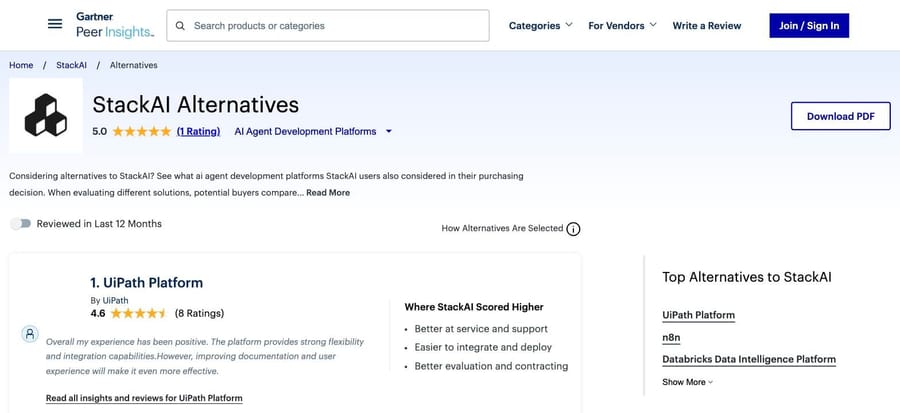
Most "why people leave" sections quote a pile of angry reviews. StackAI doesn't have one. On September 19, 2026 it had one rating on Gartner Peer Insights (5.0, from a partner at a $50M–$250M company, titled "Support And Flexibility Stand Out In Self-Developed ERP AI Chatbot Experience"), no reviews on Capterra, no Trustpilot page, and 4.5 out of 5 from 39 reviews on G2, with no pricing complaints among its top con tags. So the reasons below come from StackAI's own pricing and ownership, not from complaints, and we'd rather say that than invent a pattern.
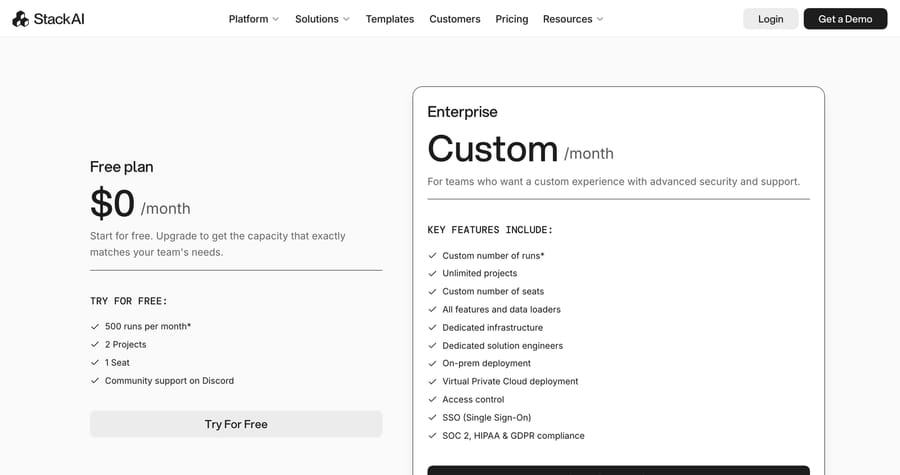
1. There's no self-serve paid plan. StackAI's pricing page lists a Free plan (500 runs a month, 2 projects, 1 seat, community support on Discord) and an Enterprise plan priced "Custom". A team that outgrows one seat goes straight to a sales conversation.
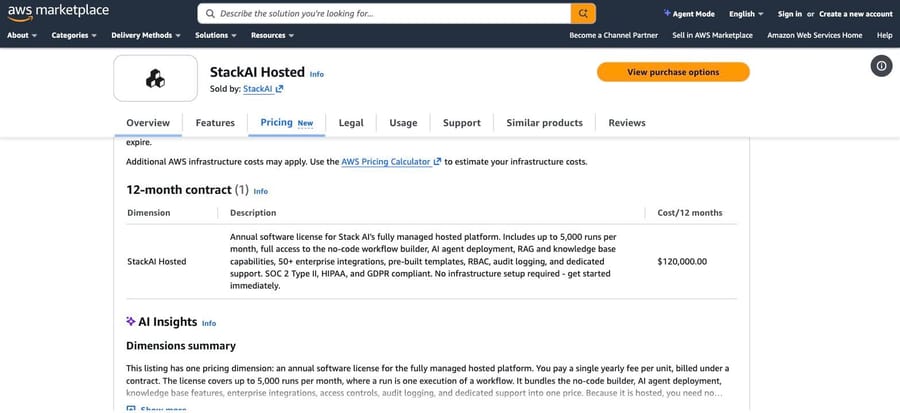
2. The one public price is $120,000 a year. StackAI's own AWS Marketplace listing, "StackAI Hosted", sells a single 12-month contract for $120,000, which "Includes up to 5,000 runs per month" plus the builder, knowledge base features, "50+ enterprise integrations", RBAC, audit logging and dedicated support. Used in full, that's 60,000 runs a year, or about $2 a run. Our Plan 1 guide cited a competitor's "five-to-six-figure" estimate; this is the vendor's own number.
The pricing shows StackAI's incentive. A free single seat costs it little and lets one builder prove a use case inside a large company; the revenue comes from the next step, an enterprise contract with dedicated solution engineers, on-prem or VPC deployment and SOC 2, HIPAA and GDPR compliance. That suits a regulated company buying for a department. It doesn't suit a ten-person team that wants to pay $50 a month.
3. It changed owners. Asana announced on May 28, 2026 that it "has completed the acquisition of StackAI" and says StackAI "continues to operate as its own product and brand." That's reassuring for now. If you're not an Asana customer, ask for roadmap and support commitments in writing at renewal.
4. It's built for internal workflows. Asana's release describes StackAI's customers as being "across financial services, healthcare, and professional services," and its workflows as connecting ERP, CRM and ITSM systems. If what you need is an agent that talks to customers on chat or voice, a platform built for that will get you there faster.
How do the Stack AI alternatives compare on price?
| Tool | Best for | Billing unit | Entry price | Free option |
|---|---|---|---|---|
| StackAI (for reference) | Regulated back-office workflows | Runs (annual contract) | Custom; AWS listing $120,000 a year | Free: 500 runs, 1 seat |
| n8n | Internal workflows, technical teams | Workflow executions | €20 a month billed yearly (2,500 executions) | Self-hosted Community edition |
| UiPath | Enterprise automation and RPA | Plan (Standard and Enterprise quoted) | Basic from $25 a month | Community, free forever |
| Microsoft Copilot Studio | Microsoft 365 companies | Copilot Credits | $30 a user a month for internal agents; credits for external | Trial |
| Voiceflow | Customer chat and voice agents | Usage credits | No public price; Vendr median $258,625 a year | Not shown on pricing page |
| Relevance AI | Sales and ops agents | Actions + Vendor Credits | $29 a month, $19 billed yearly | Free plan retired |
| Gumloop | No-code agents, many users | Credits + 8% fee | From $37 a month | 14-day trial |
| Zapier Agents | Light agents on common apps | Activities | $33.33 a month billed yearly | 400 activities a month |
| Dify | Open-source LLM app builder | Message credits | $590 a year per workspace | Sandbox; self-hosted Community |
Prices from each vendor's pricing page or docs on September 19, 2026.
What do 5,000 runs a month cost outside StackAI?
StackAI's AWS listing is priced around 5,000 runs a month, so that's the useful benchmark. Two alternatives bill in units close enough to compare:
| Option | How it counts | 5,000 runs a month |
|---|---|---|
| StackAI Hosted (AWS) | Up to 5,000 runs a month on a 12-month contract | $10,000 a month ($120,000 a year) |
| n8n Pro | One execution per workflow run, "regardless of complexity" | €50 a month billed yearly for 10,000 executions, plus your own model costs |
| Relevance AI Team | One Action per tool run; we assume 4 tools per run, so 20,000 Actions | $349 + 13,000 extra Actions at $80 per 1,000 = about $1,389 a month (estimate), with 35,000 Vendor Credits included |
These aren't like-for-like: StackAI's price includes dedicated support, enterprise integrations and compliance, and n8n's leaves model costs, hosting choices and engineering to you. The gap still shows what the contract is mostly paying for. The run itself is cheap; the enterprise wrapper is what costs $120,000.
What are the 8 best Stack AI alternatives?
1. n8n
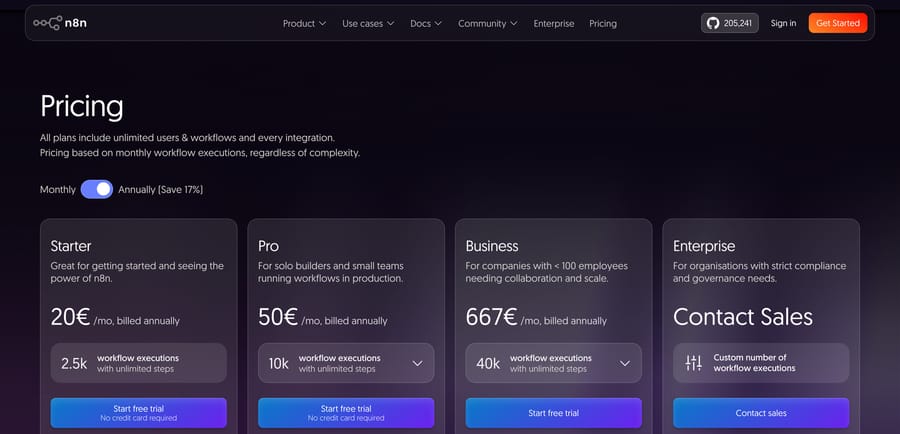
n8n is the closest match for StackAI's back-office use and the furthest from it on price. It bills "on monthly workflow executions, regardless of complexity": Starter is €20 a month billed yearly (€24 monthly) for 2,500 executions, Pro €50 for 10,000, Business €667 for 40,000, and "All plans include unlimited users & workflows and every integration." The Community edition is free to self-host, and Gartner users rate n8n 4.7 from 7 ratings on its StackAI alternatives page.
The watch-out is who does the work. n8n is a workflow builder with AI steps, closer to engineering than StackAI's no-code builder, and model calls go through your own API keys. Our n8n build guide shows what setting up an agent involves.
Choose it if you have someone technical and want StackAI's kind of workflow at a fraction of the contract price.
2. UiPath
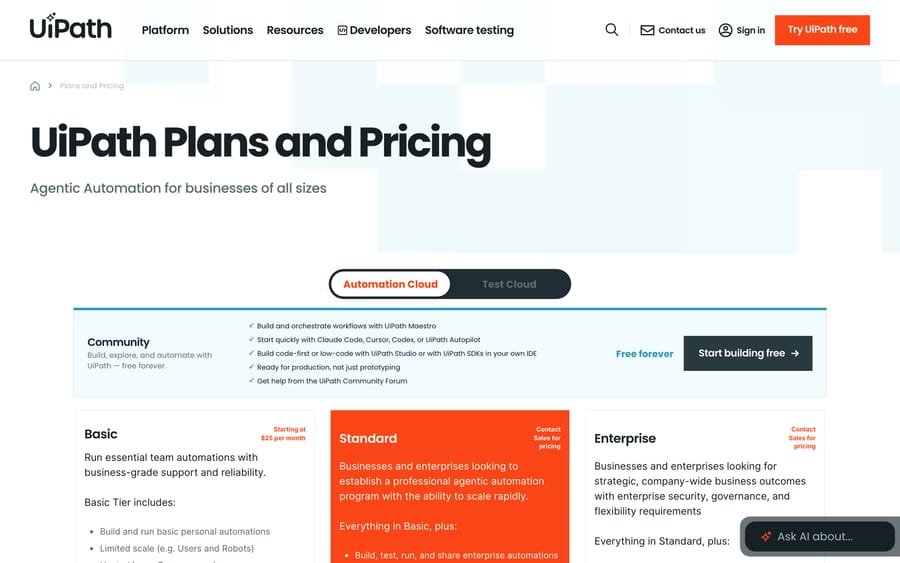
UiPath tops Gartner's list of StackAI alternatives (4.6 from 8 ratings) and is the AI Overview's "enterprise choice for agentic automation." Its pricing page offers a Community plan that's "free forever," Basic "Starting at $25 per month" with limited scale and hosting in Europe only, and Standard and Enterprise through sales, with agents, document extraction and on-premises options on the higher tiers.
It's a bigger platform than StackAI, built around robotic process automation as well as agents. That's a strength if you also automate desktop and legacy systems, and overhead if you only want an agent that reads documents and calls APIs.
Choose it if you already run automation at enterprise scale and want agents on the same governed platform.
3. Microsoft Copilot Studio
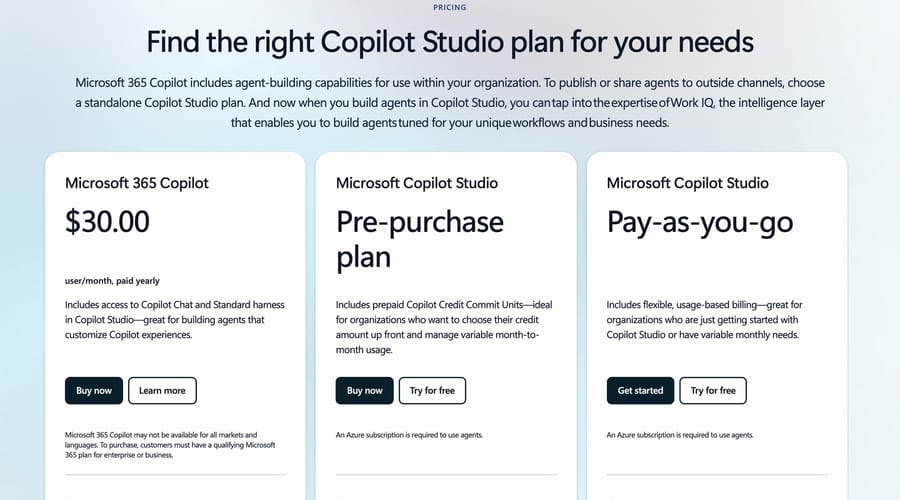
For a Microsoft shop, Copilot Studio covers much of StackAI's internal use. A Microsoft 365 Copilot seat, $30 a user a month paid yearly, "Includes access to Copilot Chat and Standard harness in Copilot Studio" for internal agents. Agents for external channels need Copilot Credits, bought as a pre-purchase plan ("Save up to 20%") or pay-as-you-go, and Microsoft's page lists capacity packs of 25,000 credits at $200 a pack a month. It also says "An Azure subscription is required to use agents."
The watch-out is forecasting: each agent action consumes credits at its own rate. Our Copilot Studio guide covers how the credits work.
Choose it if your data and people already live in Microsoft 365.
4. Voiceflow
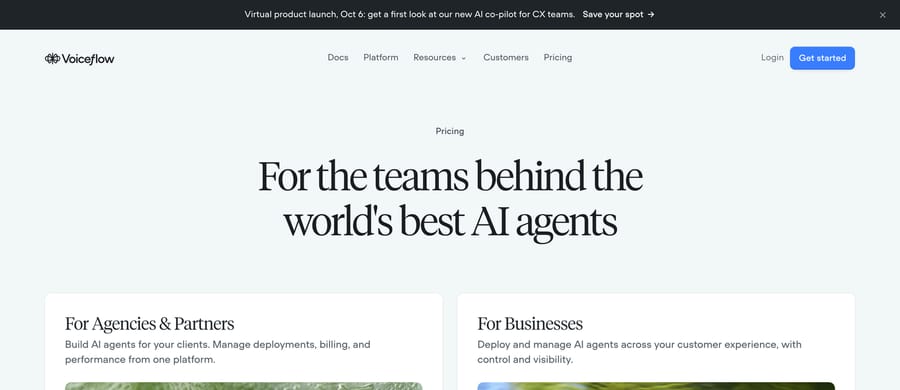
Voiceflow is the AI Overview's pick for "customer-facing chat and voice agents," which is the job StackAI isn't aimed at. It also wrote the page that ranks first for this search. Its public pricing page shows no numbers, just cards for agencies and businesses. Vendr, which negotiates software contracts for buyers, reports a median of $258,625 a year for Voiceflow, ranging from $56,040 to $322,250.
So for a large deployment, Voiceflow isn't cheaper than StackAI's AWS listing. It's a different tool: agents for customer conversations on chat and voice rather than back-office document workflows. Our Voiceflow guide covers it.
Choose it if your agents talk to customers on chat or phone.
5. Relevance AI
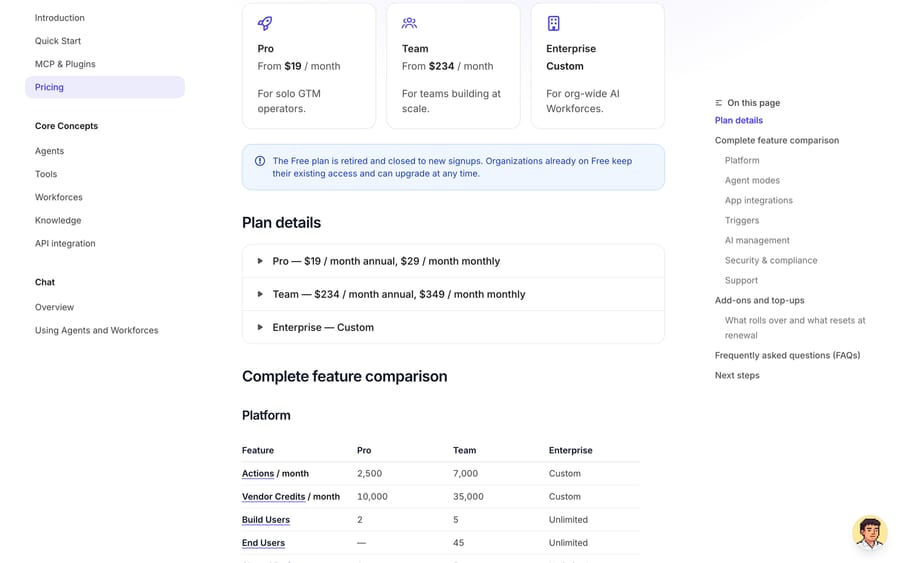
Relevance AI is the self-serve version of StackAI's promise, sold to sales and operations teams. Pro is $19 a month billed yearly or $29 monthly, with 2,500 Actions, 10,000 Vendor Credits and 2 build users; Team is $234 or $349 with 7,000 Actions, 5 builders and 45 end users. Enterprise is quoted, and the Free plan is closed to new signups.
The watch-out is two meters: Actions for every tool run and Vendor Credits for model use, which makes a multi-step agent harder to forecast than n8n's one execution per run. See our Relevance AI guide.
Choose it if a small team wants no-code agents today without an enterprise contract.
6. Gumloop
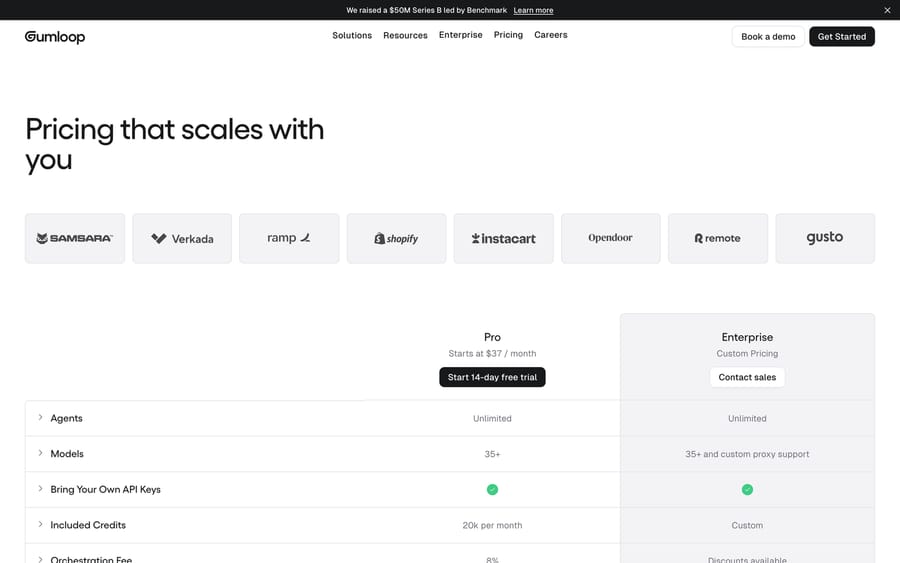
Gumloop sells a no-code builder with unlimited seats. Pro "Starts at $37 / month" with 20,000 credits, unlimited agents, bring-your-own API keys and an 8% orchestration fee on task costs, with a 14-day free trial. Enterprise is custom.
Unlimited seats answer StackAI's one-seat free plan. The watch-out is the credit pool: heavy workflows use it up, and the 8% fee earns Gumloop more as each task costs more.
Choose it if many people across the company need to build or run agents.
7. Zapier Agents
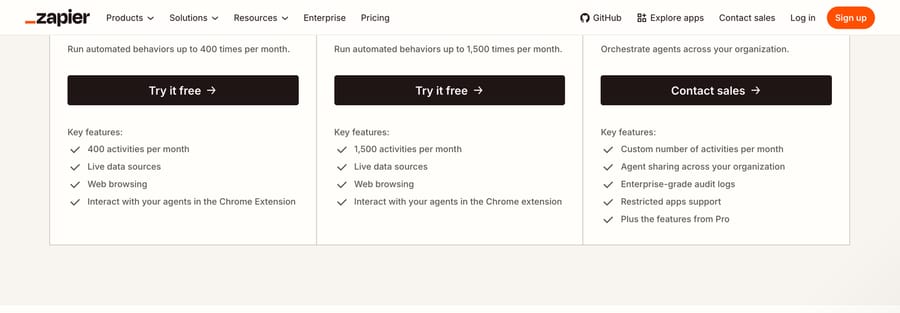
The AI Overview names Zapier for "user-friendly SaaS integrations." Zapier Agents run on its app catalog and bill in activities: Agents Free includes 400 a month, and Agents Pro is $400 billed annually ($33.33 a month) for 1,500. Enterprise adds custom activity counts, agent sharing across the organization and audit logs.
It's the lightest option here. At StackAI's 5,000 runs a month, several activities per run would push you to Enterprise.
Choose it if your agents are light and your company already runs on Zapier.
8. Dify
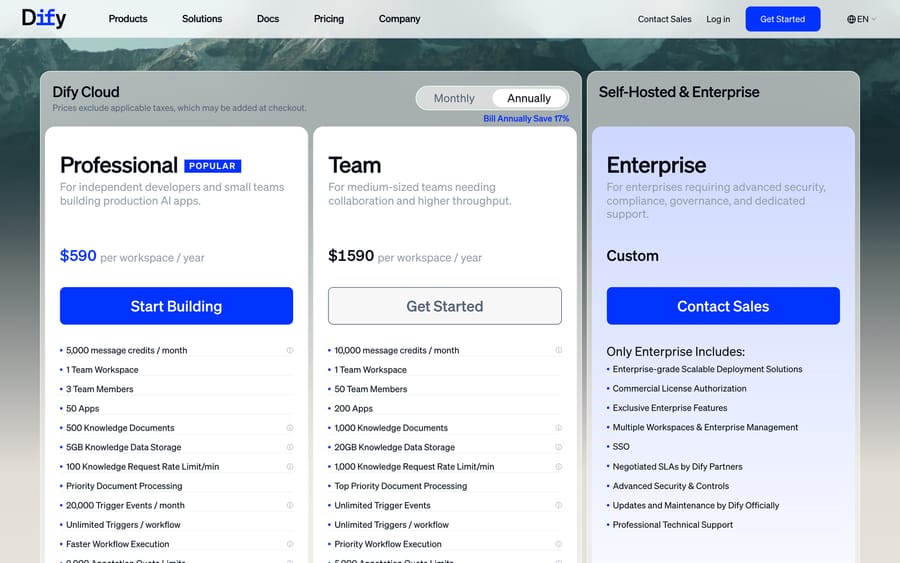
Dify is the open-source pick for developers building LLM apps and agents. Dify Cloud's Professional plan is $590 per workspace a year with 5,000 message credits a month, 3 team members and 50 apps; Team is $1,590 with 10,000 credits, 50 members and 200 apps. The Sandbox plan is free with 200 message credits.
Read the self-hosting terms before planning around them. Dify's page describes its free Community edition as "For open-source enthusiasts, individual developers, and non-commercial projects" and lists "Commercial License Authorization" under Enterprise.
Choose it if your team writes code and wants an open-source builder it can host, and you've checked the license for your use.
Also considered. Workato is the AI Overview's option for "complex team integrations." Amazon Bedrock (4.8 from 5 on Gartner), Databricks and LangSmith suit engineering teams building agents in code, and OutSystems suits companies already on its low-code platform. Flowise is another open-source builder.
What if your agents are for support tickets?
Asana's release lists customer support among the processes StackAI automates. If your support already runs in Zendesk, Freshdesk, Gorgias, Front, HubSpot or Intercom, you don't need a general agent builder for it. Macha fits teams already running one of those help desks: it's an AI agent layer on the help desk that reads each ticket, uses your knowledge and connected systems, and replies, tags or routes inside the help desk. It's priced per ticket, from $299 a month for 750 tickets (about $0.40 a ticket), with setup and monitoring by the Macha team; see pricing. Our overview of AI agents for customer service compares the routes.
Who should stay on StackAI
The things StackAI charges for are real requirements for some buyers: on-prem or VPC deployment, dedicated infrastructure, SOC 2, HIPAA and GDPR compliance, SSO and dedicated solution engineers who build alongside you. A bank, insurer or hospital automating document-heavy work in a regulated environment is who the $120,000 contract is priced for, and most of the cheaper tools above make you assemble those pieces yourself. Asana customers also get a vendor that's now part of the platform they already use. If that describes you, compare StackAI with UiPath and Copilot Studio rather than with $37-a-month builders.
What moves, and what doesn't, when you switch from StackAI?
- Workflows get rebuilt. Each builder has its own format, so plan to recreate agents node by node. Write down each workflow's inputs, tools and outputs before you start.
- Knowledge bases get re-indexed. Re-upload or reconnect the source documents in the new tool rather than moving embeddings.
- Connections get re-authorized. Salesforce, SharePoint and other system access is granted per tool.
- Front ends change. Any chat interface, Slack bot or form you published from StackAI needs replacing, and so do the links your users bookmarked.
- Keep a test set. Run the same 20 to 50 real inputs through the old and new agent and compare outputs before you switch users over.
How we researched this
On September 19, 2026 we captured StackAI's pricing page and each alternative's pricing page or docs, read StackAI's AWS Marketplace listing and Gartner's StackAI alternatives page in a browser, read Asana's investor release on the acquisition, and checked Vendr and the Microsoft marketplace. StackAI had one Gartner rating, no Capterra or Trustpilot reviews, and 4.5 from 39 on G2 (checked September 19, 2026) with no pricing complaints among its con tags, so this post has no user complaints to quote. We didn't create an account on StackAI or any alternative. The 5,000-run figures are our arithmetic, and the Relevance AI row assumes four tool calls per run.
Frequently asked questions
What are the best alternatives to Stack AI? For internal workflows on a budget, n8n. For enterprise automation with governance, UiPath. For Microsoft 365 companies, Copilot Studio. For customer-facing chat and voice, Voiceflow. For self-serve no-code agents, Relevance AI or Gumloop. For an open-source developer tool, Dify.
Is Stack AI free to use? There's a Free plan with 500 runs a month, 2 projects and 1 seat, with community support on Discord. Everything beyond it is the custom-priced Enterprise plan.
How much does Stack AI cost? StackAI doesn't list a paid price on its site. Its AWS Marketplace listing, StackAI Hosted, sells a 12-month contract for $120,000 that includes up to 5,000 runs a month, about $2 a run if you use them all.
Is there a free alternative to Stack AI? n8n's Community edition and Dify's Community edition can both be self-hosted at no cost (check Dify's license for commercial use), UiPath has a free Community plan, and Zapier Agents includes 400 activities a month free.
Who owns Stack AI? Asana. It completed the acquisition on May 28, 2026, and says StackAI continues as its own product and brand. The release didn't state a price; TechCrunch reported $75 million.
Stack AI vs n8n: which should I choose? StackAI is a no-code builder sold as an enterprise contract with compliance, deployment options and solution engineers. n8n is a workflow tool billed per execution from €20 a month, free to self-host, and more technical to use. Pick StackAI for regulated enterprise rollouts and n8n when you have builders and want low running costs.
Which Stack AI alternative is best for customer support? For customer chat and voice, Voiceflow. For tickets that already arrive in Zendesk, Freshdesk, Gorgias, Front, HubSpot or Intercom, an AI agent layer on the help desk such as Macha.
Which is better for developers than Stack AI? Dify, LangSmith and Amazon Bedrock suit teams building in code, and n8n suits technical teams who want a visual builder they can extend and self-host.
If your agents are meant to answer tickets in your help desk, start a Macha trial with $50 of free usage and no card, or see pricing.
Sources: StackAI pricing, StackAI Hosted on AWS Marketplace, StackAI on Gartner Peer Insights, Gartner: StackAI alternatives, Asana: Asana Acquires StackAI, TechCrunch on the acquisition, n8n pricing, UiPath pricing, Copilot Studio pricing, Voiceflow pricing, Vendr: Voiceflow, Relevance AI pricing docs, Gumloop pricing, Zapier Agents plans, Dify pricing.
Simple per-ticket AI pricing
One thread with one person is one charge, however many replies it takes.