Intercom
 Shopify
 Stripe
 Slack
Slack Notion
 Google Workspace
 Confluence

Best Wati Alternatives in 2026: 8 WhatsApp Platforms With Real Prices


The strongest Wati alternatives are respond.io, AiSensy, Interakt, Gallabox, SleekFlow, Trengo, Twilio and Meta's own WhatsApp Cloud API, and the right one depends on why you're leaving. Wati's reviewers complain about slow support, a hard exit when they cancel, a markup on every WhatsApp message and user caps on the cheaper plans.
Key takeaways
- respond.io is the closest swap for Wati at $99 a month on monthly billing, or $79 billed yearly, for 5 users and unlimited monthly active contacts, without Wati's message markup.
- For an 8-agent team sending 10,000 marketing and 5,000 utility templates to US numbers a month, Wati Pro costs $651.60 versus about $402 on respond.io Starter.
- Interakt answers the seat-cap complaint with unlimited agents on every plan, priced from ₹3,499 a quarter on Starter, though that tier limits users to owner roles.
- Twilio charges a flat $0.005 per WhatsApp message, inbound or outbound, on top of Meta's template fees, with no platform fee or seat price.
- From October 1, 2026, Meta charges for WhatsApp service messages at the utility rate, with 1,000 free service messages a month per business phone number, whichever provider sends them.

The best Wati alternative for most teams is respond.io, which costs $99 a month ($79 billed yearly) for 5 users and passes WhatsApp fees through at Meta's rates instead of adding Wati's 60–80% markup. Interakt suits large teams with unlimited agents, AiSensy suits Indian businesses on a budget, Trengo suits teams that also answer email, and Twilio or Meta's Cloud API suit developers. We checked every price on September 19, 2026 and rechecked respond.io, Wati, Trengo, Twilio and Meta on September 24, 2026. For what Wati itself does, read our Wati guide. This page is about leaving it, or deciding not to.
Which Wati alternative fits your reason for leaving?
| If your problem with Wati is… | Look at | Why |
|---|---|---|
| The markup on template messages | respond.io, Twilio, Meta Cloud API | They pass Meta's fees through with no margin (Twilio adds a flat $0.005 a message) |
| Paying per extra seat, or Growth's 3-user cap | Interakt, SleekFlow, Trengo | Interakt includes unlimited agents; SleekFlow and Trengo start at 10 users |
| A budget in rupees and a small team | AiSensy, Interakt | Free or low-cost entry plans and published India message rates |
| You also answer email and want one inbox | Trengo, respond.io | Both run email next to WhatsApp |
| Your support already lives in a help desk | The help desk's own WhatsApp channel, plus an AI agent layer | Keeps one queue instead of adding a second inbox |
Why do teams leave Wati?
Wati has 4.6 out of 5 on Capterra from 207 reviews, 3.1 on Trustpilot from 273, and 4.6 on G2 from 511 reviews, all checked September 19, 2026. The gap between the two sites is the story: Capterra reviewers mostly rate the product, and Trustpilot reviewers mostly rate what happened when something went wrong.
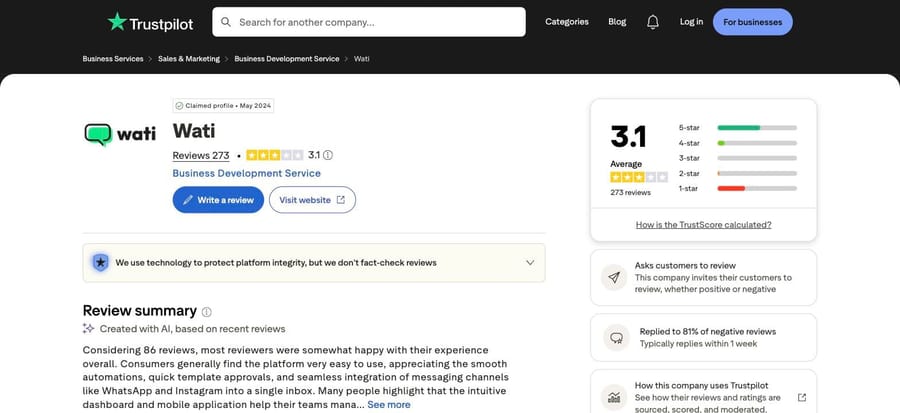
1. Support that goes quiet. This is the most common complaint in the Trustpilot sample. Reon, reviewing on September 9, 2026, wrote that Wati "Has to be the worst support system I have seen for any software or SaaS brands" and that "It will take days to sort out issues." Jose Arana, who runs a marketing agency, wrote on July 11, 2026 that the "time to wait for an answer to questions is approximately two or three days."
2. Getting out. Several reviewers describe cancellation as the hard part. Dennis Smits wrote on September 15, 2026 that Wati "Makes it purposfully extremely hard to cancel subscription" and that his team had spent two months trying to cancel while renewals kept being charged. On Capterra, Nicholas S., CEO of a 2–10 person internet company, wrote in November 2025 that "support becomes unresponsive once you request cancellation." Tarek Mohamad Al Haddad T., reviewing a free trial in April 2025, said Wati advertises monthly billing but will "force annual payments once you proceed to checkout."
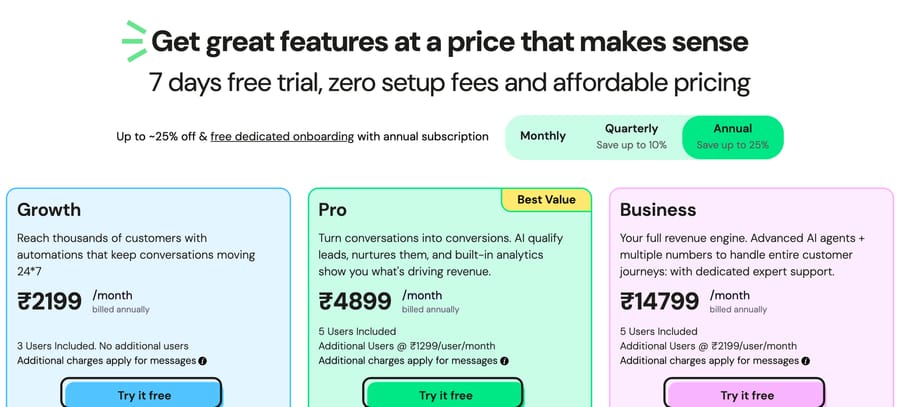
3. The message bill. Wati resells WhatsApp messages at its own rates. Our read of its July 2026 US rate card against Meta's own rate tool puts the Growth and Pro markup at 60% on marketing messages ($0.040 against Meta's $0.025) and 80% on utility ($0.00612 against $0.0034). Angad R., a financial services CEO who otherwise rates Wati five stars, put it more plainly on Capterra in April 2025: "Monthly service fee is on the higher side."
4. Seats. Growth includes 3 users and doesn't allow a fourth. Pro includes 5 and charges $24 for each extra user; Business charges $69.
5. WhatsApp account restrictions. Sphesihle Mhlongo wrote on September 12, 2026 that "Our WhatsApp business account got banned after connecting and testing 1 Astra agent from Wati." Thayatharn Deivendran wrote in August that after automation was connected, "our Meta Business was restricted and one of our telephone numbers was permanently blocked." Meta enforces its messaging policy on the business account, whichever provider sends the messages, so switching providers doesn't protect a number from a ban. What helps is testing new automation on a second number first.
How do the Wati alternatives compare on price?
| Platform | Entry price (billing) | Users included | Billing unit | WhatsApp message fees | Trial |
|---|---|---|---|---|---|
| Wati (for reference) | $69/mo US monthly; ₹2,199/mo India, billed annually | 3 (Growth, no extras) | Plan + seats + messages | Wati's own rates, 60–80% over Meta (US) | 7 days |
| respond.io | $99/mo monthly, $79 billed yearly | 5 (+$12 each) | Users; monthly active contacts from Growth up | "not included", paid at Meta's rates | 7 days, no card |
| AiSensy | Free; Basic ₹1,500/mo billed monthly | 1 owner + 5 agents on Basic | Plan + messages | India: marketing ₹1.09, utility ₹0.145 | Free plan |
| Interakt | Starter ₹3,499 a quarter | Unlimited (owner roles on Starter) | Plan + messages | India: marketing ₹0.949–₹0.970 by plan; no markup on Enterprise | Yes |
| Gallabox | ₹2,399/mo billed annually (₹2,999 quarterly) | 3 (hard cap) | Plan + AI credits + messages | Meta's fee "with our markup" | Free start, 500 AI credits |
| SleekFlow | US$139/mo monthly, US$109 billed yearly | 10 | Plan + monthly active contacts | SleekFlow rate card + US$15/mo per number | 7 days, no card |
| Trengo | €349/mo monthly, €299 billed annually | 10 | Plan + conversations | Service conversations included; templates billed per use | Yes |
| Twilio | No platform fee | None (it's an API) | Per message | Meta's fee + $0.005 per message | Free trial credit |
| Meta Cloud API | No platform fee | None (it's an API) | Per template message | Meta's rates only | n/a |
Prices checked September 19, 2026 on each vendor's pricing page. India-first vendors show rupee prices, and we've left them in rupees rather than convert.
What are the 8 best Wati alternatives?
1. respond.io
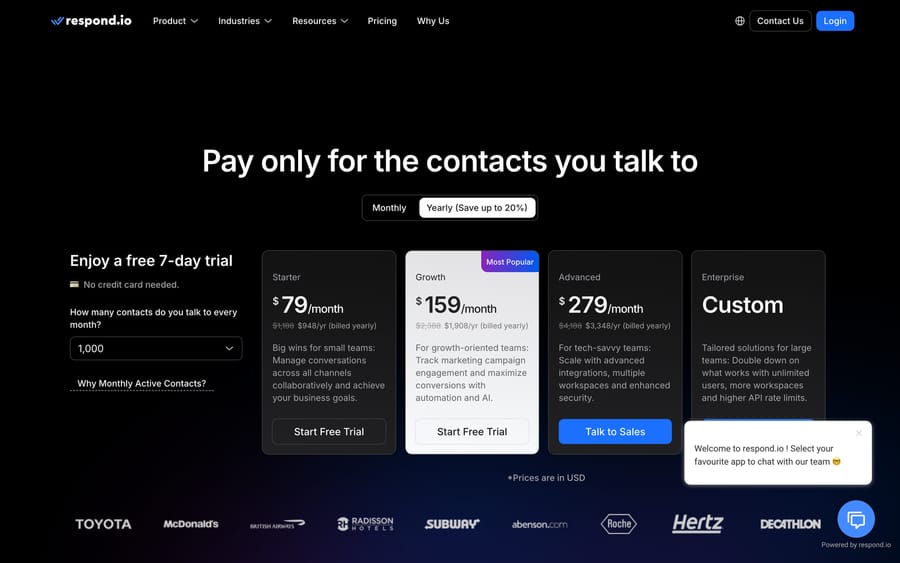
respond.io is the closest like-for-like swap for a team that wants an omnichannel inbox without a message margin. Starter costs $99 a month on monthly billing ($79 billed yearly) for 5 users and unlimited monthly active contacts, with extra users from $12. Growth, at $199 monthly or $159 billed yearly, is where respond.io's contact-based pricing starts, with 1,000 monthly active contacts. Its pricing page says "WhatsApp fees are not included in any respond.io subscription," so you pay Meta's rates for messages directly.
That's where the saving comes from. In our Wati pricing breakdown, an 8-agent team sending 10,000 marketing and 5,000 utility templates to US numbers pays $651.60 a month on Wati Pro and about $402 on respond.io Starter, almost all of the gap being Wati's message markup. The watch-out is the other billing unit on the bigger plans: from Growth up, respond.io charges by monthly active contacts, so a team that talks to many different people each month climbs tiers faster than its message count suggests. Several of Wati's own Capterra reviewers list respond.io as the alternative they considered or came from.
Choose it if you send a lot of template messages and want an inbox with email and social channels next to WhatsApp. Our respond.io guide covers the product.
2. AiSensy
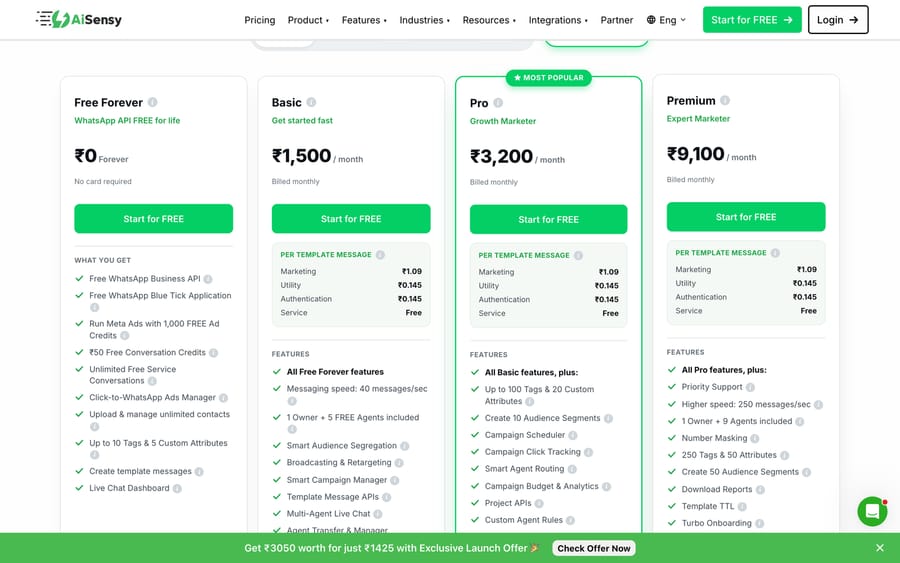
AiSensy is the cheapest way to stay on the WhatsApp API in India without Wati. Its Free Forever plan costs nothing, Basic is ₹1,500 a month billed monthly with one owner and five agents, Pro is ₹3,200 and Premium ₹9,100. The page prints the India per-message rates on every plan card: ₹1.09 per marketing message, ₹0.145 per utility or authentication message, and free service replies. Monthly billing on every paid tier answers the "forced annual" complaint directly.
The watch-out is scope. AiSensy is built around broadcasts, retargeting and click-to-WhatsApp ads, and its AI agent builder is a separate ₹1,350-a-month add-on with 1,000 AI messages. It publishes rates for Indian recipients on the card and links a spreadsheet for every other country, so check your market before you compare. AiSensy also wrote one of the listicles that ranks for this keyword and puts itself first.
Choose it if you're an Indian business running WhatsApp marketing on a tight budget and want to start free.
3. Interakt
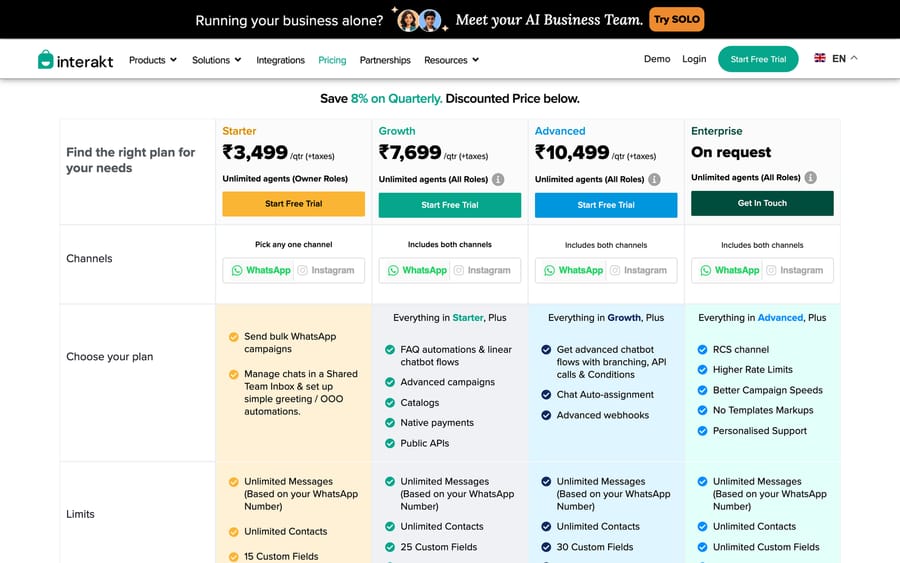
Interakt, run by Jio Haptik Technologies according to its site footer, answers the seat complaint most directly: every plan lists unlimited agents, though Starter limits them to owner roles. On quarterly billing Starter is ₹3,499 a quarter, Growth ₹7,699 and Advanced ₹10,499, plus taxes. Its message rates fall slightly as you move up (marketing in India costs ₹0.970 on Starter, ₹0.958 on Growth and ₹0.949 on Advanced), and the Enterprise plan promises "No Markup Charges."
That falling rate tells you how the plans are built. The platform fee is low and the margin sits in the message rate, which shrinks as you commit more. Starter also makes you pick one channel, WhatsApp or Instagram, and AI agents are an add-on on Growth and Advanced. Interakt is the "Switched from" answer on at least one of Wati's recent Capterra reviews, so the move runs both ways.
Choose it if your team is large and you'd rather not pay per seat. For the parent company's enterprise product, see our Haptik guide.
4. Gallabox
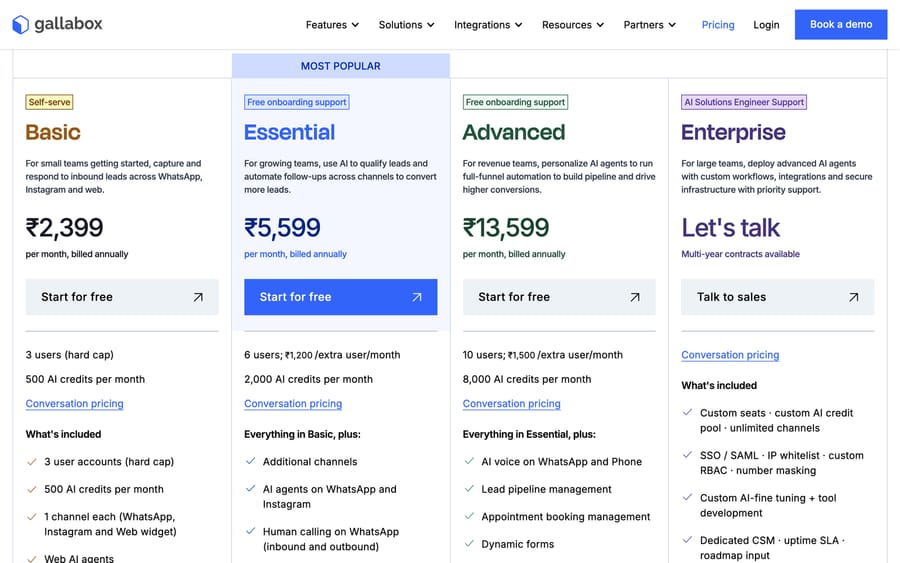
Gallabox sells to sales teams first, and its plans are built around AI credits for lead qualification. Basic is ₹2,399 a month billed annually (₹2,999 on quarterly billing) with a hard cap of 3 users and 500 AI credits. Essential is ₹5,599 with 6 users and ₹1,200 per extra user, and Advanced is ₹13,599 with 10 users. It says it is SOC 2 Type II compliant on the same page.
Two watch-outs. Gallabox offers only quarterly or yearly billing, so if Wati's annual push was your reason for leaving, this won't fix it. And its FAQ says WhatsApp conversation fees "are charged by Meta and reflected on your invoice with our markup," without publishing the percentage.
Choose it if you run WhatsApp as a sales channel and want AI lead qualification included in the plan rather than bought separately.
5. SleekFlow
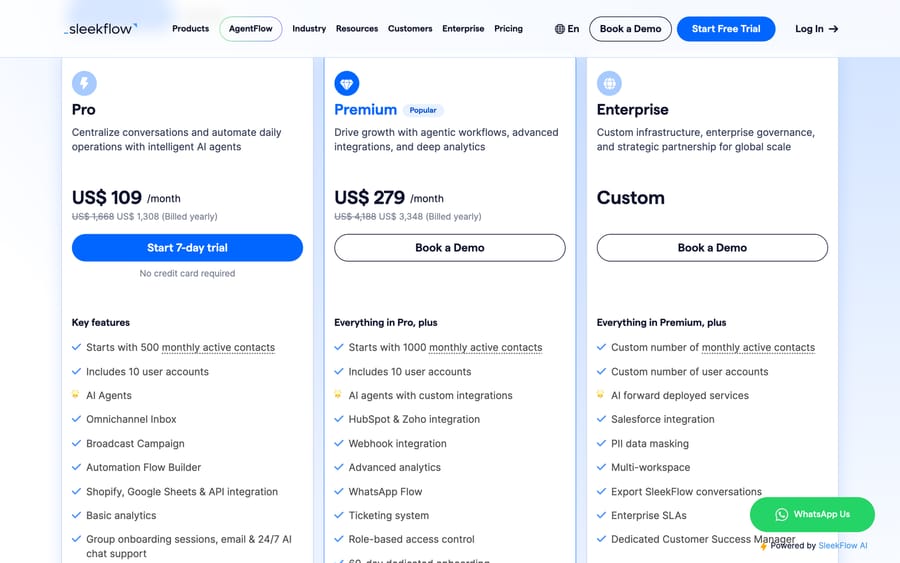
SleekFlow prices in US dollars even from India and includes 10 user accounts on both self-serve plans. Pro costs US$139 on monthly billing or US$109 a month billed yearly, with 500 monthly active contacts, AI agents, broadcasts and a flow builder. Premium is US$349 monthly or US$279 yearly and adds a ticketing system, HubSpot and Zoho integrations, and 60 days of dedicated onboarding. There's a 7-day trial with no card.
The watch-out is message pricing. SleekFlow charges US$15 a month to host each WhatsApp number and bills conversations "Per SleekFlow rate card," which isn't printed on the pricing page, so you can't compare its message margin with Wati's until you ask for the card. Premium also routes you to a demo rather than a checkout. SleekFlow wrote one of the ranking Wati-alternatives listicles.
Choose it if your team is 6 to 10 people and Wati's seat fees are what hurts. Get the rate card in writing first.
6. Trengo
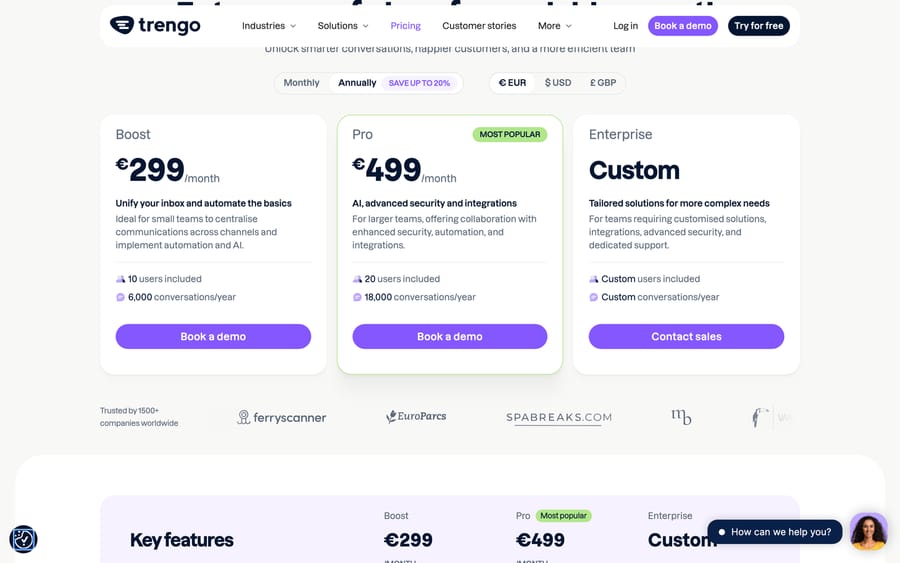
Trengo is a shared inbox where WhatsApp sits next to email, Instagram, Facebook and voice. That makes it the pick for a team whose support isn't only on WhatsApp. Boost costs €349 a month on monthly billing (€299 annually) with 10 users and 6,000 conversations a year; Pro is €599 (€499) with 20 users and 18,000. Extra conversations cost €18 per 100 on monthly billing, extra users €30 on Boost, and its AI charges €0.30 per conversation.
Trengo is the only platform here that says it includes "All WhatsApp service conversations" in the plan. That will matter more after October 1 (see below). The watch-out is the conversation cap: 500 conversations a month on Boost is small for a busy WhatsApp line, and the per-conversation AI surcharge stacks on top.
Choose it if you answer email and WhatsApp with the same team and want one queue in euros.
7. Twilio
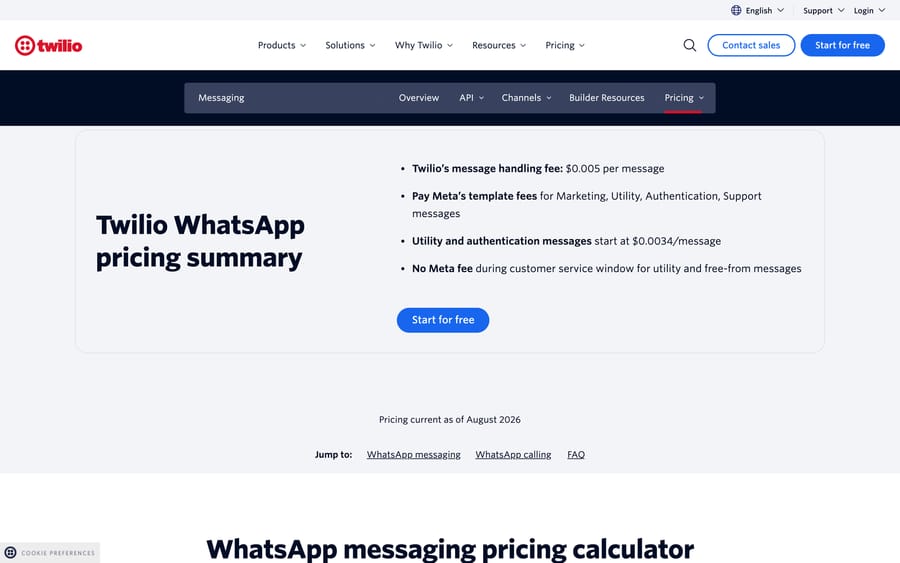
Twilio is the developer's route. It charges a flat $0.005 per message, inbound or outbound, on top of Meta's template fees, with no platform fee or seat price. For the same 8-agent US team, the messages cost $267 at Meta's rates plus $75 in Twilio fees, $342 in total.
The watch-out is everything around the messages. Twilio gives you an API, not a team inbox, chatbot builder or campaign tool, so someone has to build or buy those. The $0.005 also applies to every service reply, which Wati and the inbox vendors don't charge extra for.
Choose it if you have engineers, already use Twilio for SMS or voice, and want WhatsApp inside your own product.
8. Meta's WhatsApp Cloud API, direct
Meta's Cloud API is the price floor: you pay Meta's per-template rates and nothing else. For US numbers that's $0.025 per marketing message and $0.0034 per utility or authentication message. There's no inbox, no broadcast tool and no support desk beyond Meta's own, so in practice this suits the same technical teams as Twilio, minus Twilio's fee.
Choose it if you're building your own WhatsApp tooling and want the lowest message cost available.
Also considered. Gupshup and Infobip are enterprise messaging platforms that fit high-volume brands better than Wati's small-business buyers. Kommunicate is stronger on website and in-app chat than on WhatsApp. ManyChat appears in related searches but is built mostly for Instagram and Messenger marketing.
What changes on October 1, 2026, whichever provider you pick?
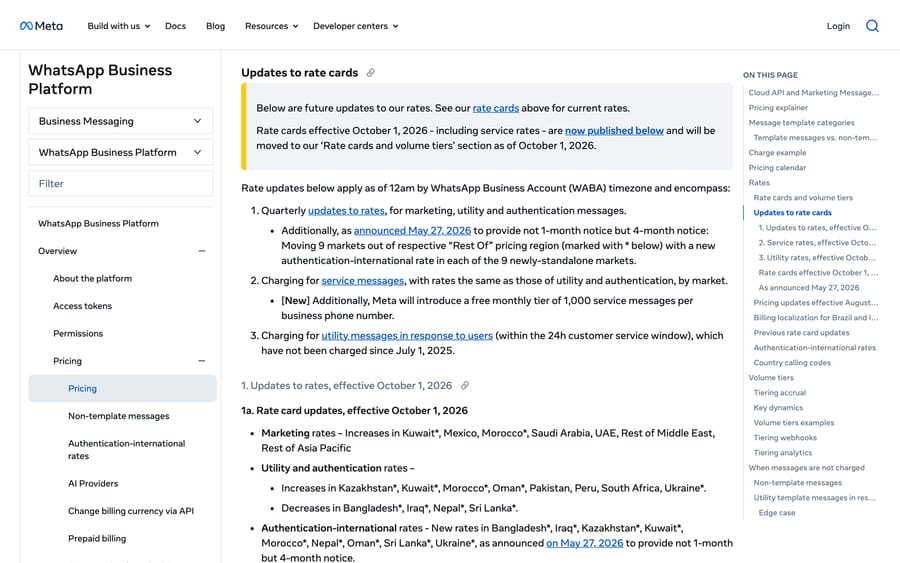
Meta's developer pricing documentation lists two changes effective October 1, 2026: "Charging for service messages, with rates the same as those of utility and authentication, by market," with "a free monthly tier of 1,000 service messages per business phone number," and charging again for utility templates sent in reply to a customer inside the 24-hour window. Wati's help center announced the same change for its own customers.
This matters for a support team more than for a marketing team, and it applies to every provider in this list, because Meta sets the rate. A US support line that sends 20,000 service replies a month will owe Meta (20,000 − 1,000) × $0.0034 = $64.60 for them, before any provider margin. Ask each provider two things before you move: whether it adds its own margin to service messages, and whether it passes the 1,000 free messages through per number. Trengo's "all WhatsApp service conversations" line is the only one on these pricing pages that covers the question, and it's worth confirming in writing.
Who should stay on Wati?
Plenty of teams should. Wati's 4.6 on Capterra comes from people using it every day, and the praise is consistent: quick setup, a clean inbox, click-to-WhatsApp ad tools and a Business plan with Google Ads integration. If you send mostly service replies rather than templates, the markup barely touches you today. If you're a team of three or fewer on Growth, the seat cap doesn't bite. And if your problem was a single slow support ticket, moving providers costs more than escalating it.
Wati's incentive is worth understanding before you decide. It earns a subscription that scales with seats and a margin on every template message, so heavy senders pay it mostly through messages. If most of your bill is messages, a pass-through provider saves money. If most of your bill is the plan, you'll save less by switching than the headline markup suggests.
What moves when you switch from Wati?
Your WhatsApp number can move. Meta's guide to migrating a phone number to a different WhatsApp Business Account says numbers keep their display name, messaging limits and Official Business Account status, and that "all eligible templates are automatically duplicated in the destination WABA." Two things don't carry cleanly:
- Template quality ratings reset: duplicated templates "start with an UNKNOWN rating," and you can't send affected templates until they finish migrating.
- Two-step verification has to be switched off on the number before the move starts.
What stays behind is Wati's own layer: chatbot flows, Astra AI agents, broadcast lists and analytics, and the inbox's conversation history, none of which Meta's migration covers. Export contacts and tags before you cancel, rebuild flows in the new tool, and plan the cutover so the number isn't mid-campaign. If you're leaving over billing, ask Wati in writing what happens to prepaid credit. Assaf Manor wrote on Trustpilot in August 2026 that after an automatic $950 charge during a downgrade, support "initially refused a cash refund, insisting on keeping my $950 as 'excess platform credit.'"
Where does Macha fit if your support runs in a help desk?
Most of this list is for teams whose WhatsApp line is its own inbox. If your support already runs through Zendesk, Freshdesk, Gorgias, Front, HubSpot or Intercom, there's a different option: connect WhatsApp to the help desk (our guide to WhatsApp in Zendesk shows how) and let an AI agent layer on the help desk work those tickets alongside email. Macha does that inside the ticket, from $299 a month for 750 tickets (about $0.40 a ticket), with setup and monitoring by the Macha team; see pricing. The help desk's WhatsApp channel still pays Meta's message fees. Our overview of AI agents for customer service covers the wider options.
How we researched this
On September 19, 2026 we loaded each vendor's pricing page in a browser and captured it, read Wati's reviews on Trustpilot and Capterra, and read Meta's developer pricing and number-migration pages. Wati's US prices and message markup come from our Wati pricing research the same day, which used Wati's own pricing data and rate cards. We also read G2 (Wati 4.6 from 511 reviews), Reddit blocked scripted access, and we didn't create an account on any of these platforms, so nothing here comes from a hands-on test. The 8-agent costs are our arithmetic on published rates.
Frequently asked questions
What is the best alternative to Wati? It depends on your reason for leaving. For lower message costs, respond.io, Twilio or Meta's Cloud API, which pass Meta's fees through without Wati's 60–80% markup. For large teams, Interakt with unlimited agents. For a free start in India, AiSensy. For email and WhatsApp in one inbox, Trengo.
Is there a free Wati alternative? AiSensy has a Free Forever plan with the WhatsApp API and a live chat dashboard, and Meta's Cloud API has no subscription at all. In both cases WhatsApp's own template message fees still apply.
Which is better, Wati or Interakt? Interakt is better for bigger teams because every plan includes unlimited agents, and its India message rates are published per plan. Wati has more mature ad and AI agent tooling and dollar pricing for international teams. Interakt's Starter plan limits you to one channel.
Which is better, AiSensy or Wati? For an Indian business on a budget, AiSensy: it has a free plan, monthly billing and India rates printed on the pricing page. Wati is the stronger pick outside India and for teams that want built-in AI agents, though its Astra agents cost extra too.
Is Wati an Indian company? Wati's site footer names Clare.ai Limited as the company, and its about page doesn't name a headquarters city. It is backed by Tiger Global, Sequoia Capital, DST Global and Shopify, according to that page. Much of its customer base is in India, and its pricing page shows rupee prices to Indian visitors.
Why do people leave Wati? On Trustpilot and Capterra the recurring reasons are slow support, difficulty canceling or getting refunds, the markup on WhatsApp messages, and user limits on the Growth plan. Wati still holds 4.6 out of 5 on Capterra from 207 reviews.
Can I keep my WhatsApp number if I switch from Wati? Yes. Meta lets you migrate a number to another provider's WhatsApp Business Account, keeping the display name, messaging limits, verified status and approved templates. Template quality ratings reset, and two-step verification must be off during the move.
Will switching providers avoid Meta's October 2026 charges? No. From October 1, 2026 Meta charges service replies at the utility rate after 1,000 free a month per number, whichever provider you use. Providers differ only in whether they add a margin on top.
What is a good substitute for WhatsApp itself? If you mean the messaging app, that's a consumer question outside this guide. If you mean another channel for business support, Instagram DMs, SMS and web chat are covered by respond.io, SleekFlow and Trengo from the same inbox.
If your WhatsApp conversations already land in Zendesk, Freshdesk, Gorgias, Front, HubSpot or Intercom, start a Macha trial with $50 of free usage and no card, or compare the tiers on our pricing page.
Sources: Wati pricing, Wati about page, Wati on Trustpilot, Wati on Capterra, respond.io pricing, AiSensy pricing, Interakt pricing, Gallabox pricing, SleekFlow pricing, Trengo pricing, Twilio WhatsApp pricing, Meta WhatsApp rate tool, Meta developer pricing documentation, Meta: migrate a number to a different WABA.
Simple per-ticket AI pricing
One thread with one person is one charge, however many replies it takes.