Intercom
 Shopify
 Stripe
 Slack
Slack Notion
 Google Workspace
 Confluence

Wati Pricing (2026): Plans, Real Costs and What You'll Actually Pay


Wati's plans cost $69, $149 or $349 a month for US customers on monthly billing ($59, $119 or $279 a month billed annually), but the plan is only part of the bill. Every WhatsApp template message is charged on top, and Wati's rate card prices those messages 60% to 80% above what Meta charges on the Growth and Pro plans. This guide lays out the plans and how they change by country, shows what 3, 8 and 15-agent teams pay once messages and seats are added, explains which charges grow fastest, and compares Wati with respond.io, Twilio and Meta's own API.
Key takeaways
- Wati charges $69, $149 or $349 a month for its Growth, Pro and Business plans in the US, but every WhatsApp template message is billed on top at Wati's own rates.
- On the Growth and Pro plans, Wati prices US marketing messages at $0.04 versus Meta's $0.025, a 60% markup, and utility messages at $0.00612 versus $0.0034, an 80% markup.
- Business plan message markups are lower, at 42% for marketing messages and 60% for utility messages, though the base plan itself costs $349 a month in the US.
- From October 1, 2026, Wati's help center says free-form service messages inside the 24-hour window become billable, with 1,000 free service conversations included per month.
- For an 8-agent team sending 15,000 US template messages a month, Wati Pro costs $651.60 versus about $402 on respond.io Starter, which bills WhatsApp fees separately without a markup.

Prices checked September 19, 2026 on Wati's pricing page and the per-message rate cards it links. Our Wati guide covers the product; this page covers what it costs, and corrects the plan prices and markup figure in that guide.
Wati pricing at a glance
| Plan | Monthly (US) | Annual (US, per month) | Users | Main limits | Message rates (US) |
|---|---|---|---|---|---|
| Growth | $69 | $59 ($708 a year) | 3, no extra users | 15,000 broadcasts a month, 1,000 automation triggers, 2 integrations, 250 AI Copilot credits | Marketing $0.040, utility $0.00612 |
| Pro | $149 | $119 ($1,428 a year) | 5, then $24 a user | Unlimited broadcasts, 2,000 automation triggers, 5 integrations incl. HubSpot, 500 AI Copilot credits | Marketing $0.040, utility $0.00612 |
| Business | $349 | $279 ($3,348 a year) | 5, then $69 a user | Unlimited broadcasts with volume discounts, 5,000 triggers, unlimited integrations incl. Salesforce, 1,500 AI Copilot credits | Marketing $0.0355, utility $0.00544 |
Prices checked September 19, 2026. There's a 7-day free trial on every plan, and the pricing page advertises "Up to ~25% off" for annual billing; the US figures work out to about 15% off on Growth and 20% on Pro and Business. Service replies inside the 24-hour customer service window cost nothing today, but see the October 1 change below.
Why the price you see depends on where you are
Wati's pricing page doesn't carry fixed numbers. It asks Wati's own pricing service for the plans that match the visitor's country, then fills them in. From our connection in India the page showed rupees:
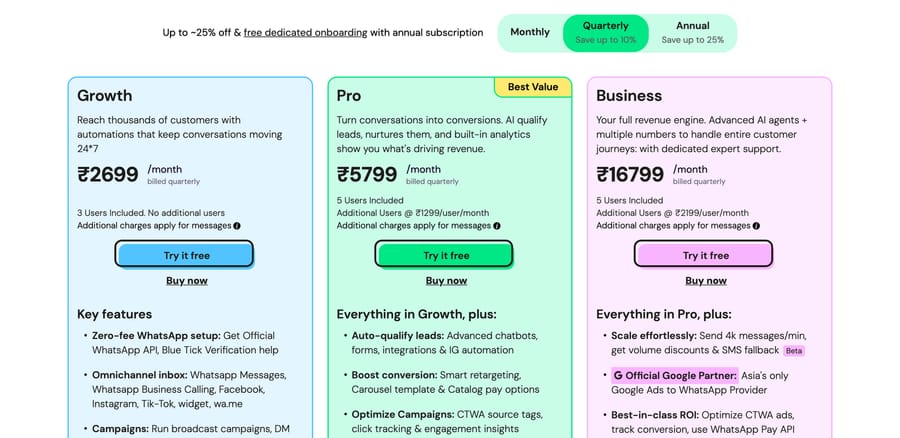
We queried the same service with other country codes on September 19, 2026:
| Region (country code we used) | Currency | Growth | Pro | Business |
|---|---|---|---|---|
| United States (US) | USD | $69 | $149 | $349 |
| United Arab Emirates (AE) | USD | $69 | $149 | $349 |
| United Kingdom (GB) | GBP | £59 | £129 | £289 |
| Indonesia (ID) | USD | $49 | $99 | $249 |
| India (IN) | INR | ₹2,999 | ₹6,499 | ₹18,499 |
All monthly billing. The US and Indonesia both pay in dollars, but Indonesia's Business plan is $100 cheaper. Treat any Wati price you read online, including ours, as specific to a region, and confirm yours on the live page. We couldn't load the page from a US address, so the US prices come from the data Wati's page loads, not from a screenshot.
What Wati charges per message
Since July 1, 2025, Meta has charged WhatsApp Business senders per template message, in three categories: marketing, utility and authentication. Service replies inside an open 24-hour window are free. Wati resells those messages from a prepaid credit balance at its own rates, published as PDFs linked from the pricing page.

Meta publishes its own rates in a rate tool on the WhatsApp Business site. For North America in US dollars it shows $0.0250 per marketing message and $0.0034 per utility or authentication message.
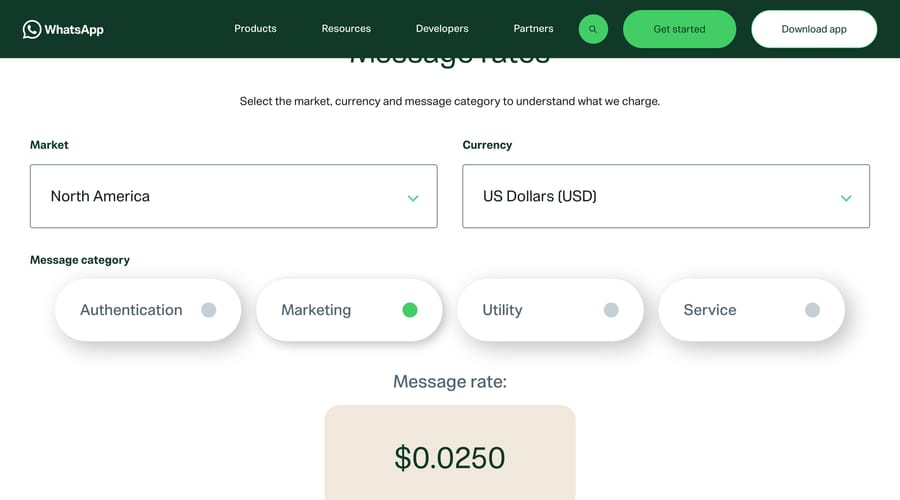
Set side by side, the markup is consistent on the two markets we could check in dollars:
| Message (recipient country) | Meta's rate | Wati Growth/Pro | Markup | Wati Business | Markup |
|---|---|---|---|---|---|
| Marketing (US) | $0.0250 | $0.0400 | 60% | $0.0355 | 42% |
| Utility or authentication (US) | $0.0034 | $0.00612 | 80% | $0.00544 | 60% |
| Marketing (UK) | $0.0635 | $0.1016 | 60% | ||
| Utility (UK) | $0.0220 | $0.0396 | 80% |
Our Wati guide, published before we checked the rate cards, described this as "roughly a 20% markup." On the Growth and Pro plans it's 60% on marketing and 80% on utility for the US and UK; Business narrows it to 42% and 60%. Wati's rate card also says conversations that start from a click-to-WhatsApp ad are free, and it charges US WhatsApp calls at $0.0145 a minute (business-initiated calling isn't available in the US). India isn't in this comparison: Wati's rate card for India-billed accounts is priced in rupees on its own schedule, not converted from the USD card, so a percentage markup against Meta's dollar rate isn't a like-for-like number. Don't assume the 60–80% US/UK markup carries over to India or any other market — check the rate for your own billing country before you budget.
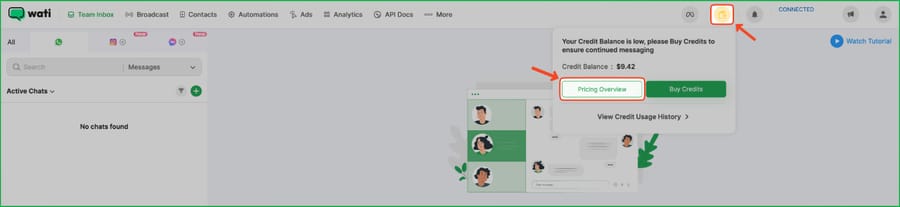
Messages draw down a prepaid wallet. Wati's help center shows the balance, a Pricing Overview with your current rates, and a credit usage history under the wallet icon in the inbox.
The October 1, 2026 change to check before you sign
Wati's help article on message-based pricing says two free categories end on October 1, 2026: "Effective October 1, 2026, free-form messages (service messages) sent within the 24-hour customer service window are billable per message for all plans," and utility templates sent inside the window "are billable again." It adds that "Meta provides 1,000 free service conversations per month" before charges apply.
We couldn't find that change on Meta's side. Meta's developer pricing page, fetched the same day, lists no change to service messages for October 2026, and Meta's rate tool still shows service messages at $0.0000. Wati's own rate card (updated July 1, 2026) still says service conversations are free. For a support team, service replies are most of the traffic, so ask Wati in writing whether service messages will be charged from October 1, at what rate, and whether the charge is Meta's or Wati's.
What Wati costs at three team sizes
We modeled three US teams on monthly billing, counting only template messages (service replies free, as they are today), each on the cheapest plan that fits its headcount:
| Small | Mid | Large | |
|---|---|---|---|
| Agents | 3 | 8 | 15 |
| Marketing messages a month | 2,000 | 10,000 | 50,000 |
| Utility messages outside the window | 1,000 | 5,000 | 20,000 |
| Plan | Growth $69 | Pro $149 + 3 × $24 = $221 | Pro $149 + 10 × $24 = $389 |
| Marketing at $0.040 | $80.00 | $400.00 | $2,000.00 |
| Utility at $0.00612 | $6.12 | $30.60 | $122.40 |
| Month on Wati | $155.12 | $651.60 | $2,511.40 |
| Same messages at Meta's rates | $53.40 | $267.00 | $1,318.00 |
| Wati's markup on messages | $32.72 | $163.60 | $804.40 |
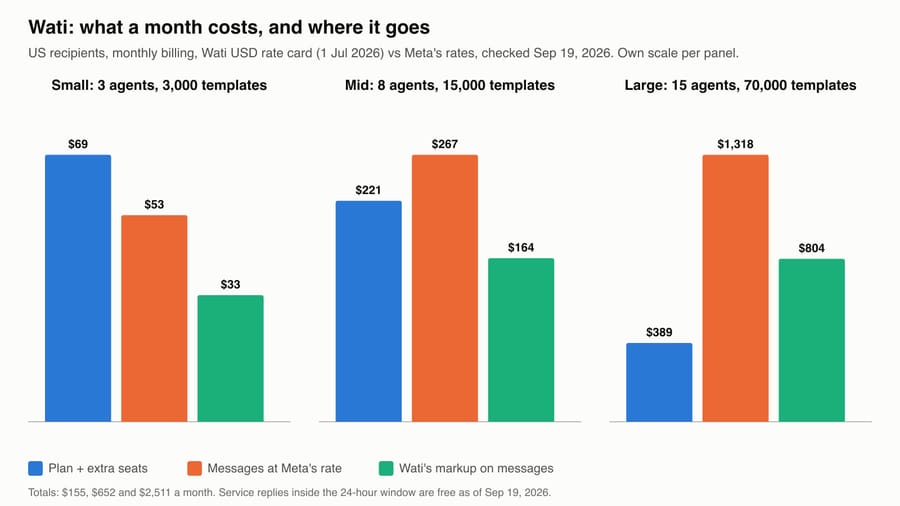
Three things stand out. Growth stops at three users with no extras, so a fourth agent forces Pro. Past a few thousand messages, messages cost more than the plan; at the large size the plan is 15% of the bill. And the markup grows with volume while the plan fee doesn't: at 50,000 marketing messages, Wati's margin on messages is about twice its Pro subscription with seats.
Business doesn't pay off at these volumes. At 15 users it costs $1,039 a month with seats ($349 + 10 × $69) against Pro's $389, and its lower rates save $0.0045 per US marketing message. That $650 gap takes about 144,000 US marketing messages a month to close, before Business's "volume discounts," which Wati doesn't publish.
What drives a Wati bill up
- Marketing messages. They're the most expensive category and carry the 60% markup on Growth and Pro. A broadcast to 10,000 US contacts costs $400 on Wati against $250 at Meta's rate.
- Recipient country. Rates follow the recipient. Wati's Growth/Pro card charges $0.2555 per marketing message to the Netherlands and $0.2184 to Germany, against $0.04 to the US.
- Seats. Growth is capped at 3 users. After that, each user is $24 a month on Pro and $69 on Business.
- Region. The same plan costs $349 in the US and $249 in Indonesia, and currencies differ elsewhere.
- Add-ons. Pro advertises Astra AI agents as an add-on "priced separately"; the page doesn't list the price. Extra WhatsApp numbers and AI Copilot credits beyond the plan's allowance are also extra, and a custom subdomain is $50 one-time.
- Service messages from October 1, 2026, if the change in Wati's help article applies to you.
What the billing model rewards
Wati earns twice on a customer: a subscription that scales with seats, and a margin on every message that scales with volume. The subscription fee is small at volume, so most of what Wati earns from a heavy sender comes from the message margin. That gives Wati an incentive to make sending easy and plentiful (unlimited broadcasts on Pro, campaign tools, click-to-WhatsApp ads), which is also what its customers want, up to the point where they compare their message bill with Meta's rates.
For a support team, the incentive cuts differently. Support is mostly service replies, which are free today, so the margin sits on the utility templates you send after the window closes (order updates, follow-ups) and on any marketing you run. If service messages become billable from October 1, the margin moves onto support traffic too.
The credit wallet adds friction on the way out. Reviewers below report refunds refused and, in one case, unused credits kept.
What users say about the price
Wati holds 4.6 out of 5 on Capterra from 207 reviews, 3.1 on Trustpilot from 273 reviews, and 4.6 on G2 from 511 reviews (all checked September 19, 2026).
Reviewers who like the product mention cost as a trade-off. Yashraj J., an IT manager at a furniture company who has used Wati for over two years, wrote on Capterra in December 2025 that it's "a little bit costly but its giving a lot of features."
The complaints are about leaving. Nicholas S., a CEO at a 2–10 person internet company, wrote on Capterra in November 2025 that "support becomes unresponsive once you request cancellation." Ramon F., a hospitality CEO, wrote in August 2026 that his refund request was declined and "We also still had approximately USD 50 in unused conversation credits, but this balance was not refunded either." On Trustpilot, Assaf Manor titled his August 10, 2026 review "Flawed downgrade process leads to automatic $950 charge & refused cash refund."
Before you buy an annual plan or a large credit top-up, ask for the cancellation, downgrade and credit-refund terms in writing.
How Wati compares on price
We priced the mid-size team (8 agents, 10,000 marketing and 5,000 utility messages to US numbers, monthly billing) on the closest alternatives, from their live pricing pages on September 19, 2026:
| Option | What you pay for | 8 agents, 15,000 US templates |
|---|---|---|
| Wati Pro | $149 plan + $24 per extra user; messages at 60–80% over Meta | $221 + $430.60 = $651.60 |
| Wati Business | $349 plan + $69 per extra user; messages at 42–60% over Meta | $556 + $382.20 = $938.20 |
| respond.io Starter | $99 a month (5 users, +$12 each) at 1,000 monthly active contacts; WhatsApp fees billed separately | $135 + $267 at Meta's rates = $402, rising with active contacts |
| Twilio | $0.005 handling fee per message plus Meta's fees; no inbox | $75 + $267 = $342, plus $0.005 on every service message |
| Meta Cloud API, direct | Meta's rates only; no inbox, you build the tooling | $267 |
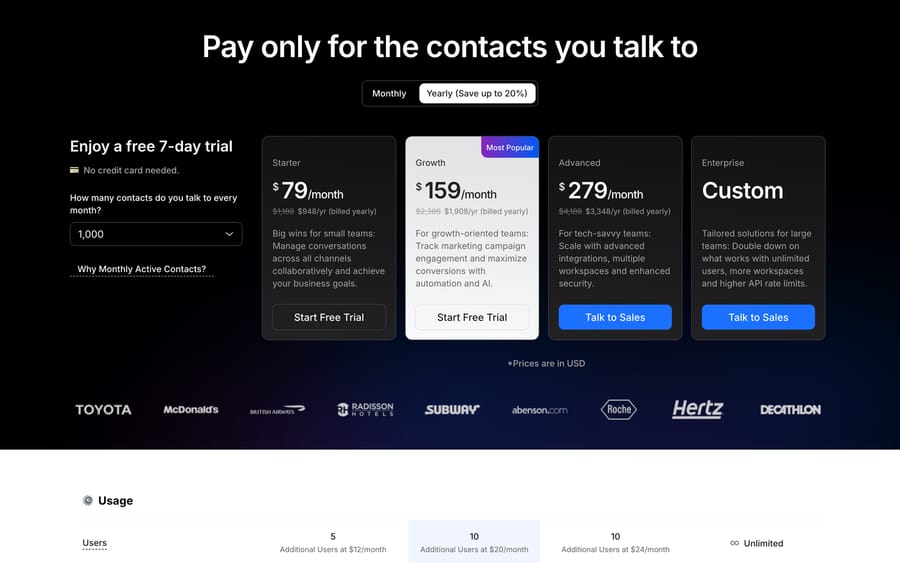
respond.io prices by users and monthly active contacts instead of message margin; its pricing page says "WhatsApp fees are not included in any respond.io subscription." At this volume that's $250 a month cheaper than Wati Pro, and the gap widens as messages grow. Our respond.io guide covers what its plans include.
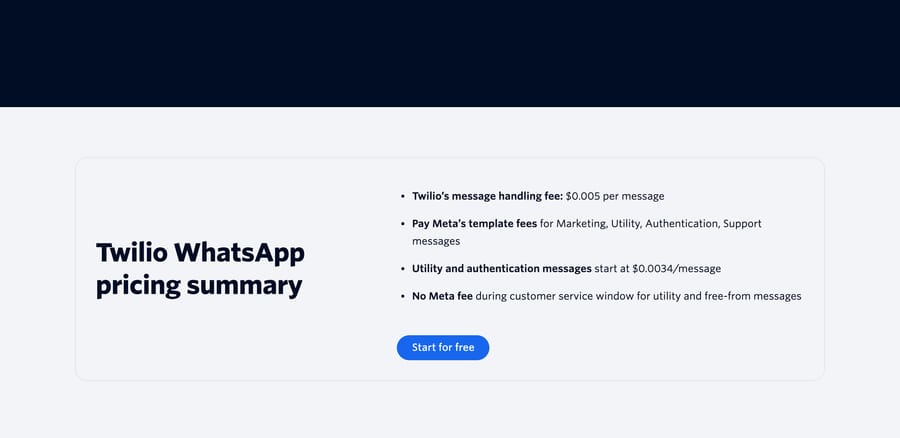
Twilio charges $0.005 per message, inbound or outbound, on top of Meta's fees, with no platform fee and no team inbox, so it suits teams with developers who'll build or buy the front end. Meta's Cloud API direct is the floor: Meta's rates and nothing else. For website and in-app chat rather than WhatsApp, Kommunicate publishes its prices too.
Wati's case is the product around the messages: a shared inbox, broadcasts, click-to-WhatsApp ads, chatbots and AI agents for a team without developers. The question is whether that's worth the message margin ($33 to $804 a month at our three sizes), on top of the subscription.
Where Macha fits
Wati is a WhatsApp inbox and campaign tool. Macha fits teams whose support already runs through a help desk: it's an AI agent layer on Zendesk, Freshdesk, Gorgias, Front, HubSpot or Intercom that works the tickets there, including WhatsApp conversations that the help desk's own integration turns into tickets (see our guides to WhatsApp in Zendesk and WhatsApp in Freshdesk). Macha bills per ticket, one charge per thread however many replies it takes, from $299 a month for 750 tickets, about $0.40 a ticket, with setup and monitoring by the Macha team (pricing). The help desk's WhatsApp connection still pays Meta's message fees. Our overview of AI agents for customer service covers how the pieces fit.
How we researched this
We checked Wati's pricing page in a browser on September 19, 2026 (it showed rupees from our location in India), then queried the pricing service the page itself calls with US, UK, UAE, Indonesian and Indian country codes. We read Wati's USD rate cards for the Growth/Pro and Business plans, checked Meta's rate tool for North America, the UK and India, and read Wati's help article on message-based pricing. Ratings and quotes come from Capterra and Trustpilot the same day; we also read G2 (4.6 from 511 reviews). We didn't create a Wati account, so the wallet image is from Wati's help center, and the monthly costs are our arithmetic on published rates at volumes we chose.
Frequently asked questions
How much does Wati cost per month? For US customers, Growth is $69, Pro $149 and Business $349 a month on monthly billing, or $59, $119 and $279 a month billed annually. WhatsApp messages are charged on top from a prepaid balance, and prices differ by country.
Does Wati charge per message? Yes. Wati charges for every marketing, utility and authentication template message at its own rates. For US recipients on Growth or Pro that's $0.04 per marketing message and $0.00612 per utility or authentication message. Service replies inside the 24-hour window are free as of September 19, 2026.
How much does Wati mark up WhatsApp messages? On Growth and Pro, Wati's US and UK rates are 60% above Meta's for marketing and 80% above for utility. The Business plan's US rates are 42% and 60% above Meta's. Wati bills India-based accounts from a separate rupee-denominated rate card, so this dollar markup doesn't carry over to India.
Why is Wati's price different in India? Wati prices by region. From India the page shows rupees: Growth ₹2,999 a month, or ₹2,699 billed quarterly. US visitors get dollar prices, and Indonesia gets lower dollar prices than the US.
Does Wati have a free trial? Yes, 7 days on every plan with no setup fee. In India there's also a pay-as-you-go option: a one-time ₹999 that becomes message credits.
Can I add more users to the Wati Growth plan? No. Growth includes 3 users and doesn't allow extras. Pro includes 5 and charges $24 for each additional user; Business includes 5 at $69 each after that.
Will Wati start charging for service messages? Wati's help center says service messages and in-window utility templates become billable from October 1, 2026, with 1,000 free service conversations a month. Meta's own pricing page didn't list that change when we checked, so confirm with Wati before relying on either.
Is Wati cheaper than respond.io? Not at volume. For 8 agents sending 15,000 US template messages a month, we calculate $651.60 on Wati Pro and about $402 on respond.io Starter, mostly because respond.io bills WhatsApp fees separately without Wati's markup.
What are Wati's hidden costs? None are hidden, but three sit outside the plan price: the markup on every template message (60–80% over Meta on Growth and Pro), extra users at $24 or $69 a month, and add-ons such as Astra AI agents and extra numbers. Message costs overtake the plan fee after a few thousand messages a month.
How much does WhatsApp itself cost a business? Meta charges per template message by category and recipient country: for US numbers, $0.025 per marketing message and $0.0034 per utility or authentication message, with service replies free inside the 24-hour window. Platforms like Wati add their own fee or markup on top.
Are Wati credits refundable? Wati's pricing page doesn't say. Two Capterra and Trustpilot reviewers in 2026 report refunds declined, including about $50 of unused credits, so ask before buying a large top-up.
If your WhatsApp and email support already lands in Zendesk, Freshdesk, Gorgias or Front, start a Macha trial with $50 of free usage, or compare the tiers on our pricing page.
Sources: Wati pricing, Wati help: message-based pricing, Wati USD rate cards for Growth/Pro and Business (linked from the pricing page, updated July 1, 2026), Meta WhatsApp rate tool, Meta developer pricing documentation, Capterra Wati reviews (capterra.com/p/204314, read in a browser; it blocks our link checker), Trustpilot Wati reviews (trustpilot.com/review/wati.io, read via fetch; it blocks our link checker), respond.io pricing, Twilio WhatsApp pricing.
Simple per-ticket AI pricing
One thread with one person is one charge, however many replies it takes.