






 Shopify
 Stripe
 Slack
 Notion
 Google Workspace
 Confluence


Who Are Intercom's Competitors in 2026? The Full Landscape by Category


Intercom's closest competitors in 2026 are Zendesk and Freshdesk among full help desk suites, Salesforce Service Cloud at the enterprise end (now, oddly, Intercom's owner), Help Scout and HubSpot Service Hub for simpler or CRM-led teams, Crisp and Tidio for chat-first small businesses, Gorgias and Front for ecommerce and shared-inbox teams, and Decagon and Sierra on the AI agent side, where Fin is Intercom's real product now. They compete on different axes, so this page is an unranked landscape that sorts them by the job they're hired for. Every price was read on the vendor's own page on November 21, 2026.
Key takeaways
- Intercom renamed the company Fin on May 12, 2026, and Salesforce completed its acquisition of Fin on September 10, 2026, while the help desk product keeps the Intercom name.
- Intercom charges $19, $85 or $132 per seat a month plus $0.99 per Fin outcome, so its competitors attack either the seat price or the per-outcome AI meter.
- Zendesk's AI agents cost $2.00 per automated resolution pay-as-you-go, Help Scout's AI resolutions cost $0.75, and Front's Autopilot starts at $0.39 a conversation, all checked November 21, 2026.
- Decagon and Sierra compete with Fin for enterprise AI agent deals, sell through sales demos, and publish no prices on their homepages.
- Macha competes with Fin without replacing Intercom: the Macha team builds and runs AI agents inside the Intercom inbox at about $0.40 per ticket, with setup included on the trial and every plan.
| Competitor | Category | Competes with Intercom on | Who picks it over Intercom | Entry price (vendor page, Nov 21, 2026) |
|---|---|---|---|---|
| Decagon | Enterprise AI agent | Fin, for large AI deals | Enterprises wanting a custom-built agent | Not published |
| Sierra | Enterprise AI agent | Fin, outcome-based contracts | Consumer brands with voice and chat at scale | Not published (outcome-based) |
| Zendesk | Full help desk suite | Omnichannel depth, ecosystem | Teams with heavy email and phone | $19 an agent (Support Team) |
| Freshdesk Omni | Full help desk suite | Price per seat, Freddy AI | Cost-conscious multichannel teams | $29 an agent (Growth) |
| Salesforce Service Cloud | Enterprise suite (Intercom's owner) | CRM-native service | Salesforce shops | $25 a user (Starter Suite) |
| Help Scout | Simpler help desk | Price, human-first email | Small B2B and services teams | Free for 5 users; $25 a user |
| HubSpot Service Hub | CRM-led help desk | One CRM for sales and support | HubSpot marketing and sales users | Free for 2 users; $7 a seat |
| Crisp | Chat-first | Flat workspace price | Small teams and startups | Free for 2 seats; $45 a workspace |
| Tidio | Chat-first | Cheap chat plus Lyro AI | Small online stores | Free plan; $33 a month |
| Gorgias | Ecommerce help desk | Shopify depth, per-ticket price | Shopify brands | $40 a month for 50 tickets, AI Agent on |
| Front | Shared inbox | Email collaboration | Ops teams living in email | $25 a seat (Starter) |
| Intercom (the incumbent) | AI-first help desk | n/a | Product-led SaaS with in-app users | $19 a seat (Essential) plus $0.99 per Fin outcome |
If you've already decided to leave and want a ranked shortlist with a cost model, our cheaper Intercom alternatives guide does that, and the best Intercom Fin alternatives covers AI agents only. This page is the landscape: who competes with Intercom, on what, and where Intercom still wins. The numbers below are for navigation, not a ranking.
How did we map the landscape?
We grouped products by the job a team hires them for, because Intercom fights different battles with different rivals. A Shopify brand comparing it to Gorgias is asking about order data. An enterprise comparing Fin to Decagon is asking about AI deployment. A five-person startup comparing it to Crisp is asking about the bill.
For each competitor we noted the axis it competes on, who picks it over Intercom, and the entry price from its own pricing page, read on November 21, 2026. We list only public prices. Where a vendor publishes none, we say so. We didn't use review-site star ratings, because G2 and Capterra block our fetches and a rating we can't check isn't worth printing. Where Reddit threads show a pattern, we paraphrase and link them.
Where does Intercom sit in the market?
Intercom built the in-app Messenger category, then bet the company on AI. Two 2026 events reshaped it. On May 12, the company renamed itself Fin, after its AI agent; Intercom's announcement says "Intercom will live on as our customer service software platform, but Fin is our future." On September 10, Salesforce completed its acquisition of Fin. Salesforce's release says Fin will operate as part of its AI Labs and sit alongside Agentforce. It doesn't say how the products will merge.
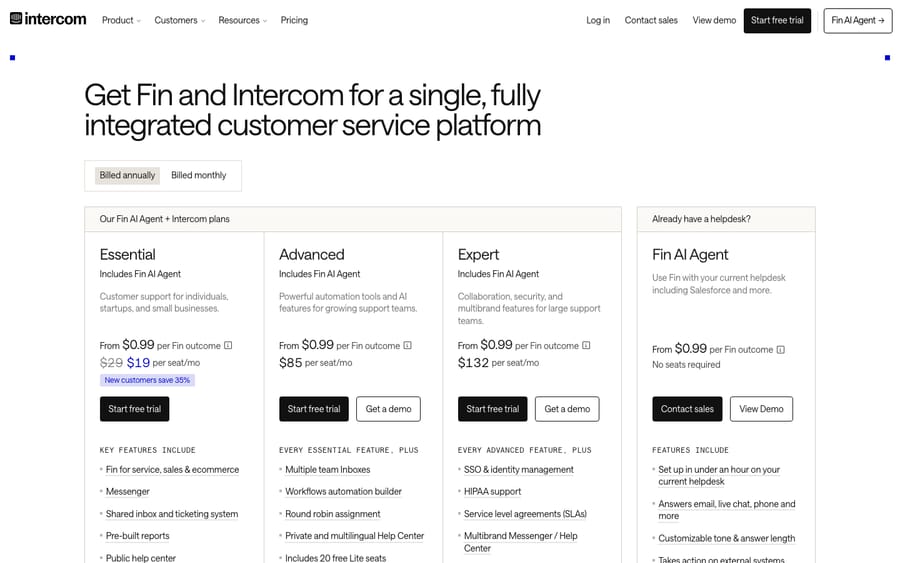
The pricing shows what Intercom optimizes for. Intercom's pricing page showed Essential at $19 a seat for new customers (marked down from $29), Advanced at $85 and Expert at $132 on November 21, 2026, with Fin at $0.99 per outcome on every plan. The seat price has been falling while the AI meter holds. That's the incentive in plain view: the company earns more as Fin handles more conversations, and the seat becomes the entry ticket.
So Intercom's competitors come at it from two sides. Help desks compete on the seat, the inbox and the channels. AI agent vendors compete on Fin. More details on how the bill builds up are in our Intercom pricing explainer, and the company history is in what Intercom is.
Keep Intercom, add AI agents: where Macha fits
Disclosure: we make Macha. It isn't a help desk, so it isn't one of Intercom's competitors in the sections below and we don't number it. It competes with Fin, for teams that want to keep Intercom and change the AI.
Macha competes with Fin without asking you to leave Intercom. It connects to your Intercom workspace with OAuth, and its agents work inside the same inbox your team uses. They read conversations and contacts, search your Help Center articles, reply to customers, add internal notes, assign, tag and close. Runs start on Intercom events: the first customer message, every customer message, an assignment, or a close.
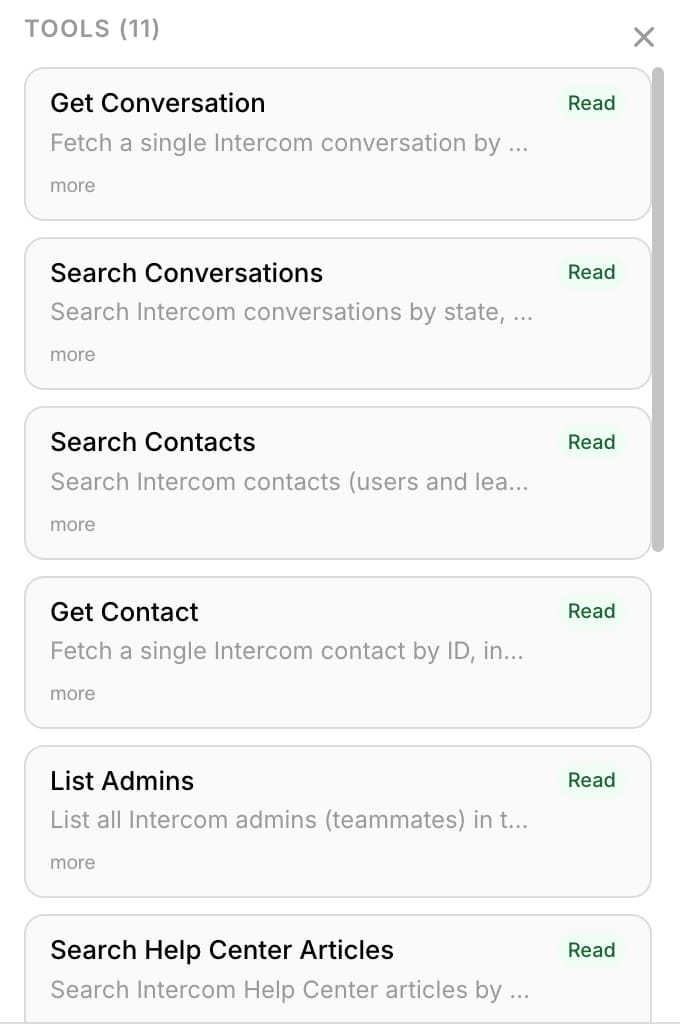
The difference from Fin is who does the work and how it's billed. Macha is the done-for-you option: the Macha team analyzes your past conversations, builds the knowledge base and the agent, and runs it in safe mode, with drafts landing as internal notes until your team approves them. That's included on the trial and every plan at about $0.40 per ticket, which also covers a dedicated success manager who handles your changes after go-live. Billing is per ticket, charged once per thread however many replies it takes, so a long conversation doesn't cost more. Macha fits teams already on Intercom who are happy with the inbox and unhappy with the AI bill or the setup burden. Our head-to-head is Macha vs Intercom Fin, and setup details are on Macha on Intercom.
Which AI agents compete with Intercom's Fin?
This is where Intercom puts its effort and where most of the new competition is. The field splits by who builds the agent and where it runs.
1. Decagon: the enterprise build
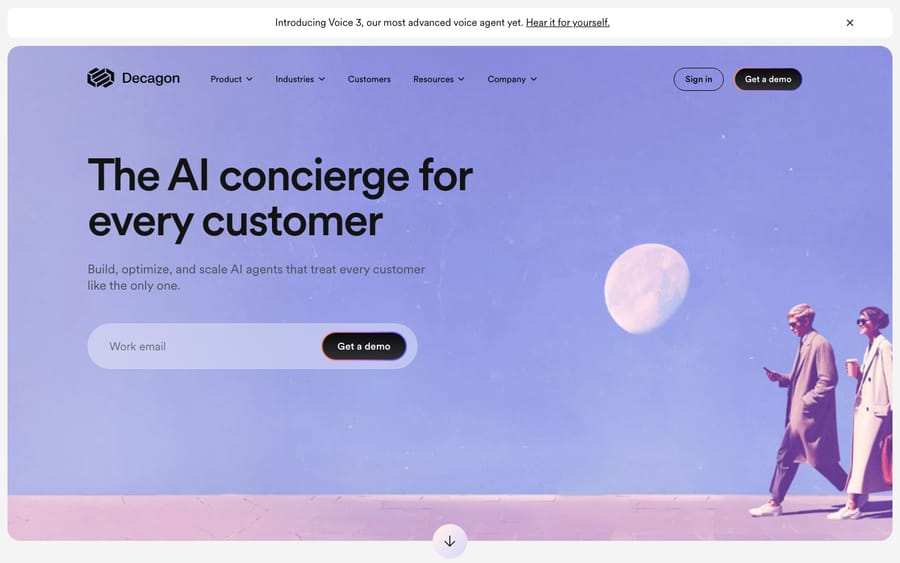
Decagon sells AI agents for chat, voice and email, built around what it calls Agent Operating Procedures, natural-language workflows the agent follows. Its homepage names customers such as Duolingo, Notion, Hertz and American Airlines and routes every visitor to "Get a demo" or "Contact Sales." No price is published. Decagon competes with Fin for large companies that want a custom agent and have the budget for a sales-led rollout.
2. Sierra: outcome-based agents for consumer brands
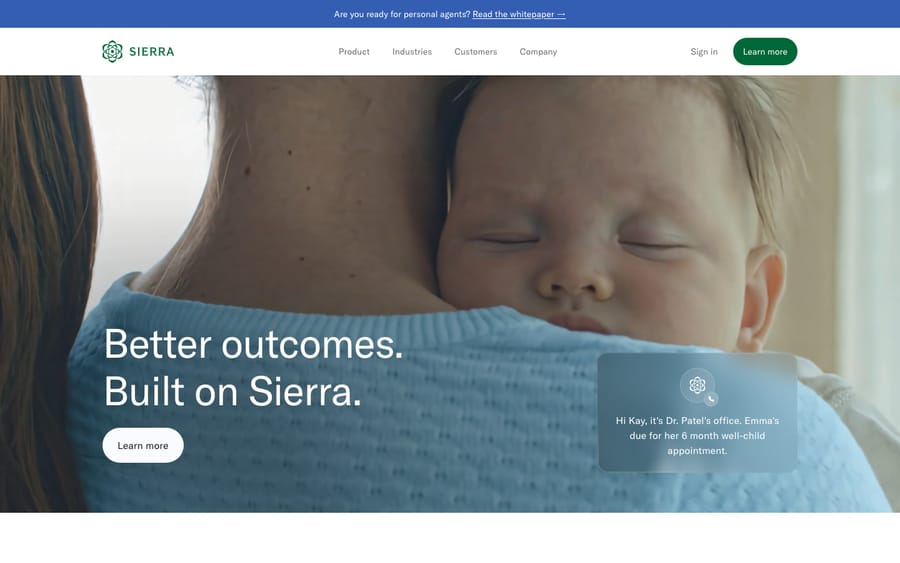
Sierra builds customer-facing agents across chat, SMS, WhatsApp, email and voice, and its homepage describes outcome-based pricing under the heading "Pay for a job well done," with no figures. That's the same incentive shape as Fin's per-outcome price, at enterprise scale. Sierra competes with Fin where a consumer brand wants voice and messaging handled by one agent.
Fin itself now competes beyond Intercom. Fin's pricing page lists it running on Salesforce, HubSpot, Freshworks, Front, Zoho, Gorgias and other help desks, at the same $0.99 per outcome with a 50-outcome monthly minimum. Reddit threads show where buyers push back: one r/CustomerSuccess poster described struggling to make Fin useful despite a large archive of past conversations and documentation, which is the setup gap every AI agent vendor is pitching into.
Which help desk suites compete with Intercom head-to-head?
These are the products a team evaluates when it's replacing the whole platform: inbox, channels, knowledge base, reporting and AI.
3. Zendesk: the omnichannel incumbent
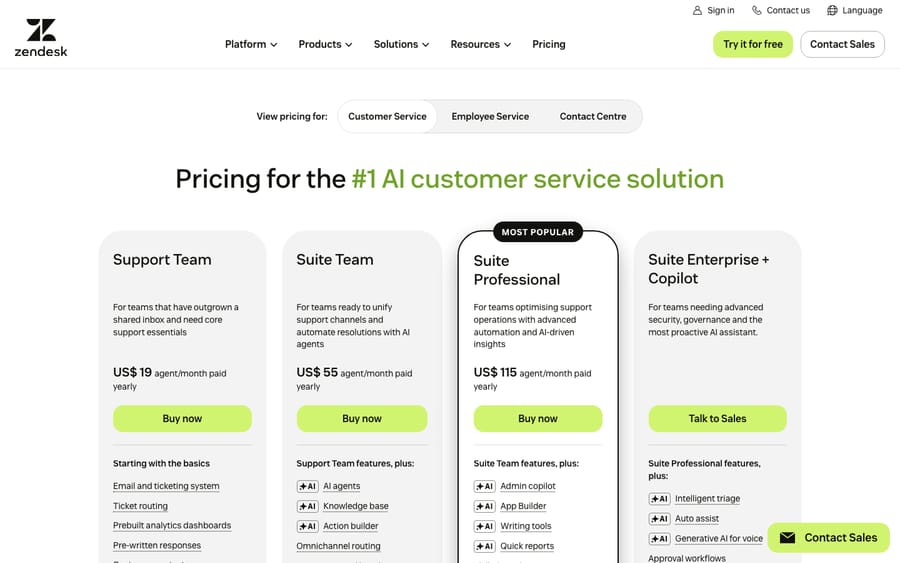
Zendesk competes on breadth: email, voice, messaging and a large app marketplace, with ticketing at the center rather than chat. Zendesk's pricing page showed Support Team at $19 an agent a month, Suite Team at $55 and Suite Professional at $115 on annual billing, with AI agent resolutions at $2.00 each pay-as-you-go and a few included per agent. Teams pick Zendesk over Intercom when email and phone dominate, or when they need ticket-centric workflows. Full comparison: Zendesk vs Intercom.
4. Freshdesk Omni: the cheaper multichannel suite
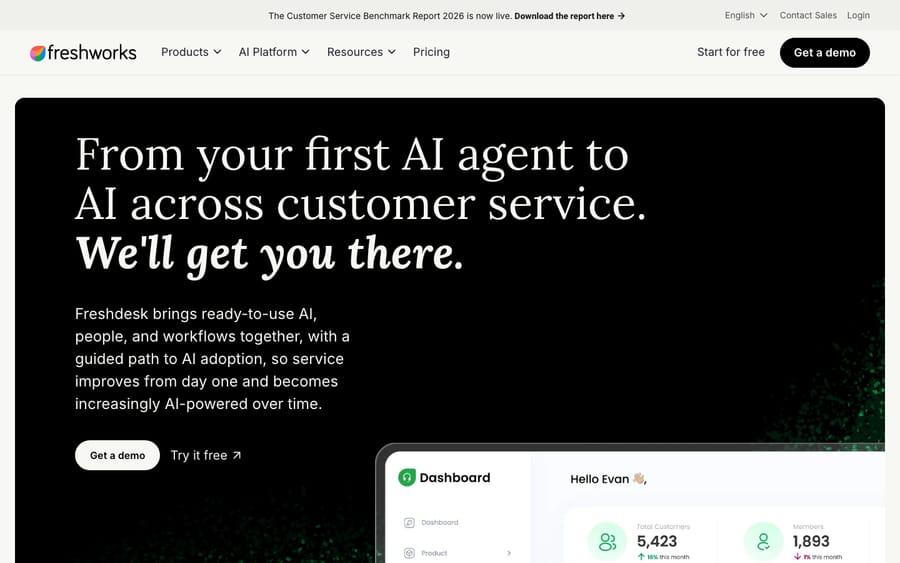
Freshworks competes on price per seat. The Freshdesk Omni pricing page showed Growth at $29, Pro at $79 and Enterprise at $119 per agent a month on annual billing, with 500 free Freddy AI Agent sessions once per account and $49 per 100 sessions after that. Freshchat, Freshworks' messaging product, covers the in-app chat Intercom is known for. Comparison: Freshdesk vs Intercom.
5. Salesforce Service Cloud: the enterprise suite that now owns Intercom
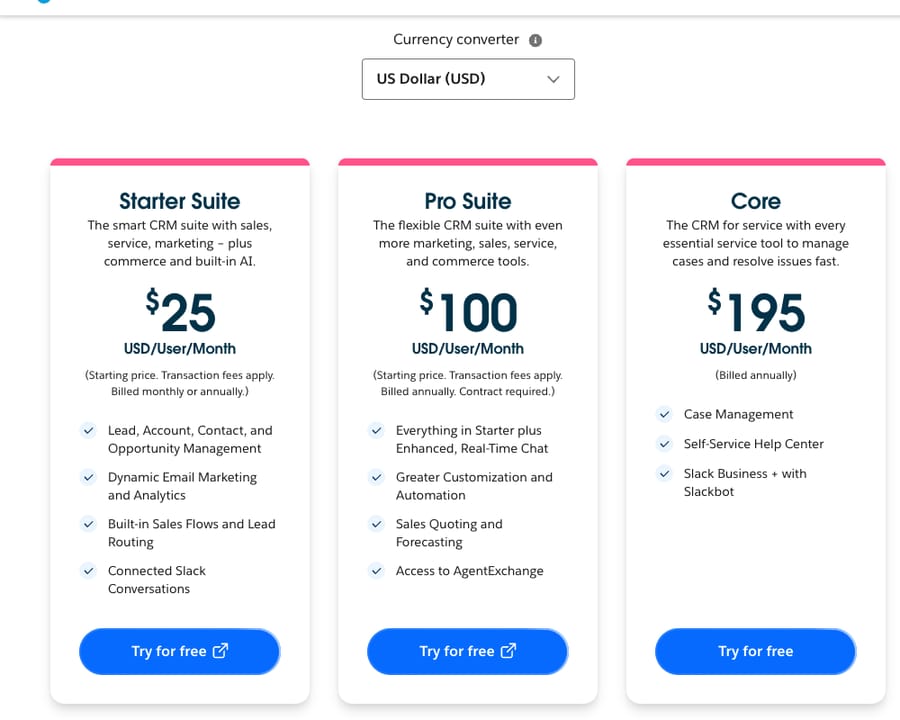
Salesforce competes with Intercom for enterprise service teams that already run Salesforce CRM. Its Service Cloud pricing page listed Starter Suite from $25 a user a month, Pro Suite from $100, and Core, Advanced and Max at $195, $395 and $550 on annual billing, with Agentforce for Service included on Max and available to buy on Advanced. Since September 10, Salesforce owns Fin as well, so it now sells two AI agent lines. Its own press release frames that as choice between fast deployment on existing help desks and larger custom rollouts. Whether Service Cloud and Intercom stay separate products is the open question for buyers on either side.
Which simpler help desks compete with Intercom on price?
These win when a team finds Intercom heavier and pricier than its support needs.
6. Help Scout: the human-first inbox
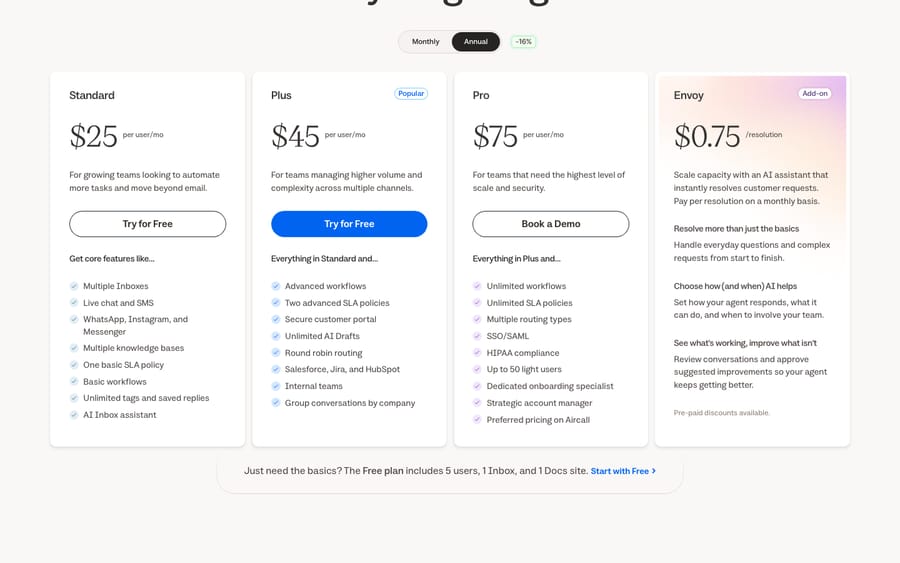
Help Scout competes on simplicity and a clearer bill. Its pricing page showed a free plan for 5 users with 1 inbox and a monthly contact cap (100 contacts in its comparison table, 25 on the plan card), then Standard at $25, Plus at $45 and Pro at $75 per user a month on annual billing. Its AI resolutions cost $0.75 each, charged once per conversation, with a monthly spending cap you can set. That cap is a direct answer to the surprise AI bills Intercom users complain about. Comparison: Help Scout vs Intercom.
7. HubSpot Service Hub: support inside the CRM
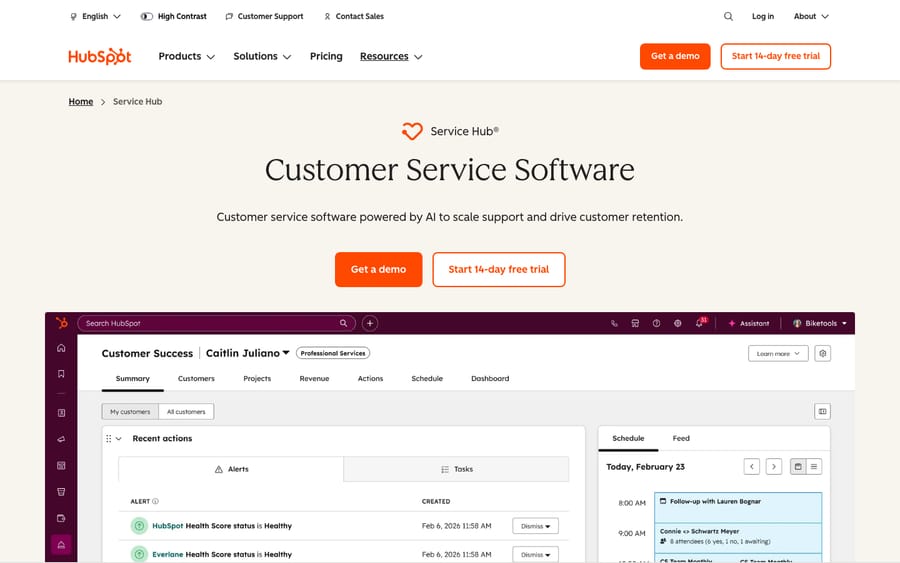
HubSpot competes when marketing and sales already live in HubSpot. HubSpot's Service Hub pricing showed free tools for up to 2 users, Starter from $7 a seat, Professional from $90 and Enterprise from $150, with one-time onboarding fees of $1,500 and $3,500 on the top two. Its Breeze Customer Agent runs on HubSpot Credits at $0.010 each. The pitch against Intercom is one customer record across the funnel instead of a sync between two systems.
Which chat-first tools compete with Intercom's Messenger?
Intercom started as a chat widget, and the chat-first tools still compete with that original product, mostly on price.
8. Crisp: flat pricing per workspace
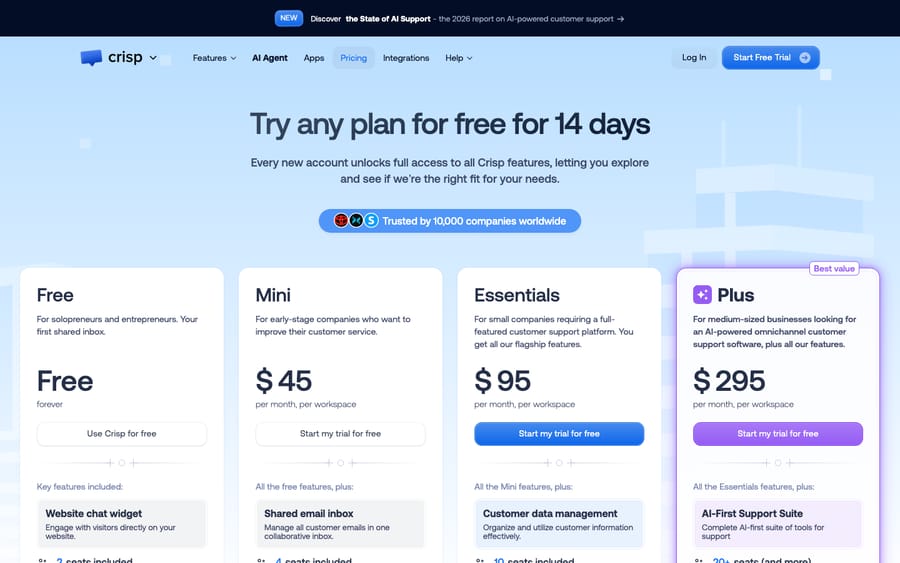
Crisp prices the workspace, not the seat. Crisp's pricing page showed Free for 2 seats, Mini at $45 a month for 4 seats, Essentials at $95 for 10 and Plus at $295 for 20, with AI credits included from Mini up. For a ten-person team that's a very different shape from per-seat billing plus a per-outcome meter. Comparison: Crisp vs Intercom.
9. Tidio: cheap chat for small stores
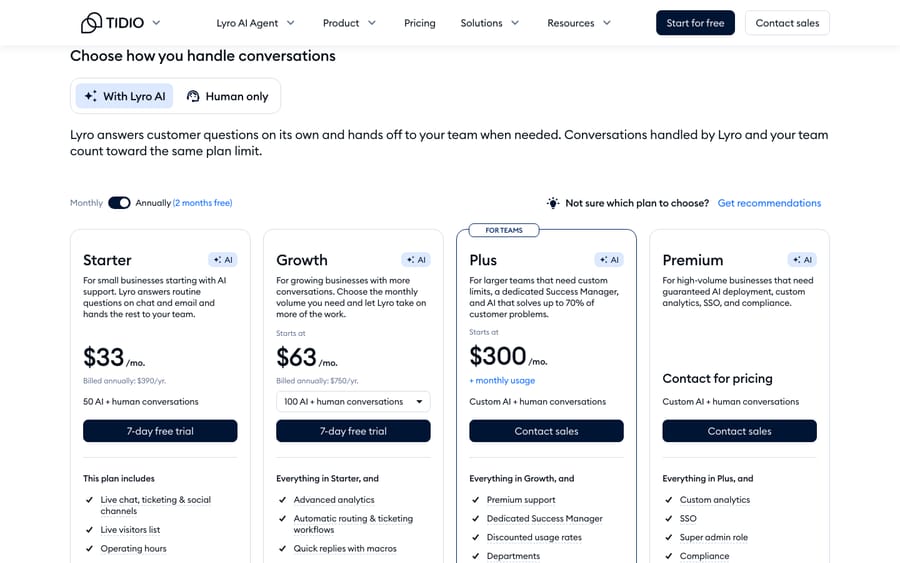
Tidio competes at the small end. Tidio's pricing page showed a free plan with 50 human conversations a month, Starter at $33 a month and Growth from $63, with its Lyro AI agent built into the paid plans. It wins with small online stores that want chat and a basic AI agent without seat math.
Which ecommerce and shared-inbox tools compete with Intercom?
10. Gorgias: the Shopify help desk
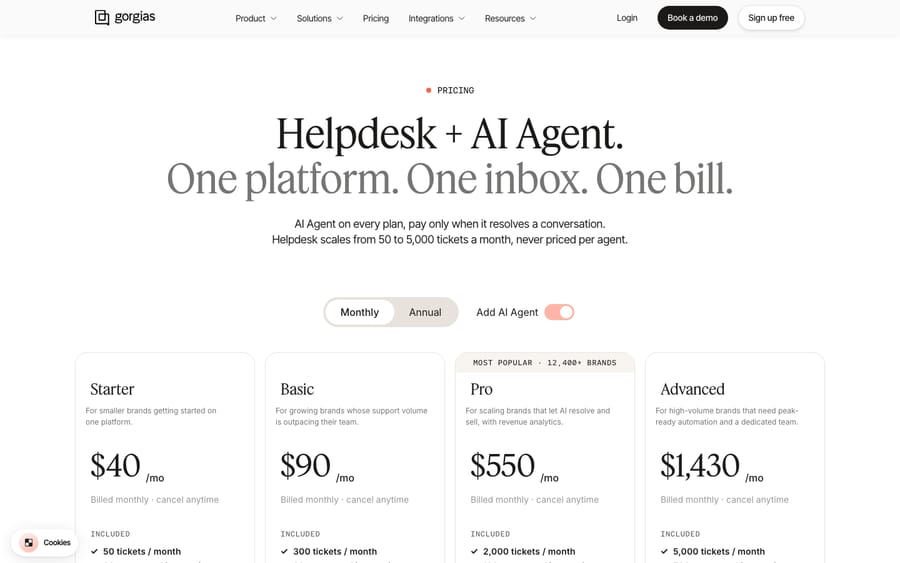
Gorgias competes for ecommerce brands, where Intercom's SaaS roots show. Gorgias' pricing page bills by ticket, not seat. With its AI Agent switched on and monthly billing, Starter is $40 a month for 50 tickets, Basic $90 for 300, Pro $550 for 2,000 and Advanced $1,430 for 5,000, and the page says you pay for the AI only when it resolves a conversation. Its order data inside the ticket is the reason Shopify brands pick it. Comparison: Gorgias vs Intercom. Gladly competes for larger consumer brands in the same space; see Gladly vs Intercom.
11. Front: the shared inbox for email-heavy teams
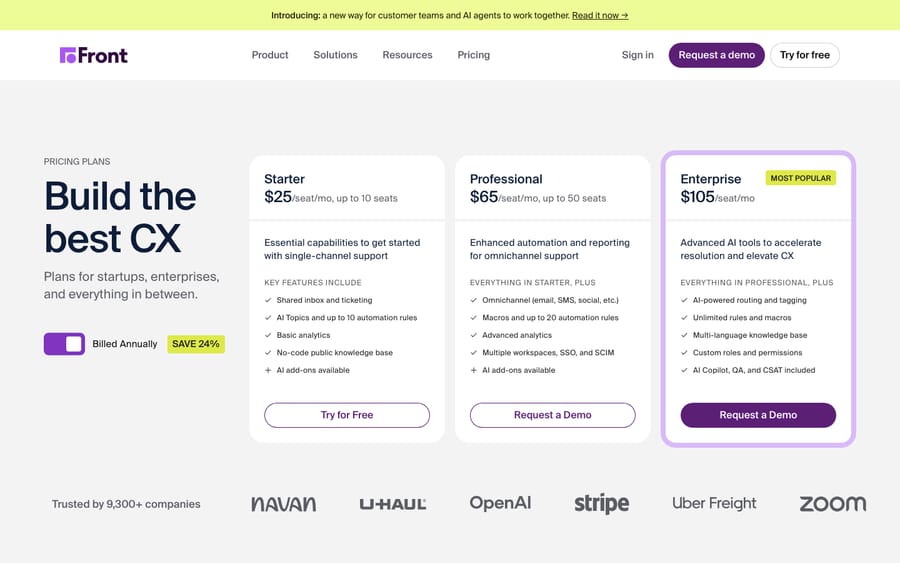
Front competes when support is mostly email and several teams share it. Front's pricing page showed Starter at $25 a seat (up to 10 seats), Professional at $65 and Enterprise at $105 on annual billing, with Copilot at $20 a seat and Autopilot from $0.39 a conversation. It's the pick for operations teams that collaborate on email threads more than they chat with users in an app. Comparison: Intercom vs Front.
Where does Intercom win and lose against the field?
| Axis | Intercom's position | Who beats it there |
|---|---|---|
| In-app messaging for software products | Strong; it built the category | Few; Crisp and Tidio match the widget, not the depth |
| AI agent maturity | Strong; Fin is the company's focus | Decagon and Sierra at enterprise scale |
| Predictable AI cost | Weak; $0.99 per outcome grows with volume | Help Scout (spending cap), Crisp (credits in the plan) |
| Email and phone depth | Middling | Zendesk, Front |
| Ecommerce order context | Weak out of the box | Gorgias, Gladly |
| Entry price for small teams | Better since Essential dropped to $19 | Help Scout, HubSpot, Crisp free tiers |
| Long-term roadmap certainty | Unclear after the Salesforce deal | Independent vendors, for buyers who weigh that |
Reddit discussions match the table's weak spots. In one r/CustomerSuccess thread a long-time user said Zendesk and Intercom were slow to ship AI and asked for chat tools beyond both; in a 2026 thread a B2B SaaS team asked for Intercom alternatives that integrate more smoothly. Both are about fit and integration more than features.
What do the Fin rename and the Salesforce deal change for competitors?
Three things, based on what the two companies have published.
First, Intercom is now explicitly an AI company that also sells a help desk. Its own announcement says Fin is "our future." Competitors that sell help desks now pitch the inbox as the thing Intercom cares about less. Competitors that sell AI agents now face a rival with Salesforce's sales force behind it.
Second, Salesforce owns two AI agent lines, Agentforce and Fin. Its press release positions Fin for fast deployment on existing help desks and Agentforce for larger custom rollouts. That makes Fin a stronger competitor on other vendors' help desks, and leaves Service Cloud buyers to watch how the two converge.
Third, ownership is now a buying criterion. Teams that want independence from a CRM vendor have a reason to look at Zendesk, Freshdesk, Help Scout or Front. Teams that like Intercom's inbox but not the Fin bill can keep the inbox and change only the AI, which is the case Macha is built for.
How we researched this
We checked every price on the vendor's own pricing page on November 21, 2026: Intercom, Zendesk, Freshdesk Omni, Salesforce Service Cloud, Help Scout, HubSpot Service Hub, Crisp, Tidio, Gorgias and Front, and captured each page for the screenshots above. Freshworks and HubSpot served Indian rupees to our capture browser, so we captured their product pages instead and used US dollar prices from a separate read of the pricing pages. Decagon and Sierra publish no prices, so we read their homepages the same day, and we read Fin's own pricing page for the help desks it supports. Ownership facts come from Intercom's May 12, 2026 rename announcement and Salesforce's September 10, 2026 completion press release. Prices are in US dollars as the pages displayed them; the Zendesk page mixed currencies for committed resolutions, so we quote only its US dollar pay-as-you-go figure.
We didn't use star ratings because the review sites we'd cite block our requests. Reddit sentiment is paraphrased from the linked threads, without names. We didn't run trials of each competitor for this page. The Macha details come from Macha's own Intercom connector screen in our demo workspace and the connector's published tool list.
Common questions
Who is Intercom's biggest competitor?
Zendesk is the biggest head-to-head help desk competitor, competing on omnichannel depth and its app marketplace. On AI agents, Intercom's main focus since the Fin rename, the enterprise rivals are Decagon and Sierra, and Salesforce's Agentforce sits under the same owner.
Who owns Intercom now?
Salesforce. It completed its acquisition of Fin, the company formerly called Intercom, on September 10, 2026. The help desk product keeps the Intercom name.
Is Intercom cheaper than Zendesk?
On the entry seat, they're level: Intercom Essential showed $19 a seat for new customers and Zendesk Support Team $19 an agent on November 21, 2026. AI is where they differ: Fin is $0.99 per outcome, while Zendesk's pay-as-you-go automated resolution is $2.00.
What are cheaper competitors to Intercom?
Help Scout, HubSpot Service Hub and Crisp all have free tiers, and Gorgias starts at $40 a month for 50 tickets with its AI Agent on. Our cheaper Intercom alternatives guide models the cost at a fixed volume.
Can I compete with Fin without leaving Intercom?
Yes. Macha runs AI agents inside your Intercom inbox, built and run by the Macha team, at about $0.40 per ticket with setup included. You keep the Intercom seats, inbox and Help Center.
Is Fin a competitor or part of Intercom?
Both. Fin is Intercom's AI agent and, since May 12, 2026, the company's name. Fin also runs on other help desks, including Salesforce, HubSpot, Freshworks, Front and Gorgias per Fin's pricing page, which makes it a competitor to the AI tools on those desks.
If you're staying on Intercom and the AI is the part you'd change, start a trial with $50 of free usage (about 125 tickets), no credit card, no time limit, and the Macha team will set up your first agent in your Intercom inbox.