Intercom
 Shopify
 Stripe
 Slack
Slack Notion
 Google Workspace
 Confluence

Is Intercom Down? How to Check Intercom Status by Region (2026)


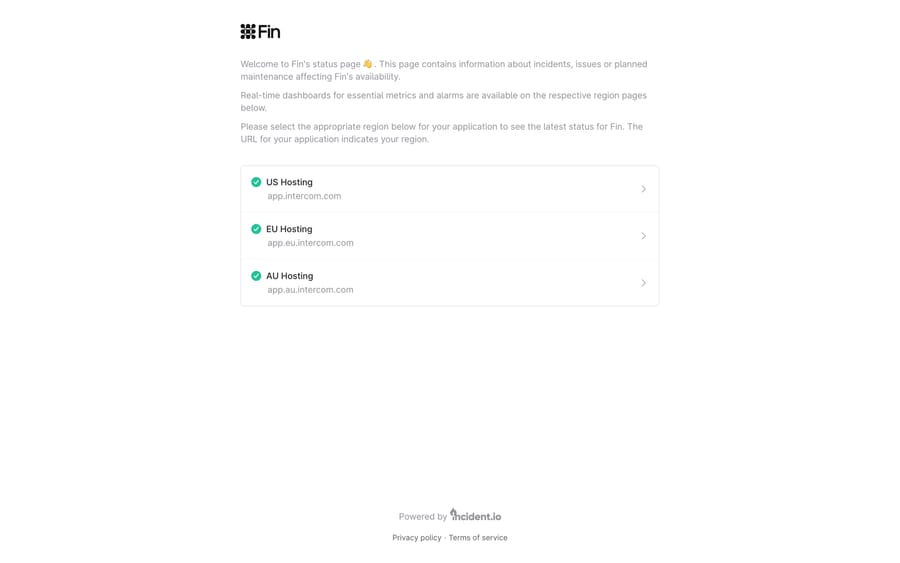
Intercom's status now lives at finstatus.com, split into US, EU and AU Hosting pages, and the old status.intercom.com address only redirects there. If you are looking for a door entry intercom, this is the wrong page: this one is about Intercom the customer-service platform.
Key takeaways
- Intercom's status page is finstatus.com, split into US Hosting for app.intercom.com, EU Hosting for app.eu.intercom.com and AU Hosting for app.au.intercom.com, and status.intercom.com returns a 302 redirect there.
- Each Intercom region page lists sixteen components in four groups, including Fin AI Agent, Inbox, Web Messenger, Webhooks and REST API, so a red marker shows which capability is degraded.
- For June to September 2026, Intercom's status history listed 7 US incidents, 4 EU and 6 AU on 24 September, and only 4 of the 9 distinct incidents appeared in all three regions.
- Intercom's own write-up of a December 2024 outage says a 32-bit integer limit in a critical part of the data model took the product down for about five hours.
- Intercom's status history changes after the fact: counts read on 20 September fell four days later, and a 23 June AU Help Center incident disappeared.

How do I check if Intercom is down?
Intercom's status page is at finstatus.com, and it is split into three region pages. Going to status.intercom.com still works, but it's only a redirect, so bookmark the destination instead.
- Open finstatus.com.
- Pick the region whose URL matches the one in your browser when you are signed in to Intercom: US Hosting for
app.intercom.com, EU Hosting forapp.eu.intercom.com, AU Hosting forapp.au.intercom.com. - Read the banner at the top of that region page. "We're fully operational" means Intercom has no open incident for your region.
- Expand the component groups underneath to see whether the specific thing you use, such as the Messenger or the REST API, is the part that is broken.
- If your region is clean and Intercom is still broken for you, work the elimination ladder further down this page.
That's the whole check, and it takes about thirty seconds. The rest of this guide is the part that matters when the answer is not obvious.
Why does status.intercom.com redirect to finstatus.com?
We checked this on 20 September 2026 and again on 24 September: a request to https://status.intercom.com/ returns a 302 Found with a Location header pointing at https://www.finstatus.com/. The page you land on is branded Fin, not Intercom, and it opens with "Welcome to Fin's status page".
That naming trips people up, so here is the mechanism. The help desk is still sold as Intercom: its homepage title reads "Intercom | A complete system for human and AI customer service" and describes "a complete system for human and AI customer service", with Fin as the AI agent inside it. Salesforce completed its acquisition of Fin on 10 September 2026, and the incident notes now tell customers to write to [email protected]. What moved is the status page, which carries the Fin brand and covers the whole platform underneath it: the Inbox, the Messenger, Tickets, Reporting and the API all live on the same page as the Fin AI Agent component.
The practical consequences are small but real. Any runbook, alert integration or bookmark pointing at status.intercom.com still resolves, but it resolves through a redirect that Intercom controls and could retire. Searching for "Intercom status" inside your own documentation will miss the page, because the word Intercom appears nowhere in the destination's branding. If your team has a status feed wired into Slack, repoint it at the region-specific RSS feed on the new host rather than the old address.
Which Intercom region page should I check?
This is the step most "is Intercom down" pages skip, and it is the one that changes the answer.
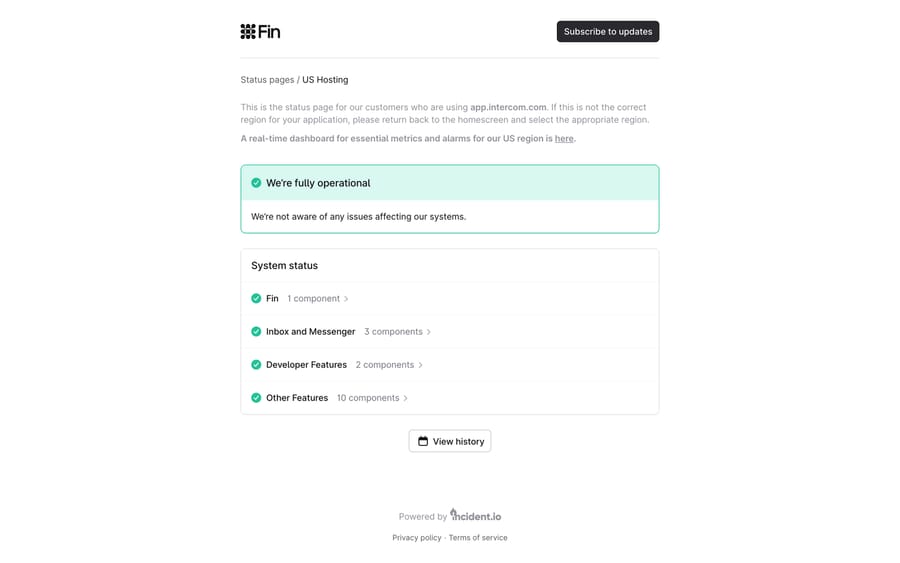
Intercom hosts workspaces in three regions, and the status page mirrors that split exactly. The US Hosting page states its scope in one line: "This is the status page for our customers who are using app.intercom.com. If this is not the correct region for your application, please return back to the homescreen and select the appropriate region."
Your region is visible in the URL bar the moment you are signed in. app.intercom.com is US, app.eu.intercom.com is EU, app.au.intercom.com is AU. Nothing else needs checking, and you don't have to ask an admin.
If that architecture feels familiar, it's the same shape as Zendesk's pods, which Zendesk describes as shared hosting environments where "service incidents affecting one Pod will not affect customers in other Pods". The consequence is identical: a green banner on the wrong region page is worse than no information, because it reads as reassurance when it isn't any.
What do the sixteen status components cover?
Each region page lists sixteen components in four groups. We read them off the US page on 20 September 2026, and the list was unchanged on 24 September:
| Group | Components | What a red or yellow marker here means for you |
|---|---|---|
| Fin (1) | Fin AI Agent | Your AI agent stops answering or answers slowly. Human replies are unaffected. |
| Inbox and Messenger (3) | Inbox, Web Messenger, Mobile Messenger | Agents cannot work the queue, or customers cannot open a conversation at all. |
| Developer Features (2) | Webhooks, REST API | Your integrations and scripts fail while the product itself may look fine. |
| Other Features (10) | Phone, Copilot, Tickets, Omnichannel, Help Center, Apps and Integrations, Reporting, Knowledge Hub, Outbound, Other | One capability is degraded. Everything else keeps running. |
The split is genuinely useful for triage. If Reporting is degraded and the Inbox is green, your agents are fine and it's your dashboard that's lying to you, and you can tell your leadership that in one sentence instead of investigating for an hour. If Webhooks are degraded and everything else is green, the ticket sync into your data warehouse will backfill later and does not need a customer-facing announcement.
The component named "Other" is worth knowing about before you need it. It's where an incident lands when Intercom hasn't yet mapped the failure to a named surface, which usually means the investigation is still early.
What does Intercom's outage history show for June to September 2026?
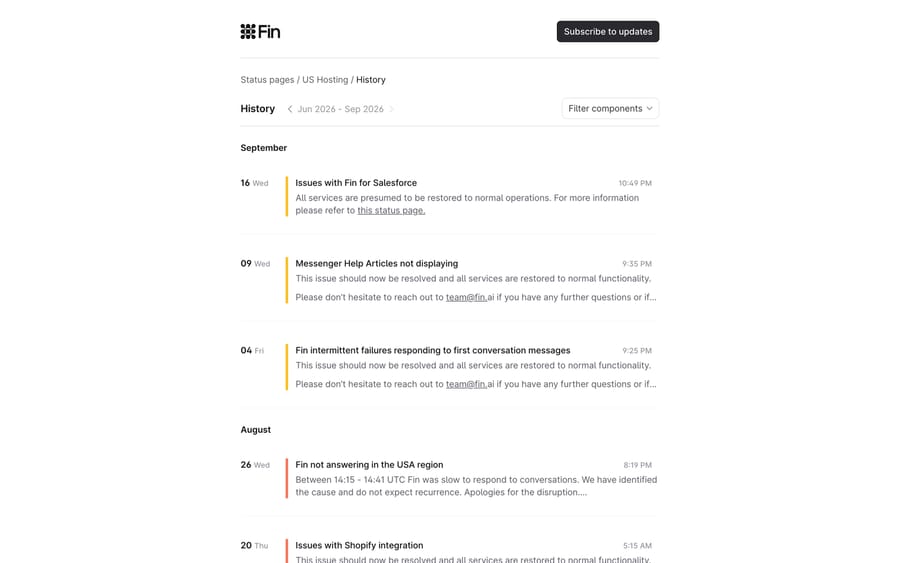
Every region page has a View history link, and it's the most useful thing on the site. We read all three on 24 September 2026 for the window the page itself labels Jun 2026 to Sep 2026:
| Region | Incidents in the window | Notes |
|---|---|---|
US Hosting (app.intercom.com) | 7 | Includes "Fin not answering in the USA region" on 26 August, degraded Inbox search on 3 August and "Issues with Fin for Salesforce" on 16 September |
EU Hosting (app.eu.intercom.com) | 4 | June and July both show "No incidents reported" |
AU Hosting (app.au.intercom.com) | 6 | Includes "Fin failures in Australia region" on 3 September and "Elevated errors affecting Helpdesk and Fin" on 10 July |
That's 9 distinct incidents across the three regions, and only 4 of them appear on all three pages. Three of the seven US incidents never appear on the EU page at all. That ratio is the argument for checking your own region rather than a generic tracker: close to half of what hit US customers in those months was invisible to an EU admin reading the wrong page.
The history is also not a fixed record. When we first read these pages on 20 September they showed 8 US, 5 EU and 8 AU incidents, including an AU Help Center incident on 23 June. Four days later June read "No incidents reported" on all three pages. If you need an incident window for a post-mortem or a credit request, screenshot it while it's there.
The incident notes carry real detail when Intercom has it. The 26 August entry reads "Between 14:15 - 14:41 UTC Fin was slow to respond to conversations. We have identified the cause and do not expect recurrence", which is a 26-minute window you can match against your own CSAT dip. The 3 August Inbox entry gives a 13:35 to 15:53 UTC window and names degraded search as the symptom.
Two older incidents are worth knowing because they set expectations for what a bad day looks like. Intercom published its own write-up of a multi-hour outage in December 2024, in which a 32-bit integer limit in a critical part of the data model took the product down for about five hours. And during a February 2024 outage, an Intercom technical support engineer posted in the community forum that the incident "prevented our customers...from replying to conversations, re-assigning conversations and closing conversations, among other things", which is a useful description of what a bad Intercom day actually looks like from an agent seat.
Is it Intercom, or is it you?
Work this ladder in order. It runs fastest first.
- Check the right region page. If your region banner is green, lean toward a local problem.
- Test from another network and device. Open Intercom on mobile data rather than office Wi-Fi. If cellular works and corporate does not, your firewall or proxy is the fault.
- Try a private window. If a clean session loads, the cause is a browser extension, a stale cache or an expired session.
- Check whether one surface is broken or all of them. Messenger broken with the Inbox fine points at your website embed, your Content Security Policy or an ad blocker, not at Intercom.
- Check your own integrations. If only Salesforce sync or only Shopify data is missing, the fault is likelier in that connector. Intercom logged separate incidents for both in this window.
The pattern worth memorizing: everything broken plus a red region banner is Intercom. One thing broken with an all-green region is you, or the integration in between.
Why is the status page green when Intercom is broken?
This is the honest caveat, and Intercom's own community is where it comes from.
In October 2025 a developer posted in the API and webhooks forum that they were getting 504 responses and "IntercomException: API service is temporarily unavailable" from the European region, and noted in the same post that the status page listed no incidents. An Intercom support engineer replied that he could not see any documented reports and asked for response headers and request IDs so engineering could investigate.
That gap is structural, and calling it negligence misses why it happens. A status page is written by the vendor whose uptime it reports, and the incentive built into that arrangement is to post an incident only once the blast radius is confirmed, because a retracted incident is worse for the vendor than a late one. Partial failures affecting a subset of API callers in one region are exactly the shape that stays unposted longest.
So treat green as a default, and treat your own telemetry as the tiebreaker. If you have your own evidence, such as a sustained error rate on a specific endpoint, open a ticket with headers and request IDs attached instead of waiting for the page to agree with you. A third thread in the same community, about a 15-hour wait on a production outage request, is a reminder that the escalation path is a support conversation like any other, so the request ID you attach at the start is what gets it moving.
How do I get alerted when Intercom goes down?
Each region page has a Subscribe to updates control at the top right, and the site publishes machine-readable feeds at /feed.rss and /feed.atom. Point one of them at whichever channel your team actually reads, and do it for your region, since the index page carries nothing.
Two things to set up while you are there. Put the region page URL, not status.intercom.com, in your incident runbook. And decide in advance where customers go when the Messenger is the thing that is down, because a status banner inside a product nobody can load helps nobody.
Does Fin keep working during an Intercom outage?
Worth being plain about this, because it is the question support leads ask next. Fin is a component on the same status page as the Inbox, which is exactly what it looks like: Fin runs inside Intercom's platform and shares its fate. When the platform is degraded, the AI agent is degraded with it. Six of the nine incidents above name Fin in their title.
That's true of any AI layer on any help desk, ours included. Macha is an AI agent layer that runs on top of Zendesk, Freshdesk, Gorgias, Front, HubSpot or Intercom, and it reads and resolves tickets through those platforms, so when one of them is offline the agents on top of it are offline too. An Intercom outage stops a Macha agent on Intercom just as it stops Fin, so nothing here is a pitch for switching during an outage. An AI layer earns its place on the other 364 days, by resolving the repetitive tickets so the backlog you dig out of after an incident is smaller. It fits teams that want agents working inside the ticket and a bill per ticket rather than per outcome, with the Macha team building and monitoring the agents. The pricing page has the numbers.
How we researched this
Everything above was read off the live pages on 20 September 2026 and captured as screenshots, and the redirect, the component list and all three incident histories were reread on 24 September: the finstatus.com index, the US Hosting region page, and the incident history for all three regions. The redirect from status.intercom.com was confirmed twice, once with a raw HTTP request that returned the 302 and its Location header, and once in a headless browser. The community threads are public posts on Intercom's own forum, linked above. We did not have access to Intercom's internal incident data, so the incident counts are counts of what Intercom published, which is a floor rather than a total.
Frequently asked questions
Is Intercom down right now? Open finstatus.com, pick the region that matches your workspace URL, and read the banner. "We're fully operational" means Intercom has no open incident for that region. Because Intercom splits status by hosting region, a green banner on the wrong page tells you nothing about your workspace.
What is the Intercom status page URL? It is finstatus.com, with region pages at /us-hosting, /eu-hosting and /au-hosting. The older status.intercom.com address redirects there, and we confirmed the 302 on 20 September 2026. Bookmark the region page that matches your workspace.
Why is Intercom's status page branded Fin? Fin is Intercom's AI agent, and the status page now carries that brand while still covering the whole platform, including the Inbox, Messenger, Tickets, Reporting and the REST API. Intercom itself has not been renamed. Its homepage still describes Intercom as the help desk and Fin as the AI agent inside it.
How do I know which Intercom region I am on? Look at the URL when you are signed in. app.intercom.com is US Hosting, app.eu.intercom.com is EU Hosting, app.au.intercom.com is AU Hosting. The status page names its region pages after the same three addresses, so the match is exact.
How often does Intercom have outages? For the window the status page labels June to September 2026, read on 24 September, it listed 7 incidents for the US region, 4 for EU and 6 for AU, which is 9 distinct incidents in total with 4 of them shared across all three regions. The published notes give UTC windows for several of them, such as 14:15 to 14:41 UTC for the 26 August Fin incident.
Intercom is broken for me but the status page is green. What now? Test from another network and in a private window, then check whether one surface is failing or all of them. If you have hard evidence such as repeated 504 responses on a specific endpoint, open a support conversation with the response headers and request IDs attached. A public community thread from October 2025 shows an API fault in the EU region that had no incident posted against it at the time.
Can I get notified when Intercom goes down? Yes. Each region page has a "Subscribe to updates" control, and the site publishes feeds at /feed.rss and /feed.atom. Subscribe on your own region page, not the index, so you won't be paged for an incident in a region you do not run in.
What should I bookmark before the next Intercom outage?
Bookmark your region page, not status.intercom.com, and not a third-party tracker. Read the component groups as well as the top banner, because Reporting being degraded and the Inbox being degraded are very different mornings. Use the history view when you need to match an incident window against your own metrics, and remember that three of the seven US incidents in the last four months never appeared on the EU page. When the page is green and your product is not, gather request IDs and open a ticket instead of refreshing. If you run support on a different platform, we have the same guide for Zendesk, Freshdesk, Gorgias and Front, and what Intercom is covers the platform itself if you are new to it.
Sources:
- Fin status page and the US Hosting region page, read 20 September 2026
- Intercom homepage, for current product naming
- Intercom's write-up of a multi-hour outage, published December 2024
- community.intercom.com: "intercom down", February 2024
- community.intercom.com: "Experiencing an API outage", October 2025
- community.intercom.com: "15 hours since opening a production outage support request", October 2024
- Zendesk: What is a Pod?, for the regional-isolation comparison
Add AI agents to your Intercom
Macha reads the conversation, drafts the reply and takes the action, inside the Intercom you already run.