Intercom
 Shopify
 Stripe
 Slack
Slack Notion
 Google Workspace
 Confluence

How Much Does Jira Service Management Cost in 2026? Plans, Bands and AI Meters


Jira Service Management costs $25.00 per agent a month on Standard for your first 15 agents, not the $20 Atlassian's calculator shows by defaulting to a 75-agent team. It is now sold only inside Atlassian's Service Collection, and usage meters for AI, automation and Assets start billing on 3 December 2026.
Key takeaways
- Jira Service Management's real entry price is $25.00 per agent a month for 1 to 15 agents on monthly billing, not the $20 figure Atlassian's calculator shows by defaulting to 75 agents.
- Jira Service Management is no longer sold on its own; Atlassian sells it only inside the Service Collection bundle with Customer Service Management, Assets and Rovo.
- Jira Service Management's annual billing charges by agent band rather than headcount, so an 11-agent team and a 15-agent team both pay $3,750 a year on Standard.
- Atlassian's virtual service agent bills $0.30 per assisted conversation above 1,000 included monthly conversations, counting even conversations it escalates to a human.
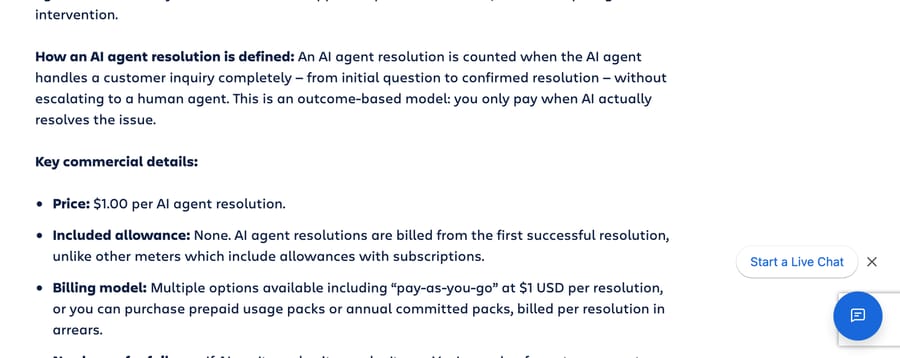
- Atlassian's Customer Service Management AI agent costs $1.00 per resolution with no included allowance, charging only when it resolves an inquiry without escalating.

Jira Service Management costs $25.00 per agent a month on Standard and $57.30 on Premium for your first 15 agents on monthly billing, Free covers three agents, and Enterprise starts at $168,500 a year for 201 to 300 agents. Those are Atlassian's own figures, read in a browser on 22 September 2026, along with the agent-band system that makes annual billing more expensive than monthly for a lot of teams and the five usage meters that start billing on 3 December 2026.
One thing to get straight before the tables, because it changes how you buy: Jira Service Management is no longer sold on its own. Atlassian now sells it inside the Service Collection, and its licensing page says so plainly: "Service Collection is sold as a single offering, including Jira Service Management, Customer Service Management, Assets, and Rovo. The apps cannot be purchased separately." Both of the old URLs redirect: atlassian.com/software/jira/service-management/pricing now lands on the Service Collection pricing page, and atlassian.com/licensing/jira-service-management lands on Service Collection licensing. Everything in this guide is priced as Service Collection, because that is the only way to buy it.
How much does Jira Service Management cost?
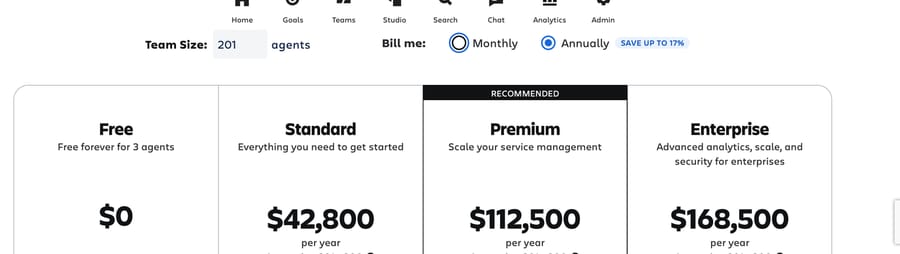
Four plans. Free is capped at three agents. Standard and Premium are self-serve. Enterprise is annual-only and, on Atlassian's own calculator, only quotes a price once you enter 201 or more agents.
| Plan | Monthly, per agent (1–15 agents) | Annual, whole subscription (11–15 agents) | Who it is for |
|---|---|---|---|
| Free | $0 (3 agents max) | $0 | A small team trying it |
| Standard | $25.00 | $3,750 / year | Most first purchases |
| Premium | $57.30 | $8,600 / year | Anyone who wants the AI agent, change management or an SLA |
| Enterprise | Not sold monthly | From $168,500 / year at 201–300 agents | 201+ agents, multi-site, Guard included |
Prices checked 22 September 2026 on atlassian.com/collections/service/pricing and atlassian.com/licensing/service-collection.
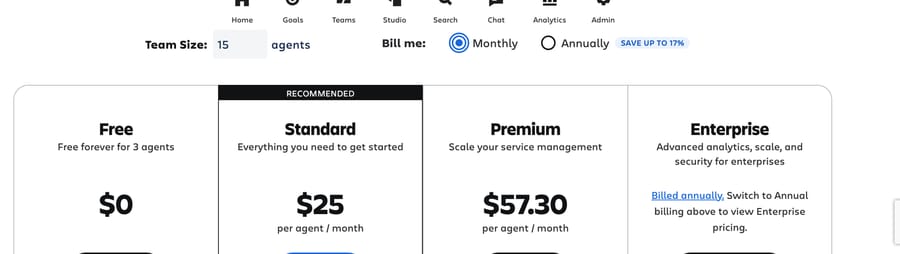
Why does Atlassian's calculator show $20 per agent?
The Atlassian calculator loads with 75 in the Team Size box. At 75 agents, Standard displays $20.00 per agent per month and Premium displays $51.42. Those two numbers have travelled: they are what the page shows on first paint, so they are what gets scraped, and Google's AI Overview for this keyword repeats "$20 per agent" citing a third-party blog that labels it "Atlassian's current list pricing" on annual billing. It is neither. It is a monthly figure at a 75-seat default.
Atlassian's actual monthly rate card is progressive — the licensing page says "Each user's unit price is based on the pricing rate in which the user falls" — so the per-agent number falls as you add seats, and the displayed "per agent" price is just your total divided by your headcount.
| Agents | Standard, per agent / month | Premium, per agent / month |
|---|---|---|
| 1–3 | USD 0 flat (Free plan) | — |
| 1–15 | USD 25.00 | USD 57.30 |
| 16–100 | USD 18.75 | USD 49.95 |
| 101–250 | USD 12.55 | USD 33.25 |
| 251–500 | USD 8.60 | USD 22.90 |
| 501–1,000 | USD 8.25 | USD 21.20 |
| 1,001–5,000 | USD 7.95 | USD 16.50 (1,001–2,500) |
| 15,001+ | USD 6.35 | USD 13.45 |
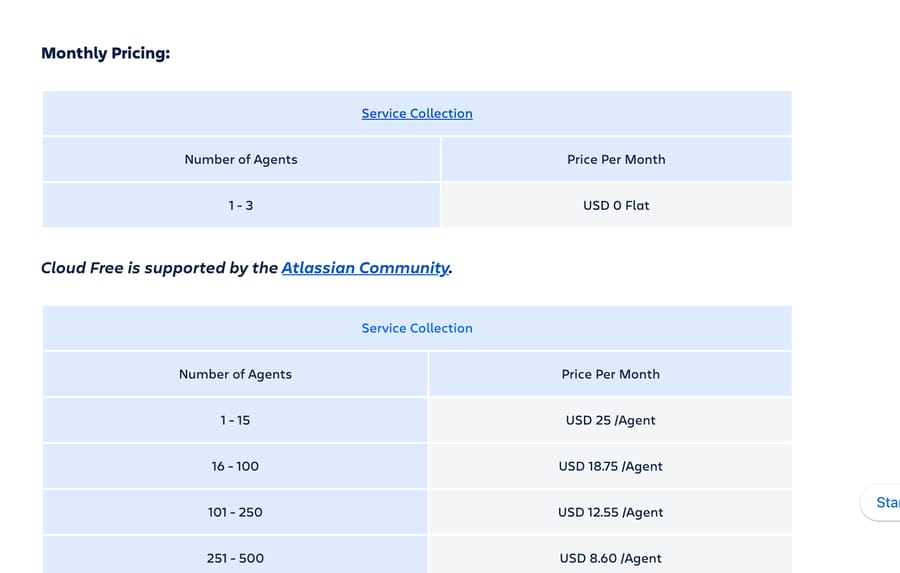
Because the bands are graduated rather than cliff-edged, you can reproduce any figure the calculator shows. Fifty agents on Standard: the first 15 at $25.00 is $375.00, the next 35 at $18.75 is $656.25, total $1,031.25 a month, which is $20.63 a head — exactly what the calculator prints. Two hundred agents: $375.00 + (85 × $18.75 = $1,593.75) + (100 × $12.55 = $1,255.00) = $3,223.75 a month, or $16.12 a head. If a third-party page quotes you a single per-agent number without a headcount attached to it, it is quoting somebody else's team.
Is annual billing cheaper than monthly?
This is the finding that surprised us, and it is checkable in thirty seconds against Atlassian's own tables.
Monthly billing is priced per agent. Annual billing is priced per agent band — you buy a tier, not a headcount. Eleven agents and fifteen agents both cost $3,750 a year on Standard. Adding agents inside a band is free; crossing a band boundary is a step.
| Agents | Standard / year | Premium / year | Enterprise / year |
|---|---|---|---|
| 1–3 | USD 750 | USD 1,700 | — |
| 4–5 | USD 1,250 | USD 2,850 | — |
| 6–10 | USD 2,500 | USD 5,750 | — |
| 11–15 | USD 3,750 | USD 8,600 | — |
| 16–25 | USD 5,650 | USD 13,600 | — |
| 26–50 | USD 10,300 | USD 26,000 | — |
| 51–100 | USD 19,700 | USD 51,000 | — |
| 101–200 | USD 32,250 | USD 84,500 | — |
| 201–300 | USD 42,800 | USD 112,500 | USD 168,500 |
| 301–400 | USD 51,400 | USD 135,500 | USD 203,000 |
| 401–500 | USD 60,000 | USD 158,000 | USD 237,500 |
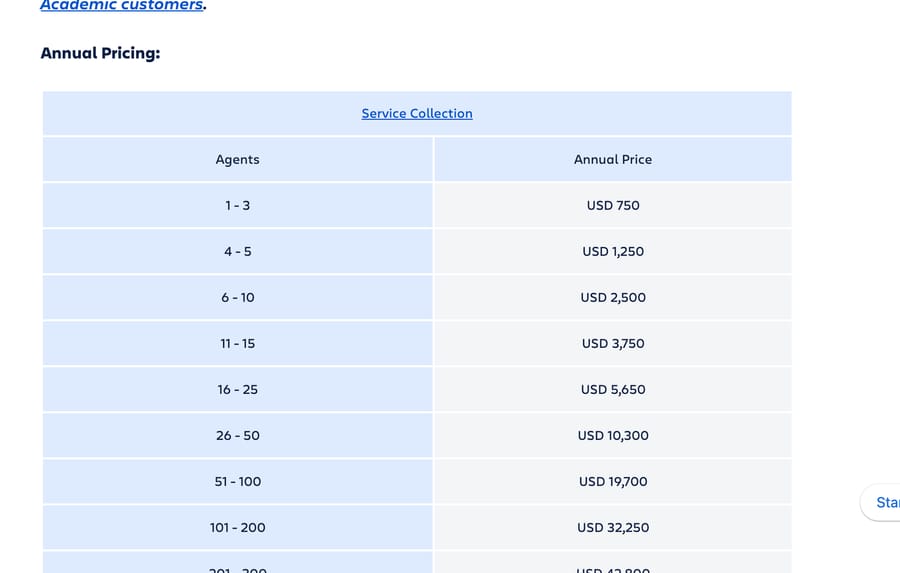
Atlassian's toggle promises "save up to 17%", and at the top of a band that is true. At the bottom of a band it is false, because you are paying for seats you do not have. Here is the same headcount costed both ways, on Standard:
| Agents | Monthly billing, annualized | Annual billing | Difference |
|---|---|---|---|
| 11 | $275 × 12 = $3,300 | $3,750 | Annual costs $450 more |
| 15 | $375 × 12 = $4,500 | $3,750 | Annual saves $750 |
| 26 | $581.25 × 12 = $6,975 | $10,300 | Annual costs $3,325 more |
| 50 | $1,031.25 × 12 = $12,375 | $10,300 | Annual saves $2,075 |
| 51 | $1,050.00 × 12 = $12,600 | $19,700 | Annual costs $7,100 more |
| 100 | $1,968.75 × 12 = $23,625 | $19,700 | Annual saves $3,925 |
| 200 | $3,223.75 × 12 = $38,685 | $32,250 | Annual saves $6,435 |
The crossover inside each band is arithmetic you can run yourself. On Standard, annual billing starts paying off at 5 agents (band 4–5), 9 (6–10), 13 (11–15), 21 (16–25), 41 (26–50), 83 (51–100) and 158 (101–200). Below those numbers, pay monthly. A 51-agent desk that signs an annual contract because "annual is cheaper" is buying 49 empty seats and paying $7,100 a year for them.
Two smaller billing details that belong in the same conversation. Monthly subscriptions run on Maximum Quantity Billing: your bill is based on the highest number of seats assigned at any point in the cycle, and removing seats mid-cycle does not reduce that month's bill. And the minimum term is one month, with monthly paid by card or PayPal only; annual quotes can go on bank transfer, ACH, check or Net-30 terms above $10,000.
What does each Jira Service Management plan include?
Free is three agents, unlimited customers, 2 GB of storage, 100 email notifications a day, 1,250 automation steps per subscription per month, one month of alert retention and Atlassian Community support. There is no Assets, no virtual service agent, no change or problem management, no uptime SLA. Above that, Atlassian offers a 14-day free trial of Standard or Premium.
Standard ($25/agent/month at the first band) adds Rovo search, chat and agents, asset and configuration management with 5,000 objects, a custom-branded help center, unlimited email notifications, 250 GB of storage, audit logs and data residency, 3,000 automation steps per user per month and 250 Rovo credits per user per month. Support is 9/5 regional.
Premium ($57.30/agent/month at the first band) is where the AI you probably came for lives. It adds the virtual service agent, advanced AIOps (alert grouping, AI incident creation, PIR generation), change and problem management with AI risk assessment, deployment gating, Hardware Asset Management and Assets Data Manager, 50,000 Assets objects, unlimited storage, 6,500 automation steps and 700 Rovo credits per user per month, and a financially backed 99.9% uptime SLA with 24/7 support for critical issues.
Enterprise adds Atlassian Analytics and Data Lake, Atlassian Guard Standard included, up to 150 sites, a 99.95% SLA, 24/7 dedicated senior support, 9,500 automation steps and 1,500 Rovo credits per user per month, and status pages.
The gap that catches people is SSO. Enforced single sign-on and SCIM are listed on Free, Standard and Premium as "Requires Atlassian Guard Standard subscription" — a separate product billed on every unique Atlassian user in your organization, not just your JSM agents, at USD 30 flat for 1–10 users and USD 4.00 per user for 11–250. If identity management is a requirement and you are not buying Enterprise, that is a second line item sized by your whole company.
What do the five usage meters cost from 3 December 2026?
Atlassian has moved a consumption layer on top of the seat licence. The usage-based pricing page states that billing begins 3 December 2026 for most meters, that allowances pool at the organization level rather than per user, that unused allowance does not roll over, and that extra usage is enabled by default for most organizations. Admins can cap or disable it per meter in Atlassian Administration, and notifications fire at 80% and 100%.
| Meter | Included allowance | Published rate above it |
|---|---|---|
| Rovo credits | 250 (Standard) / 700 (Premium) / 1,500 (Enterprise) per user per month, pooled | $0.01 per credit ($10.00 per 1,000) |
| Automation steps | 1,250 per subscription (Free); 3,000 / 6,500 / 9,500 per user per month | $0.50 per 1,000 steps |
| Assets objects | 5,000 (Standard) / 50,000 (Premium) / 500,000 (Enterprise) | from $0.02 per object per month |
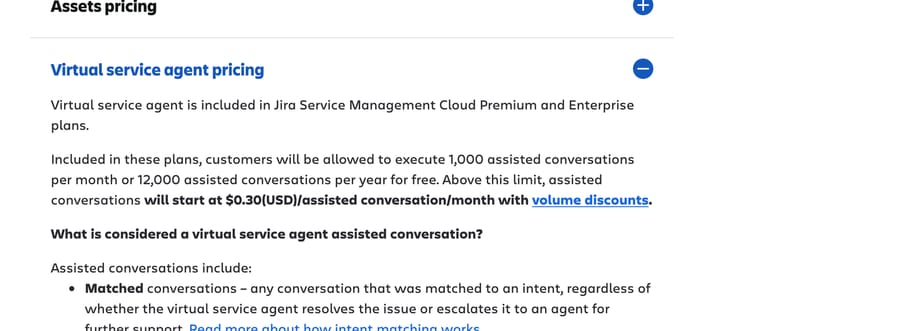
| Virtual service agent | 1,000 assisted conversations per month, or 12,000 a year — Premium and Enterprise only | from $0.30 per assisted conversation |
| CSM AI agent resolutions | None | $1.00 per resolution |
Two of these deserve a closer read.
The virtual service agent bills on assisted conversations, not resolutions. Atlassian's own definition counts "any conversation that was matched to an intent, regardless of whether the virtual service agent resolves the issue or escalates it to an agent" — so a conversation the bot fumbles and hands to a human still burns an assisted conversation. That is a volume meter, not an outcome meter, and it rewards intent coverage rather than deflection.
The Customer Service Management AI agent is the opposite, and it is the cleanest pricing Atlassian publishes: $1.00 per resolution, billed only when the AI handles an inquiry end to end without escalating. No allowance, so it bills from the first resolution. No charge if it escalates, if the customer abandons, if it deflects with an article and the customer opens a ticket anyway, or if a human finishes the job. One inquiry resolved is one resolution however many messages it takes. Resolution state is assessed after a conversation has been inactive for 24 hours and is permanent once set.
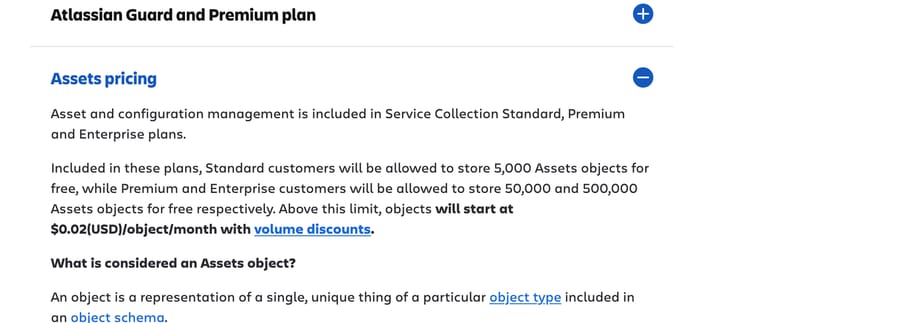
Worth knowing that the Assets rate has moved in your favour. When Atlassian announced consumption pricing in October 2024 the overage was $0.05 per object per month with 50,000 free; today the page says $0.02 with 5,000 free on Standard and 50,000 on Premium.
What does it cost a 10, 50 or 250-agent desk?
Every line below is arithmetic on a price stated above. Annual figures assume the annual tier; monthly figures use the progressive rate card.
A 10-agent internal IT desk on Standard
- Monthly billing: 10 × $25.00 = $250 a month, or $3,000 a year.
- Annual billing: agent tier 6–10 = $2,500 a year. Annual wins by $500.
- Included and probably sufficient: 2,500 Rovo credits a month (250 × 10), 30,000 automation steps a month (3,000 × 10), 5,000 Assets objects.
- No virtual service agent — it is Premium and up.
- Year one: $2,500, or $20.83 per agent per month, if you stay inside every allowance.
A 50-agent IT and HR desk on Premium, actually using the AI
- Seats, annual, tier 26–50: $26,000. (Monthly billing would be 15 × $57.30 + 35 × $49.95 = $859.50 + $1,748.25 = $2,607.75 a month, or $31,293 a year — so annual saves $5,293 here.)
- Virtual service agent at 2,500 assisted conversations a month: 1,500 over the 1,000 allowance × $0.30 = $450 a month = $5,400 a year.
- Assets at 65,000 objects: 15,000 over the 50,000 allowance × $0.02 = $300 a month = $3,600 a year.
- Rovo at 42,000 credits a month against 35,000 included (700 × 50): 7,000 × $0.01 = $70 a month = $840 a year.
- Automation at 360,000 steps a month against 325,000 included (6,500 × 50): 35,000 over = 35 × $0.50 = $17.50 a month = $210 a year.
- Total: $26,000 + $5,400 + $3,600 + $840 + $210 = $36,050 a year.
That is $10,050 — 39% — above the seat line, and it works out at $60.08 per agent per month against a $43.33 sticker. The meters are not exotic; a busy desk with a populated CMDB and a live AI agent hits them.
A 250-agent enterprise desk
- Standard, annual, tier 201–300: $42,800.
- Premium, annual: $112,500. Monthly billing at 250 would be 15 × $57.30 + 85 × $49.95 + 150 × $33.25 = $859.50 + $4,245.75 + $4,987.50 = $10,092.75 a month, or $121,113 a year — annual saves $8,613.
- Enterprise, annual: $168,500. That is $56,000 over Premium, or $18.67 per agent per month, and what it buys is Guard Standard included, up to 150 sites, a 99.95% SLA, dedicated senior support, and roughly double the Rovo and automation allowances.
Which prices does Atlassian not publish?
Three gaps, and we looked for each of them before saying so.
Enterprise below 201 agents. The Enterprise card on the calculator reads "Enterprise plan pricing is available when you enter 201 or more users above." Below that it says contact sales. The licensing rate tables stop at Premium entirely — the Enterprise figures in this guide come from the calculator, not the rate card.
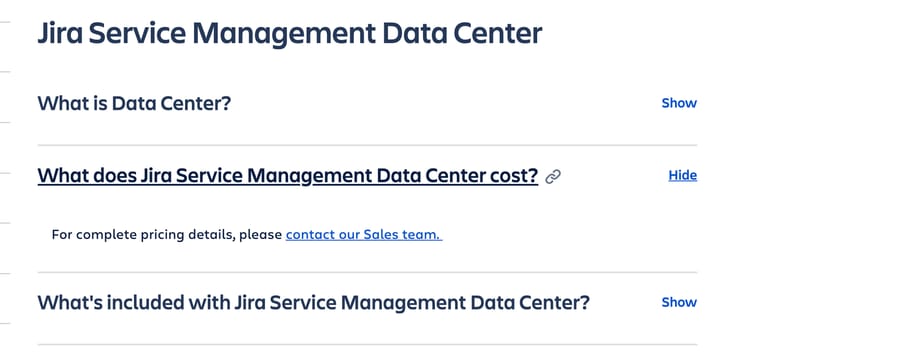
Jira Service Management Data Center. The Data Center licensing page answers "What does Jira Service Management Data Center cost?" with one sentence: "For complete pricing details, please contact our Sales team." The same page sets end of life for impacted Data Center products at 28 March 2029, after which subscriptions and Marketplace apps expire and products go read-only. If you are costing a self-managed deployment in 2026, you are costing a product with a published expiry date and an unpublished price.
The marketplaces. AWS Marketplace carries a first-party listing — Jira Service Management, sold by Atlassian, rated 4.3 from 966 reviews — and its Pricing tab is "Custom pricing options / Request private offer" with no dimension and no dollar figure anywhere on the page. Microsoft's marketplace carries Jira Service Management Data Center from Atlassian, but it is an ARM deployment template: it installs software you license separately, so it prices nothing. Neither marketplace gives you a number Atlassian's own site doesn't.
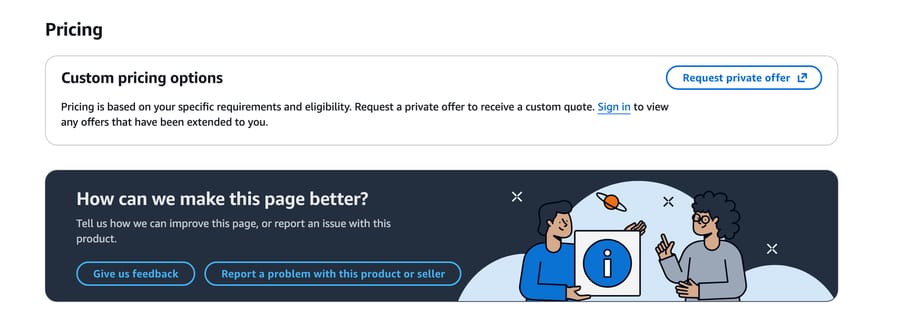
Marketplace apps are the fourth line nobody budgets. Atlassian's own comparison table advertises "1,000+ Marketplace apps"; they are priced by their vendors, per user, on top of everything above.
How does it compare with Freshservice, Zendesk and ServiceNow?
Genuinely comparable products, each read on its own live page on 22 September 2026 and rechecked on 24 September.
| Product | Billing unit | Entry price | AI pricing |
|---|---|---|---|
| Jira Service Management (Service Collection) | Per agent, progressive monthly; per agent band annually | $25.00/agent/mo at 1–15; $2,500/yr for 6–10 agents | Virtual service agent from $0.30 per assisted conversation over 1,000/mo (Premium+); CSM AI agent $1.00 per resolution |
| Freshservice | Per agent, per month | Starter $19, Growth $49, Pro $99 per agent/mo billed annually | Freddy AI Copilot $29 per agent/mo |
| Zendesk Suite | Per agent seat plus per automated resolution | Suite Team $55/agent/mo billed annually | Billed per automated resolution; Zendesk's pricing page lists $1.50 committed / $2.00 pay-as-you-go |
| ServiceNow ITSM | Not published | No plan price on the ITSM pricing page — the only dollar figure on it is a customer outcome stat | Not published |
The billing units tell you what each vendor wants you to do. Atlassian's agent bands reward standing still — adding people inside your band is free, so the incentive is to right-size once a year and stop. Freshservice's flat per-agent rate is the simplest to forecast and the most expensive to grow. Zendesk's per-resolution rate is an outcome meter with a seat floor under it. Atlassian's own CSM meter is, oddly, the most buyer-friendly of the four: you pay only when the AI finishes the job.
If your comparison is really between an ITSM platform and a customer-facing help desk, our Zendesk vs Jira Service Management and Freshdesk vs Jira Service Management breakdowns set them side by side on features rather than price, and our Freshservice pricing breakdown does this same exercise on the closest direct rival. If you are still working out what Freshservice even is, start with what is Freshservice.
What do buyers say about the cost?
On G2, Jira Service Management scores 4.3 out of 5 from 986 reviews; on Gartner Peer Insights it scores 4.4 from 1,509 ratings across all markets. Both checked 22 September 2026. Atlassian's own site banner cites a Leader placement in the 2026 Gartner Magic Quadrant for IT Service Management Platforms.
Price does not dominate the complaints, but renewal does. RaviShankar S., a Senior Enterprise Cloud Architect at an enterprise (>1,000 employees), lists "Renewal costs, and customers sometimes face obstacles when it comes to tools integration" among his dislikes (16 December 2025). Tanu S., a deputy manager at a small business, is blunter: "I believe the pricing can be much better... the premium pricing can be little more better" (4 June 2026). The recurring functional complaint is configuration sprawl rather than cost — Sahil P., an AI/ML engineer at a mid-market company, writes that "Adjusting backend settings—like ticket workflows, backup administration, user management, and fields—doesn't feel very well defined and often seems fragmented" (28 April 2026). Read against the pricing, that is the real total-cost risk: the platform is configurable enough that somebody has to own it.
How we researched this
Every Atlassian number here was read in a browser on 22 September 2026, on the US-served pages, with the currency asserted — the licensing tables print prices in the literal form "USD 25 /Agent", which is why this guide repeats that notation rather than converting it. We stepped the calculator through seventeen team sizes on both billing toggles to derive the band structure, then checked each derived total against Atlassian's own published rate cards. We searched AWS Marketplace, Microsoft's marketplace and Atlassian's Data Center licensing page before writing that anything is unpublished. We did not get a sales quote, so we cannot tell you what Atlassian discounts in practice, and we did not test Enterprise, Data Center or Marketplace app pricing, none of which is public. Freshservice's figures came from a US-served fetch of its own pricing page after a browser fetch from our location returned rupees — a reminder to check the symbol before you publish it.
Where does an AI agent layer like Macha fit?
Jira Service Management is not one of the help desks Macha runs on, and this is a JSM pricing guide, so we will keep this short and accurate. Macha is an AI agent layer that sits on top of a help desk a team already runs (Zendesk, Freshdesk, Gorgias, Front, HubSpot or Intercom) and never replaces the desk underneath it. Macha does have a Jira connector: an agent can search and read issues, create issues and comment, move an issue through its workflow statuses and react to new issues, which covers the common setup where customer support lives in one of those help desks and bugs or escalations land in Jira.
Worth noting for anyone pricing AI on either side: Macha is billed on tickets, not on seats, conversations or credits. It starts at $299 a month for 750 tickets — about $0.40 a ticket — with setup and monitoring by the Macha team included, and the trial is $50 of free usage with no credit card. A ticket is one thread with one person, charged once however many replies it takes. The contrast with agent bands is the point: nobody pays for 49 empty seats. If you want to build an AI agent against a JSM queue, our guide to building an AI agent for Jira Service Management covers what is possible natively, and connecting Zendesk to Jira covers the common two-desk setup.
You can see the whole ticket-based rate card on our pricing page, or start a trial and spend the $50 before you decide anything.
Frequently asked questions
How much does Jira Service Management cost? On monthly billing, Standard is USD 25.00 per agent per month for your first 15 agents and USD 18.75 for agents 16–100; Premium is USD 57.30 and USD 49.95 across the same bands. On annual billing you buy an agent band rather than a headcount: Standard runs from USD 750 a year for 1–3 agents to USD 32,250 for 101–200, and Premium from USD 1,700 to USD 84,500 over the same range. Free covers three agents. Checked 22 September 2026.
Is there a free version of Jira Service Management? Yes. The Free plan covers three agents and unlimited customers, with 2 GB of storage, 100 email notifications a day, 1,250 automation steps per subscription per month, one month of alert retention and Atlassian Community support. It has no Assets, no virtual service agent, no change or problem management and no uptime SLA. There is also a 14-day free trial of Standard or Premium.
Why does Atlassian's pricing calculator show $20 per agent? Because it loads with 75 agents in the Team Size box, and at 75 agents the progressive rate card averages out to $20.00 a head. It is a monthly figure for a 75-person team, not a list price and not an annual one. Atlassian's published first band is USD 25.00 per agent per month.
Is annual billing cheaper than monthly? Only above a crossover point inside each band. Annual billing charges for the whole agent band, so on Standard it starts paying off at 5 agents in the 4–5 band, 9 in the 6–10 band, 13 in 11–15, 21 in 16–25, 41 in 26–50, 83 in 51–100 and 158 in 101–200. A 51-agent desk pays $12,600 a year on monthly billing and $19,700 on annual.
What is the difference between Jira and Jira Service Management? Jira is project and work tracking for the team doing the work. Jira Service Management is the service desk in front of it — request intake through a portal, email, chat, Slack or Microsoft Teams, plus incidents, alerts and on-call, change management, and asset and configuration management. They are separate subscriptions with separate price sheets, and JSM licenses agents while letting unlimited customers raise requests for free.
Can I still buy Jira Service Management on its own? No. Atlassian's licensing page states that Service Collection "is sold as a single offering, including Jira Service Management, Customer Service Management, Assets, and Rovo. The apps cannot be purchased separately." You are not charged extra for Customer Service Management if you do not want it, and existing JSM customers keep their configuration when they move across.
What does Jira Service Management Enterprise cost? Enterprise is annual-only and the calculator quotes it once you enter 201 or more agents: USD 168,500 a year at 201–300 agents, USD 203,000 at 301–400 and USD 237,500 at 401–500. Below 201 agents there is no published figure and the card says contact sales.
How much is the AI in Jira Service Management? Three separate meters. The virtual service agent is included on Premium and Enterprise with 1,000 assisted conversations a month or 12,000 a year, then from $0.30 per assisted conversation — and an assisted conversation counts even when the bot escalates. Rovo credits run 250, 700 or 1,500 per user per month by plan, then $0.01 per credit. The Customer Service Management AI agent is $1.00 per resolution with no included allowance, charged only when it resolves an inquiry without a human.
Is Jira being phased out? Jira Cloud is not. Atlassian's self-managed Data Center products are: the Data Center licensing page sets end of life at 28 March 2029, after which subscriptions and their Marketplace apps expire and the products become read-only. Data Center list pricing is no longer published either — that page now says to contact sales.
What does Jira Service Management Data Center cost? Atlassian does not publish it. Its licensing page answers the question with "For complete pricing details, please contact our Sales team", and we found no list price on AWS Marketplace, where the first-party Jira Service Management listing is private-offer only, or on Microsoft's marketplace, where the Data Center entry is a deployment template rather than a licence.
Sources:
- Service Collection pricing (Jira Service Management) — calculator, plan contents, add-on rates
- Service Collection pricing and licensing — monthly rate cards, annual tier tables, CSM AI resolution terms
- Atlassian usage-based pricing FAQ — meters, allowances, 3 December 2026 billing start
- Rovo licensing — $0.01 per credit
- Automation licensing — $0.50 per 1,000 steps
- Atlassian Guard licensing — per-user rate card
- Jira Service Management Data Center licensing — no published price, 28 March 2029 end of life
- Jira Service Management pricing and packaging updates — the October 2024 move to consumption pricing
- AWS Marketplace: Jira Service Management — private-offer listing
- G2: Jira Service Management reviews and Gartner Peer Insights
- Freshservice pricing and ServiceNow ITSM pricing
Simple per-ticket AI pricing
One thread with one person is one charge, however many replies it takes.