Intercom
 Shopify
 Stripe
 Slack
Slack Notion
 Google Workspace
 Confluence

How Much Does Pylon Cost in 2026? No Public Price, and a $100,800 Median


Pylon publishes no price: its pricing URL redirects to a 30-minute demo form, and the only public seat rates are G2 figures dated October 2024. Those rates top out at $11,676 a year at the stated seat minimums, while Vendr puts the median Pylon contract at $100,800.
Key takeaways
- Pylon publishes no pricing on its own website, and usepylon.com/pricing redirects straight to a 30-minute demo booking form.
- The only public Pylon seat prices come from G2, dated October 10, 2024: Starter $59, Professional $89 and Enterprise $139 per seat a month.
- Vendr's data shows a median Pylon contract of $100,800 a year, far above the $11,676 maximum the published tiers can produce at their stated seat minimums.
- Pylon's Enterprise plan requires a minimum of 7 seats, versus 3 seats on Starter and Professional, according to G2's plan cards.
- Reaching Vendr's $100,800 median Pylon contract on Enterprise seats alone would take about 60 seats at the 2024 published rate of $139 a seat.

Pylon does not publish a price: usepylon.com/pricing redirects to a 30-minute demo form, and the only public seat rates are G2's October 2024 figures of $59, $89 and $139 a seat a month, against a $100,800 median contract on Vendr.
How much does Pylon cost? (September 2026)
| Source | What it says | Date on the figure |
|---|---|---|
| usepylon.com/pricing | No prices. The URL redirects to usepylon.com/schedule-demo | Checked Sep 22, 2026 |
| G2's Pylon pricing tab | Starter $59, Professional $89, Enterprise $139, per seat per month | Plan block says "last updated on October 10, 2024" |
| Vendr | Median buyer pays $100,800 a year, range $16,343 to $152,831 | Checked Sep 22, 2026 |
| docs.usepylon.com | No billing, seats or pricing section | Checked Sep 22, 2026 |
| AWS, Azure and Google Cloud marketplaces | No Pylon-published listing | Checked Sep 22, 2026 |
The short version: the only public seat prices are nearly two years old, and the only recent figure is a procurement median seven to nine times larger than those seat prices can explain. Both numbers are below, and so is the arithmetic.
Which Pylon is this about?
"Pylon pricing" returns at least two companies on page one of Google. This guide is about Pylon the B2B support platform at usepylon.com, the one that runs shared Slack and Microsoft Teams channels, a support inbox and a customer portal. It is not getpylon.com, which is a different company with a different product and its own pricing page, and it is not the structural or utility sense of the word.
What does Pylon publish about its own pricing?
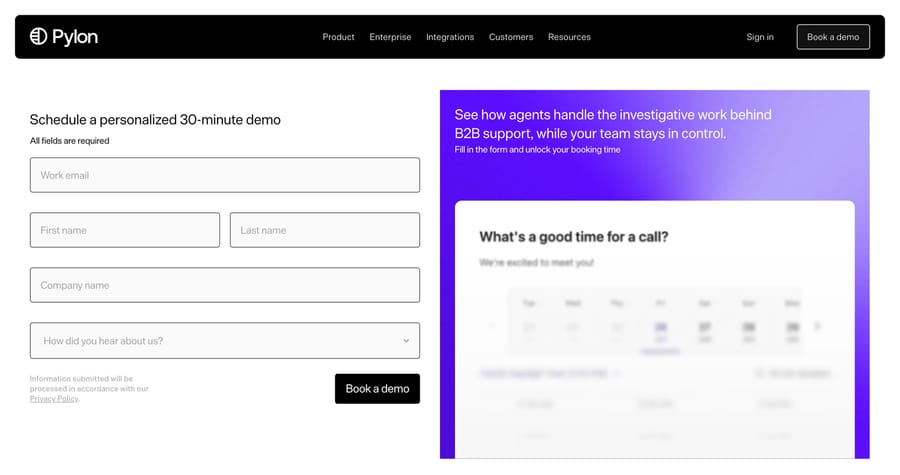
We checked on September 22, 2026, and again on September 24. usepylon.com/pricing is not a page of its own; it redirects to usepylon.com/schedule-demo, which asks for a work email, first and last name, company name and how you heard about them, in exchange for a 30-minute call. There is no plan table, no seat rate and no self-serve checkout anywhere on the marketing site.
The documentation does not fill the gap either. docs.usepylon.com covers agents, support workflows, customer portals, account and product intelligence, reporting, broadcasts and the API, with no billing or seats section at all.
Where do the only public Pylon plan prices come from?
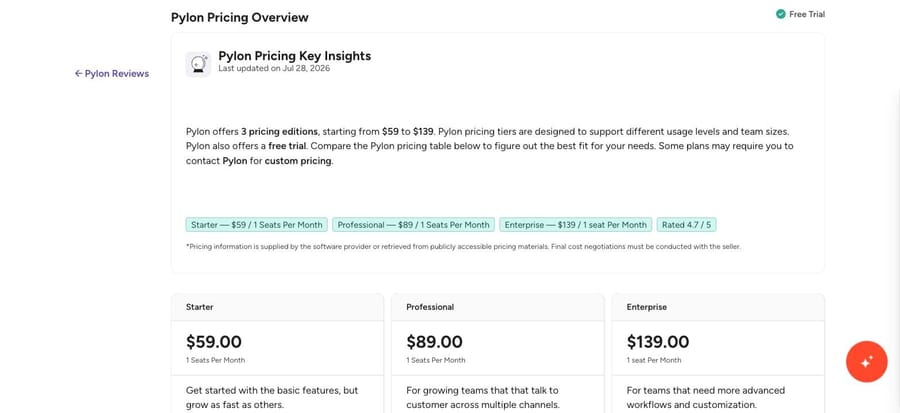
G2's Pylon pricing tab does carry plan prices, supplied, in G2's words, "by the software provider or retrieved from publicly accessible pricing materials":
| Plan | Price | Minimum seats | What it adds |
|---|---|---|---|
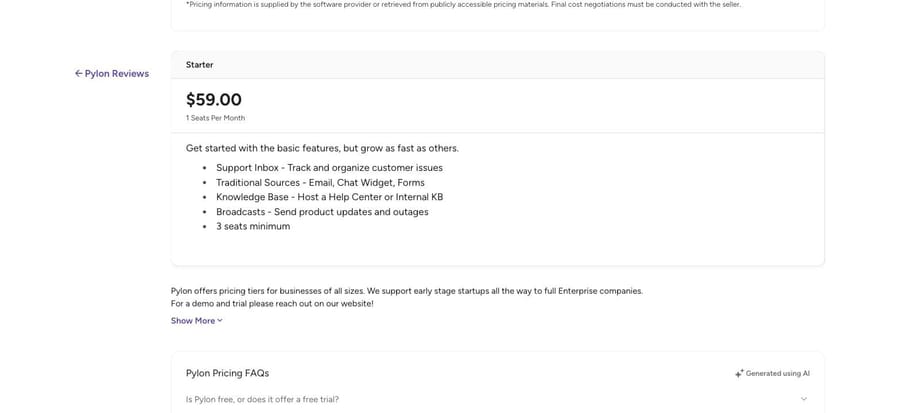
| Starter | $59 per seat/month | 3 | Support inbox, email, chat widget and forms, knowledge base, broadcasts |
| Professional | $89 per seat/month | 3 | Slack Connect and community, integrations, automations, analytics, API and webhooks |
| Enterprise | $139 per seat/month | 7 | Microsoft Teams, customer portal, RBAC, security review, MSA |
Now the part that matters. The G2 page header says "Last updated on Jul 28, 2026", which reads like a current figure. The plan block itself, further down the same page, says something different: "Pricing information was last updated on October 10, 2024." The header is when G2 refreshed the page; the prices are nearly two years older than that. We are quoting both so you can judge for yourself.
What do companies actually pay for Pylon?
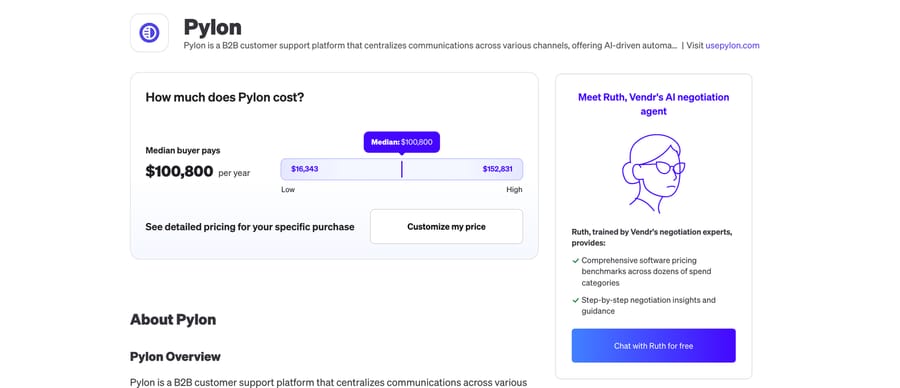
Vendr, which sells procurement help rather than a competing support platform, showed a median Pylon contract of $100,800 a year on September 22, 2026, with a low of $16,343 and a high of $152,831.
One caveat worth stating plainly: unlike Vendr's pages for Ada, Dialpad, Aircall and Genesys, the Pylon page shows no purchase count and no deals-handled tile. So we know Vendr's median, and we do not know how many contracts it rests on. Treat it as directional.
Now hold the two sources next to each other:
- The largest annual bill the published tiers can produce at their own stated minimum is $139 × 7 seats × 12 = $11,676 a year.
- To reach Vendr's $100,800 median on Enterprise seats alone you would need about 60 seats ($100,800 ÷ $139 ÷ 12). On Professional seats, about 94.
- Even the low end of Vendr's range, $16,343, needs about 10 Enterprise seats or 15 Professional seats.
Sixty seats is a large support organization for a B2B company using shared Slack channels. The more likely explanations are that the 2024 seat prices have risen, that AI or usage charges sit on top of them, or both. Pylon publishes nothing on AI pricing anywhere we could find, so we cannot say which.
What would Pylon cost a 3, 10 or 25-seat team?
These use the only public rates that exist, the October 2024 G2 figures, and every row is labeled with that vintage. Treat them as a floor and a starting point for a quote, not a quote.
Small: the minimum viable Pylon, 3 seats on Starter. 3 × $59 = $177 a month, $2,124 a year at 2024 rates. This is the smallest bill the published tiers allow.
Mid: 10 seats on Professional. 10 × $89 = $890 a month, $10,680 a year at 2024 rates. This buys the Slack Connect and community features that are the main reason teams pick Pylon, plus integrations, automations and the API.
Large: 25 seats on Enterprise. 25 × $139 = $3,475 a month, $41,700 a year at 2024 rates, with the customer portal, Microsoft Teams and RBAC. This is still under half Vendr's median, at a seat count most B2B support teams never reach.
The pattern is the point. Every row built from public prices lands well below what buyers report paying, which is the clearest available evidence that seats are not the whole bill.
What drives a Pylon bill up?
- Seat minimums. 3 on Starter and Professional, 7 on Enterprise. A five-person team on Enterprise pays for seven.
- The Enterprise gate. The customer portal, Microsoft Teams and RBAC all sit on the top tier, which is 2.4 times Starter.
- Anything metered. Pylon's site, docs and G2 listing publish no AI, usage or volume rates. The gap between $11,676 and $100,800 has to come from somewhere.
- Quote-only everything. With no self-serve checkout, every price is negotiated, which cuts both ways.
- Age of the published numbers. The only public seat rates are from October 2024.
On incentives: per-seat pricing means the vendor earns more as your support headcount grows, so a seat-priced platform has no structural reason to help you need fewer people. A per-resolution or per-ticket model inverts that. Our breakdown of AI agent pricing models goes through what each billing unit rewards and who carries the risk.
How does Pylon pricing compare with Help Scout, Front and Fin?
Prices below are each vendor's own published rate, read on the dates shown.
| Platform | Billing unit | Entry price | Published on its own site | Checked |
|---|---|---|---|---|
| Pylon | Per seat | $59 seat/month (2024 G2 figure) | No | Sep 22, 2026 |
| Help Scout | Per user | $25 user/month (Standard) | Yes | Sep 24, 2026 |
| Front | Per seat | $25 seat/month billed annually (Starter, up to 10 seats) | Yes | Sep 24, 2026 |
| Intercom Fin | Per outcome | $0.99 per outcome; the 50-outcome monthly minimum applies only when Fin runs on a help desk other than Intercom | Yes | Sep 24, 2026 |
The structural comparison matters more than the rate. Help Scout and Front publish their seat prices; Pylon does not. Fin charges per outcome rather than per seat, which is a different bet entirely, and Fin now belongs to Salesforce, which completed its acquisition on 10 September 2026. Our Help Scout, Front and Intercom Fin breakdowns cover each one, help desk software pricing compared puts the category side by side, and our Pylon guide covers what the product actually does.
Pylon suits teams doing B2B support in shared Slack or Teams channels, where the customer is an account rather than a consumer and the conversation lives where the customer already works. It is the wrong fit if you run high-volume consumer support, where per-seat pricing at $59 to $139 scales badly against per-ticket or per-resolution models, or if you need a published price to get budget approved before a sales call.
What do Pylon users say?
Pylon holds 4.7 out of 5 from 111 reviews on G2, checked September 22, 2026, which is the highest rating of the five vendors we priced this month on the smallest review base. That combination is typical of a fast-growing product with an enthusiastic early customer base. On pricing specifically, the recurring public complaint about Pylon is not the rate but the opacity and the churn in the model, which is consistent with what we found: a pricing URL that redirects to a demo form, and the only public rates carrying a 2024 timestamp.
How we researched this
On September 22, 2026 we followed usepylon.com/pricing and confirmed the redirect to the schedule-demo form, both with a plain request and in a browser, and captured the page it lands on. We read G2's Pylon pricing tab in a browser and recorded all three plans, both seat minimums and both of the page's own "last updated" dates. We read Vendr's Pylon contract page the same day and noted that, unlike Vendr's other vendor pages, it carries no purchase count. We searched AWS, Azure and Google Cloud marketplaces for a Pylon listing and found none. We queried Pylon's documentation for a billing or seats page and found none. We are not a Pylon customer and Pylon has no self-serve signup, so nothing here comes from a bill of our own.
Where does Macha fit next to Pylon?
Pylon is a help desk built for B2B support in shared channels. Macha is an AI agent layer that runs on top of the Zendesk, Freshdesk, Gorgias, Front, HubSpot or Intercom a team already uses, and it is not a help desk, so it does not replace Pylon and does not run on it.
The comparison that is real is the billing unit, because it is the thing Pylon does not publish. Macha is one plan priced on monthly ticket volume, $299/month for 750 tickets, about $0.40 per ticket at every tier, billed monthly, with setup and monitoring by the Macha team, included on every plan. A ticket is one thread between Macha and one person, charged once no matter how many messages it takes, and there are unlimited team seats, so adding people to the team does not change the bill. That is the opposite trade to a per-seat model: Macha's bill moves with volume, Pylon's moves with headcount, and which one you want depends on whether your support load or your support team is growing faster. The tiers are on our pricing page, and there is $50 of free usage (about 125 tickets), no credit card, no time limit at dashboard.getmacha.com/signup.
Frequently asked questions
How much does Pylon cost? Pylon publishes no price on its own site: usepylon.com/pricing redirects to a demo form. The only public plan prices are on G2, at $59, $89 and $139 a seat a month for Starter, Professional and Enterprise, and G2's own page dates those figures to October 10, 2024. Vendr's procurement data puts the median Pylon contract at $100,800 a year.
Why is there such a gap between the seat prices and the median contract? Because the published tiers cannot produce it. At the stated seat minimums, the largest bill the public prices allow is $139 × 7 × 12, or $11,676 a year. Reaching $100,800 on Enterprise seats alone needs about 60 seats. Either the 2024 rates have risen, or usage and AI charges sit on top, or both. Pylon publishes nothing that settles it.
Does Pylon have a free trial? G2's Pylon listing shows a "Free Trial" badge and the pricing tab says "Pylon also offers a free trial", checked September 22, 2026. Pylon's own site offers a demo booking rather than a self-serve signup, so the trial appears to start after a sales conversation.
What is Pylon's minimum seat count? G2's plan cards state a 3-seat minimum on Starter and Professional, and a 7-seat minimum on Enterprise. At Enterprise rates that makes the floor $973 a month at 2024 prices.
Is Pylon on AWS or Azure Marketplace? No Pylon-published listing came up in searches of AWS, Azure or Google Cloud marketplaces on September 22, 2026. The "Pylons" results on Azure are unrelated Ubuntu virtual-machine images from a different publisher.
What does Pylon's AI cost? Nothing public. Pylon markets an agentic support platform, and neither its site, its documentation, G2 nor any cloud marketplace publishes an AI rate, a resolution price or a usage allowance.
Is usepylon.com the same as getpylon.com? No. They are different companies, and both rank on page one for "pylon pricing". This guide covers usepylon.com, the B2B support platform.
What should you ask Pylon on the demo call?
Pylon is one of the better-reviewed support platforms in B2B, and one of the least transparent on price. What you can rely on today is a set of 2024 seat rates on G2 and a $100,800 procurement median that those rates cannot explain. That gap is the whole story, and it is the first thing to raise on the demo call: ask for the current seat rates in writing, ask what sits on top of them, and ask what the AI costs, because no public source answers any of the three.
Sources: G2: Pylon pricing · G2: Pylon reviews · Vendr: Pylon contract data · Pylon demo booking · Pylon documentation · Help Scout pricing · Fin pricing · AWS, Azure and Google Cloud marketplace searches, September 22, 2026
Simple per-ticket AI pricing
One thread with one person is one charge, however many replies it takes.