Intercom
 Shopify
 Stripe
 Slack
Slack Notion
 Google Workspace
 Confluence

Synthflow Pricing (2026): Plans, Real Costs and What You'll Actually Pay


Synthflow no longer sells a self-serve plan: its pricing page lists one Enterprise tier, and contracts "start at $30,000 annually," which works out to $2,500 a month before you've placed a call. Synthflow doesn't publish the per-minute rate inside those contracts; the last figure it published itself was $0.08 a minute, with enterprise tiers as low as $0.07, in August 2025. This guide explains what the $30,000 buys, how Synthflow meters calls and chats, what three monthly volumes cost under the floor, and how that compares with three self-serve rivals.
Key takeaways
- Synthflow no longer sells a self-serve plan: new contracts start at $30,000 a year, which averages $2,500 a month before a single call is placed.
- The last per-minute rate Synthflow published itself was $0.08 a minute in August 2025, with enterprise tiers advertised as low as $0.07 a minute.
- At the $30,000 annual floor spread evenly, $2,500 a month buys about 31,250 minutes at the old $0.08 rate, so a team using fewer minutes pays for unused capacity.
- Calls are metered per second with seconds pooled across calls, unanswered calls cost a flat 5 seconds, and billing stops the moment a call successfully transfers to a human.
- At 10,000 minutes a month, Synthflow's floor costs $2,500 versus about $1,144 on Retell AI, $848 to $1,319 on Vapi, and about $812 plus telephony on ElevenLabs Agents.

| Plan | Monthly | Annual | What's included | Caps and limits |
|---|---|---|---|---|
| Enterprise | Scoped per contract (the $30,000 floor averages $2,500 a month) | From $30,000 | Contracted SLA and support, account team and launch support, native telephony or SIP trunking, CRM and workflow integrations, MSA/DPA and security review, SSO where included | Concurrency, call-rate (CAPS) limits, allowances and carryover set in the agreement |
| Pro, Growth, Agency (legacy) | Existing customers only | n/a | Whatever the existing agreement says | "No longer available for new subscriptions," per Synthflow's docs |
Prices checked September 19, 2026 on synthflow.ai/pricing.

For the product itself (flow designer, telephony, customers), see our Synthflow complete guide. This page covers only what it costs.
What changed: from per-minute plans to a contract floor
In August 2025, Synthflow's own voice AI cost guide advertised "flat, per-minute pricing starting at $0.08/min, with enterprise tiers as low as $0.07/min," and added "No license fees, no required contracts." That page is still live and still ranks on page one for "synthflow pricing."
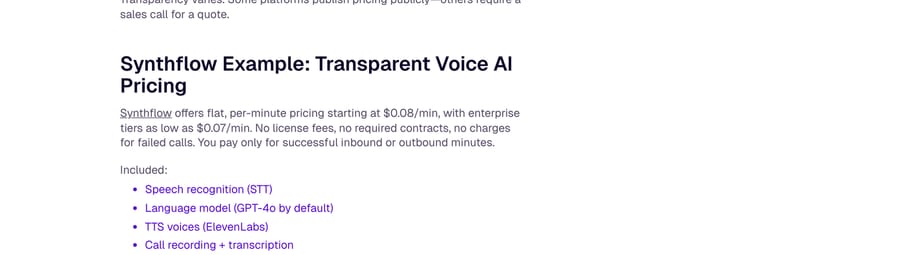
A year later the model is the opposite. Synthflow's billing overview says: "Synthflow uses sales-led pricing. Your package is scoped with the Synthflow team based on expected volume, telephony, integrations, and support needs." Its concurrency page confirms that the earlier Pro, Growth and Agency plans "are no longer available for new subscriptions and remain supported for existing customers." The pricing page's only call to action is "Contact sales."
The transition was recent. As late as June 18, 2026, Zeeg, a company that sells a competing phone assistant, described a Synthflow pay-as-you-go tier at $0.09 a minute for the voice engine. Neither Synthflow's pricing page nor its billing docs describe that tier now. If a quote or review you're reading mentions a monthly plan or a free trial, check its date.
What the $30,000 buys
Synthflow's Enterprise docs list what a contract covers:
- Pricing: a sales-led annual agreement.
- Capacity: concurrency and call-rate limits scoped to your expected volume.
- Reliability and support: contracted support and availability terms, an account team and launch support.
- Telephony: SIP trunking, Synthflow's native telephony, or approved carrier paths.
- Security and compliance: SSO and workspace controls where included; SOC 2, GDPR and ISO 27001 reviews.
- Allowances: included usage, carryover or overage terms "when included in the agreement."
The docs' own FAQ answers the minimum-commitment question with "Enterprise terms are defined in your agreement." The only public number is the $30,000 floor on the pricing page.
How Synthflow meters calls and chat
The contract sets your rate, but the metering rules are public in Synthflow's usage and billing docs, and they decide how many minutes your rate gets multiplied by.
- Calls are measured per second, from when the caller and the agent connect to when the call ends, with partial seconds rounded up.
- Seconds are pooled across calls. Synthflow doesn't round each call up to a minute; it adds seconds across calls and reports each whole accumulated minute on the invoice, carrying the remainder forward.
- Transfers stop the meter. After a successful transfer, AI usage isn't billed.
- Unanswered calls cost 5 seconds. A
no-answerorhangup_on_voicemailcall is recorded as a flat 5 seconds;failedanduser-canceledcalls aren't billed. - Chat converts to minutes: "every 5 AI-generated messages count as 1 usage minute," across API, widget and SMS.
- Simulations are metered separately and may count both the agent's and the simulated caller's messages.
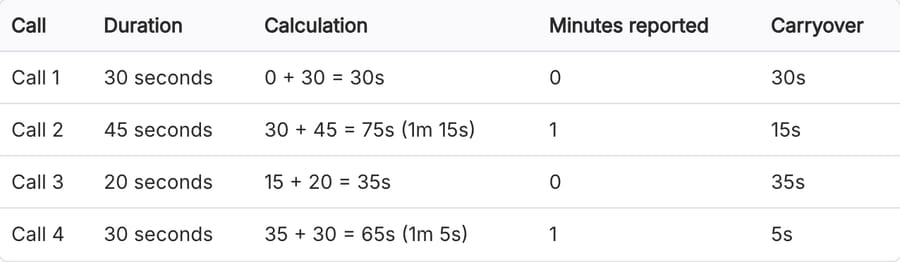
Pooling seconds is more generous than per-call rounding. Four short calls of 30, 45, 20 and 30 seconds report 2 minutes on Synthflow; a platform that rounded each call up to the minute would bill 4.
Two invoicing details matter for budgeting. Some accounts are billed by threshold, and Synthflow says plainly that "billing thresholds are triggers, not spending caps": usage keeps accruing between checks, so an invoice can exceed the threshold. And carryover of unused included minutes exists only if your agreement includes it.
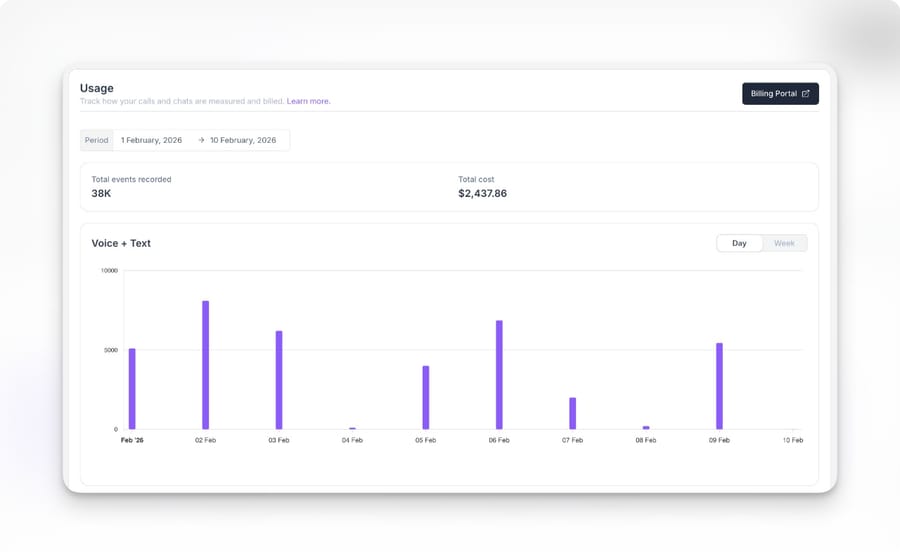
The usage dashboard shows total events and total cost for a period, with a "Cost by Provider" breakdown underneath.
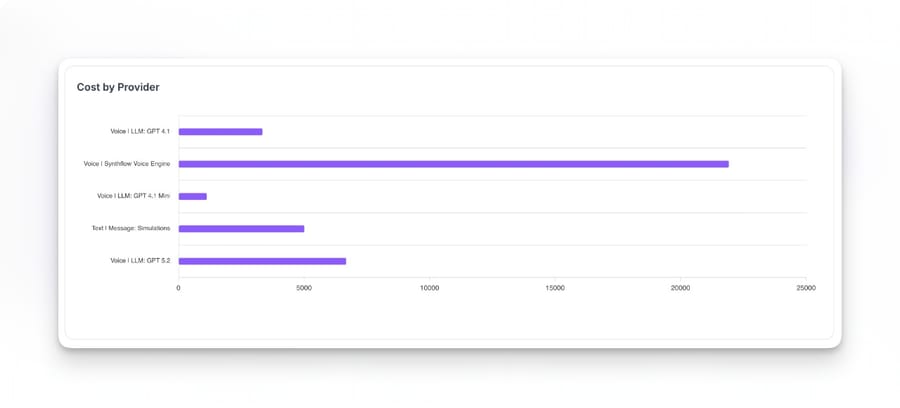
The example in Synthflow's docs splits spend across the Synthflow voice engine, several GPT models and text simulations, so the model you choose still shows up as its own cost line, even though your contract sets the overall rate.
What Synthflow costs at three call volumes
Synthflow's current per-minute rates aren't public, so this section is an estimate. We use the last rate Synthflow published itself ($0.08 a minute, August 2025) and today's $30,000 annual floor, spread evenly as $2,500 a month. Your contract rate may be higher or lower.
| Volume | Minutes at $0.08 | With the $30,000/yr floor | Effective cost per minute |
|---|---|---|---|
| Small: 1,000 minutes (about 250 four-minute calls) | 1,000 × $0.08 = $80 | $2,500 | $2.50 |
| Mid: 10,000 minutes (about 2,500 calls) | 10,000 × $0.08 = $800 | $2,500 | $0.25 |
| Large: 50,000 minutes (about 12,500 calls) | 50,000 × $0.08 = $4,000 | $4,000 (above the floor) | $0.08 |
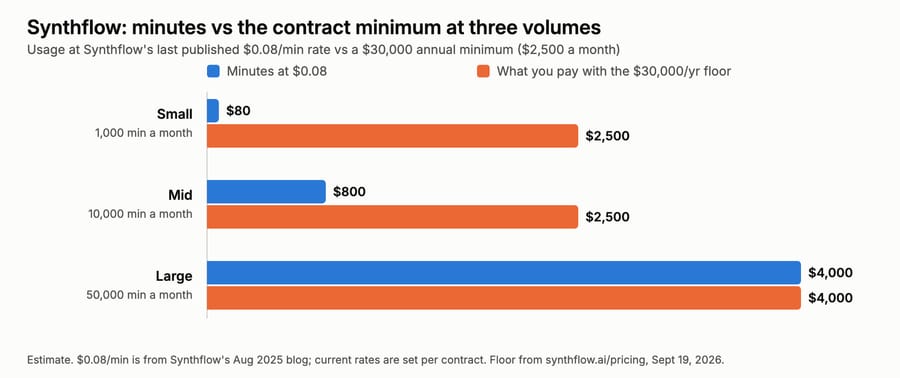
The floor is the whole story below a certain size. At $0.08 a minute, $2,500 buys 31,250 minutes a month; at the $0.07 enterprise rate it buys about 35,700. Under roughly 31,000 minutes a month you're paying for capacity you don't use, unless your agreement includes carryover. Above it, you're paying for minutes like anyone else, and at 50,000 minutes a $0.07 rate would bring the month to $3,500.
Chat follows the same logic. A team running 3,000 web chats a month at 6 AI replies each sends 18,000 AI messages, which Synthflow counts as 3,600 usage minutes: about $288 at $0.08, well inside the floor.
Enterprise pricing: what we could find elsewhere
Because Synthflow publishes no rate card, we checked the places that sometimes leak one, on September 19, 2026:
- AWS Marketplace: no Synthflow listing (a search for "synthflow" returned 0 results).
- Azure Marketplace: no Synthflow listing; the search returned only unrelated products such as LiveFlow.
- Google Cloud Marketplace: no Synthflow listing.
- Vendr: no Synthflow page.
- G2's pricing tab: G2 rates Synthflow 4.5 out of 5 from 1,015 reviews, checked September 19, 2026.
- Synthflow's docs: sales-led pricing, with rates, allowances and invoice terms "from your agreement or account setup."
So the $30,000 floor on Synthflow's own page is the only current public price.
What drives a Synthflow bill up
- The floor itself. Below about 31,000 minutes a month at $0.08, the minimum is most of the bill.
- Concurrency and call rate. Both are scoped in the contract, and exceeding them can return a
429error or queue calls, per the concurrency docs. A campaign or seasonal peak you didn't scope is a renegotiation. - Telephony. Native Synthflow numbers or your own SIP trunk are scoped per deal; the docs don't publish carrier rates.
- Voicemail and no-answers on outbound. Each costs 5 seconds. On a list of 10,000 numbers where 60% don't pick up, that's 6,000 × 5 seconds, or 500 minutes.
- Simulations. Test runs are metered, and can count both sides of the conversation.
- Threshold invoices. An invoice triggered by a threshold can land above it, because thresholds aren't caps.
White-label and agency features exist "when included in your account setup." Zeeg reported a $2,000-a-month white-label add-on in June 2026; Synthflow's pages don't publish one, so treat it as a competitor's figure from before the pricing change.
What an annual minimum rewards
A $30,000 floor moves utilization risk from Synthflow to you, and the incentive runs one way. Synthflow's revenue from a new customer is fixed up front, whether the agent handles 5,000 minutes a month or 50,000, and the buyer carries the cost of a slow rollout. That's a rational choice for a company that, by its own docs, now puts account teams, launch support and contracted SLAs on every deal: those costs don't scale down for a 1,000-minute customer.
For a buyer, it means the useful questions are contract questions. Ask what the per-minute rate is above the floor, whether unused minutes carry over, how concurrency and CAPS are set, and what happens at renewal. The metering rules above are generous (pooled seconds, free failed calls, no charge after transfer), but they only matter once you're above the floor.
How Synthflow's price compares
At the mid volume, 10,000 minutes a month, the self-serve platforms cost less than Synthflow's floor:
| Platform | Billing unit | 10,000 minutes a month | Commitment |
|---|---|---|---|
| Synthflow | Annual contract, rate per minute set in the agreement | $2,500 (floor; estimate) | From $30,000 a year |
| Retell AI | Per minute, by component | About $1,144 | None; prepaid credits |
| Vapi | $0.05 hosting a minute + providers at cost, $29 Core package | $848 to $1,319 | None; prepaid credits |
| ElevenLabs Agents | Plan minutes + $0.08 overage | About $812 + telephony | Monthly plan |
Rival prices are from each vendor's live page on September 19, 2026. Retell's figure assumes GPT 5.4 mini, a platform voice, US telephony, a knowledge base and two numbers; Vapi's is its own calculator plus Core; ElevenLabs' is Pro ($99 + 8,762 × $0.08) plus about $12 of Gemini 2.5 Flash.
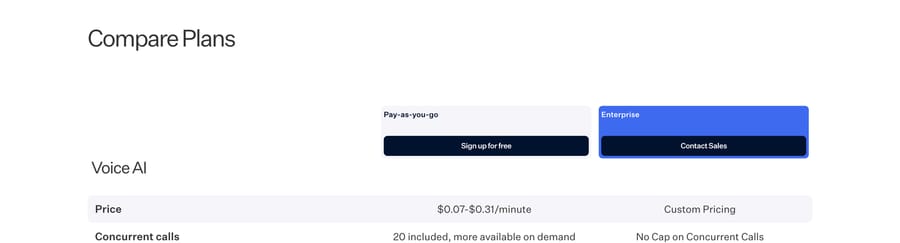
Retell publishes every component price and includes 20 concurrent calls with no contract. It's the closest self-serve match for teams that liked Synthflow's builder but don't need a $30,000 commitment. See our Retell AI guide.

Vapi charges $0.05 a minute on top of providers at cost, with packages for support and concurrency. It suits developers more than no-code builders. Our Vapi guide covers it.
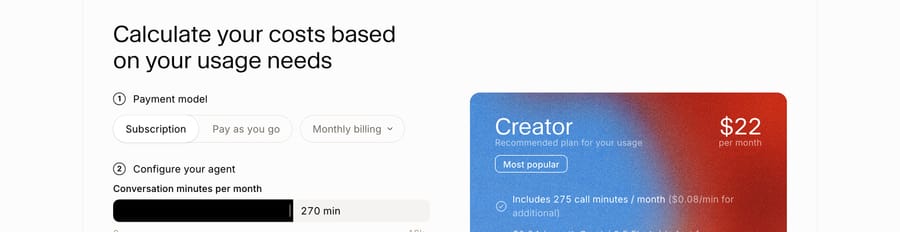
ElevenLabs Agents sells monthly plans with included minutes and a flat $0.08 overage, which makes it the cheapest row here before telephony. See our ElevenLabs Agents guide.
Synthflow's price makes sense against contract-sold platforms such as Parloa and PolyAI, where an account team, launch support and an SLA come with the deal. Against the self-serve three, it only wins once your volume is past the floor and you value the contracted support.
What users say about Synthflow's pricing
Synthflow's own pricing page shows "4.5, 1,000+ reviews on G2," and G2 confirms it: 4.5 out of 5 from 1,015 reviews, checked September 19, 2026. On Trustpilot, Synthflow holds 4.1 from 215 reviews, but only 7 were posted in the last 12 months, so the score mostly reflects the self-serve era.
The recent pricing complaints are about billing and access rather than the rate:
- Tyler Combs (US, April 2026) said he "cancelled my subscription over 5 moths ago and continue to get billed each month."
- A US reviewer (August 2025) wrote that "the tools you actually need are locked behind their absurdly overpriced enterprise plan."
The second review predates the pricing page's change and describes the same shift from the customer's side: first the features, and now the whole product, moved behind an enterprise contract.
Who Synthflow's pricing suits
Synthflow's pricing fits teams with a phone operation big enough to clear roughly 31,000 minutes a month, or that want an account team, a scoped launch and contracted SLAs and will pay a floor for them. A multi-location clinic group, a contact center automating first contact, or an agency with many client workloads under one agreement can all fill the floor.
It's the wrong fit if you're a small team testing voice AI, if you want to start without a sales call, or if your support volume is mostly email and chat tickets. For that ticket queue, Macha is an AI agent layer on the help desk you already run (Zendesk, Freshdesk, Gorgias, Front, HubSpot or Intercom), billed per ticket with no annual contract: one thread with one person is one charge however many replies it takes, from $299 a month for 750 tickets, with setup and monitoring by the Macha team included. The tiers are on our pricing page, and our guide to AI agents for customer service covers where voice and ticket agents each fit.
How we researched this
We read Synthflow's pricing page with a scripted browser on September 19, 2026, and its documentation on billing, usage, Enterprise terms, concurrency and subscription management the same day; the dashboard images come from those docs. The $0.08 rate is from Synthflow's own August 2025 blog, and the June 2026 pay-as-you-go description is from Zeeg, which competes with Synthflow. We searched AWS, Azure and Google Cloud marketplaces in Chrome and checked Vendr. We also read G2 directly (4.5 out of 5 from 1,015 reviews, checked September 19, 2026); Trustpilot was read with a scripted browser. We did not contact Synthflow's sales team or open an account, so every Synthflow cost here is an estimate.
Frequently asked questions
How much does Synthflow cost? New Synthflow contracts start at $30,000 a year, according to its pricing page, with the final price scoped around call volume, concurrency, telephony, integrations, security and launch support. That floor averages $2,500 a month.
What is Synthflow's price per minute? Synthflow doesn't publish a current per-minute rate; it's set in each agreement. The last rate it published was "starting at $0.08/min, with enterprise tiers as low as $0.07/min," in an August 2025 blog post.
Does Synthflow have a free plan or free trial? Synthflow's pricing page offers a demo and a sales contact, and its billing docs describe sales-led pricing for new deployments. Older reviews that mention a free trial or monthly plans describe terms from before that change.
What happened to Synthflow's monthly plans? Synthflow's docs say the earlier Pro, Growth and Agency plans "are no longer available for new subscriptions and remain supported for existing customers." Existing customers keep the terms in their agreements.
How does Synthflow bill calls? Per second from connection to hang-up, with seconds pooled across calls and reported as whole minutes. Failed and canceled calls are free, unanswered calls and voicemail hang-ups cost a flat 5 seconds, and billing stops after a successful transfer.
How is Synthflow chat billed? Every 5 AI-generated messages count as 1 usage minute, across the API, website widget and SMS. At 6 AI replies per chat, 3,000 chats is 3,600 usage minutes.
Is Synthflow cheaper than Retell? Not at small and mid volumes. At 10,000 minutes a month, Retell costs about $1,144 on published prices with no contract, against Synthflow's $2,500-a-month floor. Above roughly 31,000 minutes a month, Synthflow's price depends on the rate in your contract.
Is Synthflow on AWS Marketplace? We found no Synthflow listing on AWS, Azure or Google Cloud Marketplace on September 19, 2026, and no Synthflow page on Vendr.
If your support volume sits in a help desk rather than on the phone, you can start a Macha trial with $50 of free usage and no card, or see our tiers on the pricing page.
Sources: Synthflow pricing · Synthflow: Billing overview · Synthflow: Usage and billing · Synthflow: Enterprise · Synthflow: Concurrency · Synthflow: Manage your subscription · Synthflow blog: Voice AI cost (Aug 2025) · Zeeg: Synthflow AI pricing · Trustpilot: Synthflow AI (trustpilot.com/review/synthflow.ai) · Retell pricing · Vapi pricing · ElevenLabs Agents pricing
Simple per-ticket AI pricing
One thread with one person is one charge, however many replies it takes.