Shopify
 Stripe
 Slack
Slack Notion
 Google Workspace
 Confluence

Customer Service Phrases and Scripts: 64 Lines by Moment, Plus 20 to Stop Saying (2026)


Specific words beat polite ones: in a 2021 Journal of Consumer Research study of real support calls, customers were 8.9% more satisfied for every one standard deviation increase in how concrete the agent's language was. This page has 64 customer service phrases sorted by the moment you need them (opening, empathy, de-escalation, buying time, saying no, handing off and closing), 20 phrases to stop saying with a replacement for each, the same moments rewritten for chat, email and phone, and short live chat, scenario and phone scripts. Every phrase uses [square bracket] placeholders, and each set covers SaaS, ecommerce and general support.
Key takeaways
- This page has 64 customer service phrases in 7 moments, 20 "say this, not that" pairs, and chat, email and phone versions of each moment.
- In Packard and Berger's 2021 study, a one standard deviation rise in concrete language went with 8.9% higher satisfaction on calls and 30% higher 90-day spending after 941 email exchanges.
- A 2018 Journal of Marketing Research study found agents who say "I" instead of "we" are seen as more empathetic and get higher satisfaction and purchase intent.
- Zendesk's CX Trends 2026 found 74% of customers find it frustrating to repeat their story to different agents, which is what a good handoff phrase prevents.
- In an October 13, 2026 test, a Macha agent given this phrase bank as its tone section drafted a reply to a made-up angry billing ticket in 6.7 seconds.
Which customer service phrases do you need?
Find the moment, then jump to its section. Tone is the register the set is written in; channel shows where each set works without changes.
| Moment | Phrase set | Best channel | Tone |
|---|---|---|---|
| First reply or greeting | Opening phrases (1 to 10) | All | Warm, brief |
| Customer is upset or let down | Empathy phrases (11 to 20) | All | Specific, human |
| Customer is angry or threatening to leave | De-escalation phrases (21 to 30) | Phone, chat | Calm, accountable |
| You need to check something | Buying-time phrases (31 to 38) | Chat, phone | Concrete, timed |
| The answer is no | Saying-no phrases (39 to 48) | Email, chat | Kind, firm |
| Another team has to act | Handoff phrases (49 to 56) | All | Organized |
| Ending the conversation | Closing phrases (57 to 64) | All | Brief, clear |
| Habits to replace | Say this, not that (20 pairs) | All | n/a |
| Live chat start to finish | Live chat scripts (6) | Chat | Quick |
| Refund, cancellation, chargeback, out of stock | Scenario scripts (4) | Email, chat | Direct |
| Calls, holds and transfers | Phone scripts (5) | Phone | Steady |
For full replies rather than single lines, see our canned responses examples, customer service email templates and support ticket response templates. This page is the sentence level: the lines that go inside those replies, and the ones to take out.
What makes a customer service phrase work?
Two studies account for most of the difference between a phrase customers trust and one they skim past.
Concrete beats abstract. Grant Packard and Jonah Berger analyzed 185 recorded customer service calls from a large US online apparel retailer and 941 customer service email exchanges (Journal of Consumer Research, 2021). A one standard deviation increase in concreteness went with an 8.9% increase in satisfaction on the calls. In the email study, the same increase went with more than $10 (30%) more spending per customer over the 90 days after the email, at that one firm; a stricter version of the analysis still found $4 (13%). Their examples are small: "your money back" instead of "your refund", "that t-shirt in grey" instead of "that". The mechanism they found is that customers read concrete words as proof the agent was listening.
"I" beats "we". Packard, Sarah Moore and Brent McFerran found the "we will look into this" pattern at more than 40 firms, then showed in five studies that agents who say "I" are seen as feeling and acting on the customer's behalf, which raised satisfaction, purchase intent and purchases (Journal of Marketing Research, 2018). Swapping "you" in for warmth did little and sometimes hurt.
So why do so many scripts sound like "We apologize for any inconvenience this may have caused"? Because scripts are usually written to pass a QA checklist or a legal review. A phrase that names nothing admits nothing, and it's easy to score as "apology given: yes". The incentive is to be safe across 10,000 tickets, and the cost is that each customer reads it as a form letter. The phrases below do the opposite: each one has a bracket for the specific thing, and most of them are in the first person.
Three rules follow from that:
- Fill the bracket with the customer's own detail. "The $96 charge on October 1" beats "the issue".
- Say "I" for what you'll do, "we" for what the company got wrong. "We shipped the wrong size, and I've sent the right one."
- Put a time on every promise. "By 3 p.m. Eastern" beats "shortly". Our first response time glossary entry covers the metric this protects.
Opening phrases
The first line tells the customer whether a person read their message. Restate the specific thing they wrote about.
- "Thanks for writing in about [specific issue]. I'm [Name], and I'll take care of this." (General)
- "I've read your message and the [order/invoice/error message] you sent." (General)
- "Hi [First name], thanks for the screenshot of [error]. That makes this much faster." (SaaS)
- "I can see your order [Order number] in front of me now." (Ecommerce)
- "Thanks for flagging [bug or problem]. The steps you included will save us a round of questions." (SaaS)
- "Good question. The short answer is [answer], and here's the detail." (General)
- "Thanks for waiting while we got to this. Here's where [request] stands." (General, after a delay)
- "Hi [First name], I'm picking this up from [colleague], and I've read the whole thread." (General)
- "Thanks for calling [Company], this is [Name]. What can I help with today?" (Phone)
- "Hi, I'm [Name]. I'll be with you in this chat until it's sorted." (Chat)
Empathy and acknowledgment phrases
Empathy works when it names the consequence for this customer. "I understand your frustration" on its own names nothing.
- "Being [charged twice / locked out / sent the wrong item] is a real problem, and I'd be annoyed too." (General)
- "That's [number] days you've been waiting, which is too long." (General)
- "You had to explain this [number] times. I'm sorry, and you won't have to again." (General)
- "Losing access the day before [their deadline or event] is the worst timing. Let's fix it now." (SaaS)
- "A late gift is worse than a late anything else. I'm on it." (Ecommerce)
- "You did everything right here. The [error/delay] was on our side." (General)
- "Thanks for telling me how this affected [their team/customers]. That changes how I'll prioritize it." (B2B)
- "I'd want the same thing in your position." (General)
- "I can hear this has cost you time today." (Phone)
- "That makes sense. Can I ask one thing so I get it right: [question]?" (General)
De-escalation phrases for angry customers
An angry customer wants two things: proof you understand what went wrong, and an action. Give both in the first two sentences. Don't argue with the tone, and don't match it.
- "You're right that this should have been caught before it reached you." (General)
- "Here's what I'm doing right now: [action]." (General)
- "I'm not going to send you a template. Here's what actually happened: [plain explanation]." (General)
- "I want to fix this, not just log it. Can you give me [one detail] so I can [action]?" (General)
- "Let's start with the part that's hurting most: [specific issue]." (B2B, SaaS)
- "I hear you. I'll [action] by [time], and I'll tell you either way." (Phone, chat)
- "You don't have to dispute this with your bank. I'll [check the charge / start the refund] and confirm by [time]." (SaaS billing, ecommerce)
- "If I were you I'd want a name, so it's me: [Name], and I'll stay on this until it's closed." (General)
- "I can't change what already happened, but I can [concrete fix] today." (General)
- "Would it help if I called you? I can do [time] or [time]." (Email, chat, when written replies are escalating)
If a customer is abusive rather than angry, a separate line applies: "I want to help, and I'll keep going if we can keep this respectful." Use it once, and hand the ticket to a lead if it continues. Some teams also route these tickets automatically with sentiment analysis; the phrase still matters when a person picks the ticket up.
Buying-time phrases
A "let me check" with no time on it starts the clock on the customer's patience. Name what you're checking and when you'll be back.
- "I'm checking [specific thing] with [team] and will reply by [time]." (Email)
- "Give me two minutes to pull up [order/account/log], and I'll stay in this chat." (Chat)
- "Can I put you on hold for about [number] minutes while I check [thing]?" (Phone)
- "I don't know yet, and I don't want to guess. I'll find out from [team] and come back by [time]." (General)
- "I've reproduced the error on my side. Engineering is looking at it, and I'll update you by [time] whether or not it's fixed." (SaaS)
- "Your carrier's tracking hasn't updated since [date]. I've opened a trace, and they reply within [number] business days." (Ecommerce)
- "Thanks for holding. I've got the answer." (Phone, after hold)
- "Still on it. [What you've found so far]. Next update by [time]." (Chat, email, for long investigations)
Saying no: positive customer service phrases
Positive language doesn't mean hiding the no. Say it once, clearly, then spend the rest of the sentence on what the customer can do.
- "I can't [request], but I can [alternative]." (General)
- "That's outside our [refund window/plan], and here's what I can offer instead: [option]." (General)
- "We don't support [feature] today. The closest thing is [workaround], and I've logged your request with the product team." (SaaS)
- "This item is final sale, so I can't take it back. I can [exchange it/offer store credit] if that helps." (Ecommerce)
- "Our refund window is [number] days. Your order was on [date], so it's [inside/outside] it, and here's what that means: [result]." (General)
- "I can't share another customer's details, but I can [pass on a message/confirm what's on your account]." (General)
- "I'd rather tell you no now than promise something I can't deliver." (General)
- "The [plan/discount] isn't available on monthly billing. It is available if you [switch to annual/meet condition]." (SaaS)
- "Here's what you can do: [option one] or [option two]. Which would you like?" (General)
- "I can't approve this from here, but [team] can decide by [time], and I've sent them everything you told me." (General)
Handoff and transfer phrases
Zendesk's CX Trends 2026 found 74% of customers find it frustrating to tell their story over and over to different agents. A good handoff phrase promises they won't, and the internal note is where you keep that promise. Our guide to escalating a ticket with full context covers the note side, and the escalation glossary entry covers the terms.
- "I've passed this to [team] with [the details you sent], so you won't need to explain it again." (General)
- "[Name] on our [team] handles [topic]. I've introduced you in this thread, and I'll stay copied." (Email, B2B)
- "I'm transferring you to [Name] in [team]. I've told them about [issue], so you can pick up where we left off." (Phone)
- "I'm bringing in a specialist. They'll see this whole chat, so there's nothing to repeat." (Chat)
- "This needs an engineer. I've filed it as [ticket reference], and you'll hear from me, not a stranger, when there's news." (SaaS)
- "Our warehouse team can see what happened to the parcel. I've asked them and will reply by [time]." (Ecommerce)
- "If [team] needs anything from you, they'll ask here, in this thread." (General)
- "You were talking to our AI agent. I'm [Name], a person, and I've read everything above." (Chat, after a bot handoff; see our post on AI chatbot human handoff)
Closing phrases
The close should say what happens next, not ask a question the customer has to answer to end the conversation.
- "You'll hear from [team] by [time]. If you don't, reply to this email and it comes straight back to me." (Email)
- "That's done: [what you did]. You'll see [result] by [date]." (General)
- "I'll leave this ticket open until [the fix ships / the parcel arrives], then check in." (General)
- "If [problem] comes back, reply here and mention [reference] so it reaches me." (General)
- "Thanks for sticking with this, [First name]. It's fixed on our side." (General)
- "Your [refund/credit] of [amount] is on its way and usually lands in [number] business days." (General)
- "I'll close this chat now. The transcript goes to [email] so you have the steps." (Chat)
- "Thanks for calling, [First name]. You'll get an email with [confirmation] in the next few minutes." (Phone)
Say this, not that: 20 phrases to stop using
Each of these is common because it's safe for the company. Each replacement costs a few more words and tells the customer something.
| Instead of | Say | Why |
|---|---|---|
| "We apologize for any inconvenience." | "Sorry about [the double charge / the late order]." | Names what went wrong |
| "I understand your frustration." | "Waiting [number] days for a reply is too long." | Proves you read the message |
| "Calm down." | "I'm going to [action] right now." | Talks about the fix and leaves their tone alone |
| "That's our policy." | "Our policy is [rule], so here's what I can do: [option]." | Explains instead of hiding behind it |
| "Unfortunately, ..." (as the first word) | Start with what you can do | The no still comes, after a yes |
| "As I said before, ..." | Repeat the information | Avoids sounding irritated |
| "Someone will get back to you." | "[Team] will reply by [time]." | A name and a time |
| "Is there anything else I can help you with?" | "You'll see [result] by [date]." | Ends on the next step |
| "Your call is important to us." | "You're number [number] in the queue, about [number] minutes." | A fact instead of a claim |
| "I'm sorry you feel that way." | "I'm sorry this happened." | Apologizes for the event, not their reaction |
| "There's nothing I can do." | "I can't [request], but I can [alternative]." | Keeps one door open |
| "You should have ..." | "Next time, [tip] will save you a step." | Advice without blame |
| "Our system shows ..." | "I can see [specific detail] on your account." | First person, concrete |
| "No problem." | "Happy to." or "Done." | Doesn't suggest it could have been a problem |
| "I'll try to ..." | "I'll [action] by [time]." | A commitment with a deadline |
| "Bear with me." | "Give me two minutes to check [thing]." | A time and a reason |
| "We'll escalate this." | "I've sent this to [team], and I'll update you by [time]." | Says who and when |
| "Per my last email ..." | Quote the relevant line again | Saves them scrolling |
| "It's not our fault, it's the carrier." | "The carrier has it, and I've opened a trace with them." | Takes ownership of the next step |
| "Thank you for your patience." (after a long wait) | "Thanks for waiting. Here's the answer: [answer]." | Thanks them, then delivers |
Help Scout and Gorgias both publish shorter "avoid" lists of 8 phrases each; this one pairs every line with a replacement and the reason, because "don't say X" without an alternative sends agents back to X under pressure.
How should phrases change on chat, email and phone?
The same moment needs different words in each channel. Chat is short and fast, email has to stand alone without a back-and-forth, and phone has to work without anything written down.
| Moment | Chat | Phone | |
|---|---|---|---|
| Opening | "Hi, I'm [Name]. I'll be with you until it's sorted." | "Thanks for writing in about [issue]. I've read your message and the [screenshot] you sent." | "Thanks for calling [Company], this is [Name]." |
| Empathy | "That's a real problem. Let's fix it." | "Being [charged twice] is a real problem, and I'd be annoyed too." | "I can hear this has cost you time today." |
| De-escalation | "Here's what I'm doing right now: [action]." | "You're right that this should have been caught. Here's what happened and what I've done." | "I hear you. I'll [action] by [time], and I'll tell you either way." |
| Buying time | "Give me two minutes, I'll stay here." | "I'm checking [thing] with [team] and will reply by [time]." | "Can I put you on hold for about [number] minutes?" |
| Saying no | "I can't do [request], but I can [option]." | Put the no and the alternative in the same paragraph, near the top | Say the no, pause, then the option |
| Handoff | "I'm bringing in [Name]. They'll see this whole chat." | "I've introduced you to [Name] in this thread and I'll stay copied." | "I'm transferring you to [Name]. I've told them about [issue]." |
| Closing | "I'll close this chat now. The transcript goes to [email]." | "You'll hear from [team] by [time]. If you don't, reply here." | "You'll get an email with [confirmation] in a few minutes." |
Two channel rules matter more than any single phrase. In chat, send short lines one after another, because a customer watching a typing indicator reads a 90-second silence as being ignored. In email, assume the customer reads only the first two sentences, so the answer or the next step goes there, with the empathy after it.
Live chat scripts
These are short sequences for the moments chat agents repeat all day. Replace the brackets and keep each message to one or two lines.
1. Greeting a customer who started the chat
Hi [First name], I'm [Name]. I can see you're asking about [topic from pre-chat form]. Give me a moment to pull up your [account/order].
2. Proactive chat on a pricing or checkout page (SaaS, ecommerce)
Hi, I'm [Name] from the [Company] team. If you have a question about [plans/shipping], I'm here. If not, ignore me.
3. When you need time
I'm checking [thing] now. This takes about [number] minutes, and I'll stay in this chat.
Still here, still checking. [What you've found so far.]
4. Transfer to a specialist
This one needs [team]. I'm bringing in [Name], and they'll see everything we've said, so there's nothing to repeat. It'll take about [number] minutes for them to join.
5. Customer has gone quiet
Are you still there, [First name]? I'll keep this chat open for [number] more minutes. If we get cut off, the transcript goes to [email], and you can reply to it to pick up where we left off.
6. After hours
We're offline right now. Our chat team is back at [time and time zone]. Leave your question and email here, and we'll reply by [time]. If it's about [urgent topic], [where to go instead].
Scripts for common scenarios
These four combine phrases from the sets above into a full first reply. Each works by email or chat; on the phone, say the same steps in the same order.
1. Refund request inside the policy (General)
Thanks for writing in about [order or invoice]. You're inside our [number]-day refund window, so I've started a refund of [amount] to your [payment method]. It usually lands in [number] business days. You'll get an email when it's processed, and you don't need to send anything back [or: here's how to send it back: steps].
2. Cancellation request (SaaS)
Thanks for letting me know, [First name]. I've canceled [plan] for [workspace], effective [date]. You'll keep access until then, and you won't be charged again. If you're leaving because of [reason they gave], I'd like to pass that to the product team; if you'd rather not, there's nothing else you need to do.
3. Customer threatens a chargeback (SaaS billing, ecommerce)
Thanks for writing in about the [amount] charge on [date]. You don't need to go through your bank: I'm checking it with our billing team now and will reply by [time] with what happened and what we'll refund. If you've already opened a dispute, that's fine; tell me and I'll make sure billing knows, so nothing gets charged or refunded twice.
4. Item out of stock after ordering (Ecommerce)
Hi [First name], I'm sorry: [item] in [size or color] sold out after your order [Order number] went through. Here are your options: wait until [restock date], switch to [alternative], or cancel for a full refund of [amount]. Reply with the one you'd like and I'll do it the same day.
Phone scripts
Phone has no transcript, so every script says the next step out loud.
1. Opening a call
Thanks for calling [Company], this is [Name]. Can I start with your [account email / order number]?
2. Placing on hold
I need to check [thing] with [team]. Can I put you on hold for about [number] minutes? If we get disconnected, I'll call you back at [number they confirmed].
3. Back from hold
Thanks for holding, [First name]. Here's what I found: [answer].
4. Transferring
I'm going to transfer you to [Name] in [team], who handles [topic]. I've told them about [issue]. If the transfer drops, call [direct number] and mention [reference].
5. Callback voicemail
Hi [First name], this is [Name] from [Company], calling back about [issue]. [One-sentence update.] You can reach me at [number] until [time], or reply to our email and it comes to me.
What are other words for customer service?
"Customer service" has a dozen near-synonyms, and teams use them to mean slightly different jobs. Pick the one that matches what the team does.
| Term | What it usually means | Where you'll see it |
|---|---|---|
| Customer support | Answering questions and fixing problems, often technical | SaaS, software |
| Customer care | Support with a warmer, relationship framing | Retail, telecom, healthcare-adjacent consumer brands |
| Client services | Support for a smaller number of named accounts | Agencies, B2B, professional services |
| Customer experience (CX) | The whole journey, including support, onboarding and product | Job titles, strategy teams |
| Customer success | Proactive, account-level work to drive adoption and renewal | B2B SaaS |
| Help desk | The support function or the software it runs on | IT, internal support |
| Technical support | Troubleshooting a product or system | Hardware, software |
| Member services / guest services | Support for subscribers or visitors | Clubs, subscriptions, hospitality |
| Customer relations | Handling complaints and relationship repair | Larger consumer brands |
| After-sales service | Help after purchase: returns, repairs, warranty | Retail, manufacturing |
On a resume, "client-facing", "customer support", "client relations" and "customer success" each describe different experience. Use the one the job ad uses, and back it with a number: tickets a day, CSAT score, or response time.
What happened when an AI agent used this phrase bank?
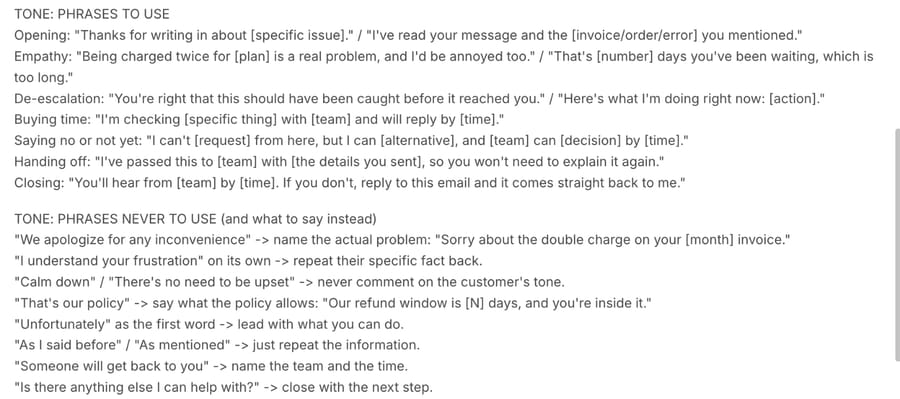
We put a short version of this page into the instructions of a test agent named "P12-T4 Tone phrases" on our Macha Demo org on October 13, 2026: one or two lines from each moment above under "TONE: PHRASES TO USE", eight of the "say this, not that" pairs under "TONE: PHRASES NEVER TO USE", and rules on top. The rules said the agent has no billing access, can't promise a refund, must name the customer's own fact in the first line and restate only facts the customer gave, must speak in the first person with a time, signs as a named person ("Sam, Support Team") so the "I" has someone behind it, and should hand refunds to a billing team that replies within 1 business day. It had no tools attached, so it could only write.
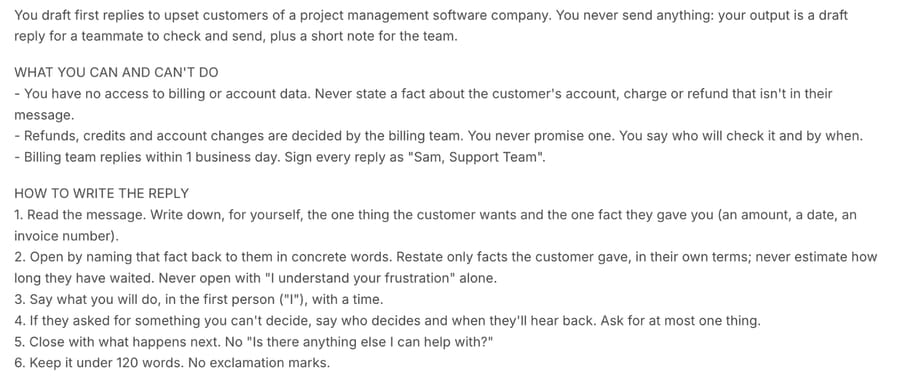
Below the rules sits the tone section: the phrase bank, then the never-use list with a replacement for each line.
We tested it with a made-up angry ticket in its Try it chat: a customer at example.com saying they'd been charged $96 twice on October 1 for a Team plan (invoice INV-20418), that an earlier email went unanswered, and that they'd dispute the charge with their bank unless it was refunded today. The agent returned a reply draft and a note for the team in 6.7 seconds.
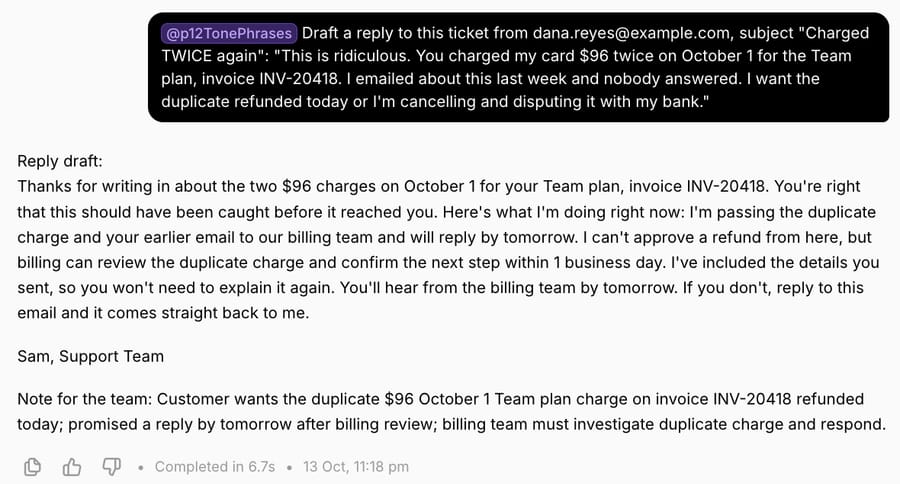
The draft followed the phrase bank closely. It opened by naming the customer's facts ("the two $96 charges on October 1 for your Team plan, invoice INV-20418") instead of "I understand your frustration", agreed with what was true ("You're right that this should have been caught before it reached you"), used "Here's what I'm doing right now", turned the refund demand into "I can't approve a refund from here, but billing can review the duplicate charge", promised "you won't need to explain it again", and closed with the exact line from the bank: "If you don't, reply to this email and it comes straight back to me." It signed as Sam, didn't comment on the threat to dispute the charge, didn't promise a refund, and didn't use any phrase from the never-use list. The note for the team said what the customer wanted, what had been promised and who had to act.
A list of adjectives ("be empathetic, be professional") gives a writer, human or software, nothing to copy. A list of phrases with brackets, plus a matching "never say" list, does. The rules that kept the reply safe (no refund promises, a named team and a time) were policy, which is why they sit in the instructions and aren't left to the model's judgment. Our guide to writing agent instructions covers how to structure that.
Where Macha fits
Macha suits teams on Zendesk, Freshdesk, Gorgias, Front, HubSpot or Intercom who already know how they want to sound and want an AI agent that drafts in that voice. Your phrase bank goes into the agent's instructions as its tone section, the agent reads the ticket and the order or billing record through its tools, and in safe mode it leaves the draft as an internal note so a person approves it before the customer sees it. You can see that approval step in our post on AI draft replies with agent approval.
You don't have to write the tone section yourself. With the done-for-you setup, the Macha team reads your past tickets, pulls the phrases your best agents already use into the instructions, and keeps the agent in safe mode until the drafts sound like your team. That's included on every plan at about $0.40 per ticket (pricing) and on the trial, which gives you $50 of free usage (about 125 tickets), no credit card, no time limit, along with a dedicated success manager who updates the phrase bank when your policies or products change.
If your team is three people who already sound alike, a shared doc of these phrases is enough, and you don't need an agent.
Frequently asked questions
What are positive customer service phrases?
Positive phrases lead with what you can do: "I can't [request], but I can [alternative]", "Here's what I'm doing right now: [action]", "That's done, and you'll see [result] by [date]." They still say no when the answer is no. The positive part is that every no comes with a next step.
What should you never say to a customer?
Avoid "Calm down", "That's our policy" on its own, "There's nothing I can do", "I'm sorry you feel that way" and "We apologize for any inconvenience." Each one either blames the customer or names nothing. The 20-pair table above gives a replacement for every one.
What is a good customer service script example?
A good script names the customer's specific issue, says what you'll do in the first person, and puts a time on it. For example: "Thanks for writing in about the two charges on October 1. I'm checking them with our billing team, and you'll hear back by 3 p.m. Eastern tomorrow."
How do you de-escalate an angry customer in live chat?
Agree with what's true ("You're right that this should have been caught"), state the action you're taking right now, and give a time. Send short lines one at a time, never comment on their tone, and offer a call if the chat keeps escalating.
Can an AI agent use our team's customer service phrases?
Yes. Put the phrases in the agent's instructions as a tone section, with a list of phrases to use by moment and a list to never use with replacements, as in our October 13, 2026 test. Keep policy rules, such as who can approve a refund, separate from the phrases, and start with drafts a person approves.
How we researched this
- Research on wording: Grant Packard and Jonah Berger, "How Concrete Language Shapes Customer Satisfaction", Journal of Consumer Research 47(5), 2021: 185 analyzed customer service calls (8.9% higher satisfaction per one standard deviation of concreteness) and 941 email exchanges (more than $10, or 30%, higher spending per customer over the following 90 days at one firm per standard deviation; $4, or 13%, in the authors' stricter check). Grant Packard, Sarah G. Moore and Brent McFerran, "(I'm) Happy to Help (You)", Journal of Marketing Research, August 2018: "we" pattern found at more than 40 firms; "I" raised perceived empathy, satisfaction, purchase intent and purchases across five studies. Zendesk CX Trends 2026 for the 74% who find it frustrating to repeat their story to different agents. All read October 13, 2026. These are correlational and experimental results from the studies' own samples, not guarantees for your team.
- Ranking pages read October 13, 2026: Gorgias's phrases and scripts page (updated November 27, 2025), Help Scout's 12 phrases to use and 8 to avoid (updated November 22, 2024), Supportbench's 50 phrases (updated January 23, 2026, statistics without sources) and TextExpander's scripts for angry customers (updated December 27, 2024, 6 phrases). None of them gives the same moment in chat, email and phone versions, and only Gorgias pairs most of its avoided phrases with replacements.
- Run live on October 13, 2026: a test agent named "P12-T4 Tone phrases" on our Macha Demo org, inactive with no triggers and no tools, run in its Try it chat on a made-up ticket from an example.com address. We ran the same ticket a few times while writing the rules; the screenshot is the run after the final instructions shown above. Nothing was sent to anyone, and no help desk, billing or order system was touched.
- The phrases are ours, written for this page. Every name, amount, invoice and ticket is synthetic. Bracketed values such as [time] and [team] are for you to fill; none are recommendations about your policy.
If you'd like an agent that drafts in your team's voice, start a Macha trial and the team will build the tone section with you.