Intercom
 Shopify
 Stripe
 Slack
Slack Notion
 Google Workspace
 Confluence

Relevance AI Pricing (2026): Plans, Real Costs and What You'll Actually Pay


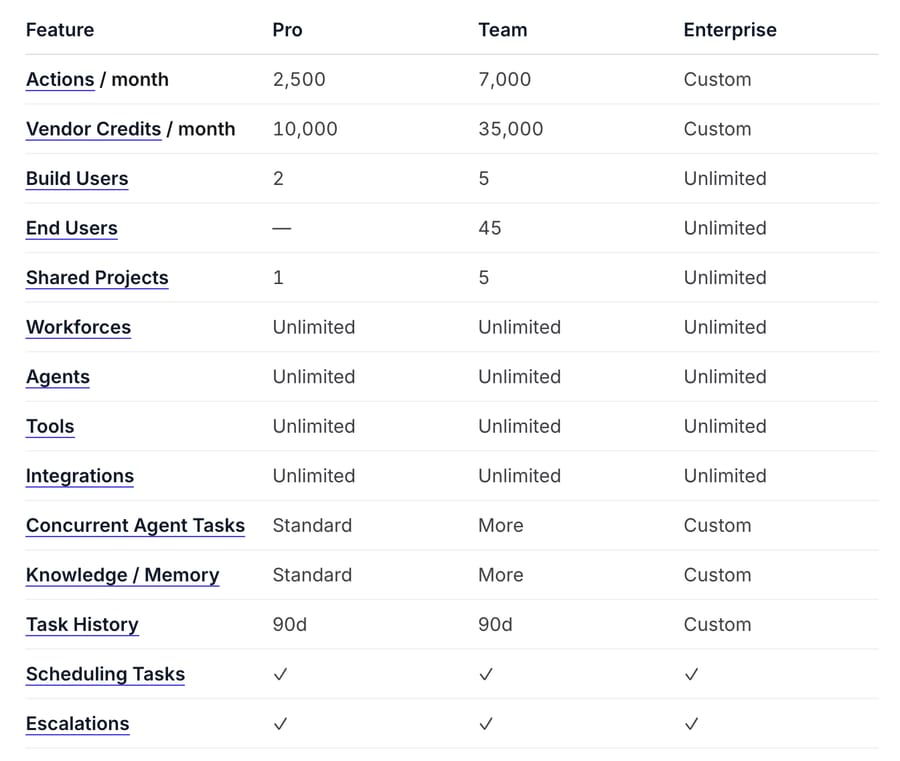
Relevance AI charges on two meters: Actions, one for every tool run, and Vendor Credits, which pass AI model costs through at wholesale. Pro costs $19 a month billed annually or $29 monthly with 2,500 Actions, Team costs $234 or $349 with 7,000 Actions, extra Actions are $80 per 1,000, and Enterprise is quoted. A support agent that runs four tools per ticket costs about $30 a month at 500 tickets, $443 at 2,000 and $2,615 at 8,000 on monthly billing. The rest of this page shows where those numbers come from, what raises them, and how they compare with Fin, Zendesk, Freshdesk and Agentforce at the same volume.

| Plan | Monthly billing | Annual billing | Actions included | Vendor Credits included | Users and projects | Caps and notes |
|---|---|---|---|---|---|---|
| Pro | $29 | $19 a month | 2,500 a month (30,000 a year on annual) | $20 a month (10,000) | 2 build users, 1 project | No calling or meeting agents |
| Team | $349 | $234 a month | 7,000 a month (84,000 a year on annual) | $70 a month (35,000) | 5 build users, 45 end users, 5 projects | Calling and meeting agents, A/B testing |
| Enterprise | Custom | Custom | Custom | Custom | Unlimited | Zendesk, Salesforce and Snowflake triggers, agent evaluations, SSO |
| Extra Actions | $80 per 1,000 | Same | Blocks of 1,000 | n/a | n/a | Top-ups roll over one cycle |
| Extra Vendor Credits | $20 per 10,000 | Same | n/a | Blocks of 10,000 | n/a | Roll over while subscribed |
Prices checked 19 September 2026 on Relevance AI's pricing documentation and its plans and credits page. The Free plan is retired and closed to new signups.
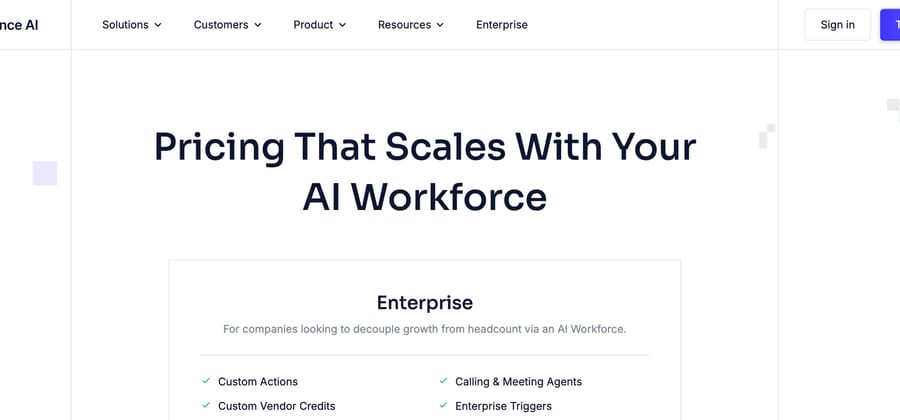
The marketing page at relevanceai.com/pricing shows only that Enterprise card. The self-serve Pro and Team prices live in the documentation, which is where the table above comes from.
How we researched this
On 19 September 2026 we checked Relevance AI's pricing page, pricing documentation, plans and credits page, spend controls page and the September 2025 pricing-change notice, and captured the plan table and the in-app billing screens from the docs. We searched AWS Marketplace and Vendr for contract prices and read Trustpilot and Product Hunt for billing complaints. We also checked G2 directly the same day (4.3 out of 5 from 20 reviews, unchanged from our guide's check four days earlier). We didn't build an agent: the Free plan is closed, so the per-ticket costs below are our arithmetic on the published prices with the assumptions stated.
Our Relevance AI complete guide covers the product and one worked cost at 3,000 tickets. This page goes further on the billing rules and prices three volumes.
How the two meters work
Actions: one per tool run, including failures
The docs define an Action as "a single run of a Tool", whether the tool sends one email or runs "a complex workflow with many steps." Two details matter for the bill.
First, the count follows tool runs, not conversations. An agent that searches knowledge, looks up an order and updates the ticket spends three Actions. An agent that searches knowledge three times before answering spends three Actions on one question.
Second, failures count. The docs say: "If the Tool fails, this will still count as one Action." A flaky API behind your order-lookup tool bills you for every failed attempt and again for the retry.
Vendor Credits: model costs at wholesale
Vendor Credits pay for the language model and some third-party tools. Relevance says it passes them through "with no markup." Top-ups cost $20 per 10,000, so one credit is $0.002. You can bring your own API keys on every plan and skip Vendor Credits, paying OpenAI, Anthropic or Google directly instead.
The split dates from 8 September 2025, when Relevance replaced a single credit with Actions and Vendor Credits, retired its Business plan and warned that "Prices will be slightly higher." Customers on the old plans moved at their first renewal on or after 1 December 2025.
What rolls over and what resets
The two meters have different rollover rules, and the difference changes how you should buy:
- Plan Actions reset at each renewal. Unused ones are lost.
- Action top-ups roll over to the next billing cycle.
- Vendor Credits roll over indefinitely while you're subscribed, whether included in the plan or bought as top-ups.
On annual billing the Actions arrive as a yearly pool (30,000 on Pro, 84,000 on Team), so a seasonal spike can borrow from quiet months. On monthly billing the 2,500 or 7,000 reset every month.
One inconsistency: the pricing docs list "Unused Credits Rollover" as a Team feature, while the plans page says Vendor Credits roll over on both Pro and Team. Confirm which applies before you count on Pro rollover.
The in-app billing screens
Relevance shows usage in two places: a counter in the bottom-left of the app, and a Plan & billing screen that breaks Actions and credits down by agent and by tool.
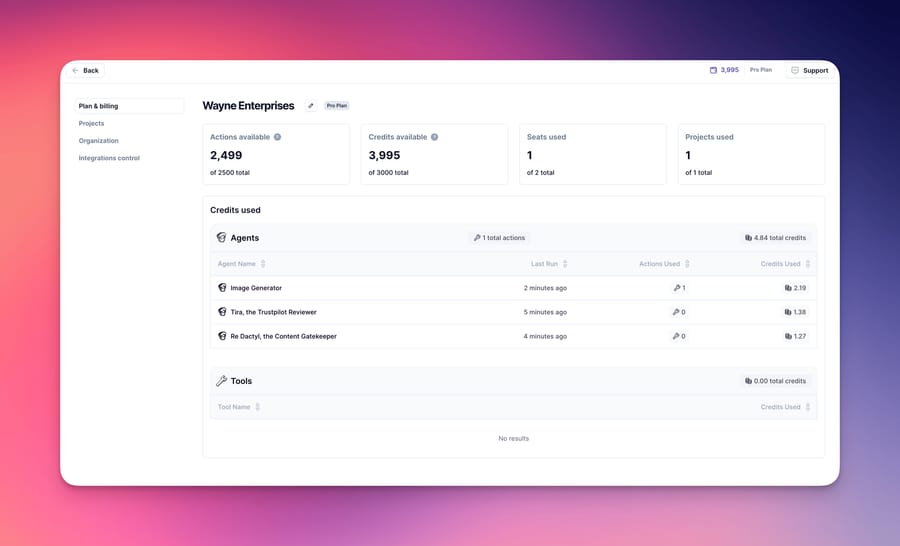
The screenshots in Relevance's own docs show a Pro plan with a 3,000-credit allowance, lower than the 10,000 the current plan table lists. They look older than the table, which is the figure we use.
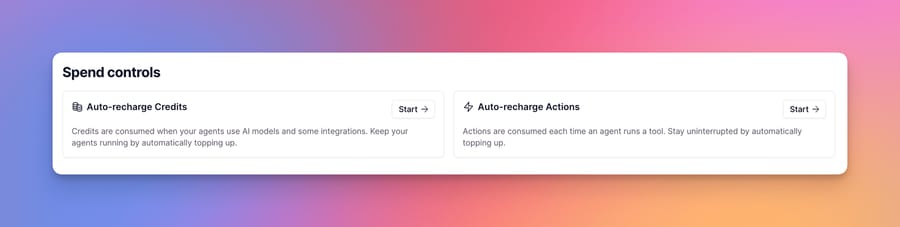
Spend controls are the setting to understand before you go live. They auto-recharge Actions or credits when your balance drops below a threshold. The charge brings your balance up to "minimum threshold + top-up amount," not just the top-up. The docs' own example: with 1,000 credits left, a 10,000 threshold and a 1,000 top-up, you're charged for 10,000 credits. There's no limit on how many times it fires.
Is there another price on AWS or Vendr?
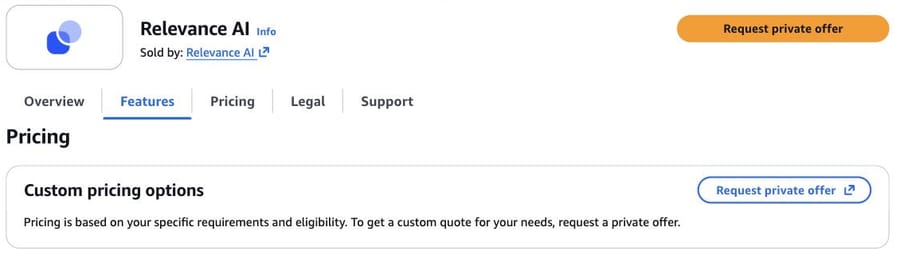
Relevance AI sells on AWS Marketplace under prodview-3brgnq4u4pi6q, and the pricing section reads only "Custom pricing options" with a private-offer button. Vendr has a Relevance AI profile with no pricing data. Neither gives an Enterprise figure, so the docs are the only public price.
What a support agent costs at three volumes
These models cost one month of a ticket-resolving agent at list price. The assumptions:
- Actions: 4 per ticket (fetch the ticket, search knowledge, look up an order, post the reply).
- Vendor Credits: about 21 per ticket, or $0.042, from our guide's model of a four-tool run on a mid-range frontier model (12,000 input and 1,200 output tokens at $2.50 and $10 per million).
- Volumes: small is 500 tickets a month, mid is 2,000 and large is 8,000.
- Top-ups: averaged at $0.08 per extra Action and $0.002 per extra credit. Top-ups roll over, so blocks bought this month are used next month; the first month's bill rounds up to whole blocks.
| Volume | Actions / credits needed | Pro, monthly | Team, monthly | Team, annual | Cheapest |
|---|---|---|---|---|---|
| Small: 500 tickets | 2,000 / 10,500 | $29 + 500 credits ($1) = $30 | $349 | $234 | Pro, $30 ($0.06 a ticket) |
| Mid: 2,000 tickets | 8,000 / 42,000 | $29 + 5,500 Actions ($440) + 32,000 credits ($64) = $533 | $349 + 1,000 Actions ($80) + 7,000 credits ($14) = $443 | $234 + $80 + $14 = $328 | Team: $443 monthly, $328 annual |
| Large: 8,000 tickets | 32,000 / 168,000 | $29 + 29,500 Actions ($2,360) + 158,000 credits ($316) = $2,705 | $349 + 25,000 Actions ($2,000) + 133,000 credits ($266) = $2,615 | $234 + $2,000 + $266 = $2,500 | Team: $2,615 monthly, $2,500 annual |
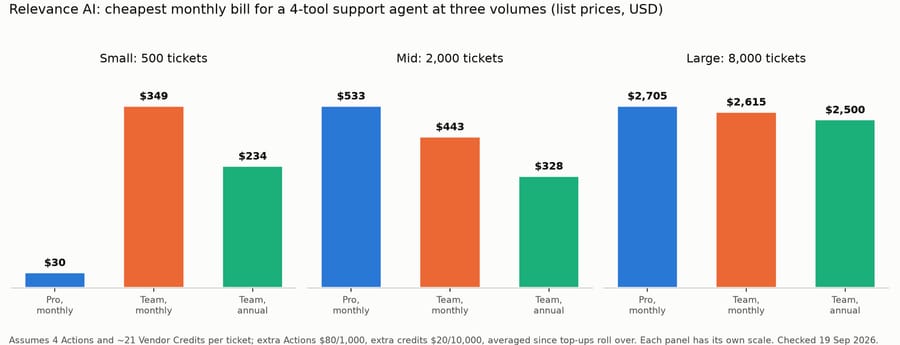
Three things fall out of the table.
Pro stops being cheaper at about 1,500 tickets. On these assumptions Pro costs $29 + $0.362 per ticket above its allowances, which is roughly $0.362 × tickets − $191. That crosses Team's flat $349 at about 1,490 tickets a month. Below that, stay on Pro and top up.
Extra Actions are the bill. At 8,000 tickets, $2,000 of the $2,615 is extra Actions at 8 cents each. The model cost is $266. Cutting one tool call per ticket saves $640 a month; the entire model cost above the plan allowance is $266.
Annual billing saves a fixed $115 a month on Team, the gap between $349 and $234. It matters at 500 tickets and barely registers at 8,000, where extra Actions dominate.
Bring-your-own-key removes the Vendor Credit line and moves the same model cost onto your OpenAI or Anthropic invoice. It doesn't change the Actions line, which is most of the bill.
What drives the bill up
Tool calls per ticket. Every tool run is an Action, including failed runs, so agent design is the biggest cost lever. An agent that retries a failing lookup three times spends three Actions on nothing.
Knowledge set to "Add all to prompt". Our guide explains that attaching knowledge with "Add all to prompt" sends the whole set on every hop, which multiplies Vendor Credits. "Allow agent to search" retrieves only relevant chunks and costs less.
Enterprise-only support features. Native Zendesk, Salesforce and Snowflake triggers, agent evaluations and SSO are Enterprise-only. On Pro or Team you can wire a Zendesk webhook to Relevance's custom webhook trigger yourself, but a support team that wants evaluations before letting an agent reply to customers is buying Enterprise, whose price is quoted.
Auto-recharge thresholds. Spend controls charge up to threshold plus top-up. A high threshold buys far more than the top-up amount the first time it fires.
Plan Actions that reset. On monthly billing, a quiet month's unused plan Actions are gone. Buying Actions as top-ups instead of a bigger plan keeps them for one more cycle.
Seats and projects. Pro allows two build users and one project. A second team that wants its own project pushes you to Team at $349 whatever your volume.
What the billing units reward
Actions reward Relevance for tool runs, so it earns more when agents take more steps, and when tools fail and retry. That is a defensible way to price a general builder, where a research agent and a ticket agent do very different amounts of work, but it puts the cost of an inefficient design on you.
Wholesale Vendor Credits point the other way. Relevance makes nothing on model choice, so it has no reason to push you toward an expensive model, and letting credits roll over removes the use-it-or-lose-it pressure. The pricing page showing only Enterprise says where the company wants revenue to come from: org-wide deployments sold by a sales team, with Pro and Team kept in the docs as the way in.
Macha takes a different position for support work. It bills one charge per ticket, a thread with one person, however many replies or tool calls the agent needs, so a retry or an extra lookup doesn't change the price.
How Relevance AI compares at 2,000 tickets a month
The mid case, 2,000 tickets with 60% resolved by the agent (1,200 resolutions), priced from each vendor's own page:
| Product | Billing unit | Published price | Cost at 2,000 tickets |
|---|---|---|---|
| Relevance AI (Team) | Per tool run plus model cost | $349 a month with 7,000 Actions; $80 per extra 1,000 | $443 monthly, $328 annual (4 Actions a ticket) |
| Fin (Salesforce) | Per outcome | $0.99, 50-outcome monthly minimum | 1,200 × $0.99 = $1,188 |
| Zendesk AI agents | Per automated resolution | $1.50 committed, $2.00 pay-as-you-go, minus a per-seat allowance | $1,800 committed to $2,400 pay-as-you-go, less $25 for 5 Suite Professional seats = $1,775–$2,375 |
| Freshdesk Freddy AI Agent | Per session | $49 per 100 sessions | 20 × $49 = $980 |
| Salesforce Agentforce | Per action | $0.10 per action | 2,000 × 3 actions × $0.10 = $600 |
| Macha | Per ticket | $1,199 for 3,000 tickets a month | $1,199 (the 1,500 tier is too small) |
Sources, checked in September 2026: Fin pricing; Zendesk's outcome-based pricing post, chatbot buyer's guide and resolution allowances article; Freshdesk pricing; Salesforce's Agentforce pricing page; Macha pricing. Each needs a help desk, and Agentforce needs Salesforce seats.
Relevance comes out cheapest in the table, and the table explains why. Fin, Zendesk and Freddy charge for a finished support product: the agent, the help-desk connection, the reply path and reporting. Relevance charges for the building blocks. You design the ticket workflow, choose which tools run, wire the webhook from your help desk, and build the path that posts the reply back, because Relevance's API trigger doesn't return the agent's answer to the caller. The price gap is the cost of that work. Our Fin pricing breakdown and Freddy pricing comparison cover the two finished products in more depth.
What users say about the cost
Review coverage is thin for a company of Relevance's size. G2 rates it 4.3 out of 5 from 20 reviews, checked September 19, 2026 (unchanged from our guide's check on 15 September). Trustpilot's page for relevanceai.com showed 3.1 from two reviews on 19 September, neither about pricing.
The clearest billing comment is on Product Hunt, where Invent by Relevance AI scores 4.0 from two reviews. Reviewer Nolan Vu wrote that "the credit model sounds fair until you're running multi-step agent chains on a lot of data and the burn rate surprises you." That matches the arithmetic above: the per-unit prices are clear, and the bill depends on how many steps your agents take, which most teams don't know until they run real volume.
Who Relevance AI's pricing fits
Pro fits a solo operator or a small team running agents on a few hundred tasks a month. At 500 tickets it costs about $30.
Team fits anyone above about 1,500 tasks a month, or anyone who needs more than two builders, more than one project, or calling agents. Take annual billing if you can commit, and buy extra Actions as top-ups so unused ones roll over.
Enterprise fits support teams that need native Zendesk triggers, agent evaluations or SSO. Get the quote before you design around Team pricing.
It's the wrong fit if you want a support agent working inside your help desk without building the ticket workflow yourself. Relevance is a general builder whose templates and customers lean toward sales and operations; our Lindy AI guide and Voiceflow guide cover two other builders priced on usage.
Macha fits teams already running Zendesk, Freshdesk, Gorgias, Front, HubSpot or Intercom who want agents acting inside the ticket without building the plumbing: it runs on the help desk you already use, prices per ticket at about $0.40 on published tiers, and the Macha team builds, tests and monitors the agents on every plan. For the wider field, see our guide to AI agents for customer service.
Frequently asked questions
How much does Relevance AI cost? Pro is $19 a month billed annually or $29 monthly, with 2,500 Actions and 10,000 Vendor Credits a month. Team is $234 a month billed annually or $349 monthly, with 7,000 Actions and 35,000 Vendor Credits. Extra Actions cost $80 per 1,000 and extra Vendor Credits $20 per 10,000. Enterprise is quoted.
Why does the Relevance AI pricing page only show Enterprise? On 19 September 2026, relevanceai.com/pricing showed only an Enterprise card with a Talk to sales button. The self-serve Pro and Team plans and their prices are listed in Relevance's documentation, which links to signup.
What is an Action in Relevance AI? An Action is one run of a tool, whether the tool sends one email or runs a long multi-step workflow. A failed tool run still counts as one Action. An agent that calls four tools on a ticket uses four Actions.
What are Vendor Credits? Vendor Credits pay for the AI model and some third-party tools, passed through at wholesale with no markup. 10,000 credits cost $20, so one credit is $0.002. They roll over while you're subscribed, and you can skip them by bringing your own API keys.
Does Relevance AI have a free plan? Not for new signups. Relevance's docs say the Free plan is retired and closed to new signups; organizations already on Free keep their access and can upgrade.
Do unused Actions roll over? Plan Actions reset at each renewal. Actions bought as top-ups roll over to the next billing cycle, and Vendor Credits roll over indefinitely while you're subscribed. On annual billing, plan Actions arrive as a yearly pool.
Is Relevance AI cheaper than Fin for customer support? Per ticket, usually yes. At 2,000 tickets a month our model puts Relevance Team at $443 against $1,188 for Fin at a 60% resolution rate. Fin's price includes a finished support agent connected to your help desk; on Relevance you build the ticket workflow, the help-desk trigger and the reply path yourself, and native Zendesk triggers need Enterprise.
If your tickets already live in Zendesk, Freshdesk, Gorgias or Front, you can start a Macha trial with $50 of free usage and no card, and compare a per-ticket price against the per-Action arithmetic above.
Sources: Relevance AI pricing · Relevance AI docs: Pricing · Relevance AI docs: Plans and credits · Relevance AI docs: Spend controls · Relevance AI docs: Pricing and packaging changes · AWS Marketplace: Relevance AI · Product Hunt: Relevance AI reviews · G2: Relevance AI · Fin pricing · Zendesk outcome-based pricing · Zendesk resolution allowances · Freshdesk pricing · Salesforce Agentforce pricing
Simple per-ticket AI pricing
One thread with one person is one charge, however many replies it takes.