Intercom
 Shopify
 Stripe
 Slack
Slack Notion
 Google Workspace
 Confluence

Best Relevance AI Alternatives in 2026: 8 Options Matched to Why Teams Switch


Teams leave Relevance AI because a per-tool-run meter climbs on multi-step agents, native app connections are thinner than Zapier or n8n, the tool builder changed, and help-desk triggers are Enterprise-only. n8n, Gumloop, Zapier Agents, Lindy, Voiceflow, Botpress, Copilot Studio and Chatbase each fix one of those, at the prices below.
Key takeaways
- n8n is the best Relevance AI alternative for multi-step agents, charging one execution per workflow run, with Starter at €24 a month or €20 billed annually for 2,500 executions.
- Relevance AI's Pro plan costs $29 a month, or $19 billed annually, with 2,500 Actions and $20 of Vendor Credits, and Team costs $349, or $234, with 7,000 Actions.
- Relevance AI bills $80 per 1,000 extra Actions once a plan's allowance runs out, and its documentation says a failed tool run still counts as one Action.
- Gumloop's Pro plan starts at $37 a month for 20,000 credits priced at $0.005 each, plus an 8% orchestration fee on the full list cost of each task.
- Botpress bills by conversation, with Plus at $150 a month billed annually for 250 conversations, so tool calls inside a conversation don't change the price.

The best Relevance AI alternative depends on why you are leaving: n8n if multi-step agents keep raising the bill (it charges one execution per workflow run, from €24 a month), Zapier Agents if you need more native app connections, Botpress or Chatbase for a customer support chat agent, and Copilot Studio if your company runs on Microsoft 365. Here are all eight, with prices checked on each vendor's page on 19 September 2026 and rechecked for Relevance AI, n8n, Gumloop, Zapier and Botpress on 24 September 2026.
How do the Relevance AI alternatives compare?
| Alternative | What it bills | Entry price (checked 19 Sep 2026) | The complaint it answers | Our guide |
|---|---|---|---|---|
| n8n | Workflow executions, any number of steps | €24/mo monthly, €20 billed annually (2,500 executions); self-hosted Community edition free | Meter surprises on multi-step agents | None yet |
| Gumloop | Credits at $0.005, plus an 8% fee | From $37/mo (20,000 credits), unlimited seats | Two meters to forecast | None yet |
| Zapier Agents | Activities | Free (400 a month); Pro $33.33/mo billed annually (1,500) | Thin native connections | None yet |
| Lindy | Credits, per user | $29.99 per user a month (3,000 credits) | Wants a ready-made assistant per person | Lindy guide |
| Voiceflow | Plan plus usage ($0.005 per user message) | Pro $60/mo in-app; no prices on the public page | Needs a support chat agent, not a GTM tool | Voiceflow guide |
| Botpress | Conversations | Plus $150/mo billed annually (250 conversations) | Wants one predictable unit per chat | Botpress guide |
| Microsoft Copilot Studio | Copilot Credits | $200 a month per 25,000 credits, or $0.01 a credit pay as you go | Company runs on Microsoft 365 | Copilot Studio guide |
| Chatbase | Message credits | Hobby $40/mo; Standard $150/mo for help desk integrations | Wants a website support agent live this week | Chatbase guide |
For context, Relevance AI's own Pro plan is $29 a month (or $19 billed annually) with 2,500 Actions and $20 of Vendor Credits, and Team is $349 (or $234) with 7,000 Actions and $70 of Vendor Credits. Our Relevance AI complete guide covers how the product works. This page is about leaving it.
Quick picks by situation:
- Your agents chain many steps and the bill keeps surprising you: n8n, which charges one execution per workflow run however many steps it takes.
- You need an app Relevance doesn't connect to: Zapier Agents or n8n.
- You're a support team and the work lives in a help desk: Botpress or Voiceflow for a chat agent you build; Chatbase for a quick website agent.
- You're a Microsoft 365 company: Copilot Studio.
- You want one assistant per employee rather than a shared workforce: Lindy.
How did we research this?
On 19 September 2026 we read every alternative's pricing page in a browser and captured it, read Relevance AI's pricing documentation, and loaded its reviews on Product Hunt, Trustpilot and Capterra. We also checked G2 directly the same day (4.3 out of 5 from 20 reviews, checked September 19, 2026), and Reddit blocks our tools, so we quote no Reddit threads. We didn't build agents on these platforms for this post; the cost table further down is our arithmetic on published prices, with every assumption stated.
Gumloop and Lindy wrote the two pages that rank first for this search, and each lists itself first.
Why do teams leave Relevance AI?
Review evidence on Relevance AI is thin. Trustpilot shows 3.1 from two reviews, Capterra 4.0 from one (dated August 2024), and Product Hunt 4.0 from two. G2 lists 4.3 from 20 reviews, checked September 19, 2026 (unchanged from our earlier 15 September check). The complaints that do exist line up with what Relevance's own documentation says.
1. The meter climbs on multi-step agents
Relevance bills two meters. Actions count every tool run at $80 per 1,000 once the plan's allowance is gone, and Vendor Credits pass through the model cost. Its plans and credits documentation adds: "If the Tool fails, this will still count as one Action." A retry loop against a flaky API bills every attempt.
Nolan Vu, who lists himself as an AI agent and workflow automation specialist, gave Relevance 4 stars on Product Hunt on 31 May 2026 and still wrote that "the credit model sounds fair until you're running multi-step agent chains on a lot of data and the burn rate surprises you."
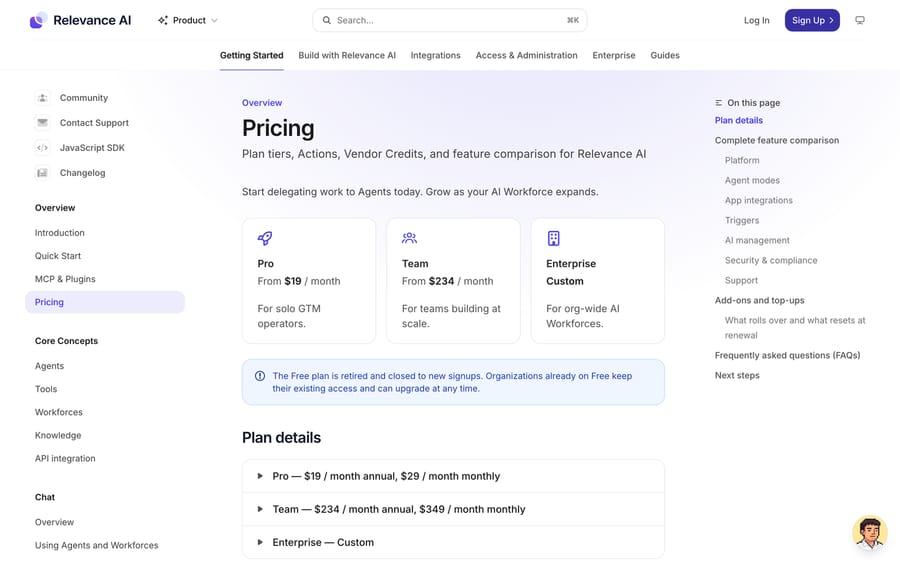
A per-tool-run meter earns Relevance more when an agent takes more steps, so the cost of an inefficient agent design lands on you.
2. Native connections are thinner than the automation tools
In the same review, Vu wrote that coming from n8n or Zapier, "native app connections are limited," and that he "had to build a few API bridges manually." The complaint is about how much of each integration comes pre-built.
3. The tool builder changed under existing users
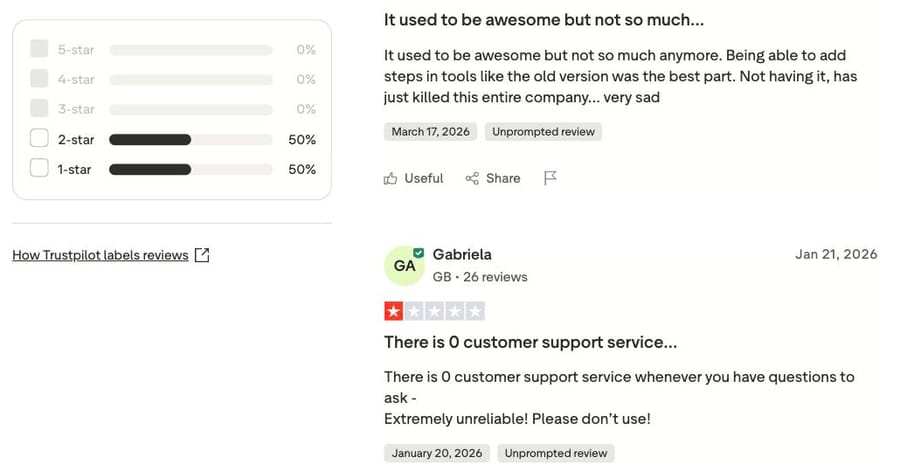
A 2-star Trustpilot review from a user listed as EM, dated 17 March 2026, says it "used to be awesome but not so much anymore," and that "being able to add steps in tools like the old version was the best part." The lesson for a buyer is to check how much of your logic lives in a format only one vendor can read.
4. Support-desk features sit behind Enterprise
This complaint comes from the plan table rather than a review. Relevance's pricing documentation marks the native Zendesk, Salesforce and Snowflake triggers as Enterprise-only, along with agent evaluations and SSO. The public pricing page shows only Enterprise, and the Free plan is closed to new signups. A support lead who wants a native help-desk trigger and evaluations before letting an agent reply to customers is buying a quoted plan. The one support complaint on Trustpilot, a 1-star review from Gabriela on 20 January 2026, says "there is 0 customer support service whenever you have questions to ask."
What are the 8 best Relevance AI alternatives?
n8n: when the step count keeps changing the bill
n8n charges by execution, and its pricing page defines one as "a single run of your entire workflow. It doesn't matter how many steps are in the workflow or how much data it processes." Starter is €24 a month billed monthly or €20 billed annually for 2,500 executions, Pro is €60 or €50 for 10,000, and Business is €800 or €667 for 40,000. Every plan includes unlimited users, and the Community edition is free to self-host.
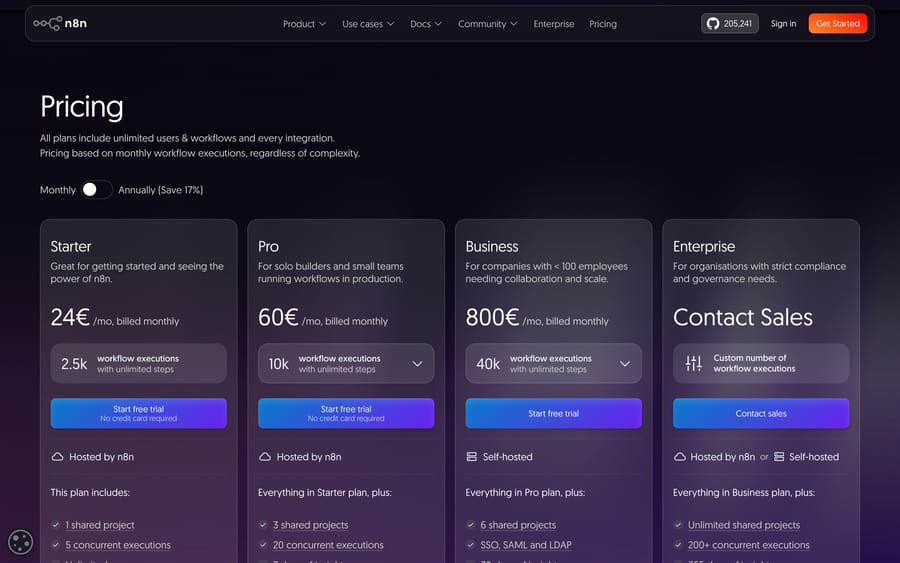
That unit is the direct answer to complaint 1. An agent that calls four tools and one that calls fourteen cost the same execution. The watch-out is what the execution doesn't include: n8n's AI nodes call models through API credentials you connect, so the model bill arrives separately from OpenAI or Anthropic. n8n is also closer to engineering than Relevance, and prices are in euros.
Choose it if you have someone technical, your agents have long or variable chains, or you want to self-host.
Gumloop: one meter instead of two
Gumloop's Pro plan "starts at $37 / month" with 20,000 credits (7,400 plus 12,600 bonus credits), unlimited seats and a 14-day trial, per its pricing page. Its FAQ says credits are "indexed at $0.005 each" and cover model tokens, compute and paid tool calls at list price, plus "an 8% orchestration fee on the full list cost of the task." Bring your own model key and that fee rises to 16%.
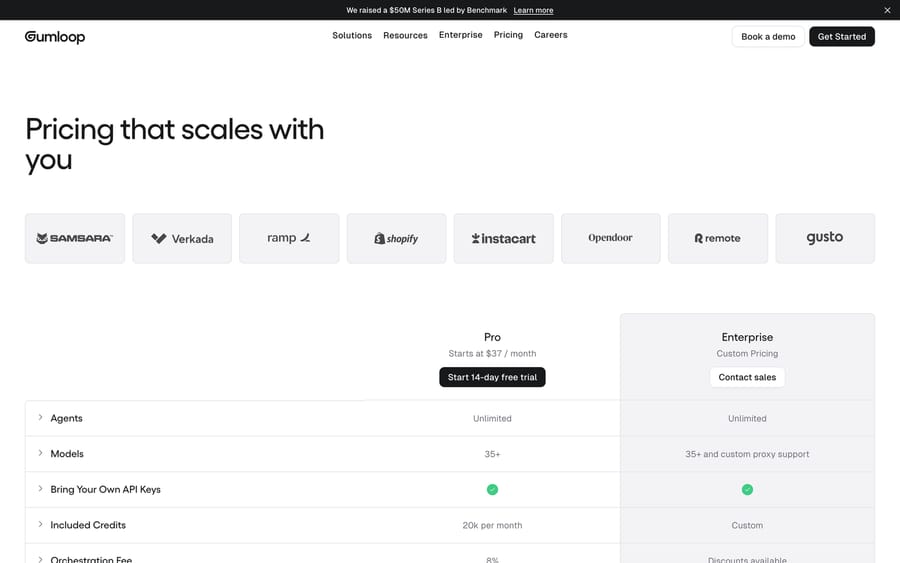
One meter is easier to forecast than Relevance's two, and seats cost nothing. The watch-outs are in the same FAQ: unused credits don't roll over, and when the 20,000 run out mid-month "your agents will stop working" until you turn on pay as you go, which is off by default. The 8% fee means Gumloop earns a little more every time a task costs more, which is the same incentive Relevance's Actions create, in a smaller dose.
Choose it if a go-to-market or ops team wants Relevance-style agents with a simpler bill and shared seats.
Zapier Agents: when the missing piece is an integration
Zapier says it connects to "9,000+ apps," and Zapier Agents sits on top of that catalog. Agents Free includes 400 activities a month, and Agents Pro is $400 billed annually ($33.33 a month) for 1,500. An activity is "any billable action an agent takes": a trigger, an answer from a knowledge source, an action, a web search.
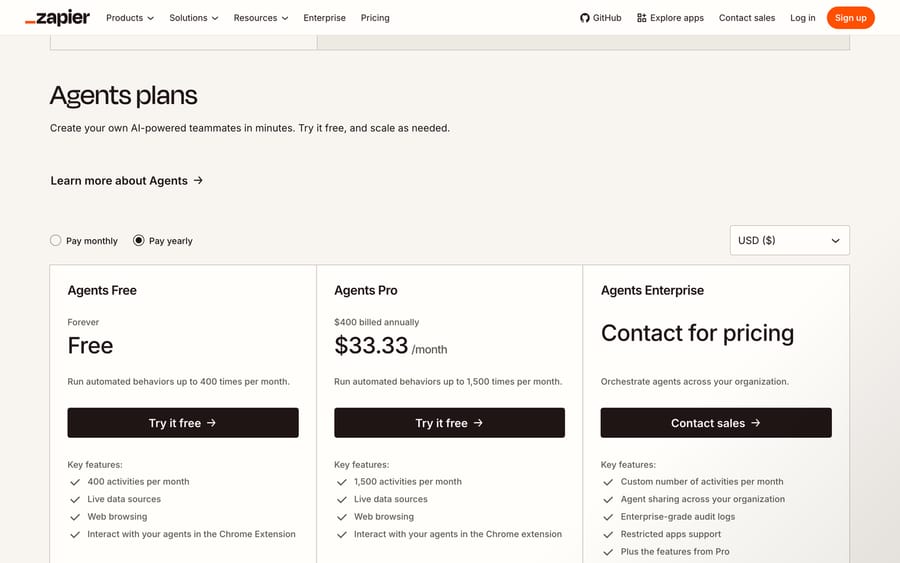
This is the answer to complaint 2 for most teams. The watch-out is volume: a paid agent run is capped at 40 activities, and 1,500 activities a month is a few hundred multi-step runs. Agents are billed separately from the Zap tasks you may already pay for.
Choose it if your agents are light, your company already runs on Zapier, and the blocker was a connection Relevance didn't have.
Lindy: one assistant per person
Lindy prices per user: Plus is $29.99 a user a month with 3,000 credits, Pro $99.99 with 15,000 and Max $199.99 with 35,000, per its pricing page. It's built around an assistant each employee works with (inbox, meetings, follow-ups) more than a shared workforce of specialist agents.
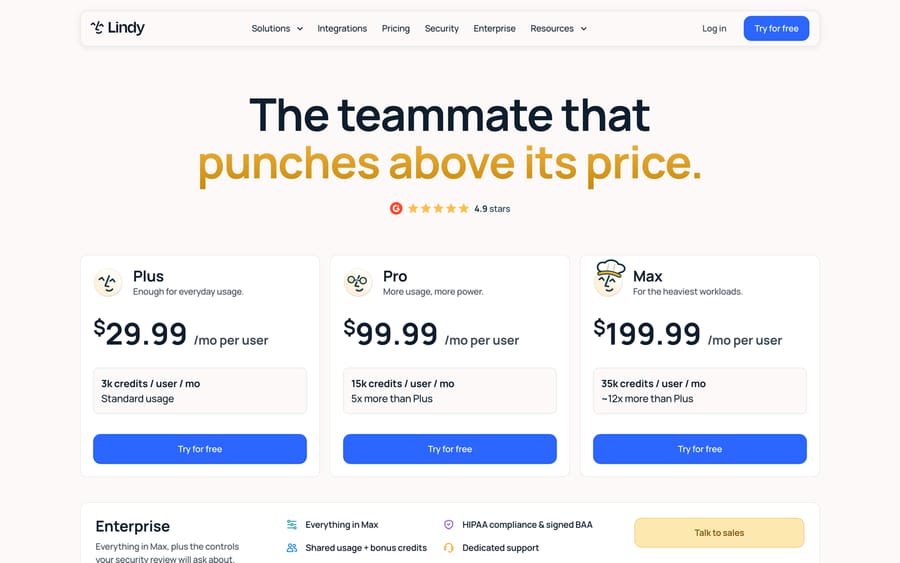
The per-seat model is the watch-out for a team: ten people on Plus is about $300 a month before anyone runs a heavy task. Trustpilot, which listed Lindy alongside Relevance when we checked, shows 1.7 from 39 reviews. Our Lindy guide goes through the credit bands.
Choose it if the goal is personal productivity agents for a handful of people, not a shared automation platform.
Voiceflow: a support agent builder with a help-desk path
Voiceflow is a builder aimed at customer-facing chat and voice agents, with workflows, knowledge and a Zendesk integration that our Voiceflow guide walks through. Its public pricing page shows no numbers. Its credits pricing table charges chat usage at $0.005 per user message plus the model's tokens, and the in-app plan screen showed Pro at $60 a month when we read it on our test account on 19 September.
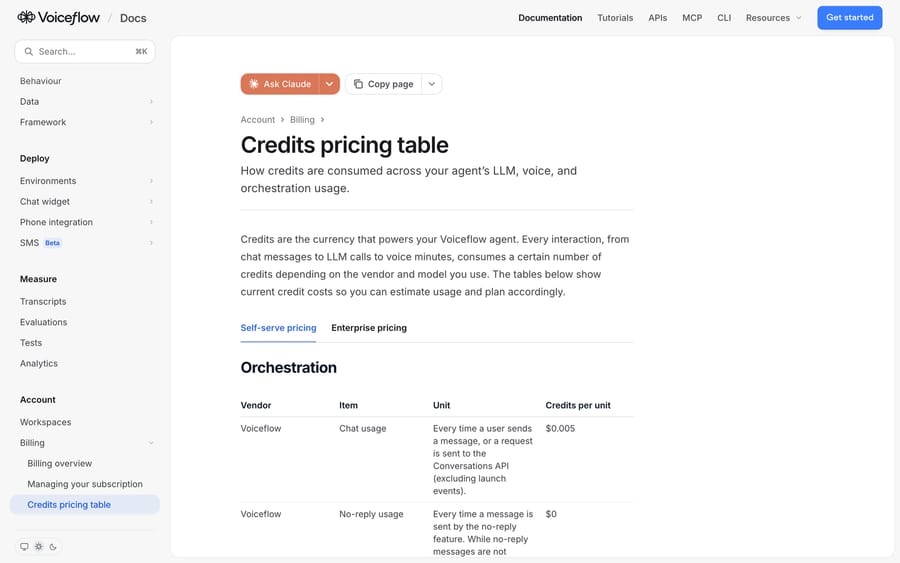
It answers complaint 4 for teams that want to build the agent themselves: support is the product's main use, not one use case of several. The watch-out is that you still design and maintain every flow, and enterprise features such as human hand-off and SSO sit on the contract tier.
Choose it if you're a support team with a builder on staff who wants control over the conversation design.
Botpress: one unit per conversation
Botpress bills by conversation. On its pricing page, Plus is $150 a month billed annually for 250 conversations, with packs of 100 more at $65, and Team is $750 billed annually for 1,500, with packs at $50. Each conversation includes $0.10 of AI usage, and the Free plan covers 25 conversations.
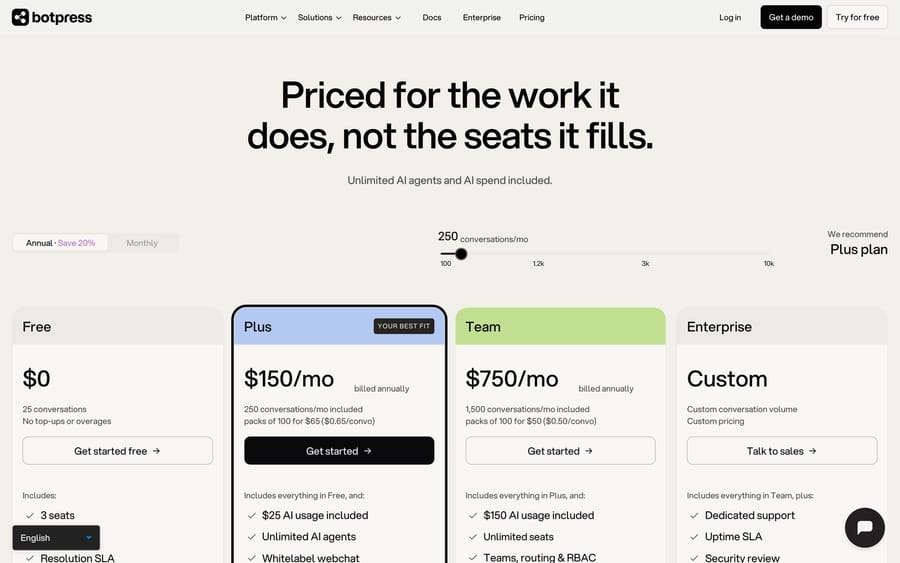
A conversation is "any exchange with at least two messages from the end user in the billing month," so tool calls inside it don't change the price. That's the cleanest fix for complaint 1 in this list. The watch-out: when AI spend reaches 95% of its limit, Botpress buys a $10 credit grant automatically, and the FAQ says the amount and trigger "aren't configurable yet." Our Botpress guide covers the builders.
Choose it if you want a support chat agent priced per conversation and are happy to build it.
Microsoft Copilot Studio: when the company runs on Microsoft 365
Copilot Studio sells a $200 monthly pack of 25,000 Copilot Credits or pay-as-you-go billing, and Microsoft's credit estimator says "1 Copilot credit = $.01". Microsoft's billing rates article charges 2 credits for a generative answer and 5 for an agent action. Internal agents used by Microsoft 365 Copilot licensed users are billed at no charge.
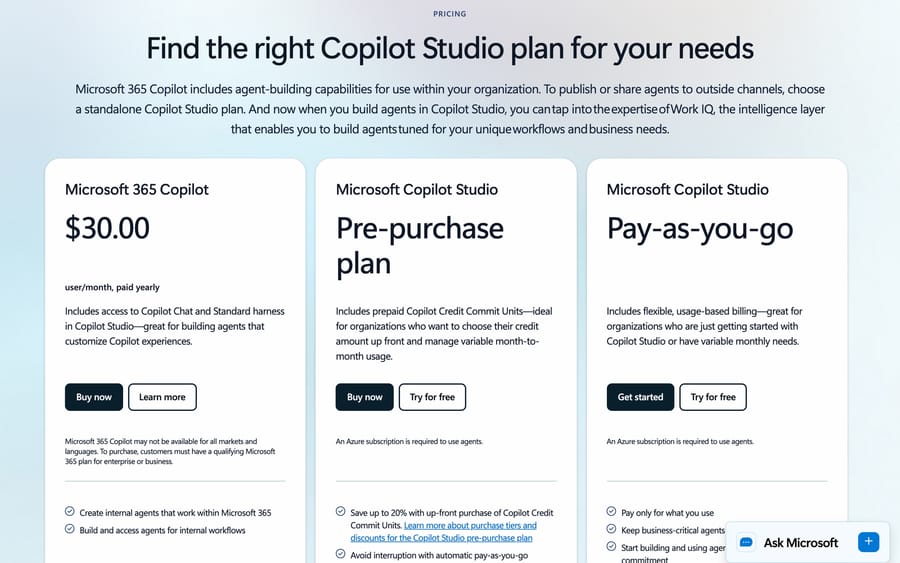
For a Microsoft shop, the governance and identity pieces Relevance keeps for Enterprise (SSO, admin controls) come with the tenant. The watch-outs: an Azure subscription is required to publish agents, and the agent is disabled once the tenant passes 125% of its prepaid credits. Our Copilot Studio guide has the detail.
Choose it if your identity, documents and approvals already live in Microsoft 365.
Chatbase: a website support agent without a build project
Chatbase trains a chat agent on your content and puts it on your site. Hobby is $40 a month with 700 message credits, Standard is $150 with 4,000 and unlocks help desk integrations including Zendesk, and Pro is $500 with 15,000, per its pricing page.
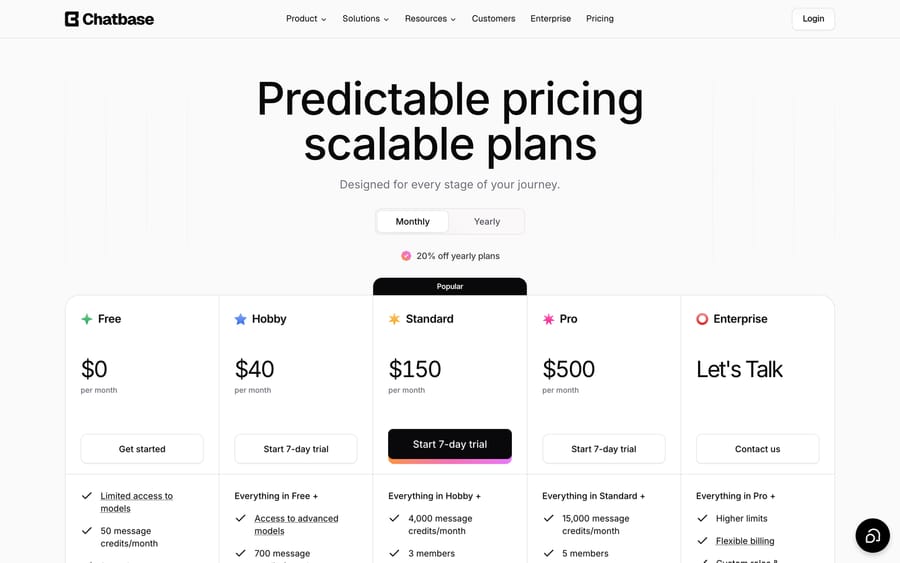
It's the fastest route from Relevance to a working support agent, because there's almost nothing to design. The watch-out is in the FAQ: each model request costs credits by model, and an agent that runs an action makes two requests for one reply. Chatbase isn't a workflow builder, so it won't replace Relevance's sales or ops agents. See our Chatbase guide.
Choose it if the only agent you need is a website chat agent that answers from your docs and hands off to a help desk.
What do 2,000 support tickets a month cost on each?
This table prices one month of the same support agent: 2,000 tickets, one agent run per ticket, four tool calls per run, and about $0.042 of model tokens per ticket (the assumptions from our Relevance pricing research). Rows marked "estimate" rest on those assumptions more than on a published price.
| Platform | How the month is built | Cost |
|---|---|---|
| Relevance AI Team, monthly | $349 + 1,000 extra Actions ($80) + $14 of extra Vendor Credits | $443 |
| n8n Starter, monthly | €24 for 2,000 of 2,500 executions, plus about $84 of model tokens on your own key | €24 + ~$84 (estimate) |
| Gumloop Pro | About 13 credits a ticket (8.4 for tokens, 4 tool calls at the 1-credit base, plus 8%) = 26,800 credits; $37 + 6,800 × $0.005 | ~$71 (estimate) |
| Zapier Agents | About 6 activities a ticket = 12,000, far above Pro's 1,500 | Enterprise quote |
| Botpress Team, annual billing | $750 for 1,500 conversations + 5 packs of 100 at $50 | $1,000 |
| Copilot Studio | 22 credits a ticket (1 generative answer + 4 agent actions) = 44,000 credits: two $200 packs, or $440 pay as you go | $400–$440 (estimate) |
| Macha | The 3,000-ticket tier; the 1,500 tier is too small | $1,199 |
Voiceflow, Lindy and Chatbase aren't modeled: their bills depend on the model chosen per message or on seats, and a row would be mostly our guess.
n8n and Gumloop are cheapest because you design, host and maintain everything, and the help-desk wiring is yours. Botpress and Macha cost more because the unit is the conversation or the ticket, so the vendor absorbs the variation in tool calls. Zapier Agents is priced for light agents; support volume pushes it to a sales conversation.
Who should stay on Relevance AI?
Stay if your agents are mostly sales and operations work (research, enrichment, meeting prep) and your tool chains are short and predictable. That's the workload Relevance is designed and priced for, and its customer stories are mostly go-to-market. Stay if you're on annual billing and use the yearly Action pool to absorb seasonal peaks, or if you rely on Invent, its agent that drafts and maintains other agents from a plain-language description.
The two meters also have a benefit: Vendor Credits pass model costs through at wholesale with no markup, and they roll over while you're subscribed. If your team has learned where the Actions go, the bill is transparent.
What moves when you switch from Relevance AI?
Knowledge moves easily. Relevance knowledge is files, crawled sites and synced sources such as Google Drive and Notion. Point the new platform at the same sources.
Tools and agents get rebuilt. A Relevance tool is a chain of steps in its own editor, and none of these alternatives advertises an importer for Relevance agents or tools. Budget time to rebuild each one, and use the rebuild to cut tool calls you no longer need.
Triggers and integrations need re-authorizing. OAuth connections to your CRM or help desk don't transfer. Webhook triggers are the easiest to move: point the sending system at the new URL.
Model keys carry over. If you brought your own OpenAI or Anthropic key, it works on n8n, Gumloop and most of the others.
Check what you'll lose on cancel. Plan Actions reset at renewal, Action top-ups roll over only one cycle, and Vendor Credits roll over only "while subscribed." Time the switch for the end of a billing period, and spend down credits first.
Calling agents need a new number setup. Relevance's calling and meeting agents sit on Team and Enterprise. If you use them, check the new platform's telephony before you cancel.
Where does Macha fit for support tickets?
Macha fits teams already running Zendesk, Freshdesk, Gorgias, Front, HubSpot or Intercom who tried Relevance for support tickets. It runs AI agents on top of the help desk you already use, acting inside the ticket: reading the thread, calling your order or billing systems, replying or tagging, and escalating to a person. It bills one charge per ticket however many tool calls or replies the agent needs, from $299 a month for 750 tickets, about $0.40 a ticket at every tier on published pricing. The Macha team builds, tests and monitors the agents on every plan, which is what the higher price in the table above pays for. It doesn't run sales or ops agents, so it replaces Relevance only for the support part of the job. For the wider field, see our guide to AI agents for customer service.
Frequently asked questions
What is the best alternative to Relevance AI? It depends on why you're leaving. For unpredictable bills on multi-step agents, n8n, which charges one execution per workflow run. For missing integrations, Zapier Agents. For customer support chat, Botpress or Voiceflow. For Microsoft 365 companies, Copilot Studio.
What is the main difference between n8n and Relevance AI? n8n is a workflow automation tool that charges per execution, a whole workflow run however many steps it has, and can be self-hosted for free. Relevance AI is an agent platform that charges per tool run (Actions) plus model costs (Vendor Credits). n8n asks for more technical skill; Relevance is quicker to a first agent.
Is Relevance AI free to use? Not for new signups. Relevance's documentation says the Free plan is retired and closed to new signups; paid plans start at $29 a month, or $19 billed annually.
Is there a free Relevance AI alternative? n8n's Community edition is free to self-host. Zapier Agents has a free plan with 400 activities a month, Botpress a free plan with 25 conversations, and Chatbase a free plan with 50 message credits.
Why is Relevance AI expensive for support teams? Two reasons. Every tool run is an Action, including failed runs, so a ticket that needs four lookups costs four Actions. And the native Zendesk trigger and agent evaluations are Enterprise-only, which is a quoted plan.
Is Gumloop cheaper than Relevance AI? On our 2,000-ticket model, yes: about $71 a month on Gumloop against $443 on Relevance Team. Gumloop's figure is our estimate, because its credits follow each task's token and tool costs. Its credits don't roll over, and agents stop at the monthly limit unless you turn on pay as you go.
What do Relevance AI reviews say? Reviews are few. Trustpilot shows 3.1 from two reviews, Capterra 4.0 from one and Product Hunt 4.0 from two; G2 shows 4.3 from 20, checked September 19, 2026. The recurring complaints are cost on multi-step agents, limited native connections and changes to the tool builder.
What should I rebuild first when switching? The agent that handles the most volume. Knowledge sources reconnect quickly, but tools and agents have to be rebuilt by hand, and the high-volume agent is where a leaner design saves the most.
If your agents are meant for support tickets in Zendesk, Freshdesk, Gorgias, Front, HubSpot or Intercom, you can start a Macha trial with $50 of free usage and no card, and compare a per-ticket price against the per-Action arithmetic above.
Sources: Relevance AI docs: Pricing · Relevance AI docs: Plans and credits · Product Hunt: Invent by Relevance AI reviews · Trustpilot: relevanceai.com · Capterra: Relevance AI · G2: Relevance AI reviews · n8n pricing · Gumloop pricing · Zapier Agents pricing · Lindy pricing · Voiceflow credits pricing table · Botpress pricing · Copilot Studio pricing · Copilot Studio billing rates · Copilot Credit Estimator · Chatbase pricing
Resolve tickets automatically with AI agents
Macha's AI agents work on top of the help desk you already use — no code.