





 Shopify
 Stripe
 Slack
 Notion
 Google Workspace
 Confluence


Which Help Desks Raised Prices in 2026? A Dated Tracker of Help Desk and AI Price Changes


Seven help desks changed what they charge between mid-2025 and November 2026, and an eighth, Intercom, was bought by Salesforce. Most of the changes landed on the AI line rather than the seat. In November 2026 Front stopped publishing its $0.05 Autopilot triage rate, so the advertised starting price moved from $0.05 to $0.39 per conversation; its handoff and resolution rates didn't change. Freshdesk raised its annual plans by up to 27% and dropped its free plan. Help Scout moved to contact-based billing and then back to per-user pricing for new signups. Gorgias switched off its legacy autoresponder on January 30, 2026, Crisp started charging for Hugo's AI replies on February 1, 2026, and HubSpot halved its Customer Agent price. Every entry below has a date and a source we checked on November 21, 2026.
Key takeaways
- Front's Autopilot starting price moved from $0.05 to $0.39 per conversation between November 2 and November 9, 2026, after Front stopped publishing its $0.05 triage rate.
- Freshdesk's annual plans rose from $15, $49 and $79 to $19, $55 and $89 per agent a month between December 2025 and March 2026, and the pricing page no longer lists a free plan.
- Gorgias Autoresponder Rules stopped working on January 30, 2026, and Gorgias points Shopify brands to its AI Agent at $0.90 to $1.00 per automated interaction.
- HubSpot cut Customer Agent from $1.00 per conversation to $0.50 per resolved conversation, paid as 50 credits, effective April 14, 2026.
- Crisp moved Hugo's AI resolutions from free to plan credits on February 1, 2026, with $5 to $75 of credits included in each paid plan.

Every help desk price change, by date
| Date | Help desk | What changed | Before | After |
|---|---|---|---|---|
| Apr 2025 (notices) | Help Scout | Billing moved from seats to contacts helped | Per user | Per contact tier, three-month average |
| May 28, 2025 | Gorgias | Legacy pricing cut-off date | One fee per ticket | Accounts created later, or on AI Agent: each AI interaction is also a helpdesk ticket |
| Jun 2025 | HubSpot | Customer Agent billed in HubSpot credits | n/a | 100 credits ($1.00) per conversation |
| Dec 2025 to Mar 2026 | Freshdesk | Annual plan prices raised | Growth $15, Pro $49, Enterprise $79 | $19, $55, $89 |
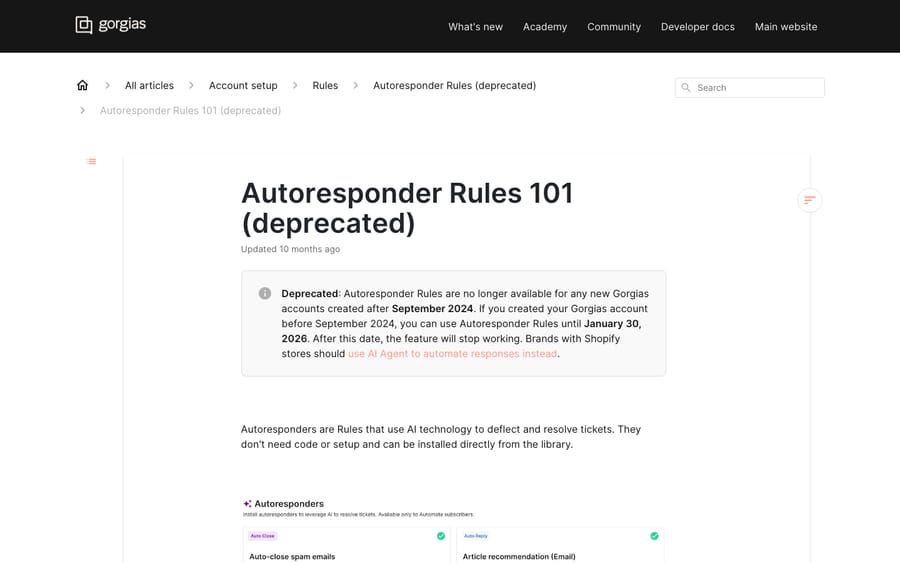
| Jan 30, 2026 | Gorgias | Legacy Autoresponder Rules switched off | Free fixed auto-replies | Rules, or AI Agent at $0.90 to $1.00 per automated interaction |
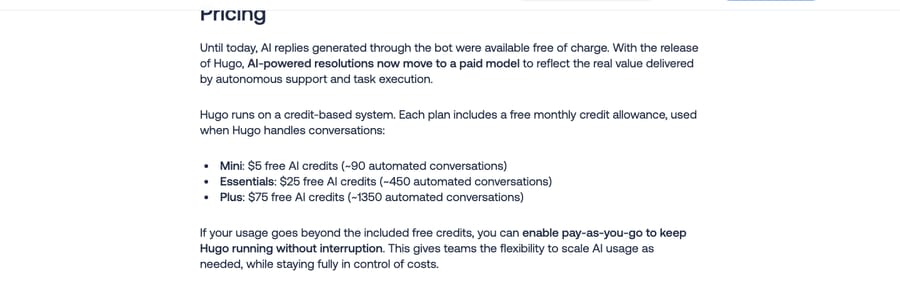
| Feb 1, 2026 | Crisp | Hugo AI resolutions moved to a paid model | Free AI replies | $5, $25 or $75 of credits a month, then pay-as-you-go |
| Apr 14, 2026 | HubSpot | Customer Agent moved to per-resolution pricing | $1.00 per conversation | $0.50 (50 credits) per resolved conversation |
| May 18, 2026 | Zendesk | Automated resolution tiers | Not tiered | Only LLM-verified resolutions draw down the allowance |
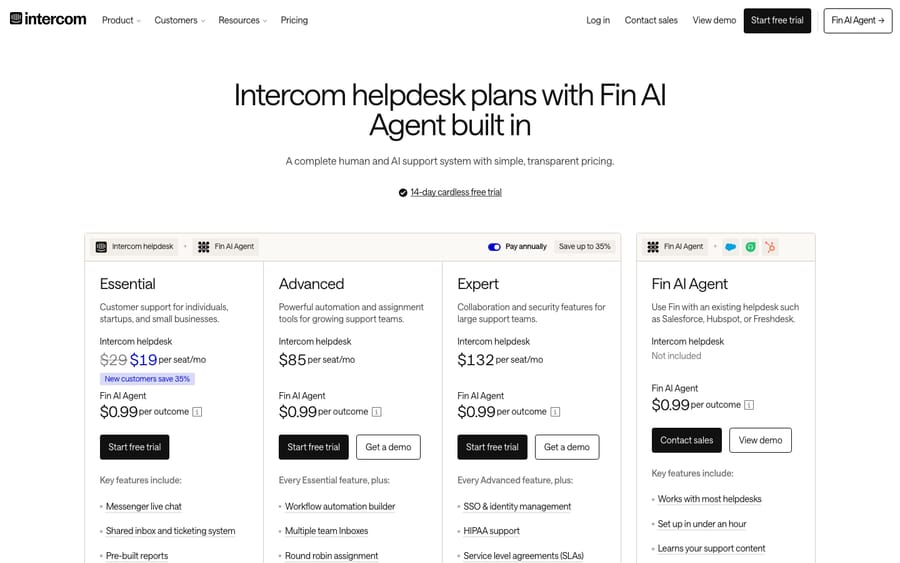
| Sep 10, 2026 | Intercom (now Fin) | Salesforce completed its acquisition | Independent | Fin inside Salesforce; $0.99 per outcome unchanged |
| By Sep 2026 | Freshdesk | Free plan off the pricing page | Free plan | 14-day trial; a 6-month Free Program for 2 agents |
| By Nov 2026 | Help Scout | Per-user pricing back for new signups | Contact-based | $25, $45, $75 per user a month; contact plans kept |
| Nov 2 to 9, 2026 | Front | Autopilot triage rate no longer published | Starting at $0.05 per conversation | Starting at $0.39; handoff $0.39 and resolution $0.89 unchanged |
Two of these are cuts, not rises: HubSpot halved its Customer Agent rate and Zendesk narrowed what counts as a billable resolution. They're in the tracker because they change the bill, and because the direction of every change says something about where each vendor expects its money to come from.
Why are help desks changing prices now?
Seat counts are the old revenue base, and AI threatens it. If an AI agent resolves a third of the tickets, a team needs fewer seats, and a seat-priced vendor loses revenue on its own best feature. Most changes in this tracker move money from the seat to the AI meter: per resolution, per conversation, per credit or per contact helped. The vendors are pricing the work the AI does because that's the line that grows as seats shrink. A per-resolution or per-conversation meter earns the vendor more each time its AI takes work off your team, so the vendor shares in the saving instead of you keeping all of it. That's the incentive behind most rows in the table, and our AI agent pricing by help desk comparison shows what each meter costs at 1,000 and 5,000 tickets a month. The two exceptions run the other way: Freshdesk raised the seat price itself, and Help Scout went back to charging per user after customers pushed back on billing by contacts.
The second pattern is free tiers closing. Freshdesk's free plan, Gorgias's free autoresponder and Crisp's free AI replies all ended within the same twelve months. A free tier is an acquisition channel, and each of these vendors has decided the AI version of the product is the thing worth charging for.
What changed with Front Autopilot pricing in November 2026?
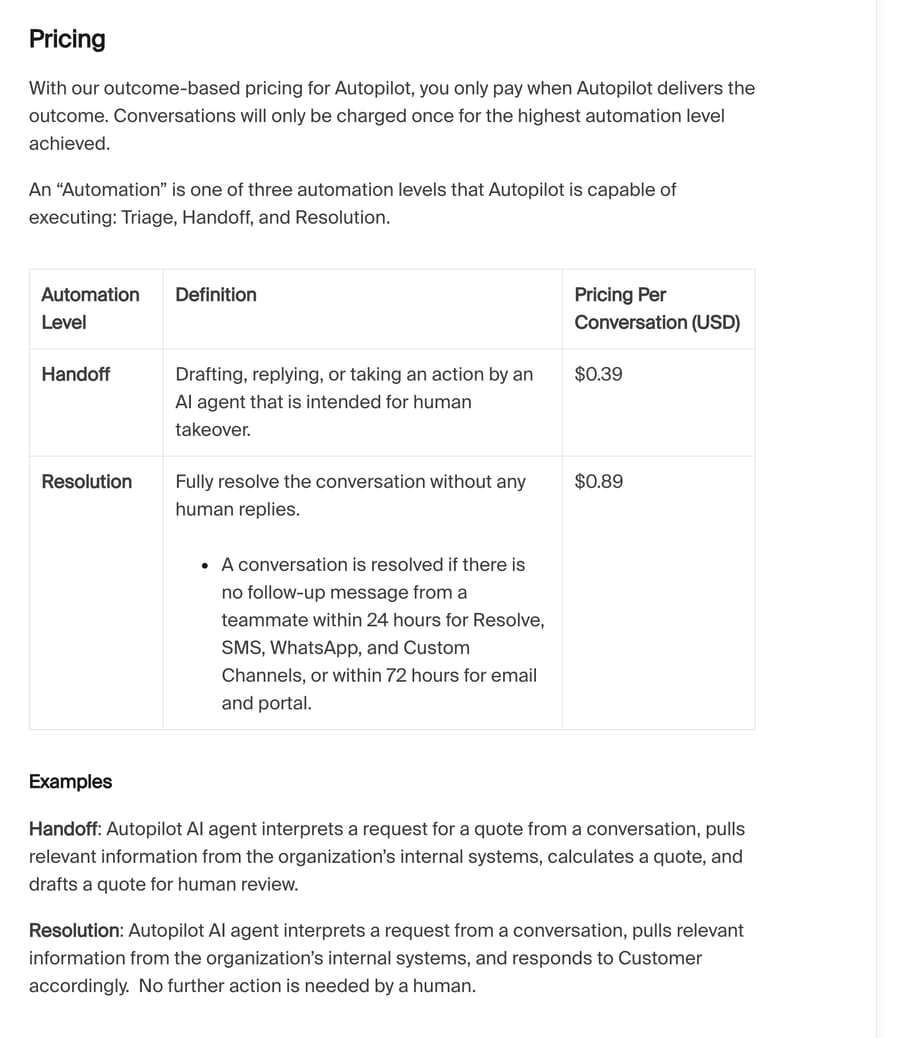
Front's pricing page shows Autopilot "starting at $0.39 /conversation". The pricingsaas tracker captured the same page on November 2 and November 9, 2026 and recorded the starting price moving from $0.05 to $0.39, detected on November 8. No published rate went up: what changed is that the cheapest level is no longer on the page.
The help center explains the ladder underneath. Front's Autopilot article bills each conversation once at the highest level reached: $0.39 for a handoff, where Autopilot drafts, replies or acts before a person takes over, and $0.89 for a resolution with no teammate follow-up within 24 hours on chat-style channels or 72 hours on email. The article still names Triage as one of three levels, but no longer prints a price for it. When we wrote our Front AI pricing comparison in October 2026, the same article listed triage (tagging, routing, summarizing) at $0.05.
What it means in practice: a team using Autopilot only to tag and route 2,000 conversations a month paid $100 at the October rate. Front hasn't published a triage-only rate since, so ask your account manager what triage-only conversations bill at before you renew.
How much did Freshdesk raise prices, and is the free plan gone?
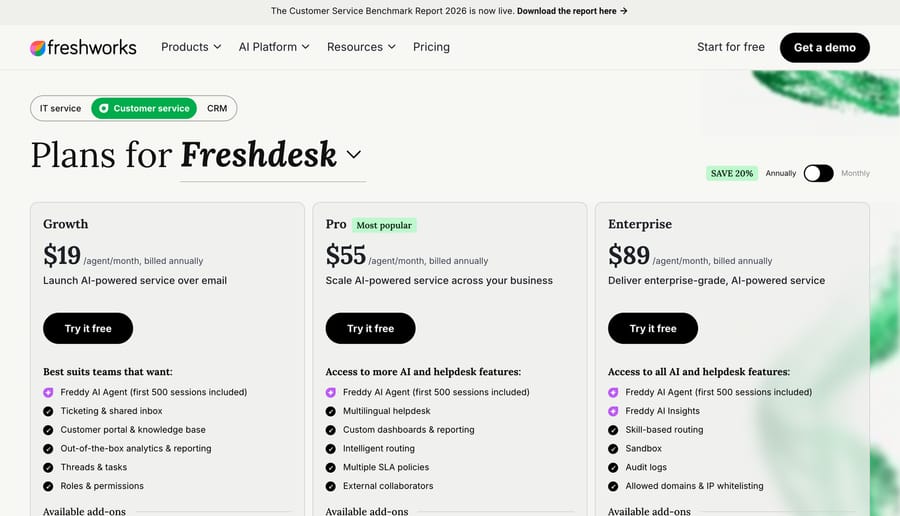
Freshdesk's annual per-agent prices went from $15 to $19 on Growth (27%), $49 to $55 on Pro (12%) and $79 to $89 on Enterprise (13%), between pricingsaas captures on December 29, 2025 and March 30, 2026. The Freshdesk pricing page shows $19, $55 and $89 today, with Freddy AI Agent at $49 per 100 sessions after a one-time 500.
The free plan is off that page. It lists a 14-day Enterprise trial and nothing free beyond it, and the old free-plan landing page returns a 404. What's left is the Freshdesk Free Program, which supports up to 2 agents for 6 months, after which the account has to upgrade.
On Reddit, an r/sysadmin thread from August 2026 opens with a team getting the email that their Freshdesk free plan was ending and asking for free alternatives, and an r/msp thread is titled Freshdesk 35% price increase. We couldn't confirm a 35% figure on any Freshworks page; the list-price rises above run from 12% to 27%. Our Freshdesk pricing guide has the full plan table.
What happened to Help Scout's contact-based pricing?
In late April 2025, Help Scout customers started receiving notice of a new model that billed by contacts helped each month instead of by seat, taking effect six months after the notice. A write-up collecting reactions quotes one small developer whose $22 plan had no new equivalent below $50 a month for 100 contacts, and a three-person team estimating a move from $66 to a new minimum of $266. An r/SaaS thread from April 2025 made the same complaint: costs that track queue volume are harder to predict.
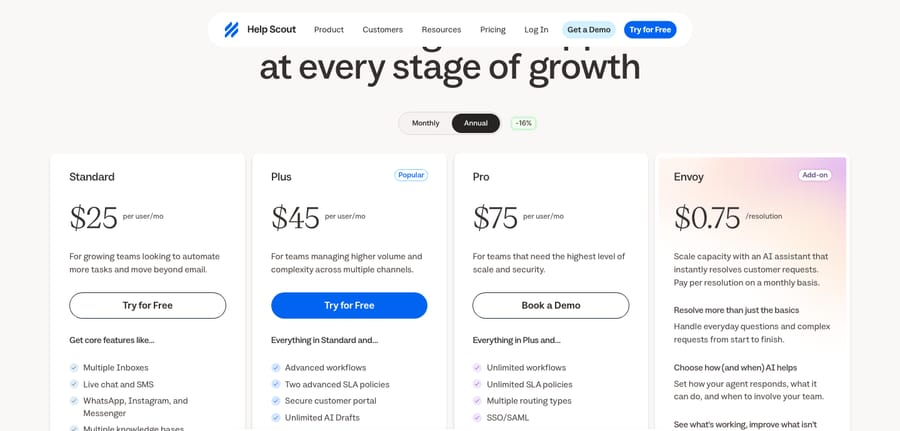
Today the Help Scout pricing page is per user again: Standard $25, Plus $45 and Pro $75 per user a month on annual billing, with contacts unlimited on paid plans. Contact-based plans haven't disappeared. Help Scout's contact-based plan guide, updated November 5, 2026, still sets each account's tier from a three-month average of contacts helped, and its user-based plans guide marks plans no longer sold to new accounts with a legacy badge. We couldn't find a Help Scout announcement dating the return to per-user pricing, so the tracker lists it as "by November 2026".
The AI line moved too. Help Scout's AI resolutions are now sold as Envoy, whose agent is called Scout, at $0.75 per resolution, with three months of unlimited resolutions free for new accounts. Our Help Scout pricing guide covers both billing models.
How did HubSpot change Breeze Customer Agent pricing?
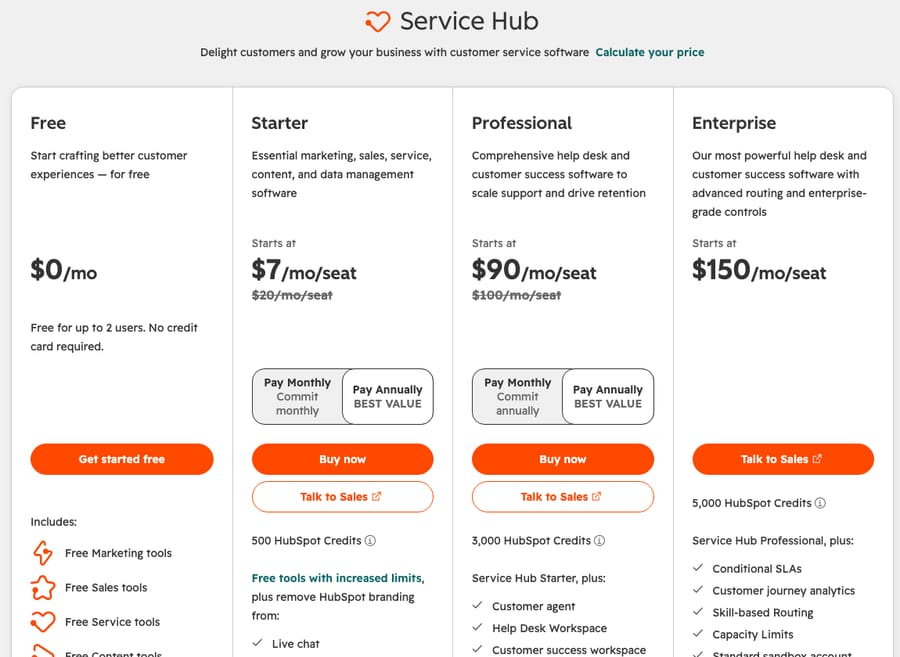
HubSpot launched credits in June 2025 and billed Customer Agent at 100 credits, or $1.00, per conversation. On April 14, 2026, it moved Customer Agent to $0.50 per resolved conversation, paid as 50 credits, so a conversation the agent hands off no longer costs anything. The Service Hub pricing page includes 500, 3,000 or 5,000 credits a month on Starter, Professional and Enterprise, sells extra credits at $0.010 each, and resets the allowance monthly.
That's a price cut on Customer Agent. The complaint on r/hubspot is about the shared pool: credits pay for enrichment and other features as well, and one team wrote that a manual enrichment of a large list consumed far more credits than they'd paid for. A September 2026 thread jokes about having to ask Breeze what using Breeze would cost. When the credits run out, HubSpot's Customer Agent documentation says the agent stops being assigned new conversations until the reset date or a credit purchase. More in our Breeze Customer Agent guide.
What changed at Gorgias and Crisp?
Gorgias. Autoresponder Rules were never offered to accounts created after September 2024, and on January 30, 2026 they stopped working for everyone else. Gorgias's guidance is that Shopify brands should use AI Agent instead, which the pricing page lists at $0.90 per automated interaction on annual billing and $1.00 monthly. Each AI Agent interaction also counts as a helpdesk ticket. Gorgias's legacy pricing doc keeps one fee per ticket only for accounts created before May 28, 2025 that haven't subscribed to AI Agent. On r/shopify, a February 2026 thread asks why WISMO automation costs so much on Gorgias and Zendesk, and a July 2026 thread asks owners what they actually pay at $1 per automated resolution. Our posts on Gorgias auto-responders and Gorgias pricing go further.
Crisp. On February 1, 2026, Crisp's AI update said AI replies had been free and that "AI-powered resolutions now move to a paid model." The pricing page now includes $5 of AI credits on Mini ($45 a month, about 90 automated conversations), $25 on Essentials ($95, about 450) and $75 on Plus ($295, about 1,350). Past the allowance, Crisp offers pay-as-you-go so Hugo keeps answering; the page doesn't publish that rate. Details in Crisp AI explained, our Crisp pricing guide and our breakdown of how Hugo credits work.
Did Zendesk or Intercom change pricing in 2026?
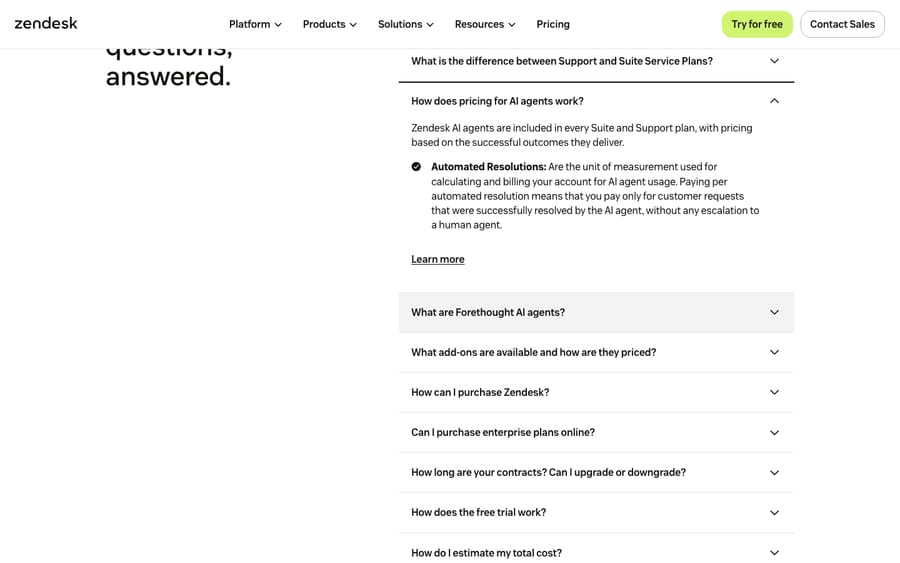
Zendesk changed what it bills rather than the rate. Since May 18, 2026, only "Verified" resolutions draw down an account's allowance: the AI agent answered, the customer didn't ask for more help, and an LLM review confirmed the request was resolved (Zendesk's tiers article). Conversations where the customer just went quiet now count as "contained" and don't draw down the allowance. The Zendesk pricing page lists $2.00 per automated resolution pay-as-you-go. See our Zendesk AI pricing breakdown.
Intercom is now Fin. Salesforce agreed to buy it in June 2026 and completed the acquisition on September 10, 2026, saying Fin "will continue to serve its customers" inside Salesforce's AI Labs. The release says nothing about prices or contracts. Fin's pricing page still lists $0.99 per outcome, with a 50-outcome monthly minimum on other help desks and a separate $9.99 rate for sales qualifications, and the Intercom seat page shows Essential at $19 a seat for new customers against a $29 regular price. Nothing published yet changes renewals. Our Fin pricing breakdown has the outcome definitions.
Four ways to protect your support budget from the next change
Each of these would have softened almost every entry above.
- Find your meter. Write down the exact billing event for every AI feature you use: resolution, outcome, session, conversation, credit or contact. Most surprises came from a meter the team didn't know it had.
- Read the help center, not just the pricing page. Front's ladder and Zendesk's verified tiers live in support articles, not on the pricing page.
- Put a cap on it. Help Scout lets you set a monthly spending cap on Envoy, and HubSpot stops assigning Customer Agent new conversations when credits run out. Know which way your vendor fails: overage or silence.
- Ask for the rate in the renewal. Front's triage rate and Fin's post-acquisition terms are both unpublished. A written rate at renewal is the only protection against a page edit.
Where Macha fits
Most of these changes moved help desk AI onto a meter that rises as the AI does more. Macha prices the other way: about $0.40 per ticket, one plan priced on monthly ticket volume ($299 a month for 750 tickets, $599 for 1,500, $1,199 for 3,000, $1,999 for 5,000, $2,999 for 7,500 and $3,999 for 10,000, with custom pricing above that), where a ticket is one thread with one person however many messages it takes, resolved or handed off. The model, the tool calls and the conversation length don't change the charge, and there are no overages.
Macha runs inside the help desk you already use, on Zendesk, Freshdesk, Gorgias, Front, Gladly, Crisp, HubSpot or Intercom, so it sits beside a price change rather than forcing a migration. It fits teams that want to keep their desk, want a flat per-ticket cost they can forecast, and would rather not staff the AI setup themselves. It's the wrong fit if you only need tagging and routing on a few hundred conversations a month; a native triage feature will cost less. Macha is the done-for-you option: the Macha team analyzes your past tickets, builds the knowledge base and the agent on your existing help desk, and runs it in safe mode, drafting replies as internal notes, until the drafts are right. That's included on the trial and every plan, with a dedicated success manager who handles new categories and instruction changes after go-live. On Crisp, for example, Macha replies on the customer's channel, drafts internal notes, updates segments, assigns conversations and changes their state, without using Hugo's credits (Macha on Crisp).
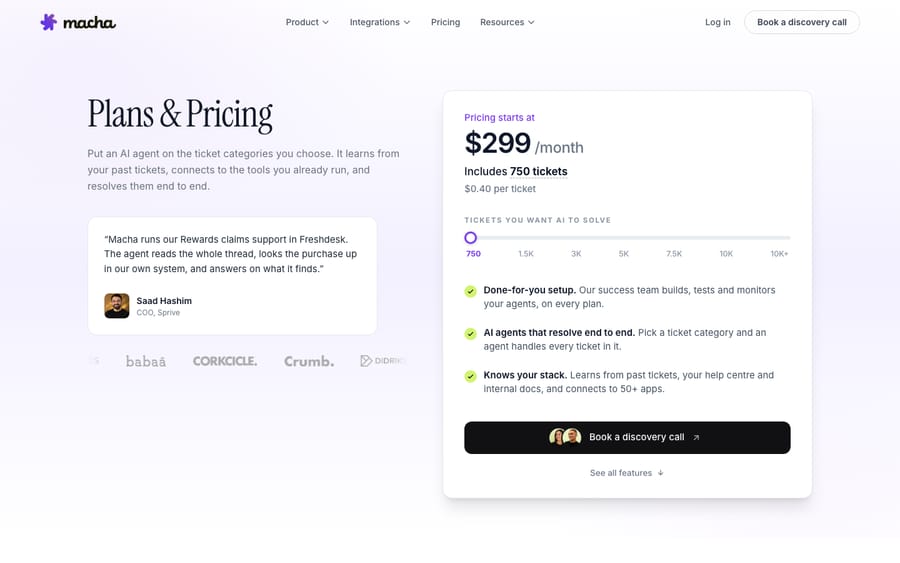
The trial is $50 of free usage (about 125 tickets), no credit card, no time limit; see done-for-you setup and pricing.
Common questions
Did Front raise Autopilot prices?
The advertised starting price did: it moved from $0.05 to $0.39 per conversation between November 2 and November 9, 2026, per the pricingsaas tracker. The handoff ($0.39) and resolution ($0.89) rates are the same as in October. What changed is that Front no longer publishes a price for triage-only conversations, which its help center listed at $0.05 in October 2026.
Does Freshdesk still have a free plan?
Not on its pricing page. Freshdesk lists Growth, Pro and Enterprise at $19, $55 and $89 per agent a month on annual billing, plus a 14-day trial. The remaining free option is the Freshdesk Free Program: up to 2 agents for 6 months, then an upgrade.
Is Help Scout priced per user or per contact in 2026?
New signups pay per user: $25, $45 or $75 a month on annual billing. Accounts that moved to contact-based billing can still be on it; Help Scout's contact-based plan guide, updated November 5, 2026, sets the tier from a three-month average of contacts helped.
When did the Gorgias autoresponder stop working?
On January 30, 2026, for accounts created before September 2024; newer accounts never had it. Gorgias tells Shopify brands to use AI Agent instead, priced at $0.90 to $1.00 per automated interaction, and other brands can build fixed auto-replies with Rules.
Did Intercom raise prices after the Salesforce deal?
Not so far. Salesforce completed the acquisition on September 10, 2026, and Fin's pricing page still lists $0.99 per outcome. Neither Salesforce nor Fin has published changes to renewals, so get your renewal rate in writing.
How we researched this
We checked every change against a primary source or a dated tracker on November 21, 2026: vendor pricing pages (Front, Freshdesk, Help Scout, HubSpot, Gorgias, Crisp, Fin, Intercom), vendor help centers and announcements linked in each section, Salesforce's press release, and pricingsaas's captures of Front's and Freshworks' pricing pages for before-and-after values.
What's from where. Freshdesk's old prices and Front's pre-November starting price come from pricingsaas's page captures; the current prices come from the vendors. Front's October triage price is from our own October 2026 check of its help center. HubSpot's June 2025 launch rate of 100 credits per conversation comes from HubSpot's credits AMA in its community, which our fetcher couldn't load; HubSpot's own April 2026 announcement confirms the $1.00 per conversation it replaced. Help Scout's 2025 change comes from customer reports and the Help Scout docs; Help Scout hasn't published a date for the return to per-user pricing. Reddit reactions are paraphrased and linked, not quoted; Reddit blocks our crawler, so we reached threads through search. Atlassian's Jira Service Management is left out because it's mainly an IT service desk and this tracker covers customer-service help desks; its Cloud price change took effect on October 13, 2026 (see Atlassian's pricing FAQ). We'll re-check every entry by May 21, 2027, and add new changes as they land.