





 Shopify
 Stripe
 Slack
 Notion
 Google Workspace
 Confluence


How Much Does Each Help Desk's AI Agent Cost? AI Agent Pricing by Help Desk (2026)


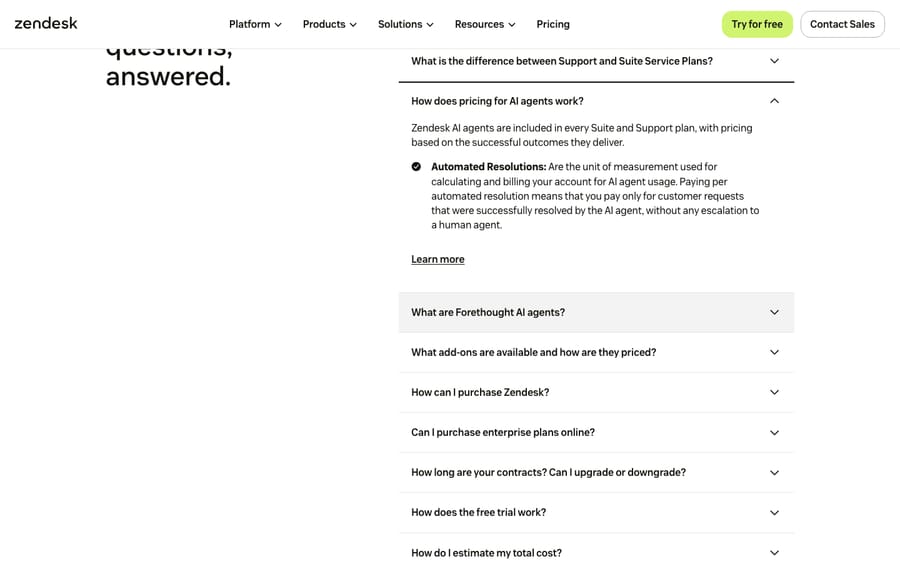
Every major help desk now sells its own AI agent, and no two bill the same thing. Zendesk charges $2.00 per automated resolution pay-as-you-go, Intercom's Fin $0.99 per outcome, HubSpot's Customer Agent $0.50 per resolved conversation in credits, Freshdesk's Freddy $49 per 100 sessions, Gorgias $0.90 to $1.00 per automated interaction, Help Scout $0.75 per resolution and Front $0.39 to $0.89 per conversation, while Crisp bundles AI credits into its plans and Gladly publishes no price at all. We checked every figure on the vendor's own page on November 21, 2026. Below is the unit each one bills, what triggers a charge, and the monthly cost at 1,000 and 5,000 tickets.
Key takeaways
- At 5,000 tickets a month with half resolved by AI, the native AI agent line ranges from $1,250 on HubSpot to $5,000 on Zendesk pay-as-you-go, with Crisp lower still if its unpublished overage rate matches its included credits.
- Zendesk, Intercom Fin, HubSpot, Gorgias and Help Scout bill per resolution or outcome, so the bill rises as the AI agent resolves more of your tickets.
- Freshdesk bills Freddy AI Agent per session at $49 per 100, so every conversation the AI handles is charged whether it resolves the question or hands it to a person.
- Front charges every Autopilot conversation once at its highest level: $0.39 for a handoff and $0.89 for a full resolution.
- Macha charges about $0.40 per ticket on every help desk it supports, with done-for-you setup and a dedicated success manager included on the trial and every plan.
What does each help desk charge for its AI agent?
| Help desk | AI agent | Pricing unit | List price (Nov 21, 2026) | What triggers a charge |
|---|---|---|---|---|
| Zendesk | AI agents | Per automated resolution | $2.00 pay-as-you-go; lower committed rate; 5 to 10 included per agent a month | A verified resolution: the customer got an answer, didn't ask for more help, and an LLM review confirms it |
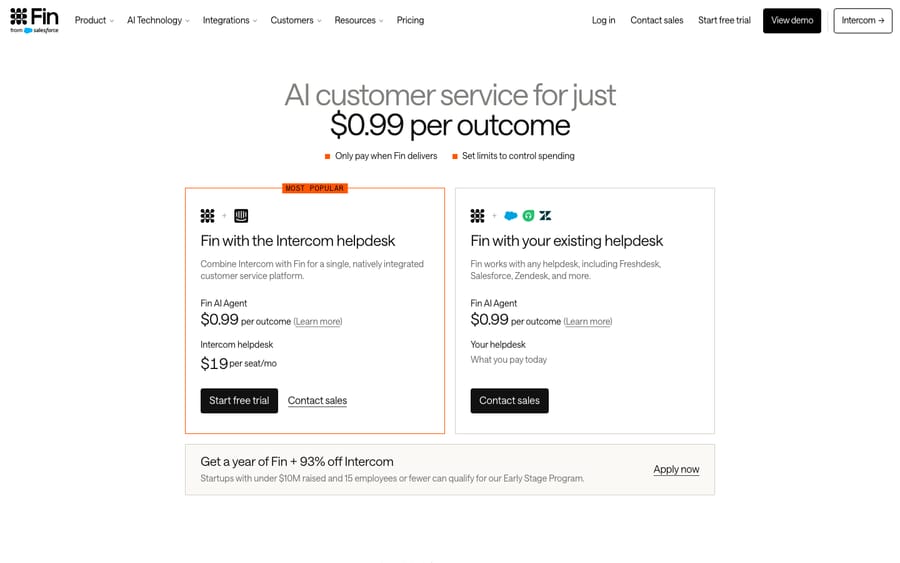
| Intercom | Fin | Per outcome | $0.99 ($9.99 for a sales qualification); 50-outcome monthly minimum on another help desk | A resolution, a Procedure handoff, a disqualification or a self-serve routing, at most once per conversation |
| HubSpot | Customer Agent | Credits per resolution | 50 credits ($0.50) per resolved conversation; extra credits $0.01 each | No visitor-requested handoff within 72 hours of the last message |
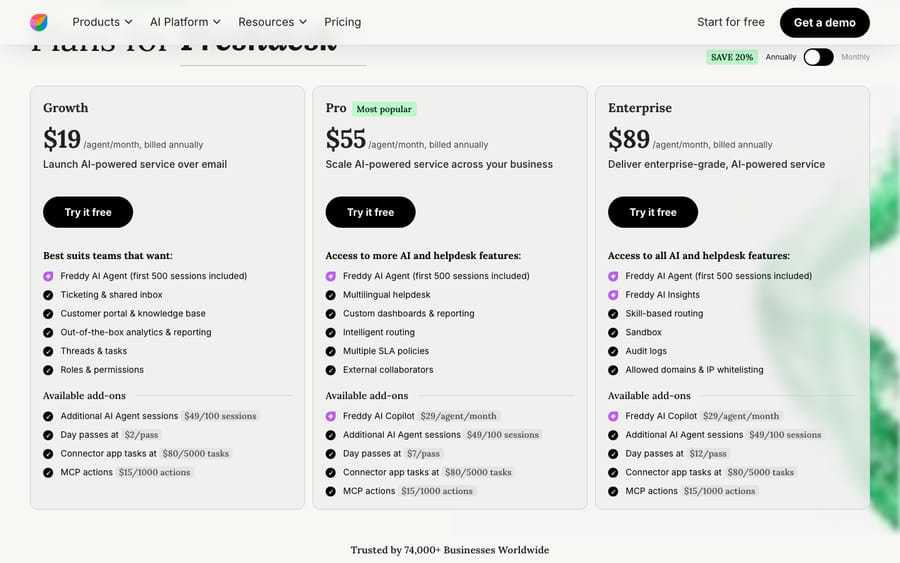
| Freshdesk | Freddy AI Agent | Per session | $49 per 100 sessions after a one-time 500 | Any unique interaction with the AI agent; email sessions are 72-hour windows |
| Gorgias | AI Agent | Per automated interaction | $0.90 annual, $1.00 monthly, $1.50 overage | A request fully resolved with no human reply within 72 hours |
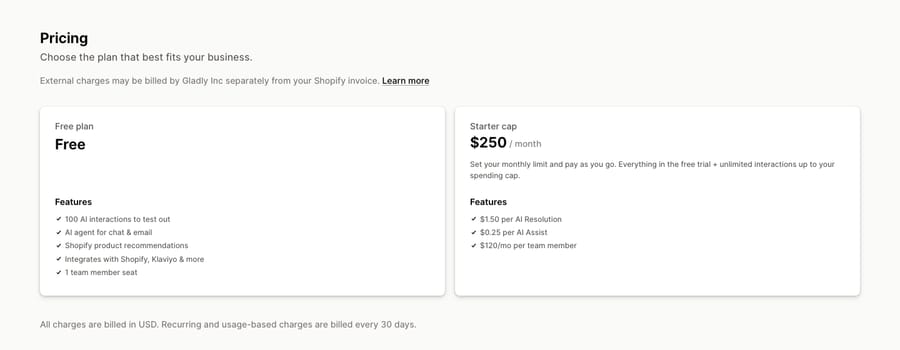
| Gladly | Gladly AI (formerly Sidekick) | Per assisted conversation (enterprise); per resolution or assist (Shopify app) | Enterprise: quoted, last public rate about $0.60 (2024). Shopify App Store plan: $1.50 per AI resolution, $0.25 per assist | Any conversation the AI helps with |
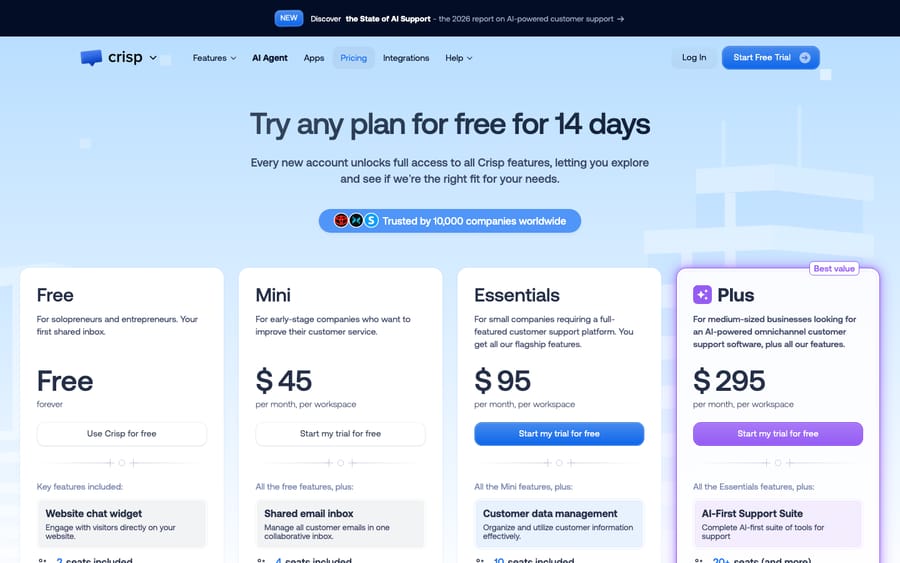
| Crisp | Hugo | Dollar AI credits in the plan | $5, $25 or $75 of credits on Mini, Essentials, Plus; pay-as-you-go after | Conversations Hugo handles (Crisp quotes about 90 per $5) |
| Help Scout | Envoy (agent: Scout) | Per resolution | $0.75 | A conversation Scout resolves where the customer doesn't ask for more help |
| Front | Autopilot | Per conversation, tiered | $0.39 handoff, $0.89 resolution | Every conversation Autopilot touches, billed once at the highest level |
The sources for every row are in "How we researched this" at the end. Our desk-by-desk pricing posts go deeper on each one: Fin, Zendesk AI, HubSpot Service Hub, Freddy, Gorgias, Help Scout, Front, Crisp's Hugo and Gladly's AI.
Why does every help desk bill its AI agent differently?
Nine price tags reduce to three billing units, and each one tells you what the vendor wants to be paid for.
Per resolution or outcome (Zendesk, Fin, HubSpot, Gorgias, Help Scout). You pay when the AI agent closes the question without a person. The pitch is "pay only for results", and it's a fair pitch for the conversations that fail: Help Scout's page says plainly that a customer who clicks "I still need help" costs nothing. The incentive runs the other way once the agent works. The better your knowledge base and the more tickets the agent resolves, the larger the bill, and the vendor captures most of the saving you created. A resolution-priced vendor earns the most from the customer whose AI program is going best.
Per session or per conversation (Freshdesk, Front, Gladly). You pay for every conversation the AI engages, resolved or not. Freshdesk counts "a unique interaction between an end-user and an AI Agent", so a session that ends in a handoff costs the same $0.49 as one that resolves. Front splits the difference with a ladder: $0.39 when Autopilot drafts or replies and a person takes over, $0.89 when it resolves. Per-session billing is easier to forecast because it tracks volume, and harder to justify on a bad month because failures are billed too.
Credits bundled into a plan (Crisp, and HubSpot in part). The AI allowance is denominated in dollars or credits that come with the subscription. Crisp includes $5 to $75 of AI credits a month and quotes about 90 automated conversations per $5; our guide to Crisp's Hugo credits explains how they're counted. HubSpot's credits are shared across every credit-metered feature in the account, so Customer Agent competes with data enrichment for the same pool. That shared pool is where a well-known r/hubspot thread came from: a team said enriching a large list by mistake burned through far more credits than it had paid for.
Zendesk also changed its definition. Since May 18, 2026, only "Verified" resolutions draw down the allowance: an LLM reviews the conversation and confirms the request was resolved. Conversations where the customer simply went quiet ("contained") no longer count. That's a real change in what you're billed for, and one of several 2026 moves we track in help desk price increases in 2026. Our Zendesk AI pricing breakdown covers the tiers and allowances in detail.
How much does a help desk AI agent cost at 1,000 tickets a month?
The assumption for both worked examples: the AI agent engages every incoming ticket, fully resolves 50% and hands the other 50% to a person. That's a middle-of-the-road rate. Fin's own marketing quotes higher averages and most first deployments land lower. The figures cover the AI line only; seats are listed separately further down. We don't net out included allowances for any vendor (Zendesk's 5 to 10 resolutions per agent, HubSpot's 500 to 5,000 credits, Gorgias's 30 to 530 automated interactions), because they depend on your seat count and plan and some are shared with other features; each one lowers the real bill a little. Fin is costed on resolutions only: if your handoffs run through a Procedure, each is also a $0.99 outcome, which would take Fin to as much as $990 at 1,000 tickets.
| Help desk | Arithmetic at 1,000 tickets | AI cost a month |
|---|---|---|
| Zendesk | 500 resolutions × $2.00 pay-as-you-go | $1,000 |
| Intercom Fin | 500 outcomes × $0.99 | $495 |
| HubSpot | 500 × 50 credits = 25,000 credits × $0.01 | $250 |
| Freshdesk | 1,000 sessions × $0.49 | $490 |
| Gorgias | 500 automated interactions × $0.90 annual ($1.00 monthly) | $450 ($500) |
| Gladly | 1,000 assisted conversations × about $0.60 | about $600 |
| Crisp | 1,000 conversations × about $0.056 (our estimate from $5 ≈ 90) | about $56, inside the $75 included on Plus |
| Help Scout | 500 resolutions × $0.75 | $375 |
| Front | 500 × $0.89 + 500 × $0.39 | $640 |
| Macha | 1,000 tickets falls in the 1,500-ticket tier | $599/month for 1,500 tickets |
Crisp is close to free at this volume because its credits are priced for small chat teams, and HubSpot is cheap on the AI line but needs Professional seats at $90 or more each plus a $1,500 onboarding fee before Customer Agent is available at all. At 1,000 tickets Macha sits in the middle of the table on price. Its bill includes the work the others leave to you, which is covered below.
How much does it cost at 5,000 tickets a month?
| Help desk | Arithmetic at 5,000 tickets | AI cost a month |
|---|---|---|
| Zendesk | 2,500 resolutions × $2.00 | $5,000 |
| Intercom Fin | 2,500 × $0.99 | $2,475 |
| HubSpot | 2,500 × 50 credits = 125,000 credits × $0.01 | $1,250 |
| Freshdesk | 5,000 sessions × $0.49 | $2,450 |
| Gorgias | 2,500 × $0.90 ($1.00 monthly) | $2,250 ($2,500) |
| Gladly | 5,000 × about $0.60 | about $3,000 |
| Crisp | 5,000 × about $0.056, if pay-as-you-go matches the included rate | about $278 ($75 included on Plus covers about 1,350) |
| Help Scout | 2,500 × $0.75 | $1,875 |
| Front | 2,500 × $0.89 + 2,500 × $0.39 | $3,200 |
| Macha | 5,000-ticket tier | $1,999 |
Zendesk's figure uses the pay-as-you-go rate. A committed volume brings it down: our October check of the US page showed $1.50 a committed resolution, which would make this $3,750. Today the page served us a non-US edition, which lists the committed rate in pounds, so we haven't restated it.
What happens to the bill if the AI agent resolves more tickets?
This is where the three units part ways. Same 5,000 tickets, three resolution rates:
| Help desk | 30% resolved | 50% resolved | 70% resolved |
|---|---|---|---|
| Zendesk (pay-as-you-go) | $3,000 | $5,000 | $7,000 |
| Intercom Fin | $1,485 | $2,475 | $3,465 |
| HubSpot | $750 | $1,250 | $1,750 |
| Freshdesk | $2,450 | $2,450 | $2,450 |
| Gorgias (monthly) | $1,500 | $2,500 | $3,500 |
| Gladly (approximate) | $3,000 | $3,000 | $3,000 |
| Help Scout | $1,125 | $1,875 | $2,625 |
| Front | $2,700 | $3,200 | $3,700 |
| Macha | $1,999 | $1,999 | $1,999 |
Read the 70% column as the success case. Zendesk's bill more than doubles between 30% and 70%, because every extra resolution is another $2.00. Front rises more gently because a handoff already costs $0.39, so moving a conversation from handoff to resolution adds only $0.50. Freshdesk, Gladly and Macha don't move at all, since they bill per conversation or per ticket rather than per outcome.
None of this makes per-resolution pricing a bad deal. At a 30% resolution rate, Fin and HubSpot are cheap. It means the right unit depends on where you expect to end up. A team planning to automate most of its order-status and returns traffic should price the 70% column, not the 30% one.
What do you pay before the AI agent is even switched on?
Native AI agents need the help desk underneath them. The AI line above sits on top of these:
| Help desk | Seat or plan prerequisite (annual billing, Nov 21, 2026) | Agent-assist copilot |
|---|---|---|
| Zendesk | Support Team $19, Suite Team $55, Suite Professional $115 per agent a month | Copilot $50 per agent a month, Professional and up |
| Intercom | Essential $29 ($19 for new customers), Advanced $85, Expert $132 per seat; or Fin alone on another desk | Copilot $35 per user a month (Salesforce, per fin.ai) |
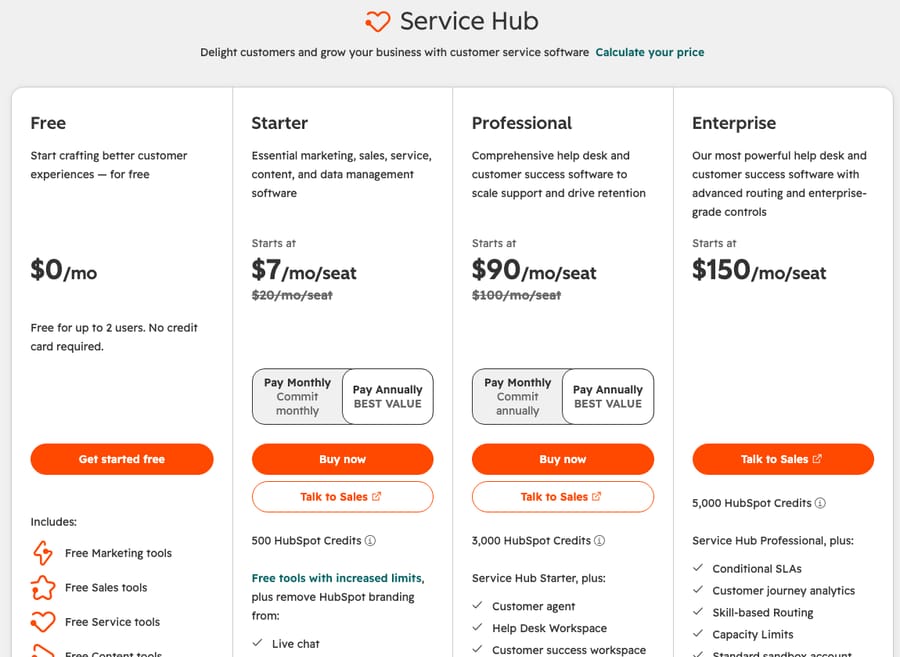
| HubSpot | Service Hub Professional from $90 a seat plus $1,500 onboarding; Enterprise from $150 plus $3,500 | Breeze features included, credit-metered |
| Freshdesk | Growth $19, Pro $55, Enterprise $89 per agent a month | Freddy Copilot $29 per agent a month, Pro and up |
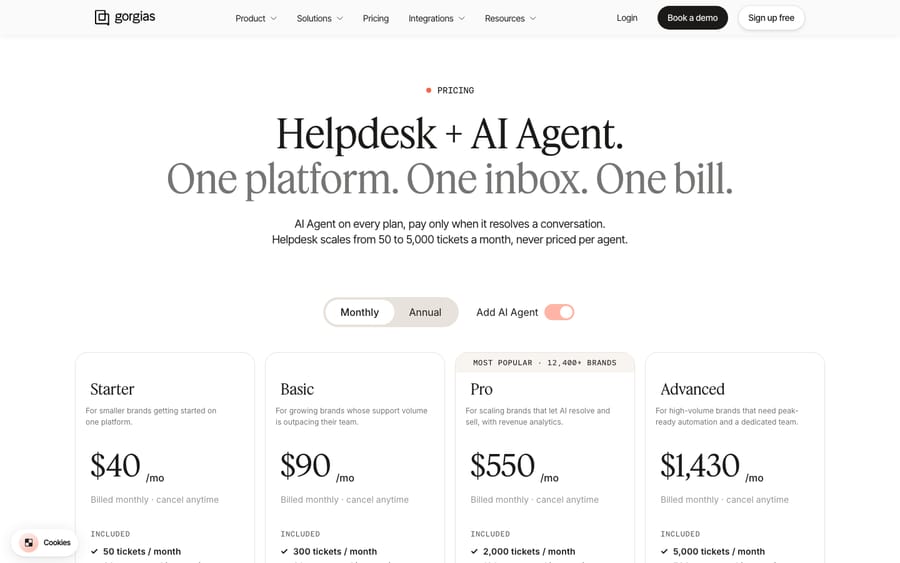
| Gorgias | Helpdesk plans by ticket volume, annual: Basic $50 (300 tickets), Pro $300 (2,000), Advanced $750 (5,000); with AI Agent added the page shows $90, $550 and $1,430 billed monthly | Not stated on the pricing page |
| Gladly | Not published; about $180 a seat with a 10-seat minimum per third parties | Not published |
| Crisp | $45, $95 or $295 per workspace a month (4, 10 or 20+ seats) | Not stated on the pricing page |
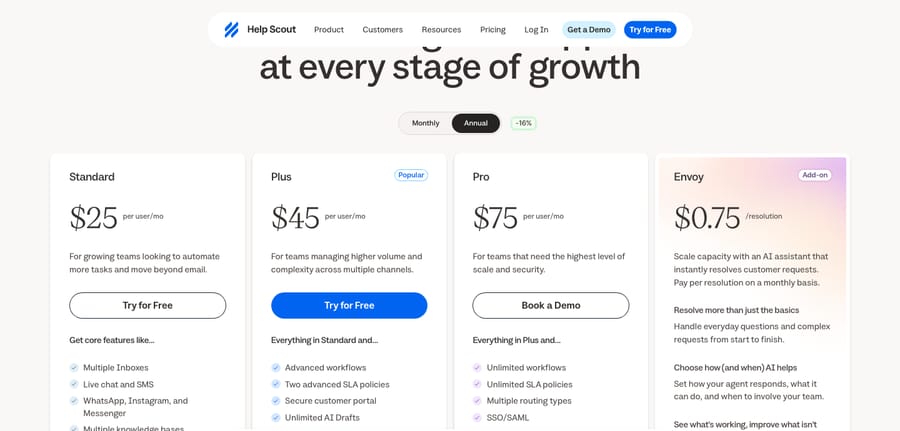
| Help Scout | Standard $25, Plus $45, Pro $75 per user a month | AI Inbox assistant on Standard; unlimited AI Drafts on Plus and Pro |
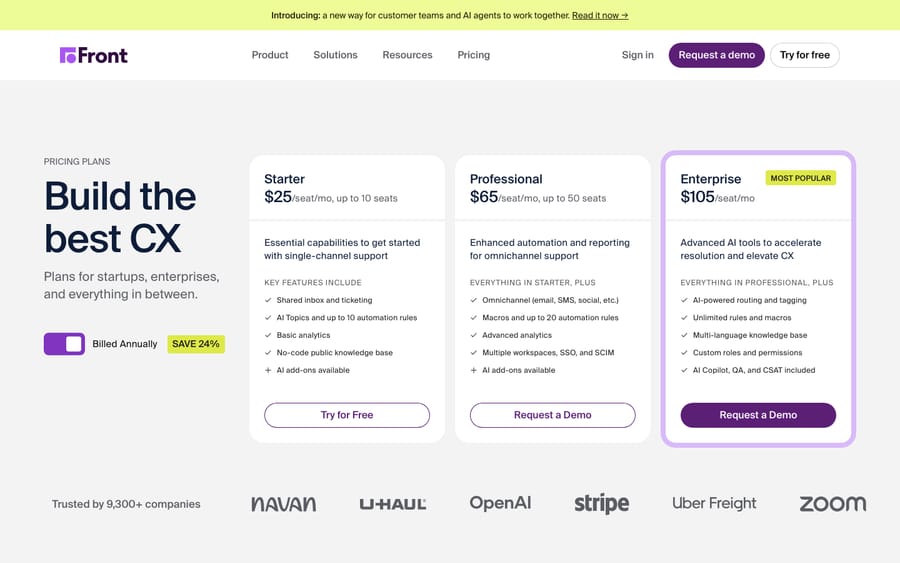
| Front | Starter $25, Professional $65, Enterprise $105 per seat a month | Copilot $20 per seat a month, included on Enterprise |
Gorgias is the odd one here. Each AI Agent interaction also counts as a helpdesk ticket against your plan's allowance, so an automated conversation consumes both an automation fee and one of your included tickets. Our Gorgias pricing breakdown works through that double count, and the exception for accounts on legacy pricing.
All-in monthly cost with seats for a 10-person team
The AI line is only part of the bill. Here's the same 50% scenario with a 10-person team added, on each desk's entry plan that sells the AI agent (annual list prices from the table above; Gladly approximate):
| Help desk | 10 seats a month | AI at 1,000 tickets | Total at 1,000 | AI at 5,000 tickets | Total at 5,000 |
|---|---|---|---|---|---|
| Zendesk (Support Team) | $190 | $1,000 | $1,190 | $5,000 | $5,190 |
| Intercom (Essential, $29) | $290 | $495 | $785 | $2,475 | $2,765 |
| HubSpot (Professional, from $90) | $900 | $250 | $1,150 | $1,250 | $2,150 |
| Freshdesk (Growth) | $190 | $490 | $680 | $2,450 | $2,640 |
| Help Scout (Standard) | $250 | $375 | $625 | $1,875 | $2,125 |
| Front (Starter) | $250 | $640 | $890 | $3,200 | $3,450 |
| Gladly (about $180 a seat) | about $1,800 | about $600 | about $2,400 | about $3,000 | about $4,800 |
Gorgias and Crisp don't price per seat (Gorgias by ticket volume, Crisp per workspace), so they're left out of this table; their plan prices are in the previous section. HubSpot's first year also carries the $1,500 Professional onboarding fee. Macha adds nothing to the seat line, since your seats stay on the help desk you already pay for, and its tier price is the whole Macha bill.
The costs that don't show on any of these tables:
- Gorgias counts twice: each automated interaction is also one of your plan's helpdesk tickets.
- Freddy bills failures: a session that ends in a handoff costs the same $0.49 as one that resolves.
- Fin bills Procedure handoffs: a handoff that runs through a Procedure is a $0.99 outcome.
- HubSpot credits are shared and expire: they reset monthly, and enrichment and other features draw on the same pool.
- Spend caps vary: Help Scout's Envoy has a monthly spending cap, Fin's pricing page says you can set limits, and HubSpot stops assigning Customer Agent new conversations when credits run out. Check the others before you assume a ceiling.
Which pricing unit suits which team?
By the shape of your volume:
- Low volume, chat-first, small team: Crisp's bundled credits are hard to beat on the AI line alone. The ceiling is what Hugo can do without tools you'd build yourself.
- Low resolution rate expected, or a pilot: per-resolution pricing (Fin, HubSpot, Help Scout) costs little while the agent is learning, because failures are free.
- High automation target: per-conversation or per-ticket pricing protects you. A flat bill at 70% beats a bill that scales with every win.
- Already on Gorgias or Zendesk at volume: model the committed rate, not the list rate, and check what your plan already includes before buying more.
- Gladly: enterprise contracts are quoted, so ask for the per-assisted-conversation rate and the minimum commitment in writing. The last public rate was about $0.60 (2024); Gladly's self-serve Shopify App Store plan lists $1.50 per AI resolution and $0.25 per assist. Our Gladly pricing guide covers seats, telephony and the rest of the contract.
The unit also decides who carries the forecasting risk. Per-outcome pricing moves risk to the vendor while the AI is weak and back to you once it's strong. Per-ticket pricing keeps it flat. If you run a single desk and plan to stay on it, the native agent is the default choice, and the question is whether its unit matches your expected resolution rate.
Where Macha fits
Macha is an AI agent layer that runs inside the help desk a team already uses, on Zendesk, Freshdesk, Gorgias, Front, Gladly, Crisp, HubSpot or Intercom. It isn't a help desk, so the seats in the table above stay where they are. Pricing is about $0.40 per ticket, where a ticket is one thread between Macha and one person, charged once no matter how many messages it takes: $299 a month for 750 tickets, $599 for 1,500, $1,199 for 3,000, $1,999 for 5,000, $2,999 for 7,500 and $3,999 for 10,000, with custom pricing above that. The model the agent runs on, the tools it calls and how long the conversation runs don't change the charge, and there are no overages.
The part the price includes is the bigger difference. Macha is the done-for-you option: the Macha team analyzes your past tickets, builds the knowledge base and the agent on your existing help desk, and runs it in safe mode, drafting replies as internal notes, until the drafts are right. That's included on the trial and every plan, with a dedicated success manager who handles new categories, instruction changes and new tools after go-live. Most native agents in this post are self-serve after purchase: your team writes the instructions, connects the data and tunes the answers. HubSpot's paid onboarding covers setting up the hub, not ongoing tuning of the agent.
Macha fits teams that want one agent setup across more than one desk, need actions through their own systems (Shopify, Stripe or any internal API through a custom tool the Macha team builds), or would rather not staff the AI project themselves. On Gladly and Crisp, Macha reads conversations and customer profiles, replies on the customer's channel, drafts internal notes in safe mode, tags, routes and changes status; see Macha on Gladly and Macha on Crisp.
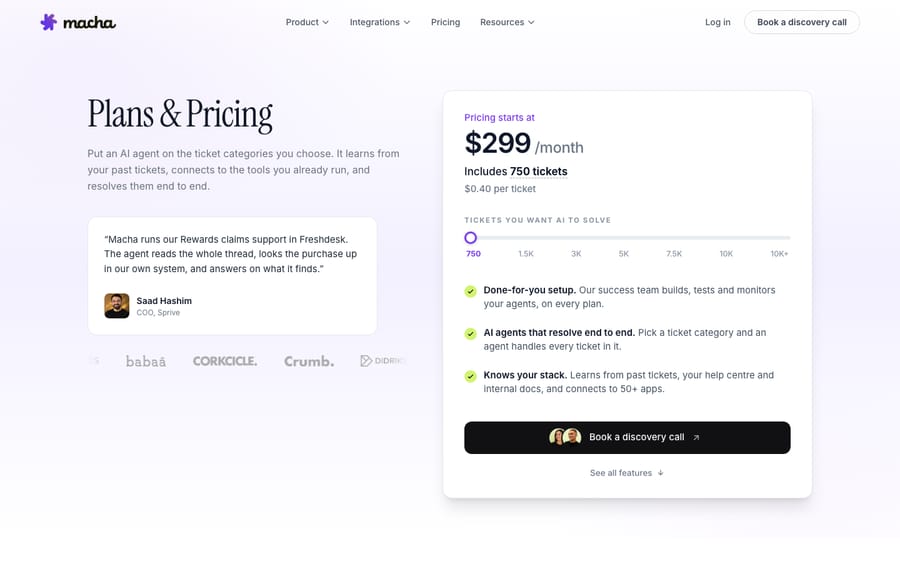
The done-for-you page lays out the setup, and pricing has the full table. If you're on a single desk and expect a low resolution rate, the native agent will often cost less, and that's a fair reason to pick it. You can try Macha on your own tickets with $50 of free usage (about 125 tickets), no credit card, no time limit: start a trial.
Common questions
Which help desk has the cheapest AI agent?
On the AI line alone, probably Crisp: its plans include $5 to $75 of AI credits and Crisp quotes about 90 automated conversations per $5, so Plus covers about 1,350 a month. Crisp doesn't publish its pay-as-you-go rate, so its cost beyond that is our estimate; the plan prices themselves are in our Crisp pricing guide. Among published rates, HubSpot's Customer Agent is lowest at 5,000 tickets with half resolved, at $1,250, but it requires Service Hub Professional seats from $90 each. The cheapest unit price isn't the cheapest total once seats and setup are counted.
Is per-resolution pricing cheaper than per-conversation pricing?
It's cheaper when the resolution rate is low and dearer when it's high. At 5,000 tickets, Zendesk's pay-as-you-go bill is $3,000 at 30% resolved and $7,000 at 70%, while Freshdesk's per-session bill stays at $2,450 either way. Pick the unit that suits the rate you expect after six months, not the pilot rate.
Does Gladly publish Sidekick pricing?
Not for enterprise plans: its pricing URL now lives on gladly.ai and offers only Get a Demo and Contact sales. Its self-serve Shopify App Store listing does show prices: $120 a seat, $1.50 per AI resolution and $0.25 per assist. Third-party pricing sites report about $0.60 per assisted conversation with a minimum commitment and seats around $180 a month with a 10-seat minimum. Treat those as estimates until Gladly quotes you.
What counts as a billable resolution on Fin?
Fin bills $0.99 per outcome, at most once per conversation: the customer confirms the issue is resolved, doesn't ask for more help after Fin's answer, or Fin completes a Procedure, including a handoff. Nothing is charged if Fin can't answer or the customer asks for a person. Running Fin on another help desk carries a 50-outcome monthly minimum.
What does Front Autopilot charge per conversation?
Front's help center lists $0.39 for a handoff, where Autopilot drafts, replies or acts before a person takes over, and $0.89 for a resolution with no teammate follow-up within 24 hours on chat-style channels or 72 hours on email. Each conversation is billed once at the highest level reached. The pricing page now shows "starting at $0.39 per conversation".
How is Macha priced compared with native AI agents?
Macha charges about $0.40 per ticket on a single plan priced by monthly ticket volume, whether the ticket is resolved or handed to a person, with setup and a dedicated success manager included. The trial is $50 of free usage (about 125 tickets), no credit card, no time limit. See which help desks Macha runs on and how AI agent pricing models compare.
How we researched this
We read every vendor's own pricing page and, where the pricing page left the billing event undefined, its help center, all on November 21, 2026. Sources: Zendesk pricing and About automated resolution tiers; Intercom pricing and Fin pricing; HubSpot Service Hub pricing, HubSpot's Customer Agent pricing announcement (updated April 13, 2026) and its Customer Agent knowledge base article; Freshdesk pricing; Gorgias pricing; Gladly's pricing URL (no prices); Crisp pricing and Crisp's February 2026 AI update; Help Scout pricing; Front pricing and Front's Autopilot help article.
What's from where. Every list price comes from the vendor's own page. Gladly publishes none, so its figures come from third-party sites (eesel's Gladly pricing guide, a competitor of ours, and Ringly's Gladly pricing guide) and are labeled approximate. Crisp's per-conversation figure is our arithmetic from Crisp's own "$5, around 90 automated conversations"; Crisp doesn't publish a pay-as-you-go rate, so we assumed the same rate. Zendesk's committed rate was shown to us in pounds because the page served a non-US edition; the US$1.50 figure is from our check on October 13, 2026. Macha's prices come from our own pricing page.
Assumptions in the worked examples: the AI agent engages every ticket; 50% are fully resolved and 50% handed to a person (30% and 70% in the sensitivity table); one ticket is one conversation; seats, Copilots and onboarding fees are excluded from the AI line; included allowances aren't netted out; Fin is costed on resolutions only; Front handoffs bill at $0.39. We didn't buy or run these native agents for this post. Prices change often, so check the vendor's page before you sign. We'll re-check every figure by May 21, 2027.