







 Shopify
 Stripe
 Slack
 Notion
 Google Workspace
 Confluence


Gladly vs Kustomer (2026): Pricing, AI and Which One Fits Your Team


Gladly and Kustomer both organize support around the customer rather than the ticket, and both sell mostly to retail and DTC brands through sales. The practical differences are in AI pricing and data. Kustomer charges $0.75 for every conversation its AI engages, whatever the outcome. Gladly's published rates charge $1.50 when its AI resolves a conversation and $0.25 when it assists before a handoff. Kustomer also gives you a CRM-style data platform with custom objects and TikTok Shop. Gladly gives you native voice with published per-minute rates. Neither publishes a seat price. We checked every figure below on the vendor's own pages on 21 November 2026.
Key takeaways
- Kustomer charges $0.75 per engaged conversation for its Concierge AI, while Gladly's published rates are $1.50 per AI resolution and $0.25 per AI assist.
- Kustomer's per-conversation AI price works out cheaper than Gladly's published rates once the AI resolves more than 40% of the conversations it touches.
- Neither Gladly nor Kustomer publishes a seat price in 2026; third-party trackers put Gladly at about $180 a seat with a 10-seat minimum.
- Kustomer sells AI for human agents as Envoy at $50 per user a month, and its voice starts at $0.02 a minute.
- Macha runs inside Gladly at about $0.40 per ticket with setup and a dedicated success manager included, but Macha doesn't run on Kustomer.

Gladly vs Kustomer at a glance
| Gladly | Kustomer | |
|---|---|---|
| Data model | One lifelong conversation per customer | One customer timeline on a CRM-style data platform |
| Published seat price | None; about $180 a seat, 10-seat minimum (third-party) | None; Enterprise and Ultimate plans are "Talk to Sales" |
| Customer-facing AI | $1.50 per AI resolution, $0.25 per AI assist (Shopify listing) | Concierge: $0.75 per engaged conversation |
| AI for human agents | Team Assist (no published price) | Envoy: $50 per user a month |
| Voice | Native; $0.01860 to $0.02794 a minute incoming (US) | Kustomer Voice from $0.02 a minute |
| Social and commerce channels | Instagram, Messenger, WhatsApp | Facebook, Instagram, WhatsApp, TikTok Shop |
| Best for | Phone and SMS heavy retail brands | Data-heavy omnichannel teams with custom objects |
| Macha runs on it | Yes | No |
Sources: Kustomer pricing, Kustomer comprehensive pricing details, Gladly pricing, Gladly on the Shopify App Store, all checked 21 November 2026.
How do Gladly and Kustomer prices compare?
Neither vendor will show you a seat price. Kustomer's pricing page says it doesn't post "one-size-fits-all pricing" and sends you to an ROI assessment. Its comprehensive pricing page lists two current plans, Enterprise and Ultimate, both "Talk to Sales", plus legacy seat-based and usage-based plans for existing customers.
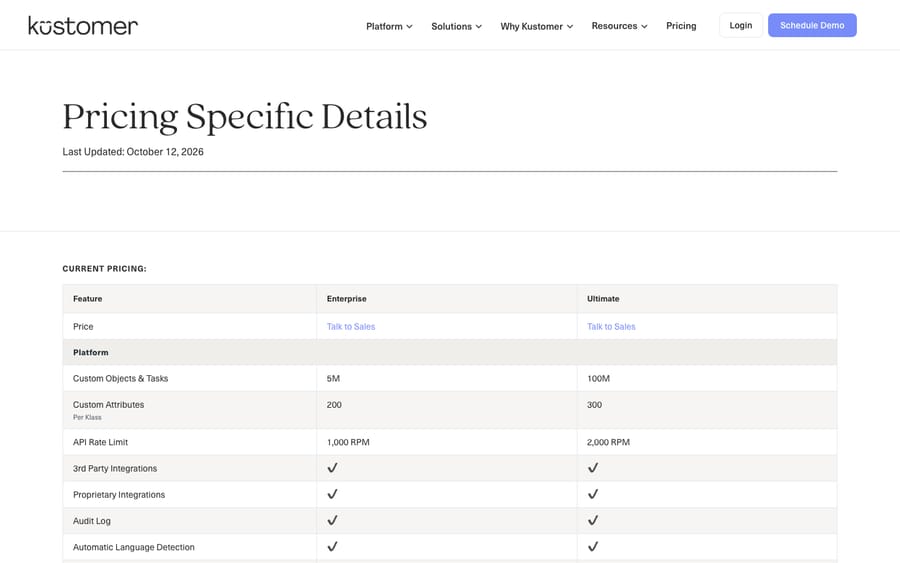
What Kustomer does publish is the add-on rate card:
| Kustomer item | Published price |
|---|---|
| Concierge (customer-facing AI agent) | $0.75 per engaged conversation |
| Envoy (AI agents for reps) | $50 per user a month |
| AI QA | $0.05 per execution |
| Conversation Intelligence | $0.02 per execution |
| Kustomer Voice | From $0.02 a minute |
| Outbound messages | $0.025 per message |
| HIPAA compliance | $25 per user a month |
| Data storage | $50 per GB a month |
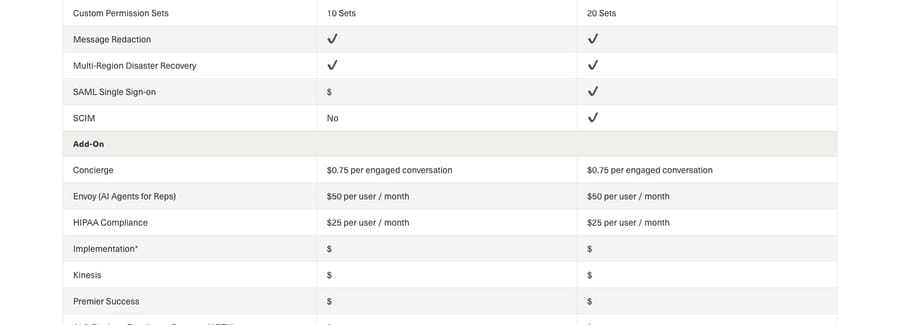
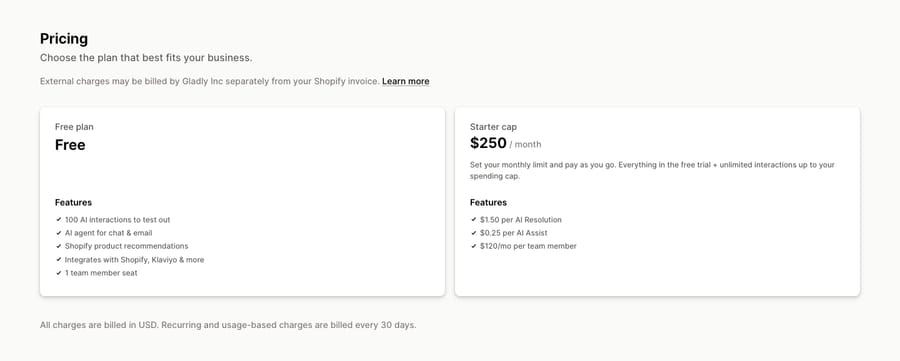
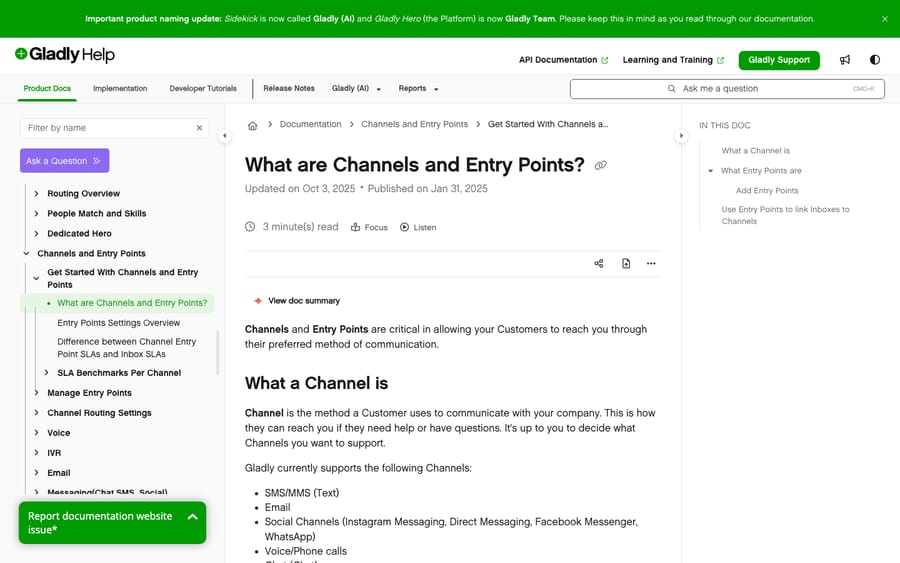
Gladly's pricing page is a contact form. Its only published rate card sits on its Shopify App Store listing: a Free plan with 100 AI interactions and one seat, and a "Starter cap" where you set a monthly limit ($250 by default) and pay $1.50 per AI Resolution, $0.25 per AI Assist and $120 a month per team member. For the full platform, eesel's Gladly pricing post (edited 17 June 2026) cites Hiver and smbguide for about $180 a seat a month, billed annually, with a 10-seat minimum. That package was called Hero; a banner across the top of Gladly's help center pages (for example its channels page, as captured on 21 November 2026) says "Gladly Hero (the Platform) is now Gladly Team" and "Sidekick is now called Gladly (AI)". More detail in our Gladly pricing guide and Kustomer pricing guide.
When does each AI price come out cheaper?
The two AI meters count different things, and that's the most useful thing to understand before a sales call.
Kustomer bills an "engaged conversation": once Concierge engages, the conversation costs $0.75, whether the AI resolves it or hands it to a person. Gladly bills by outcome. Its performance dashboard documentation defines Resolved as "Gladly AI resolved the Customer's inquiry without handing off to an Agent" and Assisted as "Gladly AI provided at least one response to the Customer, but then handed off to an Agent", and says conversations that were neither "are not considered Billable Conversations."
So Gladly's average cost per AI-touched conversation depends on the resolution rate (r): $0.25 + $1.25 × r. That equals Kustomer's $0.75 at exactly r = 40%.
| Share the AI resolves | Gladly average per conversation | Kustomer per conversation |
|---|---|---|
| 20% | $0.50 | $0.75 |
| 40% | $0.75 | $0.75 |
| Two-thirds (1,200 of 1,800) | $1.08 | $0.75 |
At 20 agents and 1,800 AI-touched conversations a month, with 1,200 resolved and 600 handed off, Gladly's published rates come to 1,200 × $1.50 + 600 × $0.25 = $1,950. Kustomer's comes to 1,800 × $0.75 = $1,350. Flip it to an AI that resolves only 360 of the 1,800 and Gladly drops to $900 (360 × $1.50 + 1,440 × $0.25) while Kustomer stays at $1,350.
Each meter has an incentive built in. Per-engaged pricing earns the vendor the same 75 cents whether the AI helped or not, so the vendor's revenue grows with how often the AI steps in. Per-outcome pricing earns more when the AI finishes the job, which is closer to what you're buying. Two caveats: Gladly's Shopify rates are its self-serve card, and enterprise contracts at either vendor negotiate these numbers.
What AI does each one sell?
Gladly sells Gladly AI, built on "Guides", step-by-step workflows that a CX team writes in plain language. On top of that sit a Commerce Agent and Shopping Assistant that recommend products and complete checkout inside the chat, Voice AI on calls, and Team Assist for human agents. Voice AI adds $0.06216 a minute to the telephony rate, charged only while it's active, per Gladly's voice cost page (updated 3 August 2026). Gladly reports a 19% conversion lift and 41% of carts saved for its Commerce Agent; those are vendor figures we haven't verified. Our Gladly AI explainer covers where it stops.
Kustomer names a longer AI line-up on its pricing page: Concierge (customer-facing agent), Envoy (agent-facing), Architect, assistants for knowledge, search, workflows and automations, Multi-Agent Mode, AI Evaluations and Conversation Safeguards, and an MCP Server. Only Concierge, Envoy, AI QA and Conversation Intelligence carry a printed price. See our Kustomer AI explainer for what each does.
The real difference is where each AI gets its context. Kustomer's AI sits on its data platform, so it can read custom objects you define (subscriptions, warranties, loyalty tiers) as first-class data. Gladly's AI reads the customer profile, the conversation timeline and the systems you connect, with commerce built in. A brand whose answers depend on custom data models will lean Kustomer. A brand whose AI needs to sell will lean Gladly.
Which channels does each support?
| Channel | Gladly | Kustomer |
|---|---|---|
| Email, chat | Yes | Yes |
| Voice | Native, built into Gladly | Kustomer Voice, from $0.02 a minute |
| SMS | SMS/MMS, $0.00273 a segment on a local US number | Part of Kustomer Voice (talk, SMS and transcription), pay-as-you-go |
| Facebook Messenger, Instagram | Yes | 25 Facebook pages and 25 Instagram accounts on Enterprise, 50 each on Ultimate |
| Yes | 3 accounts on Enterprise, 5 on Ultimate; Kustomer adds 20% of Meta's per-message fee | |
| TikTok Shop | Not listed | Yes |
| Slack, online forms | Not listed | Yes |
Gladly's channel documentation lists SMS/MMS, email, Instagram, Facebook Messenger, WhatsApp, voice and chat, and its features overview says "Voice is natively built into Gladly." Gladly also prints its telephony rates to five decimal places. Kustomer lists more surfaces, including TikTok Shop and Slack.
What shows up on the contract after you sign?
Both vendors bill beyond the seat line, and the extras land in different places.
Gladly bills seats by what a person does, not by job title. Its billing documentation (updated 16 July 2026) lists four billable user types: Support users (anyone who emails, chats, texts or calls a customer), Task users (billed at a reduced rate), Analyst users (licensed per role) and Information users (free). It also lists four invoice types: Subscription, Renewal, Monthly Telephony Platform and Monthly True-Up. Usage is reviewed monthly and billed quarterly, and the True-Up is the one to watch. A supervisor on a Task license who answers a customer during a busy week becomes a Support user for billing. The renewal notice arrives before an opt-out window Gladly describes as "usually 60 days before your contract expiration", so put the date in the calendar.
Kustomer gates more by plan tier. On its comprehensive pricing page, Enterprise allows 5 million custom objects and a 1,000 requests-per-minute API limit; Ultimate allows 100 million and 2,000. SAML single sign-on shows as a paid line ("$") on Enterprise and included on Ultimate, and SCIM user provisioning is "No" on Enterprise. Implementation, Premier Success and Kinesis also show as priced lines with no figure, and data storage beyond the allowance is $50 per GB a month. If your security team requires SCIM, you're on Ultimate.
Neither of these is a reason to rule a vendor out. Both are reasons to ask for the True-Up terms (Gladly) or the add-on lines (Kustomer) in writing before the first invoice.
What does implementation and switching look like?
Neither product is a same-day switch. Kustomer's pricing page notes that "some configurations may require a statement of work and an implementation fee", and Implementation appears as a priced line with no published figure. Gladly sells implementation packages as well; we covered their published range in our Gladly AI implementation guide, and the agencies that do this work are in our list of Gladly implementation partners. G2's Gladly listing puts the reviewer-reported time to implement at 2 months.
Moving between the two is easier than moving from a ticket-based desk, because both store history per customer. The rebuild is in the automation layer: Gladly's Guides, rules and inboxes on one side, Kustomer's workflows and custom objects (Klasses) on the other. If your Kustomer setup leans on custom objects, map them before you sign, because Gladly stores custom data as attributes on the customer profile.
Each vendor also argues against the other, so read their comparison pages as sales material. Kustomer's Gladly comparison page says "Gladly requires Zapier for many automation use cases" and "a separate Looker license for advanced analytics", and offers to "save up to 25% when you switch from Gladly." We haven't verified the Zapier or Looker claims against Gladly's documentation, and the 25% has no stated baseline.
What do users say about Gladly and Kustomer?
On G2, checked 21 November 2026, Gladly rates 4.7 out of 5 from 1,115 reviews and Kustomer rates 4.4 from 570. Gladly's listing also shows reviewer-reported averages of about 2 months to implement, 12 months to see a return, and an 11% average discount off list. Our Gladly review goes through what those reviewers praise and complain about. If you're comparing more widely, our Zendesk vs Kustomer comparison, Gladly vs Zendesk and Gladly alternatives roundup cover the next options.
Who should pick Gladly, and who should pick Kustomer?
Gladly fits teams that:
- run a retail or DTC brand with lots of phone and SMS volume from repeat shoppers;
- want voice native in the product, with telephony costs they can read in advance;
- want the AI to sell (recommendations, in-chat checkout) as well as answer;
- prefer outcome-based AI pricing, where a handoff costs a quarter.
Gladly is the wrong fit if your answers depend on custom data objects, you sell through TikTok Shop, or you need a lot of channels beyond the core seven.
Kustomer fits teams that:
- need a CRM-style data model with custom objects that agents and AI both read;
- run many brands (Kustomer's comprehensive pricing page allows 25 on Enterprise and 300 on Ultimate) or social surfaces at scale;
- expect a high AI resolution rate, where a flat $0.75 beats paying per outcome;
- want AI QA and conversation analytics metered per execution.
Kustomer is the wrong fit if voice is your main channel and you want its costs predictable, or if your AI resolves less than about 40% of what it touches. Kustomer's ownership has also moved (background in our what is Kustomer explainer): Meta bought it and then spun it out in May 2023, as CNBC reported, and it has run as an independent company since.
Where Macha fits
Macha is an AI agent layer that runs inside a help desk you already use. It runs on Gladly. It doesn't run on Kustomer today, so if you choose Kustomer, its own Concierge is the in-platform AI option. Macha runs on Zendesk, Freshdesk, Gorgias, Front, Gladly, Crisp, HubSpot and Intercom; the Gladly setup is on the Gladly integration page.
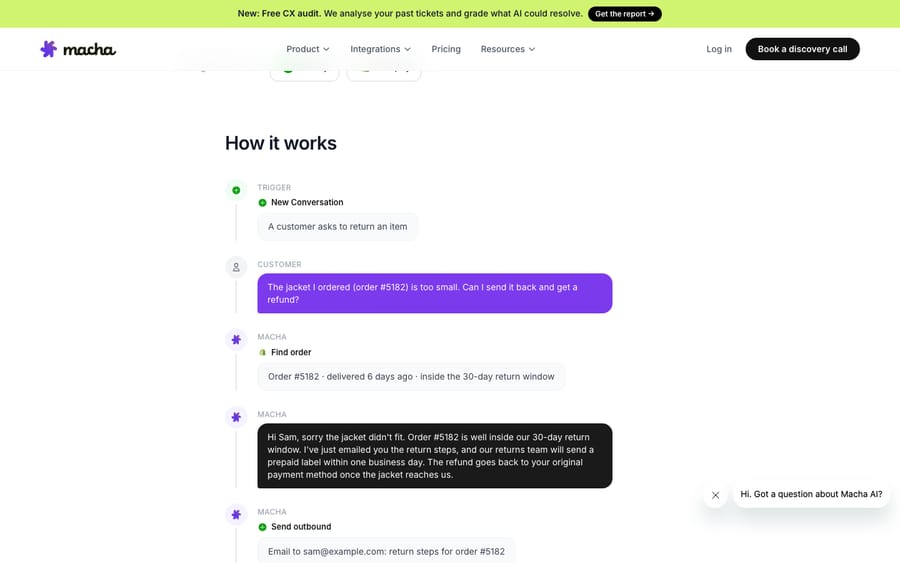
On Gladly, Macha connects with an API token and works the full conversation:
- reads the conversation, its messages and the customer profile, including custom attributes;
- replies on the customer's channel, or drafts the reply as an internal note for review (safe mode);
- adds Gladly topics, changes status, and reassigns to an agent or inbox;
- sends outbound messages to existing customers on email, SMS or chat;
- starts automatically on a new conversation or a new customer message;
- looks up orders in Shopify and payments in Stripe through Macha's other connectors.
For the mechanics on Gladly, see how Gladly internal notes work, what the Gladly API exposes, and how to automate order status in Gladly.
Two common jobs are routing Gladly conversations to the right inbox and triaging return and refund requests.
Macha's meter is different from both vendors above. It charges about $0.40 per ticket: one thread with one person is one charge, however many replies it takes, and a handoff costs the same as a resolution. That price includes setup and a dedicated success manager who handles your changes. The Macha team analyzes your past conversations, builds the knowledge base and the agent, and runs it in safe mode until the drafts are right, on the trial and every plan; the trial is $50 of free usage (about 125 tickets), no credit card, no time limit. See done for you and Macha on Gladly.
Macha suits a Gladly team that wants an AI agent without signing a second AI contract with Gladly, or that wants the AI set up and managed for it.
Common questions
Is Gladly or Kustomer cheaper?
Neither publishes a seat price, so the seat comparison happens in a sales call. On AI, Kustomer's $0.75 per engaged conversation is cheaper than Gladly's published $1.50 per resolution and $0.25 per assist once the AI resolves more than 40% of the conversations it touches, and dearer below that.
What's the difference between Gladly and Kustomer?
Both organize support around the customer, not the ticket. Gladly leans on native voice, SMS and commerce AI that sells in the chat. Kustomer leans on a CRM-style data platform with custom objects, more social channels including TikTok Shop, and per-conversation AI pricing.
What is Kustomer Concierge?
Concierge is Kustomer's customer-facing AI agent. Kustomer's comprehensive pricing page lists it at $0.75 per engaged conversation, billed whether the AI resolves the conversation or hands it to a person.
What is Gladly Sidekick called now?
Gladly's help center carries a banner saying "Sidekick is now called Gladly (AI)" and "Gladly Hero (the Platform) is now Gladly Team." Older comparison posts still use the old names.
Can Macha run on Kustomer?
No. Macha runs on Gladly and the other help desks on its integrations list, but not on Kustomer. On Kustomer, use Concierge.
How we researched this
We checked every price on 21 November 2026 on the vendor's own pages: Kustomer pricing, Kustomer comprehensive pricing details, Gladly pricing (no prices), Gladly on the Shopify App Store, and Gladly's help center pages on billable conversations, voice and SMS costs and channels. Gladly's seat estimate comes from eesel's Gladly pricing post, citing Hiver and smbguide, and is labeled approximate. Gladly's conversion and cart figures are vendor-reported on gladly.ai. G2 ratings and Gladly's implementation, ROI and discount averages come from G2's Gladly and Kustomer listings, read through Wayback Machine copies saved on 21 November 2026 because G2 blocks automated requests. Gladly's billing and features overview pages and Kustomer's Gladly comparison page were also read that day.
The break-even table is our own arithmetic on the two published AI rates, not a customer's bill. Macha's Gladly capabilities come from Macha's own connector (the screen above) and its integration listing; we didn't run a live Gladly conversation for this post.
To try Macha inside your Gladly account, start a trial or see pricing.