
 Shopify
 Stripe
 Slack
Slack Notion
 Google Workspace
 Confluence

What Are the Most Common Gorgias Complaints? (2026 Fixes)


The most common Gorgias complaint is the bill: per-ticket overages of $0.40 or $0.36 and AI Agent resolutions that carry both a ticket fee and an automation fee. The other headaches are a Shopify-first feature set, configuration breakage and cancellation friction, and each has a practical fix.
Key takeaways
- The most common Gorgias complaint is billing: each ticket past the monthly allowance costs $0.40 on Starter and Basic and $0.36 on Pro and Advanced.
- Gorgias charges both a ticket fee and an automation fee when AI Agent resolves a ticket entirely without human intervention, according to its own Help Center.
- Gorgias AI Agent interactions cost $1.00 each on Starter, $0.90 on Basic and Pro and $0.85 on Advanced, then $1.50 each past the plan's bundle.
- Gorgias holds a Trustpilot TrustScore of 2.1 from 152 reviews but rates 4.3 from 705 reviews on the Shopify App Store.
- Gorgias supports Shopify and WooCommerce on every plan, while BigCommerce requires Basic or above and Magento requires Pro or above.

The most common Gorgias complaint is billing: Gorgias charges per ticket, so a busy month runs past the plan allowance and every extra ticket costs $0.40 on Starter and Basic or $0.36 on Pro and Advanced (gorgias.com/pricing, checked 24 September 2026). The other recurring complaints are AI Agent resolutions that carry both a ticket fee and an automation fee, a Shopify-first feature set, day-to-day configuration breakage, and sales or cancellation friction. On Trustpilot, Gorgias holds a TrustScore of 2.1 from 152 reviews, with 37% at one star; on the Shopify App Store it rates 4.3 from 705 reviews.
| Complaint | What drives it | First fix |
|---|---|---|
| Overage bills | $0.40 or $0.36 per ticket past the monthly allowance | Model peak volume before picking a tier |
| AI double charge | A ticket AI Agent resolves alone carries a ticket fee and an automation fee | Price both fees at your real volume |
| Shopify dependency | The best in-ticket actions are built for Shopify | Check your platform's plan requirements |
| Tickets, syncs or rules breaking | Mostly configuration | Use the fix guides below |
| Sales pressure and cancellation | Trial outreach, surprise invoices | Get terms in writing |
Why do Gorgias bills come in higher than expected?
If you read only one section, read this. The most-cited Gorgias complaint has nothing to do with features and everything to do with the bill arriving bigger than the pricing page implied.
The root cause is the model. Gorgias charges per ticket, not per seat. That's a real advantage, and one Capterra reviewer notes that "charging per ticket instead of per user allowed nearly everyone in our company to use it freely without worrying about seat limits." It also means your cost tracks your volume, and volume spikes. Gorgias's helpdesk plans on monthly billing are Starter at $10 for 50 tickets, Basic at $60 for 300, Pro at $360 for 2,000 and Advanced at $900 for 5,000. Go past the allowance and you pay $0.40 per extra ticket on Starter and Basic, $0.36 on Pro and Advanced. Do the arithmetic for a Basic account that gets 1,500 tickets in November: 1,200 extra tickets at $0.40 is $480 on top of the $60 plan. That's why merchants describe peak-season bills that are several times their normal month.
The sharper complaint is about AI double-billing, and Gorgias states the rule itself: "An automation fee and a ticket fee may apply to the same ticket only when the ticket is entirely resolved by AI Agent, without human intervention" (Gorgias Help Center). AI Agent is now included on every plan, with a bundle of automated interactions priced at $1.00 each on Starter, $0.90 on Basic and Pro and $0.85 on Advanced, then $1.50 per automated interaction past the bundle. Pro with AI Agent, for example, is $550 a month for 2,000 tickets and 190 automated interactions. So a ticket the AI fully resolves carries two charges, stacked. That's the part that catches people out, and it's why some brands run clean AI test chats, like the results, and then open a cancellation once they see the billing page. The incentive is plain: a vendor that bills per ticket and per resolution earns more on both sides of every automated conversation.
How to handle it:
- Model the arithmetic at your volume, not the demo's. Take your real monthly ticket count, add an expected peak-season spike, and price both the ticket fees and the AI automation fees on top. Our Gorgias pricing explained breakdown walks the plan tiers and overage math.
- Filter out junk before it becomes a billable ticket. Auto-responders and spam that hit your inbox can each count as a ticket. Tighten rules and email routing so bots and no-reply noise don't run up the meter.
- Watch your usage dashboard, not just your inbox. Set a threshold and check ticket volume weekly during peak, so an overage is a decision you made rather than a surprise you discovered.
Does Gorgias work well if you're not on Shopify?
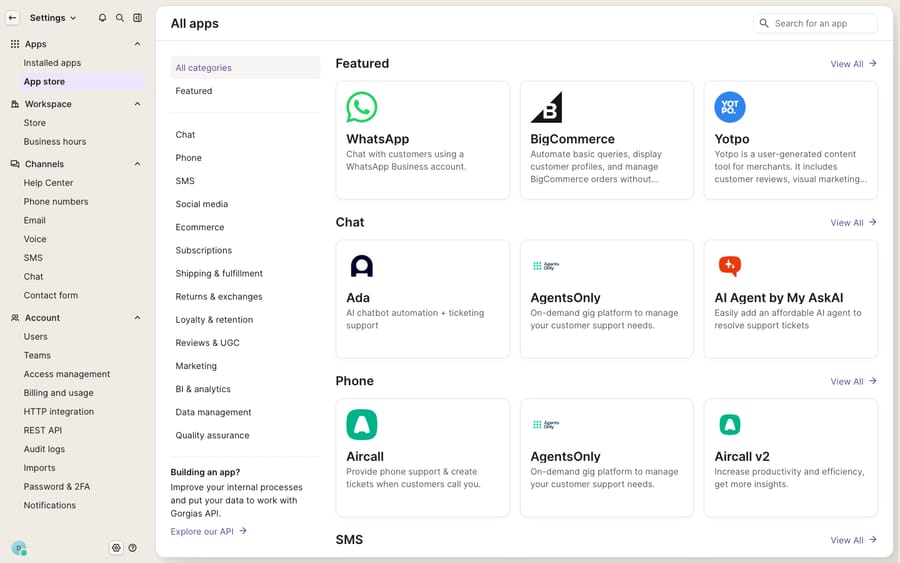
Gorgias's headline strength is also, for some merchants, its biggest limitation. The Shopify integration is excellent: you can view orders, issue refunds and edit orders without leaving the ticket, and reviewers who run Shopify stores rate it highly. That in-ticket ecommerce workflow is what makes Gorgias what it is and why it wins for DTC brands.
The flip side shows up on Capterra: the marketing leans heavily on Shopify, and many promoted features are Shopify-first. The pricing page makes the gating concrete. Shopify and WooCommerce work on every plan, BigCommerce needs Basic or above, and Magento needs Pro or above. On a headless stack or a marketplace-heavy setup, Gorgias still runs well as a help desk, but the out-of-the-box order actions are thinner than the demo suggests. That's positioning, not a bug, and worth knowing before you buy. If you're Shopify-native, most of this concern goes away; see Gorgias for Shopify for what that integration actually does.
What breaks day to day in Gorgias, and where are the fixes?
Day to day, the complaints cluster around reliability at scale and a few missing conveniences rather than outright breakage. The rules and automation builder gets cluttered once you have a lot of them, and reviewers ask for saved filtered inbox views (like "oldest first"). Gorgias does ship an iOS and Android app, though reviewers treat it as a way to answer on the go rather than to run the whole inbox. On top of that, the usual operational headaches (tickets not appearing, orders not syncing, rules that quietly stop firing) are common enough that Gorgias and the community have well-worn fixes.
Rather than restate all of them, here's the roundup. Jump to the guide for whatever is broken:
| Symptom | Likely cause | Fix guide |
|---|---|---|
| Emails arrive but no ticket is created | Forwarding / channel connection / spam rules | Gorgias not creating tickets from emails |
| Shopify order data missing on a ticket | Integration re-auth / customer email mismatch | Gorgias Shopify orders not syncing |
| Automations stopped firing | Rule order / conditions / trigger scope | Gorgias rules not triggering |
| Reporting numbers look wrong | Timezone, business hours, ticket-vs-message counting | Gorgias stats showing wrong numbers |
| CSAT surveys never reach customers | Survey trigger / channel / send conditions | Gorgias CSAT survey not sending |
Most of these are configuration issues, not platform failures. They still cost real hours, and knowing the fix ahead of time is the difference between a five-minute correction and a bad afternoon.
Why is Gorgias rated so low on Trustpilot?
Sales pressure and cancellation friction are what drive the Trustpilot score down. A recurring theme in the low-star reviews is aggressive sales outreach during trials and evaluations, and cancellations that felt harder than they should have been: surprise or "uninformed" billing, and difficulty getting a bill wound down after a spike. One reviewer's warning is blunt: "Be cautious for unexpected/uninformed billings." Trustpilot's sample is small (152 reviews against 705 on the Shopify App Store) and skews toward people who came to vent, which is how the same product sits at 2.1 in one place and 4.3 in another.
How to handle it: get commitments in writing before you sign. Confirm your ticket allowance, your exact overage rate, how AI Agent resolutions are billed, and your cancellation and downgrade terms, in email and not just on a call. Note that Starter is monthly billing only, while the other plans offer an annual discount that also locks you in. If you're mid-contract and staring at an overage, contact support early rather than after the invoice; adjustments are easier to negotiate before the billing cycle closes.
Who is Gorgias a good fit for?
Strip away the noise and the picture is fair. Gorgias is an excellent ecommerce help desk with a pricing model that punishes anyone who doesn't model it carefully.
| If you are… | Gorgias is… |
|---|---|
| A Shopify DTC brand with steady volume and a whole team in the inbox | A strong fit: per-ticket pricing and deep Shopify actions shine |
| A high-volume brand with big seasonal spikes | Workable, but budget for overages and watch usage closely |
| Heavily reliant on AI automation to cut costs | Do the double-billing math first: the AI fee stacks on the ticket fee |
| Not on Shopify | Usable, but check plan gating for BigCommerce and Magento |
| Extremely price-sensitive or tiny (1–2 agents) | Starter at $10 is cheap, but 50 tickets runs out fast |
For a fuller feature-by-feature take, our Gorgias review goes deeper. The short version: the complaints are real, but most of them are predictable and manageable if you go in with eyes open on cost.
Can you add AI to Gorgias without per-resolution billing?
This touches the loudest complaint. Much of the billing anxiety comes from AI resolutions being charged per resolution on top of the ticket fee, so the more the AI helps, the more the meter runs in a way that's hard to forecast.
An AI agent layer that sits on top of Gorgias changes that arithmetic. Macha is one such layer: it connects to the Gorgias you already use as a native connector (it does not replace your help desk) and runs agents that read tickets, look up order or account status through a custom tool, and draft or send grounded replies. The category of AI agents for customer service exists to do that reasoning-heavy work, and Macha's AI agent for Gorgias approach bills per ticket, not per resolution: one conversation, charged once however many messages it takes, so the bill never hangs on an outcome definition you don't control. Keep Gorgias as your system of record for tickets and Shopify actions and layer agents on top for the answering. Macha runs on Zendesk, Freshdesk, Gorgias, Front, HubSpot or Intercom. Pricing starts at $299 a month for 750 tickets, with setup and monitoring by the Macha team included; the pricing page has the tiers.
FAQ
Why is Gorgias highly rated on the Shopify App Store but poorly rated on Trustpilot? Different audiences. The Shopify App Store collects reviews from installed merchants and sits at 4.3 from 705 reviews. Trustpilot skews toward people motivated to complain, usually about billing, overages or cancellation, which puts it at 2.1 from 152 reviews. Both are true at once.
What causes surprise Gorgias bills? Two things. First, overage fees of $0.40 per ticket on Starter and Basic, or $0.36 on Pro and Advanced, once you pass your plan's monthly allowance, which spike during peak season. Second, AI Agent resolutions that carry both a ticket fee and an automation fee, with automated interactions past your bundle at $1.50 each. Model both at your real volume before committing.
Do I have to use Shopify to get value from Gorgias? No, but the best features are Shopify-first. On Shopify you get order lookups, refunds and edits inside the ticket. Off Shopify, Gorgias still works as an omnichannel help desk, and BigCommerce and Magento are supported from Basic and Pro respectively.
My tickets, syncs, or rules broke. Where do I start? Use the roundup table above. Most issues (no ticket from an email, missing Shopify data, rules not firing, wrong stats, CSAT not sending) are configuration problems with documented fixes, each covered in a dedicated guide.
Can I add AI to Gorgias without the per-resolution billing model? An AI agent layer like Macha connects to Gorgias as a native connector and runs on top of your existing help desk. It bills per ticket (one conversation, charged once however many messages it takes) rather than per resolution, while Gorgias stays your system of record.
Want AI that resolves routine tickets without a per-resolution meter running? Start a free trial of Macha and connect it to your Gorgias.