


 Intercom
 Shopify
 Stripe
 Slack
Slack Notion
 Google Workspace
 Confluence

Is Tidio Worth It? Tidio Review (2026) With Real Prices and Limits


Tidio scores 26 out of 30 on our rubric, with strong built-in AI and a low entry price, but light ticketing and a bill that climbs faster than buyers expect. Its three public ratings disagree too: 4.8 on the Shopify App Store, 4.6 on G2 and 3.7 on Trustpilot.
Key takeaways
- Tidio scores 26 out of 30 on the published rubric, tying Zendesk and ranking above Crisp, Intercom, Chatwoot, tawk.to and LiveChat in this comparison.
- Tidio's Free plan allows 50 billable conversations a month, but caps Flows automation at 100 unique visitors and grants only 50 Lyro AI conversations as a one-off, not monthly.
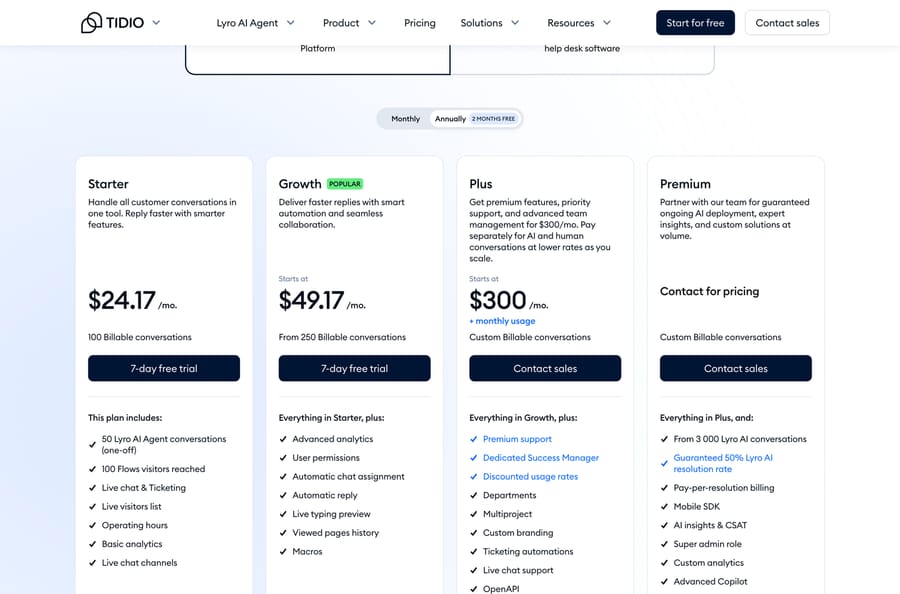
- Tidio's paid plans start at Starter for $24.17 a month for 100 billable conversations, rising to Growth from $49.17 and Plus from $300 a month.
- Tidio's Premium tier guarantees a 50% Lyro AI resolution rate with pay-per-resolution billing from 3,000 Lyro conversations, a rare written guarantee on a published plan.
- On G2, 76 reviews of Tidio are tagged Expensive and 56 more Cost, out of 1,962 total ratings, making price the most common complaint.

Tidio scores 26 out of 30 on our published rubric, with a Free plan for 50 billable conversations a month and paid plans from $24.17 a month. It is the strongest like-for-like swap in the small-business live chat category, because the AI agent is part of the same product, not a sibling you buy separately, and because it prices on conversations instead of seats. It loses points on ticketing depth, and the single most common complaint about it, visible in 76 G2 reviews tagged Expensive and 56 more tagged Cost, is that the bill climbs faster than people expect. It suits stores and small SaaS teams under about ten agents. It is the wrong fit if you need a real ticket queue with SLAs behind the chat.
Macha publishes this page. Macha is not a live chat platform, Tidio is not a Macha integration, and Macha is not scored here; it appears once, in a clearly marked section near the end. Every Tidio price and quota below was read on Tidio's own live page, forced to the US region, on 22 September 2026, and rechecked on 24 September 2026.
What does Tidio cost in 2026?
| What it is | Live chat, email and social in one inbox, with a built-in AI agent (Lyro) and a visual automation builder (Flows) |
| Billed on | Billable conversations, not agent seats |
| Entry price | Free for 50 billable conversations a month; Starter $24.17/mo for 100 |
| AI | Lyro, sold as a conversation quota, with pay-per-resolution on the top tier |
| Channels | Web chat, email, Facebook Messenger, Instagram, WhatsApp |
| Trial | 7 days, no credit card; the account drops to Free afterwards unless you upgrade |
| Ratings | G2 4.6 (1,962) · Shopify App Store 4.8 (1,341) · Trustpilot 3.7 (225) |
| Company | TIDIO LLC, 1301 Sansome Street, San Francisco; Trustpilot contact details in Szczecin, Poland; Shopify listing launched 14 July 2014 |
A summary of the plans, with the caveat that the full tier-by-tier breakdown belongs in a pricing post:
| Plan | Price | What you get |
|---|---|---|
| Free | $0 | 50 billable conversations a month, up to 10 seats, live chat and ticketing |
| Starter | $24.17/mo | 100 billable conversations, 50 Lyro conversations (one-off), 100 Flows visitors |
| Growth | from $49.17/mo | From 250 billable conversations, advanced analytics, automatic assignment, macros |
| Plus | from $300/mo | Custom volume plus usage, departments, multiproject, custom branding, OpenAPI |
| Premium | by quote | From 3,000 Lyro conversations, a guaranteed 50% Lyro resolution rate, pay-per-resolution billing |
Annual billing is badged two months free. Every paid plan carries a 7-day trial, half the 14 days Intercom gives. When the trial ends, Tidio moves the account back to the Free plan unless you upgrade.
Why do Tidio's three ratings disagree?
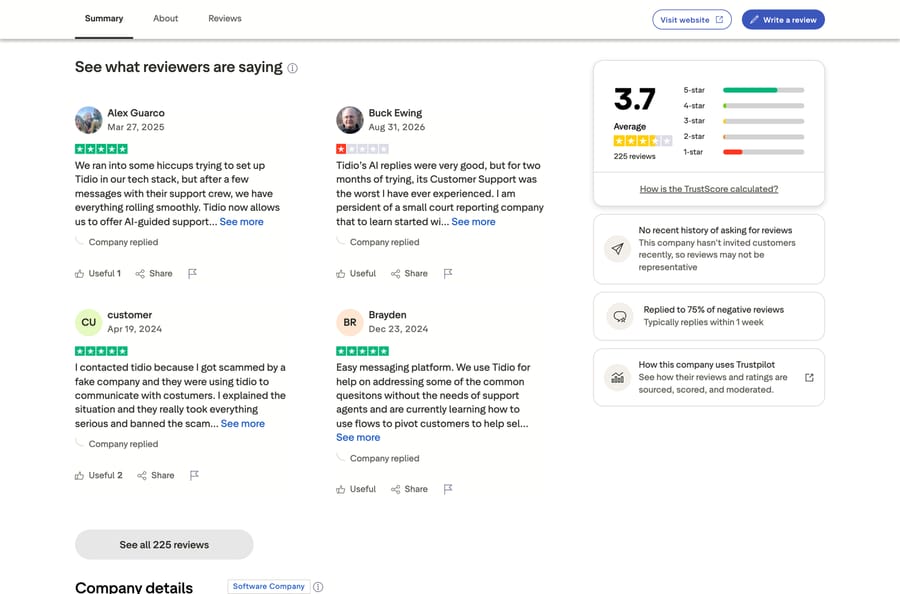
The gap between 4.8 and 3.7 is not noise, and it is worth understanding before you weight any of them.
The Shopify App Store's 4.8 from 1,341 reviews is the most positive and the most self-selecting. These are merchants who installed Tidio inside Shopify, where the AI can read an order and act on it, and who are reviewing an app, not a company. The distribution is visible on the listing, and the low end is small but real: 50 one-star reviews and 24 two-star.
G2's 4.6 from 1,962 ratings is the biggest sample and the most useful for a buyer. Its automatically generated tag counts show what people praise and what they complain about. Positives: Ease of Use 221, Helpful 179, Easy Setup 149, Chatbots 149, Features 139. Negatives: Expensive 76, Limited Customization 57, Cost 56, Missing Features 55, Limited Features 51. Cost is not one complaint among several; on the two tags that mean the same thing, it is the complaint.
Trustpilot's 3.7 from 225 is the harshest and the smallest, and Trustpilot itself publishes three caveats on the page: "No recent history of asking for reviews", with the note that Tidio "hasn't invited customers recently, so reviews may not be representative", "Replied to 75% of negative reviews", and "Typically replies within 1 week". Unsolicited review sites skew negative because happy users rarely volunteer, so read 3.7 as a floor, not a verdict. The response rate is a genuine point in Tidio's favor.
Worth naming the incentive here, because it shapes all three numbers: an app store rewards a vendor for being easy to install, a review platform with vendor-invited reviews rewards being easy to like, and an unsolicited platform collects the people who wanted their money back. None of the three is lying. They are measuring different moments.
Which Tidio limits cause surprise bills?
This is where most of the Expensive tags come from, and it is a genuine documentation problem rather than a pricing trick. Tidio's Free plan has three separate caps and they are not the same number.
- 50 billable conversations a month. This is the plan's actual conversation allowance, and it resets monthly.
- 100 unique visitors a month for Flows. This caps the automation builder, not the inbox. A Flow that greets visitors stops greeting them at 100 unique people, whatever your conversation count says.
- 50 Lyro AI Agent conversations, one-off. This is Lyro's own free allowance and it is a lifetime grant, not a monthly one. It is the single most misread number in the product: people budget it as recurring, it does not recur, and the next month's bill is a surprise.
A fourth thing catches Starter users: Starter's 100 billable conversations include those 50 one-off Lyro conversations, not 50 more each month. If you want Lyro running continuously you buy a Lyro quota, which starts at $32.50 a month for 50 conversations as an add-on.
To Tidio's credit, the Shopify listing states the mitigation plainly: "Capped AI usage: Lyro pauses at your limit, so bills never surprise you." Agents pausing at a limit is the right design, and it is worth knowing that is what happens instead of an overage.
Are Tidio's Shopify plans the same as its website plans?
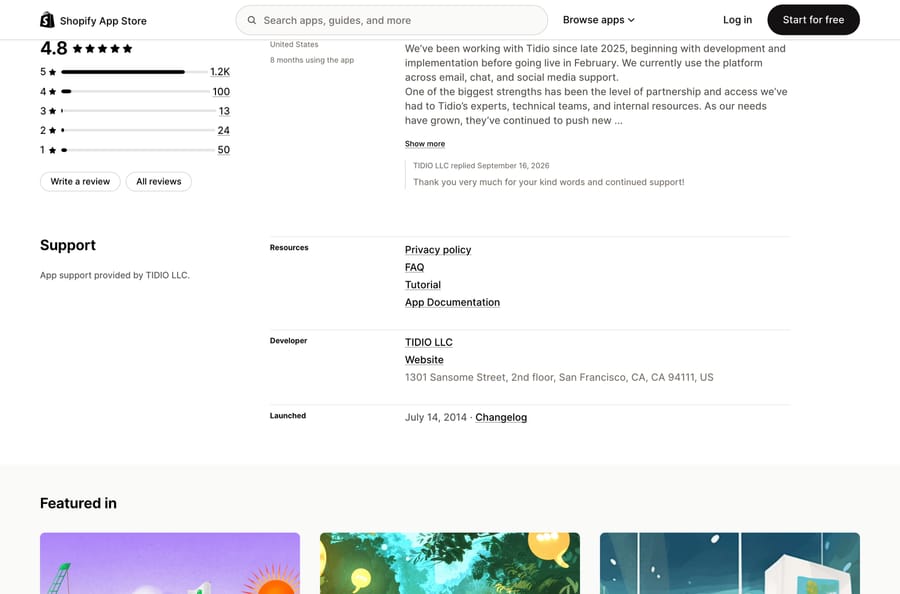
This is the most practical thing in this review and almost nobody writes it down. Tidio sells through two storefronts and the plan shapes are different.
| tidio.com | Shopify App Store | |
|---|---|---|
| Entry paid plan | Starter $24.17/mo (100 conversations) | Customer Service $29/mo or $290/yr |
| Mid tier | Growth from $49.17/mo (from 250) | "250 - 1000 conversations for $59" |
| Automation | Bundled into the plan tiers | Flows sold separately, $29/mo or $290/yr, up to 40k visitors |
| AI agent | Lyro quota bought on top | Lyro AI Chatbot $39/mo or $390/yr, up to 200 Lyro conversations |
| Annual saving | Badged two months free | Badged 17% |
If you are a Shopify merchant, price both. The Shopify route unbundles Flows and Lyro into separate subscriptions, which is more expensive if you want all three and cheaper if you only want one. The Shopify listing also carries capabilities the main pricing page does not spell out, including Lyro Actions for refunds and order edits in Shopify or through your own API.
What does Lyro, Tidio's AI agent, actually do?
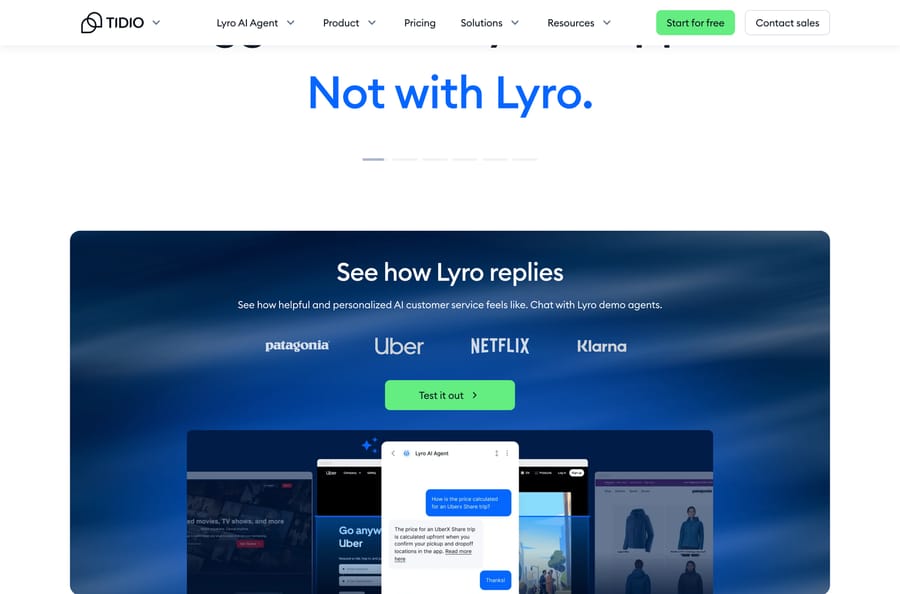
Lyro is the reason to choose Tidio over a cheaper chat widget, so it deserves a straight description.
It answers customer questions from your own content, which you point it at by scraping your site or uploading material. On Shopify it can also act: order status, refunds, cancellations and order edits, within rules you set, and it can do the same through your own API elsewhere. It sells as well as supports, starting conversations on product pages and adding to cart. Tidio publishes a set of public demo agents built on Patagonia, Uber, Netflix and Klarna content so you can try the replies before signing up, which is more honest than most vendor demos.
The number that matters most is on the Premium tier: a guaranteed 50% Lyro AI resolution rate with pay-per-resolution billing from 3,000 Lyro conversations. A vendor writing a resolution-rate guarantee into a published plan is rare, and it is the strongest single signal in Tidio's favor. It is also only available at the top of the price list, so most readers of this page will not get it. Elsewhere on the same page Tidio markets Lyro as solving "up to 67% of customer problems"; that is a ceiling in marketing copy, not the guarantee, and the guarantee is the number to plan around.
What do Tidio users actually say?
Three dated, attributed quotes, chosen to cover the positive, the mixed and the negative.
The negative, and the one that recurs. Buck Ewing, in a one-star Trustpilot review dated 31 August 2026: "Tidio's AI replies were very good, but for two months of trying, its Customer Support was the worst I have ever experienced." That shape, where the product works and the support around it did not, appears more than once in the one-star band.
The cost complaint, verbatim. Mathew B., a Warehouse Specialist at a company of fifty or fewer people, reviewing on G2 on 9 December 2024 at 3 out of 5: "The cost is way too high, and they make you pay for multiple packages that really should be included in one. Overall, it feels very overpriced." Tidio replied publicly to that review, which is consistent with its 75% negative-response rate on Trustpilot.
The mixed, from a recent technical buyer. Ibrahim C., a CTO at a small business, on G2 on 8 September 2026 at 4 out of 5, praised having live chat and email in one place and being able to transfer tickets between agents, then said: "The UI windows are often too small or crowded and need to be able to be customized to the business need."
How did we score Tidio?
We score every chat platform we cover on the same six criteria, so the numbers mean something across pages and not just within one. Each is scored 0 to 5, for a maximum of 30, and a product needs 18 out of 30, or 60%, for us to recommend it at all.
| Criterion | 5 points | 0 points | Tidio |
|---|---|---|---|
| Published pricing | Every plan and AI rate on the vendor's own page, in dollars | Nothing public | 4 |
| Entry cost | A free plan with real volume, or under $20 a seat | Over $100 a month minimum | 5 |
| Channels beyond the widget | Email, social, WhatsApp and messaging, voice | Website chat only | 4 |
| AI that answers customers | Built in, with a rate or quota you can calculate | No AI a customer ever talks to | 5 |
| Independent review base | 1,000 or more G2 ratings | None | 5 |
| Ticketing behind the chat | Chats become tracked tickets with assignment and SLAs | Transcripts only | 3 |
| Total | 26/30 |
Why 4 and not 5 for published pricing. Every number is on the page, but the three quota limits above are spread across a plan card, a footnote and an FAQ, and the Shopify storefront publishes a different plan shape again. A reader who prices this in five minutes will price it wrong.
Why 3 for ticketing. Tidio has ticketing, and it is genuinely useful for a small team: tickets exist, they can be assigned, and Growth adds automatic chat assignment and macros. What it does not have is the SLA machinery, routing rules and reporting depth of a help desk. Ticketing automations arrive on Plus at $300 a month.
Why 5 for AI. Lyro is part of the same product, priced as a quota you can count, with a published resolution-rate guarantee at the top tier. Only Intercom's Fin has a clearer unit bill in this category, at $0.99 per outcome on top of Intercom seats that start at $29 a seat billed annually.
How does Tidio compare with Crisp, Intercom and Zendesk?
Same rubric, same scores as our live chat roundup, so the two pages cannot disagree.
| Platform | Entry price | AI billing | Score |
|---|---|---|---|
| Zendesk | $55 per agent/mo annual | Per automated resolution; $1.50 committed on Zendesk's pricing page | 26/30 |
| Tidio | Free for 50 chats; $24.17/mo | Lyro quota; pay-per-resolution on Premium | 26/30 |
| Crisp | Free for 2 seats; $45/mo per workspace | AI credits in dollars | 25/30 |
| Intercom | $29 per seat/mo annual | $0.99 per Fin outcome | 25/30 |
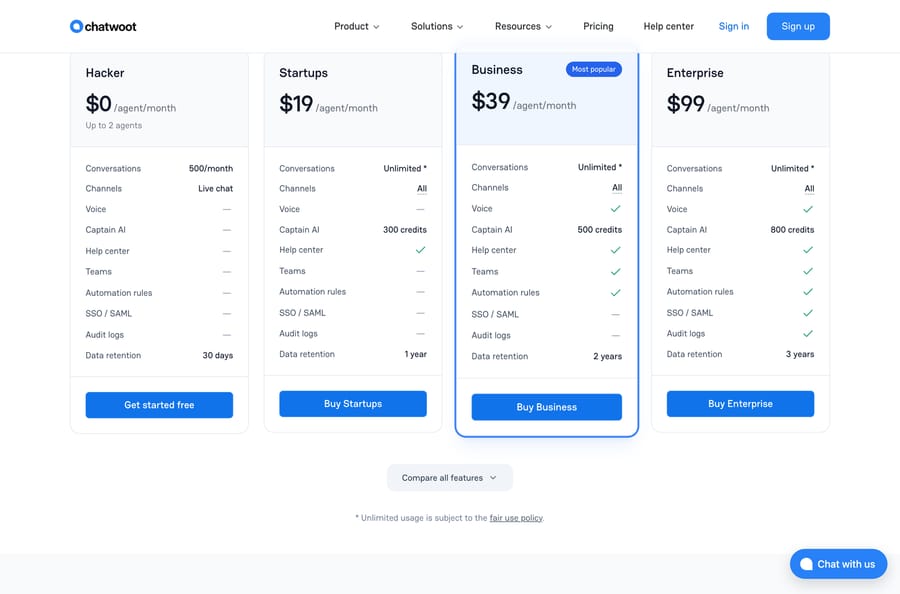
| Chatwoot | Free for 2 agents; $19 per agent/mo | Captain AI credits | 23/30 |
| tawk.to | Free forever, unlimited agents | AI Assist $29/mo | 22/30 |
| LiveChat | $19 per person/mo annual | Sold as separate Text products | 18/30 |
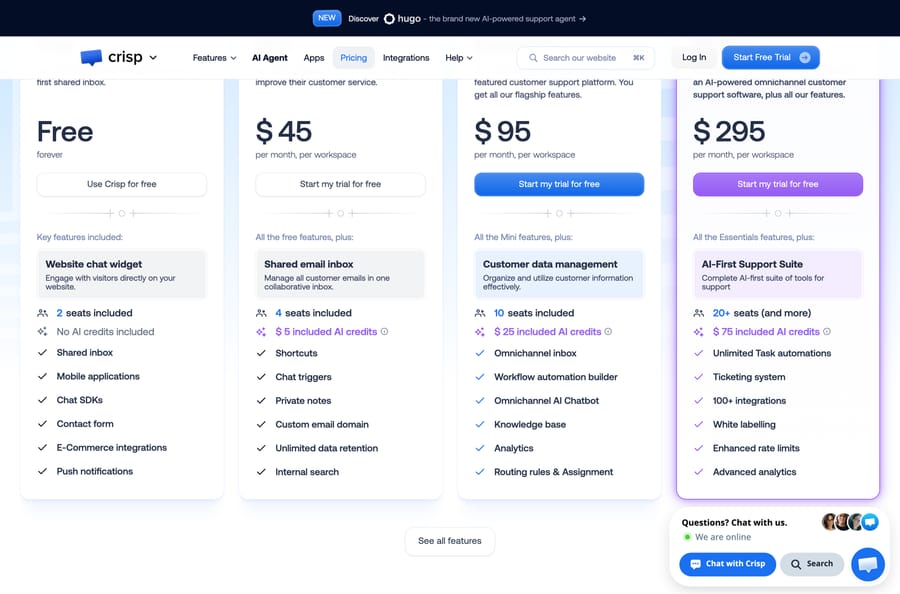
Against Crisp. Crisp charges per workspace with seats included, so a five-person team pays $95 flat at Essentials against Tidio's conversation-based bill. Crisp wins if your team is growing and your chat volume is not. Tidio wins if the reverse is true, and its AI is considerably more developed. Our Crisp alternatives page has more.
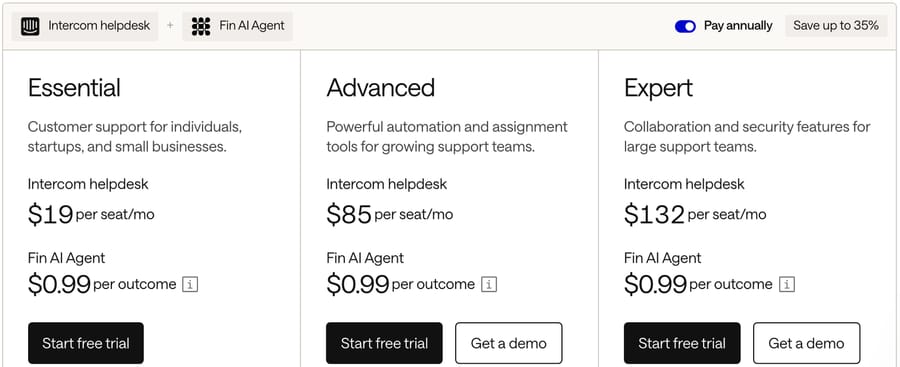
Against Intercom. Fin has the cleanest AI bill in the category at $0.99 per outcome, and Intercom's ticketing is a real help desk rather than a light one. It is also billed per seat, $29 a seat billed annually on Essential and $85 on Advanced (Intercom has also shown $19 for Essential in a pricing test), so a five-person team pays for five seats before Fin answers anything. The 50-outcome monthly minimum applies only when Fin runs on a help desk other than Intercom. Salesforce completed its acquisition of Fin on 10 September 2026. Our Fin explainer and cheaper Intercom alternatives cover that fork.
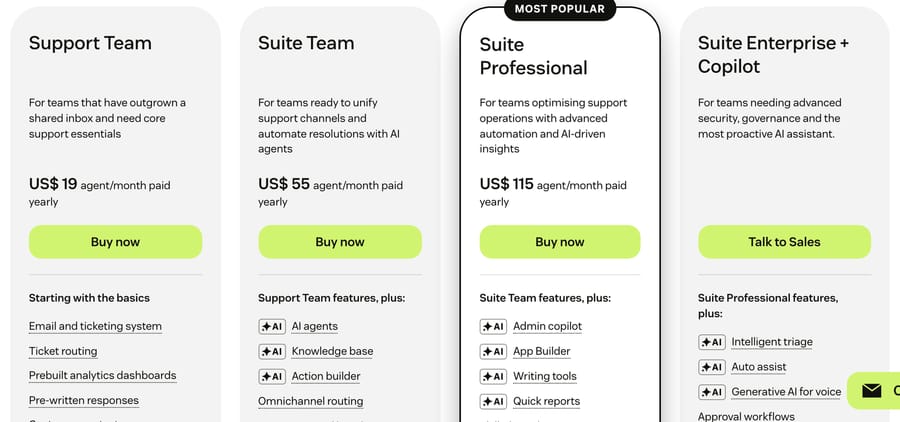
Against Zendesk. Zendesk ties Tidio at 26 and gets there completely differently: a huge review base, every channel including voice, real SLAs, and a $55 seat before the AI agents, which Zendesk bills per automated resolution at $1.50 committed and $2.00 pay-as-you-go, the rates on its pricing page. If chat is one channel among five, Zendesk. If chat is the channel, Tidio. Our Zendesk AI pricing breakdown does the arithmetic.
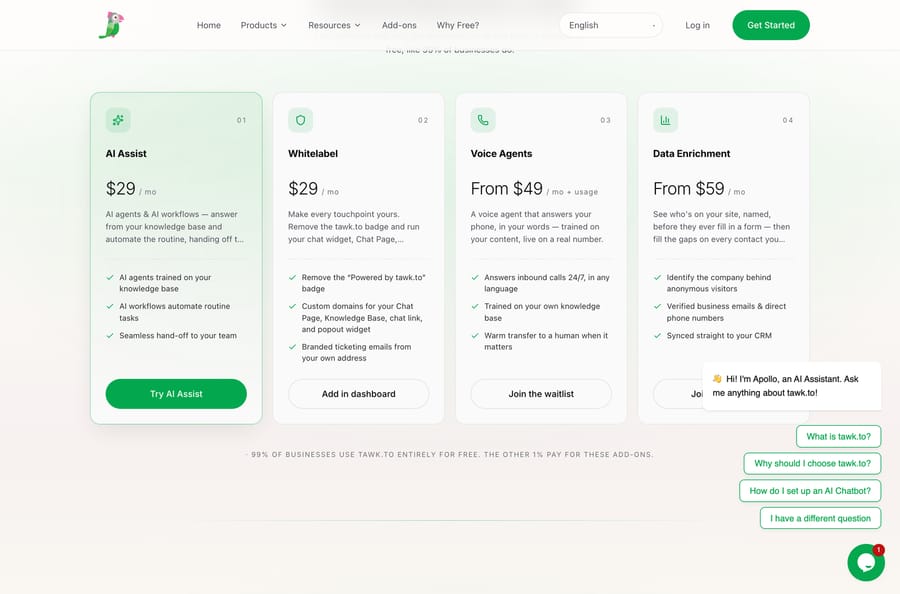
Against tawk.to and Chatwoot. tawk.to is free forever with unlimited agents and free ticketing, and its AI is a $29-a-month add-on rather than an agent built into the product. Chatwoot publishes $0, $19, $39 and $99 per agent, covers every channel from its $19 tier and can be self-hosted, but has sixteen G2 ratings. Both are the right answer when budget or control outranks AI capability. Our Chatwoot explainer and free help desk roundup cover that branch.
Our full Tidio alternatives roundup goes wider if you have already decided to leave.
Who should buy Tidio, and who should skip it?
Buy it if: you run a Shopify store or a small SaaS product, your support is mostly chat with some email, you have fewer than about ten agents, and you want an AI agent that is part of the product rather than a second subscription. The free tier is genuinely usable for evaluating it, and Lyro's public demo agents let you judge the reply quality before you sign up.
Think twice if: your conversation volume is spiky. Conversation-based pricing punishes a month where volume triples, and the three quota limits above make it hard to predict. Price the Plus tier before you assume Growth will hold.
Skip it if: you need SLAs, routing rules, approval flows or deep reporting behind the chat. That is a help desk, and Tidio scores 3 on that criterion for good reason. Skip it too if you need voice, which it does not have at all, or if your team is large enough that a per-seat product works out cheaper.
What if your help desk is fine and only the AI disappoints?
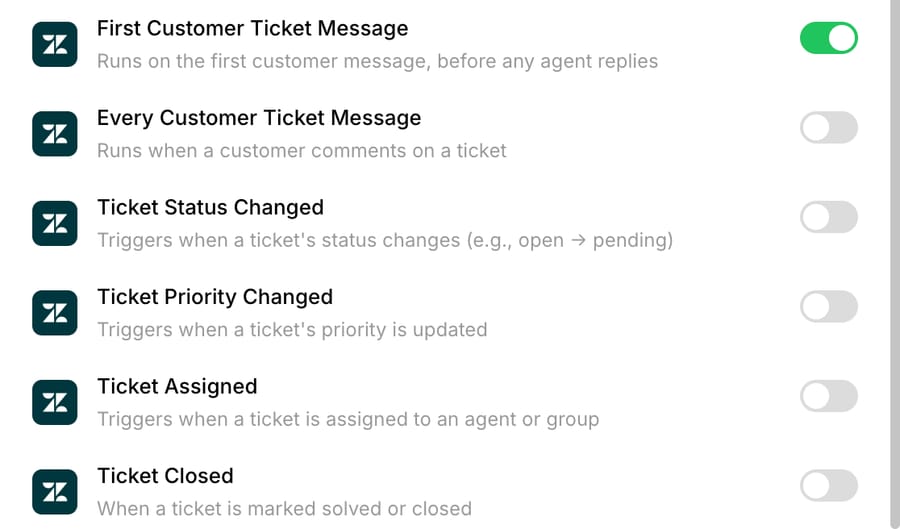
One more option that isn't on the list, and it needs saying plainly because it's the one we sell. If you already run a help desk and the only frustration is the AI attached to it, you can add an agent layer instead of switching platforms. That's what Macha is: an AI agent layer that runs on top of the help desk a team already uses, never a replacement for it. Every agent you build is set by you to reply to the customer, write an internal note for a human, or only change fields on the ticket. It's priced on monthly ticket volume, from $299 a month for 750 tickets, about $0.40 a ticket at every tier, with setup and monitoring by our team included on every plan. A ticket is one thread with one person, charged once however many replies it takes. Full detail is on our pricing page.
Where it falls short, in the same terms as everything above: Macha does not connect to Tidio, so this is not an upgrade path from the product this page reviews. It runs on Zendesk, Freshdesk, Gorgias and Front, and on Intercom and HubSpot; the current list is on our integrations page. It also has no independent review base at all, zero G2 ratings as of 22 September 2026, no voice channel, and an agent does what its instructions say, so vague instructions make a vague agent. At $299 a month it starts well above Tidio's $24.17, and for a small store Tidio is the better buy. Our piece on adding an AI layer instead of rip-and-replace makes the case where it does apply.
How we researched this
We checked every price and quota on tidio.com/pricing/ and on the Shopify App Store listing on 22 September 2026 and rechecked both on 24 September 2026, in a real browser forced to the US region: US locale, New York timezone, English-US headers and the MaxMind geoip lookup stubbed. Every figure printed here starts with a dollar sign on the page it came from. We captured the pricing page, the Lyro product page, the Shopify listing and the Trustpilot summary ourselves.
G2 returns a 403 to every scripted request, so the G2 rating, review count and tag counts were read in a real Chrome session the same day, as were the Trustpilot figures. The Shopify App Store's star distribution rounds its top band to "1.2K", so it does not reconcile to the stated total of 1,341; we print only the two exact low-star counts and never present the distribution as arithmetic. We did not build a production chat widget on Tidio for this review, and we are not quoting benchmark results we did not run. The three quoted reviews are reproduced as written, with the reviewer identification each platform publishes.
Frequently asked questions
Is Tidio good? On our rubric it scores 26 out of 30, which puts it level with Zendesk and above every other small-business chat tool we've scored. It's strongest on AI and entry cost and weakest on ticketing depth. It suits stores and small SaaS teams under about ten agents and is the wrong fit for anyone who needs SLAs and routing behind the chat.
Why does Tidio have 4.8 on Shopify and 3.7 on Trustpilot? Different samples. Shopify reviewers are merchants reviewing an app they chose to install inside a store where the AI can act on orders. Trustpilot collects unsolicited reviews, which skew negative everywhere, and Trustpilot itself notes on the page that Tidio hasn't invited customers recently so its reviews "may not be representative". G2's 4.6 from 1,962 is the largest sample and the most useful of the three.
Is Tidio expensive? It's the most common complaint about it: 76 G2 reviews are tagged Expensive and another 56 Cost, out of 1,962. The entry price is low at $24.17 a month, and the bill climbs when you add Lyro conversation quotas on top of billable conversations, and again if you need the Plus tier at $300 for ticketing automations and custom branding.
How many free conversations does Tidio give you? Three different allowances, and confusing them is why people get a surprise. The Free plan gives 50 billable conversations a month. Flows are separately capped at 100 unique visitors a month. And the 50 free Lyro AI Agent conversations are a one-off grant, not a monthly one.
Does Tidio have a free plan? Yes. It covers 50 billable conversations a month for up to 10 seats, with live chat, ticketing, the mobile app and social media integrations. Paid plans carry a 7-day free trial, which is the shortest in this category.
What is Lyro? Tidio's AI agent. It answers customer questions from your own content, and on Shopify it can also take action on orders, including refunds, cancellations and order edits within rules you set. The Premium tier advertises a guaranteed 50% Lyro resolution rate with pay-per-resolution billing from 3,000 Lyro conversations.
Is Tidio cheaper on Shopify or on tidio.com? It depends what you want. The Shopify App Store sells Customer Service, Flows and the Lyro AI Chatbot as three separate subscriptions at $29, $29 and $39 a month, so buying one is cheaper than the website's bundled tier and buying all three is more expensive. Price both storefronts before you commit.
What are the best Tidio alternatives? Crisp if per-conversation pricing doesn't suit you and you'd rather pay per workspace, Intercom if you want the cleanest AI bill and can pay per seat from $29 a month billed annually, Zendesk if chat is one channel among several, and tawk.to or Chatwoot if budget or self-hosting outranks AI capability.
Is Tidio worth it?
Tidio earns its 26 out of 30. The AI comes with the product, the entry price is genuinely low, the free tier is usable, and the Premium tier does something almost nobody else does by writing a resolution-rate guarantee into a published plan. Against that, the bill is the recurring complaint in its own review base, three separate quota limits make it hard to forecast, the ticketing is light, and the Shopify storefront prices the same product differently from the website.
Read the three quota limits before you buy, price both storefronts if you are on Shopify, and take the free plan far enough to see what Lyro does with your own content. If it turns out you need SLAs and routing behind the chat, you are shopping for a help desk instead, and our roundup of the category is the better starting point. And if you already run a desk and only the AI is the problem, an agent layer on the one you have starts with $50 of free usage and no credit card.
Sources: Tidio pricing · Lyro AI Agent · Tidio on the Shopify App Store · Trustpilot: Tidio · Crisp pricing · Chatwoot pricing · tawk.to add-ons · Zendesk pricing · fin.ai pricing · LiveChat pricing · Macha pricing
Simple per-ticket AI pricing
One thread with one person is one charge, however many replies it takes.