Shopify
 Stripe
 Slack
Slack Notion
 Google Workspace
 Confluence

Common Gorgias Terms Glossary (Rules, Macros, Flows, Views, Tags)


Gorgias is the ecommerce helpdesk a lot of Shopify and BigCommerce brands run their support on, and like any platform it comes with a vocabulary of its own — Rules, Macros, Flows, Views, Tags, and a dozen smaller terms that all sound obvious until you actually have to configure one. This glossary is a plain-English map of that vocabulary: what each term means, where it lives in the app, and how the pieces fit together. One quick disambiguation before we start, because search engines still get confused: this is about the customer support software, not the Socratic dialogue Plato wrote around 380 BC or the Sicilian sophist Gorgias of Leontini who argues with Socrates in it. If you came here for rhetoric, you want a different page. If you came here to make sense of your inbox, read on — and follow the links, because each term below has its own deeper guide.

How Gorgias organizes everything
Most of the automation-related terminology lives in one place: the Workflows area, reached from the dropdown menu in the top-left of the app. Inside Workflows sits a Tools navigation with tabs for Rules, Macros, Ticket assignment, Auto-merge, CSAT, SLAs, and Fields & tags. When someone on your team says "add a rule" or "edit that macro," this is the screen they mean. The screenshot below is that module, with the Rules list open and the Tools sidebar visible — a good visual anchor for the terms in this glossary.
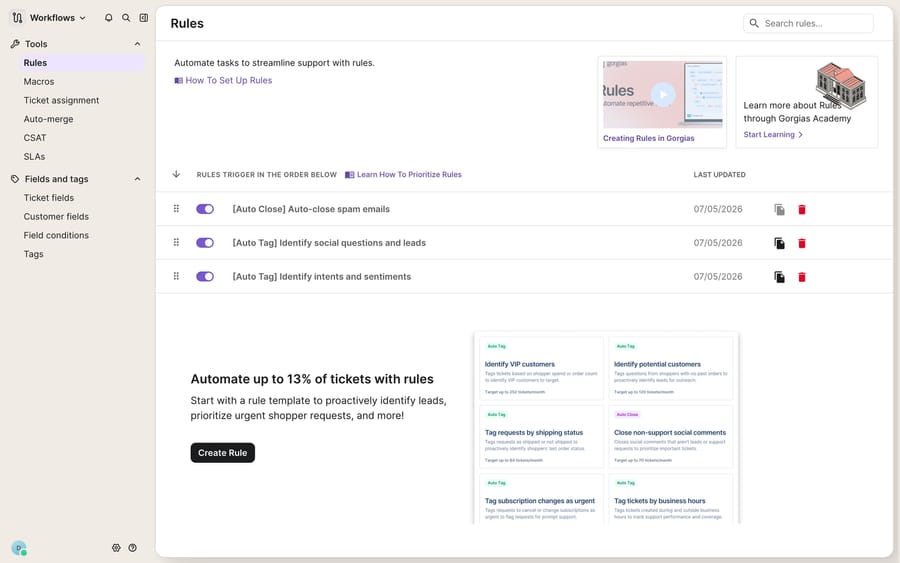
If you're brand new to the platform, start with our overview of what Gorgias is for the big picture, then use the definitions below as a reference you can jump back to.
The core automation terms
Rules. A Rule is Gorgias's if-this-then-that automation engine. It's built on a WHEN / IF / THEN structure: a trigger fires (WHEN), conditions are evaluated (IF), and actions run (THEN). Per the Gorgias Rules Glossary, the available triggers include Ticket Created, Ticket Updated, Ticket Assigned To User, Ticket Snooze Delay Ends, New Message In Ticket, and Satisfaction Survey Responded. Actions range from replying to the customer and adding an internal note to setting status, setting priority, assigning an agent or team, snoozing, and adding or removing tags. Rules are where auto-tagging, auto-replies, and routing actually happen. Full walkthrough: Gorgias Rules explained.
Macros. A Macro is a saved, reusable response — a template reply plus an optional bundle of actions. You reach them from menu → Workflows → Tools → Macros, then Create macro. Beyond canned text, a macro can carry actions like Add tags, Set status, or Set priority, and — when a Shopify store is connected — order actions like duplicate, cancel, refund, or edit an order. Agents apply macros by hand, and Rules can apply them automatically. Deep dive: Gorgias Macros explained.
Tags. Tags are case-sensitive smart labels you stick on tickets to categorize them — refund, sizing, wismo, and so on. Because they're case-sensitive, Refund and refund are two different tags, which is a common source of messy taxonomies. Tags are the glue between Rules, Macros, and Views: a Rule adds a tag, a View filters on it, a Macro references it. More on keeping them clean: Gorgias Tags explained.
Views. A View is a saved, filtered slice of your ticket list that shows up in the left sidebar. Per Gorgias's Manage Views and Sections docs there are three kinds: Default Views (built-in, not customizable), Shared Views (created by Admins or Lead Agents, up to 500, visible to everyone), and Private Views (anyone can make up to 20, visible only to them). Each View is defined by one or more Filters, and every filter is three parts — the filter, the operator, and the value. See Gorgias Views explained.
Flows. Flows are the guided conversation automations bundled with the AI Agent subscription. They run alongside AI Agent on Chat, often handling the first part of a conversation — sizing questions, order-status prompts, policy clarifications — before AI Agent takes over if the shopper needs more. Think of a Flow as a scripted decision tree and AI Agent as the free-form reasoner behind it. Details: Gorgias Flows explained.
The surrounding vocabulary
Beyond the big five, a handful of terms round out day-to-day Gorgias fluency:
- Chat — the on-site widget shoppers message you through; it's where Flows and AI Agent live. See Gorgias Chat explained.
- Customer sidebar — the panel beside a ticket showing the shopper's profile, order history, and integration data, so agents don't leave the conversation to answer "where's my order?" Walkthrough: the Gorgias customer sidebar explained.
- Ticket — a single customer conversation, threaded across email, chat, social, and SMS into one object.
- Auto-merge — the Tools feature that fuses duplicate tickets from the same customer so two agents don't reply to the same person.
- CSAT — the satisfaction survey sent after a ticket closes; a "Satisfaction Survey Responded" event can even trigger a Rule.
- Fields & tags — the Tools tab where you define custom ticket fields and manage your tag list.
- Stats & reporting — the analytics area for volume, response time, and agent performance. See Gorgias stats and reporting explained.
- API — the REST interface for programmatic access to tickets, customers, macros, and views. Start with how to use the Gorgias API.
A quick reference table
| Term | What it is | Where it lives |
|---|---|---|
| Rule | WHEN/IF/THEN automation | Workflows → Tools → Rules |
| Macro | Saved reply + actions | Workflows → Tools → Macros |
| Tag | Case-sensitive ticket label | Fields & tags; applied everywhere |
| View | Saved filtered ticket list | Left sidebar |
| Flow | Guided Chat automation | Chat / AI Agent |
| Auto-merge | Combines duplicate tickets | Workflows → Tools → Auto-merge |
| CSAT | Post-resolution survey | Workflows → Tools → CSAT |
The honest limits — where the vocabulary stops
Gorgias's building blocks are genuinely strong, and much of this is included natively: Rules, Macros, Tags, and Views are core to every plan, and the WHEN/IF/THEN builder is deterministic and dependable. But two honest caveats belong in any glossary.
First, the deepest automation is Shopify-gated. The macro order actions — duplicate, cancel, refund, edit an order — and the richest revenue and order-management context only light up when a Shopify (or supported ecommerce) store is connected. On a bare helpdesk, those verbs are greyed out. The AI Agent and its Flows are also a separate, usage-priced add-on, not something that ships switched on with the base seat.
Second, everything above is rules-based, not reasoning-based. A Rule fires on a trigger and a matched condition; a Flow follows a branch you drew by hand. Neither reads an ambiguous message, works out what the shopper actually meant, and composes a novel answer. The moment a ticket falls outside the tree you built, it lands on a human. That's the seam where an AI agent layer fits — and it's worth thinking through the build-versus-buy tradeoff before you reach for one.
Macha is one such layer. It runs on top of the Gorgias you already use as a live native connector — it does not replace Gorgias, your Rules, or your Macros. The broader category of AI agents for customer service exists to do exactly the reasoning-heavy work a Rule or Flow can't: read the ticket, understand intent, look up a live order through a custom tool that turns a REST API into something the agent can call, and draft or send a grounded reply. Credits are consumed per AI action, not per resolution — the pricing page has the breakdown. The clean division of labour: keep Gorgias's Rules, Macros, Views, and Tags as your deterministic backbone, and layer an agent on top for the judgement calls the vocabulary doesn't have a word for.
FAQ
Is "Gorgias" the software or Plato's dialogue? Both share a name. This glossary is about the ecommerce helpdesk software Gorgias. Plato's Gorgias is a Socratic dialogue from around 380 BC named after the Sicilian sophist Gorgias of Leontini — unrelated to the support tool beyond the spelling.
What's the difference between a Rule and a Macro in Gorgias? A Macro is a saved reply plus optional actions that an agent applies (or a Rule triggers). A Rule is the automation itself — a WHEN/IF/THEN condition that runs actions, one of which can be "apply this macro." Macros are content; Rules are logic.
What are Flows versus AI Agent? Flows are guided, scripted conversation paths bundled with the AI Agent subscription; they handle predictable first steps in Chat. AI Agent is the free-form model that answers open-ended questions and takes over when a Flow reaches its limit.
How many Views can I create? Admins and Lead Agents can create up to 500 Shared Views visible to everyone; any agent can create up to 20 Private Views visible only to themselves. Default Views are built in and can't be edited.
Can I add AI to Gorgias without replacing it? Yes. A layer like Macha connects to Gorgias as a native connector and runs on top of your existing Rules, Macros, Views, and Tags — it doesn't replace them. It handles the reasoning-heavy tickets your rules-based automations can't, while Gorgias stays the system of record.
Want the reasoning layer your Rules and Flows can't provide? Start a free trial of Macha and connect it to your Gorgias in minutes.
Add AI agents to your Gorgias
Macha reads the ticket, drafts the reply and takes the action, inside the Gorgias you already run.