Intercom
 Shopify
 Stripe
 Slack
Slack Notion
 Google Workspace
 Confluence

What Are the Best Netomi Alternatives in 2026?


Netomi publishes no prices and its homepage says "New engagements are by referral", while Vendr's buyer data puts the median Netomi contract at $85,000 a year. The right alternative depends on how big you are. Enterprise teams that want the same depth should look at Ada, Sierra, Decagon and Maven AGI. Mid-market teams already on Salesforce, Zendesk, Intercom or Freshdesk usually do better with that vendor's own agent. Smaller teams should look at Fini, Macha and eesel AI, which publish their prices and let you start without a sales cycle.
Key takeaways
- The best Netomi alternatives in 2026 are Ada, Sierra, Decagon and Maven AGI for enterprise teams, Agentforce, Zendesk, Fin and Freddy for help-desk-native agents, and Fini, Macha and eesel AI for smaller teams.
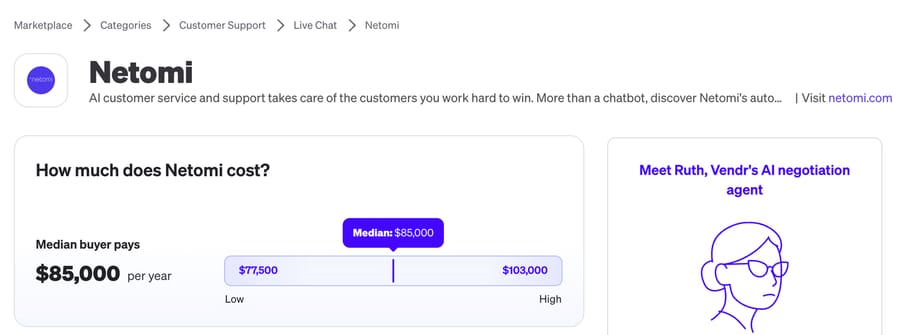
- Netomi publishes no pricing and takes new engagements by referral, and Vendr's data puts its median contract at $85,000 a year in a range of $77,500 to $103,000.
- Vendr's buyer data puts Ada's median contract at $72,000 a year and Decagon's at $432,750, while Maven AGI's AWS Marketplace listing starts at $25,000 for a 12-month contract.
- Intercom Fin charges $0.99 per outcome, Zendesk AI agents $1.50 per automated resolution committed, and Salesforce Agentforce $0.10 per action through Flex Credits at $500 per 100,000 credits.
- Macha bills about $0.40 per ticket, from $299/month for 750 tickets, with $50 of free usage (about 125 tickets), no credit card, no time limit, and runs as an agent layer on an existing help desk such as Zendesk, Freshdesk or Gorgias.

How do the Netomi alternatives compare at a glance?
Eleven tools in three groups, sorted by the buyer each one is built for, with Netomi as the baseline. Entry prices come from each vendor's own page or, where a vendor publishes nothing, from Vendr's purchase data or an AWS Marketplace listing. We read all of them on October 5, 2026.
| Tool | Buyer size | Billing unit | Entry price (public or benchmark) | Voice | Self-serve start | Main watch-out |
|---|---|---|---|---|---|---|
| Netomi (the baseline) | Enterprise | Negotiated | Vendr median $85,000/yr | Yes | No, referral only | No price, no trial, referral-led sales |
| 1. Ada | Enterprise | Negotiated | Vendr median $72,000/yr | Yes | No | Range runs to $295,400 a year |
| 2. Sierra | Enterprise | Outcome-based, negotiated | ~$150K to $350K+ year one (third-party) | Yes | No | Most expensive on the page |
| 3. Decagon | Enterprise | Negotiated | Vendr median $432,750/yr | Yes | No | Median contract is 5x Netomi's |
| 4. Maven AGI | Enterprise | Per resolution, contracted | $25,000 / 12 months minimum (AWS listing) | Yes | No | The rate per resolution isn't published |
| 5. Salesforce Agentforce | Mid-market and up, on Salesforce | Per action (Flex Credits) | $500 per 100,000 credits ($0.10 an action) | Yes | Free Foundations tier | Cost grows with steps, not tickets |
| 6. Zendesk AI agents | Mid-market, on Zendesk | Per verified resolution | $1.50 committed, $2.00 pay-as-you-go | Sold separately | 14-day trial | Highest per-resolution rate here, plus seats |
| 7. Intercom Fin | Mid-market, any desk | Per outcome | $0.99, 50-outcome monthly minimum off Intercom | Fin Voice, sales-led | 14-day trial (Intercom desk) | Standalone Fin is "Contact sales" |
| 8. Freshdesk Freddy AI Agent | Small to mid-market, on Freshdesk | Per session (24-hour window) | $49 per 100 sessions | Not in session packs | 500 one-time sessions | Free sessions vanish once you buy a pack |
| 9. Fini | Small to mid-market | Per resolved ticket | $0.89 (Growth) to $0.49 (Enterprise) | Yes, own rate card | Sales call | No monthly plan fee printed |
| 10. Macha | Small to mid-market, on Zendesk, Freshdesk, Gorgias, Front, HubSpot, Intercom | Per ticket | $299/month for 750 tickets | No | $50 free usage, no card | Agent layer only, not a help desk |
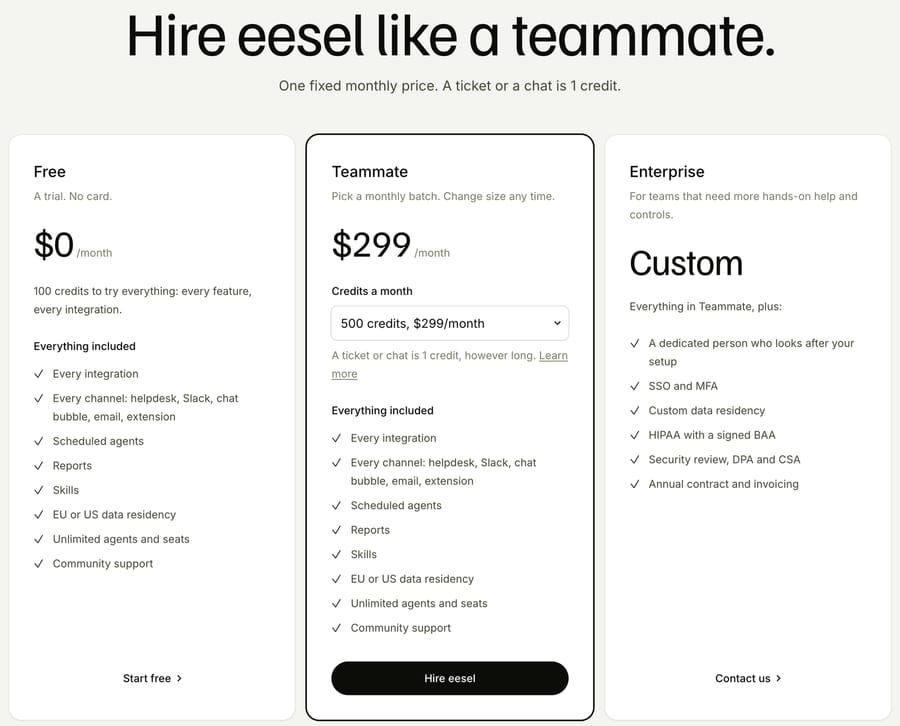
| 11. eesel AI | Small teams | Per ticket or chat (1 credit) | $299/mo for 500 credits | None listed | 100 free credits, no card | Credits don't roll over |
Disclosure: Macha publishes this blog and is entry 10. It's described against the same criteria as everyone else, sits in the group those criteria put it in, and carries a "where it falls short" line like every other entry.
Why do teams look for a Netomi alternative?
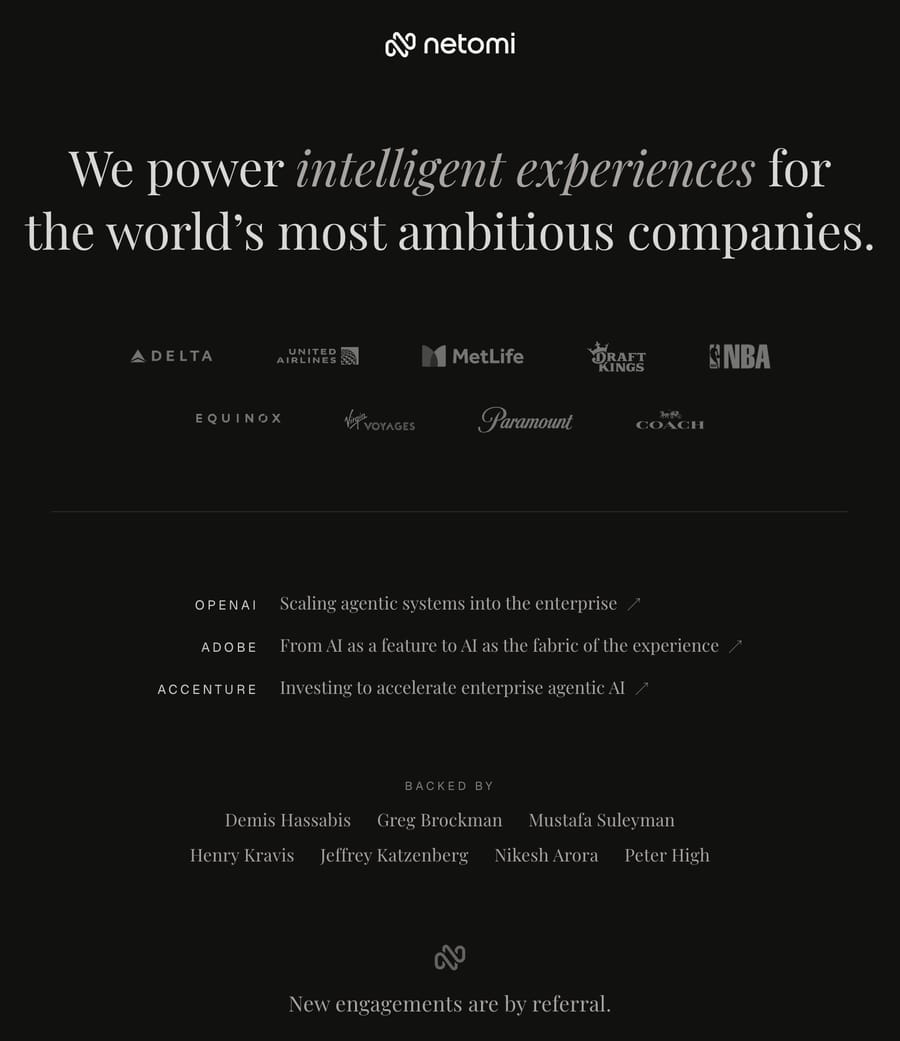
Netomi is a serious enterprise platform and it's worth crediting that before listing reasons to leave. Its homepage shows Delta, United, MetLife, DraftKings, the NBA, Virgin Voyages, Equinox and Coach among its clients. Accenture's April 30, 2026 announcement of its investment describes brands using Netomi "across chat, email, and voice", and our Netomi pricing guide covers the $110 million round, the governance controls and the help desks it connects to. If you're a global airline with a compliance team, a voice channel and a services budget, Netomi is built for you.
The reasons teams look elsewhere are almost all about access and cost:
- You can't get in the door. The homepage on October 5, 2026 is one page: logos, partners, backers and the sentence "New engagements are by referral." There's no product tour, no pricing page and no signup. A team without an introduction has no route to a demo.
- The contract is enterprise-sized. Vendr's Netomi page shows a median buyer paying $85,000 a year, with a low of $77,500 and a high of $103,000. That's about $7,083 a month before you know your volume.
- It's sold through a services channel. Accenture's announcement says the partnership gives "the firm that designs, implements, and operates customer experience inside the world's largest enterprises" direct access to Netomi. When a platform reaches customers through a systems integrator, the deal gets priced and scoped as a transformation program with implementation hours on top of the software, because services are how the integrator earns. Great if you're buying a program. Overkill if you want an agent answering order-status tickets next month.
- Your volume doesn't justify it. At 1,000 tickets a month, $85,000 a year works out to about $7.08 a ticket whether the agent resolves it or not. Every per-unit tool on this page charges $2 or less.
How we picked and grouped the alternatives
We kept to autonomous AI agents: software that reads a customer's message, pulls from knowledge and connected systems, and either resolves the conversation or hands it to a human with context. Draft-only copilots are out. Each entry gets its billing unit, its entry price, who it fits and a watch-out.
The groups follow buyer size, because that's what decides whether you can even buy a Netomi-class product:
- Enterprise (four tools): sales-led, negotiated contracts, voice and many languages, a vendor team that builds with you. These are the like-for-like swaps.
- Mid-market on a big help desk (four tools): the AI agent your desk or CRM vendor already sells. No new vendor, metered pricing, and the agent lives where your tickets already are.
- Small and mid-size teams (three tools): published per-ticket or per-resolution prices, a free or low-cost start, and an agent that plugs into your existing desk.
Within a group the order isn't a ranking. Where we have a full write-up on a vendor, we link to it rather than repeat it. The sibling roundups for Ada, Sierra and Decagon cover overlapping vendors from those starting points.
The billing unit matters more than the sticker price, so it helps to know the five in play here:
- Negotiated contract (Netomi, Ada, Sierra, Decagon): an annual number set in a sales process.
- Per resolution or outcome (Maven AGI, Zendesk, Fin, Fini): you pay when the vendor's definition of "resolved" is met. The vendor writes that definition.
- Per action (Agentforce): you pay for each step the agent takes, so a conversation that needs five lookups costs five times one that needs one.
- Per session (Freddy): you pay for every 24-hour conversation window the agent handles, resolved or not.
- Per ticket (Macha, eesel): one charge per thread, however many replies or tool calls it takes.
Which alternatives fit an enterprise team?
These four sell the way Netomi does: a demo, a scoping call, a negotiated contract. Pick from here if you need voice, many languages and a vendor team that builds with you, and you have a budget north of $25,000 a year.
1. Ada
What it is: an enterprise AI agent platform with no-code authoring. Ada's homepage pitches "omnichannel, multilingual CX" and leads with its automated resolution rate. It's the closest like-for-like to Netomi in buyer, price and channel coverage. Our Ada guide covers the product in depth.
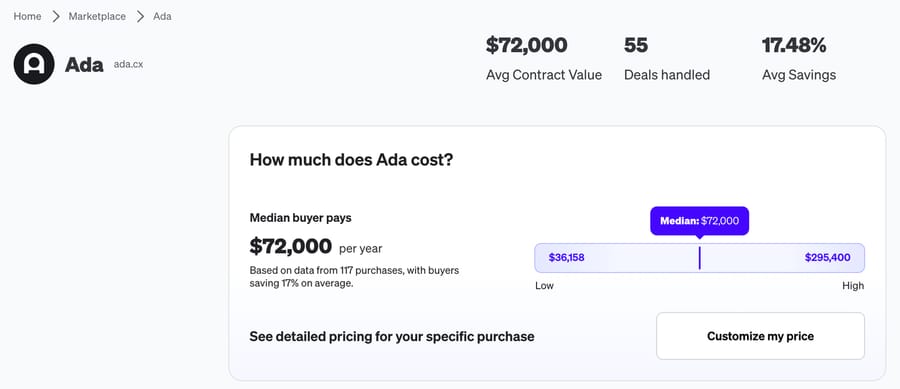
Billing and price: there's no pricing page. ada.cx/pricing on October 5 was a demo form asking for your expected contact volume across all channels. Vendr's Ada page puts the median at $72,000 a year, based on 117 purchases, in a range of $36,158 to $295,400.
Who it fits: enterprise and upper mid-market teams that want Netomi's shape at a somewhat lower median, with a much larger pool of reference buyers.
Watch-out: the range is wide. The top of it is nearly three times Netomi's Vendr high of $103,000, and third-party reports say what counts as a billable resolution is set per contract.
2. Sierra
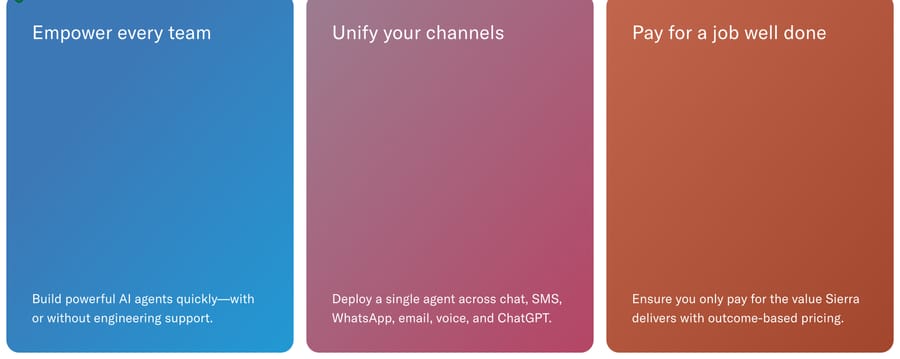
What it is: an agent platform that builds a brand-owned agent with you. Sierra's homepage says you can "deploy a single agent across chat, SMS, WhatsApp, email, voice, and ChatGPT", which is the broadest channel list on this page. Our Sierra guide has the details.
Billing and price: outcome-based. The homepage says you "only pay for the value Sierra delivers with outcome-based pricing", but neither the rate nor the definition of an outcome is published. Third-party estimates put year-one cost at roughly $150K to $350K or more under multi-year agreements. That figure is a secondary estimate, not a Sierra number.
Who it fits: large consumer brands that want an agent across every channel, including ChatGPT, and can fund a bespoke build.
Watch-out: it's the most expensive route here by estimate, and "outcome" is the vendor's word to define. You can't model the bill before the sales call.
3. Decagon
What it is: an enterprise agent platform where workflows are written as natural-language "Agent Operating Procedures". Decagon's homepage says it "unifies chat, voice, and email within a single intelligence layer". See our Decagon guide.
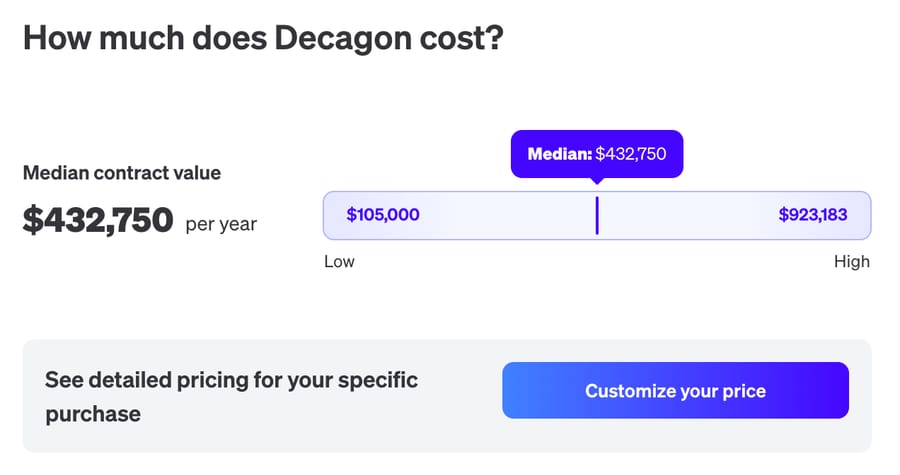
Billing and price: no public price; decagon.ai/pricing returned the site's not-found page in September. Vendr's Decagon page shows a median contract value of $432,750 a year, ranging from $105,000 to $923,183.
Who it fits: very high-volume consumer, fintech and subscription brands that want operations teams, not engineers, to own the agent's procedures.
Watch-out: the median is about five times Netomi's ($432,750 against $85,000). If Netomi's price was the problem, Decagon makes it worse.
4. Maven AGI
What it is: an enterprise agent platform that says it works "across your existing help desk, CRM, and telephony", with a Maven Voice product. Its homepage cites customer results such as "up to 93% autonomous resolution in 6 weeks" for one customer; those are Maven's own case figures. Our Maven AGI guide goes further.
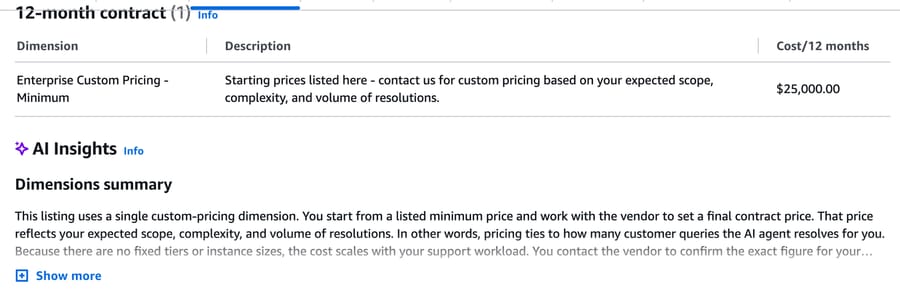
Billing and price: Maven's site has no prices, but its AWS Marketplace listing shows a 12-month contract at $25,000 as the "Enterprise Custom Pricing - Minimum", with the final price set by "expected scope, complexity, and volume of resolutions".
Who it fits: enterprise teams that want a published floor and procurement through their AWS account, which can draw down committed AWS spend.
Watch-out: $25,000 is a minimum, not a quote. The per-resolution rate isn't printed anywhere we found, so you still can't price your volume without a call.
Which alternatives fit a mid-market team already on a big help desk?
Netomi connects to the large help desks and CRMs rather than replacing them. If you already pay one of those vendors, the cheapest procurement path is often the agent they sell. These four bill by usage, so cost follows volume.
5. Salesforce Agentforce
What it is: Salesforce's agent platform, built into Service Cloud. It's the natural pick for a Netomi buyer whose cases live in Salesforce. Our Agentforce guide explains the builder.
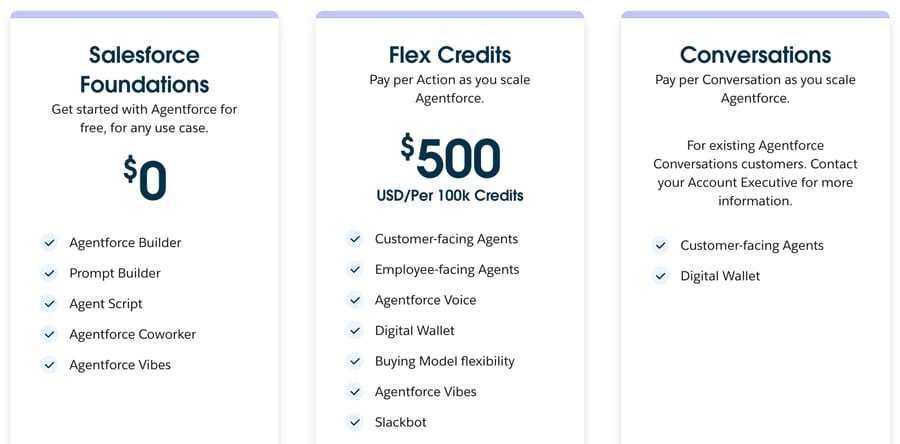
Billing and price: the Agentforce pricing page sells Flex Credits at $500 per 100,000 credits, and says "Agentforce actions are 20 Flex Credits, while Agentforce Voice actions are 30 Flex Credits". That's $0.10 per action and $0.15 per voice action. A per-conversation model still exists, but the page says it's for existing Conversations customers. A $0 Salesforce Foundations tier lets you start building.
Who it fits: Salesforce shops, especially ones that want employee-facing and customer-facing agents on one meter.
Watch-out: you pay per step. Salesforce's own definition of an action includes "updating a record, summarizing a complex case, answering a product inquiry". A refund conversation that looks up an order, checks a policy, updates the case and replies is four actions, or $0.40, before it's resolved or not. The vendor earns more the more steps an agent takes, which isn't the same thing as earning more when the customer's problem is solved.
6. Zendesk AI agents
What it is: the AI agent built into Zendesk, so there's no second vendor and the agent sits in the same workspace as your human team.
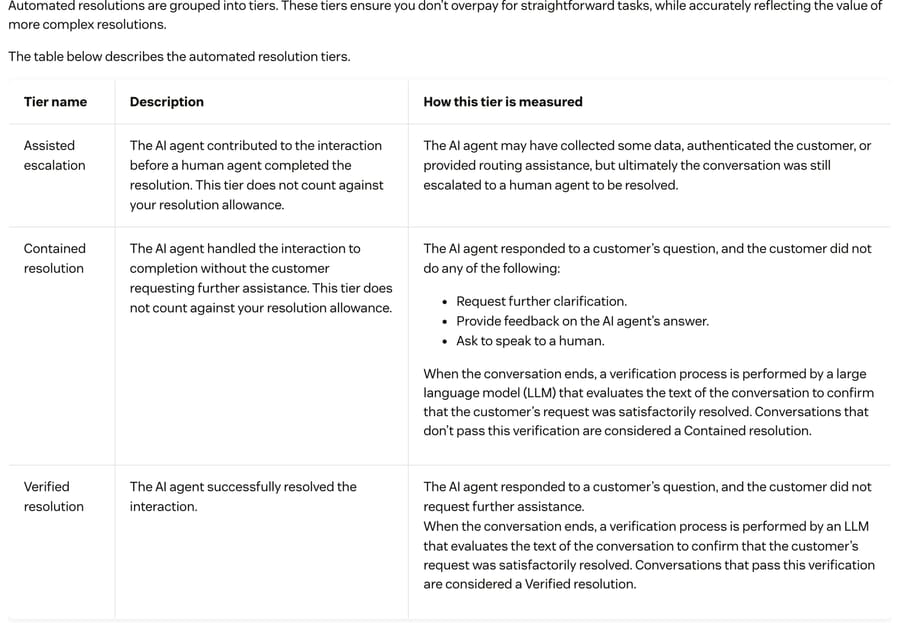
Billing and price: per automated resolution: $1.50 on a committed volume or $2.00 pay-as-you-go, read from the "Compare all plan features" table on Zendesk's US pricing page on September 25, 2026. Plans include an allowance, 5 automated resolutions per agent a month on Support Team and Suite Team. Since May 18, 2026, Zendesk sorts conversations into tiers, and its help article on resolution tiers says assisted escalations and contained resolutions don't count against your allowance; only verified resolutions, confirmed by an LLM reading the conversation, do.
Who it fits: teams committed to Zendesk who want the vendor's own agent and its reporting.
Watch-out: $1.50 is the highest per-resolution rate on this page, and you still pay for agent seats. The LLM verification step is generous to buyers, but it's still Zendesk grading its own work.
7. Intercom Fin
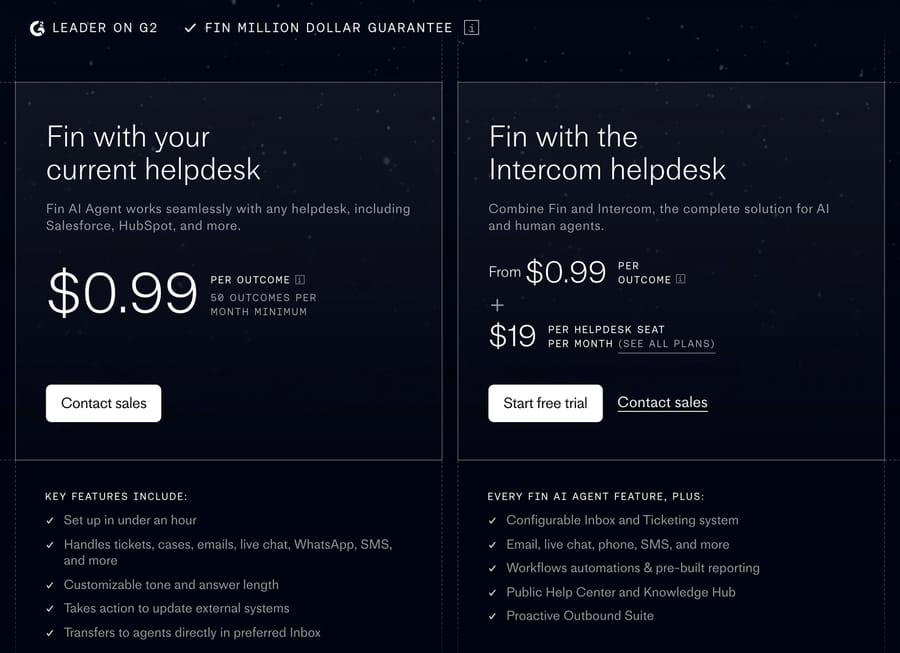
What it is: Intercom's AI agent, sold on the Intercom help desk or on top of another desk. The pricing page says it "works seamlessly with any helpdesk, including Salesforce, HubSpot, and more". Salesforce completed its acquisition of Fin on September 10, 2026, so for a Salesforce shop, Fin and Agentforce now share a parent. Our Fin explainer covers the outcome definition.
Billing and price: $0.99 per outcome on fin.ai/pricing. On another help desk there's a 50-outcome monthly minimum and the button says "Contact sales". On Intercom's own desk you add a seat: Intercom's normal Essential price is $29 a seat billed annually, and the load we captured showed $19, a lower price Intercom has been testing since September.
Who it fits: mid-market SaaS and consumer teams that want a public per-outcome price and a fast trial.
Watch-out: Intercom counts an outcome when the customer confirms resolution, doesn't ask for more help, or Fin completes a workflow "including handoffs". A conversation that ends with a human can still be billed.
8. Freshdesk Freddy AI Agent
What it is: the AI agent inside Freshdesk and Freshchat, for the Netomi buyer whose desk is Freshworks. Our Freshdesk AI agents roundup compares it with the add-ons.
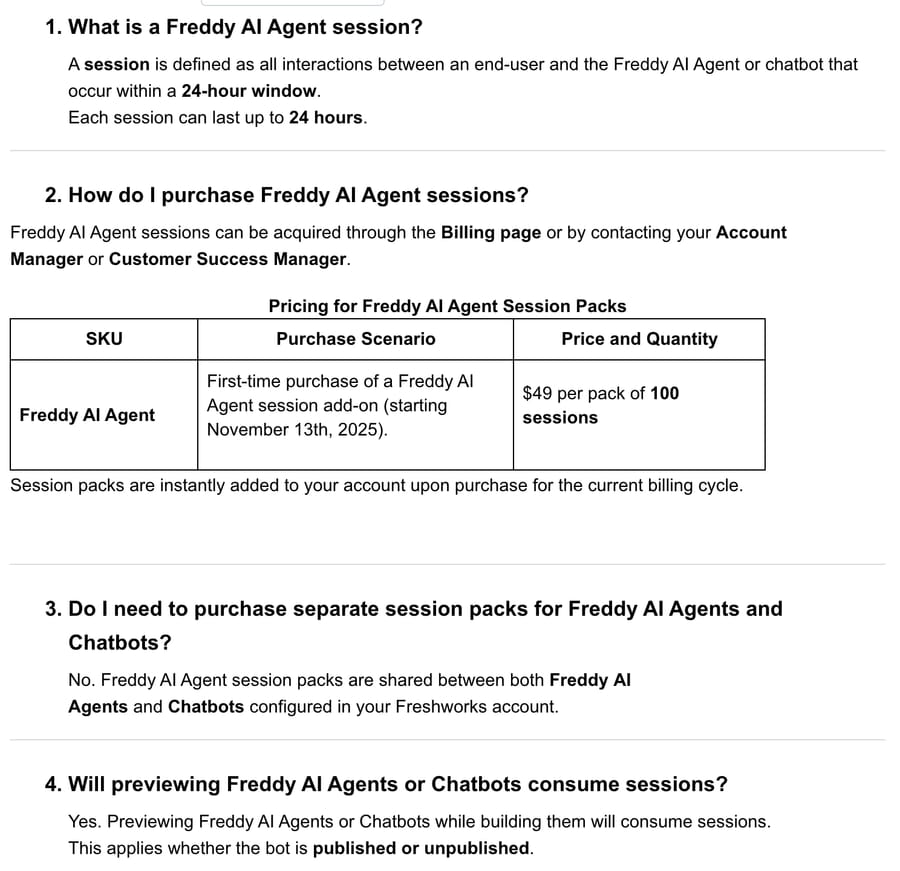
Billing and price: per session. Freshworks' sessions FAQ defines a session as "all interactions between an end-user and the Freddy AI Agent or chatbot that occur within a 24-hour window" and prices packs at $49 per 100 sessions, or $0.49 each. Growth, Pro and Enterprise accounts get 500 one-time complimentary sessions.
Who it fits: small and mid-size teams on Freshdesk who want an agent without adding a vendor.
Watch-out: three details in the same FAQ. Previewing the agent while you build it consumes sessions. Buying your first pack removes whatever complimentary sessions you had left. And when sessions run out, self-service widgets "stop functioning and will not be handed over to a live agent", so a busy month can leave customers with nothing.
Which alternatives fit a small or mid-size support team?
If Netomi's referral gate and five-figure minimum rule it out, these three publish their prices and work on top of the help desk you already run.
9. Fini
What it is: an AI agent that plugs into Zendesk, Intercom, HubSpot, Salesforce, Gorgias, Front, Freshdesk and others, with a voice option on every plan. Our Fini guide covers setup.
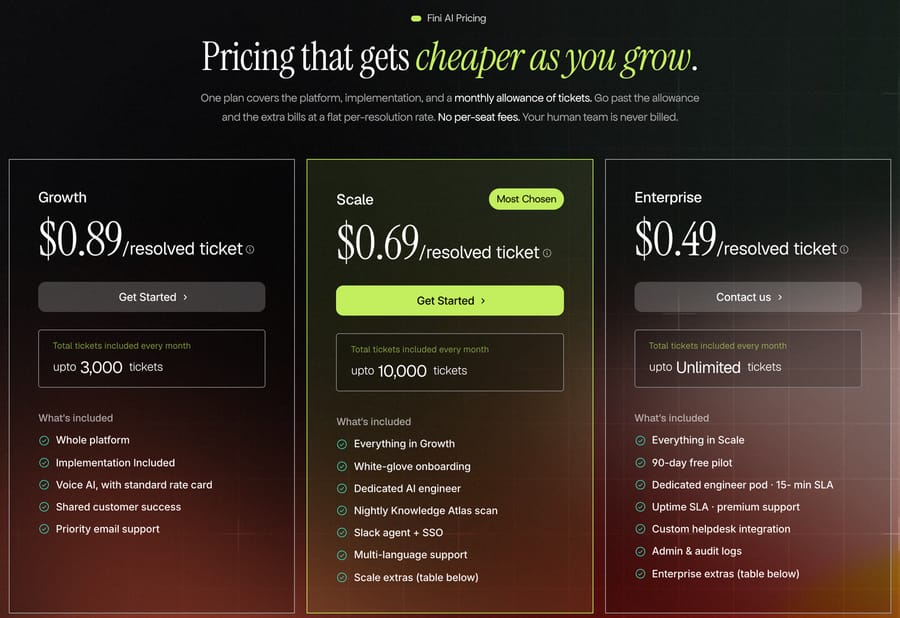
Billing and price: per resolved ticket on Fini's pricing page: $0.89 on Growth (up to 3,000 tickets a month), $0.69 on Scale (up to 10,000) and $0.49 on Enterprise. The page says one plan "covers the platform, implementation, and a monthly allowance of tickets", that escalations to your team are free, and that unused allowance rolls forward one month. A flat per-conversation rate is available on request.
Who it fits: growing teams that want outcome pricing and implementation included, with a path to enterprise extras like data residency and a dedicated engineer.
Watch-out: the page prints a per-resolution rate and a ticket allowance but no monthly plan fee, so confirm the commitment before you assume you only pay for resolutions.
10. Macha
What it is: this is our product, so here's the mechanism rather than the pitch. Macha is an AI agent layer that connects to Zendesk, Freshdesk, Gorgias, Front, HubSpot or Intercom over each desk's API. An agent is a set of written instructions plus the tools it's allowed to call: read the ticket and its history, search connected knowledge such as a help center, Notion, Confluence or Google Docs, look up an order in Shopify or a payment in Stripe through built-in connectors, then post a reply, an internal note, tags or field changes. Anything else with an HTTP API, such as a loyalty or warranty system, is added as a custom API tool that Macha's team sets up during onboarding. See Macha on Zendesk for how it sits inside a desk.
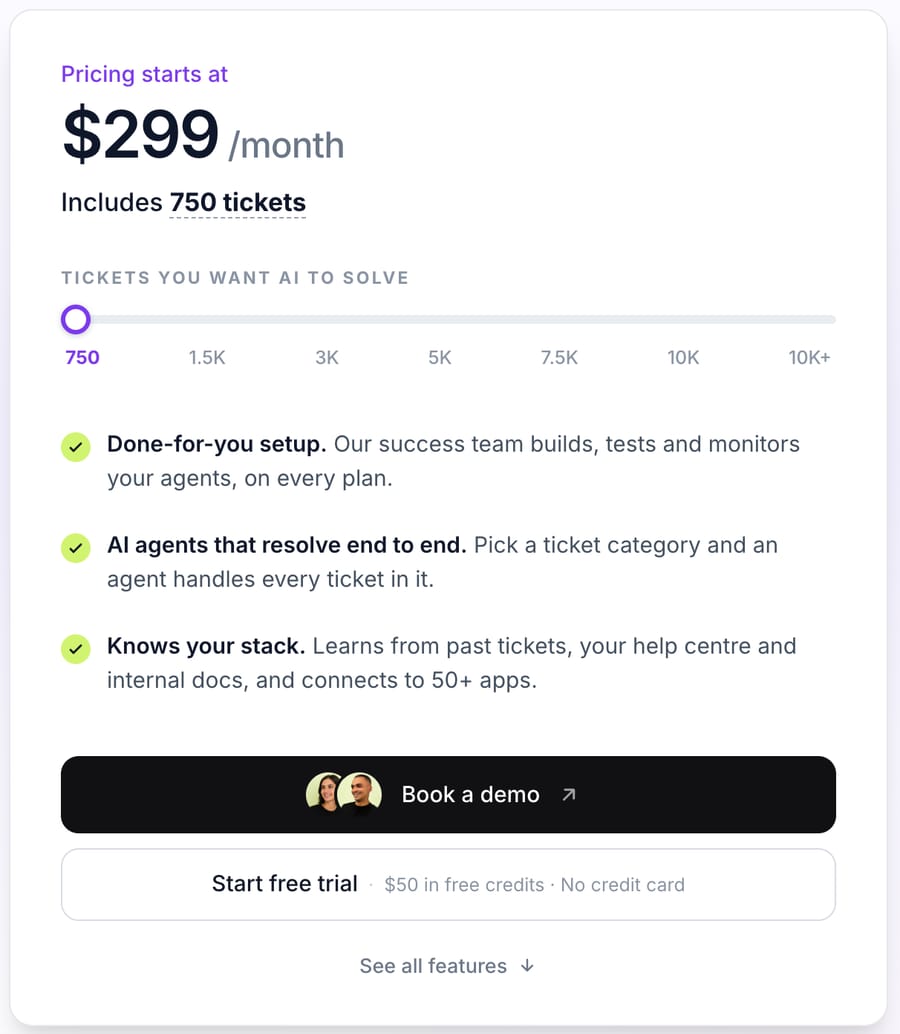
Billing and price: $299 a month for 750 tickets, $599 for 1,500, $1,199 for 3,000, $1,999 for 5,000, $2,999 for 7,500 and $3,999 for 10,000, with custom pricing above that. That's about $0.40 per ticket at every tier, billed monthly. A ticket is one thread between Macha and one person, charged once no matter how many messages it takes, and the AI model doesn't change the charge. Agents pause when the month's tickets run out instead of billing overage, seats are unlimited, and setup and monitoring by the Macha team, included on every plan. The trial is $50 of free usage (about 125 tickets), no credit card, no time limit.
Who it fits: teams on Zendesk, Freshdesk, Gorgias, Front, HubSpot or Intercom handling roughly 750 to 10,000 tickets a month who want Netomi-style actions (order lookups, refunds, tagging, routing) inside the desk they already run, at a price they can read off a page.
Where it falls short: Macha is far smaller than Netomi, with no G2 or Capterra profile and no analyst coverage, so a procurement process that requires third-party review volume will stop us. There's no voice channel: Macha covers email tickets, live chat and agent-facing Copilot chats. It isn't a help desk, so if your cases live in a system outside that list, the native agents above fit better. And an agent does what its instructions say, which is why the setup is done with you rather than handed over as an empty console.
11. eesel AI
What it is: an AI agent that plugs into nine help desks plus its own chat bubble, Slack and email. Our eesel guide has the product details.
Billing and price: eesel's pricing page now sells monthly credit batches, from $299 for 500 credits to $1,899 for 5,000. "A ticket or chat is 1 credit, however long." There are 100 free credits to start, overage is an opt-in $0.80 a credit, and the Enterprise tier adds HIPAA with a signed BAA, SSO and annual contracts. The $0.40 per task that eesel advertised in September is gone.
Who it fits: small teams that want a flat monthly number and the widest help-desk list on this page.
Watch-out: credits reset monthly and don't roll over, and at 500 credits for $299 the entry batch works out to about $0.60 a ticket. Slack questions and reports draw from the same credits.
What does each Netomi alternative cost at 1,000, 5,000 and 10,000 tickets a month?
This is the table Netomi's sales process won't let you build, so we built it with stated assumptions. Software fees only: help-desk seats, implementation and taxes are excluded. For per-resolution and per-outcome tools we assume the agent resolves 50% of tickets. For Agentforce we assume four actions per conversation. For Freddy we assume one session per ticket, after the 500 free sessions are used.
| Tool | 1,000 tickets/mo | 5,000 tickets/mo | 10,000 tickets/mo | How we got it |
|---|---|---|---|---|
| Netomi | ~$7,083 | ~$7,083 | ~$7,083 | Vendr median $85,000 / 12; real price scales with volume |
| Ada | ~$6,000 | ~$6,000 | ~$6,000 | Vendr median $72,000 / 12 |
| Decagon | ~$36,063 | ~$36,063 | ~$36,063 | Vendr median $432,750 / 12 |
| Maven AGI | from ~$2,083 | from ~$2,083 | from ~$2,083 | AWS minimum $25,000 / 12 |
| Salesforce Agentforce | $400 | $2,000 | $4,000 | tickets x 4 actions x $0.10 |
| Zendesk AI agents | $750 | $3,750 | $7,500 | 50% resolved x $1.50 |
| Intercom Fin | $495 | $2,475 | $4,950 | 50% resolved x $0.99 |
| Freshdesk Freddy | $490 | $2,450 | $4,900 | tickets x $0.49 |
| Fini | $445 | $1,725 | $3,450 | 50% resolved x $0.89 (Growth) or $0.69 (Scale) |
| Macha | $599 | $1,999 | $3,999 | 1,500, 5,000 and 10,000-ticket tiers |
| eesel AI | $499 | $1,899 | Talk to us | 1,000 and 5,000-credit batches |
Three things stand out. First, the enterprise contracts are flat lines: below about 5,000 tickets a month, an $85,000 Netomi contract costs more per ticket than anything metered on this page. Second, the per-resolution tools look cheapest at low resolution rates and get dearer as the agent gets better, so the vendor earns more each time your agent improves. At 80% resolution, Zendesk at 10,000 tickets is $12,000 a month, not $7,500. Third, the per-ticket tools (Macha, eesel) don't move with resolution rate at all, so the number you see is the number you pay.
The 50% and four-action assumptions are ours, not the vendors'. Plug in your own resolution rate before you shortlist. Our cost breakdown of help-desk AI versus standalone agents runs the same math with seats included.
Where Macha fits
Macha fits the Netomi buyer who doesn't need a transformation program: a team on Zendesk, Freshdesk, Gorgias, Front, HubSpot or Intercom handling a few thousand tickets a month that wants an agent taking real actions inside the ticket. The Zendesk, Shopify and Stripe connectors are built in, so an order-status or refund agent on Zendesk uses Shopify's Get Order and Search Orders tools and replies on the ticket. Systems without a built-in connector, like a loyalty platform or a warehouse API, need a custom API tool that Macha's team configures during onboarding. At 3,000 tickets a month that's the $1,199 tier; at 5,000 it's $1,999. If you need voice, a regulated-industry compliance review or a vendor that operates the agent for you under a services contract, the enterprise group above is the better fit.
How do you choose a Netomi alternative?
Start from three questions, in this order:
- Do you need voice or more than a handful of languages? If yes, you're choosing between Netomi, Ada, Sierra, Decagon, Maven, Agentforce Voice, Fin Voice and Fini's voice rates. Everything else on the page is text-only.
- Where do your cases live? If it's Salesforce, price Agentforce and standalone Fin first. If it's Zendesk or Freshdesk, price their native agents, then compare an agent layer such as Macha, Fini or eesel at the same volume.
- What will procurement accept? A referral-only vendor with a Vendr median of $85,000 needs an executive sponsor. A tool with a free trial needs a credit card or nothing at all. Match the vendor to the buying process you actually have.
Then build the cost table above with your own numbers and run a trial on real tickets where one exists.
Frequently asked questions
What are the best alternatives to Netomi? For enterprise teams, Ada, Sierra, Decagon and Maven AGI are the closest matches. Teams on a large help desk should price Salesforce Agentforce, Zendesk AI agents, Intercom Fin or Freshdesk's Freddy AI Agent. Smaller teams can start with Fini, Macha or eesel AI, which publish prices.
How much does Netomi cost? Netomi publishes no pricing. Vendr's buyer data on October 5, 2026 showed a median Netomi contract of $85,000 a year, in a range of $77,500 to $103,000. Final pricing is negotiated per deal.
Can I sign up for Netomi without a referral? Netomi's homepage says "New engagements are by referral", and it offers no signup, trial or pricing page. Accenture also distributes Netomi through a strategic partnership announced on April 30, 2026.
Which Netomi alternative is cheapest? At 1,000 tickets a month with a 50% resolution rate, Fini ($445), Agentforce ($400 at four actions per conversation), Freddy ($490), Fin ($495), eesel ($499) and Macha ($599) all cost a small fraction of Netomi's roughly $7,083 a month median. The cheapest depends on your resolution rate and how many steps each conversation takes.
Which Netomi alternatives support voice? Ada, Sierra, Decagon and Maven AGI all sell voice agents. Salesforce bills Agentforce Voice actions at 30 Flex Credits, Fin Voice is sales-led, and Fini has a per-call voice rate card. Macha has no voice channel, and eesel's pricing page lists none.
Is Macha a replacement for Netomi? For teams on Zendesk, Freshdesk, Gorgias, Front, HubSpot or Intercom that want text-channel agents taking actions inside the ticket, yes. Macha is an agent layer billed about $0.40 per ticket, not an enterprise platform with voice, so a global omnichannel program is better served by the enterprise group.
How we researched this
We loaded every vendor page in this article on October 5, 2026 in a fresh US-locale headless Chrome session and screenshotted the pricing or documentation shown above. Sources:
- Netomi homepage and Accenture's April 30, 2026 press release.
- Vendr pages for Netomi, Ada and Decagon. These are procurement benchmarks from Vendr's buyers, not vendor list prices.
- Maven AGI's AWS Marketplace listing, written by the seller and hosted by AWS.
- Vendor pages: sierra.ai, decagon.ai, ada.cx, mavenagi.com, fin.ai/pricing, Agentforce pricing, Freshworks sessions FAQ, Zendesk resolution tiers, usefini.com/pricing, eesel.ai/pricing and getmacha.com/pricing.
What's a vendor self-report: resolution percentages on Ada's and Maven's homepages, Netomi's client logos, and each vendor's own definition of a resolution, outcome, action or session. What's secondhand: Sierra's year-one range is a third-party estimate carried from our Sierra coverage, and the Zendesk $1.50 and $2.00 rates were read on September 25, 2026 because zendesk.com/pricing served Zendesk India from our location on October 5.
The arithmetic: Netomi $85,000 / 12 = $7,083 a month, and $7,083 / 1,000 tickets = $7.08 a ticket. Ada $72,000 / 12 = $6,000. Decagon $432,750 / 12 = $36,063. Maven $25,000 / 12 = $2,083. Agentforce $500 / 100,000 credits x 20 credits = $0.10 an action, and 30 credits = $0.15 a voice action; 1,000 tickets x 4 actions x $0.10 = $400. Zendesk 500 x $1.50 = $750, 2,500 x $1.50 = $3,750, 5,000 x $1.50 = $7,500, and 8,000 x $1.50 = $12,000 at 80%. Fin 500 x $0.99 = $495. Freddy $49 / 100 = $0.49 a session. Fini 500 x $0.89 = $445, 2,500 x $0.69 = $1,725, 5,000 x $0.69 = $3,450. eesel $299 / 500 = $0.60 a credit. Decagon against Netomi: $432,750 / $85,000 = 5.1.
We did not run any of these products for this page, including our own; it compares public pricing and documentation only. G2 and Capterra blocked automated reads, so we cite no star ratings. Any ticket scenarios mentioned are synthetic.
If Netomi's referral gate is the blocker and you're on one of the desks Macha connects to, you can put an agent on a real ticket category with $50 of free usage (about 125 tickets), no credit card, no time limit and see what it does before anyone talks about a contract.
Resolve tickets automatically with AI agents
Macha's AI agents work on top of the help desk you already use — no code.