Intercom
 Shopify
 Stripe
 Slack
Slack Notion
 Google Workspace
 Confluence

Zendesk Competitors: The Full Landscape (Who Does What) — 2026


Search "Zendesk competitors" and you get a flat list — a dozen logos in no particular order, each crowned "best" by whoever wrote the page. That's not how the market actually works. Zendesk doesn't have one set of rivals; it has several, and they compete on completely different fronts. A Shopify store comparing Zendesk to Gorgias is asking a different question than an enterprise IT team comparing it to ServiceNow.

So this isn't a ranking. It's a map. Below, Zendesk's competitors are sorted into six categories — general-purpose helpdesks, AI-first platforms, enterprise/CRM-unified suites, ITSM tools, shared-inbox apps, and in-app/mobile specialists — with a one-line read on what each one competes with Zendesk on and who picks it over Zendesk. If you want a ranked shortlist instead, that lives in our best Zendesk alternatives hub. This page is for understanding the terrain before you shortlist.
How this landscape was built: products are grouped by the job they're hired for, not by a single "best" score; G2 ratings were observed June 2026 and spot-verified via web search (review-base sizes vary widely, so a 4.9 on ~60 reviews isn't directly comparable to a 4.3 on thousands); and we run Zendesk hands-on in a live test account (screenshot below) as the fixed reference point every competitor is measured against.
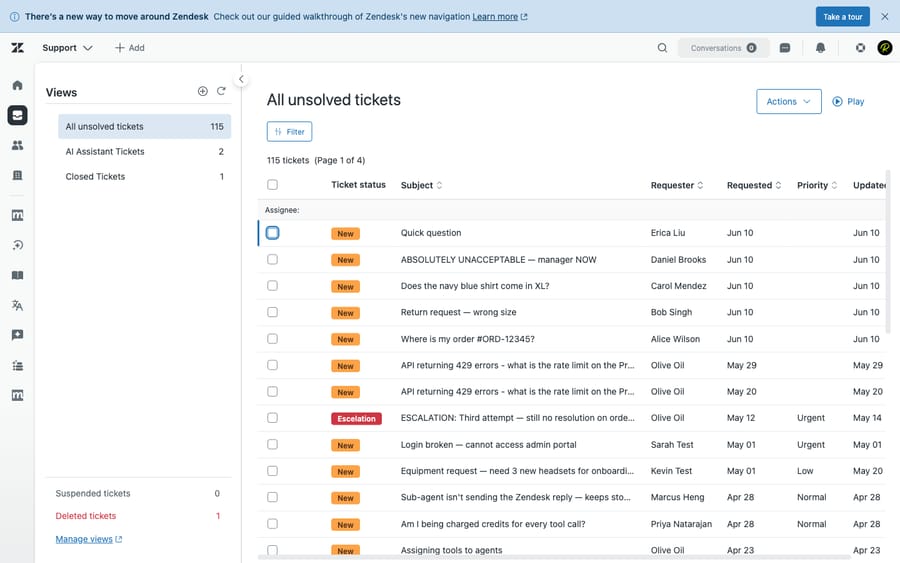
Zendesk's Agent Workspace in a live test account — the unified ticket queue, views, and macros that every competitor below is positioned against. The categories differ in how they try to beat this: on price, on AI, on ecosystem fit, or on simplicity.
One thing to settle first. If your only complaint about Zendesk is that its AI doesn't resolve enough, none of these competitors is the obvious answer — switching helpdesks to fix an AI gap is a big swing for a narrow problem. More on that, honestly, near the end. For now, the map.
The landscape at a glance
| Competitor | Category | Competes with Zendesk on | Best for | G2 rating |
|---|---|---|---|---|
| Freshdesk | General-purpose helpdesk | Same job, lower price | All-around value | 4.4 / 5 |
| Zoho Desk | General-purpose helpdesk | Price + Zoho ecosystem | Budget / Zoho shops | 4.4 / 5 |
| HappyFox | General-purpose helpdesk | Clean ticketing, flat pricing | Mid-market simplicity | 4.5 / 5 |
| Kayako | General-purpose helpdesk | Classic multichannel ticketing | Legacy-style helpdesk | 4.0 / 5 |
| Intercom | AI-first / conversational | AI resolution + messaging | Product-led SaaS | 4.5 / 5 |
| Gorgias | AI-first / conversational | E-commerce automation | Shopify stores | 4.6 / 5 |
| Pylon | AI-first / conversational | B2B + Slack-connected support | B2B / SaaS | 4.9 / 5 * |
| Kustomer | AI-first / conversational | Omnichannel timeline at scale | High-volume CX | 4.5 / 5 |
| Salesforce Service Cloud | Enterprise / CRM-unified | CRM-native service at scale | Salesforce shops | ~4.4 / 5 † |
| ServiceNow | Enterprise / CRM-unified | Enterprise workflow platform | Large enterprise | 4.4 / 5 |
| HubSpot Service Hub | Enterprise / CRM-unified | Support on one CRM record | HubSpot shops | 4.4 / 5 |
| Jira Service Management | ITSM / internal IT | IT + dev workflows | Dev/IT teams | 4.3 / 5 |
| Freshservice | ITSM / internal IT | Modern ITSM, easy setup | IT service desks | 4.6 / 5 |
| Spiceworks | ITSM / internal IT | Free internal IT helpdesk | Small IT teams | 4.3 / 5 |
| Help Scout | SMB / shared-inbox | Simplicity, fast setup | Small teams | 4.4 / 5 |
| Front | SMB / shared-inbox | Collaborative shared inbox | Email-heavy teams | 4.7 / 5 |
| LiveChat | SMB / shared-inbox | Real-time chat & sales | Chat-first teams | 4.5 / 5 |
| Helpshift | In-app / mobile | In-app & mobile support | Mobile apps & games | 4.3 / 5 |
| Zendesk (the incumbent) | — | — | The default to beat | 4.3 / 5 |
Update (September 2026): Salesforce completed its acquisition of Fin — the company that had already renamed itself from Intercom on May 12, 2026, before any deal was signed — on September 10, 2026, in a deal worth ~$3.6 billion, and plans to fold it into Salesforce's Agentforce. Worth weighing in any long-term Intercom/Fin decision.
\ Pylon's 4.9 is on a small base (~61 G2 reviews) — strong, but not directly comparable to incumbents rated on thousands. † Salesforce Service Cloud's G2 listing was renamed "Agentforce Service" and now blends AI-agent sentiment, so its star average is hard to isolate — treat as approximate. Ratings observed June 2026.*
Category 1 — General-purpose helpdesks (the like-for-like swaps)
These are the most direct Zendesk competitors: ticketing, multichannel inboxes, knowledge bases, automations, and reporting — the same job, usually at a lower price or with simpler administration. If you'd describe Zendesk as "a helpdesk," these are the other helpdesks.
- Freshdesk — competes on: doing Zendesk's job for less. The closest like-for-like swap, with Freddy AI baked in. Picked over Zendesk by teams who want comparable features without Suite-tier pricing. (G2 4.4)
- Zoho Desk — competes on: price and ecosystem. Excellent feature-to-price ratio, with a free tier and tight integration into the broader Zoho suite. Picked over Zendesk by budget-conscious teams already living in Zoho. (G2 4.4)
- HappyFox — competes on: clean ticketing with predictable pricing. A no-drama mid-market helpdesk that avoids Zendesk's admin sprawl. Picked over Zendesk by teams who want a tidy queue without a configuration project. (G2 4.5)
- Kayako — competes on: classic multichannel ticketing. An older-school helpdesk with a unified customer view. Picked over Zendesk by teams who want straightforward ticketing over a sprawling platform. (G2 4.0)
This is where switching is most "boring" in the good sense — the mental model carries over, so migration is mostly about moving data and rebuilding automations rather than relearning support itself.
Category 2 — AI-first / conversational platforms
These competitors lead with conversation and automation rather than the ticket queue. They overlap with Zendesk on support, but their pitch is resolution and messaging — they'd rather deflect or auto-handle a conversation than route a ticket.
- Intercom — competes on: AI resolution and in-app messaging. Its Fin AI agent is the headline, priced per resolution. Picked over Zendesk by product-led SaaS teams who want proactive, in-product support. (G2 4.5)
- Gorgias — competes on: e-commerce automation. Purpose-built for Shopify/BigCommerce, with order and refund context inside the ticket. Picked over Zendesk by online stores that want commerce-aware automation out of the box. (G2 4.6)
- Pylon — competes on: B2B and Slack-connected support. AI-native, built for B2B accounts that live in shared Slack channels. Picked over Zendesk by B2B/SaaS teams whose customers don't open email tickets. (G2 4.9 on a small base)
- Kustomer — competes on: an omnichannel customer timeline at scale. A single conversation history across every channel. Picked over Zendesk by high-volume consumer brands that want one timeline, not many ticket threads. (G2 4.5)
The trade-off across this category is pricing shape: usage- and resolution-based models can be cheaper at low volume and pricier as you scale — model it at your conversation volume, not the headline number.
Category 3 — Enterprise / CRM-unified suites
Here Zendesk competes not with a "better helpdesk" but with a bigger platform — support as one module inside a CRM or workflow engine. The draw is one customer record across sales, service, and beyond; the cost is complexity and a higher total bill.
- Salesforce Service Cloud — competes on: CRM-native service. Deeply customizable, unified with the Salesforce CRM and now its Agentforce AI. Picked over Zendesk by organizations already standardized on Salesforce. (G2 ~4.4, approximate)
- ServiceNow — competes on: enterprise workflow at scale. A platform for IT, HR, and customer workflows across a large org. Picked over Zendesk by enterprises that need governance and cross-department workflow, not just support. (G2 4.4)
- HubSpot Service Hub — competes on: support on one shared CRM record. Keeps service, sales, and marketing on the same contact. Picked over Zendesk by teams already running on HubSpot who want support to live there too. (G2 4.4)
For a focused support team, this category is usually overkill — you adopt it because the rest of the company already runs on the platform, and unifying the customer record is worth the weight.
Category 4 — ITSM / internal IT
These tools compete with Zendesk for internal service — IT helpdesks, employee requests, incident and change management — rather than external customer support. Zendesk can do internal IT, but ITSM-native tools are built for it.
- Jira Service Management — competes on: IT and developer workflows. Tight Atlassian/Jira integration with strong incident and change management. Picked over Zendesk by dev-adjacent IT teams already in the Atlassian stack. (G2 4.3)
- Freshservice — competes on: modern ITSM with easy setup. ITIL-aligned service management without the legacy heaviness. Picked over Zendesk by IT service desks that want structured ITSM without a ServiceNow-scale rollout. (G2 4.6)
- Spiceworks — competes on: a free internal IT helpdesk. Ad-supported and genuinely free, with an IT-pro community attached. Picked over Zendesk by small IT teams with no software budget. (G2 4.3)
If your "support" is mostly employees filing IT tickets, this is your row — and Freshservice in particular is rated highly by the IT crowd.
Category 5 — SMB / email-first / shared-inbox
These compete on the opposite axis from the enterprise suites: less platform, more speed-to-value. They're built for small teams that want a shared inbox working today, not an admin center to configure.
- Help Scout — competes on: simplicity and fast setup. Email-first, human-feeling support with no "admin center" rabbit holes. Picked over Zendesk by small teams who find Zendesk too much tool. (G2 4.4)
- Front — competes on: collaborative shared inbox. A team inbox across email, chat, SMS, and social, with AI Copilot and Autopilot. Picked over Zendesk by teams who manage shared inboxes and want to reply as a team. (G2 4.7)
- LiveChat — competes on: real-time chat and sales. Best-in-class live chat with a sales lean. Picked over Zendesk by teams whose priority is converting and helping on-site visitors in real time. (G2 4.5)
These score well on G2 partly because they're scoped — fewer features, fewer ways to be disappointed. The watch-out is the inverse: you can outgrow them as workflows and reporting needs deepen.
Category 6 — In-app / mobile
A narrow but real category: support embedded inside an app, especially mobile games and consumer apps.
- Helpshift — competes on: in-app and mobile-native support. In-context help, bots, and SDKs built for mobile apps and games. Picked over Zendesk by mobile-first products where support has to live inside the app, not a web portal. (G2 4.3)
If your support surface is a phone screen rather than an inbox, this is the specialist Zendesk competes against.
How Zendesk stacks up against each category
Zendesk's superpower is that it's credible in every one of these rows at once — that's why it's the default. But "credible everywhere" also means "best-in-class nowhere," and each category exposes a specific gap:
- vs. general-purpose helpdesks: Zendesk usually has deeper reporting and a bigger app marketplace, but costs more — Freshdesk and Zoho do the same core job for less.
- vs. AI-first platforms: Zendesk has strong native AI now, but its DNA is the ticket queue; Intercom, Gorgias, and Pylon were built conversation- and resolution-first.
- vs. enterprise suites: Zendesk is faster to stand up than ServiceNow or Salesforce, but it isn't the single source of truth for the whole company — that's the suites' whole pitch.
- vs. ITSM tools: Zendesk can run an IT desk, but Jira Service Management and Freshservice are purpose-built for ITIL, incidents, and change.
- vs. shared-inbox apps: Zendesk is more powerful but heavier; Help Scout and Front win on time-to-value for small teams.
- vs. in-app specialists: Zendesk has mobile SDKs, but Helpshift lives and breathes in-app support.
The pattern: you rarely leave Zendesk because it's bad. You leave because a competitor is sharper on the one axis you care most about — price, AI, ecosystem, ITSM, simplicity, or in-app.
How to read this landscape for your use case
Don't start from the logos — start from your constraint, then look at the matching row:
- "Zendesk costs too much." → General-purpose row: Freshdesk, Zoho Desk, HappyFox.
- "Our problem is AI / resolution rate." → AI-first row: Intercom, Gorgias (e-comm), Pylon (B2B) — and read the Macha note below, because you may not need to switch at all.
- "We're standardizing the whole company on one platform." → Enterprise row: Salesforce Service Cloud, ServiceNow, HubSpot Service Hub.
- "This is really an internal IT desk." → ITSM row: Jira Service Management, Freshservice, Spiceworks.
- "Zendesk is too much tool for our small team." → Shared-inbox row: Help Scout, Front, LiveChat.
- "Support has to live inside our app." → In-app row: Helpshift.
Pick the row first; the shortlist inside it is short by design. When you're ready to rank within a row, the best Zendesk alternatives hub does exactly that, and each competitor above links to a head-to-head Zendesk-vs-X breakdown.
Where Macha fits — and where it doesn't
Honest aside, because it matters for one common case: Macha isn't on this map, and shouldn't be. It's not a Zendesk competitor — it's an AI agent layer that runs on top of a helpdesk, including Zendesk and most of the tools above. So it doesn't belong in any of the six categories; it complements whichever one you pick.
That distinction matters because a lot of "Zendesk competitor" searches are really "Zendesk's AI isn't good enough" searches — and replatforming to fix an AI gap is an expensive way to solve a narrow problem. If the helpdesk is fine and only the automation falls short, you can add an AI layer instead of migrating.
On pricing model, Macha is deliberately different from the resolution-priced AI in this landscape (Intercom's Fin, Zendesk's own AI). It charges per ticket — one conversation, charged once, and that single charge covers every automated step inside it: triage, tagging and routing, a lookup in another system, a drafted reply, or a full resolution. That's the automation category, not deflection or per-resolution; the bill tracks the conversations you handle, not a predefined outcome. (The model an agent runs on doesn't change the price, so you can pick the model that does the job best.)
The watch-out, stated plainly: a layer only helps if your underlying helpdesk is genuinely fine and the gap is automation. If your real problem is cost, channels, ecosystem fit, or ITSM workflow, a layer won't fix it — pick the right row above instead. Want to test the AI-gap theory without a migration? $50 of free usage, no credit card required.
Frequently asked questions
Who are Zendesk's biggest competitors? By market presence, the heavyweight rivals are Freshdesk and Zoho Desk (general-purpose helpdesks), Intercom (AI-first), and Salesforce Service Cloud and ServiceNow (enterprise). But "biggest" depends on your segment — for a Shopify store the real rival is Gorgias; for an IT desk it's Freshservice or Jira Service Management.
What's the difference between a Zendesk competitor and a Zendesk alternative? In practice, little — both refer to tools you'd use instead of Zendesk. We use "competitors" for the whole landscape mapped by category (this page) and "alternatives" for a ranked shortlist of the best ones to switch to.
Which companies are most like Zendesk? The closest like-for-like products are in the general-purpose helpdesk category: Freshdesk, Zoho Desk, HappyFox, and Kayako — same core job (ticketing, multichannel, knowledge base, automations), usually at a lower price.
Is there a free Zendesk competitor? Yes. Zoho Desk and Jira Service Management have free tiers for small teams, HubSpot Service Hub has a free plan, and Spiceworks is a fully free (ad-supported) internal IT helpdesk.
Do I have to switch off Zendesk to get better AI? No. If your only gripe is the AI, an agent layer like Macha adds autonomous AI on top of Zendesk (or whichever helpdesk you choose) — no migration. Switch helpdesks for cost, channels, ecosystem, or workflow reasons; for an AI gap alone, a layer is usually the smaller, cheaper fix.
The bottom line
Zendesk doesn't have one competitor — it has six categories of them, each winning on a different axis. General-purpose helpdesks (Freshdesk, Zoho, HappyFox, Kayako) compete on price; AI-first platforms (Intercom, Gorgias, Pylon, Kustomer) on resolution and messaging; enterprise suites (Salesforce, ServiceNow, HubSpot) on CRM unification; ITSM tools (Jira Service Management, Freshservice, Spiceworks) on internal IT; shared-inbox apps (Help Scout, Front, LiveChat) on simplicity; and in-app specialists (Helpshift) on mobile. Find your constraint, read that row, then rank within it. And keep the AI question separate from the helpdesk question — sometimes the best move isn't a competitor at all, but a layer on the platform you already have.
Not the helpdesk — just the AI? See how Macha adds autonomous AI agents on top of your existing helpdesk, whichever one you pick. $50 of free usage, no credit card required. Learn more.
Written by Abbas (LinkedIn) — operator at Macha working on customer support and AI. Reviewed by Ankeet (co-founder). Published 2026-06-20 · Last updated 2026-06-20.
Add AI agents to your Zendesk
Macha reads the ticket, drafts the reply and takes the action, inside the Zendesk you already run.